From Surf Wiki (app.surf) — the open knowledge base
Water fluoridation by country
None
None
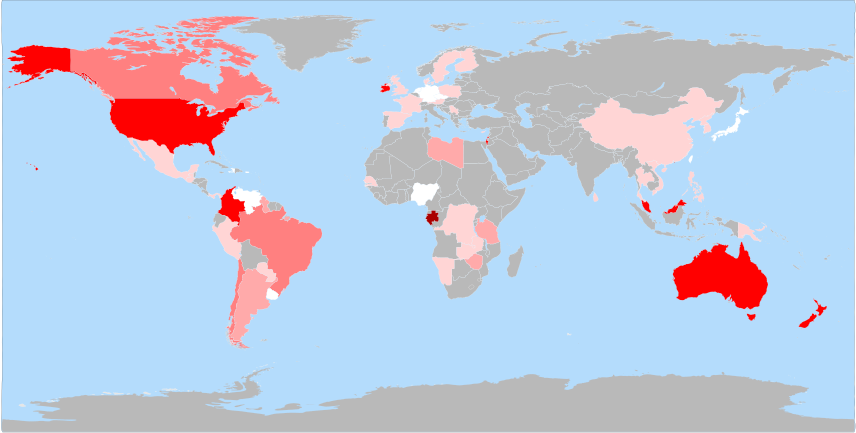
]] Water fluoridation is the controlled addition of fluoride to a public water supply to reduce tooth decay, and is handled differently by countries across the world.
Water fluoridation is considered very common in the United States, Canada, Ireland, Chile and Australia where over 50% of the population drinks fluoridated water.
Most European countries including Italy, France, Finland, Germany, Sweden, Netherlands, Scotland, Austria, Poland, Hungary and Switzerland do not fluoridate water.
Fluoridated water contains fluoride at a level that is proven effective for preventing cavities; this can occur naturally or by adding fluoride. Fluoridated water creates low levels of fluoride in saliva, which reduces the rate at which tooth enamel demineralizes, and increases the rate at which it remineralizes in the early stages of cavities. Typically, a fluoridated compound is added to drinking water, a process that in the U.S. costs an average of about $ per person-year. Defluoridation is needed when the naturally occurring fluoride level exceeds recommended limits. In 2011, the World Health Organization suggested a level of fluoride from 0.5 to 1.5 mg/L (milligrams per liter), depending on climate, local environment, and other sources of fluoride. Bottled water typically has unknown fluoride levels.
Health effects
Dental cavities remain a major public health concern in most industrialized countries, affecting 60–90% of schoolchildren and the vast majority of adults. Water fluoridation may slightly reduce cavities in children, while efficacy in adults is less clear. Recent studies suggest that water fluoridation, particularly in industrialized countries, may be unnecessary because topical fluorides (such as in toothpaste) are widely used and cavity rates have become low. For this reason, some scientists consider fluoridation to be unethical due to the lack of informed consent. However, a recent study funded by NHS found no significant difference between individuals who receive fluoridated water and those who don't in terms of missing teeth and reducing social inequities.
Although fluoridation can cause dental fluorosis, which can alter the appearance of developing teeth or enamel fluorosis, There is no clear evidence of other adverse effects from water fluoridation, as revealed by the York review from 2000. A 2007 Australian systematic review used the same inclusion criteria as York's, plus one additional study. This did not affect the York conclusions. Fluoride's effects depend on the total daily intake of fluoride from all sources. Drinking water is typically the largest source; other methods of fluoride therapy include fluoridation of toothpaste, salt, and milk. The views on the most effective method for community prevention of tooth decay are mixed. The Australian government states that water fluoridation is the most effective means of achieving fluoride exposure that is community-wide.
Currently about 372 million people (around 5.7% of the world population) receive artificially fluoridated water in about 24 countries, including Australia, Brazil, Canada, Chile, Republic of Ireland, Malaysia, the U.S., and Vietnam. Fluoridated salt and milk is promoted in some European countries instead. Water fluoridation has been replaced by other modes in many countries where water supplies are too decentralized for it to be a practical choice, or existing natural fluoride levels were already ample, including Germany, Finland, Japan, Netherlands, Sweden, Switzerland (Switzerland has 1 mg fluoride per 1 liter, USA only between 0.3 mg and 0.7 mg) water Denmark and at a time Israel. While fluoridation can result in mild dental fluorosis, this effect is barely detectable and causes no concerns with the appearance or health of teeth. Countries practicing artificial water fluoridation vary in their recommended fluoride levels according to what health authorities in each have determined to be most effective for its citizens. The US recently reset the recommended optimal level of fluoride in drinking water, lowering it slightly, because of observed increased fluorosis levels, likely due to additional fluoride sources like toothpaste and mouthwash which were not present when this level was originally set.
Africa
Libya
Before 2003, 400,000 Libyans were receiving artificially fluoridated water.
Nigeria
Only a fraction of Nigerians receive water from waterworks, so water fluoridation affects very few people. A 2009 study found that about 21% of water sources naturally contain fluoride to the recommended range of 0.3–0.6 ppm. About 62% have fluoride below this range.
South Africa
South Africa's Health Department recommends adding fluoridation chemicals to drinking water in some areas. It also advises removal of fluoride from drinking water (defluoridation) where the fluoride content is too high.
Legislation around mandatory fluoridation was introduced in 2002, but has been delayed since then pending further research after opposition from water companies, municipalities and the public.
Zambia
Approximately 947,000 (7% of the population) receives water with naturally occurring fluoride in it.
Zimbabwe
Roughly 2,600,000 (21% of the population) receives water with naturally occurring fluoride in it.
Asia
China
Many areas in China have fluoride at levels far higher than recommended due to natural occurrence or industrial contamination, which has resulted in a large amount of skeletal fluorosis. Water fluoridation levels are set at a national standard of 1 mg/L, with higher levels for rural areas at 1.2 mg/L. Water fluoridation began in 1965 in the urban area of Guangzhou. It was interrupted during 1976–1978 due to the shortage of sodium silico-fluoride. It was resumed only in the Fangcun district of the city, but was halted in 1983 after opponents claimed that fluoride levels were already sufficiently high in local foods and tea. Later analysis in 1988 found that the incidence of dental caries among 4-year-old children had increased by 62%. The fluoridation reduced the number of cavities, but increased dental fluorosis; the fluoride levels could have been set too high, and low-quality equipment led to inconsistent, and often excessive, fluoride concentrations.
Hong Kong
All Hong Kong residents receive natural occurring fluoride in water, Recent tests showed drinking water to have an average fluoride level of 0.48 mg/L, and a maximum of 0.69 mg/L.
India
Water fluoridation is not practiced in India. Due to naturally occurring fluoride, both skeletal and dental fluorosis have been endemic in India in at least 20 states, including Uttarakhand, Jharkhand and Chhattisgarh. The maximum permissible limit of fluoride in drinking water in India is 1.2 mg/L, and the government has been obligated to install fluoride removal plants of various technologies to reduce fluoride levels from industrial waste and mineral deposits. Now reverse osmosis plants are widely used. Household and public system reverse osmosis plants are common in the market. Alleppey in Kerala is most affected with over-fluoridated water. Government-installed reverse osmosis plants supply free filtered water. Rotary International Club, Saratoga USA, helped to install 3 RO Plants in rural Alleppey.
, there are 14,132 habitations in 19 States still containing fluoride above the permissible levels in drinking water. Rajasthan has the highest number of habitations (7,670) with high amount of fluoride in drinking water. Telangana has 1174, Karnataka has 1122 and Madhya Pradesh has 1055 habitation. Assam, Andhra Pradesh, Bihar, Chhattisgarh, Maharashtra, Odisha, West Bengal and Uttar Pradesh also has such habitations.
The government of India launched the National Programme for Prevention and Control of Fluorosis in 2008–2009. In 2013–2014, the programme was brought under the National Rural Health Mission, which has so far covered 111 districts. The programme includes surveillance of fluorosis in the community, training and manpower support, establishment of diagnostic facilities, treatment and health education. The Indian Council of Medical Research has formed a task force on fluorosis to address issues related to prevention and control.
Israel
Fluoride was required in water supplies nationwide by legislation passed in 2002, but the requirement was repealed in 2014, and artificial fluoridation was disparaged by national health officials, effectively ending the practice in Israel for a short while. After the election of 2015 the fluoridation program was to be re-debated the new deputy Health Minister Yaakov Litzman.
Mekorot, Israel's national water company states, "In the South of the country, it is unnecessary to add fluoride because it is found naturally in the water." Water fluoridation was introduced in Israel's large cities in 1981, and a national effort to fluoridate all the country's water was approved in 1988.
In 2002, the Union of Local Authorities (ULA) and others petitioned Israel's High Court to stop the Health Ministry from forcing cities to implement water fluoridation. The court soon issued a restraining order, but after half a year ULA withdrew its petition upon the request of the court.
By 2011, about 65% of the municipalities and local authorities in Israel had agreed to allow fluoridation, and there was active opposition to the spread of fluoridation to the towns where it has not yet been instituted. In 2011, the Health and Welfare Committee of the Knesset criticized the Health Ministry for continuation of water fluoridation.
On 26 August 2014, Israel officially stopped adding fluoride to its water supplies. According to a Ministry of Health press release statement, the reasons it ended water fluoridation were: "Only some 1% of the water is used for drinking, while 99% of the water is intended for other uses (industry, agriculture, flushing toilets etc.). There is also scientific evidence that fluoride in large amounts can lead to damage to health. When fluoride is supplied via drinking water, there is no control regarding the amount of fluoride actually consumed, which could lead to excessive consumption. Supply of fluoridated water forces those who do not so wish to also consume water with added fluoride."
After the election of 2015, the new deputy Health Minister Yaakov Litzman announced that the fluoridation program will be re-debated.
In 2022, the Israel Journal of Health Policy Research released a study titled The effect of community water fluoridation cessation on children's dental health: a national experience which concluded that lack of fluoride in the water caused a surge in tooth decay, especially in children. The paper stated, "our results clearly show the benefits of CWF in maintaining pediatric dental health. It seems that CWF was stopped for political reasons, and the lack of fluoride has led to an increase in dental problems which can cause systemic health issues."
As of July 2024, although in practice there is no legal impediment today to the return of drinking water fluoridation, it has not yet been returned in practice, and there has been no drinking water fluoridation in Israel.
Japan
The first community water fluoridation programme was in Kyoto prefecture in 1952, lasting 13 years. The second was established by US military authorities in Okinawa prefecture in 1957, lasting 15 years. The last experience was in Mie Prefecture in 1967, lasting 4 years.
Less than 1% of Japan practices water fluoridation. Instead, as of March 2010, a total of 7,479 schools and 777,596 preschool to junior high school children were participating in school-based fluoride mouth-rinsing programme (S-FMR), with an estimate of 2,000,000 children participating in 2020.
South Korea
In 2005, the ruling Uri Party proposed legislation for compulsory water fluoridation for municipalities. The legislation failed, and only 29 out of around 250 municipal governments had introduced water fluoridation at that time. Fluoridation was proposed again in 2012.
Malaysia
In 1998, 66% of Malaysians were getting fluoridated water.
In 2010, Bernama reported, "Principal Director (Oral Health) in the Health Ministry, Datuk Dr Norain Abu Taib said that only 75.5% of the country's population are enjoying the benefits of water fluoridation".
Singapore
In 1956, Singapore was the first Asian country to institute a water fluoridation program that covered 100% of the population. Water is fluoridated to a typical value of 0.4-0.6 mg per litre.
Taiwan
Taiwan does not currently fluoridate its water.
Vietnam
Only about 4% of the population of Vietnam has water fluoridation, whereas only 70% get their water from public supplies. Many places in Vietnam already have sufficient levels of fluoride or in some cases, fluoride concentrations were already too high and needed to be reduced to avoid the effects of fluorosis.
Europe
Out of a population of about three-quarters of a billion, under 14 million people (approximately 2%) in Europe receive artificially fluoridated water. Those people are in the UK (5,797,000), Republic of Ireland (4,780,000), Spain (4,250,000), and Serbia (300,000).
The first water fluoridation in Europe was in West Germany and Sweden in 1952, bringing fluoridated water to about 42,000 people. By mid-1962, about 1 million Europeans in 18 communities in 11 countries were receiving fluoridated water.
Many European countries have rejected water fluoridation, including: Austria, Belgium, Finland, France, Germany, Hungary, Luxembourg, Netherlands, Northern Ireland, Norway, Sweden, Switzerland, Scotland, Iceland, and Italy. A 2003 survey of over 500 Europeans from 16 countries concluded that "the vast majority of people opposed water fluoridation".
Armenia
Drinking water (tap water, spring water, river water) was tested in every region in Armenia, and as of 2024 the fluoride content in Armenia ranges from 0.099 mg/L to 0.407 mg/L depending on the province, which are levels below the WHO maximum guideline of 1.5 mg/L.
Austria
Austria has never implemented fluoridation due to an adequate level of fluoride in drinking water according to a study conducted in 1993. (Nell A, Sperr W. Fluoridgehaltuntersuchung des Trinkwassers in Osterreich 1993 [Analysis of the fluoride content of drinking water in Austria 1993]. Wien Klin Wochenschr. 1994;106(19):608-14. German. [//www.ncbi.nlm.nih.gov/pubmed/7998407?dopt=Abstract PMID 7998407].)
Belgium
Belgium does not fluoridate its water supply, although legislation permits it.
Czech Republic
Czech Republic (previously Czechoslovakia) started water fluoridation in 1958 in Tábor. In Prague fluoridation started in 1975. It was stopped in Prague in 1988 and subsequently in the whole country. Since 2008 no water has been fluoridated. Fluoridated salt is available.
Croatia
Croatia does not fluoridate their tap water.
Denmark
Denmark has released test results for levels of various water contaminants, including fluoride, in the drinking water of some cities: Copenhagen, Brøndby, Albertslund, Dragør, Hvidovre, Rødovre, Vallensbæk, and Herlev.
Estonia
There is no water fluoridation in Estonia. About 4% of Estonians drink high-fluoride drinking water and are exposed to toxic effects of fluoride.
Finland
Kuopio is the only community in Finland with at least 70,000 people that has ever had water fluoridated. In regions with rapakivi bedrock (small, but densely populated regions), 22% of well waters and 55% of drilled well waters exceed the legal limit of 1.5 mg/L; generally, surface and well waters have 0.5-2.0 mg/L fluoride in affected regions.
France
Fluoridated salt is available in France, and 3% of the population uses naturally fluoridated water, but the water is not artificially fluoridated.
Georgia
Water fluoridation in the capital of Tbilisi ranges from 0.08 to 0.22 mg/L.
Germany
Public drinking water supplies are not currently fluoridated in any part of Germany, however for children and adolescents use of fluoridated salt and toothpaste, as well as fluoride tablets and washes is strongly encouraged by the German Ministry of Health.
Kassel-Wahlershausen in West Germany became the second location in Europe where water fluoridation was practiced in 1952. By 1962, no other part of the FRG was fluoridating, and Kassel-Wahlershausen discontinued the practice in 1971.
In the GDR (East Germany) in the late 1980s, about 3.4 million people (20%) were receiving water with added fluoride. Fluoride tablets were also provided. The fluoridated areas of the GDR included the towns of Karl-Marx-Stadt (now Chemnitz), Plauen, Zittau, and Spremberg. Children in those towns were part of large long-running studies of caries prevalence. A fluoride cessation study found that consistent with a previously observed population-wide phenomenon that the rate of cavities continued to drop after the fluoride concentration in water fell from the augmented 1.0 ppm to its natural level below 0.2 ppm. Water fluoridation was discontinued after the German reunification although still exists on some US military bases.
Greece
There is no water fluoridation in Greece.
Hungary
In the early 1960s the city of Szolnok briefly fluoridated its water. The program was discontinued due to technical problems and a public view that fluoridation did not seem reasonable. Hungary has not used artificially fluoridated water since then.
Ireland
Ireland is the only European country with a policy of mandatory water fluoridation. Worldwide, the Irish Republic, Singapore and New Zealand are the only countries which implement mandatory water fluoridation.
The majority of drinking water in the Republic, (but not Northern Ireland), is fluoridated. In 2012, roughly 3.25 million people received artificially fluoridated water. All public water supplies are fluoridated and the remainder of the supplies are group water schemes which are privately owned and not fluoridated artificially. The fluoridation agent used is hydrofluorosilicic acid (HFSA; H2SiF6). In a 2002 public survey, 45% of respondents expressed some concern about fluoridation.
In 1957, the Department of Health established a Fluorine Consultative Council which recommended fluoridation at 1.0 ppm of public water supplies, then accessed by approximately 50% of the population. This was felt to be an effective way of preventing tooth decay, in an era before fluoridated toothpaste was commonly used. This led to the Health (Fluoridation of Water Supplies) Act 1960, which mandated compulsory fluoridation by local authorities. The statutory instruments made in 1962–65 under the 1960 Act were separate for each local authority, setting the level of fluoride in drinking water to 0.8–1.0 ppm.A full list is in The current regulations date from 2007, and set the level to 0.6–0.8 ppm, with a target value of 0.7 ppm.
Implementation of fluoridation was held up by preliminary dental surveying and water testing, and a court case, Ryan v. Attorney General.
In 1960, the Fianna Fáil minister for health, Seán MacEntee, brought forward the Health (Fluoridation of Water Supplies) Act and a Dublin housewife Gladys Ryan challenged the Act as an "invasion of family rights". Ryan lost the case, which lasted 65 days, at the High Court (Ireland), and appealed to the Supreme Court. Ryan was represented in court by Seán MacBride who argued that fluoridation was an infringement of human rights since people had no option but to drink it. Ryan's lawyers, including Richie Ryan (politician) worked on a pro bono basis and expenses were paid by fundraising. In 1965, the Supreme Court rejected Gladys Ryan's appeal that the Act violated the Constitution of Ireland's guarantee of the right to bodily integrity.
By 1965, Greater Dublin's water was fluoridated; by 1973, other urban centers were too. Studies from the late 1970s to mid 1990s showed a decrease in (and lower incidence of) dental decay in school children living in areas where water was fluoridated than in areas where water was not fluoridated. The government of the Republic of Ireland has yet to carry out a public health survey on the effects of fluoridation, even though this is required to under the 1960 Health (Fluoridation of Water Supplies) Act.
A private member's bill to end fluoridation was defeated in the Dáil on 12 November 2013. It was supported by Sinn Féin and some of the technical group and opposed by the Fine Gael-Labour government and Fianna Fáil.
There is much local government opposition to compulsory fluoridation, legally mandated nationwide by Dáil Éireann. Early in 2014, Cork County Council and Laois County Council passed motions for the cessation of water fluoridation. In Autumn 2014, Cork City Council, Dublin City Council and Kerry County Council passed similar motions. However, because of the 1960 law forcing artificial fluoridation of the public water, city councils and corporations can only vote to stop fluoridation but have no power to stop it, unless the law is repealed.
Fine Gael was opposed to compulsory water fluoridation but they now support the policy. Fianna Fáil is in favour of compulsory water fluoridation and in 2004 Micheal Martin set up the pro-fluoride Irish Expert Body on Fluorides and Health.
Italy
There is no water or food fluoridation in Italy. Except for isolated locations near volcanos or polluters, fluoride in water is low across the country.
Latvia
There is no water fluoridation in Latvia.
Netherlands
Water was fluoridated in large parts of the Netherlands from 1960 to 1973, when the High Council of The Netherlands declared fluoridation of drinking water unauthorized. Dutch authorities had no legal basis for adding chemicals to drinking water if they would not contribute to a sound water supply. Drinking water has not been fluoridated in any part of the Netherlands since 1973.
Norway
In 2000, representatives of the Norwegian National Institute for Public Health reported that no cities in Norway were practicing water fluoridation. There had been intense discussion of the issue around 1980, but no ongoing political discussion in 2000. In recent years, Norway has continued its policy against water fluoridation. The Norwegian Directorate of Health has stated that there is no need for water fluoridation due to the low prevalence of dental caries and the availability of fluoride through other means, such as toothpaste and professional dental treatments. Public debate in Norway remains focused on promoting overall dental hygiene rather than introducing fluoridation of public water supplies.
Serbia
About 300,000 people in Serbia (3%) were receiving fluoridated water before 2003.
Spain
Around 10% of the population (4,250,000 people) receive fluoridated water.
Sweden
In 1952, Norrköping in Sweden became one of the first cities in Europe to fluoridate its water supply. It was declared illegal by the Supreme Administrative Court of Sweden in 1961, re-legalized in 1962 and finally prohibited by the parliament in 1971, after considerable debate. The parliament majority said that there were other and better ways of reducing tooth decay than water fluoridation. Four cities received permission to fluoridate tap water when it was legal. An official commission was formed, which published its final report in 1981. They recommended other ways of reducing tooth decay (improving food and oral hygiene habits) instead of fluoridating tap water. They also found that many people found fluoridation to infringe upon personal liberty/freedom of choice by forcing them to be medicated, and that the long-term effects of fluoridation were insufficiently acknowledged. They also lacked a proper study on the effects of fluoridation on formula-fed infants.
Switzerland
In Switzerland, since 1962, two fluoridation programs had operated in tandem: water fluoridation in the City of Basel, and salt fluoridation in the rest of Switzerland (around 83% of domestic salt sold had fluoride added). However it became increasingly difficult to keep the two programs separate. As a result, some of the population of Basel were assumed to use both fluoridated salt and fluoridated water. In order to correct the situation, in April 2003 the Grand Council of Basel-Stadt resolved to cease water fluoridation and expand salt fluoridation to Basel.
United Kingdom
Around 14% of the population of the United Kingdom receives fluoridated water. About half a million people receive water that is naturally fluoridated with calcium fluoride, and about 6 million total receive fluoridated water. The Water Act 2003 required water suppliers to comply with requests from local health authorities to fluoridate their water.
The following UK water utility companies fluoridate their supply:
- Anglian Water Services Ltd
- Northumbrian Water Ltd
- South Staffordshire Water plc
- Severn Trent plc
- United Utilities Water plc
Earlier plans were undertaken in the Health Authority areas of Bedfordshire, Hertfordshire, Birmingham, Black Country, Cheshire, Merseyside, County Durham, Tees Valley, Cumbria, Lancashire, North, East Yorkshire, Northern Lincolnshire, Northumberland, Tyne and Wear, Shropshire, Staffordshire, Trent and West Midlands South whereby fluoridation was introduced progressively in the years between 1964 and 1988.
The South Central Strategic Health Authority carried out the first public consultation under the Water Act 2003, and in 2009 its board voted to fluoridate water supplies in the Southampton area to address the high incidence of tooth decay in children there. Surveys had found that the majority of surveyed Southampton residents opposed the plan, but the Southampton City Primary Care Trust decided that "public vote could not be the deciding factor and that medical evidence shows fluoridation will reduce tooth decay – and failed to back up claims of serious negative side effects". Fluoridation plans in the northwest of England were delayed after concerns over increased projected costs and health risks were raised. In October 2014, Public Health England abandoned plans for water fluoridation for 195,000 people in Southampton and neighbouring parts of south-west Hampshire due to opposition from both Hampshire County Council and Southampton City Council.
It was reported in 2007 that the UK Milk Fluoridation Programme, centered in the northwest of England, involved more than 16,000 children.
The water supply in Northern Ireland has never been artificially fluoridated except in two small localities where fluoride was added to the water for about 30 years. By 1999, fluoridation ceased in those two areas, as well.
In 2004, following a public consultation, Scotland's parliament rejected proposals to fluoridate public drinking water.
There are currently no community fluoridation schemes in Wales. The Welsh Government stated in November 2014 that it had no plans to fluoridate the water supply, but said that it was something the Welsh Government will continue to review.
In September 2021, the UK's chief medical officers concluded that fluoridation of water supplies would cut tooth decay.
North America
Canada
The decision to fluoridate lies with local governments, with guidelines set by provincial, territorial, and federal governments. Brantford, Ontario, became the first city in Canada to fluoridate its water supplies in 1945. In 1955, Toronto approved water fluoridation, but delayed implementation of the program until 1963 due to a campaign against fluoridation by broadcaster Gordon Sinclair. The city continues to fluoridate its water .
In 2008, the recommended fluoride levels in Canada were reduced from 0.8 to 1.0 mg/L to 0.7 mg/L to minimize the risk of dental fluorosis. Ontario, Alberta, and Manitoba have the highest rates of fluoridation, about 70–75%. The lowest rates are in Quebec (about 6%), British Columbia (about 4% - Vancouver does not add Fluoride), and Newfoundland and Labrador (1.5%), with Nunavut and the Yukon having no fluoridation at all. Overall, about 45% of the Canadian population had access to fluoridated water supplies in 2007. A 2008 telephone survey found that about half of Canadian adults knew about fluoridation, and of these, 62% supported the idea.
In 2010, the Region of Waterloo held a non-binding referendum for residents to decide whether water fluoridation should continue. The regional council honored the vote, and over forty years of fluoridation in Waterloo Region ended in November.
In 2011, Calgary city council voted 10–3 to stop adding fluoride to the city's drinking water, having started water fluoridation in 1991. A research project has been planned to study the effects of Calgary's cessation, using Edmonton as a control.
Lakeshore and Amherstberg have voted to end water fluoridation.
Hamilton, London, and Toronto have recently chosen to continue fluoridation. Toronto treats its water to 0.6 mg/L.
Fluoridation was gradually abandoned in the province of Quebec, with Montreal stopping the treatment in the areas where it was still in operation in 2024, leaving St-George as the last municipality in the province to maintain it.
On 28 January 2013, Windsor city council voted 8–3 to cease fluoridation of Windsor's drinking water for five years, honoring a February 2012 recommendation by the Windsor Utilities Commission. Tecumseh gets its water from Windsor, and Tecmuseh's council had voted on 13 March 2012 to ask Windsor to stop fluoridating. Money formerly spent on fluoridation was reallocated to oral health and nutrition education programs. Windsor's water had been fluoridated for over fifty years. On 14 December 2018, Windsor city council voted 8–3 to reintroduce fluoridation of Windsor's drinking water. According to the Oral Health 2018 report released by the health unit, the percentage of children with tooth decay or requiring urgent care has increased by 51 per cent in 2016–17 compared to 2011–12.
In 2021, Regina, Saskatchewan, city council voted to add fluoride to the city's drinking water with the program expected to start once upgrades to the Buffalo Water Treatment plant are completed in 2025. Communities such as Saskatoon and Moose Jaw fluoridate their water, while others do not.
Mexico
Mexico has no water fluoridation program; instead it has a table salt fluoridation program. But the potable water in Mexico City has higher levels of fluoride than recommended by WHO.
United States
Main article: Water fluoridation in the United States
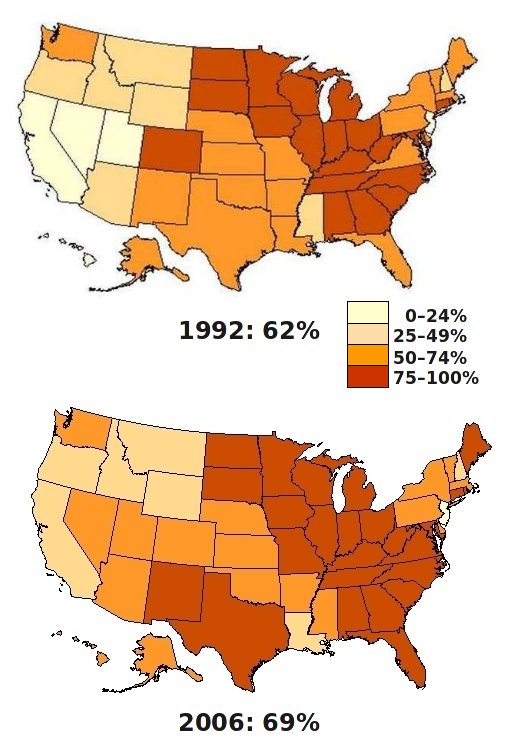
As of May 2000, 42 of the 50 largest U.S. cities had water fluoridation. In 2010, 66% of all U.S. residents and 74% of U.S. residents with access to community water systems receive fluoridated water. In 2010, a U.S. Centers for Disease Control and Prevention study determined that "40.7% of adolescents aged 12–15 had dental fluorosis [in 1999–2004]". In response, in 2011 the U.S. Department of Health and Human Services and the U.S. Environmental Protection Agency (EPA) proposed to reduce the recommended level of fluoride in drinking water to the lowest end of the current range, 0.7 milligrams per liter of water (mg/L), from the previous recommended maximum of 0.7 to 1.2 mg/L in recognition of the increase in sources of fluoride such as fluoridated toothpastes and mouthwashes. This could effectively terminate municipal water fluoridation in areas where fluoride levels from mineral deposits and industrial pollution exceed the new recommendation. As of 2021 the federal maximum contaminant level for fluoride in public water systems remains at 4.0 mg/L, which had been promulgated by EPA in 1986. Several states have set more stringent standards, including New York, where the fluoride MCL is 2.2 mg/L.
As of 2023, approximately 73% of the U.S. population continues to receive fluoridated water. In the same year, the CDC reported that water fluoridation prevents roughly 25% of cavities in children and adults. Despite this, debates about the safety and necessity of fluoridation persist. Some municipalities, such as Portland, Oregon, have chosen not to fluoridate their water, citing concerns over potential health risks and the ethical implications of mass medication. Conversely, areas like San Francisco, California, have maintained their fluoridation programs, emphasizing the public health benefits, particularly for low-income populations who may have limited access to dental care. A 2022 study in the Journal of Public Health Dentistry found that cessation of water fluoridation in Calgary, Alberta, led to an increase in dental caries among children, reinforcing the CDC's stance on the importance of fluoridation.
Oceania
Australia
Main article: Water fluoridation in Australia

Australia now provides fluoridated water for 70% or more of the population in all states and territories. Many of Australia's drinking water supplies began fluoridation in the 1960s and 1970s. By 1984 almost 66% of the Australian population had access to fluoridated drinking water, represented by 850 towns and cities. Some areas within Australia have natural fluoride levels in the groundwater, which was estimated in 1991 to provide drinking water to approximately 0.9% of the population.
The first town to fluoridate the water supply in Australia was Beaconsfield, Tasmania in 1953. Queensland became the last state to formally require the addition of fluoride to public drinking water supplies in December 2008, though since 2012 exceptions have been granted on the basis of cost. In 2023, 72% of Queenslanders have access to fluoridated water (mostly in the south east), while 53 out of 77 councils do not have fluoridated water (18 have fluoride added, the remaining have naturally high levels).
Fiji
In 2011, Water Authority of Fiji announced that it would add fluoride to water supplied to residents of the Suva-Nausori corridor, with the long term goal of adding fluoride to water nationwide.
New Zealand
The use of water fluoridation first began in Hastings, New Zealand in 1954. A Commission of Inquiry was held in 1957 and then its use rapidly expanded in the mid 1960s. New Zealand now has fluoridated water supplied to about half of the total population. Of the six main centers, only Christchurch and Tauranga do not have a fluoridated water supply. Wellington's water supply is mostly fluoridated, but the suburbs of Petone and Korokoro receive a non-fluoridated supply. In Auckland, the suburbs Onehunga and Huia Village do not fluoridate water.
In 2013, a Hamilton City Council committee voted to remove fluoride from late June 2013. A referendum was held during the council elections in October 2013 with approximately 70% of voters voting for fluoride to be added back into the water supply, and in March 2014, the council voted 9 to 1 to re-introduce fluoride into the supply. In a 2007 referendum about half of voters in the Central Otago, South Otago and the Southland Region did not want fluoridation and voters in the Waitaki District were against water fluoridation for all Wards.{{citation |title=Waitaki District Council: all Wards with referendum vote NO to fluoridation |date=18 October 2007 blacklisted |url=http://fluoridealert.org/news/waitaki-district-council-all-wards-with-referendum-vote-no-to-fluoridation/ |access-date=27 July 2017--}} Ashburton and Greymouth also voted against fluoridation.
In 2014, the Prime Minister's Chief Science Advisor and the Royal Society of New Zealand published a report on the health effects of water fluoridation.
In June 2018, the Supreme Court of New Zealand in New Health New Zealand Inc v South Taranaki District Council upheld the legality of water fluoridation in New Zealand.
In late July 2022, Director-General of Health Ashley Bloomfield ordered 14 territorial authorities to add fluoride to their water supplies. Bloomfield stated that this measure would boost the number of the New Zealand population receiving water fluoridation by from 51% to 60%.
Central and South America
Argentina
As of 2012, 21% of the Argentinian population had fluoridated water. The capital city, Buenos Aires, has its water fluoridated via a local scheme.
Brazil
By 2008, 41% of people (73.2 million) in Brazil were getting artificially fluoridated water.
Water fluoridation was first adopted in Brazil in the city of Baixo Guandu, ES, in 1953. A 1974 federal law required new or enlarged water treatment plants to have fluoridation, and its availability was greatly expanded in the 1980s, with optimum fluoridation levels set at 0.8 mg/L. Today, the expansion of fluoridation in Brazil is a governmental priority; Between 2005 and 2008, fluoridation became available to 7.6 million people in 503 municipalities. As of 2008, 3,351 municipalities (60.6%) had adopted fluoridation, up from 2,466 in 2000.
Chile
In Chile, 70.5% of the population receives fluoridated water (10.1 million added by chemical means, 604,000 naturally occurring). The Biobio Region is the only administrative division that doesn't fluoridate water.
Colombia
In Bogota, the average drinking water fluoride concentration is 0.08 ppm. Medellin is the only city which preserves an annual oral health prevention programme based on education and fluoridated mouth rinses in public schools since 1981, and its drinking water contains an average Fluoride concentration of 0.05 ppm. Cartagena is located in the coastal region of Colombia, presenting one of the highest average temperatures in the country and its drinking water has an average Fluoride concentration of 0.08 ppm.
The average fluoride residing in Bogota and Medellin is comparable with the values reported for the optimally fluoridated water of Indianapolis.
Guatemala
As of 2012, 1,800,000 people received fluoridated water, amounting to 13% of the population.
Guyana
In Guyana, 245,000 people, or 32% of the population, have access to fluoridated water. Of those with access, 45,000 have access to artificially fluoridated water, with the rest being naturally fluoridation.
Panama
By 2012, over 15% (510,000 people) of the population were receiving artificially fluoridated water. There are fluoridation schemes in Panama City and San Miguelito.
Paraguay
Approximately 6% of the population, or 350,000 people, receive fluoridated water as of 2012.
Peru
An estimated 80,000 people drink naturally fluoridated water, with 500,000 people receiving artificially fluoridated water. This amounts to 2% of the population.
Venezuela
Following an unsuccessful rollout of water fluoridation, the government began a salt fluoridation program in 1995. Fluoride levels were introduced at a level of 60–90 mgF per kg of salt. This concentration was later raised to 180-220 mgF per kg, considered the appropriate range for preventing dental caries in the Latin American population who are at a minimal risk of dental fluorosis. In markets, around 80% of table salt is fluoridated.
References
References
- Centers for Disease Control and Prevention. (2001). "Recommendations for using fluoride to prevent and control dental caries in the United States". MMWR Recomm Rep.
- Pizzo G, Piscopo MR, Pizzo I, Giuliana G. (2007). "Community water fluoridation and caries prevention: a critical review". Clin Oral Investig.
- Taricska JR, Wang LK, Hung YT, Li KH. (2006). "Advanced Physicochemical Treatment Processes". Humana Press.
- [http://apps.who.int/iris/bitstream/10665/44584/1/9789241548151_eng.pdf Guidelines for Drinking-water Quality, 4th Edition] WHO, 2011. {{ISBN
- Hobson WL, Knochel ML, Byington CL, Young PC, Hoff CJ, Buchi KF. (2007). "Bottled, filtered, and tap water use in Latino and non-Latino children". Arch Pediatr Adolesc Med.
- Petersen PE, Lennon MA. (2004). "Effective use of fluorides for the prevention of dental caries in the 21st century: the WHO approach". Community Dent Oral Epidemiol.
- (2024-10-04). "Water fluoridation for the prevention of dental caries". The Cochrane Database of Systematic Reviews.
- (2011). "Introduction to the SCHER opinion on Fluoridation". European Commission Scientific Committee on Health and Environmental Risks (SCHER).
- (5 April 2013). "Fluoride in Drinking Water: A Review of Fluoridation and Regulation Issues".
- Maitreyee P. Unde, Raju Umaji Patil, and Persis P. Dastoor. (2018). "The Untold Story of Fluoridation: Revisiting the Changing Perspectives". Indian Journal of Occupational and Environmental Medicine.
- "Future benefits of water fluoridation not guaranteed, study shows".
- National Health and Medical Research Council (Australia). (2007). "A systematic review of the efficacy and safety of fluoridation". Evid Based Dent.
- McDonagh M, Whiting P, Bradley M. (2000). "A systematic review of public water fluoridation". NHS Centre for Reviews and Dissemination.
- (1 January 2008). "Fluoridation". Evidence-Based Dentistry.
- Fawell J, Bailey K, Chilton J, Dahi E, Fewtrell L, Magara Y. (2006). "Fluoride in Drinking-water". World Health Organization.
- Jones S, Burt BA, Petersen PE, Lennon MA. (2005). "The effective use of fluorides in public health". Bull World Health Organ.
- (2011). "What role does fluoride play in preventing tooth decay?".
- (2004). "One in a Million: The facts about water fluoridation". The British Fluoridation Society, The UK Public Health Association; The British Dental Association; The Faculty of Public Health.
- "98 percent of Europe banned water fluoridation – TIP".
- "Willkommen beim Kantonalen Laboratorium".
- Ärzteblatt, Deutscher Ärzteverlag GmbH, Redaktion Deutsches. (30 November 2017). "Leitungswasser in den USA: Viele Kinder mit besseren Zähnen, nur wenige mit mehr Blei im Blut".
- (2007). "Adding fluoride to water supplies". BMJ.
- (27 April 2015). "US lowers fluoride levels in drinking water for first time in over 50 years".
- Akpata ES, Danfillo IS, Otoh EC, Mafeni JO. (2009). "Geographical mapping of fluoride levels in drinking water sources in Nigeria". Afr Health Sci.
- ml "Water Fluoridation – The Facts", from South Africa's [http://www.doh.gov.za/department/ Department of Health] {{webarchive. link. (27 September 2007 website. Retrieved 29 April 2006.)
- "The Water Page – Rand Water and Fluoridation".
- "Fluoridation scheme halted by health concerns".
- (23 June 2015). "Fluoride, arsenic and iodine in China's drinking water poisons 50 million people".
- "Standards for Drinking Water Quality".
- (December 2008). "Effective use of fluorides in the People's Republic of China--a model for WHO Mega Country initiatives". Community Dental Health.
- "Water Treatment Process". Water Supplies Department, The Government of the Hong Kong Special Administrative Region.
- "Drinking Water Quality for the Period of October 2013 – September 2014". Water Supplies Department, The Government of Hong Kong Special Administrative Region.
- Ingram, Colin. (2006). ''The Drinking Water Book''. pp. 15-16
- "Control of Fluorosis in India".
- "Fluoridation and Fluorosis Disaster – India: Fluoride in water takes its toll in Assam – La Leva di Archimede (ENG)".
- "WHO | Naturally occurring hazards".
- Kak Ramachandran, Smriti. (28 December 2014). "Huge population at fluorosis risk". The Hindu: Mobile Edition.
- Shlomo P. Zusman. "Water Fluoridation in Israel: Ethical and Legal Aspects". Public Health Reviews, Vol. 34, No. 1.
- Press Releases (17 August 2014) [http://www.health.gov.il/English/News_and_Events/Spokespersons_Messages/Pages/17082014_1.aspx End of Mandatory Fluoridation in Israel] {{Webarchive. link. (17 November 2014 , [[Ministry of Health (Israel)]]. Retrieved 29 September 2014.)
- (31 May 2015). "Deputy health minister moves to restore water fluoridation". www.israelnationalnews.com.
- "F.A.Q.". www.mekorot.co.il.
- (28 May 2002). "Court Petition to Stop Fluorination of Drinking Water". www.israelnationalnews.com.
- (26 June 2002). "Cities Can't Be Forced to Add Fluoride". www.israelnationalnews.com.
- (21 November 2002). "Court paves way for fluoridated water". www.haaretz.com.
- Lev, David. (18 May 2011). "The Fluoride Debate Goes On – in the Knesset". www.israelnationalnews.com.
- (30 May 2011). "If Danger is Proven – We Will Stop Fluorination". www.israelnationalnews.com.
- (29 August 2014). "Israel Bans Water Fluoridation".
- (2022-01-28). "The effect of community water fluoridation cessation on children's dental health: a national experience". Israel Journal of Health Policy Research.
- (2021-07-19). "פלואוריד במשחת שיניים - כבר מהשן הראשונה, וכמה צריך בכל גיל?". Ynet.
- "Prevention of Dental Caries Through Fluoridation of Drinking Water - Ministry of Health, Dental Health Division".
- (2011). "Associations between oral health behavior and anxiety about water fluoridation and motivation to establish water fluoridation in Japanese residents". Journal of Oral Science.
- NCFPR. [http://waterfluoridationcenter.org/papers/2001/antifluoride.html Fluoridation Facts: Antifluoride Assertion – "Advanced Countries Shun Fluoridation"] {{Webarchive. link. (25 April 2012 . Drawn from the ADA [http://www.ada.org/sections/newsAndEvents/pdfs/fluoridation_facts.pdf Fluoridation Facts] {{webarchive). link. (15 March 2016 document.)
- (1 June 2014). "National survey on school-based fluoride mouth-rinsing programme in Japan: regional spread conditions from preschool to junior high school in 2010". International Dental Journal.
- Moon, Gwang-lip. (7 November 2005). "NGOs Oppose Water Fluoridation".
- (17 January 2012). "South Korea Debates Water Fluoridation". OOSKAnews.
- Rahimah A. Kadir. (14 June 1998). "Dental Fluorosis: Facts and Myths". New Sunday Times.
- (31 December 2010). "Water fluoridation re-introduced". Bernama.
- Loh T. (September 1996). "Thirty-eight years of water fluoridation--the Singapore scenario". Community Dental Health.
- Teo CS. (April 1984). "Fluoridation of public water supplies in Singapore". Annals of the Academy of Medicine, Singapore.
- "PUB".
- (Mar 2000). "Fluoride in Drinking Water and Cancer Mortality in Taiwan". Environmental Research.
- (May 2012). "Extent of Water Fluoridation". British Fluoridation Society.
- "High fluoride levels in water endanger health".
- "Statements from European Health & Environment Authorities on Fluoridation".
- (18 November 2004). "Fluoride plan goes down the drain". www.bbc.co.uk.
- (19 July 2016). "Is Fluoridated Drinking Water Safe?". Harvard Public Health Magazine.
- (April 2008). "European citizens' opinions on water fluoridation". Community Dent Oral Epidemiol.
- https://www.researchgate.net/profile/Lusine-Sahakyan/publication/385350253_Ion-chromatographic_determination_of_common_anions_in_drinking_water_in_some_regions_of_the_Republic_of_Armenia/links/6722423bdb208342dede583c/Ion-chromatographic-determination-of-common-anions-in-drinking-water-in-some-regions-of-the-Republic-of-Armenia.pdf {{Bare URL PDF. (July 2025)
- "MEDICAL TRIBUNE CZ > Sláva a pád jedné preventivní metody".
- (August 2025). "Malý zub taky zub aneb zoubky našich dětí IV.}}{{Dead link".
- "Archived copy".
- "Archived copy".
- "Archived copy".
- "Archived copy".
- "Archived copy".
- "Archived copy".
- "Archived copy".
- "Archived copy".
- "Human exposure to fluorides via drinking water in Estonia - Eesti Arst - Eesti Arstide Liidu ajakiri".
- "Human exposure to fluorides via drinking water in Estonia - Eesti Arst - Eesti Arstide Liidu ajakiri".
- (2002). "Caries Occurrence in a Fluoridated and a Nonfluoridated Town in Finland: A Retrospective Study Using Longitudinal Data from Public Dental Records". Caries Res.
- GTK. "HAKKU – Portti Suomen geologiseen tietoon – Gateway to Finland's geological information".
- (2020). "Dental Fluorosis Prevalence, Severity and Associated Risk Factors in Pre-School Aged Children Residing in Fluoride Deficient Regions of Georgia". Georgian Medical News.
- "Question: European countries have rejected fluoridation, so why should we fluoridate water?".
- . Recognize – Assess – Act : On the Health of Children and Adolescents in Germany, Germany Ministry of Health. [http://www.bmg.bund.de/fileadmin/dateien/Downloads/K/Kindergesundheit/KiGGS_GPA.pdf Erkennen – Bewerten – Handeln: Zur Gesundheit von Kindern und Jugendlichen in Deutschland] {{Webarchive. link. (5 July 2016 . 2008.)
- (September 1964). "Status and Prospects of Fluoridation in Europe". American Journal of Public Health and the Nation's Health.
- Brian Martin. (1991). "Scientific knowledge in controversy: the social dynamics of the fluoridation debate, electronic edition". SUNY Press.
- (1997). "Rise and fall of caries prevalence in German towns with different F concentrations in drinking water". Caries Res..
- (October 2000). "Decline of caries prevalence after the cessation of water fluoridation in the former East Germany". Community Dent Oral Epidemiol.
- "Θεραπεία Φθορίου & Τερηδόνα". www.ododiatros.com.gr.
- "Argument for fluoridation doesn't hold water?". Irish Independent.
- "Fluoride-Free Water – Anti-Fluoridation Campaign for Drinking Water in Ireland".
- Report of the Forum on Fluoridation 2002, pp.29–30
- Report of the Forum on Fluoridation 2002, p.37
- "Forum on Fluoridation, 2002". Stationery Office, Government of Ireland.
- Report of the Forum on Fluoridation 2002, p.72
- [http://www.irishstatutebook.ie/1960/en/act/pub/0046/print.html Health (Fluoridation of Water Supplies) Act, 1960], [[Irish Statute Book]]
- Report of the Forum on Fluoridation 2002, p.170
- (2 February 2007). "S.I. No. 42 of 2007: Fluoridation of Water Supplies Regulations 2007". Irish Statute Book.
- Report of the Forum on Fluoridation 2002, p.73
- {{cite BAILII. (1965). (3 July 1965)
- "'Brave woman' who challenged State over fluoridation". Irish Times.
- Report of the Forum on Fluoridation 2002, pp.74–76
- Report of the Forum on Fluoridation 2002, p.76
- Report of the Forum on Fluoridation 2002, pp.76–78
- "Fluoride in our water: are we brushing with danger?". Irish Independent.
- (9 May 2013). "Health (Fluoridation of Water Supplies) (Repeal) Bill 2013 [PMB] (Number 47 of 2013)". Oireachtas.
- (12 November 2013). "Dáil Éireann – 12/Nov/2013 Health (Fluoridation of Water Supplies)(Repeal) Bill 2013: Second Stage (Resumed) (Continued)". Dáil Éireann debates.
- Brennan, Michael. (9 November 2013). "Fluoride will stay in water after charges". [[Evening Herald]].
- (9 November 2013). "TDs call for end to fluoride in water". [[RTÉ.ie]].
- "Ireland Begins To Give Up On Water Fluoridation". IAOMT.org.
- "FG election promise to ban fluoride in drinking water". Irish Independent.
- "Forum on Fluoridation". dentalhealth.ie.
- "The Italian perspective on fluoride intake in children and adolescents". European Journal of Paediatric Dentistry.
- (13 February 1976). "De Gids". G. J. A. Beijerinck.
- (2005). "Bestuursrecht 1, 2de druk". Boom Uitgevers, Den Haag.
- (1 March 2000). "Norway Has Rejected Fluoridation".
- "Helsedirektoratet".
- Mullen J. (October 2005). "History of water fluoridation". British Dental Journal.
- Larsson, Gerhard. (May 1981). "Fluor i kariesförebyggande syfte – Betänkande av fluorberedningen". Statens offentliga utredningar / Socialdepartementet.
- (22 November 1962). "Fluoreringsfrågan avgjord". Västmanlands läns tidning.
- (19 November 1971). "Stopp för fluor". Västmanlands läns tidning.
- J. MEYER and P. Wiehl in Schweiz Monatsschr. Zahnmed 2003; 113: 702 (in French) and 728-729 (in German)
- (9 April 2012). "Basel-Stadt schafft umstrittene Trinkwasserfluoridierung ab (tr: Basel-Stadt abolishes controversial water fluoridation)". bsk/sda.
- "BMA – Home".
- Gibson-Moore H. (2009). "Water fluoridation for some—should it be for all?". Nutrition Bulletin.
- [http://www.dentistry.co.uk/2009/06/30/southampton-fluoridation-challenge-launched/ "Southampton Fluoridation Challenge Launched"] Seb Evans in ''Dentistry.co.uk'', 30 June 2009.
- (24 July 2009). "Fluoride plan costs increase".
- Public Health England. (28 October 2014). "Public Health England (PHE) takes no further action to implement fluoridation scheme in Hampshire".
- (2007). "Oral Health Strategies for Northern Ireland". UK Department of Health, Social Services, and Public Safety.
- "Fluoride".
- (23 September 2021). "Fluoride will be added to UK drinking water to cut tooth decay".
- [http://archives.cbc.ca/IDC-1-75-341-1816/science_technology/fluoride/clip4 "Gordon Sinclair's rant"], from the [http://archives.cbc.ca/index.asp?IDLan=1 Canadian Broadcasting Corporation Archives] website. Retrieved 27 March 2006.
- (2017-11-17). "Tap Water in Toronto".
- Rabb-Waytowich D. (2009). "Water fluoridation in Canada: past and present". J Can Dent Assoc.
- (2009). "Public opinions on community water fluoridation". Can J Public Health.
- "Past Results, 2010 Municipal Election: Monday, Oct. 25, 2010".
- (26 October 2010). "City officials to support 'no' vote on fluoridation". [[CKCO-DT]].
- (2010). "Ontario Cities Vote Against Water Fluoridation". J Can Dent Assoc.
- (30 November 2010). "Fluoride officially turned off". www.waterloochronicle.ca.
- (8 February 2011). "Calgary removing fluoride from water supply". www.cbc.ca.
- (19 May 2011). "Calgary stops adding fluoride to water". www.cbc.ca.
- (11 February 2014). "The Impact of Removing Fluoridation from Municipal Water Supplies in Canada: a Tale of Two Cities". J Can Dent Assoc.
- Natalie Alcoba. (5 April 2011). "Fluoride to stay in tap water". news.nationalpost.com.
- Kasisi-Monet, Camille. (22 November 2024). "L'abandon de la fluoration de l'eau dans l'ouest de Montréal cause des remous". Radio-Canada.
- (26 November 2024). "Fluoridation of drinking water to be ended at Pointe-Claire and Dorval plants".
- Doug Schmidt. (30 January 2013). "Windsor votes to remove fluoride from drinking water". blogs.windsorstar.com.
- (29 January 2013). "Windsor to stop adding fluoride to water". The Canadian Press.
- (14 March 2012). "Tecumseh wants fluoride out of water". www.cbc.ca.
- CBC News. (14 December 2018). "Windsor to put fluoride back into the water after council vote". www.cbc.ca.
- "Regina city council votes to add fluoride to drinking water".
- 0188-4999.
- Klein RJ. (7 February 2008). "Healthy People 2010 Progress Review, Focus Area 21, Oral Health". National Center for Health Statistics.
- "The Benefits of Fluoride". Centers for Disease Control and Prevention (CDC).
- "2010 Water Fluoridation Statistics". CDC.
- (November 2010). "Prevalence and Severity of Dental Fluorosis in the United States, 1999–2004". CDC, National Center for Health Statistics.
- (2020-01-21). "Community Water Fluoridation FAQs". CDC.
- Barclay, Eliza. (2011-01-07). "Feds To Lower Fluoride Limits For Water To Avoid Tooth Damage". National Public Radio.
- fluoridealert.org/re/thiessen-2-14-11.hhs.pdf{{dead link. (June 2018)
- . (2021-01-05). ["National Primary Drinking Water Regulations"](https://www.epa.gov/ground-water-and-drinking-water/national-primary-drinking-water-regulations). *U.S. Environmental Protection Agency (EPA)*.
- (2018). "New York Codes, Rules and Regulations. Title 10, SubPart 5-1—Public Water Supplies. Public Water Systems; Maximum Contaminant Levels; Monitoring Requirements; Notification Requirements.". New York State Department of Health.
- CDC. (2024-06-24). "Centers for Disease Control and Prevention".
- CDC. (2024-06-24). "Centers for Disease Control and Prevention".
- (2015). "U.S. Public Health Service Recommendation for Fluoride Concentration in Drinking Water for the Prevention of Dental Caries". Public Health Reports.
- CDC. (2024-06-24). "Centers for Disease Control and Prevention".
- P Forster, Queensland Health Systems Review. The Consultancy Bureau, Brisbane, 2005, p. 53. Forster acknowledges this diagram as that of AJ Spencer.
- "Inquiry into Water Fluoridation in the ACT – Report by the Standing Committee on Social Policy, 1991".
- Commonwealth Department of Health, Fluoridation of Water: A Collection. 9; Commonwealth Department of Health, Fluoridation of Water in Australia 1984 (Canberra: Australian Government Publishing Service, 1985), 13.
- (1987). "Australians:Events and Places". Fairfax, Syme & Weldon Associates.
- (5 December 2007). "Qld to get fluoridated water".
- Springborg, Lawrence. (2012-09-19). "Minister ends speculation on water fluoridation".
- (2023-11-19). "Queensland is significantly lagging behind the rest of Australia when it comes to the simple health measure of water fluoridation". ABC News.
- "Suva/Nausori corridor residents benefit from fluoride in water supply".
- (30 August 2011). "Fluoridation history". New Zealand Ministry of Health.
- (20 January 2011). "Drinking Water Supplies of New Zealand by LA District". ESR Water Group.
- Newman, Sue. (14 June 2005). "Christchurch targeted for new fluoridation drive". Ashburton Guardian.
- (12 January 2011). "Tauranga City Council > Council Services > Water & Drainage > Water Supply > Water Quality > Fluoride".
- "Fluoride". Greater Wellington Regional Council.
- "Auckland City".
- (5 June 2014). "Fluoride to be removed from Hamilton's water supply". [[TVNZ]].
- (27 March 2014). "Hamilton votes to restart fluoridation". The New Zealand Herald.
- (3 November 2007). "Voters say no to water fluoridation". [[The Southland Times]].
- Keast, John. (12 March 2007). "Ashburton fluoride bid fails". [[The Press]].
- (August 2014). "Health Effects of Water Fluoridation: a Review of the Scientific Evidence".
- {{cite court. (27 June 2018). link
- (27 July 2022). "Dr Ashley Bloomfield orders 14 councils' water supplies to be fluoridated". [[Stuff (website).
- "Pesquisa Nacional de saneamento Básico, 2008". Ministro do Planejamento, Orçamento e Gestão.
- Information from the Oral Health Department of the Chilean Ministry of Health. December 2004.
- "Octava Región gana pelea por la no fluoración del agua potable".
- (2005). "Total fluoride intake in children aged 22–35 months in four Colombian cities". CES University, Medellin, Antioquia University, Medellin.
- Salas MT (1997). La fluoruración de la sal en costa Rica (Inglish translation= Fluoridation of salt in Costa Rica). Informe Final, Taller de Vigilancia epidemiológica de fluoruración de la sal, Ministerio de 089 Afr. J. Dent. Salud de Costa Rica, OPS, OMS pp. 27-32
- Héctor, Franco. (April 2021). "The fluoride intake and urinary fluoride excretion in children attending a daycare center in Maracay, Aragua state, Venezuela". African Journal of Dentistry.
This article was imported from Wikipedia and is available under the Creative Commons Attribution-ShareAlike 4.0 License. Content has been adapted to SurfDoc format. Original contributors can be found on the article history page.
Ask Mako anything about Water fluoridation by country — get instant answers, deeper analysis, and related topics.
Research with MakoFree with your Surf account
Create a free account to save articles, ask Mako questions, and organize your research.
Sign up freeThis content may have been generated or modified by AI. CloudSurf Software LLC is not responsible for the accuracy, completeness, or reliability of AI-generated content. Always verify important information from primary sources.
Report