From Surf Wiki (app.surf) — the open knowledge base
W. & J. Sloane
Luxury furniture and rug store in New York City
Luxury furniture and rug store in New York City
| Field | Value |
|---|---|
| name | W. & J. Sloane |
| image | Arnold Constable 115 Fifth Avenue.jpg |
| image_caption | Flagship store at 19th and Broadway |
| fate | Bankruptcy |
| foundation | March 7, 1843 |
| defunct | September 11, 1985 |
| location | New York City, U.S. |
| industry | Retail |
| key_people | William Sloane, founder |
| William D. Sloane, treasurer | |
| products | Rugs and home furnishings |
| parent | City Stores Company (starting in 1955) |
William D. Sloane, treasurer
W. & J. Sloane (also known as W&J Sloane or Sloane's) was a chain of furniture stores that originated from a luxury furniture and rug store in New York City that catered to the prominent, including the White House and the Breakers, and wealthy, including the Rockefeller, Whitney, and Vanderbilt families.
After a long period of prosperity, nationwide expansion and prominence, the firm went through a short period of decline and was forced to file for bankruptcy in 1985.
History
On March 2, 1843, the company was founded as a rug importer and seller by William Sloane, who had just emigrated from Kilmarnock, Scotland, a town famous for expensive furniture, fine carpets and rugs. Its teak and jute resources came from East Bengal (present day Bangladesh). In 1852, his younger brother John W. Sloane joined the firm, upon which it was renamed W. & J. Sloane, followed by William's son William D. Sloane. It was the first company to import oriental carpets into the United States. It soon expanded to include furniture and other home furnishings, and quickly became the choice of the elite in New York.
In 1875, Sloane's established an outlet for the import of carpets and home furnishings in San Francisco.
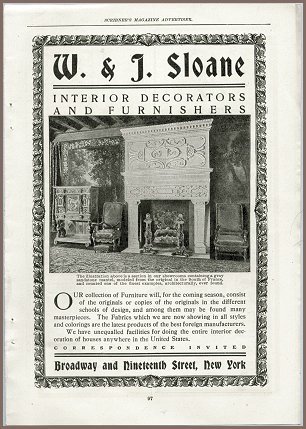
In the late 19th century, the company added an antiques department, started producing furniture, and became the first home furnishings store in the country, billing itself as "W. & J. Sloane Interior Decorators and Home Furnishers." Its flagship store was originally located at Broadway and 19th Street, in "Ladies' Mile", relocating later to 414 Fifth Avenue at 38th Street, the former flagship of Franklin Simon & Co.
Taste-setter for America
In 1891, W. & J. Sloane incorporated and set the national decorating taste of the United States, and over the next sixty years decorated the homes of the most prominent people in the country, including the Breakers and the White House, created Hollywood movie sets, and even designed and decorated interiors of automobiles. It opened a branch in San Francisco, California originally to furnish pavilions at the 1915 Panama-Pacific Exposition (it also furnished the model homes at the 1939 New York World's Fair). It later acquired other upscale firms such as the California Furniture Company, and in 1925 a subsidiary, the Company of Master Craftsmen was founded by William Sloane Coffin Sr. (the father of the Rev. William Sloane Coffin) to create Colonial Revival furniture.
San Francisco
In March 1909, Sloane's moved from Van Ness and Market and the next month held the grand opening of its grand new, 120000 sqft, 9-story Gothic/Renaissance-style flagship store near Union Square at 216–228 (now 222) Sutter Street, designed by Reid & Reid, which still bears the W. & J. Sloane sign as part of its cladding.
Washington, D.C.
In March 1926, Sloane's moved its small Washington, D.C. store on H Street near the White House into much larger quarters at 708–12 12th St. near G St., site of a present-day Macy's in the F Street shopping district. It would later move again to Connecticut Avenue in the Dupont Circle.
Los Angeles stores
In 1928, it acquired the California Furniture Company and converted its store at the Joseph E. Carr Building, 644–6 S. Broadway in Downtown Los Angeles, built in 1908-9 and designed by architect Robert Brown Young, to the W. & J. Sloane Los Angeles store. The building would later (1947–1980) serve as the second downtown flagship of local clothing chain Harris & Frank. In 1935 it closed and moved to the then-new upscale shopping district, Beverly Hills. The building at 9536 Wilshire Boulevard on the corner of Rodeo Drive would later house a branch of Los Angeles-based Haggarty's Furniture, and from 1972 to 1987, Bonwit Teller. Sloane's first Beverly Hills location was so successful that it soon moved to larger quarters next door, which would become a Gumps after Sloane's demise.
During World War II the company worked with the Newport News Company and the North Carolina Shipbuilding Company on shipbuilding contracts for the United States Navy fitting out the interiors of liberty ships under the direction of John Sloane Griswold.
Suburban expansion
In 1955, after a three-year internal struggle, control of the firm left the hands of a direct descendant of the Sloanes when Benjamin Coates, 37, was elected president. This meant the ouster of president W.E.S. Griswold Jr. and chairman of the board John D. Sloane, both grandsons of the founders. Coates was a financier who married John D. Sloane's daughter in 1944 and served on the board. Along with the City Stores Company syndicate, he bought up 70% of the stock to win control and become head of the firm.
After the store left family hands, further growth over the decades was characterized as "over-expansion" while Sloane's lowered the price and quality of its goods during this period. Sloane's opened New York City-area suburban US branches in Garden City, Manhasset, on Post Road in White Plains, Fashion Center in Paramus, Short Hills, Red Bank, Fox Pavilion in Jenkintown, PA outside Philadelphia, and in Connecticut at Ridgeway Center in Stamford as well as in Hartford, for an eventual total of 15.
Decline
City Stores was forced to file for bankruptcy in 1979 so that it could "continue operating while it works out a plan to pay its creditors."
Sloane's was then acquired by Hollywood-based RB Furniture in 1981. The chain closed its 38th Street store in 1984, and filed for bankruptcy on September 11, 1985. Its remaining stores were sold in 1986.
Legacy
The company generated considerable wealth for the direct descendants of William and John Sloane, who include in addition to the Rev. Mr. Coffin, diplomat Cyrus Vance, attorney Cyrus Vance Jr., musical producer John H. Hammond, his son, musician John P. Hammond, and philanthropist Emily Thorn Vanderbilt Sloane. It also brought the Sloane family into prominence in New York City, where they intermarried with the Whitneys, the Vanderbilts, and the Pynes. Employees who worked for the firm include the American cooking icon Julia Child (then Julia McWilliams), whose first job out of Smith College in October 1935 was Assistant to the New York Advertising Manager, A. W. Forester. Other notables include the Bevelacqua brothers: Salvatore and Aurelio, who designed under the Sloane banner before their respective success in furniture design.
References
References
- (September 10, 1985). "W&J Sloane filed for protection from creditors.". [[Los Angeles Times]].
- "Merestead". Westchester County Government.
- (1950). "The Story of Sloane's". W. and J. Sloane (firm).
- (June 6, 2013). "BIG OLD HOUSES: We'd Call It Old Money". BIG OLD HOUSES.
- (October 2, 1875). "Advertisement for Lazard Freres". San Francisco Chronicle.
- (1919). "The Pacific Printer: The Leading Trade Journal in the West for the Printing and Allied Interests, Vol. 21-22".
- (1998). "City Center to Regional Mall: Architecture, the Automobile, and Retailing in Los Angeles, 1920-1950". [[MIT Press]].
- (2012). "Maynard L. Parker: Modern Photography and the American Dream". [[Yale University Press]].
- (10 April 1909). "Magnificent Displays Mark Downtown Opening". The San Francisco Call and Post.
- Parry, Dave. (2010-11-08). "Architects' Profiles: Pacific Heights Architects #31 - Reid Brothers". Way Back Machine.
- (9 October 2019). "Former Loehmann’s building in S.F. hits the market seeking $100 million". www.bizjournals.com.
- (5 January 1926). "Ad for W. & J. Sloane". Evening Star.
- [https://www.loc.gov/item/2019679788/ "W & J Sloane, 1217 Connecticut" (photos), Library of Congress]
- (24 September 1928). "Ad for Sloane's". The Los Angeles Times.
- (May 18, 2004). "Los Angeles Union Station Run-through Tracks Project: Environmental Impact Statement".
- (January 17, 1980). "Harris & Frank advertisement". Los Angeles Times.
- (2010). "City of Beverly Hills General Plan: Historic Preservation". City of Beverly Hills.
- (June 6, 1955). "PERSONNEL: Changes of the Week".
- (9 October 1977). "W&J Sloane advertisement". Daily News.
- (July 28, 1979). "Owner of W. & J. Sloane Submits Bankruptcy Petitions". [[The New York Times]].
- (June 17, 1981). "W&J Sloane has been put up for sale after...". UPI.
- (January 12, 1984). "W & J Sloane Store on 38th St. Closing". [[The New York Times]].
- (September 19, 1985). "Sloane Furniture Firm Files For Chapter 11". [[Chicago Tribune]].
- (November 5, 1986). "RB is selling its remaining W&J Sloane stores.". [[Los Angeles Times]].
- "Thursday Night Hikes: Irvine/Cherokee Park Hike Architecture Notes, Part 1".
- (2007). "Julia Child". Penguin.
- (August 1936). "Fine Furniture".
This article was imported from Wikipedia and is available under the Creative Commons Attribution-ShareAlike 4.0 License. Content has been adapted to SurfDoc format. Original contributors can be found on the article history page.
Ask Mako anything about W. & J. Sloane — get instant answers, deeper analysis, and related topics.
Research with MakoFree with your Surf account
Create a free account to save articles, ask Mako questions, and organize your research.
Sign up freeThis content may have been generated or modified by AI. CloudSurf Software LLC is not responsible for the accuracy, completeness, or reliability of AI-generated content. Always verify important information from primary sources.
Report