From Surf Wiki (app.surf) — the open knowledge base
Vovinam
Vietnamese martial art

Vietnamese martial art
| Field | Value |
|---|---|
| logo | File:VVN logo.jpg |
| logosize | 198px |
| image | Vovinam demonstration Master de fleuret 2014 t223129.jpg |
| imagecaption | Vovinam demonstration in France in 2014 |
| imagesize | 200px |
| name | Vovinam |
| aka | Việt Võ Đạo, VVN, VVN/VVD |
| focus | Hybrid |
| hardness | Full-contact |
| country | Vietnam |
| creator | Nguyễn Lộc |
| parenthood | Vietnamese martial arts, Vietnamese traditional wrestling |
| famous_pract | Lê Sáng (Grandmaster) |
| olympic | No |
| website | [World Vovinam Federation (WVVF)](https://vovinam.world/) |
Vovinam (short for Võ Việt Nam, meaning "Vietnamese Martial Arts"), officially known as Việt Võ Đạo (越武道, meaning "Vietnamese Way of Martial Arts") is a Vietnamese martial art founded in 1938 by Nguyễn Lộc. It is based on traditional Vietnamese eclectic sources. Vovinam today is considered by the Ministry of Culture, Sports and Tourism to be a "National Intangible Cultural Heritage" as of November, 2023.
Vovinam, based on the principle of "hard and soft", involves the use of strikes, elbows, kicks, knees, and wrestling moves, as well as weapons such as swords, knives, chisels, claws and fans that serve as training devices for reaching optimal control of body and mind. Students also learn defense techniques and forms. Amongst Vietnamese martial arts, Vovinam is the largest and most developed with more than 60 schools around the world, including Poland, Belgium, Canada, Cambodia, Denmark, Germany, the United States, Morocco, Norway, Russia, France, Romania, Switzerland, Sweden, Singapore, Uzbekistan, Thailand, Italy, Australia, India, Pakistan, Iran, Spain, Algeria, Taiwan and Greece, among others. Vovinam's international governing body is the World Vovinam Federation (WVVF), and competitors compete in the international Vovinam professional circuit.
History
Vovinam was founded in 1938 by Nguyễn Lộc (1912 – 1960) in Hanoi, with the intent of providing practitioners with an efficient method of self-defense after a short period of study. Nguyễn believed martial arts would contribute to freeing Vietnam from colonial rule, which had been ruled by France since 1861, and from outside domination. Vovinam added elements of Chinese and Japanese systems to traditional Vietnamese martial arts, systems, which were thus partially created as a response to the French occupation, meant to promote a sense of national identity for the Vietnamese people. Hence, it is similar to taekwondo in that it is an eclectic system with combined elements of Japanese and Chinese martial arts within an indigenous framework.
After being invited to demonstrate Vovinam publicly in Hanoi with his disciples in 1940, Nguyễn was invited to teach the art at Hanoi's École Normale, and Vovinam gained in popularity. During the following years, political unrest increased throughout Vietnam; due to the system's nationalist political orientation, the art came under suppression. By 1954, Nguyễn had emigrated to South Vietnam, where he was able to continue to teach and establish Vovinam schools. His discipline was well received and within the year of arriving, he was even invited to train the police in Thủ Đức, Saigon. Unfortunately, he would fall terminally ill that same year and have to delegate all teaching to his senior student Grandmaster Lê Sáng while he relegated himself to backline research & study until he succumbed to his illness four years later. After his death in 1960, Grandmaster Lê Sáng continued the development and international promotion of Vovinam until his own death on September 27, 2010. During the Vietnam War throughout the mid-60's under Lê, Vovinam secured teaching opportunities when its instructors were invited to train officers from the National Police. However, a brief rivalry was brewing between Vovinam practitioners and Taekwondo when the South Vietnamese government decided to have the hand-to-hand system utilized by the South Korean military to be the main hand-to-hand system for the South Vietnamese soldiers and have the South Korean troops train the South Vietnamese soldiers. The rivalry was only settled when the Central Military Command later came to an agreement for both Vovinam & Taekwondo as well as Judo to be allowed to be taught to the South Vietnamese military.
The first Vovinam school outside of Vietnam was established in Houston, Texas by Vietnamese emigrants in 1976 after the Fall of Saigon. By 2000, Vovinam schools had been established in Australia, Belgium, Canada, France, Germany, Italy, Morocco, Poland, Spain, Switzerland, and the United States. Vovinam now exists without the political overtones (including anti-communist ones) it originally carried.
Logo
The Vovinam/Việt Võ Đạo logo is framed in a yellow shield. This shape symbolizes the harmony of hard and soft. Within this yellow shape, the red text "Vovinam" is written above the marine blue text "Việt Võ Đạo". Beneath the text appears an Âm-Dương symbol in red and marine blue. The Âm-Dương is surrounded by a thick, white circle, symbolizing the being of the Dao, with the mission to mediate between negative and positive (Âm = Negative, Dương = Positive), to subdue the two, to enable life of all beings. A yellow map of Vietnam is superimposed on the symbol.
Theory
Hard and soft
The yin and yang theory (Vietnamese: "Âm-Dương" and "Nhu-Cương") states that everything in the universe and on earth is initiated through the interrelation of Âm (negative) and Dương (positive). As to this theory there are martial arts that prefer the hard over the soft and others that prefer the soft over the hard. Vovinam Việt Võ Đạo does not prefer any over the other. Hard and soft are used equally to adapt to every situation, to every problem.
The student aims to develop the ability to combine hard and soft in combat and in daily life. This aims to develop both their physical abilities and spirit.
Not only the principle of the harmony of hard and soft but also many other things resulting from the training contribute to internalizing the martial art philosophy, e.g. fighting spirit, courage, tenacity, fairness, modesty and tolerance. Above all the training in morality and the way of applying the techniques shape the students' character. Emphasis is placed on recognizing one's ego and overcoming it.
In doing so the Vovinam student will gain generosity and tolerance with other people. With the awareness that the most important thing in a human's life are other humans, the final goal is to be able to not only help oneself but also to help others to live in peace and harmony with their surroundings.
With the salutation "Iron Hand over benevolent heart", the student is reminded of the main principle and the goal of Vovinam Việt Võ Đạo with every training. It is also about using the opponent's force and reaction, reaching maximum effect with comparatively little force.
10 principles of Vovinam Việt Võ Đạo
The term Việt Võ Đạo ("the way (Dao) of Viet Vo") was coined by the patriarch of the second generation of the Vovinam Viet Vo Dao, Lê Sáng, with the objective of adding a philosophical dimension to his martial art. This "Viet Vo Dao" consists of ten principles:
- Vovinam's disciples vow to pursue high proficiency in their martial art in order to serve the people and humanity.
- Promise to be faithful to the intentions and teaching of Vovinam and develop the young generation of Vovinam Viêt Võ Dao.
- Be united in spirit and heart, respect one's elder, be kind to one's peers.
- Respect discipline absolutely, maintain the high standard of personal conduct and honour of a martial art disciple.
- Have respect for other martial art schools, only use martial art skills for self-defense and protect justice.
- Be studious, strengthen the mind, enrich one's thought & behavior.
- Live simply, with chastity, loyalty, high principles and ethics.
- Build up a spirit of steely determination and vigor, overcome powers of violence.
- Make intelligent judgments, carry out struggles with perseverance and act with alertness.
- Be self-confident, self-controlled, modest and generous. (The wording can vary slightly between Vovinam schools)
A "Việt Võ Đạo Federation" was founded on November 3, 1973, in order to reunite some Vietnamese martial arts. Therefore, "Việt Võ Đạo", in Europe, is also used as a generic term for certain Vietnamese martial arts and philosophies but in Vietnam is only used to refer to "Vovinam Việt Võ Đạo".
Belt system, the uniforms and the colors
Uniforms
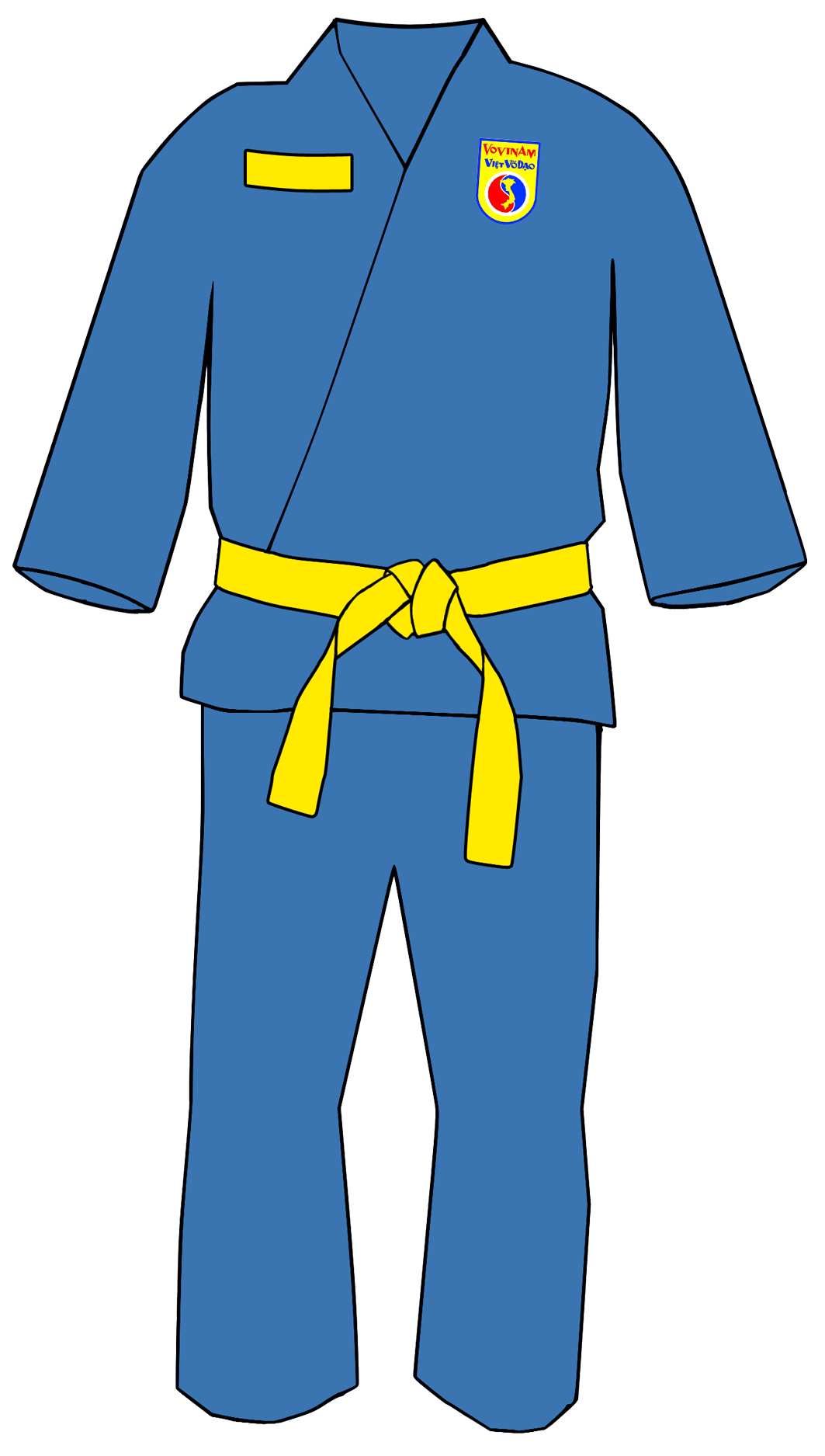
From 1938 to 1964, there was no official uniform. Following the lifting of the ban on martial arts in Vietnam in 1963, the first Council of Vovinam-Viet Vo Dao was gathered in 1964 to codify Vovinam, establishing a rank hierarchy and uniforms and codifying the training curriculum according to rank. The color blue was adopted as the official color for Vovinam uniforms. A separate development of the "Việt Võ Đạo Federation" in 1973 until 1990 the uniforms' color was black.
In the summer of 1990, Vovinam masters from around the world met at the International Vovinam-Viet Vo Dao Conference in California with the goal of creating a structured organization for Vovinam Việt Võ Đạo outside Vietnam (the International Vovinam-Viet Vo Dao Federation). One of the decisions was that the suit in Vovinam Việt Võ Đạo were now to be blue worldwide.
Belts
| Title | Tự Vệ | Nhập Môn / | |||||
|---|---|---|---|---|---|---|---|
| Lam Đai | Hoàng Đai | Hồng Đai | Bạch Đai | Rank | Belt | ||
| Novice | Practitioner | Instructor | Master | Grandmaster | |||
| [[Image:Light blue vovinam belt.svg | 65px]] | [[Image:Blue vovinam belt.svg | 65px]] | ||||
| [[Image:Blue vovinam belt 1stripe.svg | 65px]] | ||||||
| [[Image:Blue vovinam belt 2stripe.svg | 65px]] | ||||||
| [[Image:Blue vovinam belt 3stripe.svg | 65px]] | [[Image:Judo yellow belt.svg | 65px]] | ||||
| [[Image:Yellow vovinam belt 1stripe.svg | 65px]] | ||||||
| [[Image:Yellow vovinam belt 2stripe.svg | 65px]] | ||||||
| [[Image:Yellow vovinam belt 3stripe.svg | 65px]] | [[Image:Yellow red vovinam belt.svg | 65px]] | ||||
| [[Image:Red vovinam belt 1stripe.svg | 65px]] | ||||||
| [[Image:Red vovinam belt 2stripe.svg | 65px]] | ||||||
| [[Image:Red vovinam belt 3stripe.svg | 65px]] | ||||||
| [[Image:Red vovinam belt 4stripe.svg | 65px]] | ||||||
| [[Image:Red vovinam belt 5stripe.svg | 65px]] | ||||||
| [[Image:Red vovinam belt 6stripe.svg | 65px]] | [[Image:Multicolor vovinam grandmaster belt.svg | 65px]] |
The student begins with a cyan belt - the same color as his/her suit.

Following in a longer period of time, respectively 3 red stripes are added to the yellow belt. This corresponds to the 1st, 2nd, respectively 3rd degree blackbelt (Đẳng). The exam following the 3rd red stripe is the master's exam. Passing the exam successfully assigns the right to wear a red belt with a circulating yellow border (4th degree blackbelt).
Now, Vovinam has two different sets of belt ranking because of the different training program: The WVVF Vovinam (headquarter: Vietnam) uses the traditional program and (headquarter: France) uses the new training program.
Name plates
With every change of belt color the name plate color changes. Blue belt students start off with yellow text on blue name plates. With the yellow belt the name plate changes to red text on yellow ground. The red belt comes along with white text on a red name plate. The patriarch carries red text on a white name plate. Thin, colored lines in blue, yellow and red are shown on the upper and lower borders of this white name plate.
Specialties
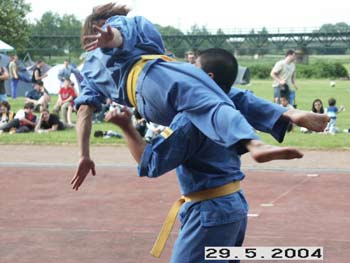
Vovinam has some specialised techniques:
- Đòn Chân Tấn Công
- : A group of leg grappling techniques that is designed to grab the opponent by the feet or legs and take them down using twisting motions usable as a surprise attack in a fight. There are 21 leg grappling techniques.
- Đấm Lao
- : A backfist swung reversely to the temple.
- Đá Cạnh
- : A diagonally applied kick.
Techniques and weapons
- Hand techniques (đòn tay)
- Elbow techniques (chỏ)
- Kicking techniques (đá)
- Knee techniques (gối)
- Forms (Quyền, Song Luyện, Đa Luyện)
- Attack techniques (chiến lược)
- Self-defense (tự vệ)
- Self-defense against knife attack (phản đòn dao)
- Traditional wrestling (Vật cổ truyền)
- Leg attack take-downs (đòn chân tấn công)
- Staff (côn)
- Sword (kiếm)
- Halberd (dao dài)
- Sabre (đao)
- Dagger (dao găm)
- Machete (mã tấu)
- Spear (thương)
World Championships
Vovinam has Voninam World Championships since 2002 as well as Vocotruyen World Championships.
Guardian Girls Vovinam
The World Vovinam Federation (WVVF) officially signed a global Memorandum of Understanding with Guardian Girls International (GGI) in Hanoi, Vietnam, on September 16, 2025. Through this partnership, WVVF joined GGI in launching Guardian Girls Vovinam (GGV), a global initiative dedicated to advancing gender equality and protecting women and girls from violence through the practice and values of Vovinam.
References
- "Nguyen Van Chieu: Vietnam's martial arts missionary". CNN.
- H. Nguyên. (November 13, 2023). "Vovinam - Việt Võ Đạo được công nhận là di sản văn hóa phi vật thể quốc gia".
- Thuỷ, Phương. (17 October 2007). "Đại hội thành lập Liên đoàn Vovinam Việt Nam".
- (16 September 2025). "Guardian Girls International, World Vovinam Federation, United Nations Population Fund and Embassy of Japan in Viet Nam Launch Global Project to Empower Women and Girls Through Vietnamese Martial Arts and Sport".
- (17 September 2025). "Launch of the Guardian Girls Vovinam Global Project".
- (2001). "Martial Arts of the World : A-Q". ABC-CLIO.
- Tri Nguyen. "Vovinam". Atlanta Martial Arts Directory.
- Green, Thomas A.. (2001). "Martial Arts of the World: A-Q". ABC-CLIO.
- [https://vovinaminfo.com/vovinam-history/ Vovinam History]
- (2001). "Martial Arts of the World : A-Q". ABC-CLIO.
- "vovinam.com".
- Schwerdtmann, Jürgen. "Föderation Vovinam Viet VO Dao Deutschland".
- "Home".
- "Belt System on the website of the European Vovinam Viet Vo Dao Federation".
- "Ranking".
- [http://vovinammelbourne.wordpress.com/vovinam-viet-vo-dao-techniques/tu-ve-self-defence/ "Tự Vệ (Self Defence)"]. Vovinam Flemington.
- "World Vovinam Championship scores and results - Vovinam World Map".
- "Launch of the Guardian Girls Vovinam Global Project".
- "Memorandum of understanding on initiative of empowering women and girls through martial arts and sports signed".
- "Guardian Girls International, World Vovinam Federation, United Nations Population Fund and Embassy of Japan in Viet Nam Launch Global Project to Empower Women and Girls Through Vietnamese Martial Arts and Sport".
This article was imported from Wikipedia and is available under the Creative Commons Attribution-ShareAlike 4.0 License. Content has been adapted to SurfDoc format. Original contributors can be found on the article history page.
Ask Mako anything about Vovinam — get instant answers, deeper analysis, and related topics.
Research with MakoFree with your Surf account
Create a free account to save articles, ask Mako questions, and organize your research.
Sign up freeThis content may have been generated or modified by AI. CloudSurf Software LLC is not responsible for the accuracy, completeness, or reliability of AI-generated content. Always verify important information from primary sources.
Report