From Surf Wiki (app.surf) — the open knowledge base
Volvox
Genus of algae
Genus of algae
- Besseyosphaera
- Campbellosphaera
- Copelandosphaera
- Janetosphaera
- Merrillosphaera
- Sphaerosira
Volvox is a polyphyletic genus of chlorophyte green algae in the family Volvocaceae. Volvox species form spherical colonies of up to 50,000 cells, and for this reason they are sometimes called globe algae. First reported by Antonie van Leeuwenhoek in 1700, it is distinctive and easily identified in the microscope. It occurs in a variety of freshwater habitats and has a widespread, cosmopolitan distribution.
Volvox diverged from unicellular ancestors approximately . Colonies of Volvox are differentiated into somatic and reproductive cells, and are capable of both sexual and asexual reproduction. Additionally, its close relatives are diverse in body plan and reproductive strategy, ranging from unicellular organisms such as Chlamydomonas to simple colonial organisms such as Pandorina and Eudorina. Because of this, Volvox and its relatives are used as model organisms in the classroom and laboratory to study biological processes such as cellular movement, sexual reproduction, and evolution of multicellularity.
History of knowledge
Antonie van Leeuwenhoek first reported observations of Volvox in 1700. After some drawings and a fuller description by Henry Baker in 1753, Carl Linnaeus named the genus in his 1758 work Systema Naturae; Linnaeus named the genus Volvox, with two species: V. globator and V. chaos. The name comes from the Latin term volvere, meaning "to roll", and -ox, meaning "fierce". Volvox chaos is an amoeba now known as Chaos sp.
Linnaeus' description of Volvox globator was vague enough that it could apply to any of the currently accepted species of Volvox. The current circumscription of V. globator is based on Christian Gottfried Ehrenberg's descriptions; however, he mistakenly thought the asexual and sexual colonies of Volvox were different species, and placed the male colonies in a separate genus, Sphaerosira. This confusion was cleared up by Samuel Friedrich Stein in 1878.
In the twentieth century, W. R. Shaw added several species to Volvox, but also split off many species into several genera, namely Besseyosphaera, Campbellosphaera, Merrillosphaera, Copelandosphaera, and Janetosphaera. Although most systematists did not accept these genera, they did accept them as sections within the genus Volvox; Gilbert Morgan Smith reduced this to four sections in total. Therefore, in 2015 Hisayoshi Nozaki and colleagues emended the sections.
Description
Mature colonies of Volvox are composed of hundreds, up to tens thousands of cells from two differentiated cell types: numerous flagellate somatic cells and a smaller number of germ cells lacking in soma that are embedded in the surface of a hollow sphere or coenobium containing an extracellular matrix made of glycoproteins.
Adult somatic cells compose a single layer with the flagella facing outward, forming a hollow spheroid. The cells swim in a coordinated fashion, with distinct anterior and posterior poles. Each cell is enclosed in a gelatinous sheath, which is either distinct or confluent depending on the species. Cells are ovoid, spherical, or star-shaped, each with two equal flagella. The cells have a cup-shaped chloroplast with a single pyrenoid and an anterior eyespot that enables the colony to swim toward light. The cells of colonies in the more basal Euvolvox clade are interconnected by thin strands of cytoplasm, called protoplasmates. Cell number is specified during development and is dependent on the number of rounds of division.
Reproduction
Volvox is facultatively sexual and can reproduce both sexually and asexually. In the lab, asexual reproduction is most commonly observed; the relative frequencies of sexual and asexual reproduction in the wild is unknown. The switch from asexual to sexual reproduction can be triggered by environmental conditions and by the production of a sex-inducing pheromone. Desiccation-resistant diploid zygotes are produced following successful fertilization.
An asexual colony includes both somatic (vegetative) cells, which do not reproduce, and large, non-motile gonidia in the interior, which produce new colonies asexually through repeated division. In sexual reproduction two types of gametes are produced. Volvox species can be monoecious or dioecious. Male colonies release numerous sperm packets, while in female colonies single cells enlarge to become oogametes, or eggs.
Kirk and Kirk showed that sex-inducing pheromone production can be triggered in somatic cells by a short heat shock given to asexually growing organisms. The induction of sex by heat shock is mediated by oxidative stress that likely also causes oxidative DNA damage. It has been suggested that switching to the sexual pathway is the key to surviving environmental stresses that include heat and drought. Consistent with this idea, the induction of sex involves a signal transduction pathway that is also induced in Volvox by wounding.
Colony inversion
Colony inversion is a special characteristic during development in the order Volvocaceae that results in new colonies having their flagella facing outwards. During this process the asexual reproductive cells (gonidia) first undergo successive cell divisions to form a concave-to-cup-shaped embryo or plakea composed of a single cell layer. Immediately after, the cell layer is inside out compared with the adult configuration—the apical ends of the embryo protoplasts from which flagella are formed, are oriented toward the interior of the plakea. Then the embryo undergoes inversion, during which the cell layer inverts to form a spheroidal daughter colony with the apical ends and flagella of daughter protoplasts positioned outside. This process enables appropriate locomotion of spheroidal colonies of the Volvocaceae. The mechanism of inversion has been investigated extensively at the cellular and molecular levels using the model species, Volvox carteri. Another species Volvox globator has a similar mode of colony inversion, but begins at the posterior instead of the anterior.
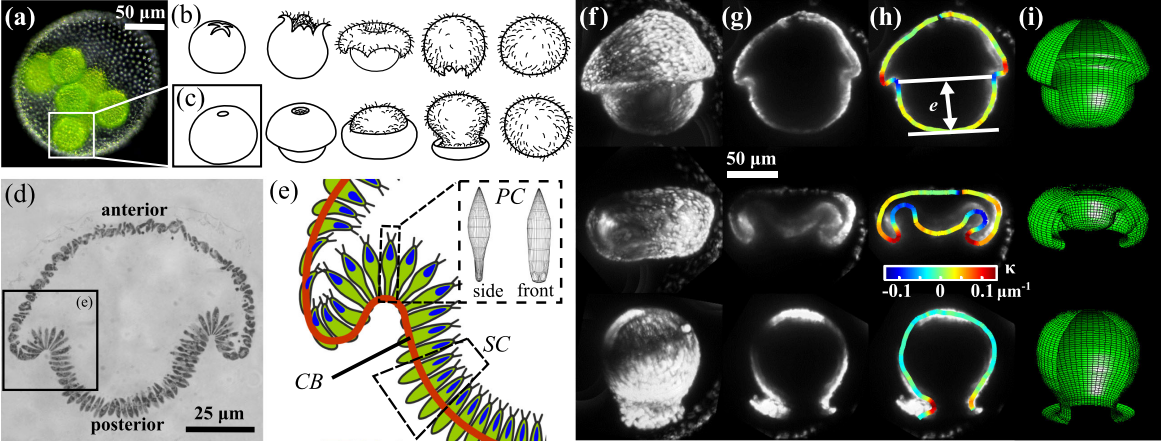
Phys. Rev. Lett. 114, 178101 – Published 27 April 2015. [[File:CC-BY icon.svg|50px]] This article contains quotations from this source, which is available under the Creative Commons Attribution 3.0 (CC BY 3.0) license.]]
Habitats
Volvox is a genus of freshwater algae found in ponds and ditches, even in shallow puddles. According to Charles Joseph Chamberlain,
"The most favorable place to look for it is in the deeper ponds, lagoons, and ditches which receive an abundance of rain water. It has been said that where you find *Lemna*, you are likely to find *Volvox*; and it is true that such water is favorable, but the shading is unfavorable. Look where you find *Sphagnum*, *Vaucheria*, *Alisma*, *Equisetum fluviatile*, *Utricularia*, *Typha*, and *Chara*. Dr. Nieuwland reports that *Pandorina*, *Eudorina* and *Gonium* are commonly found as constituents of the green scum on wallows in fields where pigs are kept. The flagellate, *Euglena*, is often associated with these forms."
Taxonomy
Volvox is divided into four sections, which differ from each other by the morphology of their somatic cells, asexual spheroids and zygotes:
- Volvox sect. Volvox — Cells have coarse cytoplasmic connections between each other and are therefore stellate in polar view. The gonidia are relatively small, less than 15 μm in diameter, and are differentiated late in the development of the colony. Zygotes have spiny walls.
- Volvox sect. Besseyosphaera — Cells have no cytoplasmic connections between each other and are circular in polar view. Asexual spheroids have more than 20 gonidia. Zygotes lack spiny walls.
- Volvox sect. Merrillosphaera (synonyms: sect. Campbellosphaera, sect. Copelandosphaera) — Cells have delicate cytoplasmic connections (or no connections) between each other, and are circular in polar view. Asexual spheroids have less than 20 gonidia. Zygotes lack spiny walls.
- Volvox sect. Janetosphaera — Cells have delicate cytoplasmic connections between each other, and are circular in polar view. They lack distinct gelatinous sheaths surrounding individual cells, instead having a colonial matrix where individual sheaths are fused together. Gelatinous strands also radiate from the center to the inner surface of the colonial matrix.
In practice gelatinous sheaths and delicate cytoplasmic connections are difficult to observe, and are only reliably visible after staining with a dye such as methylene blue.
Species
Volvox contains the following species, according to AlgaeBase.
Volvox sect. Besseyosphaera
- Volvox gigas
- Volvox powersii
Volvox sect. Janetosphaera
- Volvox aureus
- Volvox pocockiae
Volvox sect. Merrillosphaera
- Volvox africanus
- Volvox carteri
- Volvox dissipatrix
- Volvox obversus
- Volvox ovalis
- Volvox reticuliferus
- Volvox spermatosphaera
- Volvox tertius
- Volvox zeikusiiClosely related to V. dissipatrix.
Volvox sect. Volvox
- Volvox amboensis
- Volvox biwakoensis
- Volvox barberi
- Volvox capensis
- Volvox ferrisii
- Volvox globator
- Volvox kirkiorum
- Volvox longispiniferus
- Volvox merrillii
- Volvox perglobator
- Volvox prolificus
- Volvox rousseletii Unplaced to section
- Volvox fertilis
Although the genus Volvox is easy to identify, species-level identification of Volvox can be difficult. Species are morphologically distinguished based on a variety of characters including zygote morphology, developmental characteristics, and sexual characteristics (e.g. dioicy or monoicy).
Evolution
Volvox is polyphyletic. The section containing the type species, Volvox sect. Volvox, is sister to the rest of the family. Other members of Volvox are dispersed within three clades, all nested within Eudorina.
Ancestors of Volvox transitioned from single cells that initially resembled Chlamydomonas to form multicellular colonies at least , during the Triassic period. Genera intermediate in morphology, such as Gonium, contain 16 Chlamydomonas-like cells and are thought to represent intermediate stages in evolution. An estimate using DNA sequences from about 45 different species of volvocine green algae, including Volvox, suggests that the transition from single cells to undifferentiated multicellular colonies took about 35 million years.
References
Notes
References
- "''Volvox'' Linnaeus, 1758".
- University of Arizona. (February 22, 2009). "Single-celled algae took the leap to multicellularity 200 million years ago".
- Herron, Matthew D.. (2016). "Origins of multicellular complexity: ''Volvox'' and the volvocine algae". Molecular Ecology.
- van Leeuwenhoek, Antonie. (1700). "Part of a Letter from Mr Antony van Leeuwenhoek, concerning the Worms in Sheeps Livers, Gnats, and Animalcula in the Excrements of Frogs". [[Philosophical Transactions of the Royal Society]].
- link. (2016-06-03.)
- Baker, H. (1753). ''Employment for the microscope''. R. Dodsley: London, pl. XII, f. 27, [https://www.biodiversitylibrary.org/bibliography/45920].
- Linnaeus, C. (1758). ''[[Systema naturae]] per regna tria naturae, secundum classes, ordines, genera, species, cum characteribus, differentiis, synonymis, locis''. Tomus I. Editio decima, reformata. Editio decima revisa. Vol. 1 pp. [i-iv], [1]-823. Holmiae [Stockholm]: impensis direct. Laurentii Salvii.
- (2004). "Volvox". Current Biology.
- link. (2016-06-03.)
- Spencer, M.A., Irvine, L.M. & Jarvis, C.E. (2009). Typification of Linnaean names relevant to algal nomenclature. ''Taxon'' 58: 237-260, [http://images.algaebase.org/algaebase/pdf/5964B937079ef2A1D4lrS280C31A/45005.pdf] {{Webarchive. link. (2016-05-08.)
- (1944). "A Comparative Study of the Species of ''Volvox''". Transactions of the American Microscopical Society.
- (2010). "Evolution of developmental programs in ''Volvox'' (Chlorophyta)". Journal of Phycology.
- (2015). "Delineating a New Heterothallic Species of Volvox (Volvocaceae, Chlorophyceae) Using New Strains of "Volvox africanus"". PLOS ONE.
- Hallmann, A.. (2003). "Extracellular matrix and sex-inducing pheromone in ''Volvox''".
- (2014). "Freshwater Algae of North America: Ecology and Classification". Elsevier Inc..
- (1968). "The protoplasmic connection in ''Volvox''". [[Journal of Eukaryotic Microbiology]].
- Kirk, David L.. (1998). "''Volvox'': A Search for the Molecular and Genetic Origins of Multicellularity and Cellular Differentiation". [[Cambridge University Press]].
- Hallmann, Armin. (2003). "International Review of Cytology Volume 227".
- Powers, J. H.. (1908). "Further studies in ''Volvox'', with descriptions of three new species". [[Transactions of the American Microscopical Society]].
- (1986). "Heat shock elicits production of sexual inducer in Volvox". Science.
- (2003). "Sex as a response to oxidative stress: the effect of antioxidants on sexual induction in a facultatively sexual lineage". Proc. Biol. Sci..
- (2004). "Sex as a response to oxidative stress: a twofold increase in cellular reactive oxygen species activates sex genes". Proc. Biol. Sci..
- (1998). "The sex-inducing pheromone and wounding trigger the same set of genes in the multicellular green alga Volvox". Plant Cell.
- (Nov 2016). "Alternative evolution of a spheroidal colony in volvocine algae: developmentalanalysis of embryogenesis in Astrephomene (Volvocales, Chlorophyta)". BMC Evol. Biol..
- Chamberlain, Charles Joseph. (2007). "Methods in Plant Histology". Read Books.
- (1916). "On the life-history of a soil amoeba". University of California Publications in Zoology.
- (2019). "Morphology, reproduction and taxonomy of ''Volvox dissipatrix'' (Chlorophyceae) from Thailand, with a description of ''Volvox zeikusii'' sp. nov.". Phycologia.
- (2024). "Two species of the green algae ''Volvox'' sect. ''Volvox'' from the Japanese ancient lake, Lake Biwa". PLOS ONE.
- (2020). "A new preferentially outcrossing monoicous species of ''Volvox'' sect. ''Volvox'' (Chlorophyta) from Thailand". PLOS ONE.
- (1934). "On some freshwater algae from Egypt". Revue algologique.
- (2024-04-10). "Fossil-calibrated molecular clock data enable reconstruction of steps leading to differentiated multicellularity and anisogamy in the Volvocine algae". BMC Biology.
- (2009). "Triassic origin and early radiation of multicellular volvocine algae". Proceedings of the National Academy of Sciences, USA.
This article was imported from Wikipedia and is available under the Creative Commons Attribution-ShareAlike 4.0 License. Content has been adapted to SurfDoc format. Original contributors can be found on the article history page.
Ask Mako anything about Volvox — get instant answers, deeper analysis, and related topics.
Research with MakoFree with your Surf account
Create a free account to save articles, ask Mako questions, and organize your research.
Sign up freeThis content may have been generated or modified by AI. CloudSurf Software LLC is not responsible for the accuracy, completeness, or reliability of AI-generated content. Always verify important information from primary sources.
Report