From Surf Wiki (app.surf) — the open knowledge base
Volkswagen Polo
Model series by Volkswagen

Model series by Volkswagen
| Field | Value |
|---|---|
| name | Volkswagen Polo |
| image | VW Polo beats (VI) – f 03032019.jpg |
| alt | Front-three-quarter view of a small front-engined five-door car with a two-box body style fitted with door mirrors, alloy wheels, flush headlamps, and fog lamps. |
| manufacturer | Volkswagen |
| production | 1975–present |
| class | Supermini/subcompact car (B) |
| layout | Front-engine, front-wheel-drive |
The Volkswagen Polo is a supermini car (B-segment) produced by the German car manufacturer Volkswagen since 1975. It is sold in Europe and other markets worldwide in hatchback, saloon, and estate variants throughout its production run. As of 2018, six separate generations of the Polo had been produced, usually identified by a "Series" or "Mark" number.{{cite web | access-date = 16 October 2008 | archive-url = https://web.archive.org/web/20070608171124/http://media.vw.com/article_display.cfm?article_id=9381 | archive-date = 8 June 2007
Some generations were facelifted midway through production, with the updated versions known unofficially by an addition of the letter F to the mark number, e.g., Mk2F. Some members of the automotive press and some enthusiasts consider the facelifts to be separate models, so have used the unofficial designations Polo Mk1 to Mk7 for previous generations.{{cite web |access-date = 16 October 2008 |archive-url = https://web.archive.org/web/20081220223654/http://www.vwpoloshow.co.uk/historyframes2.htm |archive-date = 20 December 2008 |url-status = dead
Volkswagen vehicles built on different platforms have carried the Polo nameplate. For example, the Volkswagen Polo Playa hatchback sold in Southern Africa in the late 1990s was a rebadged SEAT Ibiza, which has a different body shell from the Polo Mk3 sold in Europe at the same time. Starting in 1982, Volkswagen sold the Polo in Japan initially through an agreement with Japanese dealership Yanase that specializes in European and North American vehicles. Of all Volkswagens imported into Japan, only the Polo (until 2017) and the Golf (until 1997), complied with Japanese government dimension regulations until the introduction of the VW Up! in 2012.
Body styles
The first Polos were hatchbacks, with the saloon being marketed as the Volkswagen Derby.
With the release of the Polo Mk2, the saloon was renamed the Volkswagen Polo Classic' and the "conventional"-styled hatchback (with a sloping tailgate) was renamed as a coupé, the Volkswagen Polo Coupé. Unusually, the third (and new) body that was actually marketed as the Volkswagen Polo Hatchback was closer in concept to a small estate, albeit with exactly the same wheelbase and floor pan as the coupé instead of the (longer) saloon. This latter version, also known as the squareback (in the original German brochures, "steilheck", literally "steep tail"), amongst other nicknames, was the most popular in virtually every country where the Polo was sold. Despite the differences in silhouette and target market segment, all body types were two- or three-door only.
From the Polo Mk3 onwards, the range was more straightforwardly conventional, including unambiguous "saloon", "hatchback", and "estate" models, with only the hatchback offering both five-door and slightly shorter three-door models (both still with quite vertical tailgates, the coupé variation having been retired), the others being four or five-door only and increasing in length from hatch to saloon to estate.
Summary
- Three-door hatchback (Mk1 to Mk5) – the Mk2 and Mk2F were available in two separate three-door hatchback styles, one of which was badged as a coupé.
- Two-door saloon (Mk1, Mk1F, Mk2, Mk2F)
- Four-door saloon (Mk3, Mk3F, Mk4, Mk4F, Mk5, Mk6)
- Five-door hatchback (Mk3, Mk3F, Mk4, Mk4F, Mk5, Mk6)
- Five-door estate (Mk3, Mk3F)
- Five-door crossover SUV-style (two-wheel drive) hatchback (Mk4, Mk4F, Mk5)
Mechanical layout
The Polo is a compact car, with a traditional transversely mounted engine and front-wheel drive. Mk1 Polos only came with four-cylinder petrol engines, but for the Mk2, a diesel engine was offered for the first time, although only in certain markets, others having to wait until the launch of the Mk3. The current range includes a variety of three- and four-cylinder petrol and diesel engines.
Early versions used a four-speed manual transmission, whilst the current car is available with either six-speed manual or seven-speed automatic transmission. The suspension system on all models uses a fully independent MacPherson strut front suspension, and a twist-beam rear suspension. Most models use disc brakes at the front and rear drum brakes, although some recent models have all-round disc brakes.
First generation (86; 1975) {{Anchor|86}}
Main article: Volkswagen Polo Mk1

The first-generation Polo, a rebadged version of the Audi 50, was introduced in 1975 and was produced until October 1981.{{cite web |access-date = 16 October 2008 |url-status = dead |archive-url = https://web.archive.org/web/20081227083850/http://www.vwpoloshow.co.uk/history/mk1.htm |archive-date = 27 December 2008
The differences between the Audi and Volkswagen models were minor, with the Polo being cheaper and much more basic. The two cars were initially sold alongside each other, but the Audi 50 never sold as well, and was withdrawn in 1978. The Polo was manufactured at the Volkswagen plant in Wolfsburg.
The manufacturer let it be known that Bertone had been involved in the styling of the Polo and its Audi sibling, although the car was essentially an in-house Audi design, with the Italian design studio's contribution restricted to the circular extractor vent cover at the base of the C pillar, and the small "flick-up" at the rear end of the waistline.
In 1977, the Derby saloon was released, which was simply a Polo, identical to the hatchback from the C-pillar forward, with a large boot attached.
The Mark 1 Polo and Derby were facelifted in 1979 (unofficially referred to as the Mark 1F) with plastic bumpers, a different front grille, and a revised dashboard. The round headlights of the Derby were replaced with square ones, bringing it in line with the similar Golf-based Jetta saloon.
Second generation (86C; 1981) {{Anchor|86C}}
Main article: Volkswagen Polo Mk2
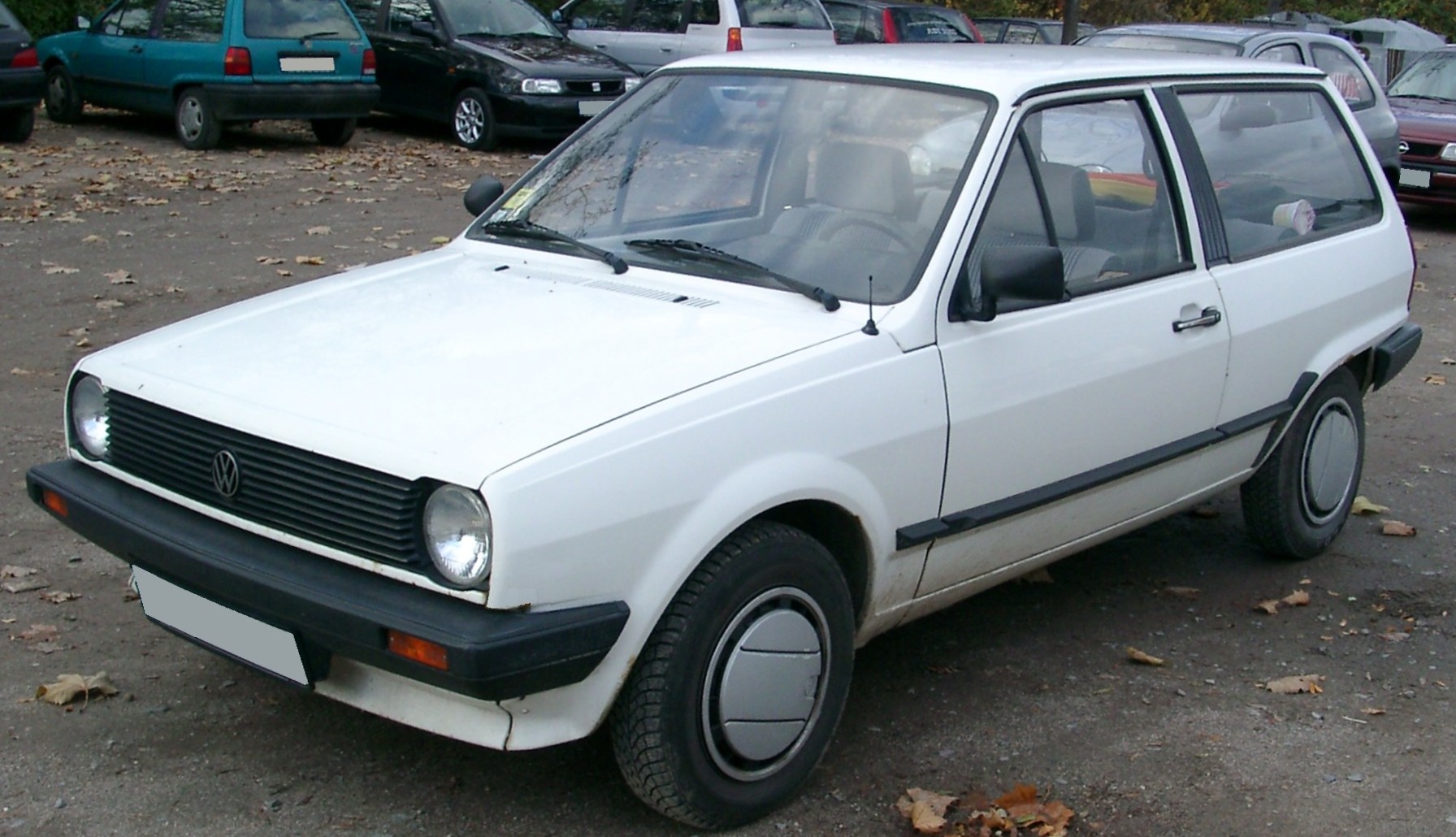
The Polo Mk2 (or Typ 86C) was introduced in October 1981,{{cite web |access-date = 16 October 2008 |archive-url = https://web.archive.org/web/20081227094124/http://www.vwpoloshow.co.uk/history/mk2.htm |archive-date = 27 December 2008 |url-status = dead
The Polo competed in the supermini sector with its new rivals such as the Austin Metro and Ford Fiesta, and it was one of the largest superminis in production at this time, meaning that it was close to larger cars, including the Ford Escort in terms of size, space, and price. Within two years of its launch, however, it was faced with competition from a wave of new rivals, particularly the Fiat Uno and Peugeot 205.

The Polo Mk2 was used extensively by Volkswagen to develop future innovations, for example supercharging with a 40-mm G-Lader supercharger in the GT G40 version. A 60-mm G-Lader would later be used on the larger and more technically challenging G60 engine used in the Golf and Corrado.
A fuel-efficient two-cylinder diesel was prototyped in the mid-1980s with a G40 supercharger to overcome its small capacity, although this did not enter production. A high fuel-efficiency model that did make production was the petrol-engined Formel E (E for economy), introduced at the launch in 1981 with a 1.1-litre engine and from 1983 with a 1.3-litre engine, overdrive top-gear ratio and an early stop-start ignition system (called "SSA"), which would cut the engine when idle for more than two seconds to save fuel whilst temporarily stopped in traffic, and restart the engine on moving the gear lever to the left in neutral.
Similar systems were later used on the Volkswagen Golf Mk3 and various systems from other car manufacturers.
It was a popular import in the UK, competing with the likes of the Peugeot 205, Fiat Uno, and Nissan Micra. While of an outdated design, its reliability and build quality were among the best to be found on a small car of this era. In the years since then, it went on to achieve a higher survival rate than many of its competitors.
However, some engines were only available on certain markets. For example, the British market never received any diesel-engined versions of the Polo, though the diesel engine was already available on many similar cars by the end of the 1980s, namely the Ford Fiesta, Vauxhall Nova, and Peugeot 205.
Facelift (1990–1994)


The Mark II Facelift (referred to as the Mark IIF, also erroneously known as the "Mark 3") was a far-reaching facelift of the MkII, including a reskin of the bodywork, launched in the autumn of 1990. The new look had square headlights, enlarged and reshaped taillights, bigger bumpers, and a new interior (dashboard and door trim). The three different body styles were maintained. Under the skin, the car received modifications to the chassis, suspension, and brakes, as well as the cosmetic differences. The new Polo retained the previous four-cylinder engines, but now as well as the carburetted 1.0-litre, a fuel-injected model was available with single-point injection, and all engines came with a catalytic converter as standard to combat tightening European emissions regulations. The saloon was only produced in Spain, and production ceased in 1992 due to disappointing sales.
At the time of launch of the Mark IIF Polo, the highest-performance model was the Polo GT. This featured a multipoint fuel-injected version of the 1272-cc engine, and a top speed more than 100 mph. This produced 75 PS and had a quoted top speed of 107 mi/h. Times for 0–60 stood at 11.1 seconds. The defining features of the GT include red piping in the bumpers, black overhead cloth, a tachometer, and a red "GT" badge in the grille. This was succeeded by the launch of the G40 in May 1991, displacing the GT as the most powerful Polo at the time, with a top speed around 120 mph – rivalling the likes of the Ford Fiesta XR2i, Peugeot 205 GTI, and Renault Clio 16v.
Soon after the launch of the Mark IIF, another sporting model was added to the range — a new version of the supercharged G40, now as a full production model in all markets rather than the limited batch of Mark II G40s. As with the previous model, Volkswagen Motorsport modified G40 Cup cars were sold for racing in a one-make series, the Volkswagen Polo G40 Cup. Features that define the G40 from other Polo models at the time (on top of the GT) include a bee-sting aerial, BBS cross-spoke alloy wheels, Le Mans interior trim, and front and rear red "G40" badges.
Third generation (6N/6KV; 1994){{anchor|6N/6KV}}
Main article: Volkswagen Polo Mk3
_5-door_hatchback_(2009-01-07)_01.jpg)
The Mark III Polo or Typ 6N, (sometimes referred to as the "Mark 4" by enthusiasts as it is the Polo's fourth guise) appeared in 1994, and was a completely new model (on a new chassis), available as three- and five-door hatchback versions, the latter making VW the last major European manufacturer to finally offer rear side doors in this class. It shared its platform with the SEAT Ibiza Mark 2. This platform actually used the floorpan of the Volkswagen Golf Mk3 (a multitude of mechanical parts and all of the suspension components were interchangeable among the three models). Although the dashboard and a number of mechanical components, including engines, were shared with the Ibiza, outwardly the two cars were different, with no shared body panels.
_5-door_hatchback_(2015-07-10)_02.jpg)
An all-new 1.0-litre petrol engine was added to the range from launch, while the 1.3-litre petrol engine from the MK2 was briefly carried over. Also new to the range were 1.4- (8-valve or 16-valve) and 1.6-litre petrol engines, as well as a 1.9-litre diesel (with or without a turbocharger).
The saloon and estate versions of the Mark III, which debuted in 1995, were essentially rebadged version of the SEAT Córdoba, which were launched early in 1994. They were referred to internally by Volkswagen as the Typ 6KV, and shared body panels with the SEAT model rather than the Polo hatchback models, with some cosmetic alterations such as new rear and front bumpers and headlights. The Volkswagen Caddy 9K van also shares the same platform and front-end styling as the 6KV models.
The later Volkswagen Lupo and SEAT Arosa city cars were based on a shortened version of the Typ 6N platform and shared many components.
Polo Playa (1996–2003)

Main article: Volkswagen Polo Playa
The Volkswagen Polo Playa was a model for the South African market, where the SEAT brand was not available. It was sold instead of the European Polo Mark III from 1996 until 2002 and was effectively a rebadged SEAT Ibiza Mark II. In 2002, the Mark IV Polo was adopted in South Africa, and the separate Polo Playa model was dropped.
Fourth generation (6Q/9N/9N3; 2001) {{Anchor|6Q/9N/9N3}}
Main article: Volkswagen Polo Mk4

_SE_5-door_hatchback_01.jpg)
Unveiled in September 2001, the all-new Mark IV (or Typ 9N, sometimes erroneously referred to as the "Mark 4") model was put on sale in early 2002. It shares its platform with the SEAT Ibiza Mk3, Škoda Fabia Mk1, and Škoda Fabia Mk2. The car is all new compared to the Mark III/F and bears structural resemblance to Golf MK4 (1J). The rear taillights resemble those of the B5.5 Passat. Outwardly, the most recognisable change is the use of quadruple round headlights similar to the Lupo's.
Volkswagen Racing rallied a Polo S1600 in the 2003 Junior World Rally Championships, winning the Turkish round. The Super 1600 developed 165 kW/215 to its front wheels. This version of the Polo was a mixed success in the United Kingdom. It sold reasonably well (though not as well as some earlier Polos), but several customer-satisfaction surveys by high-profile motoring magazines such as Top Gear gave the Polo a very low rating.
A saloon version of the Mk4 Polo was produced for markets outside Europe, including most Latin American countries, South Africa and China.
Fifth generation (6R/6C/61; 2009) {{Anchor|6R/6C/61}}
Main article: Volkswagen Polo Mk5
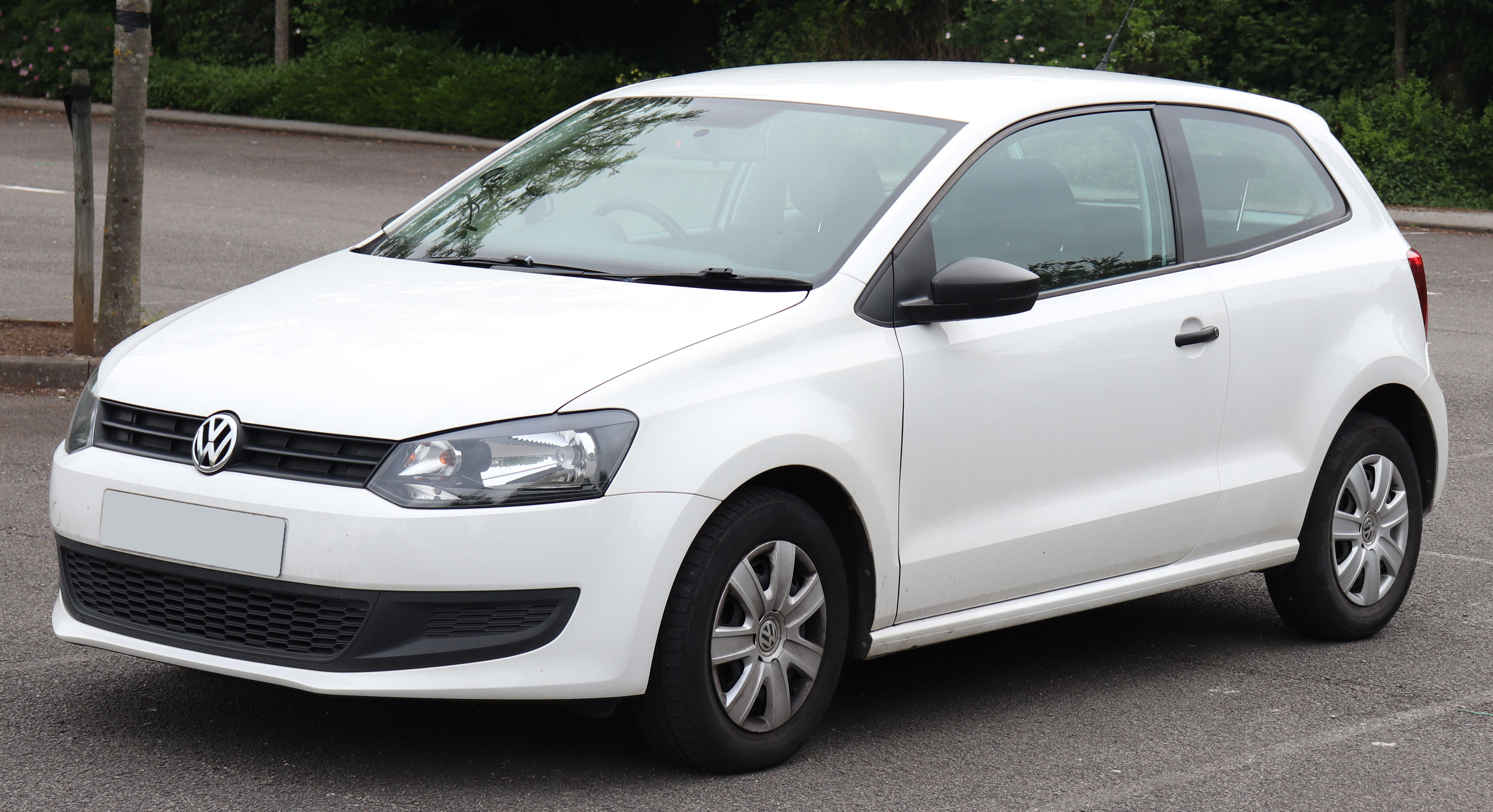
Volkswagen launched the fifth generation Polo (internal designation Typ 6R) at the Geneva Motor Show in March 2009. For the first time in Polo's history, the car was declared European Car of the Year, for 2010. The Polo was also declared 2010 World Car of the Year at the New York International Auto Show in April 2010. It also won What Car? Supermini of the Year 2010, as well as being awarded Japan Import Car of the Year for 2010–2011.
It shares its platform with the SEAT Ibiza Mk4 and the Audi A1. Production for the UK market started in August 2009, with first deliveries beginning in October 2009. The Polo Mark V is 44 mm longer, 32 mm wider, and sits 13 mm lower to the road than the previous generation Polo. Boot capacity is increased by 10 L to 280 L of storage space with 952 L with the seats folded down. The car is 7.5% lighter than its predecessor. The Polo has thoracic airbags and has been awarded a five-star Euro NCAP crash impact rating.
Saloon versions
Volkswagen Vento/Polo Sedan

In 2010, a saloon based on the Polo Mk5 platform was developed for launch in India and Russia. This saloon is known as the Vento or Polo Sedan, depending on the country. It has a length of 4,384 mm, increased wheelbase (2,552 mm) and ground clearance (168–170 mm), and had one petrol engine (1.6-litre, four-cylinder, 105 PS; coupled with either five-speed manual or six-speed automatic gearbox) and one diesel engine (1.6-litre, turbocharged four-cylinder common-rail, 105 PS; only five-speed manual gearbox) options available.
In several markets, it is succeeded by the Virtus, while some markets such as Mexico offered the Virtus alongside the Vento for the purpose of keeping a budget-friendly option. In Russia, the Polo Mk5-based Polo Saloon is succeeded by the Škoda Rapid-based Polo liftback.
Volkswagen Ameo
Main article: Volkswagen Ameo
The Ameo is another saloon based on the Polo Mk5 which was released in June 2016. It was specifically developed for the Indian market which offers lower excise tax for vehicles shorter than 4 meter in length. The Ameo is more heavily derived from the hatchback body of the Polo, retaining its shorter wheelbase and the rear doors, unlike the larger Vento/Polo Saloon. It was discontinued in 2020 due to low demand.
File:2016-2020 Volkswagen Ameo front.jpg|alt=|Volkswagen Ameo File:2016-2020 Volkswagen Ameo rear.jpg|alt=|Rear view
{{Anchor|Mk6|AW|Sixth|VI}}Sixth generation (AW/BZ; 2017)
Main article: Volkswagen Polo Mk6
_IMG_5732.jpg)
The sixth generation Polo was unveiled on 16 June 2017, with production starting at the Pamplona plant on 17 July 2017. Built on the Volkswagen Group's MQB A0 platform, it is the first generation Polo not to be available as a 3-door model.
The boot space has increased by around 25% from 280 to 351 litres. As an option, this generation introduces the fully digital instrument cluster called "Active Info Digital Display Cockpit", the first car in the small car segment to do so. In addition, the Polo VI introduces a series of driver assistance systems such as traffic sign recognition, blind spot assistant and automatic emergency braking. On 21 April 2021, it received a mid-cycle facelift.
{{Anchor|Polo Track}} Polo Track
Announced in November 2022 as a replacement for the Gol, the Polo Track was released in February 2023 as a low-cost version of the Mk6 Polo. Aimed at fleet buyers, the Track version has a shorter list of features and a simpler exterior appearance. It is powered by a 1.0-litre MPI (1.6-litre 16V MSI 105 hp for Colombia and other countries) petrol flex engine producing 85 PS. File:2023 Volkswagen Polo Track (Colombia) front view.png|Polo Track File:2023 Volkswagen Polo Track (Colombia) rear view 01.png|Rear view
{{anchor|Mk7|Seventh|VII}}Seventh generation (2026)
Main article: Volkswagen ID. Polo

The ID. Polo is a battery electric car using the Polo nameplate to be sold in 2026.
{{Anchor|GTI}}GTI
The Volkswagen Polo GTI is a hot hatch version of the Polo.
Mk2 Polo GT G40 and Mk2F Polo G40
The Volkswagen Polo GTI can trace its roots back to the original hot Polo, the supercharged 1.3-litre 115 PS G40. It was sold in the United Kingdom between 1990 and 1994 in the form of the Mk2F Polo but was available during the late 1980s in limited numbers in Europe in the form of the Mk2 Polo GT G40. The car was expensive compared to its rivals of the time, so did not sell in vast numbers. This makes it highly collectible today, and according to Top Gear, "a potential future classic."
Mk3 Polo GTI
After production of the G40 ended in 1994, Volkswagen decided to release the first GTI-branded Polo in a limited batch of just 3000. It was released in 1995 and available only in left-hand drive. It featured a 1.6-litre, 16-valve 120 PS engine. The GTI was not available in the UK at any stage during its limited production, so as of 1994, the UK only had the 100 bhp 1.4-litre, 16-valve as a model with any sporting intent.
Facelift (6N2)
Between 1999 and 2002, Volkswagen offered two sporting models — the 16V and GTI. The 16V came with the 1.4-litre, 16-valve (V), 100 PS engine, and had options such as 15-in Spa alloys and air conditioning. However, the GTI – available only in three- or five-door hatchback body styles in three colours being red, silver, and black, used a 1.6-litre 16-V 125 PS engine with variable valve timing. External changes included a deeper front splitter with honeycomb mesh grilles, lowered sports suspension (by 10 mm), a subtle rear spoiler, deeper side skirts, fog lights, and 15" BBS RXII split rims for the wheels, bearing 195/45/15 tyres. There were also standard extras such as Climatronic fully automatic air conditioning, xenon headlights with a headlight washer system, a six-disc CD autochanger with a GAMMA head unit, exclusive sports interior with leather steering wheel, handbrake and gearstick, chrome inserts, and driver aids such as ABS with EBD and an EDL (a system to aid traction). Leather and satellite navigation were also optional extras. The Polo GTI Mk3F, however, never got the new six-speed gearbox that was introduced in the smaller Volkswagen Lupo GTI, which shared the same engine.
File:1999-2001 Volkswagen Polo GTI.jpg|alt=Front-three-quarter view of a five-door car with fog lamps and alloy wheels.|Front view File:1999-2001 Volkswagen Polo GTI rear.jpg|alt=Rear-three-quarter view of a two-box car with door mirrors and a small aerodynamic spoiler atop the rear hatch|Rear view File:Cockpit Polo III GTI RHD.jpg|alt=Dashboard of a car with a manual gearbox, digital and analogue gauges, front airbags, and some sort of head unit.|Interior
Mk4 Polo GT
With the introduction of the 2002 Polo, the GTI model was discontinued and was given no direct replacement. A GT model, though, was produced, featuring the same 1.9-litre TDI, 130 PS engine found in the popular Škoda Fabia vRS and SEAT Ibiza FR TDI, as well as a six-speed gearbox. Although this model had a relatively slow 0–100 km/h (62 mph) time over 9 seconds, it did have impressive midrange clout with torque figures of 310 Nm (228 lb-ft).
Mk4 Polo GTI
The GTI was not released until late 2005, after yet another Polo revamp was reintroduced. This time it boasted a 1.8-litre, 150 PS engine, which had been used in models from the Mk4 Volkswagen Golf GTI to the Audi A6. Despite the impressive figures, this new model lacked the standard features of the Polo GTI Mk3, with xenon headlights not even on the options list, and fully digital climate control only being an expensive option. Although faster than the 2000–2002 Polo GTI, the newer model was also seen as being off the pace when compared to its rivals, most of which are now nudging 200 PS. In Europe, this led to VW quickly beefing up the Polo further to create the Polo GTI Cup Edition, which was tuned to around 180 PS and featured more aggressive styling, 17" wheels and larger diameter 312mm front disc brakes. The Polo GTI Cup Edition has 177 bhp, 29 bhp more than the standard Polo GTI. The standard Polo GTI model completes 0–100 km/h in 8.2 seconds, but in the Cup, it completes 0–100 km/h in 7.5 seconds.
File:2005-2010 Volkswagen Polo (9N3) GTI 3-door hatchback (2011-10-25).jpg|alt= Front-three-quarter view of a three-door car with a two-box body style fitted with alloy wheels, a sunroof, and fog lamps.|Front view File:2005-2010 Volkswagen Polo (9N3) GTI 3-door hatchback 02.jpg|alt= Rear-three-quarter view of a car fitted with a roof rack|Rear view File:Polopics1.jpg|alt= Dashboard of a car with a manual gearbox, compact disc player, front airbags, electric windows, rotary stereo and heater controls, and analogue and digital gauges|Interior
Mk5 Polo GTI
The Mk5 Polo GTI was launched at the 2010 Geneva Motor Show. The new GTI is powered by VW's award-winning 180 PS 1.4-litre TSI engine (adapted from that used in the current Scirocco), which uses both a supercharger and turbocharger to provide torque throughout the revolution range. The Mk5 Polo is also 7.5% lighter than its predecessor and with a 30 PS increase in power over the previous generation Polo GTI it accelerates from 0 to 100 km/h (62 mph) in 6.9 seconds. The Mk5 Polo also includes features not found on previous generation Polos, such as touch-screen satellite navigation and a seven-speed version of VW's DSG gearbox as standard.
File:VW Polo GTI (V) – Frontansicht, 7. März 2011, Mettmann.jpg|alt= Front-three-quarter view of a five-door car with fog lamps and alloy wheels|Front view (5-door) File:VW Polo GTI (V) – Heckansicht, 7. März 2011, Mettmann.jpg|alt= Rear-three-quarter view of a car with twin exhausts|Rear view (5-door)
Facelift
The Mk5 Polo GTI facelift was launched in 2015. It featured a new 1.8-litre turbocharged engine, which had been developed by Audi. It produced 189 bhp and was capable of sprinting from 0-60 mph in 6.4 seconds (real world test). It was now also available with a manual transmission.
File:2015 Volkswagen Polo GTi S-A 1.8 Front.jpg|alt= Front-three-quarter view of a three-door car with fog lamps and alloy wheels|Front view (3-door) File:2015 Volkswagen Polo GTi S-A 1.8 Rear.jpg|alt= Rear-three quarter view of a three-door car with twin exhaust pipes|Rear view (3-door)
Mk6 Polo GTI
The Mk6 Polo GTI was launched in 2017. It features a slightly detuned version of the 2.0-litre TSI petrol engine from the Mk7 Golf GTI. It produced 200 PS, an 8 PS increase over the previous 1.8-litre engine, and was capable of getting to 100 km/h in under 6.7 seconds. Available transmissions are a 6-speed manual or a 6-speed dq250 DSG. Along with the engine, the GTI version came standard with lowered suspension, GTI badges, GTI bumpers, 17-in wheels, sill extensions, bigger brakes, red brake calipers, twin exhausts, tartan seats, sport steering, red stitching, and a roof spoiler. It is equipped with a standard ‘sport’ chassis and optional ‘Sport Select’ chassis.
File:2019 Volkswagen Polo GTi Plus TSi S-A 2.0.jpg|alt=Front-three-quarter view of a five-door car with fog lamps and oversized alloy wheels|Front view File:2019 Volkswagen Polo GTi Plus TSi S-A 2.0 Rear.jpg|alt= Car with twin exhaust pipes|Rear view File:KristofferssonRallySweden2020(1).jpg|alt= Five-door two-box car in a racing livery fitted with a rear aerofoil and a roof-mounted air scoop for ventilation travelling at speed on a gravel course|Mk6 Polo GTi R5 rally car
Facelift
File:Volkswagen Polo VI GTI (2021) 1X7A0344.jpg|Front view File:Volkswagen Polo VI GTI (2021) 1X7A0343.jpg|Rear view
Performance versions and motorsport
Volkswagen helped consolidate the pre-eminence of the so-called hot hatch genre of high-performance hatchbacks with their Golf GTI in 1975 and has produced a number of performance versions of the Polo. The first of these was the Polo GT version of the Polo Mk1F.
The Polo Mk2 and Mk2F were available as supercharged G40 models. The GT G40 with its 1.3-litre 85 kW engine could reach 100 km/h in 8.1 seconds from standstill and had a maximum speed of 196 km/h. It was used by Volkswagen to set a number of world endurance speed records, such as the 1.3-litre class records for speed over 24 hours and speed over a distance of 5000 km.
The fastest version of the Polo Mk3 on the United Kingdom market was the 1.6-litre, 16-V, 92 kW model. A 88 kW Polo GTI model was also produced, but only in a limited edition in Germany, and this was the first time the GTI label had been used for a Polo. A GTI version of the Polo Mk3F, with a 92 kW 1.6-litre petrol engine was also produced.
In 2004, Volkswagen Individual, a specialist division of Volkswagen, produced a limited number of (Polo Mk4) Club Sports with a 1.8-litre, turbocharged engine producing 132 kW. Available only in Germany, this was based on the one-make racing series Polo Cup Racer hatchback. The Club Sport came with a roll cage inside the vehicle and Recaro racing seats as standard.
A GTI version of the Polo Mk4F was launched in 2006. These feature styling similar to that of the contemporary Golf GTI and a turbocharged 20-V, 110 kW, 1.8-litre petrol engine. It has a 0–100 km/h time of 8.2 seconds and a top speed of 134 mi/h.
Volkswagen Individual have also engineered an even faster Polo called the Polo GTI Cup Edition. Available with the same 1.8-litre, turbocharged engine, albeit with 180 hp, its claimed 0–100 km/h is 7.5 seconds, and it has a claimed top speed of 225 km/h.
Volkswagen Racing in South Africa rallied a four-wheel drive Polo Mk4F that shared some components with its sister World Rally Championship Škoda Fabia; the S2000 has a 2.0-litre, 191 kW engine. Mk4 Polos have been entered into the Junior World Rally Championship. The Polo also competed in the Russian Touring Car Championship.
A number of one-make race series were made of the Polo, starting with the G40 Cup for Polo Mk2 and Mk2F G40 versions. The current Polo Cup championship for 105 hp cars is a support race at rounds of the Deutsche Tourenwagen Masters.
Sébastien Ogier won the FIA World Rally Championship for Drivers in 2013, 2014, 2015 and 2016 driving a Volkswagen Polo R WRC.
Sales
The sales of Volkswagen Polo set a benchmark for Volkswagen, which sold more than 12 million cars globally so far; in February 2010 Volkswagen produced the 11,111,111th Polo worldwide at the celebration event of its first production anniversary in Pune, India. In 2010, its first full year on sale in the United Kingdom, more than 45,000 units were sold. It was the UK's sixth-best selling new car.
11 years later, in 2021, the Polo has maintained consistent sales figures with it being the fifth best-selling car in the UK in 2021 having had 30,634 new registrations throughout the year.
In South Africa, the previous model year's Polo is produced as well, and branded as the Polo Vivo.
Volkswagen Polo remains one of Volkswagen’s key global models with notable developments and sustained demand in several markets in 2024 and early 2025. In 2024, Volkswagen produced approximately 472,000 Polo units globally, indicating a recovery from the pandemic-related downturns of previous years. Over its lifetime, the Polo has sold more than 13 million units worldwide, maintaining steady interest especially in Europe. Volkswagen has emphasized mild-hybrid technology and compliance with stricter emissions regulations to keep Polo competitive and sustainable in key European markets. The discontinuation of higher emission variants like the GTI in some markets is part of this pivot.
| Year | Global (production) | Europe | Brazil | Polo Classic/Saloon | ||||
|---|---|---|---|---|---|---|---|---|
| 1997 | 456,363 | |||||||
| 1998 | 426,341 | |||||||
| 1999 | 351,666 | |||||||
| 2000 | 376,164 | 364,402 | 56,670 | |||||
| 2001 | 328,542 | 335,862 | 32,598 | |||||
| 2002 | 523,512 | 357,146 | 23,038 | 24,702 | ||||
| 2003 | 422,003 | 344,169 | 30,193 | 84,272 | ||||
| 2004 | 334,143 | 306,935 | 24,807 | 100,331 | ||||
| 2005 | 352,120 | 288,274 | 20,828 | 59,623 | ||||
| 2006 | 401,551 | 295,176 | 28,924 | 67,237 | ||||
| 2007 | 449,602 | 289,388 | 50,955 | 86,861 | ||||
| 2008 | 408,679 | 276,098 | 42,626 | 62,167 | ||||
| 2009 | 453,824 | 289,279 | 32,002 | 16,764 | ||||
| 2010 | 635,555 | 360,937 | 29,654 | 16,692 | ||||
| 2011 | 809,549 | 356,355 | 21,394 | 12,850 | ||||
| title=VWAG FY2012 | url=http://www.volkswagenag.com/content/vwcorp/info_center/en/publications/2013/03/Y_2012_e.bin.html/binarystorageitem/file/GB+2012_e.pdf | url-status=dead | archive-url=https://web.archive.org/web/20131002114230/http://www.volkswagenag.com/content/vwcorp/info_center/en/publications/2013/03/Y_2012_e.bin.html/binarystorageitem/file/GB+2012_e.pdf | archive-date=2 October 2013}} | 711,519 | 286,167 | 24,002 | 15,265 |
| 2013 | 725,291 | 264,763 | 12,971 | |||||
| 2014 | 753,754 | 279,463 | 8,862 | |||||
| 2015 | 754,546 | 301,462 | 2,872 | |||||
| 2016 | 794,388 | 307,462 | ||||||
| 2017 | 271,369 | 9,521 | ||||||
| 2018 | 295,403 | 69,584 | ||||||
| 2019 | 257,804 | 72,057 | ||||||
| 2020 | 169,467 | 41,836 | ||||||
| 2021 | 154,066 | 19,196 | ||||||
| 2022 | 113,588 | 8,193 | ||||||
| 2023 | 111,247 | |||||||
| 2024 | 472,000 | 140,154 | ||||||
| 2025 | 122,677 |
References
References
- "Volkswagen UK: Used car locator". Volkswagen.co.uk.
- (22 January 1977). "MotorWeek: News flashes".
- Casucci, P. (March 1979). "Il Salone di Amsterdam: all'insegna del Sol Levante". Editoriale Domus.
- Borglund, Staffan. (1991-05-30). "Stor triumf i lilla klassen". Specialtidningsförlaget AB.
- "Polo Register Volkswagen Polo History 1990 – 94". vwpoloshow.co.uk.
- "Polo Mark III".
- [https://www.telegraph.co.uk/motoring/news/6693570/VW-Polo-is-European-car-of-the-Year.html VW Polo is European Car of the Year 2010], ''The Daily Telegraph'', 30 November 2009
- [http://www.wcoty.com/media/?release=57&year=2010 2010 World Car of the Year], World Car Awards, 1 April 2010
- [http://www.jcoty.org/history/ 2010–2011 Japanese Car of the Year]. This fifth-generation Polo was launched in India in 2010, and is still being continued with minor physical updates and interior updates.{{webarchive. link. (24 April 2012 , Japanese Car Awards)
- (March 2009). "Volkswagen News: Smarter, lighter and even cleaner: fifth generation Polo unveiled". www.volkswagen.co.uk.
- "The new Volkswagen Polo".
- "Volkswagen Polo gets three doors and five stars".
- Krishnan, Srinivas. (13 August 2010). "Volkswagen Vento review – Ventastic!". Business Standard Motoring.
- (3 July 2012). "Polo седан < Модели. < Volkswagen Russia". Volkswagen.ru.
- (9 April 2020). "Volkswagen Ameo and Tiguan discontinued: Reasons and possible replacements".
- (14 November 2022). "New VW Polo Track Replaces The Gol As A Budget-Friendly Hatch For South America".
- "Volkswagen Polo". Auto Express.
- "Volkswagen TSI engine – Technology Supreme". Sgcarmart.com.
- Stevens, Dan. (2 March 2010). "Geneva motor show: VW Polo GTI". [[Autocar (magazine).
- (19 February 2010). "World Premiere I: The New Polo GTI Is Here!". volkswagen-media-services.com.
- (30 March 2023). "丰满熟女BBWBBW_大胆顶级人休艺术A片_午夜免费视频男人的天堂_免费观看视频18禁止免费观看-ҳ".
- (2017-06-19). "New 2018 Volkswagen Polo GTI revealed".
- (4 February 2010). "Volkswagen Group 11,111,111th Polo leaves assembly line at Volkswagen Group India". Volkswagenag.com.
- (7 January 2011). "UK 2010 car sales analysis: winners and losers". Carmagazine.co.uk.
- "SMMT - Car Registrations". smmt.co.uk.
- "Why is the Polo Vivo so popular?". IOL.
- "Polo Vivo or Corolla Cross? SA's 10 best-selling cars of 2023". cars.co.za.
- (2025-07-23). "2025 Volkswagen Polo Trends: Facelift, Edition 50 & Sales".
- "Volkswagen Group publications_overview". Volkswagenag.com.
- "TOTAL DE EMPLACAMENTOS DE VEÍCULOS LEVES NO BRASIL POR MÊS E ANO". autoo.com.br.
- (12 March 2012). "Volkswagen Group Volkswagen Group presents record results for 2011". Volkswagenag.com.
- "VWAG FY2012".
- (2025-03-11). "Annual Report 2024". Volkswagen.
This article was imported from Wikipedia and is available under the Creative Commons Attribution-ShareAlike 4.0 License. Content has been adapted to SurfDoc format. Original contributors can be found on the article history page.
Ask Mako anything about Volkswagen Polo — get instant answers, deeper analysis, and related topics.
Research with MakoFree with your Surf account
Create a free account to save articles, ask Mako questions, and organize your research.
Sign up freeThis content may have been generated or modified by AI. CloudSurf Software LLC is not responsible for the accuracy, completeness, or reliability of AI-generated content. Always verify important information from primary sources.
Report