From Surf Wiki (app.surf) — the open knowledge base
Vis-à-vis (carriage)
Four-wheeled horse-drawn vehicle
.jpg)
Four-wheeled horse-drawn vehicle
Vis-à-vis has two meanings in carriage driving: a general seating arrangement with passengers sitting face-to-face, and a specific narrow carriage for just two passengers.
Carriage seating arrangement

Vis-à-vis is one of the five seating arrangements of carriages. Vis-à-vis is French for "face to face", and these carriages are four-wheeled and hold four passengers. There are two crosswise seats in the body, with two people seated in the rear facing forward, and two seated in the front facing rearward, so that passengers sit face-to-face with each other. Such a seating arrangement is the most common seen in tourist carriages, regardless of actual carriage type, because they carry many passengers in a social setting, with easy entry, a good view, and independent seating for the coachman up front. In the wagonette seating arrangement, passengers also sit face-to-face, but the seating is longitudinal instead of crosswise (passengers travel sideways), and it is not called a vis-à-vis.
Several carriage types have vis-à-vis seating arrangements, such as the Barouche, Karozzin, Landau, and Sociable. All coaches have vis-à-vis seating arrangements; examples include the Berlin and Clarence.
The vis-à-vis carriage
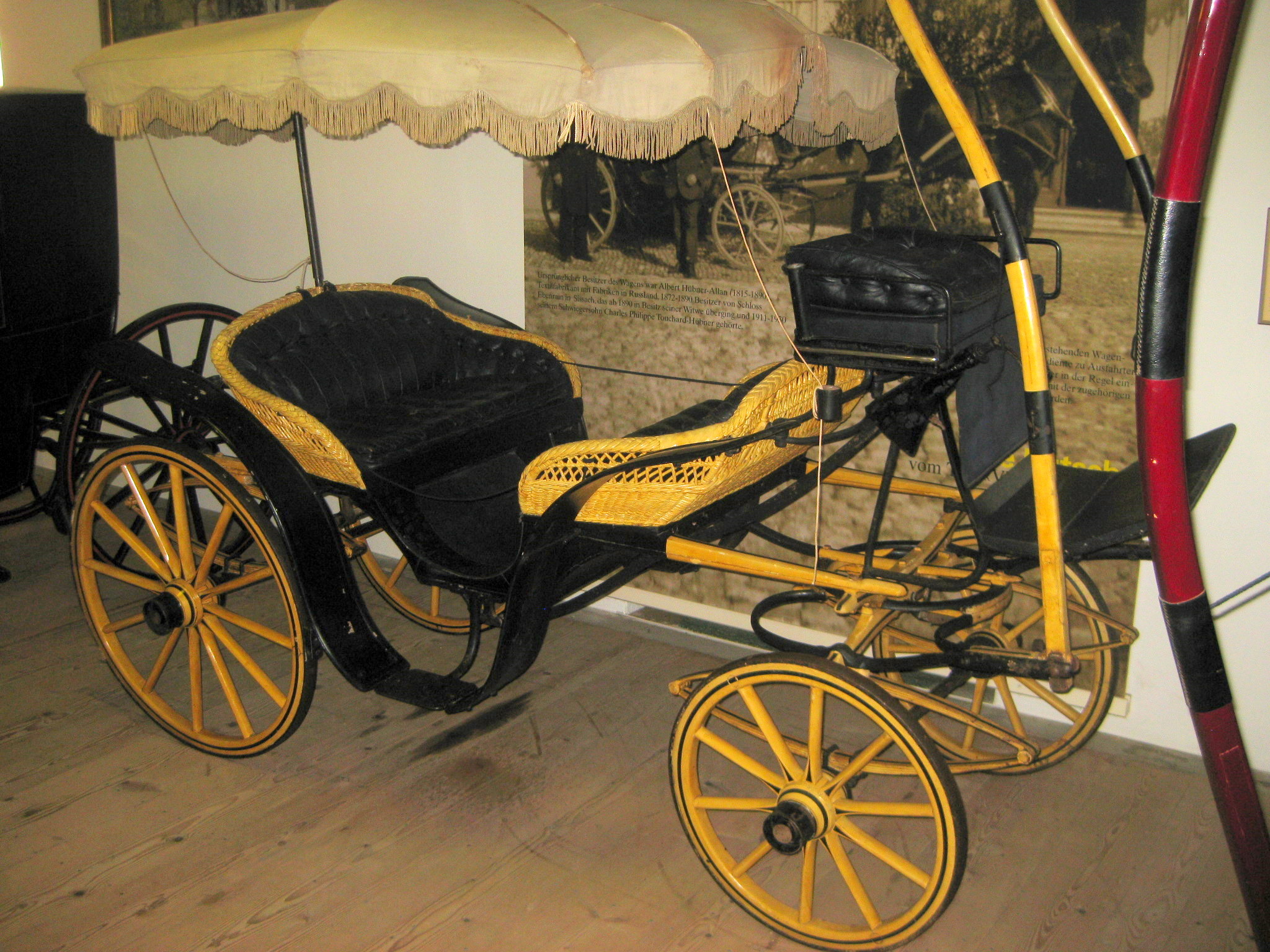
The original vis-à-vis carriage carried only two passengers. It is a longitudinal "halving" of a carriage body, narrowing the carriage to where there is only one passenger seated facing forward and another passenger facing rearward. It was driven by a coachman.
Vis-à-vis automobiles

There were vis-à-vis automobiles in the early history of motoring. These were driven from the forward-facing rear seat, with front passengers sitting ahead of the steering controls and facing the driver. Passengers in the front seat would obstruct the vision of the driver in the rear seat, and the style fell out of favour before 1905.
Notes
References
References
- Beattie, Ian. (1977). "The Complete Book of Automobile Body Design". The Haynes Publishing Group.
- Berkebile, Donald H.. (1978). "Carriage Terminology: An Historical Dictionary". Smithsonian Institution Scholarly Press.
- (2013). "The Complete Catalogue of British Cars 1895 - 1975". Veloce Publishing.
- Haajanen, Lennart W.. (2007). "Illustrated Dictionary of Automobile Body Styles". McFarland.
- Smith, D.J.M.. (1988). "A Dictionary of Horse Drawn Vehicles". J. A. Allen & Co. Ltd..
- Walrond, Sallie. (1979). "The Encyclopaedia of Driving". Country Life Books.
This article was imported from Wikipedia and is available under the Creative Commons Attribution-ShareAlike 4.0 License. Content has been adapted to SurfDoc format. Original contributors can be found on the article history page.
Ask Mako anything about Vis-à-vis (carriage) — get instant answers, deeper analysis, and related topics.
Research with MakoFree with your Surf account
Create a free account to save articles, ask Mako questions, and organize your research.
Sign up freeThis content may have been generated or modified by AI. CloudSurf Software LLC is not responsible for the accuracy, completeness, or reliability of AI-generated content. Always verify important information from primary sources.
Report