From Surf Wiki (app.surf) — the open knowledge base
Vicious circle
Self-reinforcing sequence of events
Self-reinforcing sequence of events
A vicious circle (or cycle) is a complex chain of events that reinforces itself through a feedback loop, with detrimental results. It is a system with no tendency toward equilibrium (social, economic, ecological, etc.), at least in the short run. Each iteration of the cycle reinforces the previous one, in an example of positive feedback. A vicious circle will continue in the direction of its momentum until an external factor intervenes to break the cycle. A well-known example of a vicious circle in economics is hyperinflation.
When the results are not detrimental but beneficial, the term virtuous cycle is used instead.
Examples
Subprime mortgage crisis
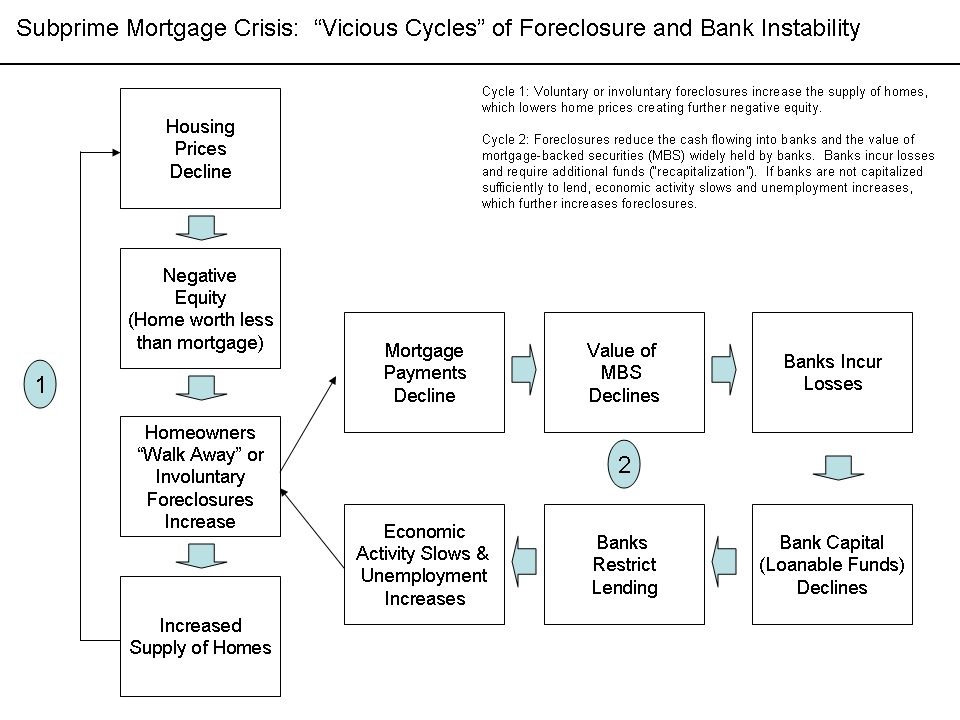
The contemporary subprime mortgage crisis is a complex group of vicious circles, both in its genesis and in its manifold outcomes, most notably the late 2000s recession. A specific example is the circle related to housing. As housing prices decline, more homeowners go "underwater", when the market value of a home drops below that of the mortgage on it. This provides an incentive to walk away from the home, increasing defaults and foreclosures. This, in turn, lowers housing values further from over-supply, reinforcing the cycle.
The foreclosures reduce the cash flowing into banks and the value of mortgage-backed securities (MBS) widely held by banks. Banks incur losses and require additional funds, also called "recapitalization". If banks are not capitalized sufficiently to lend, economic activity slows and unemployment increases, which further increase the number of foreclosures. Economist Nouriel Roubini discussed vicious circles in the housing and financial markets in interviews with Charlie Rose in September and October 2008.
Ecological areas
By involving all stakeholders in managing ecological areas, a virtuous circle can be created where improved ecology encourages the actions that maintain and improve the area.
Other
Other examples include the poverty cycle, sharecropping, and the intensification of drought. In 2021, Austrian Chancellor Alexander Schallenberg described the recurring need for lockdowns in the COVID-19 pandemic as a vicious circle that could only be broken by a legally-required vaccination program.
References
General and cited references
- Rational Choice with Passion:Virtue in a Model of Rational Addiction – In this link the author uses Aristotelian virtue as a mediator between passion and reason in the construction of utility/consumption functions in an esoteric part of consumer behaviour theory related to decision making in addictive situations.
- China: A Stabilizing or Deflationary Influence in East Asia? The Problem of Conflicted Virtue – In this paper the author is using virtue in the sense of a positive outcome (balance of payments surplus) that conflicts with long term regional growth and stability.
References
- Charles Webel, [[Johan Galtung]]. (19 March 2012). "Handbook of Peace and Conflict Studies". Routledge.
- Feldstein, Martin. (18 November 2008). "How to Help People Whose Home Values Are Underwater". [[The Wall Street Journal]].
- "Roubini & Panel". Charlie Rose.
- "Rose & Roubini Discussion". Charlierose.com.
- "Rose & Roubini". Charlierose.com.
- Morrison Scott A. (March 2016). "Designing virtuous socio-ecological cycles for biodiversity conservation". Elsevier.
- (November 20, 2021). "Covid: WHO says it is very worried about Europe surge". BBC News.
This article was imported from Wikipedia and is available under the Creative Commons Attribution-ShareAlike 4.0 License. Content has been adapted to SurfDoc format. Original contributors can be found on the article history page.
Ask Mako anything about Vicious circle — get instant answers, deeper analysis, and related topics.
Research with MakoFree with your Surf account
Create a free account to save articles, ask Mako questions, and organize your research.
Sign up freeThis content may have been generated or modified by AI. CloudSurf Software LLC is not responsible for the accuracy, completeness, or reliability of AI-generated content. Always verify important information from primary sources.
Report