From Surf Wiki (app.surf) — the open knowledge base
Venezuelans
People of Venezuela
People of Venezuela
| Field | Value | |||||||
|---|---|---|---|---|---|---|---|---|
| group | Venezuelans | |||||||
| *Venezolanos* | ||||||||
| population | **33.5 million** | |||||||
| Diaspora **7.89 million** | ||||||||
| 0.44% of world's population | ||||||||
| image | Map of the Venezuelan Diaspora in the World.svg | |||||||
| popplace | **Venezuela** () | |||||||
| region1 | Colombia | |||||||
| pop1 | 2,820,000 | |||||||
| ref1 | ||||||||
| region2 | Peru | |||||||
| pop2 | 1,662,889 | |||||||
| ref2 | ||||||||
| region3 | United States | |||||||
| pop3 | 1,168,271 (2024) | |||||||
| ref3 | ||||||||
| region4 | Chile | |||||||
| pop4 | 728,586 (2023) | |||||||
| ref4 | ||||||||
| region5 | Brazil | |||||||
| pop5 | 626,885 (2024) | |||||||
| ref5 | ||||||||
| region6 | Spain | |||||||
| pop6 | 518,918 (2023) | |||||||
| ref6 | ||||||||
| region7 | Ecuador | |||||||
| pop7 | 500,000 | |||||||
| ref7 | ||||||||
| region8 | Argentina | |||||||
| pop8 | 162,495 | |||||||
| region9 | Dominican Republic | |||||||
| pop9 | 124,100 | |||||||
| ref9 | ||||||||
| region10 | Portugal | |||||||
| pop10 | 100,000 | |||||||
| ref10 | ||||||||
| region11 | Panama | |||||||
| pop11 | 94,400 | |||||||
| ref11 | ||||||||
| region12 | Trinidad and Tobago | |||||||
| pop12 | 78,849 | |||||||
| ref12 | ||||||||
| region13 | Syria | |||||||
| pop13 | 60,000 - 200,000 | |||||||
| ref13 | ||||||||
| region14 | Italy | |||||||
| pop14 | 59,000 - 150,000 | |||||||
| ref14 | ||||||||
| region15 | Mexico | |||||||
| pop15 | 53,000 | |||||||
| ref15 | ||||||||
| region16 | Uruguay | |||||||
| pop16 | 33,000 | |||||||
| ref16 | ||||||||
| region17 | France | |||||||
| pop17 | 30,000 | |||||||
| ref17 | ||||||||
| region18 | Canada | |||||||
| pop18 | 28,395 | |||||||
| ref18 | ||||||||
| region19 | Germany | |||||||
| pop19 | 20,000 | |||||||
| ref19 | ||||||||
| region20 | French Guiana | |||||||
| *(Overseas France)* | ||||||||
| pop20 | 19,000 | |||||||
| ref20 | ||||||||
| region21 | Bolivia | |||||||
| pop21 | 18,940 | |||||||
| ref21 | ||||||||
| region22 | Aruba | |||||||
| pop22 | 17,000 | |||||||
| ref22 | ||||||||
| region23 | Curaçao | |||||||
| pop23 | 17,000 | |||||||
| ref23 | ||||||||
| region24 | United Kingdom | |||||||
| pop24 | 15,000 | |||||||
| ref24 | ||||||||
| region25 | Cuba | |||||||
| pop25 | 15,000 | |||||||
| ref25 | ||||||||
| region26 | Lebanon | |||||||
| pop26 | 12,000 | |||||||
| ref26 | ||||||||
| region27 | Australia | |||||||
| pop27 | 10,000 | |||||||
| ref27 | ||||||||
| region28 | Ireland | |||||||
| pop28 | 5,000 | |||||||
| ref28 | ||||||||
| region29 | Paraguay | |||||||
| pop29 | 4,000 | |||||||
| ref29 | ||||||||
| region30 | Puerto Rico | |||||||
| pop30 | 3,108 | |||||||
| ref30 | ||||||||
| region31 | Costa Rica | |||||||
| pop31 | 3,000 | |||||||
| ref31 | ||||||||
| region32 | Guyana | |||||||
| pop32 | 3,000 | |||||||
| ref32 | ||||||||
| region33 | United Arab Emirates | |||||||
| pop33 | 2,500 | |||||||
| ref33 | ||||||||
| region35 | New Zealand | |||||||
| pop35 | 2,000 | |||||||
| ref35 | ||||||||
| region34 | Sweden | |||||||
| pop34 | 2,274 | |||||||
| ref34 | ||||||||
| region36 | Denmark | |||||||
| pop36 | 1,325 | |||||||
| ref36 | ||||||||
| region37 | China | |||||||
| pop37 | 1,000 | |||||||
| ref37 | ||||||||
| region38 | Netherlands | |||||||
| pop38 | 1,000 | |||||||
| ref38 | ||||||||
| region39 | Saudi Arabia | |||||||
| pop39 | 1,000 | |||||||
| ref39 | ||||||||
| region40 | South Africa | |||||||
| pop40 | 1,000 | |||||||
| ref40 | ||||||||
| region41 | Bonaire | |||||||
| pop41 | 713 | |||||||
| ref41 | ||||||||
| region42 | Sint Maarten | |||||||
| pop42 | 600 | |||||||
| ref42 | ||||||||
| langs | Primarily Venezuelan Spanish (96.6%) | |||||||
| {{Collapsible list | framestyle | border:none; padding:0; | title=Other languages | Chinese (1.33%) | Portuguese (0.84%) | Italian (0.66%) | Wayuu-Goajiro (0.63%), Pemon (0.1%) and other Amerindian languages (0.33%) | Arabic (0.36%)}} |
| rels | Christian majority: Catholicism (71.0%), Protestantism (Evangelicals) (22.0%), other Christians: Eastern Orthodoxy, Mormonism, Jehovah Witnesses | |||||||
| minorities: Santería (1%), Judaism (0.05%)<ref name | "grumilla"/ | |||||||
| related | Spaniards, Mestizo, Amerindians |
Venezolanos Diaspora 7.89 million 0.44% of world's population (Overseas France) Irreligion, Deism, Agnosticism and Atheism: (8.0%) minorities: Santería (1%), Judaism (0.05%) Venezuelans (Spanish: venezolanos) are the citizens identified with the country of Venezuela. This connection may be through citizenship, descent or cultural. For most Venezuelans, many or all of these connections exist and are the source of their Venezuelan citizenship or their bond to Venezuela.
Venezuela is a diverse and multilingual country, home to a melting pot of people of distinct origins. As a result, many Venezuelans do not regard their nationality with ethnicity, but with citizenship or allegiance. From the 1820s to 1930s Venezuela received 2.1 million European immigrants, the third most in Latin America, behind Argentina and Brazil.
Historical and ethnic aspects
Pre-Columbian period
Writing was not used in pre-Columbian times, a historical stage where various groups began to move throughout the Americas, thus making it difficult to find evidence of the people who began to populate this land. However, archaeological excavations show evidence of certain periods that were taking place on the continent.
Venezuela was probably first settled by humans 16,000 years ago, due to migration flows from other indigenous cultures of America, from the south to the Amazon, from the west through Los Andes and north by the Caribbean Sea.
There are four periods of diversity that develop in the current Venezuela, which also entering a new period, it did not mean the end of the previous.
The first migrations to the continent were probably from East Asia to 15,000 years. C. These early migrants (called forth by the generic name "Indians") came at first to be located in North America, later moving to the territory of present Venezuela.
During this period, various mammals were disappearing by climatic changes already beginning to take place from 5000 years ago, so the population in the mainland, starts to move towards the coast and spread to some nearby islands, trying to find new feeding alternatives.
Colonization
On August 2, 1498 (), Christopher Columbus, and the Spanish colonizers' ships, first landed on the American mainland in what is currently Venezuelan territory. Colonization was rapid despite small local indigenous rebellions, and the Spaniards managed to conquer the territory. During this period, the most significant crossbreeding process took place. One that will later define the social profile of the country.
With the passage of time, and the introduction of the African continent, a third race, the Africans, started to integrate into the population, creating heterogeneity in the faces of the society of the time.
During colonial times (16th, 17th, and 18th centuries), "peninsular whites" began to settle Venezuela, coming directly from the Iberian Peninsula, primarily from the Basque region. These people tended to hold positions in the crown, and they represented 15% of the population. Another group of whites who were born in Venezuela were originally called "Creole", representing 20% of the population: they were mostly from the Canary Islands and they worked mainly in petty trade. The other two smaller groups were the original inhabitants (Indians) and Venezuelan-born blacks originally brought from Africa: they were about 5% of the population. Soon the racial groups started to intermix and the "browns" were created. They are mixed descendants of Whites, Indians, Blacks, and other Browns. By the 18th century, they were the largest racial group in Venezuela, making up more than 60% of the population.
This process is currently responsible for the majority of Venezuelans who are of mixed race. This number, however, would continue to decrease after the economic boom in the mid 20th century.
Current ethnic groups
The country has a diverse population that reflects its rich history and the people that have lived here since antiquity to the present. The historic amalgam of different principal groups form the basis of the current demographics of Venezuela: the European immigrants, the Amerindian peoples, African, and other recent immigrants.
Many of the indigenous peoples were absorbed by the mixed population, but the remaining 500,000 currently represent more than 85 different cultures.
European immigrants were mainly Spanish colonists, but another large and growing number are descendants of Europeans (Portuguese, Italians, Germans and Americans) who migrated to the region in mid-twentieth century during the oil growth in the country. Small numbers are descendants of French, English and Polish, as they emigrated during World War II and the Cold War.
Black Africans were brought as slaves, mostly coastal lowlands, beginning early in the sixteenth century and continuing into the nineteenth century. Other immigrant populations are Asian and Middle East, particularly Lebanon, Syria and the Arab world, some Jews from southern Spain, Israel and Central European nations, Dominicans, Trinidadians and Tobagonians, Haitians, Cubans, Peruvians, Argentines, Uruguayans, Chileans, Ecuadorians, Guyaneses and Colombians, this being the greatest social impact due to a large number of displaced individuals who entered the Venezuelan territory during the armed conflict in that country; which generated a high supply of labor, personnel and domestic economy informal.
Ethnic-somatic characteristics
As of 1981, according to the critic D'Ambrosio and other academics, about 51.6% of Venezuelans are mestizos or mulattos (called Criollos: the 40% of them are with mostly white features, 20% with mostly black features and 10% with mostly Indians features), 45% are white, 2% are black and 1% Indians. According to these scholars, is the fact that virtually there are no pure blacks nor indigenous people in Venezuela. With the exception of direct descendants of immigrants or specific indigenous tribes.
In addition, according to a genetic autosomal DNA study conducted in 2008 by the University of Brasilia (UNB), the composition of the population of Venezuela is: 60.60% European, 23% of Native American contribution and 16% of Africa's contribution.
Demography
Main article: Demographics of Venezuela

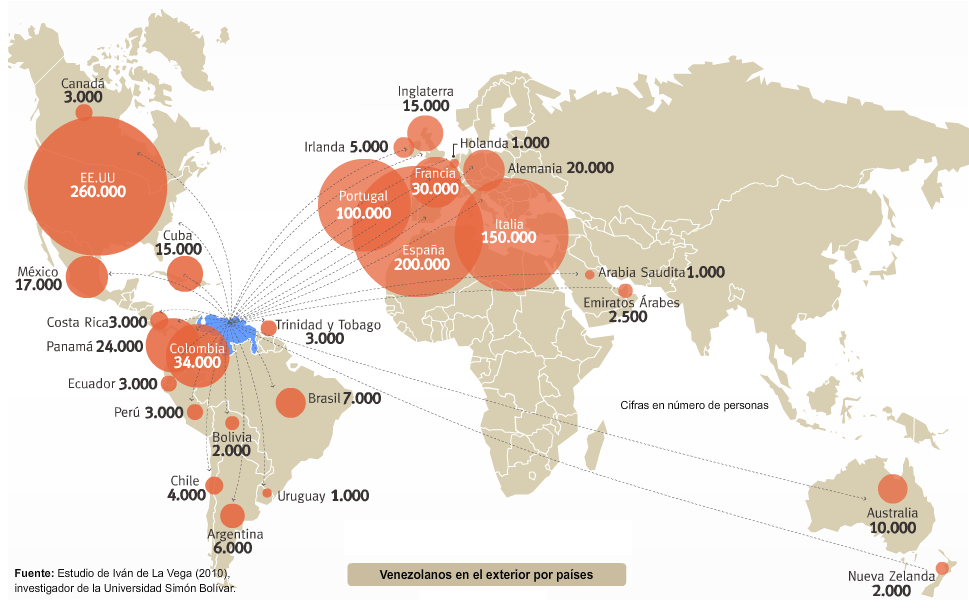
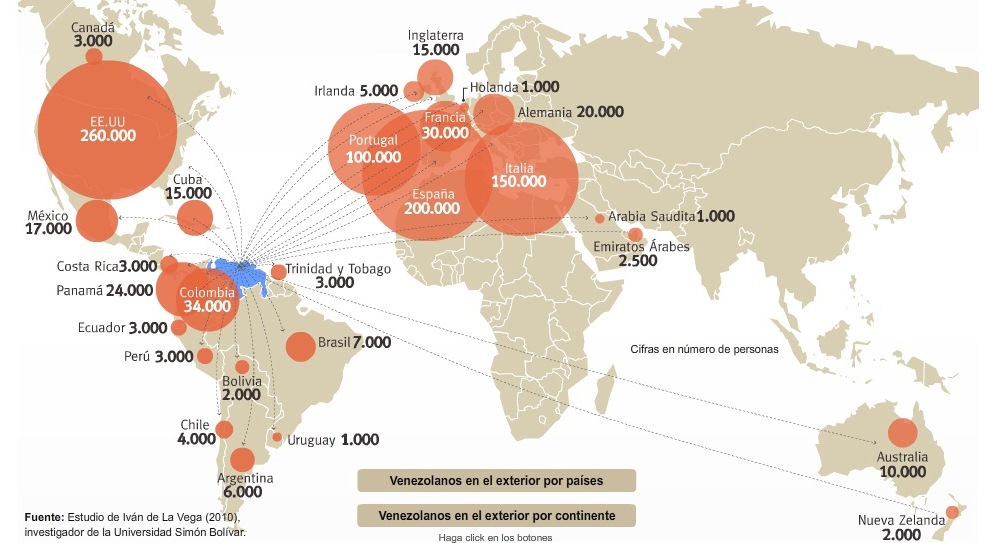
]] The population of approximately 28 million people (in 2011) made Venezuela the sixth-most populous country in Latin America (after Brazil, Mexico, Colombia, Argentina and Peru). Approximately more than one million (4-6% of the total population) are living in other countries. Due to the worsening economic conditions in Venezuela, there are 100,000 Venezuelans living in neighbouring Guyana and larger numbers living in Peru, Colombia, Brazil, Ecuador, the USA, Trinidad and Tobago, Chile and Panama.
More than ninety percent of the Venezuelans live in urban areas – a figure significantly higher than the world average. The literacy rate (98 percent) in Venezuela is also well above the world average, and the rate of population growth slightly exceeds the world average. A large proportion of Venezuelans are young, largely because of recent decreases in the infant mortality rate. While 30 percent of the people are 14 years old or younger, just 4 percent are aged 65 or older.
Ethnic groups


The country has a diverse population that reflects its colorful history and the peoples that have resided there throughout. The historic amalgam of the different main groups forms the basics of Venezuela's current demographics: European immigrants, Amerindian peoples, Africans, Asians (including the Arabs/West Asians) and other recent immigrants. The autosomal DNA genetic composition of population in Venezuela, is 60.60% of European contribution, 23% of Amerindian contribution, and 16.30% of African contribution.
Morenos
Main article: Moreno Venezuelans
Many of the indigenous peoples were absorbed into the Moreno population, because of the heavy mixture of European and African people. They represent over half of the country's population (about 51.6%). This proportion is beginning to decrease, though, as mixed lower income Venezuelans are more likely to flee to other South American countries.
Europeans
Main article: European Venezuelan, History of the Jews in Venezuela
Early European settlers and post-independence immigrants were mostly Spanish colonists, but a high number of other Europeans brought in were from Portuguese, Italian, and German immigrants to the region in the middle 20th century by the Petroleum Growth, and in much smaller numbers of French, English, Portuguese, Polish, Russian, Greek, Scandinavian, Romanian, Ukrainian and Hungarian communities who immigrated during the Second World War and the Cold War. 300,000 Italians and an equal numbers of Spaniards and immigrated in the 1940s and 1950s, and earlier who were fleeing from the Spanish Civil War (1930s).
Up to 95% of Venezuelans live principally in important urban areas like Greater Caracas, Maracaibo, Maracay, Valencia, Lecheria, Barquisimeto/Cabudare, Colonia Tovar, Punto Fijo; the Andean States, Margarita Island and Araya Peninsula. They represent almost half of the population with 43.6% self-identifying as ‘blanco’ (white) in the 2011 census.
Afro-Venezuelans
Main article: Afro-Venezuelan
African people were brought as slaves, mostly to the coastal lowlands, beginning early in the 16th century, and continuing into the mid 19th century. Although they are located in almost the entire country, the Black and African population are concentrated in places where they used to be enslaved and worked as farm hands on subsistence farms of plantains, cocoa, tobacco, sugar cane and cotton in the Aroa Valley, Litoral varguense, Eastern Falcon state; Gibraltar, Bobures and Palmarito in the Sur del Lago Region; and in areas where slaves would run away during Colonial Venezuela and formed cumbes, communities in mountainous and isolated areas, such as, the Sierra de Falcón, Barlovento Region (Acevedo, Andrés Bello, Brión, Buroz and Páez municipalities), Ocumare de La Costa, Choroní; El Callao and Paria Peninsula (where Afro-Trinidadian also migrated); and through Los Llanos, well dispersed in small to decent percents. They represent 3.6% of the population.
Amerindians
Main article: Indigenous peoples in Venezuela
Before the Spanish colonization of the region that would become the country of Venezuela, the territory was the home to many different indigenous peoples. Today more than fifty different indigenous ethnic groups inhabit Venezuela. Most of them speak languages belonging to the Arawakan, Cariban, and Chibchan languages families. Pure indigenous Amerindians comprise around 2 percent of the population. There are 101 languages listed for Venezuela in the Ethnologue database, of which 80 are spoken today as living languages. Today, they're mostly located south of the Orinoco, in the Guayana Region, an area that covers half of the country but the population represents just 2.7% of Venezuelans; other important regions where they're located are on Zulia state, Apure state, the Eastern Region and Orinoco Delta.
Asians
East and South Asians
Main article: Chinese Venezuelan, Japanese Venezuelan, Korean Venezuelan, Indian Venezuelan
The largest sub-groups are immigrants or descendants of immigrants from Mainland China, Philippines, India, Japan and Korea. The first wave of immigrants began in 1847 and consisted of mainly Cantonese immigrants; then the second wave during beginning of the 1940s and 1950s, consisted of Chinese and Japanese immigrants; reaching a peak in the mid-1970s in connection with the oil boom, where Korean and Indian immigrants (mostly Indo-Caribbeans) formed a new group to the country. Asian people represent around 1% of the Venezuelan population.
The Chinese in Venezuela are the 4th largest diaspora in the Americas after the United States, Canada and Peru.
Arabs/West Asians
Main article: Arab Venezuelan, Lebanese Venezuelan
Arab immigration to Venezuela started as early as the 19th and 20th centuries. They came mostly from Western Asia, particularly Lebanon, Syria, and Palestine. According to the president of the Federación de Entidades Árabes de Venezuela (FEARAB), the Arab community in the country numbers around 2 million people. They are mostly located in the most important urban areas and Margarita Island, representing around 5% of the population in Venezuela. In religion, the majority of Arab-Venezuelans are Christians who belong to the Roman Catholic, Eastern Orthodox and Eastern Rite Catholic Churches. There are few Muslims.
Israel has been chosen by many Venezuelan Jews, along with the United States and other countries.
According to the Venezuelan Institute of Statistics, about one million Venezuelans have Syrian origins and more than 20,000 Venezuelans are registered in the Venezuelan Embassy in Damascus. Other sources stated that there is around 60,000 Syrian-Venezuelans living in Syria. More than 200,000 people from the Sweida area carry Venezuelan citizenship and most are members of Syria's Druze sect, who immigrated to Venezuela in the past century.
Religion
Main article: Religion in Venezuela
| Affiliation | % of Venezuela population | |
|---|---|---|
| Christian | {{bartable | 88.3 |
| Catholic | {{bartable | 71 |
| Protestant | {{bartable | 17 |
| Mormon | {{bartable | 0.3 |
| Non-Christian faiths | {{bartable | 2.7 |
| Jewish | {{bartable | 0.05 |
| Muslim | {{bartable | 0.4 |
| Santería | {{bartable | 1 |
| Other Non-Christian faiths | {{bartable | 1.25 |
| Unaffiliated | {{bartable | 9 |
| Agnostic/indifferent | {{bartable | 6 |
| Atheist | {{bartable | 2 |
| Don't know/refused answer | {{bartable | 1 |
| **Total** | {{bartable | 100 |
According to a 2011 poll, 88.3 percent of the population is Christian, primarily Roman Catholic (71%), 17 percent Protestant, and the remaining 0.03 percent Mormons (LDS Church). The Venezuelans without religion are 9% (atheist 2%, agnostic or indifferent 6% and doesn't know/doesn't respond 1% ), almost 3% of the population follow other religions (1% of them are of santeria).
References
References
- "DANE - Serie - Notas Estadísticas".
- (3 June 2024). "Refugiados y migrantes de Venezuela". r4v.info.
- "Naciones Unidas Perú: La migración venezolana y su impacto".
- (2021-01-21). "Infografía: Migrantes y Refugiados Venezolanos en El Perú: El Impacto de la Crisis de la Covid-19 (#Coronavirus)".
- (9 November 2020). "Refugiados y migrantes de Venezuela en Perú". r4v.info.
- "Explore Census Data".
- (30 December 2024). "Nueva entrega de estimación de población extranjera 2023". INE.
- (5 December 2024). "R4V América Latina y el Caribe, Refugiados y Migrantes Venezolanos en la Región -- Noviembre 2024".
- "Población residente por fecha, sexo, grupo de edad y país de nacimiento(56937)".
- "Country analysis ECUADOR".
- (9 March 2023). "Regularization Brings Hope and Stability to Venezuelan Migrants in Ecuador".
- (2024-10-15). "Argentina es el octavo país del mundo con más población venezolana".
- "R4V Venezolanos en la Región Noviembre 2023".
- "República Dominicana, principal receptor de migrantes venezolanos en la región del Caribe".
- "Últimas Noticias (2014), Venezolanos en el exterior".
- (8 November 2018). "ONU: Ya son 3 millones los migrantes venezolanos en el mundo". [[Deutsche Welle.
- (2019). "Trinidad and Tobago organizations need help to support Venezuelan refugees".
- (9 April 2018). "Venezuelans flock to T&T seeking asylum".
- (Sep 2009). "Chavez tells Israelis to disobey 'genocidal' govt". 26 September News.
- (October 2010). "Venezuela afianza relaciones con Siria". Aristobulo Isturiz PSUV.
- "Venezuelani in Italia - statistiche e distribuzione per regione".
- "Los países con más migrantes venezolanos 2022".
- "Venezolanos en el exterior - Infografías".
- (7 March 2016). "Venezolanos en Uruguay".
- (21 December 2023). "Población inmigrante en Uruguay crece por primera vez en un siglo, impulsada por venezolanos y cubanos".
- "Venezolanos en el mundo".
- (7 May 2021). "Canada Census Profile 2021". Statistics Canada Statistique Canada.
- (2023-06-19). "Les Vénézuéliens en Guyane recommencent leur vie avec des saveurs de chez eux". IOM Storyteller.
- (31 July 2024). "Bolivia, un destino de paso que ahora es el hogar permanente de muchos venezolanos". [[El Diario (La Paz).
- (23 March 2022). "Aruba and Curaçao Fact Sheet, January - February 2022 - Aruba (The Netherlands)".
- (18 July 2017). "As crisis deepens, more Venezuelans are emigrating to Lebanon".
- (4 February 2021). "Venezuelans in Lebanon wonder which country is worse". Financial Times.
- [https://reliefweb.int/attachments/9b9f2af6-521d-3855-acdf-6575f0525906/R4V%20Southern%20Cone%20SitRep%20-%20October%20and%20November%202019.pdf Southern cone]reliefweb.int {{Webarchive. link. (30 October 2023)
- "Place of Birth for the Foreign-Born Population in Puerto Rico".
- (December 2024). "Befolkning efter födelseland och ursprungsland, 31 december 2024, totalt". Statistiska centralbyrån.
- (July 2025). "Befolkningen den 1. i kvartalet efter oprindelsesland, herkomst, alder, køn, område og tid". [[Statistics Denmark]].
- "CBS.nl on X".
- (10 March 2019). "Hundreds of undocumented Venezuelans on Sint Maarten : 'no risk of being deported'".
- "Venezuela".
- (2012). "L'Italiano in Venezuela". Università degli Studi di Milano.
- "Indigenous languages in Venezuela". Ethnologue.
- (2003). "Mass Migration to Modern Latin America". Rowman & Littlefield.
- Godinho, Neide Maria de Oliveira. (2008). "O impacto das migrações na constituição genética de populações latino-americanas". Universidade de Brasília.
- "Ine.gob.ve".
- "Altag.net".
- "Resultado Básico del XIV Censo Nacional de Población y Vivienda 2011 (Mayo 2014)". Ine.gov.ve.
- Bahar, Dany. (September 2020). "Venezuelan Migration, Crime, and Misperceptions".
- "Censos de población y vivienda".
- "Intute – World Guide – Venezuela".
- Adachi, Nobuko. (3 October 2006). "Japanese Diasporas: Unsung Pasts, Conflicting Presents and Uncertain Futures". Routledge.
- Lim, Byung-Keun. "Photos Show Daily Lives of S. Korean Residents in Venezuela: "Kyopo: Koreans in Venezuela"". The Seoul Times.
- Lim, Byung-Keun. "Venezuelans Excited about Korean Culture".
- (21 August 2025). "La "pequeña Venezuela": Sweida, la capital de los drusos en Siria donde el 20% de la población es venezolana". BBC News Mundo.
- Margolis, Mac. (15 September 2013). "Abdel el-Zabayar: From Parliament to the Frontlines".
- [http://www.timesofisrael.com/post-chavez-venezuelan-jews-plant-roots-elsewhere/ Post-Chavez, Venezuelan Jews plant roots elsewhere] {{Webarchive. link. (4 January 2015 - The Times of Israel.)
- (Feb 2012). "EL LEVANTE Y AMÉRICA LATINA. UNA BITÁCORA DE LATINOAMÉRICA EN SIRIA, LÍBANO, JORDANIA Y PALESTINA".
- (October 2010). "Venezuela afianza relaciones con Siria". Aristobulo Isturiz PSUV.
- (Sep 2009). "Chavez tells Israelis to disobey 'genocidal' govt". 26 September News.
- (June 2012). "Informe Sociográfico sobre la religión en Venezuela". El Centro Gumilla.
- "2007 Report on International Religious Freedom".
- "LDS Starics". Mormon Newsroom.
This article was imported from Wikipedia and is available under the Creative Commons Attribution-ShareAlike 4.0 License. Content has been adapted to SurfDoc format. Original contributors can be found on the article history page.
Ask Mako anything about Venezuelans — get instant answers, deeper analysis, and related topics.
Research with MakoFree with your Surf account
Create a free account to save articles, ask Mako questions, and organize your research.
Sign up freeThis content may have been generated or modified by AI. CloudSurf Software LLC is not responsible for the accuracy, completeness, or reliability of AI-generated content. Always verify important information from primary sources.
Report