From Surf Wiki (app.surf) — the open knowledge base
Venetian language
Romance language of Veneto, northeast Italy
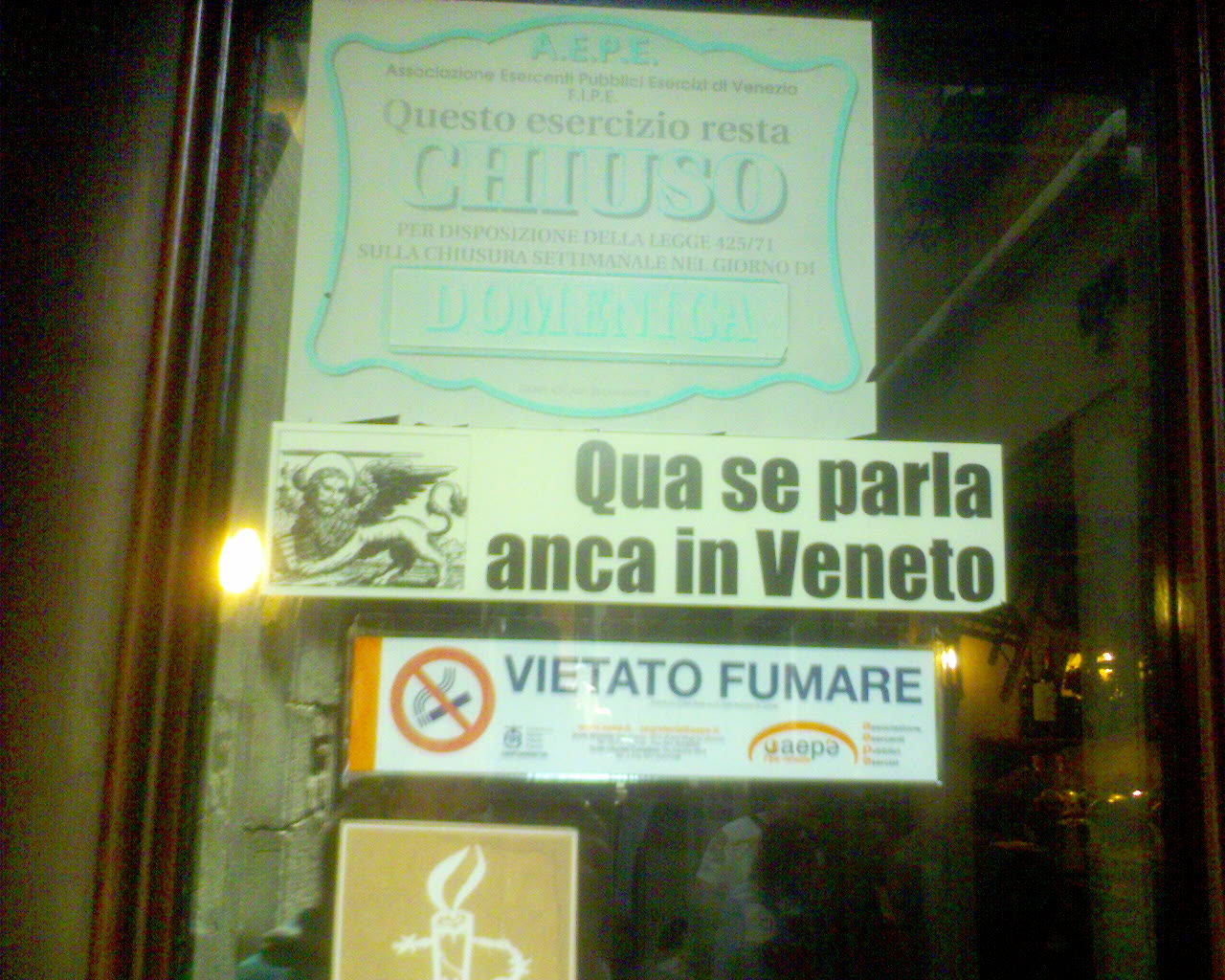
Romance language of Veneto, northeast Italy
| Field | Value | |||||||||||
|---|---|---|---|---|---|---|---|---|---|---|---|---|
| name | Venetian | |||||||||||
| nativename | łengoa/łengua vèneta, vèneto | |||||||||||
| states | Italy, Slovenia, Croatia, Montenegro | |||||||||||
| region | ||||||||||||
| * Veneto<ref name | "UNM" | |||||||||||
| * Friuli-Venezia Giulia<ref name | "UNM"/ | |||||||||||
| * Trentino<ref name | "UNM"/ | |||||||||||
| * Istria County<ref name | "JMI" | |||||||||||
| *Slovene Istria<ref name | "JMI"/ | |||||||||||
| speakers | million | |||||||||||
| date | 2002 | |||||||||||
| ref | e18 | |||||||||||
| familycolor | Indo-European | |||||||||||
| fam2 | Italic | |||||||||||
| fam3 | Latino-Faliscan | |||||||||||
| fam4 | Latinic | |||||||||||
| fam5 | Romance | |||||||||||
| fam6 | Italo-Western | |||||||||||
| fam7 | (disputed) | |||||||||||
| dia1 | Chiplo | |||||||||||
| dia2 | Fiuman | |||||||||||
| dia3 | Paduan† | |||||||||||
| dia4 | Talian | |||||||||||
| dia5 | Judeo-Venetian† | |||||||||||
| dia6 | Triestine | |||||||||||
| minority | {{plainlist | |||||||||||
| *Brazil (Talian dialect)<ref>{{Cite web | url | http://www.ipol.org.br/ler.php?cod=597 | title=Subsídios para o reconhecimento do Talian | last=Tonial | first=Honório | date=26 June 2009 | website=Instituto de Investigação e Desenvolvimento em Política Linguística (IPOL) | language=pt | trans-title=Subsidies for the recognition of Talian | archive-url=https://web.archive.org/web/20120127132553/http://www.ipol.org.br/ler.php?cod=597 | archive-date=27 January 2012 | access-date=21 August 2011}} |
| iso3 | vec | |||||||||||
| glotto | vene1258 | |||||||||||
| glottorefname | Venetian | |||||||||||
| <!-- does not (yet) exist ... | ELP | 10416, 10701 | ||||||||||
| ELPname | Veneto, Venetian-- | lingua = 51-AAA-n | ||||||||||
| map | Venetian_Language_distribution.png | |||||||||||
| notice | IPA | |||||||||||
| mapcaption | **Venetian language distribution in Triveneto**: | |||||||||||
| dia7 | Corfiot |
the modern Romance language
- Veneto
- Friuli-Venezia Giulia
- Trentino
- Istria County
- Primorje-Gorski Kotar
- Slovene Istria
- Italy
- → Veneto
- Brazil (Talian dialect)
- → São Paulo
- → Rio Grande do Sul
- → Santa Catarina
- → Paraná
- → Espírito Santo
- Mexico (Chipilo)
- → Querétaro
- → Veracruz
- → Puebla
Venetian, also known as wider Venetian or Venetan (łengua vèneta ) or vèneto ), is a Romance language spoken natively in the northeast of Italy, mostly in Veneto, where most of the five million inhabitants can understand it. It is sometimes spoken and often well understood outside Veneto: in Trentino, Friuli, the Julian March, Istria, and some towns of Slovenia, Dalmatia (Croatia) and the Bay of Kotor (Montenegro) by a surviving indigenous Venetian population, and in Argentina, Australia, Brazil, Canada, Mexico, the United States and the United Kingdom by Venetians in the diaspora.
Although referred to as an "Italian dialect" (; ) even by some of its speakers, the label is primarily political, referring to geography and not linguistics. In the realm of linguistics, Venetian is often considered a separate language from Italian, with its own local varieties. Its precise place within the Romance language family remains somewhat controversial however. Both Ethnologue and Glottolog group it into the Gallo-Italic branch (and thus, closer to French and Emilian–Romagnol than to Italian). Devoto, Avolio and Ursini reject such classification, and places it in the Italo-Dalmatian branch of Romance.
History
Like all members of the Romance language family, Venetian evolved from Vulgar Latin, and is thus a sister language of Italian and other Romance languages. Venetian is first attested in writing in the 13th century.
The language enjoyed substantial prestige in the days of the Republic of Venice, when it attained the status of a lingua franca in the Mediterranean Sea. Notable Venetian-language authors include the playwrights Ruzante (1502–1542), Carlo Goldoni (1707–1793) and Carlo Gozzi (1720–1806). Following the old Italian theatre tradition (commedia dell'arte), they used Venetian in their comedies as the speech of the common folk. They are ranked among the foremost Italian theatrical authors of all time, and plays by Goldoni and Gozzi are still performed today all over the world.
Other notable works in Venetian are the translations of the Iliad by Giacomo Casanova (1725–1798) and Francesco Boaretti, the translation of the Divine Comedy (1875) by Giuseppe Cappelli, and the poems of Biagio Marin (1891–1985). Notable too is a manuscript titled Dialogo de Cecco di Ronchitti da Bruzene in perpuosito de la stella Nuova attributed to Girolamo Spinelli, perhaps with some supervision by Galileo Galilei for scientific details.
Several VenetianItalian dictionaries are available in print and online, including those by Boerio, Contarini, Nazari and Piccio.
As a literary language, Venetian was overshadowed by Dante Alighieri's Tuscan dialect (the best known writers of the Renaissance, such as Petrarch, Boccaccio and Machiavelli, were Tuscan and wrote in the Tuscan language) and languages of France like the Occitano-Romance languages and the langues d'oïl including the mixed Franco-Venetian.
Even before the demise of the Republic, Venetian gradually ceased to be used for administrative purposes in favor of the Tuscan-derived Italian language that had been proposed and used as a vehicle for a common Italian culture, strongly supported by eminent Venetian humanists and poets, from Pietro Bembo (1470–1547), a crucial figure in the development of the Italian language itself, to Ugo Foscolo (1778–1827).
Venetian spread to other continents as a result of mass migration from the Veneto region between 1870 and 1905, and between 1945 and 1960. Venetian migrants created large Venetian-speaking communities in Argentina, Brazil (see Talian), and Mexico (see Chipilo Venetian dialect), where the language is still spoken today.
In the 19th century, large-scale immigration towards Trieste and Muggia extended the presence of the Venetian language eastward. Previously, the dialect of Trieste had been a Rhaeto-Romance dialect known as Tergestino. This dialect became extinct as a result of Venetian migration, which gave rise to the Triestino dialect of Venetian spoken there today.
Internal migrations during the 20th century also saw many Venetian-speakers settle in other regions of Italy, especially in the Pontine Marshes of southern Lazio where they populated new towns such as Latina, Aprilia and Pomezia, forming there the so-called "Venetian-Pontine" community (comunità venetopontine).
Some firms have chosen to use Venetian language in advertising, as a beer did some years ago (Xe foresto solo el nome, 'only the name is foreign'). In other cases advertisements in Veneto are given a "Venetian flavour" by adding a Venetian word to standard Italian: for instance an airline used the verb xe (Xe sempre più grande, "it is always bigger") into an Italian sentence (the correct Venetian being el xe senpre pì grando) to advertise new flights from Marco Polo Airport.
In 2007, Venetian was given recognition by the Regional Council of Veneto with regional law no. 8 of 13 April 2007 "Protection, enhancement and promotion of the linguistic and cultural heritage of Veneto". Though the law does not explicitly grant Venetian any official status, it provides for Venetian as object of protection and enhancement, as an essential component of the cultural, social, historical and civil identity of Veneto.
Geographic distribution

Venetian is spoken mainly in the Italian regions of Veneto and Friuli-Venezia Giulia and in both Slovenia and Croatia (Istria, Dalmatia and the Kvarner Gulf). Smaller communities are found in Lombardy (Mantua), Trentino, Emilia-Romagna (Rimini and Forlì), Sardinia (Arborea, Terralba, Fertilia), Lazio (Pontine Marshes), Tuscany (Grossetan Maremma) and formerly in Romania (Tulcea).
It is spoken in North and South America by the descendants of Italian immigrants. Notable examples of this are Argentina and Brazil, particularly the city of São Paulo and the Talian dialect spoken in the Brazilian states of Espírito Santo, São Paulo, Paraná, Rio Grande do Sul and Santa Catarina.
In Mexico, the Chipilo Venetian dialect is spoken in the state of Puebla and the town of Chipilo. The town was settled by immigrants from the Veneto region, and some of their descendants have preserved the language to this day. People from Chipilo have gone on to make satellite colonies in Mexico, especially in the states of Guanajuato, Querétaro, and State of Mexico. Venetian has survived in the state of Veracruz, where other Italian migrants have settled since the late 19th century. The people of Chipilo preserve their dialect and call it chipileño, and it has been preserved as a variant since the 19th century. The variant of Venetian spoken by the Cipiłàn (Chipileños) is northern Trevisàn-Feltrìn-Belumàt.
In 2009, the Brazilian city of Serafina Corrêa, in the state of Rio Grande do Sul, gave Talian a joint official status alongside Portuguese. Until the middle of the 20th century, Venetian was also spoken on the Greek Island of Corfu, which had long been under the rule of the Republic of Venice. Venetian had been adopted by a large proportion of the population of Cephalonia, one of the Ionian Islands, because the island was part of the Stato da Màr for almost three centuries.
Classification

Venetian is a Romance language and thus descends from Vulgar Latin. Its classification has always been controversial: According to Tagliavini, for example, it is one of the Italo-Dalmatian languages and most closely related to Istriot on the one hand and Tuscan–Italian on the other.
Some authors include it among the Gallo-Italic languages, and according to others, it is not related to either one. Although both Ethnologue and Glottolog group Venetian into the Gallo-Italic languages, the linguists Giacomo Devoto and Francesco Avolio and the Treccani encyclopedia reject the Gallo-Italic classification.
Although the language region is surrounded by Gallo-Italic languages, Venetian does not share some traits with these immediate neighbors. Some scholars stress Venetian's characteristic lack of Gallo-Italic traits (agallicità) or traits found further afield in Gallo-Romance languages (e.g. French, Franco-Provençal) or the Rhaeto-Romance languages (e.g. Friulian, Romansh). For example, Venetian did not undergo vowel rounding or nasalization, palatalize and , or develop rising diphthongs and , and it preserved final syllables, whereas, as in Italian, Venetian diphthongization occurs in historically open syllables.
On the other hand, Venetian does share many other traits with its surrounding Gallo-Italic languages, like interrogative clitics, mandatory unstressed subject pronouns (with some exceptions), the "to be behind to" verbal construction to express the continuous aspect ("El ze drio manjar" = He is eating, lit. he is behind to eat) and the absence of the absolute past tense as well as of geminated consonants. Venetian has some unique traits which are shared by neither Gallo-Italic, nor Italo-Dalmatian languages, such as the use of the impersonal passive forms and the use of the auxiliary verb "to have" for the reflexive voice (both traits shared with German).
Modern Venetian is not a close relative of the extinct Venetic language spoken in Veneto before Roman expansion, although both are Indo-European, and Venetic may have been an Italic language, like Latin, the ancestor of Venetian and most other languages of Italy. The ancient Veneti gave their name to the city and region, which is why the modern language has a similar name, while their language may have also left a few traces in modern Venetian as a substrate.
Regional variants
The main regional varieties and subvarieties of Venetian language:
- Central (Padua, Vicenza, Polesine), with about 1,500,000 speakers
- Venice
- Eastern/Coastal (Trieste, Grado, Istria, Fiume)
- Western (Verona, Trentino)
- Northern Sinistra Piave of the Province of Treviso (most of the Province of Pordenone)
- North-Central Destra Piave of the Province of Treviso (Belluno, comprising Feltre, Agordo, Cadore, and Zoldo Alto)
All these variants are mutually intelligible, with a minimum 92% in common among the most diverging ones (Central and Western). Modern speakers reportedly can still understand Venetian texts from the 14th century to some extent.
Other noteworthy variants are:
- the variety spoken in Chioggia
- the variety spoken in the Pontine Marshes
- the variety spoken in Dalmatia
- the Talian dialect of Antônio Prado, Entre Rios, Santa Catarina and Toledo, Paraná, among other southern Brazilian cities
- the Chipilo Venetian dialect () of Chipilo, Mexico
- the extinct Judeo-Venetian dialect formerly spoken by the Jewish community of Venice
Grammar
Main article: Venetian grammar

Like most Romance languages, Venetian has mostly abandoned the Latin case system, in favor of prepositions and a more rigid subject–verb–object sentence structure. It has thus become more analytic, if not quite as much as English. Venetian also has the Romance articles, both definite (derived from the Latin demonstrative ille) and indefinite (derived from the numeral unus).
Venetian also retained the Latin concepts of gender (masculine and feminine) and number (singular and plural). Unlike the Gallo-Iberian languages, which form plurals by adding -s, Venetian forms plurals in a manner similar to standard Italian. Nouns and adjectives can be modified by suffixes that indicate several qualities such as size, endearment, deprecation, etc. Adjectives (usually postfixed) and articles are inflected to agree with the noun in gender and number, but it is important to mention that the suffix might be deleted because the article is the part that suggests the number. However, Italian is influencing Venetian language:
| Venetian | Veneto dialects | Italian | English |
|---|---|---|---|
| el gato graso | el gato graso | il gatto grasso | the fat (male) cat |
| la gata grasa | ła gata grasa | la gatta grassa | the fat (female) cat |
| i gati grasi | i gati grasi | i gatti grassi | the fat (male) cats |
| le gate grase | łe gate grase | le gatte grasse | the fat (female) cats |
In recent studies on Venetian variants in Veneto, there has been a tendency to write the so-called "evanescent L" as . While it may help novice speakers, Venetian was never written with this letter. In this article, this symbol is used only in Veneto dialects of Venetian language. It will suffice to know that in Venetian language the letter L in word-initial and intervocalic positions usually becomes a "palatal allomorph", and is barely pronounced.
Very few Venetic words seem to have survived in present Venetian, but there may be more traces left in the morphology, such as the morpheme -esto/asto/isto for the past participle, which can be found in Venetic inscriptions from about 500 BC:
- Venetian: Mi A go fazesto ("I have done")
- Venetian Italian: Mi A go fato
- Standard Italian: Io ho fatto
Redundant subject pronouns
A peculiarity of Venetian grammar is a "semi-analytical" verbal flexion, with a compulsory clitic subject pronoun before the verb in many sentences, echoing the subject as an ending or a weak pronoun. Independent/emphatic pronouns (e.g. ti), on the contrary, are optional. The clitic subject pronoun (te, el/ła, i/łe) is used with the 2nd and 3rd person singular, and with the 3rd person plural. This feature may have arisen as a compensation for the fact that the 2nd- and 3rd-person inflections for most verbs, which are still distinct in Italian and many other Romance languages, are identical in Venetian.
| Venetian | Italian | English |
|---|---|---|
| Mi go | Io ho | I have |
| Ti ti ga | Tu hai | You have |
| Venetian | Italian | English |
|---|---|---|
| Mi so | Io sono | I am |
| Ti ti xe | Tu sei | You are |
The Piedmontese language also has clitic subject pronouns, but the rules are somewhat different. The function of clitics is particularly visible in long sentences, which do not always have clear intonational breaks to easily tell apart vocative and imperative in sharp commands from exclamations with "shouted indicative". For instance, in Venetian the clitic el marks the indicative verb and its masculine singular subject, otherwise there is an imperative preceded by a vocative. Although some grammars regard these clitics as "redundant", they actually provide specific additional information as they mark number and gender, thus providing number-/gender- agreement between the subject(s) and the verb, which does not necessarily show this information on its endings.
Interrogative inflection
Venetian also has a special interrogative verbal flexion used for direct questions, which also incorporates a redundant pronoun:
| Venetian | Veneto dialects | Italian | English |
|---|---|---|---|
| Ti geristu sporco? | (Ti) jèristu onto? | ||
| or (Ti) xèrito spazo? | (Tu) eri sporco? | Were you dirty? | |
| El can, gerilo sporco? | El can jèreło onto? | ||
| or Jèreło onto el can ? | Il cane era sporco? | Was the dog dirty? | |
| Ti te gastu domandà? | (Ti) te sito domandà? | (Tu) ti sei domandato? | Did you ask yourself? |
Auxiliary verbs
Reflexive tenses use the auxiliary verb avér ("to have"), as in English, the North Germanic languages, Catalan, Spanish, Romanian and Neapolitan; instead of èssar ("to be"), which would be normal in Italian. The past participle is invariable, unlike Italian:
| Venetian | Veneto dialects | Italian | English |
|---|---|---|---|
| Ti ti te ga lavà | (Ti) te te à/gà/ghè lavà | (Tu) ti sei lavato | You washed yourself |
| (Lori) i se ga desmissià | (Lori) i se gà/à svejà | (Loro) si sono svegliati | They woke up |
Continuing action
Another peculiarity of the language is the use of the phrase eser drìo (literally, "to be behind") to indicate continuing action:
| Venetian | Veneto dialects | Italian | English |
|---|---|---|---|
| Me pare, el ze drìo parlàr | Mé pare 'l ze drìo(invià) parlàr | Mio padre sta parlando | My father is speaking |
Another progressive form in some Venetian dialects uses the construction èsar łà che ():
- Venetian dialect: Me pare l'è là che'l parla ().
The use of progressive tenses is more pervasive than in Italian; e.g.
- English: "He wouldn't have been speaking to you".
- Venetian: No'l sarìa miga sta drio parlarte a ti.
That construction does not occur in Italian: *Non sarebbe mica stato parlandoti is not syntactically valid.
Subordinate clauses
Subordinate clauses have double introduction ("whom that", "when that", "which that", "how that"), as in Old English:
| Venetian | Veneto dialects | Italian | English |
|---|---|---|---|
| Mi so de chi che ti parli | So de chi che te parli | So di chi parli | I know who you are talking about |
As in other Romance languages, the subjunctive mood is widely used in subordinate clauses.
| Venetian | Veneto dialects | Italian | English |
|---|---|---|---|
| Mi credeva che'l fuse ... | Credéa/évo che'l fuse ... | Credevo che fosse ... | I thought he was ... |
Phonology
Consonants
| Labial | Dental | Alveolar | Post-alv. | ||||||||||
|---|---|---|---|---|---|---|---|---|---|---|---|---|---|
| /Palatal | Velar | Nasal | Plosive/ | ||||||||||
| Affricate | voiceless | voiced | Fricative | voiceless | voiced | Tap | Approximant | ||||||
| () | |||||||||||||
| () | |||||||||||||
| () | |||||||||||||
| () | |||||||||||||
| () |
Some dialects of Venetian have certain sounds not present in Italian, such as the interdental voiceless fricative , often spelled with , , , or , and similar to English th in thing and thought. This sound occurs, for example, in çéna ("supper", also written zhena, žena), which is pronounced the same as Castilian Spanish cena (which has the same meaning). The voiceless interdental fricative occurs in Bellunese, north-Trevisan, and in some Central Venetian rural areas around Padua, Vicenza and the mouth of the river Po.
Because the pronunciation variant is more typical of older speakers and speakers living outside of major cities, it has come to be socially stigmatized, and most speakers now use or instead of . In those dialects with the pronunciation , the sound has fallen together with ordinary , and so it is not uncommon to simply write (or between vowels) instead of or (such as sena).
Similarly some dialects of Venetian also have a voiced interdental fricative , often written (as in el pianze 'he cries'); but in most dialects this sound is now pronounced either as (Italian voiced-Z), or more typically as (Italian voiced-S, written , as in el pianxe); in a few dialects the sound appears as and may therefore be written instead with the letter , as in el piande.
Some varieties of Venetian also distinguish an ordinary vs. a weakened or lenited ("evanescent") , which in some orthographic norms is indicated with the letter or ; in more conservative dialects, however, and are merged as ordinary . In those dialects that have both types, the precise phonetic realization of ⟨ł⟩ depends both on its phonological environment and on the dialect of the speaker. In Venice and its mainland as well as in most of central Veneto (excluding the peripheral provinces of Verona, Belluno and some islands of the lagoon) the realization is a non-syllabic (usually described as nearly like an "e" and so often spelled as ), when is adjacent (only) to back vowels (), vs. a null realization when is adjacent to a front vowel ().
In dialects further inland may be realized as a partially vocalised . Thus, for example, góndoła 'gondola' may sound like góndoea , góndola , or góndoa . In dialects having a null realization of intervocalic , although pairs of words such as scóła, "school" and scóa, "broom" are homophonous (both being pronounced ), they are still distinguished orthographically.
Venetian, like Spanish, does not have the geminate consonants characteristic of standard Italian, Tuscan, Neapolitan and other languages of southern Italy; thus Italian fette ("slices"), palla ("ball") and penna ("pen") correspond to féte, bała, and péna in Venetian. The masculine singular noun ending, corresponding to -o/-e in Italian, is often unpronounced in Venetian after continuants, particularly in rural varieties: Italian pieno ("full") corresponds to Venetian pien, Italian altare to Venetian altar. The extent to which final vowels are deleted varies by dialect: the central–southern varieties delete vowels only after , whereas the northern variety deletes vowels also after dental stops and velars; the eastern and western varieties are in between these two extremes.
The velar nasal (the final sound in English "song") occurs frequently in Venetian. A word-final is always velarized, which is especially obvious in the pronunciation of many local Venetian surnames that end in , such as Marin and Manin , as well as in common Venetian words such as man ( "hand"), piron ( "fork"). Moreover, Venetian always uses in consonant clusters that start with a nasal, whereas Italian only uses before velar stops: e.g. "to sing", "winter", "to anoint", "to cope with".
Speakers of Italian generally lack this sound and usually substitute a dental for final Venetian , changing for example to and to .
Vowels
| Front | Central | Back | Close | Close-mid | Open-mid | Open |
|---|---|---|---|---|---|---|
| () |
An accented á is pronounced as [], (an intervocalic // could be pronounced as a [] sound).
Prosody
While written Venetian looks similar to Italian, it sounds very different, with a distinct lilting cadence, almost musical. Compared to Italian, in Venetian syllabic rhythms are more evenly timed, accents are less marked, but on the other hand tonal modulation is much wider and melodic curves are more intricate. Stressed and unstressed syllables sound almost the same; there are no long vowels, and there is no consonant lengthening. Compare the Italian sentence va laggiù con lui "go there with him" (all long/heavy syllables but final) with Venetian va là zo co lu (all short/light syllables).

Sample etymological lexicon
As a direct descent of regional spoken Latin, Venetian lexicon derives its vocabulary substantially from Latin and (in more recent times) from Tuscan, so that most of its words are cognate with the corresponding words of Italian. Venetian includes however many words derived from other sources (such as ancient Venetic, Greek, Gothic, and German), and has preserved some Latin words not used to the same extent in Italian, resulting in many words that are not cognate with their equivalent words in Italian, such as:
| English | Italian | Venetian (DECA) | Venetian word origin | ||||
|---|---|---|---|---|---|---|---|
| today | oggi | uncò, 'ncò, incò, ancò, oncò, ancúo, incoi | from Latin + | ||||
| pharmacy | farmacia | apotèca | from Ancient Greek (*apothḗkē*) | ||||
| to drink | bere | trincàr | from German "to drink" | ||||
| apricot | albicocca | armelín | from Latin | ||||
| to bore | dare noia, seccare | astiàr | from Gothic {{wt | got | 𐌷𐌰𐌹𐍆𐍃𐍄𐍃}}, {{wt | got | haifsts}} "contest" |
| peanuts | arachidi | bagígi | from Arabic habb-ajiz | ||||
| to be spicy hot | essere piccante | becàr | from Italian , literally "to peck" | ||||
| spaghetti | vermicello, spaghetti | bígolo | from Latin (bom)byculus | ||||
| eel | anguilla | bizàto, bizàta | from Latin "beast", compare also Italian , a kind of snake | ||||
| snake | serpente | bísa, bíso | from Latin bestia "beast", compare also Ital. biscia, a kind of snake | ||||
| peas | piselli | bízi | related to the Italian word | ||||
| lizard | lucertola | izarda, rizardola | from Latin , same origin as English | ||||
| to throw | tirare | trar via | local cognate of Italian | ||||
| fog | nebbia foschia | calígo | from Latin | ||||
| corner/side | angolo/parte | cantón | from Latin | ||||
| find | trovare | catàr | from Latin *adcaptare | ||||
| chair | sedia | caréga, trón | from Latin and (borrowings from Greek) | ||||
| hello, goodbye | ciao | ciao | from Venetian s-ciao "slave", from Medieval Latin | ||||
| to catch, to take | prendere | ciapàr | from Latin | ||||
| when (non-interr.) | quando | co | from Latin | ||||
| to kill | uccidere | copàr | from Old Italian , originally "to behead" | ||||
| miniskirt | minigonna | carpéta | compare English *carpet* | ||||
| skirt | sottana | còtoła | from Latin , "coat, dress" | ||||
| T-shirt | maglietta | fanèla | borrowing from Greek | ||||
| drinking glass | bicchiere | gòto | from Latin , "cruet" | ||||
| big | *grande* | *grosi* | From German *groß(e)* | ||||
| exit | uscita | insía | from Latin in + exita | ||||
| I | io | mi | from Latin me "me" (accusative case); Italian io is derived from the Latin nominative form ego | ||||
| too much | troppo | masa | from Greek (*mâza*) | ||||
| to bite | mordere | morsegàr, smorsegàr | deverbal derivative, from Latin morsus "bitten", compare Italian | ||||
| moustaches | baffi | mustaci | from Greek (*moustaki*) | ||||
| cat | gatto | munín, gato, gateo | perhaps onomatopoeic, from the sound of a cat's meow | ||||
| big sheaf | grosso covone | meda | from Latin "cone, pyramid"; cf. Old French "haystack" | ||||
| donkey | asino | muso | from Latin , "snout" (compare French ) | ||||
| bat | pipistrello | nòtoła, notol, barbastrío, signàpoła | derived from not "night" (compare Italian notte) | ||||
| rat | ratto | pantegàna | from Slovene podgana | ||||
| beat, cheat, sexual intercourse | imbrogliare, superare in gara, amplesso | pinciàr | from French (compare English ) | ||||
| dandelion | tarassaco | pisalet | from French | ||||
| truant | marinare scuola | plao far | from German blau machen | ||||
| apple | mela | pomo/pón | from Latin | ||||
| to break, to shred | strappare | zbregàr | from Gothic {{wt | got | 𐌱𐍂𐌹𐌺𐌰𐌽}} (), related to English *to break* and German | ||
| money | denaro soldi | schèi | from German | ||||
| grasshopper | cavalletta | saltapaiusc | from "hop" + "grass" (Italian ) | ||||
| squirrel | scoiattolo | zgiràt, scirata, skirata | Related to Italian word, probably from Greek (*skíouros*) | ||||
| spirit from grapes, brandy | grappa acquavite | znjapa | from German | ||||
| to shake | scuotere | zgorlàr, scorlàr | from Latin *ex + {{wt | la | crollare}}* | ||
| rail | rotaia | sina | from German | ||||
| tired | stanco | straco | from Lombard strak | ||||
| line, streak, stroke, strip | linea, striscia | strica | from Gothic {{wt | got | 𐍃𐍄𐍂𐌹𐌺𐍃}}, {{wt | got | striks}} or German 'stroke, line'. Example: Tirar na strica "to draw a line". |
| to press | premere, schiacciare | strucàr | from Gothic or Lombard; cf. German 'to press', Swedish . Example: Struca un tasto / boton "Strike any key / Press any button". | ||||
| to whistle | fischiare | supiàr, subiàr, sficiàr, sifolàr | from Latin sub + flare, compare French | ||||
| to pick up | raccogliere | tòr su | from Latin | ||||
| pan | pentola | técia, téia, tegia | from Latin | ||||
| lad, boy | ragazzo | tozàt(o) (toxato), fio | from Italian tosare, "to cut someone's hair" | ||||
| lad, boy | ragazzo | puto, putèło, putełeto, butèl | from Latin *{{wt | la | puer}}, {{wt | la | putus}}* |
| lad, boy | ragazzo | matelot | from French "sailor" | ||||
| cow | mucca, vacca | vaca | from Latin | ||||
| gun | fucile-scoppiare | sciop, sciòpo, sciopàr, sciopón | from Latin (onomatopoeic) | ||||
| path(way), trail | sentiero | troi | from Friulian , from Gaulish **trogo*; cf. Romansh | ||||
| to worry | preoccuparsi, vaneggiare | dzavariàr, dhavariàr, zavariàr | from Latin |
Spelling systems
Modern script (GVIM-DECA)
Since December 2017 the Venetian language adopted a modern writing system, named GVIM (acronym for Grafia del Veneto Internazionale Moderno, i.e. Writing system for Modern International Venetian) thanks to the 2010 2nd Regional ad hoc Commission of the Regione del Veneto. The Academia de ła Bona Creansa – Academy of the Venetian Language, an NGO accredited according to the UNESCO 2003 Convention for the Venetian language and culture had already worked, tested, applied and certified a full writing system (presented in a scientific publication in linguistics in 2016), known with the DECA acronym (Drio El Costumar de l'Academia, i.e. literally According to the Use of the Academia).
The DECA writing system has been officialized by the Veneto Region under the name Grafia Veneta Internazionale Moderna, by unanimous vote of the Commissione Grafia e Toponomastica (i.e. Script and Topononymy Committee) of the Venetian language on December 14, 2017, and available at portal of the Venetian Regional Council dedicated to the Venetian language. The same writing system was then employed for the first grammar of the Venetian language to be published by a university, in Brasil, in 2018.
The DECA, then GVIM, had already been used in a trilingual document approved by the Veneto Regional Council (Aprile 2016) in Italian, Venetian, and English.
Traditional system
Venetian currently has an official writing system. Traditionally it is written using the Latin script—sometimes with certain additional letters or diacritics. The basis for some of these conventions can be traced to Old Venetian, while others are modern innovations.
Medieval texts, written in Old Venetian, include the letters , and to represent sounds that do not exist or have a different distribution in Italian. Specifically:
- The letter was often employed in words that nowadays have a voiced -sound (compare English xylophone); for instance appears in words such as raxon, Croxe, caxa ("reason", "(holy) Cross" and "house"). The precise phonetic value of in Old Venetian texts remains unknown, however.
- The letter often appeared in words that nowadays have a varying voiced pronunciation ranging from to or or even to ; even in contemporary spelling zo "down" may represent any of or even , depending on the dialect; similarly zovena "young woman" could be any of , or , and zero "zero" could be , or .
- Likewise, was written for a voiceless sound which now varies, depending on the dialect spoken, from to to , as in for example dolçe "sweet", now , dolçeça "sweetness", now , or sperança "hope", now .
The usage of letters in medieval and early modern texts was not, however, entirely consistent. In particular, as in other northern Italian languages, the letters and were often used interchangeably for both voiced and voiceless sounds. Differences between earlier and modern pronunciation, divergences in pronunciation within the modern Venetian-speaking region, differing attitudes about how closely to model spelling on Italian norms, as well as personal preferences, some of which reflect sub-regional identities, have all hindered the adoption of a single unified spelling system.
Nevertheless, in practice, most spelling conventions are the same as in Italian. In some early modern texts letter becomes limited to word-initial position, as in xe ("is"), where its use was unavoidable because Italian spelling cannot represent there. In between vowels, the distinction between and was ordinarily indicated by doubled for the former and single for the latter. For example, basa was used to represent ("he/she kisses"), whereas bassa represented ("low"). (Before consonants there is no contrast between and , as in Italian, so a single is always used in this circumstance, it being understood that the will agree in voicing with the following consonant. For example, represents only , but represents .)
Traditionally the letter was ambiguous, having the same values as in Italian (both voiced and voiceless affricates and ). Nevertheless, in some books the two pronunciations are sometimes distinguished (in between vowels at least) by using doubled to indicate (or in some dialects ) but a single for (or , ).
In more recent practice the use of to represent , both in word-initial as well as in intervocalic contexts, has become increasingly common, but no entirely uniform convention has emerged for the representation of the voiced vs. voiceless affricates (or interdental fricatives), although a return to using and remains an option under consideration.
Regarding the spelling of the vowel sounds, because in Venetian, as in Italian, there is no contrast between tense and lax vowels in unstressed syllables, the orthographic grave and acute accents can be used to mark both stress and vowel quality at the same time: à , á , è , é , í , ò , ó , ú . Different orthographic norms prescribe slightly different rules for when stressed vowels must be written with accents or may be left unmarked, and no single system has been accepted by all speakers.
Venetian allows the consonant cluster (not present in Italian), which is sometimes written or before i or e, and or before other vowels. Examples include s-ciarir (Italian schiarire, "to clear up"), s-cèt (schietto, "plain clear"), s-ciòp (schioppo, "gun") and s-ciao (schiavo, "[your] servant", ciao, "hello", "goodbye"). The hyphen or apostrophe is used because the combination is conventionally used for the sound, as in Italian spelling; e.g. scèmo (scemo, "stupid"); whereas before a, o and u represents : scàtoła (scatola, "box"), scóndar (nascondere, "to hide"), scusàr (scusare, "to forgive").
Proposed systems
Recently there have been attempts to standardize and simplify the script by reusing older letters, e.g. by using for and a single for ; then one would write baxa for ("[third person singular] kisses") and basa for ("low"). Some authors have continued or resumed the use of , but only when the resulting word is not too different from the Italian orthography: in modern Venetian writings, it is then easier to find words as çima and çento, rather than força and sperança, even though all these four words display the same phonological variation in the position marked by the letter . Another recent convention is to use (in place of older ) for the "soft" l, to allow a more unified orthography for all variants of the language. However, in spite of their theoretical advantages, these proposals have not been very successful outside of academic circles, because of regional variations in pronunciation and incompatibility with existing literature.
More recently, on December 14, 2017, the Modern International Manual of Venetian Spelling was approved by the new Commission for Spelling of 2010. It was translated into three languages (Italian, Venetian and English) and it exemplifies and explains every single letter and every sound of the Venetian language. The graphic accentuation and punctuation systems are added as corollaries. Overall, the system was greatly simplified from previous ones to allow both Italian and foreign speakers to learn and understand the Venetian spelling and alphabet in a more straightforward way.
The Venetian speakers of Chipilo use a system based on Spanish orthography, even though it does not contain letters for and . The American linguist Carolyn McKay proposed a writing system for that variant based entirely on the Italian alphabet. However, the system was not very popular.
Orthographies comparison
| [IPA] | Official (GVIM-DECA) | classic | Brunelli | Chipilo | Talian | Latin origin | Examples |
|---|---|---|---|---|---|---|---|
| à | à | à | á | à | ă , ā | ||
| b | b | b | b, v | b | b- , bb | **b**ar**b**a (beard, uncle) from **b**ar**b**a | |
| + a \ o \ u | c | c | c | c | c | c- , cc , tc , xc | |
| + i \ e \ y \ ø | ch | ch | ch | qu | ch | ch , qu | **ch**iete (quiet) from **qu**iētem |
| (between vowels) | c(h) | cc(h) | c(h) | c / qu | c(h) | cc , ch , qu | ta**c**üin (notebook) from ta**cc**uinum |
| /kw/ | cu | qu | cu | qu /kw/ | |||
| + a \ o \ u | ts~th~s | ç, (z) | ç | -~zh~- | – | ti , th | |
| + i \ e \ y \ ø | c, (z) | c- , cc , ti , th , tc , xc | |||||
| (between vowels) | zz | ti , th | |||||
| (before a vowel) | s | s | s | s | s | s- , ss , sc , ps , x | |
| (between vowels) | ss | ss | ca**s**a (cash des) from ca**ps**a | ||||
| (before unvoiced consonant) | s | s | |||||
| + a \ o \ u | ci | chi | ci | ch | ci | cl- , ccl | |
| + i \ e \ y \ ø | c | c | c | **ci**eza (church) from e**ccl**ēsia | |||
| (between vowels) | c(i) | cchi | c(i) | c(i) | |||
| (ending of word) | c' | cch' | c' | ch | c' | mo**c''* (snot) from **mu**cc'*eus* | |
| d | d | d | – | d | d , -t- , (g , di , z ) | ca**d**ena (chain) from ca**t**ēna | |
| è | è | è | è | è | ĕ , ae | ||
| é | é | é | é | é | ē , ĭ , oe | p**é**vare (pepper) from p**i**per | |
| – | f | f | f | f | f | f- , ff , ph- | |
| (between vowels) | ff | ff , pph | |||||
| + a \ o \ u | g | g | g | g | g | g , -c- , ch | |
| + i \ e \ y \ ø | gh | gh | gh | gu | gh | gu , ch | |
| + a \ o \ u | dz~dh~z | z | z | -~d~- | – | z , di | |
| + i \ e \ y \ ø | z , g , di | **g**en**g**iva (gum) from **g**in**g**iva | |||||
| (before a vowel) | z | x | x | z | z | ?, (z /dz/, g /ɉ/, di /dj/) | |
| (between vowels) | s | s | -c- (before e/i), -s- , x | pa**x**e (peace) from pā**x**, pā**c**is | |||
| (before voiced consonant) | s | s | s | s- , x | **s**gorlar (to shake) from e**x**-crollare | ||
| + a \ o \ u | gi | ghi | gi | gi | j | gl , -cl- | |
| + i \ e \ y \ ø | g | g | g | gi | **gi**iro (dormouse) from **gl**īris | ||
| j~g(i) | g(i) | j | – | j | i , li | a**j**o / a**gi**o (garlic) from ā**li**um | |
| j, i | j, i | i | y, i | i | i | ||
| í | í | í | í | í | ī , ȳ | f**i**o (son) from f**ī**lius | |
| – | h | h | h | h | h | h | màc**h**ina (machine) from māc**h**ina |
| l | l | l | l | l | l | ||
| ł | l | ł | – | – | l | ||
| li~j~g(i) | li | lj | ly | li | li , | Ta**li**a / Ta**j**a / Ta**lgi**a (Italy) from Itā**li**a | |
| (before vowels) | m | m | m | m | m | m | |
| (before vowels) | n | n | n | n | n | n | |
| (at the end of the syllable) | n' / 'n | – | n' | n' | n' | n | do**n'''' (we go) from *anda**m'''o |
| (at the end of the syllable) | n / n- | m, n | n | n | n | m , n , g | |
| ni~ng(i) | ni | n-j | ny | n-j | ni | ||
| nj | gn | gn | ñ | gn | gn , ni | cu**gn**à (brother-in-law) from co**gn**ātus | |
| ò | ò | ò | ò | ò | ŏ | ||
| ó | ó | ó | ó | ó | ō , ŭ | ||
| – | p | p | p | p | p | p- , pp | |
| (between vowels) | pp | ||||||
| r | r | r | r | r | r | ||
| ri~rg(i) | (ri) | rj | ry | rj | |||
| – | t | t | t | t | t | t- , tt , ct , pt | |
| (between vowels) | tt | ||||||
| ú | ú | ú | ú | ú | ū | ||
| (after , or before o) | u | u | u | u | u | u | |
| v | v | v | v | v | u , -b- , -f- , -p- | ||
| (dialectal) | â / á | – | – | – | – | ē , an | |
| (ø) | (oe) | (o) | – | – | o | ch**ø**r (heart) from Latin c**o**r | |
| (y / ý) | (ue) | (u) | – | – | ū | sch**y**ro (dark) from obsc**ū**rus | |
| h / fh | – | – | – | – | f | **h**èr (iron) from **f**errus | |
| lj | – | – | – | – | li | bata**lj**a (battle) from *battā**li**a* | |
| sj | – | (sh) | – | – | s | ||
| zj | – | (xh) | – | – | g | **xj**al (rooster) from **g**allus |
Sample texts

Ruzante returning from war
The following sample, in the old dialect of Padua, comes from a play by Ruzante (Angelo Beolco), titled Parlamento de Ruzante che iera vegnù de campo ("Dialogue of Ruzante who came from the battlefield", 1529). The character, a peasant returning home from the war, is expressing to his friend Menato his relief at being still alive:
|{{lang|vec|Orbéntena, el no serae mal star in campo per sto robare, se 'l no foesse che el se ha pur de gran paure. Càncaro ala roba! A' son chialò mi, ala segura, e squase che no a' no cherzo esserghe gnan. ... Se mi mo' no foesse mi? E che a foesse stò amazò in campo? E che a foesse el me spirito? Lo sarae ben bela. No, càncaro, spiriti no magna.}} |Really, it would not be that bad to be in the battlefield looting, were it not that one gets also big scares. Damn the loot! I am right here, in safety, and almost can't believe I am. ... And if I were not me? And if I had been killed in battle? And if I were my ghost? That would be just great. No, damn, ghosts don't eat.
{{lang|vec|Discorso de Perasto}}
The following sample is taken from the Perasto Speech (Discorso de Perasto), given on August 23, 1797, at Perasto, by Venetian Captain Giuseppe Viscovich, at the last lowering of the flag of the Venetian Republic (nicknamed the "Republic of Saint Mark").
|{{lang|vec|Par trezentosetantasete ani le nostre sostanse, el nostro sangue, le nostre vite le xè sempre stàe par Ti, S. Marco; e fedelisimi senpre se gavemo reputà, Ti co nu, nu co Ti, e sempre co Ti sul mar semo stài lustri e virtuosi. Nisun co Ti ne gà visto scanpar, nisun co Ti ne gà visto vinti e spaurosi!}} |For three hundred and seventy seven years our bodies, our blood our lives have always been for You, St. Mark; and very faithful we have always thought ourselves, You with us, we with You, And always with You on the sea we have been illustrious and virtuous. No one has seen us with You flee, No one has seen us with You defeated and fearful!}}
Francesco Artico
The following is a contemporary text by Francesco Artico. The elderly narrator is recalling the church choir singers of his youth. (see the full original text with audio):
|{{lang|vec|Sti cantori vèci da na volta, co i cioéa su le profezie, in mezo al coro, davanti al restèl, co'a ose i 'ndéa a cior volta no so 'ndove e ghe voéa un bèl tóc prima che i tornésse in qua e che i rivésse in cao, màssima se i jèra pareciàdi onti co mezo litro de quel bon tant par farse coràjo.}} |These old singers of the past, when they picked up the Prophecies, in the middle of the choir, in front of the twelve-branched candelabrum, with their voice they went off who knows where, and it was a long time before they came back and landed on the ground, especially if they had been previously 'oiled' with half a litre of the good one [wine] just to make courage.
Miscellaneous
Due to the diacritic letter Ł being present in few languages besides Polish and Venetian, the latter of which does not have any official recognition by software producers like Microsoft and Apple, the Polish magazine KomputerSwiat noted that the Venice region has the highest usage of Polish keyboard settings outside of Poland on iPhones and Windows, although the same article found in an unrepresentative sample that when needing the letter without the keyboard, some Venetians google the Polish złoty or the exchange rate in order to copy-paste the letter.
Venetian lexical exports to English
Many words were exported to English, either directly or via Italian or French. The list below shows some examples of imported words, with the date of first appearance in English according to the Shorter Oxford English Dictionary.
| Venetian (DECA) | English | Year | Origin, notes |
|---|---|---|---|
| arsenal | arsenal | 1506 | Arabic دار الصناعة ar "house of manufacture, factory" |
| articioco | artichoke | 1531 | Arabic الخرشوف ar; previously entered Castillian as alcachofa and then French as artichaut |
| bałota | ballot | 1549 | ball used in Venetian elections; cf. English to "black-ball" |
| cazin | casino | 1789 | "little house"; adopted in Italianized form |
| contrabando | contraband | 1529 | illegal traffic of goods |
| gazeta | gazette | 1605 | a small Venetian coin; from the price of early newssheets gazeta de la novità "a penny worth of news" |
| gheto | ghetto | 1611 | from Gheto, the area of Cannaregio in Venice that became the first district confined to Jews; named after the foundry or gheto once sited there |
| njòchi | gnocchi | 1891 | lumps, bumps, gnocchi; from Germanic *knokk*- 'knuckle, joint' |
| góndola | gondola | 1549 | from Medieval Greek |
| łaguna | lagoon | 1612 | Latin lacunam "lake" |
| łazareto | lazaret | 1611 | through French; a quarantine station for maritime travellers, ultimately from the Biblical Lazarus of Bethany, who was raised from the dead; the first one was on the island of Lazareto Vechio in Venice |
| łido | lido | 1930 | Latin litus "shore"; the name of one of the three islands enclosing the Venetian lagoon, now a beach resort |
| łoto | lotto | 1778 | Germanic *lot*- "destiny, fate" |
| malvazìa | malmsey | 1475 | ultimately from the name μονοβασία Monemvasia, a small Greek island off the Peloponnese once owned by the Venetian Republic and a source of strong, sweet white wine from Greece and the eastern Mediterranean |
| marzapan | marzipan | 1891 | from the name for the porcelain container in which marzipan was transported, from Arabic مَرْطَبَان ar, or from Mataban in the Bay of Bengal where these were made (these are some of several proposed etymologies for the English word) |
| Montenegro | Montenegro | "black mountain"; country on the Eastern side of the Adriatic Sea | |
| Negroponte | Negroponte | "black bridge"; Greek island called Euboea or Evvia in the Aegean Sea | |
| Pantałon | pantaloon | 1590 | a character in the Commedia dell'arte |
| pistacio | pistachio | 1533 | ultimately from Middle Persian pistak |
| cuarantena | quarantine | 1609 | forty day isolation period for a ship with infectious diseases like plague |
| regata | regatta | 1652 | originally "fight, contest" |
| scanpi | scampi | 1930 | Greek "caterpillar", lit. "curved (animal)" |
| sciao | ciao | 1929 | cognate with Italian schiavo "slave"; used originally in Venetian to mean "your servant", "at your service"; original word pronounced "s-ciao" |
| Zani | zany | 1588 | "Johnny"; a character in the Commedia dell'arte |
| zechin | sequin | 1671 | Venetian gold ducat; from Arabic سكّة ar "coin, minting die" |
| ziro | giro | 1896 | "circle, turn, spin"; adopted in Italianized form; from the name of the bank Banco del Ziro or Bancoziro at Rialto |
References
Bibliography
References
- (1991). "Fifth United Nations Conference on the Standardization of Geographical Names: Vol.2". [[United Nations]].
- Holmes, Douglas R.. (1989). "Cultural disenchantments: worker peasantries in northeast Italy". [[Princeton University Press]].
- Minahan, James. (1998). "Miniature empires: a historical dictionary of the newly independent states". Greenwood.
- Kalsbeek, Janneke. (1998). "The Čakavian dialect of Orbanići near Žminj in Istria".
- Tonial, Honório. (26 June 2009). "Subsídios para o reconhecimento do Talian".
- "Venetian".
- "Venetian".
- "Venetan". [[Linguasphere]].
- "Indo-european phylosector".
- Ethnologue
- "Language".
- "Italiani all'estero".
- Devoto, Giacomo. (1972). "I dialetti delle regioni d'Italia". Sansoni.
- Avolio, Francesco. (2009). "Lingue e dialetti d'Italia". Carocci.
- [https://www.treccani.it/enciclopedia/dialetti-veneti_(Enciclopedia-dell'Italiano) ''Dialetti veneti'', Treccani.it]
- Tagliavini, Carlo. (1948). "Le origini delle lingue Neolatine: corso introduttivo di filologia romanza". Pàtron.
- "Dialogo de Cecco Di Ronchitti da Bruzene in perpuosito de la stella nuova". [[Unione Astrofili Italiani]].
- Boerio, Giuseppe. (1856). "Dizionario del dialetto veneziano". Giovanni Cecchini.
- Contarini, Pietro. (1850). "Dizionario tascabile delle voci e frasi particolari del dialetto veneziano". Giovanni Cecchini.
- Nazari, Giulio. (1876). "Dizionario Veneziano-Italiano e regole di grammatica". Arnaldo Forni.
- Piccio, Giuseppe. (1928). "Dizionario Veneziano-Italiano". Libreria Emiliana.
- "Forum Nathion Veneta".
- Right spelling, according to: Giuseppe Boerio, ''Dizionario del dialetto veneziano'', Venezia, Giovanni Cecchini, 1856.
- [http://www.consiglioveneto.it/crvportal/leggi/2007/07lr0008.html Regional Law no. 8 of 13 April 2007] {{Webarchive. link. (25 March 2013 . "Protection, enhancement and promotion of the linguistic and cultural heritage of Veneto".)
- veneti nel mondo. I veneti della maremma
- "Vereadores aprovam o talian como língua co-oficial do município".
- "Talian em busca de mais reconhecimento".
- Kendrick, Tertius T. C.. (1822). "The Ionian islands: Manners and customs". J. Haldane.
- Haller, Hermann W.. (1999). "The other Italy: the literary canon in dialect". [[University of Toronto Press]].
- Renzi, Lorenzo. (1994). "Nuova introduzione alla filologia romanza". Il Mulino.
- Alberto Zamboni (1988:522)
- Giovan Battista Pellegrini (1976:425)
- Belloni, Silvano. (1991). "Grammatica veneta".
- Belloni, Silvano. (1991). "Grammatica veneta".
- Brunelli, Michele. (2007). "Manual Gramaticałe Xenerałe de ła Łéngua Vèneta e łe só varianti".
- Tomasin, Lorenzo. (2010). "La cosiddetta "elle evanescente" del veneziano: fra dialettologia e storia linguistica". Centro di studi filologici e linguistici siciliani.
- [[Unicode]]: {{unichar. 023D. Latin capital letter l with bar and {{unichar. 019A. Latin small letter l with bar
- Zamboni, Alberto. (1975). "Veneto". Pacini.
- Nowadays, DECA-GVIM writing system is still very criticized by Venetian speakers, therefore neither them nor the Regione Veneto use it.
- [https://ich.unesco.org/en/accredited-ngos-00331 NGO accreditation of Academia de ła Bona Creansa for the 2003 UNESCO Convention (2022)]
- [https://www.ichngoforum.org/ngos/academia-de-la-bona-creansa Official profile of the Academia de ła Bona Creansa (Accredited NGO, UNESCO 2003 Convention, 2022), at the "ICH NGO" Forum, collecting all the accredited NGOs]
- (2016). "EuroComRom: I sete tamizi. Ła ciave par capir tute łe łengue romanse". Shaker Verlag.
- Established with Regional Government Decree, DGR, n. 287 del 16/02/2010 ([https://bur.regione.veneto.it/BurvServices/Pubblica/DettaglioDgr.aspx?id=222456&highlight=true Full text of the regional bill establishing the Committee, on the Official regional gazette of the Veneto Region)]
- (2018). "Gramàtega da Scarseła de ła Veneta Łengua & Grafìa Intarnasionałe de'l Veneto Moderno". UFSM - BR (1st ed.), El Fóntego Editore - IT (2nd ed.).
- "SOTTOSCRIZIONE E RICONOSCIMENTO DEL CONSIGLIO REGIONALE VENETO DELLA "DICHIARAZIONE DI BRUXELLES" DEL 9 DICEMBRE 2015 E DEI PRINCIPI IVI AFFERMATI".
- Ursini, Flavia (2011). ''Dialetti veneti''. http://www.treccani.it/enciclopedia/dialetti-veneti_(Enciclopedia-dell'Italiano)/
- "Grafia Veneta ufficiale – Lingua Veneta Modern International Manual of Venetian Spelling.".
- "Grafia Veneta ufficiale – Lingua Veneta".
- "News/Articoli – Lingua Veneta".
- (6 June 2023). "18 tys. Zł za gogle do oglądania filmów. Tak Apple robi ludzi w balona [OPINIA]".
This article was imported from Wikipedia and is available under the Creative Commons Attribution-ShareAlike 4.0 License. Content has been adapted to SurfDoc format. Original contributors can be found on the article history page.
Ask Mako anything about Venetian language — get instant answers, deeper analysis, and related topics.
Research with MakoFree with your Surf account
Create a free account to save articles, ask Mako questions, and organize your research.
Sign up freeThis content may have been generated or modified by AI. CloudSurf Software LLC is not responsible for the accuracy, completeness, or reliability of AI-generated content. Always verify important information from primary sources.
Report