From Surf Wiki (app.surf) — the open knowledge base
Vavilov center
Area where domestication traits arise
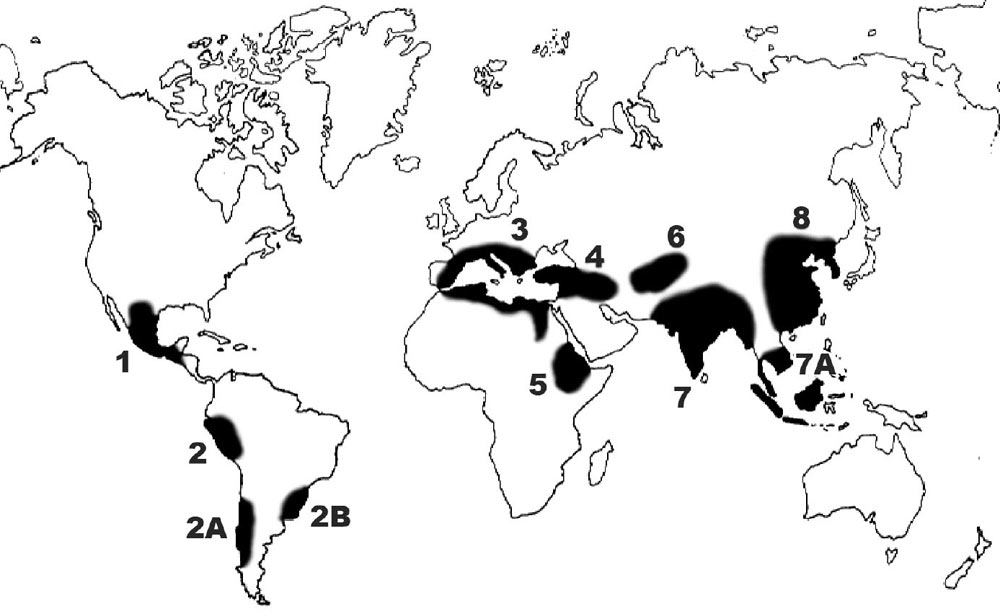
Area where domestication traits arise
A Vavilov centre or centre of origin is a geographical area where a group of organisms, either domesticated or wild, first developed its distinctive properties. Centers of origin were first identified in 1924 by Nikolai Vavilov. Vavilov posited that the center of origin for a species or genus is the same as its center of diversity, the geographic area where it has the highest genetic diversity, but this equivalence has been disputed by later scholars.
Plants
Locating the origin of crop plants is basic to plant breeding. This allows one to locate wild relatives, related species, and new genes (especially dominant genes, which may provide resistance to diseases). Knowledge of the origins of crop plants is important in order to avoid genetic erosion, the loss of germplasm due to the loss of ecotypes and landraces, loss of habitat (such as rainforests), and increased urbanization. Germplasm preservation is accomplished through gene banks (largely seed collections but now frozen stem sections) and preservation of natural habitats (especially in centers of origin).
Vavilov centers

A Vavilov Center (of Diversity) is a region of the world first indicated by Nikolai Vavilov to be an original center for the domestication of plants. For crop plants, Nikolai Vavilov identified differing numbers of centers: three in 1924, five in 1926, six in 1929, seven in 1931, eight in 1935 and reduced to seven again in 1940.
Vavilov argued that plants were not domesticated somewhere in the world at random, but that there were regions where domestication started. The center of origin is also considered the center of diversity.
Schery (1972) and Janick (2002)
Vavilov centers are regions where a high diversity of crop wild relatives can be found, representing the natural relatives of domesticated crop plants.
| Center | Subcenter | Plants |
|---|---|---|
| **1) South Mexican and Central American Center** | ||
| Includes southern sections of Mexico, Guatemala, El Salvador, Honduras and Costa Rica. | ||
| **2) South American Center** | ||
| 62 plants listed; three subcenters | ***2) Peruvian, Ecuadorean, Bolivian Subcenter*** | |
| ***2A) Chiloé Subcenter*** | ||
| ***2B) Brazilian-Paraguayan Subcenter*** | ||
| **3) Mediterranean Center** | ||
| Includes all of Southern Europe and Northern Africa bordering the Mediterranean Sea. 84 listed plants | ||
| **4) Middle East** | ||
| Includes interior of Asia Minor, all of Transcaucasia, Iran, and the highlands of Turkmenistan. 83 species | ||
| **5) Abyssinian Center** | ||
| Includes Ethiopia, Eritrea, and part of Somalia. 38 species listed; rich in wheat and barley. | ||
| **6) Central Asiatic Center** | ||
| Includes Northwest India (Punjab, Northwest Frontier Provinces and Kashmir), Afghanistan, Tajikistan, Uzbekistan, and western Tian-Shan. 43 plants | ||
| **7) Indian Center** | ||
| Two subcenters | ***7) Indo-Burma Subcenter*** | |
| Main Center (India): Includes Assam, Bangladesh and Burma, but not Northwest India, Punjab, nor Northwest Frontier Provinces, 117 plants | ||
| ***7A) Siam-Malaya-Java Subcenter*** statt Indo-Malayan Center | ||
| Includes Indo-China and the Malay Archipelago, 55 plants | ||
| **8) Chinese Center** | ||
| A total of 136 endemic plants in the largest independent center |
Purugganan and Fuller (2009)
| Center | Plants | Years before present |
|---|
References
References
- (2009). "International Treaty on Plant Genetic Resources for Food and Agriculture". Food and Agriculture Organization of the United Nations.
- Singh, Dhan Pal. (January 1, 2021). "Plant Breeding and Cultivar Development". Academic Press.
- (2003). "Farmers and Their Languages: The First Expansions". Science.
- Blaine P. Friedlander Jr. (June 20, 2000). "Cornell and Polish research scientists lead effort to save invaluable potato genetic archive in Russia".
- Vavilov, N. I.. (1992). "Origin and Geography of Cultivated Plants". Cambridge University Press.
- Corinto, Gian Luigi. (2014). "Nikolai Vavilov's Centers of Origin of Cultivated Plants With a View to Conserving Agricultural Biodiversity". Human Evolution.
- Adapted from Vavilov (1951) by R. W. Schery, Plants for Man, Prentice Hall, Englewood Cliffs, NJ, 1972
- History of Horticulture, Jules Janick, Purdue University, 2002
- (April 21, 2014). "Archaeological and genetic insights into the origins of domesticated rice". Proceedings of the National Academy of Sciences.
- (2009). "The nature of selection during plant domestication". [[Nature Research]].
This article was imported from Wikipedia and is available under the Creative Commons Attribution-ShareAlike 4.0 License. Content has been adapted to SurfDoc format. Original contributors can be found on the article history page.
Ask Mako anything about Vavilov center — get instant answers, deeper analysis, and related topics.
Research with MakoFree with your Surf account
Create a free account to save articles, ask Mako questions, and organize your research.
Sign up freeThis content may have been generated or modified by AI. CloudSurf Software LLC is not responsible for the accuracy, completeness, or reliability of AI-generated content. Always verify important information from primary sources.
Report