From Surf Wiki (app.surf) — the open knowledge base
Valley of Elah
Geographical place mentioned in the Bible
Geographical place mentioned in the Bible
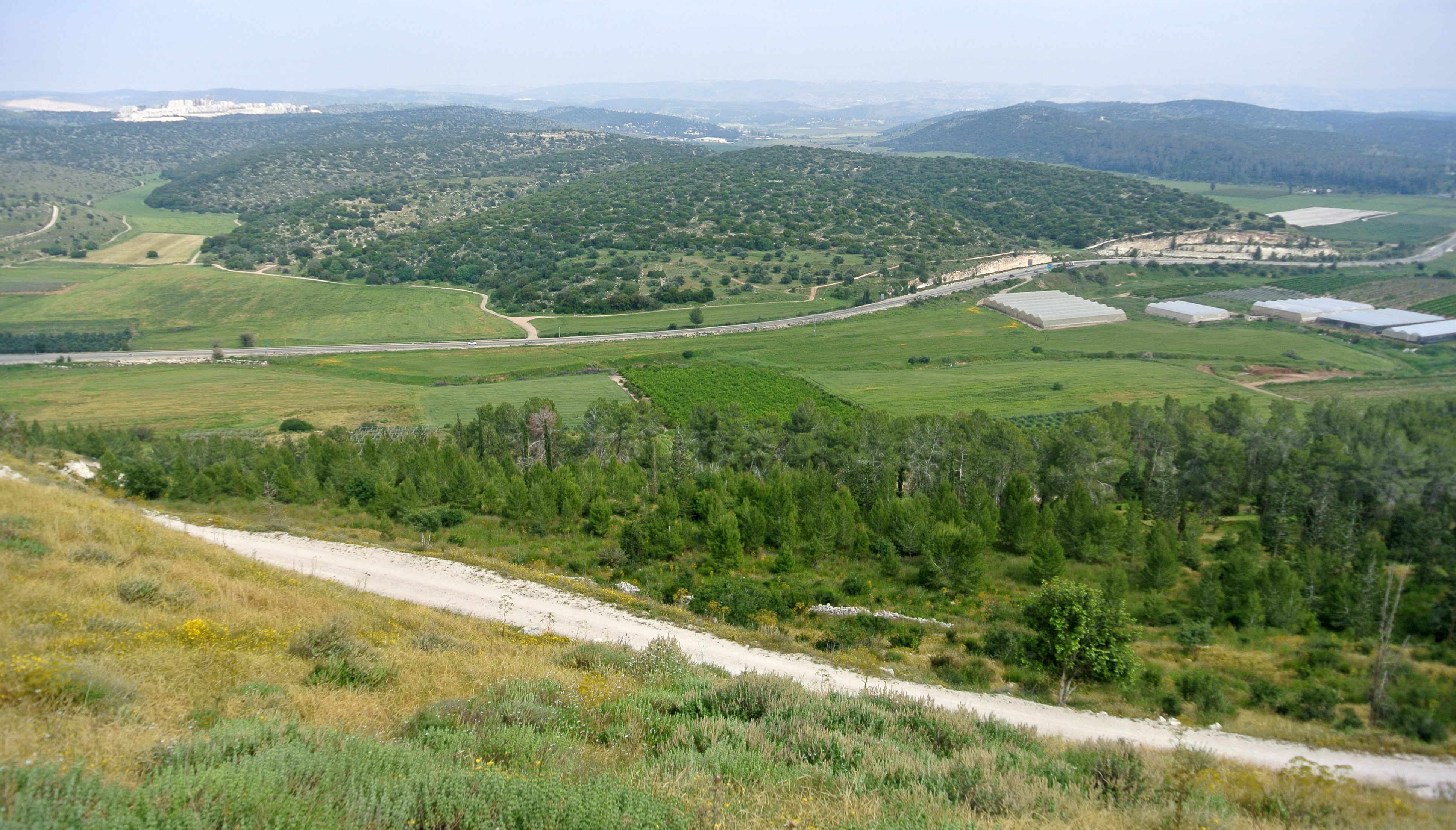
The Valley of Elah, Ella Valley ("Valley of the terebinth"; from the ), or Wadi es-Sunt (), is a long, shallow valley in the Shephelah area of Israel. It is best known from the Hebrew Bible incident where David defeated Goliath (1 Samuel 17:2 and 19). It is home to several important archaeological sites, including those identified as the ancient towns of Azekah and Sokho (1 Samuel 17:1). Rising from the valley on its extreme southeast end lies the hilltop ruin Adullam, and on its north lie the ruins of the ancient fortress city of Khirbet Qeiyafa, which is identified with the ancient town of Shaaraim mentioned in 1 Samuel 17:52.
The valley is named after its indigenous trees: in Hebrew after the large and shady terebinth trees (Pistacia terebinthus and P. palaestina), and in Arabic for the white acacia trees (Faidherbia). On the west side of the valley, near Socho, there is a huge and ancient terebinth, 55 ft in height with a trunk 17 ft in circumference and a canopy at least 75 ft in diameter. This tree is notable for being one of the largest terebinths in the area, and marks the valley's upper end.[[File:Elah Valley - Passover 2014.jpg|thumb|right|Extension of Elah Valley on its southeastern side, Wadi es-Sur]]
Since the early 1970s, the valley has also contained a large satellite relay station, with an antenna farm containing some 120 satellite dishes of various sizes. From 2010 to 2014, the region around the valley was believed to be threatened by shale oil extraction through the CCR ground-heating process, with the Green Zionist Alliance (now Aytzim) and the grassroots group , among others, working to stop exploitation of the region. The plan was ultimately blocked in 2014 by a zoning committee decision. In July 2019, the Elah Valley came under the Israel Nature and Parks Authority, owing mainly to its historical importance and the desire to curtail the encroaching city limits of Beit Shemesh to its north.
History
In 2009, Professor Yosef Garfinkel discovered a fortified city from the Iron Age II dated sometime between 1050 and 915 BC at Khirbet Qeiyafa, southwest of Jerusalem in the Elah Valley. The fortifications have been said to support the biblical account of the United Monarchy, the theory that Israel in the time of King David at the beginning of Iron Age II was more than simply a tribal chiefdom. Others are skeptical and suggest it might represent either a Judahite or Canaanite fortress.
Flora and fauna
.JPG)
Numerous plant species are native to the Elah Valley, including:
- Terebinth (Pistacia terebinthus)
- Kermes oak (Quercus coccifera)
- Buckthorn (Rhamnus lycioides)
- Carob (Ceratonia siliqua)
- Sweet marjoram (Origanum syriacum)
- Sage (Salvia fruticosa)
- Khella (Visnaga daucoides)
- Fennel (Foeniculum vulgare)
- Anemone (Anemone coronaria)
- Cyclamen (Cyclamen persicum)
- Lupine (Lupinus pilosus)
- Daisy (Glebionis coronaria)
- Syrian cornflower-thistle (Centaurea cyanoides, rare)
- Mallow (Malva nicaeensis)
- Asparagus (Asparagus palaestinus Baker)
- Chicory (Cichorium pumilum; syn. Cichorium endivia)
- Broom lettuce (Lactuca serriola)
- Stinging nettle (Urtica urens)
- Asphodel (Asphodelus aestivus)
- Wild oat (Avena sterilis)
- Wild barley (Hordeum spontaneum; syn. H. ithaburense)
- White mustard (Sinapis alba)
- Arum; cuckoo-pint (Arum palaestinum)
- Caper (Capparis spinosa)
- Wild carrot (Daucus carota)
- Globe-thistle (Echinops adenocaulos)
- Ciliate vetchling (Lathyrus blepharicarpus)
- Spiny broom (Calicotome villosa)
- White acacia (Faidherbia)


Animal species native to the Elah Valley include:
- Mountain gazelle (Gazella gazella)
- Syrian jackal (Canis aureus syriacus)
- Arabian red fox (Vulpes thaleb)
- Crested porcupine (Hystrix cristata)
- Egyptian mongoose (Herpestes ichneumon)
- Southern white-breasted hedgehog (Erinaceus concolor)
- Middle East blind mole-rat (Spalax ehrenbergi; syn. Nannospalax ehrenbergi)
- Greek tortoise (Testudo graeca)
- Günther's vole (Microtus guentheri)
- Sheltopusik (Pseudopus apodus)
References
Gallery
File:View_of_Elah_Valley_from_atop_Aderet,_March_2015.jpg|Panoramic view of Elah Valley and Neve Michael as seen from atop Moshav Aderet File:Elah Valley below Adullam.jpg|The Valley of Elah, near Adullam File:Elah_Valley_as_seen_from_Tel_Socho,_Feb._2015.jpg|Elah Valley as seen from atop of Tel Socho File:Elah_Valley_from_Tel-Socho,_Feb.2015.jpg|View of Elah Valley, looking east from atop of Tel Socho File:The Elah Valley, en route to Tel Socho, Feb 2015.jpg|Elah Valley, en route to Tel Socho File:Elah Valley Wheat Fields.jpg|Elah valley in Spring, with ripening grain File:Crown_Daisy(Chrysanthemum_coronarium),_March_2015.jpg|Crown daisy (Glebionis coronaria) File:Pistacia atlantica, Elah Valley, June 2015.jpg|Pistacia atlantica, from which the valley takes its name File:Pistacia atlantica, in sunlight.jpg|Beneath the shady boughs of a Persian turpentine tree (Pistacia atlantica) in the Elah valley File:Asphodel flowers.jpg|Asphodel in blossom, in the Elah Valley
References
- Elah, ''Langenscheidt's Hebrew Dictionary'', Dr Karl Feyerabend
- Krantz, David. (1 May 2011). "Israel: The New Saudi Arabia?". Jewcology.
- Cheslow, Daniella. (18 Dec 2011). "Shale oil project raises hackles in Israel". AFP.
- Laylin, Tafline. (5 March 2013). "Saudi Turns to Solar, Israel Stuck on Shale". Green Prophet.
- link
- (2019). "The Elah Valley Declared a National Park". Rubin Publishers.
- “Newly Discovered: A Fortified City from King David’s Time,” Biblical Archaeology Review 35.1 (2009): 38, 40–43.[https://www.baslibrary.org/biblical-archaeology-review/35/1/8]
- Govier, Gordon "Archaeology: What an Ancient Hebrew Note Might Mean" ''Christianity Today'' 1/18/2010 [http://www.christianitytoday.com/ct/2010/januaryweb-only/13-11.0.html]
- Julia Fridman, [https://www.haaretz.com/archaeology/.premium-1.543216 'Crying King David: Are the ruins found in Israel really his palace? ,'] at [[Haaretz]], 26 August 2013.
- C.R. Conder & H.H. Kitchener, ''The Survey of Western Palestine'', vol. III, London 1883, p. 298
This article was imported from Wikipedia and is available under the Creative Commons Attribution-ShareAlike 4.0 License. Content has been adapted to SurfDoc format. Original contributors can be found on the article history page.
Ask Mako anything about Valley of Elah — get instant answers, deeper analysis, and related topics.
Research with MakoFree with your Surf account
Create a free account to save articles, ask Mako questions, and organize your research.
Sign up freeThis content may have been generated or modified by AI. CloudSurf Software LLC is not responsible for the accuracy, completeness, or reliability of AI-generated content. Always verify important information from primary sources.
Report