From Surf Wiki (app.surf) — the open knowledge base
Valladolid
| Field | Value |
|---|---|
| name | Valladolid |
| settlement_type | Municipality |
| official_name | |
| image_skyline | {{Multiple image |
| perrow | 1/1/2/1 |
| border | infobox |
| total_width | 280 |
| caption_align | center |
| image1 | Ciudad de Valladolid, desde el aire edited.jpg |
| caption1 | Panoramic view |
| image2 | Plaza Mayor Valladolid1 edited.jpg |
| caption2 | The Town Hall in the Plaza Mayor |
| image3 | Church of San Pablo 2023 - Main Façade.jpg |
| caption3 | Church of San Pablo |
| image4 | Valladolid Cathedral 2023 - Main Façade with Sunstar.jpg |
| caption4 | Cathedral of the Assumption |
| image5 | 2021-05-15 Valladolid 2 edited.jpg |
| caption5 | Landscaped sign installed in the Campo Grande; and the |
| image_flag | Bandera valladolid.svg |
| image_shield | Valladolid-COA.svg |
| mapframe | yes |
| mapframe-zoom | 9 |
| mapframe-point | none |
| mapframe-caption | Interactive map of Valladolid |
| map_caption | Location of Valladolid |
| pushpin_map | Spain Castile and León#Spain |
| pushpin_relief | 1 |
| subdivision_type | Country |
| subdivision_name | Spain |
| subdivision_type1 | Autonomous community |
| subdivision_name1 | Castile and León |
| subdivision_type2 | Province |
| subdivision_name2 | Valladolid |
| seat_type | |
| coordinates | |
| elevation_m | 698 |
| area_total_km2 | 197.47 |
| established_title | Founded |
| established_date | 1072 |
| population_as_of | 2024 |
| population_footnotes | |
| population_total | 299816 |
| population_demonym | Vallisoletan |
| Vallisoletano, -a | |
| pucelano, -a (informal) | |
| population_density_km2 | auto |
| timezone | CET |
| utc_offset | +1 |
| timezone_DST | CEST |
| utc_offset_DST | +2 |
| postal_code_type | Postal code |
| postal_code | 47001–47016 |
| area_code_type | Dialing code |
| area_code | 983 |
| leader_title | Mayor |
| leader_name | Jesús Julio Carnero (2023) |
| government_type | *ayuntamiento* |
| governing_body | Ayuntamiento de Valladolid |
| website |
| mapframe-zoom = 9 | mapframe-point = none | mapframe-caption = Interactive map of Valladolid
Vallisoletano, -a pucelano, -a (informal)
Valladolid ( ; ) is a city in Spain and the largest city as well as primary seat of government and de facto capital of the autonomous community of Castile and León. It is also the capital of the province of Valladolid. With a population of 299,816, it is the 13th largest municipality in Spain.
The city is located roughly in the centre of the northern half of the Iberian Peninsula's Meseta Central, at the confluence of the Pisuerga and Esgueva rivers 15 km before they join the Duero, surrounded by winegrowing areas. The area was settled in pre-Roman times by the Celtic Vaccaei people, and then by Romans themselves. The settlement was purportedly founded after 1072, growing in prominence within the context of the Crown of Castile, being endowed with fairs and different institutions such as a collegiate church, University (1241), Royal Court and Chancellery and a royal mint.
Valladolid was the location of Europe's first moral debate on the treatment of indigenous people and is the city in which Christopher Columbus died. It was briefly the capital of Habsburg Spain between 1601 and 1606. The city then declined until the arrival of the railway in the 19th century, and with its industrialisation into the 20th century.
The old town is made up of a variety of historic houses, palaces, churches, plazas, avenues and parks, and includes the National Museum of Sculpture as well as the houses of Zorrilla and Cervantes which are open as museums. Notably, the city's Plaza Mayor was the first of its kind in Spain, dating back to the thirteenth century. It was eventually used as a model for similar plazas such as Plaza Mayor in Madrid.
Among the events that are held each year in the city are the famous Holy Week, the World Jigsaw Puzzle Championships, and the Valladolid International Film Festival (Seminci). In 2019, Valladolid was recognised as a City of Film as part of UNESCO's Creative Cities Network. Together with another 15 surrounding municipalities, it belongs to an urban community of around 404,000 inhabitants.
Name
There is no direct evidence for the origin of the modern name of Valladolid.
It is mentioned as Valledolit in the Primera Crónica General; earlier documented variants include Valledolidi, Valleolide (1092) and Valleolit, Valleoleti, Valleoliti (1095).
One widely held etymological theory suggests that the modern name Valladolid derives from the Celtiberian language expression Vallis Tolitum, meaning "valley of waters", referring to the confluence of rivers in the area.
Another theory suggests that the name derives from the Arabic expression (, Balad al-Walid), which is the Arabic exonym currently used and means 'city of al-Walid', referring to Al-Walid I.
Yet a third claims that it derives from Vallis Olivetum, meaning 'valley of the olives'; however, no olive trees are found in that terrain. Instead, innumerable pine trees abound in the south part of the city. The gastronomy reflects the importance of the piñón (pine nut) as a local product, rather than olives.
In texts from the Middle Ages the town is called Vallisoletum, meaning 'sunny valley', and inhabitants are still called today Vallisoletano (male) and Vallisoletana (female).
The city is also popularly called Pucela, a nickname whose origin is not clear, but may refer to knights in the service of Joan of Arc, known as La Pucelle. Another theory is that Pucela comes from the fact that Pozzolana cement was sold there, the only city in Spain that sold it.
History
Precedents
The Vaccaei were a Celtic tribe, the first people documented as a stable presence on the sector of the middle valley of the River Duero.
Remains of Celtiberian and of a Roman camp have been excavated near the city. The nucleus of the city was originally located in the area of the current San Miguel y el Rosarillo square and was surrounded by a palisade. Proofs of the existence of three ancient lines of walls have been found.
After the Muslim invasion in Spain in 711, the Christian kings moved the population of the Douro basin into more easily defended areas and deliberately created a no man's land as a buffer zone against Muslim encroachment from the south. The area was reconquered by the Christian king Alfonso I of Asturias who reigned in 739-757, but because the area was close to the frontier, it had a small population until after the Christians had secured the entire Douro basin in the battle of Simancas, in 939.
Repopulation and growth
In 1072 Alfonso VI of León and Castile gave the Lordship of Valladolid to Count Pedro Ansúrez. Entrusted with the repopulation of the area, Ansúrez led the foundation of Valladolid along with his wife . By 1084 the project for the foundation of the settlement was already underway. Ansúrez built a palace (now lost) and La Antigua church. Eylo founded three hospitals and the Churches of San Sebastián and San Nicolás. Both co-founded the church of Santa María. Valladolid was repopulated by people from the lands of Carrión and Saldaña.
In the 12th and 13th centuries, Valladolid grew rapidly, favoured by the commercial privileges granted by the kings Alfonso VIII and Alfonso X.
Early modern period
In 1469, Queen Isabella I of Castile and King Ferdinand II of Aragon were married in the city; by the 15th century Valladolid was the residence of the kings of Castile. In 1506, Christopher Columbus died in Valladolid "still convinced that he had reached the Indies" in a house that is now a museum dedicated to him.
From 1554 to 1559, Joanna of Austria, sister of Philip II, served as regent, establishing herself in Valladolid, with the latter becoming the political center of the Hispanic Monarchy by that time. She favoured the Ebolist Party, one of the two leading factions of the Court of Philip II, in competition with the albistas. The Reformation took hold in some parts of the city where Protestant circles appeared presumably around the leading figure of Augustino de Cazalla, an adviser of Joanna. Ensuing autos de fe against the Protestant sects took place in 1559 in Valladolid. A catastrophic fire in 1561 destroyed a portion of the city.
During 1550–1551 the town held the first moral debate in European history to discuss the rights and treatment of the indigenous people by conquerors.
Valladolid was granted the status of city in 1596, also becoming a bishopric.
In the midst of the reign of Philip III, Valladolid briefly served as the capital of the Hispanic Monarchy between 1601 and 1606 under the auspice of the Duke of Lerma, valido of Philip III. Lerma and his network had bought plots in Valladolid before in order to sell those to the Crown. Promoted by Lerma, the decision on moving the capital from Madrid to Valladolid has been portrayed as case of a (double) real estate speculative scheme, as Lerma had bought housing in Madrid as the prices plummeted when the capital was moved from the city.
The city was again damaged by a flood of the rivers Pisuerga and Esgueva.
Contemporary history

From 1950 onwards Valladolid became an important industrial centre. This was the context in which companies such as ENDASA (1950), FASA (1954), TECNAUTO (1956) and SAVA (1957) were created. The city was declared as a Polo de Desarrollo Industrial ("Pole for Industrial Development") in 1964. During the 1960 and early 1970s the city attracted many immigrants, chiefly coming from the province of Valladolid and neighbouring provinces. The city started to expand across the western bank of the Pisuerga in the early 1960s.

In the context of the fraught process for the creation of the autonomous community of Castile and León (completed in 1983), Valladolid vied for the condition of regional capital, competing with other cities, most notably creating a sense of antagonism with Burgos. Although the capital was not explicitly enshrined in the from 1983, Valladolid was designated in 1987 as the de jure seat of the executive and legislative institutions (the Junta of Castile and León and the Cortes of Castile and León).
25 June 2024, the church de la Vera Cruz built in 1581 broke down, causing dust to encircle the whole city. This accident was supposedly due to renovation works.
Jewish History
The earliest documented presence of a Jewish community in Valladoilid dates to 1221. In 1288, Sancho IV prohibited Jews from acquiring land in Valladolid and the surrounding area. In 1322, Christians were prohibited from being treated by Jewish doctors, and could not attend Jewish or Muslim weddings. Furthermore, Jews were barred from positions of public office. In the early 15th century, the Laws of Valladolid were passed with anti-Jewish legislation. These laws stripped the Jews of Valladolid of their autonomy, which included the right to have their own court system. Additionally, Jews and Moors were prohibited from leaving Castille. In 1432, however, officials in Valladolid met with Don Abraham Benveniste in the Jewish quarter of the city, and agreed to restore Jewish autonomy. Converso poet Juan de Valladolid wrote poems criticizing treatment of Jews in Valladolid. Jewish life in Valladolid was nonexistent in the 16th century, after the expulsion of the Jews.
Geography

Valladolid is located at roughly 735 metres above sea level, at the centre of the Meseta Norte, the plateau drained by the Duero river basin covering a major part of the Northwest of the Iberian Peninsula. The primitive urban core was built ex novo in the 11th century on a small elevation near the confluence of the Esgueva with the Pisuerga, on the left-bank of the latter river. The city of Valladolid currently lies on both banks of the Pisuerga, a major right-bank tributary of the Douro.
Besides the main territory on which the city lies, the municipality also includes two exclaves: Navabuena (5,129 hectares, hosting the ) and El Rebollar (400 hectares).
Climate
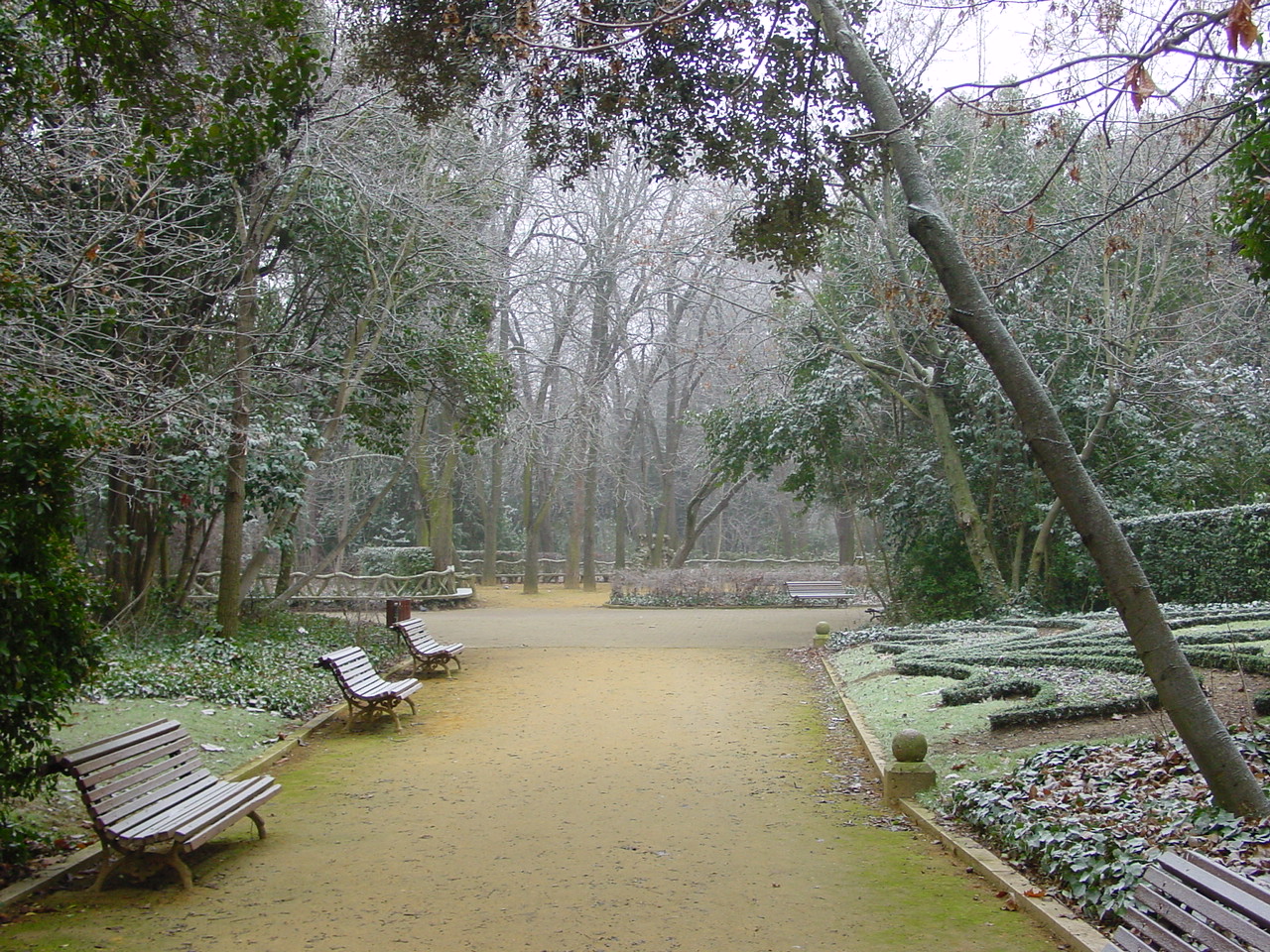
The city of Valladolid experiences a continentalized hot-summer Mediterranean climate (Köppen: Csa; Trewartha: Doak) with influences of a cold semi-arid climate (Köppen: BSk; Trewartha: BSak). Valladolid's climate features cool and windy winters due to altitude and the inland location of the city. Fog is very typical in the morning during winter. Winters experience occasional snow and low temperatures below freezing during cold fronts. Valladolid's climate is influenced by the distance from the sea and its higher altitude.
Valladolid is drier than Spain's northern coastal regions, although there is year-round precipitation. Average annual precipitation is 433 mm and the average annual relative humidity is 64%.
WMO ID: 08141; Climate ID: 2422; coordinates ; elevation: 734 m; 1991–2020 provisional normals, extremes 1973–present{{cite web |access-date = 13 November 2024 |archive-url = https://web.archive.org/web/20241113115453/https://opendata.aemet.es/opendata/sh/4a2f221b |archive-date = 2024-11-13}} |Jan record high C = 18.0 |Feb record high C = 22.9 |Mar record high C = 26.6 |Apr record high C = 30.1 |May record high C = 34.5 |Jun record high C = 39.8 |Jul record high C = 41.1 |Aug record high C = 40.0 |Sep record high C = 38.2 |Oct record high C = 33.3 |Nov record high C = 24.0 |Dec record high C = 21.4 |Jan avg record high C = 14.0 |Feb avg record high C = 17.3 |Mar avg record high C = 22.1 |Apr avg record high C = 25.2 |May avg record high C = 30.1 |Jun avg record high C = 35.4 |Jul avg record high C = 37.2 |Aug avg record high C = 36.9 |Sep avg record high C = 32.5 |Oct avg record high C = 25.9 |Nov avg record high C = 19.1 |Dec avg record high C = 14.4 |year avg record high C = 38.0 |Jan avg record low C = -4.8 |Feb avg record low C = -4.0 |Mar avg record low C = -2.2 |Apr avg record low C = -0.4 |May avg record low C = 2.5 |Jun avg record low C = 6.4 |Jul avg record low C = 9.3 |Aug avg record low C = 9.5 |Sep avg record low C = 6.1 |Oct avg record low C = 1.8 |Nov avg record low C = -1.9 |Dec avg record low C = -4.5 |year avg record low C = -6.3 |Jan record low C = -11.0 |Feb record low C = -11.5 |Mar record low C = -10.2 |Apr record low C = -6.0 |May record low C = -1.7 |Jun record low C = 2.6 |Jul record low C = 3.2 |Aug record low C = 3.6 |Sep record low C = 0.0 |Oct record low C = -3.4 |Nov record low C = -6.8 |Dec record low C = -10.8 |access-date = 24 December 2020}}{{cite web |access-date = 2022-07-16}}{{cite web |access-date = 16 December 2024 |archive-url = https://web.archive.org/web/20241212032502/https://opendata.aemet.es/opendata/sh/b62ba7df |archive-date = 2024-12-12}}{{cite web |access-date = 16 December 2024 |archive-url = https://web.archive.org/web/20241216152706/https://opendata.aemet.es/opendata/sh/0c2da701 |archive-date = 2024-12-16}}{{cite web |access-date = 2024-11-13}} |archive-url = https://web.archive.org/web/20240329103401/https://www.nodc.noaa.gov/archive/arc0216/0253808/2.2/data/0-data/Region-6-WMO-Normals-9120/Spain/CSV/CADIZOBS_8452.csv |archive-date = 29 March 2024}}--}}
|access-date = 16 December 2024 |archive-url = https://web.archive.org/web/20241216153943/https://www.aemet.es/en/serviciosclimaticos/datosclimatologicos/valoresclimatologicos?l=2422&k=47 |archive-date = 2024-12-16 |access-date = 1 October 2023}}
Administration

Valladolid is a municipality, the basic local administrative division in Spain. The Ayuntamiento de Valladolid is the body charged with the municipal government and administration. The Plenary of the ayuntamiento is formed by 27 elected municipal councillors, who in turn invest the mayor. The last municipal election took place on 26 May 2019. Since 2015, Óscar Puente (PSOE) serves as Mayor. He renewed his spell for a second mandate following the 2019 election.
Demographics
As of 2024, the population of the city proper of Valladolid is 299,816, and the population of the entire urban area is estimated to be 406,923 as of 2015. The most important municipalities of the urban area are (after Valladolid itself) Laguna de Duero and Boecillo on the south, Arroyo de la Encomienda, Zaratán, Simancas and Villanubla on the west, Cigales and Santovenia de Pisuerga on the north, and Tudela de Duero and Cistérniga on the east.
After new neighbourhoods developed in recent decades, like Covaresa, the high prices in the municipality led young people to buy properties in towns around the city, due to which the population has fallen in Valladolid but is growing fast in other peri-urban areas (for example, Arroyo de la Encomienda or Zaratán).
As of 2024, the foreign-born population of the city is 33,307, equal to 11.1% of the total population.
| Nationality | Population |
|---|---|
| Colombia | 5,274 |
| Morocco | 3,997 |
| Venezuela | 2,993 |
| Dominican Republic | 2,445 |
| Bulgaria | 1,690 |
| Peru | 1,683 |
| Ecuador | 1,477 |
| Brazil | 1,299 |
| Romania | 1,264 |
| Cuba | 913 |
| France | 887 |
| Argentina | 781 |
| Bolivia | 700 |
| Ukraine | 607 |
| China | 573 |
Economy
Valladolid is a major economic center in Spain. The automotive industry is one of the major motors of the city's economy since the founding of FASA-Renault in 1953 for the assembling of Renault branded vehicles, which would later become Renault España. Four years later, in 1957, Sava was founded and started producing commercial vehicles. Sava would later be absorbed by Pegaso and since 1990 by the Italian truck manufacturer Iveco. Together with the French tire manufacturer Michelin, Renault and Iveco form the most important industrial companies of the city.
Besides the automotive and automotive auxiliary industries, other important industrial sectors are food processing (with local companies like Acor and Queserías Entrepinares and facilities of multinationals like Cadbury, Lactalis or Lesaffre), metallurgy (Lingotes Especiales, Saeta die Casting...), chemical and printing. In total 22 013 people were employed in 2007 in industrial workplaces, representing 14.0% of total workers.
The main economic sector of Valladolid in terms of employment is however the service sector, which employs 111,988 people, representing 74.2% of Valladolid workers affiliated to Social Security.
The construction sector employed 15,493 people in 2007, representing 10.3% of total workers.
Finally, agriculture is a tiny sector in the city which only employs 2,355 people (1.5% of the total). The predominant crops are wheat, barley and sugar beet.
Top 10 companies by turnover in 2013 in € million were: Renault (4 596), Michelin (2 670), Iveco (1 600), the Valladolid-based supermarket chain Grupo El Árbol (849), cheese processing Queserías Entrepinares (204), sugar processing Acor (201), service group Grupo Norte (174), automobile auxiliary company Faurecia-Asientos de Castilla y León (143), Sada (129) and Hipereco (108).
Education
Education management and policing in Valladolid depends on the Ministry of Education of the Government of Castile and León, the department responsible for the education at the regional level, both at the university and non-university level.
Universities
University of Valladolid
Main article: University of Valladolid
The University of Valladolid (UVA) was founded in 1241 by Alfonso VIII of Castille. It is one of the oldest universities in the world. It has four campuses around the city (Huerta del Rey, Centro, Río Esgueva and Miguel Delibes) as well as another three campuses scattered around the wider region of Castile and León (Palencia, Soria and Segovia). Spread over 25 colleges and their associated centers, about 2000 teachers give classes to more than 23,800 students enrolled in 2011.
It also features the 25 centers, a number of administrative buildings such as the Palacio de Santa Cruz, where the rector, and the Museum of the University of Valladolid (MUVa), The House of Students, featuring the other administrative services mainly related to international relations, or CTI (Center for Information Technology), both located in the basement of the University Residence Alfonso VIII, next to the old Faculty of Science.
Miguel de Cervantes European University
Main article: Miguel de Cervantes European University

The Miguel de Cervantes European University (Universidad Europea Miguel de Cervantes; UEMC) is a private university with roughly 1,500 students. It is spread over three faculties: Social Sciences, Law and Economics, Health and the Polytechnic School. It has later expanded its campus with a new facility doubling the area devoted to teaching and research. It also has a dental clinic and a library.
Primary and secondary schools
Lycée Français de Castilla y León, a French international school, is near Valladolid, in Laguna de Duero. San Juán Bautista de La Salle School, a High Private College in Valladolid. Integral and Superior Education. Integrates Kindergarten, Primary School and High School.
Architecture
12th century romanesque architecture is present in the belltowers of the churches of Santa María La Antigua and .
The School of San Gregorio has been highlighted as an outstanding example Late Gothic architecture (Isabelline gothic). The Gothic style is also present in the Church of San Pablo (featuring also Renaissance and plateresque elements). The late 15th century Palace of Santa Cruz (current seat of the rectorate of the University of Valladolid) has been noted as a pioneer example of Renaissance art in Spain.
The monumental Plaza Mayor, considered the first in its genre in Spain, was projected by by 1561–62, following the great fire of 1561. The porticoed plaza distinctly employs stone columns with wooden footings and lintels. The design of the façades of the plaza served as template for a number of buildings in nearby streets.
.jpg)
The unfinished Cathedral of Valladolid, initially projected by Juan de Herrera in the 16th century (intending to follow a Mannerist style) experienced protracted building works owing to financial problems and its main body was not opened until 1668. Decades later, in 1730, finished the work on the main front.
The Teatro Lope de Vega is a theater built in the classical style in 1861 and now very run-down. There has been recent controversy over whether the city should pay to restore it.{{cite web |access-date=2011-11-10 |archive-url=https://web.archive.org/web/20131217221323/http://www.elnortedecastilla.es/20080827/valladolid/riva-confia-obras-lope-20080827.html |archive-date=17 December 2013 |url-status=dead
The Francoist dictatorship left an example of "Imperial Architecture" of neo-herrerian (or escurialense) style in the building for the Seminario Menor, clearly influenced by the Spanish capital's Ministry of the Air.
The city preserves the residences of iconic city neighbors such as the Casa de Cervantes and the house of José Zorrilla. The Christopher Columbus House-Museum, by contrast, is a 1960s reconstruction.
Transport
Public transport
Urban transit system was based on the Valladolid tram network from 1881 to 1933. A public urban bus system started in 1928, managed by different private tenders until 1982, when the service was taken over by the municipality. Today the public company AUVASA operates the network, with 22 regular lines and 5 late night lines.
High-speed rail
.jpg)
Valladolid-Campo Grande railway station is integrated into the Spanish high-speed network AVE. The Madrid–Valladolid high-speed rail line was inaugurated on 22 December 2007. The line links both cities, crossing the Sierra de Guadarrama through the namesake tunnel, the fourth longest train tunnel in Europe. Valladolid will become the hub for all AVE lines connecting the north and north-west of Spain with the rest of the country. Trainsets used on this line include S-114 (max speed 250 km/h), S-130 (Patito, max speed 250 km/h) and the S102 (Pato, max speed 320 km/h or 199 mph). This line connects the city with Madrid, which can be reached in 56 minutes.
Roads
Several highways connect the city to the rest of the country.
Airport
Main article: Valladolid Airport
The airport serving the city is not located within the municipal limits, but in Villanubla. The airport has connections to Barcelona, Málaga, and the Canary Islands.
Culture
Languages
Spanish is the only official language throughout the city. Valladolid stands out for having been the residence of the author of Don Quixote, Miguel de Cervantes, as well as authors such as José Zorrilla or Miguel Delibes and the thrust of its University. The province stands out for receiving a significant number of people who want to learn the Spanish language (Language tourism).
Easter
Main article: Holy Week in Valladolid

Holy Week ("Semana Santa" in Spanish) holds one of the best known Catholic traditions in Valladolid. The Good Friday processions are considered an exquisite and rich display of Castilian religious sculpture. On this day, in the morning, members of the brotherhoods on horseback make a poetic proclamation throughout the city. The "Sermon of the Seven Words" is spoken in Plaza Mayor Square. In the afternoon, thousands of people take part in the Passion Procession, comprising 31 pasos (religious statues), most of which date from the 16th and 17th centuries. The last statue in the procession is the Virgen de las Angustias, and her return to the church is one of the most emotional moments of the celebrations, with the Salve Popular sung in her honour.
Easter is one of the most spectacular and emotional fiestas in Valladolid. Religious devotion, art, colour and music combine in acts to commemorate the resurrection of Jesus Christ: the processions. Members of the different Easter brotherhoods, dressed in their characteristic robes, parade through the streets carrying religious statues (pasos) to the sound of drums and music.
Seminci
Main article: Seminci
The city is also host to one of the foremost (and oldest) international film festivals, the Semana Internacional de Cine de Valladolid (Seminci), founded in 1956. Valladolid, through various loopholes in state censorship, was able to present films that would otherwise have been impossible to see in Spain. An award or an enthusiastic reception from the audience and the critics meant, on numerous occasions, that the official state bodies gave the go-ahead to certain films which Francisco Franco's regime considered out of line with their ideology.
Even after the death of Franco in 1975, Valladolid continued to be the "testing ground" for films which had been banned. For example, the premiere in Spain of Stanley Kubrick's A Clockwork Orange at the 1975 festival is still recalled as a landmark.
Local cuisine
Main article: Cuisine of the province of Valladolid

Although an inland province, fish is commonly consumed, some brought from the Cantabrian Sea. Fish like red bream and hake are a major part of Valladolid's cuisine.
The main speciality of Valladolid is, however, lechazo (suckling baby lamb). The lechazo is slowly roasted in a wood oven and served with salad.
Valladolid also offers a great assortment of wild mushrooms. Asparagus, endive and beans can also be found. Some legumes, like white beans and lentils are particularly good. Pine nuts are also produced in great quantities.
Sheep cheese from Villalón de Campos, the famous pata de mulo (mule's foot) is usually unripened (fresh), but if it is cured the ripening process brings out such flavour that it can compete with the best sheep cheeses in Spain.
Valladolid has a bread to go with every dish, like the delicious cuadros from Medina del Campo, the muffins, the pork-scratching bread and the lechuguinos, with a pattern of concentric circles that resemble a head of lettuce.
The pastries and baked goods from the province of Valladolid are well-known, specially St. Mary's ring-shaped pastries, St. Claire's sponge cakes, pine nut balls and cream fritters.
Valladolid is also a producer of wines. The ones that fall under the Designation of Origin Cigales are very good. White wines from Rueda and red wines from Ribera del Duero are known for their quality.
Sports
Valladolid's main association football club is Real Valladolid, nicknamed Pucela, who play in the country's second-tier league, LaLiga Hypermotion. Players who went on to play for the Spain national football team include Fernando Hierro, José Luis Caminero and Rubén Baraja. The municipally owned stadium where Real Valladolid play their home matches, the Estadio Nuevo José Zorrilla, was built as a venue for the 1982 FIFA World Cup and in preparation staged the 1982 Copa del Rey Final.
Real Valladolid Baloncesto is the city's new basketball team since the dissolution of CB Valladolid in 2015. Arvydas Sabonis and Oscar Schmidt played for the latter team. Currently playing in the Segunda FEB, the CBC Valladolid matches are held at the Polideportivo Pisuerga.
In handball Valladolid was represented by BM Valladolid of the Liga ASOBAL. They won 2 King's Cup, 1 ASOBAL Cup and 1 EHF Cup Winners' Cup. After the disappearance of this club, BM Atlético Valladolid was born, which also competes in the Liga ASOBAL. They play their games at the Polideportivo Huerta del Rey.
Rugby union is a very popular sport in Valladolid. VRAC and CR El Salvador, with 37 and 28 titles respectively, have dominated Spanish rugby for the last decades. They play their matches at Estadio Pepe Rojo.
The , a bullring, opened on 29 September 1890, and it has a capacity of 11,000.
International relations
Twin towns – sister cities
Valladolid is twinned with:
- Florence, Italy (2007)
- Lecce, Italy (2009)
- Lille, France (1987)
- Morelia, Michoacán, Mexico (1978)
- Orlando, Florida, United States (2006)
Other partnerships
Valladolid cooperates with:
- Ahmedabad, Gujarat, India
- Boston, Massachusetts, United States
- Guadalajara, Jalisco, Mexico
- Kenitra, Morocco
- Lovech, Bulgaria (2004)
Notable people
- Anne of Austria (1601–1666), Queen of France
- Miriam Blasco (born 1963), judoka
- María Mercedes Capa Estrada (born 1970), goalball athlete
- José Manuel Capuletti (1925–1978), painter
- Jesús Cifuentes (born 1966), singer and founder of Celtas Cortos
- Miguel Delibes (1920–2010), writer
- Francis Ferdinand de Capillas (1607–1648), protomartyr saint of China
- Justo Garrán Moso (1867–1942), Traditionalist politician
- Alberto García (born 1970), musician for Celtas Cortos
- Henry IV of Castile (1425–1474), King of Castile and León, brother of Isabella I of Castile
- Cecilia del Nacimiento (1570–1646), nun, mystic, writer, and poet
- Aodh Ruadh Ó Domhnaill, also known as Red Hugh O'Donnell (1572–1602), Irish Gaelic chieftain, buried here
- Philip II of Spain (1527–1598), King of Spain and Portugal and jure uxoris King of England and Ireland
- Philip IV of Spain (1605–1665), King of Spain and Portugal
- Roldán Rodríguez (born 1984), racing driver
- Sancho the Brave (1258–1295), King of Castile
- Carlos Soto (born 1968), musician and founder of Celtas Cortos
- Juan de Torquemada (1388–1468), Bishop and Cardinal
- Goyo Yeves (born 1968), musician and founder of Celtas Cortos
- José Luis Rodríguez Zapatero (born 1960), Spanish Prime Minister
- José Zorrilla (1817–1893), writer
- Juan de Valladolid (1420-?), a converso poet and astrologer
References
;Informational notes
;Citations
;Bibliography
References
- "Annual population census 2021-2024". [[National Statistics Institute (Spain).
- (23 February 2012). "Constituida la Comunidad Urbana de Valladolid, que agrupa a la capital y 15 municipios del entorno".
- Marín, Manuela et al., eds. 1998. The Formation of Al-Andalus: History and Society. Ashgate. {{ISBN. 0-86078-708-7
- [[Muhammad ibn Jarir al-Tabari]], v. 23 The Zenith of the Marwanid House, transl. Martin Hinds, Suny, Albany, 1990
- (28 September 2018). "De anonimato a ciudad próspera, Valladolid evocará 900 años de su repoblación".
- Roger Crowley. ''Conquerors: How Portugal Forged the First Global Empire''. NY: Random House, 2015, p. 161
- (26 March 2019). "El Duque de Lerma, precursor de la corrupción Inmobiliaria en España".
- (9 April 2018). "¿Cómo dio el 'pelotazo' el Duque de Lerma?".
- "Los pasos de la caída de la Vera Cruz".
- "Valladolid".
- Cabarga, Gloria. (17 November 2019). "¿Por qué no nieva en Valladolid?".
- Pascual, Daniel. (14 February 2008). "Valladolid tiene su 'Alaska' situado a 20 kilómetros del centro de la ciudad".
- Becerro Alonso, Sara. (27 December 2019). "La niebla de todos los días. ¿Por qué se produce?".
- "Ayuntamiento de Valencia". Ayuntamiento de Valencia.
- (15 June 2019). "Óscar Puente revalida la alcaldía de Valladolid y tendrá apoyo de afines a IU".
- "INEbase. Alterations to the municipalities in the Population Censuses since 1842". [[National Institute of Statistics (Spain).
- (27 February 2015). "Las localidades que rodean Valladolid ya suman 100.000 vecinos".
- Data from [http://www.cajaespana.es/pubweb/decyle.nsf/9C21FF15F589D493C12578720023B41F/$File/47186.PDF?OpenElement Informe de Datos Económicos y Sociales de los Municipios de España] {{Webarchive. link. (7 April 2014 , written by Caja España)
- ''Castilla y León Económica'', no. 211, February 2013
- "[http://lfcyl.org/fr/ Accueil] {{Webarchive. link. (17 January 2016 "/"[http://lfcyl.org/ Inicio] {{Webarchive). link. (1 March 2016 ." Lycée Français de Castilla y León. Retrieved on 13 February 2015. "Avenida de Prado Boyal, n° 28 47140 – Laguna de Duero Valladolid (ESPAÑA)")
- "[http://lasallevalladolid.es/ Home] {{Webarchive. link. (12 September 2017 "/"[http://lasallevalladolid.es/ Inicio] .")
- Parrado, Diego. (21 February 2019). "10 restauraciones de edificios en España que todos lamentan y ya no tienen vuelta atrás".
- [https://www.rsssf.org/tables/82full.html World Cup 1982 finals]. Rsssf.com. Retrieved on 2013-09-05.
- (2019-11-25). "La plaza de las Ciudades Hermanas de Valladolid". Valladolid.
- (28 November 2019). "Valladolid contempla el hermanamiento con el estado mexicano de Guanajuato ante la petición de cuatro de sus ciudades".
- "Валядолид, Испания". Lovech.
This article was imported from Wikipedia and is available under the Creative Commons Attribution-ShareAlike 4.0 License. Content has been adapted to SurfDoc format. Original contributors can be found on the article history page.
Ask Mako anything about Valladolid — get instant answers, deeper analysis, and related topics.
Research with MakoFree with your Surf account
Create a free account to save articles, ask Mako questions, and organize your research.
Sign up freeThis content may have been generated or modified by AI. CloudSurf Software LLC is not responsible for the accuracy, completeness, or reliability of AI-generated content. Always verify important information from primary sources.
Report