From Surf Wiki (app.surf) — the open knowledge base
Utility fog
Concept of a swarm of tiny robots
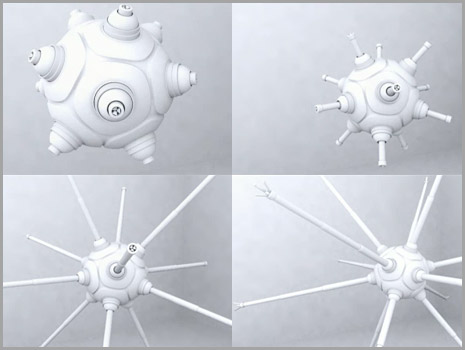
Concept of a swarm of tiny robots

Utility fog (also referred to as foglets) is a hypothetical collection of tiny nanobots that can replicate a physical structure. As such, it is a form of self-reconfiguring modular robotics.
Conception
The term was coined by John Storrs Hall in 1989. Hall thought of it as a nanotechnological replacement for car seatbelts. The robots would be microscopic, with extending arms reaching in several different directions, and could perform three-dimensional lattice reconfiguration. Grabbers at the ends of the arms would allow the robots (or foglets) to mechanically link to one another and share both information and energy, enabling them to act as a continuous substance with mechanical and optical properties that could be varied over a wide range. Each foglet would have substantial computing power, and would be able to communicate with its neighbors.
In the original application as a replacement for seatbelts, the swarm of robots would be widely spread out, and the arms loose, allowing air flow between them. In the event of a collision the arms would lock into their current position, as if the air around the passengers had abruptly frozen solid. The result would be to spread any impact over the entire surface of the passenger's body.
While the foglets would be micro-scale, construction of the foglets would require full molecular nanotechnology. Hall suggests that each bot may be in the shape of a dodecahedron with twelve arms extending outwards. Each arm would have four degrees of freedom. The foglets' bodies would be made of aluminum oxide rather than combustible diamond to avoid creating a fuel air explosive.
Hall and his correspondents soon realized that utility fog could be manufactured en masse to occupy the entire atmosphere of a planet and replace any physical instrumentality necessary to human life. By foglets exerting concerted force, an object or human could be carried from location to location. Virtual buildings could be constructed and dismantled within moments, enabling the replacement of existing cities and roads with farms and gardens. While molecular nanotech might also replace the need for biological bodies, utility fog would remain a useful peripheral with which to perform physical engineering and maintenance tasks. Thus, utility fog also came to be known as "the machine of the future".
References
References
- Hall, J. Storrs. (July 5, 2001). "Utility Fog: The Stuff that Dreams Are Made Of". KurzweilAI.
- Hall, J. Storrs. (July 6, 2001). "What I want to be when I grow up, is a cloud". KurzweilAI.
- [http://pivot.net/~jpierce/aspects_of_ufog.htm On Certain Aspects of Utility Fog] {{Webarchive. link. (2017-12-16 by Dr. J. Storrs Hall)
- [http://www.islandone.org/MMSG/9609lego.htm LEGOs (TM) to the Stars] {{Webarchive. link. (2007-09-27 The Assembler, Volume 4, Number 3 Third Quarter, 1996, Tihamer Toth-Fejel)
- John Storrs Hall, "Utility Fog: A Universal Physical Substance," in ''Vision-21: Interdisciplinary Science and Engineering in the Era of Cyberspace'', [[Geoffrey A. Landis. G. A. Landis]], ed., NASA Publication CP-10129, pp. 115-126 (1993)
- J. Storrs Hall. (2008). "Utility Fog: the machine of the future". Nanotechnol. Perceptions.
This article was imported from Wikipedia and is available under the Creative Commons Attribution-ShareAlike 4.0 License. Content has been adapted to SurfDoc format. Original contributors can be found on the article history page.
Ask Mako anything about Utility fog — get instant answers, deeper analysis, and related topics.
Research with MakoFree with your Surf account
Create a free account to save articles, ask Mako questions, and organize your research.
Sign up freeThis content may have been generated or modified by AI. CloudSurf Software LLC is not responsible for the accuracy, completeness, or reliability of AI-generated content. Always verify important information from primary sources.
Report