From Surf Wiki (app.surf) — the open knowledge base
Urban area
Human settlement with high population density and infrastructure of built environment
Human settlement with high population density and infrastructure of built environment

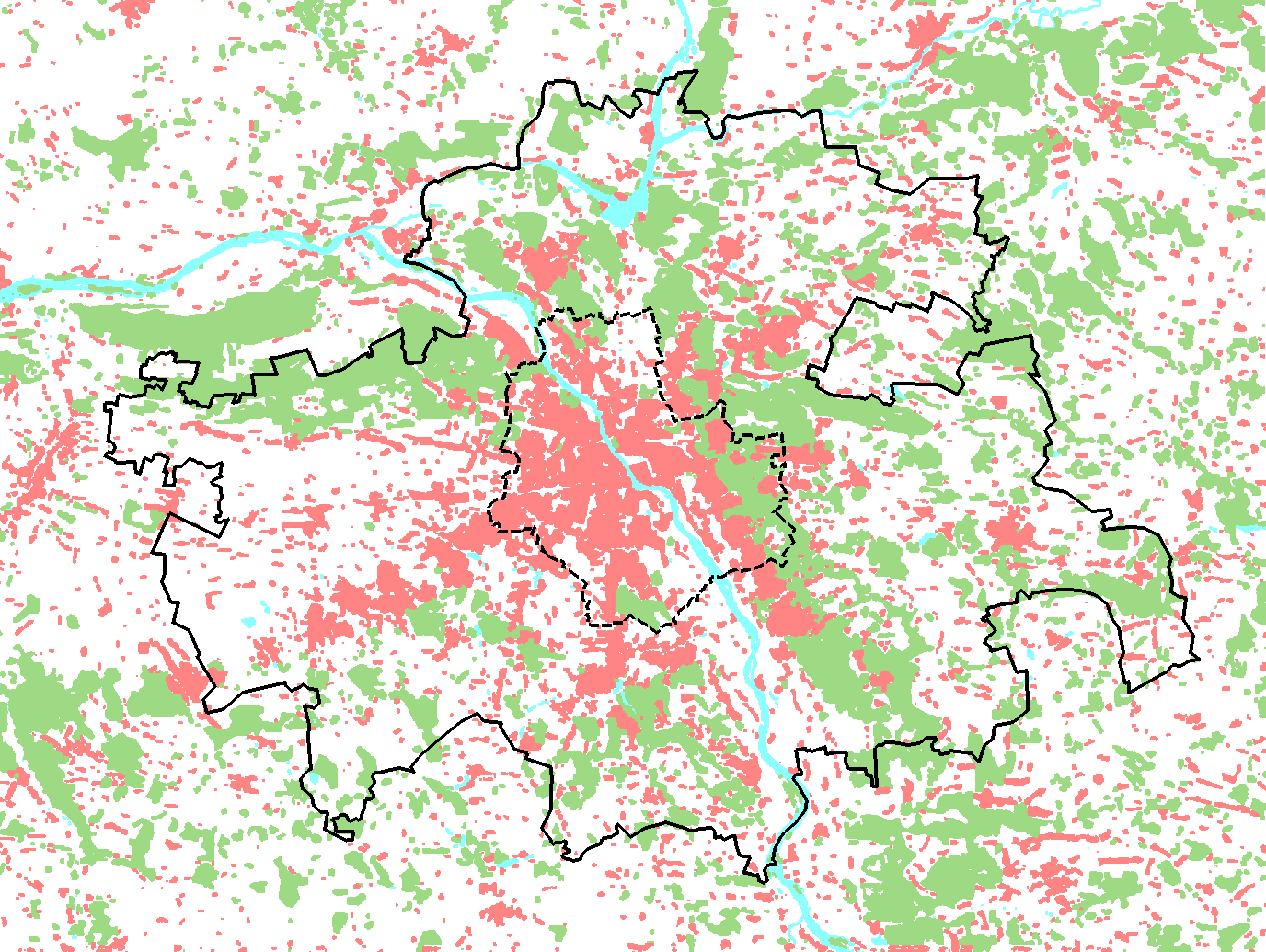
An urban area is a human settlement with a high population density and an infrastructure of built environment. Urban areas originate through urbanization, and researchers categorize them as cities, towns, conurbations or suburbs. In urbanism, the term "urban area" contrasts to rural areas such as villages and hamlets; in urban sociology or urban anthropology, it often contrasts with natural environment.
The development of earlier predecessors of modern urban areas during the urban revolution of the 4th millennium BCE |orig-date = 1972 |publication-place = London led to the formation of human civilization and ultimately to modern urban planning, which along with other human activities such as exploitation of natural resources has led to a human impact on the environment.
Recent historical growth

In 1950, 764 million people (or about 30 percent of the world's 2.5 billion people) lived in urban areas. In 2009, the number of people living in urban areas (3.42 billion) surpassed the number living in rural areas (3.41 billion), and since then the world has become more urban than rural. By 2014, it was 3.9 billion (or about 53 percent of the world's 7.3 billion people) that lived in urban areas. The change was driven by a combination of increased total population and increased percent of population living in urban areas. This was the first time that the majority of the world's population lived in a city. By that time a high estimate calculated up to 3.5 million square kilometers of land were urban, estimates ranging from 1% of global land area.
In 2014 there were 7.3 billion people living on the planet, of which the global urban population comprised 3.9 billion. The Population Division of the United Nations Department of Economic and Social Affairs at that time predicted the urban population would occupy 68% of the world population by 2050, with 90% of that growth coming from Africa and Asia.
Urbanization
Main article: Urbanization
,_OWID.svg)

Urban areas are created and further developed by the process of urbanization. They are measured for various purposes, including analyzing population density and urban sprawl. Urban areas are generally found in the United States, Canada, Brazil, Mexico, Argentina, Chile, Japan, Australia, and many other countries where the urbanization rate is high.
Unlike an urban area, a metropolitan area includes not only the urban area, but also intervening rural land and satellite cities that are socio-economically connected to the urban area. The urban area serves as the core of a metropolitan area, typically by employment ties through commuting, with the urban area being the primary labor market.
The concept of an "urban area" as used in economic statistics should not be confused with the concept of the "urban area" used in road safety statistics. This term was first created by Geographer Brian Manning. The last concept is also known as "built-up area in road safety". According to the definition by the Office for National Statistics, "Built-up areas are defined as land which is 'irreversibly urban in character', meaning that they are characteristic of a town or city. They include areas of built-up land with a minimum of 20 ha. Any areas [separated by] less than 200 metres [of non-urban space] are linked to become a single built-up area.
Argentina and Japan are countries where the urbanization rate is over 90% while Australia, Brazil, Canada, Chile, Mexico, and the United States are countries where the urbanization rate is between 80% and 90%, although within the U.S. state of New Jersey, the urbanization rate is 100%.
Largest urban areas
There are two measures of the degree of urbanization of a population. The first, urban population, describes the percentage of the total population living in urban areas, as defined by the country. The second measure, rate of urbanization, describes the projected average rate of change of the size of the urban population over the given period of time. According to Urbanization by sovereign state article, the world as a whole is 56.2% urbanized, with roughly one-quarter of the countries reported as greater than 80% urbanized. Data is taken from the U.S. Central Intelligence Agency World Factbook estimates from 2020.
According to Demographia, these are the urban areas in the world with a population exceeding 5,000,000 (as of 2025):
| Urban Area | Country/ Region | Population |
|---|---|---|
| 1 | Guangzhou-Shenzhen | China |
| 2 | Shanghai-Changzhou | China |
| 3 | Tokyo-Yokohama | Japan |
| 4 | Jakarta | Indonesia |
| 5 | Delhi | India |
| 6 | Mumbai | India |
| 7 | Manila | Philippines |
| 8 | Dhaka | Bangladesh |
| 9 | Seoul-Incheon | South Korea |
| 10 | Cairo | Egypt |
| 11 | Beijing | China |
| 12 | São Paulo | Brazil |
| 13 | Karachi | Pakistan |
| 14 | New York | United States |
| 15 | Kolkata | India |
| 16 | Bangkok | Thailand |
| 17 | Mexico City | Mexico |
| 18 | Moscow | Russia |
| 19 | Bangalore | India |
| 20 | Ho Chi Minh City | Vietnam |
| 21 | Buenos Aires | Argentina |
| 22 | Los Angeles | United States |
| 23 | Lagos | Nigeria |
| 24 | Johannesburg-Pretoria | South Africa |
| 25 | Osaka-Kobe-Kyoto | Japan |
| 26 | Istanbul | Turkey |
| 27 | Lahore | Pakistan |
| 28 | Tehran | Iran |
| 29 | Kinshasa | Democratic Republic of the Congo |
| 30 | Rio de Janeiro | Brazil |
| 31 | Hangzhou-Shaoxing | China |
| 32 | Shantou-Jieyang | China |
| 33 | Tianjin | China |
| 34 | Chennai | India |
| 35 | Luanda | Angola |
| 36 | Chongqing | China |
| 37 | London | United Kingdom |
| 38 | Paris | France |
| 39 | Lima | Peru |
| 40 | Bogota | Colombia |
| 41 | Hyderabad | India |
| 42 | Wuhan | China |
| 43 | Kuala Lumpur | Malaysia |
| 44 | Taipei | Taiwan |
| 45 | Nagoya | Japan |
| 46 | Nanjing | China |
| 47 | Dar es Salaam | Tanzania |
| 48 | Chicago | United States |
| 49 | Riyadh | Saudi Arabia |
| 50 | Xi'an | China |
| 51 | Chengdu | China |
| 52 | Ahmedabad | India |
| 53 | Addis Ababa | Ethiopia |
| 54 | Shenyang-Fushun | China |
| 55 | Onitsha | Nigeria |
| 56 | Khartoum | Sudan |
| 57 | Washington-Baltimore | United States |
| 58 | Bandung | Indonesia |
| 59 | Boston-Providence | United States |
| 60 | Nairobi | Kenya |
| 61 | Santiago | Chile |
| 62 | Baghdad | Iraq |
| 63 | Hong Kong | Hong Kong SAR |
| 64 | Dallas-Fort Worth | United States |
| 65 | Madrid | Spain |
| 66 | Pune | India |
| 67 | Essen-Düsseldorf | Germany |
| 68 | Zhengzhou | China |
| 69 | Surabaya | Indonesia |
| 69 | Yangon | Myanmar |
| 71 | Houston | United States |
| 72 | Amman | Jordan |
| 73 | Quanzhou | China |
| 74 | Abidjan | Ivory Coast |
| 75 | Toronto | Canada |
| 76 | San Francisco | United States |
| 77 | Accra | Ghana |
| 78 | Surat | India |
| 79 | Xiamen-Zhangzhou | China |
| 80 | Miami | United States |
| 81 | Singapore | Singapore |
| 82 | Kabul | Afghanistan |
| 83 | Alexandria | Egypt |
| 84 | Hefei | China |
| 85 | St. Petersburg | Russia |
| 86 | Qingdao | China |
| 87 | Hanoi | Vietnam |
| 88 | Philadelphia | United States |
| 89 | Faisalabad | Pakistan |
| 90 | Ankara | Turkey |
| 91 | Milan | Italy |
| 92 | Atlanta | United States |
| 93 | Barcelona | Spain |
| 94 | Jiddah | Saudi Arabia |
| 95 | Taiyuan | China |
| 96 | Belo Horizonte | Brazil |
| 97 | Mashhad | Iran |
| 98 | Rawalpindi-Islamabad | Pakistan |
| 99 | Kumasi | Ghana |
| 100 | Melbourne | Australia |
| 101 | Dubai | United Arab Emirates |
| 102 | Yaounde | Cameroon |
| 103 | Kampala | Uganda |
| 104 | Sydney | Australia |
Definitions
Presently, urban data are based on arbitrary definitions that vary from country to country and from year or census to the next, making them difficult to compare.
European countries define urbanized areas on the basis of urban-type land use, not allowing any gaps of typically more than 200 m, and use satellite imagery instead of census blocks to determine the boundaries of the urban area. In less-developed countries, in addition to land use and density requirements, a requirement that a large majority of the population, typically 75%, is not engaged in agriculture and/or fishing is sometimes used.
By region
Africa
South Africa
South Africa has eight metro areas. Metropolitan municipalities (Category A municipalities), as defined in SA, are the most developed areas of the country, and execute all the functions of local government for a city or conurbation. They are created by provincial governments. As per the country's 2022 census data, South Africa has five metros (major urban areas) with a population of over four million residents, with the other three having a population of around one million. Metropolitan municipalities (Category A municipalities), as defined in SA, are the most developed areas of the country, and execute all the functions of local government for a city or conurbation. They are created by provincial governments. The country's three branches of government are split over different cities. Cape Town is the legislative capital, Pretoria the administrative capital, and Bloemfontein the judicial capital. The table below shows all South African metro areas, ranked by population size.
| Name | Province | Seat of government | Population | ||
|---|---|---|---|---|---|
| (2022) | url=http://www.demarcation.org.za/site/shapefiles/ | title=Shapefiles Statistics | website=Demarcation.org.za | access-date=2017-08-29}} | Pop. density |
| (per km2) | |||||
| City of Johannesburg Metropolitan Municipality | Gauteng | Johannesburg | 4,803,262 | 1,645 | 2,924 |
| City of Cape Town Metropolitan Municipality | Western Cape | Cape Town | 4,772,864 | 2,446 | 1,956 |
| eThekwini Metropolitan Municipality | KwaZulu-Natal | Durban | 4,239,901 | 2,556 | 1,659 |
| City of Ekurhuleni Metropolitan Municipality | Gauteng | Germiston | 4,066,691 | 1,975 | 2,058 |
| City of Tshwane Metropolitan Municipality | Gauteng | Pretoria | 4,040,315 | 6,298 | 642 |
| Nelson Mandela Bay Metropolitan Municipality | Eastern Cape | Gqeberha | 1,190,496 | 1,957 | 608 |
| Buffalo City Metropolitan Municipality | Eastern Cape | East London | 975,255 | 2,750 | 354 |
| Mangaung Metropolitan Municipality | Free State | Bloemfontein | 811,431 | 9,886 | 82 |
Asia
East Asia
China
Main article: List of cities in China by population
Since 2000, China's cities have expanded at an average rate of 10% annually. It is estimated that China's urban population will increase by 292 million people by 2050, when its cities will house a combined population of over one billion. The country's urbanization rate increased from 17.4% to 46.6% between 1978 and 2009. Between 150 and 200 million migrant workers work part-time in the major cities, returning home to the countryside periodically with their earnings.
China has more cities with one million or more long-term residents than any other country, including the three global cities of Beijing, Hong Kong, and Shanghai; by 2025, the country will be home to 221 cities with over a million inhabitants. the figures below include only long-term residents.
Japan
In Japan, urbanized areas are defined as contiguous areas of densely inhabited districts (DIDs) using census enumeration districts as units with a density requirement of 4000 PD/sqkm.
South Korea
Seoul is the largest urban area in South Korea.
Taiwan
Greater Taipei is the largest urban area in Taiwan.
South Asia
Bangladesh
In Bangladesh, there are total 532 urban areas, which are divided into three categories. Those are City Corporation, Municipal Corporation (Pourasova) and Upazila town. Among those urban areas, Dhaka is the largest city by population and area, with a population of 19.10 million. In Bangladesh, there are total 11 City Corporations and 329 Municipal Corporations and 203 Small towns, which serves as the center for Upazilas. According to 2011 population census, Bangladesh has an urban population of 28%, with a growth rate of 2.8%. At this growth rate, it is estimated that the urban population of Bangladesh will reach 79 million or 42% of total population by 2035.
India
Main article: Urbanization in India, List of cities in India by population
For the Census of India 2011, the definition of urban area is a place having a minimum population of 5,000 of density 400 /km2 or higher, and 75% plus of the male working population employed in non-agricultural activities. Places administered by a municipal corporation, cantonment board or notified town area committee are automatically considered urban areas.
The Census of India 2011 also defined the term "urban agglomeration" as an integrated urban area consisting of a core town together with its "outgrowths" (contiguous suburbs).
Pakistan
Main article: Urbanisation in Pakistan, List of cities in Pakistan by population
In Pakistan, an area is a major city and municipality if it has more than 100,000 inhabitants according to census results. Cities include adjacent cantonments.
Urbanisation in Pakistan has increased since the time of independence and has several different causes. The majority of southern Pakistan's population lives along the Indus River. Karachi is its most populous city. In the northern half of the country, most of the population lives in an arc formed by the cities of Lahore, Faisalabad, Rawalpindi, Islamabad, Gujranwala, Sialkot, Gujrat, Jhelum, Sargodha, Sheikhupura, Nowshera, Mardan and Peshawar. During 1990–2008, city dwellers made up 36% of Pakistan's population, making it the most urbanised nation in South Asia. Furthermore, 50% of Pakistanis live in towns of 5,000 people or more. Karachi is the most populated city in Pakistan closely followed by Lahore according to the 2017 Census.
Southeast Asia
Philippines
In 2020, 54 percent of the Philippine population lived in urban areas. With an estimated population of 16.3 million, Metro Manila is the most populous metropolitan area in the Philippines and the 11th in the world. However, the greater urban area is the 5th largest in the world with a population of 20,654,307 people (2010 estimate).
Singapore
As an island city-state, about 5.6 million people live and work within 700 km2. With 64 islands and islets, Singapore Island makes up the largest urban area in the country. According to the United Nations Economic and Social Commission for Asia and the Pacific, the country has the highest urbanised population in Southeast Asia, with 100 percent of its population living in an urban area. The Urban Redevelopment Authority (URA) is responsible for the urban land-use planning, which designates land use and urban density of the country. The country is divided into 5 regions for planning purposes by the URA, even though as a city state Singapore is defined as a single continuous urban area. It is further subdivided into 55 urban planning areas, which acts as the boundaries of planned towns within the country.
Thailand
Bangkok is the largest urban area in Thailand.
Vietnam
In Vietnam, there are six types of urban areas:
- Special urban area (2 municipalities): Hanoi and Ho Chi Minh City.
- Type I urban area (18 provincial cities and 3 municipalities): Long Xuyên, Pleiku, Mỹ Tho, Thủ Dầu Một, Bắc Ninh, Biên Hòa, Hải Dương, Thanh Hóa, Hạ Long, Việt Trì, Thái Nguyên, Nam Định, Vũng Tàu, Buôn Ma Thuột, Đà Lạt, Quy Nhơn, Nha Trang, Huế, Vinh, Cần Thơ, Đà Nẵng and Hải Phòng.
- Type II urban area (21 provincial cities and 1 district):Châu Đốc, Đồng Hới, Uông Bí, Bắc Giang, Ninh Bình, Bạc Liêu, Bà Rịa, Thái Bình, Rạch Giá, Cà Mau, Phan Rang–Tháp Chàm, Tuy Hòa, Phan Thiết, Vĩnh Yên, Lào Cai and Phú Quốc.
- Type III urban area (31 provincial cities and 12 towns).
- Type IV urban area (35 towns and 35 townships).
- Type V urban area (586 townships and 54 communes).
Europe
Finland
Main article: Urban areas in Finland, List of urban areas in Finland by population
As in other Nordic countries, an urban area (taajama in Finnish) in Finland must have a building at least every 200 m and at least 200 people. To be considered a town or a city (kaupunki) for statistical purposes, an urban area must have at least 15,000 people. This is not to be confused with the city / town designation used by municipalities.
France
Main article: Functional area (France)
In France, an urban area (Fr: aire d'attraction d'une ville) is a zone encompassing an area of built-up growth (called an "urban unit" (unité urbaine) – close in definition to the North American urban area) and its commuter belt (couronne). Americans would find the INSEE definition of the urban area to be similar to their metropolitan area.
The largest cities in France, in terms of urban area population (2017), are Paris (12,628,266), Lyon (2,323,221), Marseille (1,760,653), Toulouse (1,360,829), Bordeaux (1,247,977), Lille (1,191,117), Nice (1,006,201), Nantes (972,828), Strasbourg (790,087) and Rennes (733,320).
Germany
Germany has a number of large cities. The largest conurbation is the Rhine-Ruhr region (11 million ), including Düsseldorf (the capital of North Rhine-Westphalia), Cologne, Bonn, Dortmund, Essen, Duisburg, and Bochum.
Netherlands
The Netherlands is the 30th-most densely populated country in the world, with 404.6 PD/sqkm—or 497 PD/sqkm if only the land area is counted. The Randstad is the country's largest conurbation located in the west of the country and contains the four largest cities: Amsterdam, Rotterdam, The Hague, and Utrecht. The Randstad has a population of 7 million inhabitants and is the 6th largest metropolitan area in Europe.
Norway
Main article: List of urban areas in Norway by population
Norway defines urban areas ("tettsteder") similarly to the other Nordic countries. Unlike in Denmark and Sweden, the distance between each building has to be of less than 50 m, although exceptions are made due to parks, industrial areas, rivers, and similar. Groups of houses less than 400 m from the main body of an urban area are included in the urban area.
Poland
In Poland, official "urban" population figures simply refer to those localities which have the status of towns (miasta). The "rural" population is that of all areas outside the boundaries of these towns. This distinction may give a misleading impression in some cases, since some localities with only village status may have acquired larger and denser populations than many many smaller towns with most excessive example of Poznań, most spread urban area of the country with population of the city app. 534 thousand and metropolitan area around 1 million inhabitants. On the other hand, the Katowice urban area with numerous large and medium cities covers 1,468 km and has above 2 million people. The metropolitan areas in Poland are the biggest urban zones (e.g. Katowice metropolitan area, Łódź metropolitan area and Szczecin metropolitan area) and have great impact on the rural surroundings, as it is around Lublin, Radom, Kielce, Tarnów and Białystok.
Russia
Moscow, the capital and largest city of Russia, has a population estimated at 12.4 million residents within the city limits, while over 17 million residents in the urban area, and over 20 million residents in the Moscow Metropolitan Area. It is among the world's largest cities, being the most populous city entirely within Europe, the most populous urban area in Europe, the most populous metropolitan area in Europe, and also the largest city by land area on the European continent. Saint Petersburg, the cultural capital, is the second-largest city, with a population of roughly 5.4 million inhabitants. Other major urban areas are Yekaterinburg, Novosibirsk, Kazan, Nizhny Novgorod, and Chelyabinsk.
Spain
Spain is a very highly urbanized country. Madrid is its largest urban area. The Southern and Eastern coasts with Barcelona, Valencia and Málaga are more urbanised than the Northern and Western ones.
Sweden
Main article: Urban areas in Sweden#Statistics{{!}}List of urban areas in Sweden by population
Urban areas in Sweden (tätorter) are statistically defined localities, totally independent of the administrative subdivision of the country. There are 1,956 such localities in Sweden, with a population ranging from 200 to 1,372,000 inhabitants.
United Kingdom
Main article: List of urban areas in the United Kingdom
In 2013 the United Kingdom's Office for National Statistics (ONS) published 2011 Built-up Areas – Methodology and Guidance which sets out its definition of a built-up area (BUA) as an area of built-up land of at least 20 ha, separated from other settlements by at least 200 m. For 2011 census data there are 5,493 built-up areas, of which 501 are divided into built-up area sub-divisions (BUASD) for which data is also available. Each built-up area is named algorithmically, using Ordnance Survey place-name data.
The ONS has produced census results from urban areas since 1951, since 1981 based upon the extent of irreversible urban development indicated on Ordnance Survey maps. The definition is an extent of at least 20 ha and at least 1,500 census residents. Separate areas are linked if less than 200 m (220 yd) apart. Included are transportation features. The UK has five Urban Areas with a population over a million and a further sixty nine with a population over one hundred thousand.
North America
Canada
Main article: List of the largest population centres in Canada
According to Statistics Canada, an urban area in Canada is an area with a population of at least 1,000 people where the density is no fewer than 400 /km2. If two or more urban areas are within 2 km of each other by road, they are merged into a single urban area, provided they do not cross census metropolitan area or census agglomeration boundaries.
In the Canada 2011 Census, Statistics Canada redesignated urban areas with the new term "population centre"; the new term was chosen in order to better reflect the fact that urban vs. rural is not a strict division, but rather a continuum within which several distinct settlement patterns may exist. For example, a community may fit a strictly statistical definition of an urban area, but may not be commonly thought of as "urban" because it has a smaller population, or functions socially and economically as a suburb of another urban area rather than as a self-contained urban entity, or is geographically remote from other urban communities. Accordingly, the new definition set out three distinct types of population centres: small (population 1,000 to 29,999), medium (population 30,000 to 99,999) and large (population 100,000 or greater). Despite the change in terminology, however, the demographic definition of a population centre remains unchanged from that of an urban area: a population of at least 1,000 people where the density is no fewer than 400 persons per km2.
Mexico
Mexico is one of many countries where the urbanization rate is at least 80%. Mexico City, its capital, is the largest urban area in the country.
United States
Main article: List of United States urban areas
In the United States, the Census Bureau defines urban areas and delineates urban area boundaries after each census. The Bureau defines an urban area as "a statistical geographic entity consisting of a densely settled core created from census blocks and contiguous qualifying territory that together have at least 2,000 housing units or 5,000 persons." There were 2,646 urban areas identified by the Census Bureau for 2020. 511 of these had a population of 50,000 or more.
For the 2000 and 2010 censuses, the Census Bureau differentiated between two kinds of urban areas: urbanized areas and urban clusters. The term urbanized area denoted an urban area of 50,000 or more people. Urban areas under 50,000 people were called urban clusters. Urbanized areas were first delineated in the United States in the 1950 census, while urban clusters were added in the 2000 census. The distinction between urbanized areas and urban clusters was removed for the 2020 census.
Urban areas consist of a densely-settled urban core, plus surrounding developed areas that meet certain density criteria. Since urban areas are composed of census blocks and not cities, counties, or county-equivalents, urban area boundaries may consist of partial areas of these political units. Urban areas are distinguished from rural areas: any area not part of an urban area is considered to be rural by the Census Bureau.
The largest urban area in the United States is that of New York City and its surrounding suburbs. The New York–Jersey City–Newark, NY–NJ urban area had a population of 19,426,449 as of 2020, while the larger metropolitan area had a population of 20,140,470, and the combined statistical area had a population of 23,582,649. The next five largest urban areas in the U.S. are those of Los Angeles, Chicago, Miami, Houston, and Dallas. 80.0 percent of the population of the United States lives within the boundaries of an urban area as of the 2020 census.
- Riverside Church
- Time Warner Center
- 220 Central Park South
- Central Park Tower
- One57
- 432 Park Avenue
- 53W53
- Chrysler Building
- Bank of America Tower
- Conde Nast Building
- The New York Times Building
- Empire State Building
- Manhattan West
- a: 55 Hudson Yards, b: 35 Hudson Yards, c: 10 Hudson Yards, d: 15 Hudson Yards
- 56 Leonard Street
- 8 Spruce Street
- Woolworth Building
- 70 Pine Street
- 30 Park Place
- 40 Wall Street
- Three World Trade Center
- Four World Trade Center
- One World Trade Center}}
The concept of Urbanized Areas as defined by the U.S. Census Bureau is often used as a more accurate gauge of the size of a city, since in different cities and states the lines between city borders and the urbanized area of that city are often not the same. For example, the city of Greenville, South Carolina has a city population just over 68,000 and an urbanized area population of around 400,000, while Greensboro, North Carolina has a city population just over 285,000 and an urbanized area population of around 300,000 — meaning that Greenville is actually "larger" for some intents and purposes, but not for others, such as taxation, local elections, etc.
In the U.S. Department of Agriculture's natural resources inventory, urban areas are officially known as developed areas or urban and built-up areas. Such areas include cities, ethnic villages, other built-up areas of more than 10 ac (4 ha), industrial sites, railroad yards, cemeteries, airports, golf courses, shooting ranges, institutional and public administration sites, and similar areas. The 1997 national resources inventory placed over 98,000,000 ac (40,000,000 ha) in this category, an increase of 25,000,000 ac (10,000,000 ha) since 1982.
Oceania
Australia
The Australian Bureau of Statistics refers to urban areas as Urban Centres, which it generally defines as population clusters of 1,000 or more people. Australia is one of the most urbanised countries in the world, with more than 50% of the population residing in Australia's three biggest urban centres.
New Zealand
Main article: Urban areas of New Zealand
Statistics New Zealand defines urban areas in New Zealand, which are independent of any administrative subdivisions and have no legal basis. There are four classes of urban area: major urban areas (population 100,000+), large urban areas (population 30,000–99,999), medium urban areas (population 10,000–29,999) and small urban areas (population 1,000–9,999). As of 2021, there are 7 major urban areas, 13 large urban areas, 22 medium urban areas and 136 small urban areas. Urban areas are reclassified after each New Zealand census, so population changes between censuses does not change an urban area's classification.
South America
Argentina
Argentina is highly urbanized. The ten largest metropolitan areas account for half of the population, and fewer than one in ten live in rural areas. About 3 million people live in Buenos Aires City and the Greater Buenos Aires metropolitan area totals around 15 million, making it one of the largest urban areas in the world, with a population of 18 million all up.
Córdoba has around 1.5 million people living in the urban area, while Rosario, Mendoza and Tucumán have around 1.2 million inhabitants each have at least 500,000 people each.
Brazil
Chile
Chile is highly urbanized. The largest urban area in the country is its capital, Santiago.
Notes
References
References
- Florida. "The Real Powerhouses That Drive the World's Economy". Bloomberg.com.
- "United Nations Population Division – Department of Economic and Social Affairs".
- "City population to reach 6.4bn by 2050". Herald Globe.
- "Urban population growth". World Health Organization.
- (July 23, 2010). "How Much of the World is Covered by Cities?".
- Ritchie, Hannah. (May 2024). "Land Use". Our World in Data.
- "Current world population". UniGeoHive.
- "Climate Change 2022: Mitigation of Climate Change".
- "Urban land area (km²)".
- "US Census Glossary". US census Bureau.
- (28 June 2013). "2011 Census: Characteristics of Built-Up Areas (4. Introduction)". Office for National Statistics.
- Ritchie, Hannah. (2024-02-23). "Urbanization". Our World in Data.
- "World Factbook Urbanization". Central Intelligence Agency.
- Cox, Wendell. (August 2025). "Demographia World Urban Areas – 20th Annual Edition". [[Demographia]].
- (2014). "A harmonised definition of cities and rural areas: the new degree of urbanisation". Europa Commission.
- "Hoàng Huy New City".
- "South Africa: Administrative Division (Provinces and Municipalities) - Population Statistics, Charts and Map".
- "Shapefiles Statistics".
- (February 2009). "Preparing for China's urban billion". McKinsey Global Institute.
- (2011). "China urbanization (PDF)". World Bank Institute.
- Harney, Alexandra. (3 February 2008). "Migrants are China's 'factories without smoke'". CNN.
- Tschang, Chi-Chu. (4 February 2009). "A Tough New Year for China's Migrant Workers". Business Week.
- The figures in the table below are from the 2008 census, and are only estimates of the urban populations within administrative city limits; a different ranking exists when considering the total municipal populations (which includes suburban and rural populations). The large "[[floating population]]s" of migrant workers make conducting censuses in urban areas difficult;Francesco Sisci. "China's floating population a headache for census". ''The Straits Times''. 22 September 2000.
- "Bangladesh Population & Housing Census-2011".
- (Aug 2014). "Population and Housing Census 2011 – Volume 3: Urban Area Report". Bangladesh Bureau of Statistics.
- (13 February 2012). "Provisional Population Totals Urban Agglomerations and Cities, Data Highlights". Census of India 2011.
- (10 April 2015). "Urban Agglomeration". India Economic Service.
- N. (2008-06-02). "Series Overview: The Urban Frontier — Karachi". NPR.
- Burke, Jason. (2008-08-16). "Pakistan looks to life without the general". The Guardian.
- (July 4, 2022). "Urban Population of the Philippines (2020 Census of Population and Housing)". [[Philippine Statistics Authority]].
- "World: metropolitan areas". World Gazetteer.
- (2015). "The State of Asian and Pacific Cities 2015". United Nations ESCAP.
- "Singapore Urban Redevelopment Authority". URA (Singapore).
- "Urban Redevelopment Authourity".
- "Locality – Concepts". Statistics Finland.
- "Alueluokkien kuvaukset". Ymparisto.
- (October 31, 2016). "Urban unit". INSEE.
- (October 31, 2016). "Urban area". INSEE.
- "Tableaux de l'économie française, Édition 2020, Villes et communes de France". INSEE.
- (2017). "Verdichtungsräume nach Fläche, Bevölkerung und Bevölkerungsdichte am 31.12.2017, im November 2018 wegen korrigierter Bevölkerung revidiert". Statistisches Bundesamt.
- (June 20, 2008). "Population statistics. Population and land area in urban settlements, 1 January 2008". Statistics Norway.
- "Polish official population figures".
- (August 8, 2020). "RUSSIA: Central'nyj Federal'nyj Okrug – Central Federal District". City Population.de.
- "Demographia World Urban Areas". Demographia.
- Alexander Akishin. (August 17, 2017). "A 3-Hour Commute: A Close Look At Moscow The Megapolis". Strelka Mag.
- (September 11, 2017). "Moscow, a City Undergoing Transformation". Planète Énergies.
- (8 August 2020). "RUSSIA: Severo-Zapadnyj Federal'nyj Okrug: Northwestern Federal District". City Population.de.
- "Fortsatt stor ökning av befolkning i tätorter". [[Statistics Sweden]].
- ONS Geography. (August 2015). "2011 Built-up Areas – Methodology and Guidance". Office for National Statistics.
- [http://www.statistics.gov.uk/StatBase/ssdataset.asp?vlnk=8271&Pos=2&ColRank=1&Rank=224 KS01 Usual resident population: Census 2001, Key Statistics for urban areas]
For the OS definition of an Urban Area, see the notes tab on the Excel version. - (2009-11-20). "Urban area (UA)". Statistics Canada.
- (2009-11-20). "More information on Urban area (UA)". Statistics Canada.
- "From urban areas to population centres".
- United States Census Bureau. (March 24, 2022). "Urban Area Criteria for the 2020 Census-Final Criteria".
- "List of 2020 Census Urban Areas". [[United States Census Bureau]].
- (December 29, 2022). "Nation's Urban and Rural Populations Shift Following 2020 Census". United States Census Bureau.
- {{CRS. link. Jasper Womach
- (23 May 2011). "Australian Statistical Geography Standard (ASGS)".
- (30 March 2021). "3218.0 – Regional Population Growth, Australia, 2019–20". [[Australian Bureau of Statistics]].
- "Urban area: Definition". Statistics New Zealand.
- "Field listing – Urbanization". CIA.
- "Major Cities". Government of Argentina.
- "Ubicación de la ciudad de salta". Directorate-General of Tourism, Municipality of the City of Salta.
This article was imported from Wikipedia and is available under the Creative Commons Attribution-ShareAlike 4.0 License. Content has been adapted to SurfDoc format. Original contributors can be found on the article history page.
Ask Mako anything about Urban area — get instant answers, deeper analysis, and related topics.
Research with MakoFree with your Surf account
Create a free account to save articles, ask Mako questions, and organize your research.
Sign up freeThis content may have been generated or modified by AI. CloudSurf Software LLC is not responsible for the accuracy, completeness, or reliability of AI-generated content. Always verify important information from primary sources.
Report