From Surf Wiki (app.surf) — the open knowledge base
Upsilon meson
Subatomic particle
Subatomic particle
| Field | Value | |
|---|---|---|
| name | Upsilon | |
| symbol | ||
| image | [[Image:Upsilon peak.jpg | 150px]] |
| caption | A plot of the invariant mass of muon pairs, from the **Upsilon particle** discovery paper. The peak at about is due to the contribution of the Upsilon meson. | |
| num_types | 1 | |
| composition | ||
| statistics | Bosonic | |
| group | Mesons | |
| interaction | Strong, weak, electromagnetic, gravity | |
| antiparticle | Self | |
| discovered | E288 experiment (1977) | |
| mass | ||
| mean_lifetime | ||
| electric_charge | 0 *e* | |
| spin | 1 *ħ* | |
| isospin | 0 | |
| hypercharge | 0 | |
| parity | −1 | |
| c_parity | −1 |
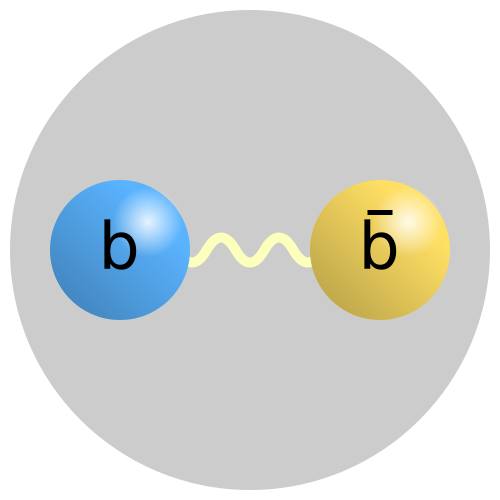
The Upsilon meson () is a quarkonium state (i.e. flavourless meson) formed from a bottom quark and its antiparticle.
It was discovered by the E288 experiment team, headed by Leon Lederman, at Fermilab in 1977. It has a lifetime of and a mass about in the ground state.
Overview
There are many species of bottomonium known, but the ones generated by colliding beams (or proton–nucleus collisions decaying to + X) are the ones generally referred to as upsilon mesons.
Thus, among the bound bottomonium species, the S-state triplet resonances are identified as upsilons, and are assigned the shorthand notations (S1), (S2), (S3), etc., where the numbers 1, 2, 3 represent the principal quantum number n.
Alternatively, the notation parenthesizing the measured mass in MeV/c2 is used, e.g. (10860). In the narrow sense, "Upsilon particle" refers strictly to the (1S).
As clear from its quark structure, the Upsilon meson carries no charge or flavor, and has 0 isospin.
The zero spin state should have a lighter mass by about 0.1% to 1% according to quantum chromodynamics.
Discovery
Lederman's E288 experiment team at Fermilab had made a preliminary finding of a resonance at in November 1976, but was more reticent in announcing it because earlier they had prematurely announced a resonance event (which they were planning to name upsilon; cf. Oops-Leon) with their equipment in dielectron () mode; this find did not pan out and ultimately could not be confirmed. However, with their equipment converted to dimuon () mode with increased sensitivity upped 100 times, they began measurement in May 1977 and clearly confirmed resonance peaks at 9.4/9.5. 10. (cf. under S1, S2, S3) These peaks were verified by the German team using DESY's DORIS storage ring.
The upsilon was the first particle containing a bottom quark to be discovered because it is the lightest that can be produced without additional massive particles.
Resonant states
{{SubatomicParticle|Upsilon}}(1S)
Mass measured at (Lawrence Berkeley National Laboratory, Particle Data Group, 2008)
Lifeime of about 10−20 calculated from measured energy width to .
The types of decay modes are diverse, with electron pair, muon pair, tauon pair decays (all three lepton decays) each occurring at 2.5% frequency.
The short lifetime (τ) is calculable from the usual formula , so in the subsequent sections, the listing of the lifetimes will be eschewed.
{{SubatomicParticle|Upsilon}}(2S)
Mass measured at .
Here again, decay modes are diverse, decaying into (1S) and charged pion pair, approx. 20% of the time, into (1S) and neutral pair, approx. 10%, and into lepton (e, μ, τ) pairs, about 2% each.
A B-factory at SLAC's PEP-II accelerator postponed the termination of operation by 2 months to conduct experiments starting February 2008 to generate (2S) and (3S) (cf. below). While the data remained to be fully analyzed, the team announced in the fall of 2008 that they discovered the spin 0 ground state bottomonium corresponding to the spin 1 (1S) state. The published mass difference with (1S) was .
{{SubatomicParticle|Upsilon}}(3S)
Mass measured at
Again, diversely decaying into Υ(2S) + X (such as pion pairs), approx. 10% Υ(1S) + X (such as pion pairs), also lepton (μ, τ) pairs, about 2% apiece, but e+e^ decay is quite rare.
{{SubatomicParticle|Upsilon}}(4S)
Also called (10580) 。
Nearly completely decays ( 96%) into B meson pairs, almost fifty–fifty between charged pairs and uncharged pairs.
Thus for B meson research, this (4S) mode of resonance is of great importance, and its research has been undertaken by various B-factories (up to c. 1999).。
{{SubatomicParticle|Upsilon}}(10860)
Also called Y(5S). Measured mass of
Main decay mode into B meson pairs only or with 1 or 2 pions, about 60% of the time, and into charm B meson pairs, about 20% of the time.
In this 2008 data report, the strange B meson () decay is also tentatively reported. The energy threshold was also met by Japan's KEKB accelerator whose Belle B factory experiment also contemplated the strange B meson decay. The successes of Y(4S) research has led to the advent of studying Y(5S) at the higher luminosities From around 2008.
{{SubatomicParticle|Upsilon}}(11020)
Mass measured at .
The decay modes are unclear except a small percentage of electron pair decays, as of 2008.。
Explanatory notes
References
Citations
Bibliography
References
- Amsler, C.. (2008). "{{SubatomicParticle". Physics Letters B.
- Amsler, C.. (2008). "{{SubatomicParticle". Physics Letters B.
- Schwarzschild, Bertram. (1 September 2008). "The ground state of bottomonium has finally been found". Phys.Today.
- Amsler, C.. (2008). "{{SubatomicParticle". Physics Letters B.
- Amsler, C.. (2008). "{{SubatomicParticle". Physics Letters B.
- Amsler, C.. (2008). "{{SubatomicParticle". Physics Letters B.
- Amsler, C.. (2008). "{{SubatomicParticle". Physics Letters B.
- Aleksan, Roy. (1999). "Techniques and Concepts of High Energy Physics X". Kluwer Academic Publishers.
- (1998). "An Introduction to the Standard Model of Particle Physics". Cambridge University Press.
- (2009). "Fermilab: Physics, the Frontier, and Megascience". University of Chicago Press.
- Kinoshita, Kay. (2009). "Fundamental Interactions: Proceedings of the 23rd Lake Louise Winter Institute, Lake Louise, Alberta, Canada, 18-23 February, 2008". World Scientific.
- (2010). "A Dictionary of Science". Oxford University Press.
- Sundaresan, Monsur K.. (2017). "Handbook of Particle Physics". CRC Press.
- (2017-07-13). "Relationship of half-life and decay widths".
This article was imported from Wikipedia and is available under the Creative Commons Attribution-ShareAlike 4.0 License. Content has been adapted to SurfDoc format. Original contributors can be found on the article history page.
Ask Mako anything about Upsilon meson — get instant answers, deeper analysis, and related topics.
Research with MakoFree with your Surf account
Create a free account to save articles, ask Mako questions, and organize your research.
Sign up freeThis content may have been generated or modified by AI. CloudSurf Software LLC is not responsible for the accuracy, completeness, or reliability of AI-generated content. Always verify important information from primary sources.
Report