From Surf Wiki (app.surf) — the open knowledge base
University of Osaka
Public university in Osaka, Japan

Public university in Osaka, Japan
| Field | Value | ||
|---|---|---|---|
| name | The University of Osaka | ||
| native_name | 大阪大学 | ||
| image | [[File:Osaka University logo.svg | 150px | Osaka University logo]] |
| motto | 地域に生き世界に伸びる | ||
| mottoeng | Live Locally, Grow Globally | ||
| established | Kaitokudo founded 1724; Osaka Imperial University established 1931 | ||
| type | Public (National) | ||
| president | Shojiro Nishio | ||
| city | Toyonaka/Suita/Minoh | ||
| province | Osaka | ||
| country | Japan | ||
| students | 23,226 | ||
| undergrad | 15,075 | ||
| postgrad | 8,151 | ||
| doctoral | 3,374 | ||
| other | 537 (research students and auditors) 特別聴講学生を含まない。 | ||
| faculty | 3,357 | ||
| administrative_staff | 3,672 | ||
| budget | 186.718 billion yen (2023) | ||
| campus | Suburban, 1.58 km² | ||
| colors | Sky blue | ||
| free_label | Authorized Student Groups | ||
| free | 59 sports-related, 70 culture-related | ||
| mascot | Dr. Wani | ||
| website | |||
| logo | University of Osaka logo, A.svg | ||
| coor |
The University of Osaka, abbreviated as UOsaka or Handai, is a national research university in Osaka, Japan. The university traces its roots back to Edo-era institutions Tekijuku (1838) and Kaitokudo (1724), and was officially established in 1931 as the sixth of the Imperial Universities in Japan, with two faculties: science and medicine. Following the post-war educational reform, it merged with three pre-war higher schools, reorganizing as a comprehensive university with five faculties: science, medicine, letters, law and economics, and engineering. After the merger with Osaka University of Foreign Studies in 2007, UOsaka became the largest national university in Japan by undergraduate enrollment. The official name of the university in English has been changed from "Osaka University" to "The University of Osaka (UOsaka)" as of April 2025.
UOsaka is one of the most productive research institutions in Japan. Numerous prominent scholars and scientists have attended or worked at UOsaka, such as Nobel Laureate in Physics Hideki Yukawa, Nobel Laureate in Medicine Shimon Sakaguchi, manga artist Osamu Tezuka, Lasker Award winner Hidesaburō Hanafusa, author Ryōtarō Shiba.
History
The academic traditions of the University of Osaka reach back to the Kaitokudō, an Edo-period school for local citizens founded in 1724, and the Tekijuku, a school of Rangaku for samurai founded by Ogata Kōan in 1838. The spirit of the university's humanities programmes is believed to be intimately rooted in the history of the Kaitokudō, whereas that of the natural and applied sciences is based upon the traditions of the Tekijuku. UOsaka traces its modern origins back the founding of Osaka Prefectural Medical School in downtown Osaka City in 1869. The school was later designated the Osaka Prefectural Medical College with university status by the University Ordinance (Imperial Ordinance No. 388) in 1919. The Medical College merged with the newly founded College of Science to form Osaka Imperial University in 1931. Osaka Imperial University was the sixth imperial university in Japan. Osaka Technical College was incorporated to form the School of Engineering two years later. The entire university was renamed Osaka University in 1947.
After merging with Naniwa High School and Osaka High School as a result of the government's education system reform in 1949, UOsaka started its postwar era with five faculties: Science, Medicine, Engineering, Letters, and Law. Since that time new faculties and research institutes have been established, including the first Japanese School of Engineering Science and the School of Human Sciences which covers such cross-disciplinary research interests as broadly as psychology, sociology, and education. Built on the then-existing faculties, ten graduate schools were set up as part of the government's education system reform program in 1953. Two more graduate faculties were added in 1994.
In 1993, Osaka University Hospital was relocated from the Nakanoshima campus in downtown Osaka to the Suita campus, completing the implementation of the university's plan to integrate the scattered facilities into the Suita and Toyonaka campuses. In October 2007, a merger between UOsaka and the Osaka University of Foreign Studies in Minoh was completed. The merger made UOsaka one of two national universities in the country with a School of Foreign Studies, along with the Tokyo University of Foreign Studies. The merger also made UOsaka the largest national university in Japan.
Campus
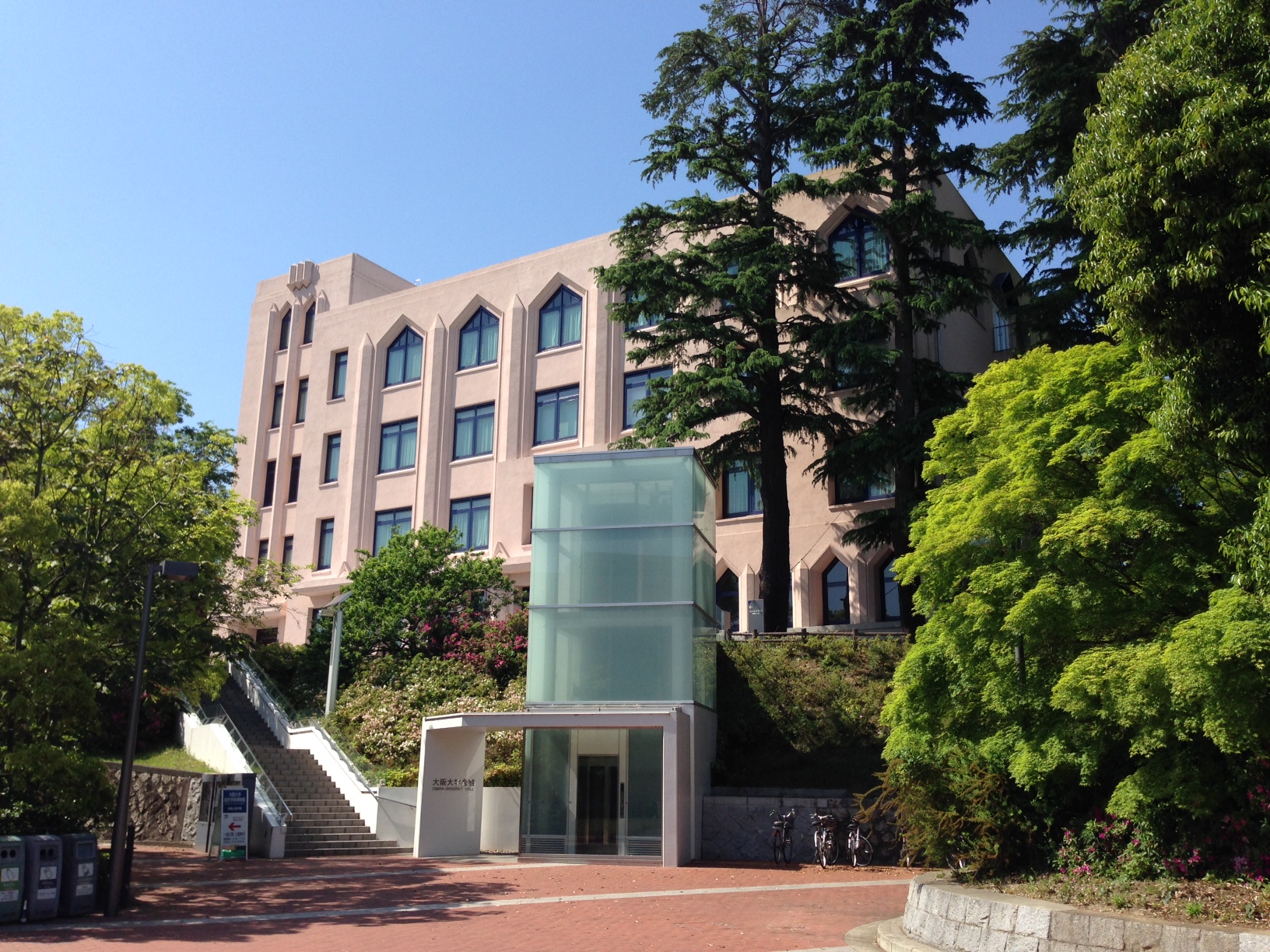

.jpg)
Toyonaka campus
The Toyonaka campus is home to faculties of Humanities, Law, Economics, Science, and Engineering Science. It is also the academic base for Graduate Schools of International Public Policy, Language and Culture, a portion of Information Science, and the Center for the Practice of Legal and Political Expertise. All undergraduates attend classes on the Toyonaka campus during their first year of enrollment. Sports activities are primarily concentrated on the Toyonaka campus, with the exception of tennis, which is located in Suita.
Suita campus
The Suita campus houses faculties of Human Sciences, Medicine, Dentistry, Pharmaceutical Sciences, and Engineering. It contains the Graduate School of Frontier Biosciences and a portion of the Graduate School of Information Science and Technology. The campus is also home to the University of Osaka Hospital and the Nationwide Joint Institute of Cybermedia Center and Research Center for Nuclear Physics.
Minoh campus
The Minoh campus was incorporated following the merger with the Osaka University of Foreign Studies in October 2007. The Minoh campus is home to the School of Foreign Studies, the Research Institute for World Languages, and the Center for Japanese Language and Culture.
In addition to these three campuses, the former Nakanoshima campus, the university's earliest campus located in downtown Osaka, served as the hub for the faculty of medicine until the transfer to the Suita campus was completed in 1993. In April 2004, the Nakanoshima campus became the university's Nakanoshima Center, serving as a venue for information exchange, adult education classes, and activities involving academic as well as non-academic communities.
Organization
The University of Osaka consists of 11 undergraduate schools and 15 graduate schools. The undergraduate schools include Letters, Human Sciences, Foreign Studies, Law, Economics, Science, (Faculty of) Medicine, Dentistry, Pharmaceutical Sciences, Engineering, and Engineering Science. At postgraduate level, the schools cover a range of disciplines: Humanities, Human Sciences, Law and Politics, Economics, Science, Medicine, Dentistry, Pharmaceutical Sciences, Engineering, Engineering Science, International Public Policy, Information Science and Technology, Frontier Biosciences, Law (Law School), and the United School of Child Development, which is a collaboration with Kanazawa University, Hamamatsu University School of Medicine, Chiba University, and the University of Fukui.
UOsaka also has 21 research institutes, 4 libraries, and 2 university hospitals.
Some staff at UOsaka are represented by the General Union, a member of the National Union of General Workers, which is itself a member of the National Trade Union Council.
UOsaka maintains four overseas Centers for Education and Research, in San Francisco, Groningen, Bangkok, and Shanghai.
English-medium programs
The University of Osaka's School of Human Sciences on the Suita Campus hosts an English-medium four-year undergraduate degree program. The program started in 2011 as a result of the national government's G30 (Global 30) Project. Although the government ended the G30 Project in 2014 and replaced it with the Top Global University Project, the OU Human Sciences International Undergraduate Program continues. Areas of study include sociology, anthropology, philosophy, education, behavioral sciences, psychology, human development, and area studies. Focus is on the development of an interdisciplinary, international, and problem-solving orientation to research and education. The degree programme is based on international benchmarking standards, has competitive entry requirements and attracts students from all over the world. The current director of this programme is Beverley Yamamoto, who leads a UNESCO Chair in Global Health and Education.
UOsaka's Graduate School of Humanities hosts another English-medium program in Global Japanese Studies for graduate students, one of the Graduate Programs for Advanced Interdisciplinary Studies.
Academic alliances
The University of Osaka has academic exchange agreements with a large number of universities in other countries and regions. These academic exchange agreements have been concluded on the university-to-university level and also on the school-to-school level. Joint research as well as researcher and student exchanges take place between UOsaka and these universities and schools. At certain of these universities and schools, it is possible for undergraduate and graduate students to take classes and/or engage in research for up to one year without paying tuition to that university or school while retaining their enrollment status at their home university. Inter-university agreements number is 156, and inter-faculty agreements number is 651 as of May 1, 2024.
UOsaka's academic alliances include Cornell University (1989), Harvard University (2008), Stanford University (2008), and the California Institute of Technology (2008) in the United States, McGill University (1996), the University of Toronto (1999) and the University of British Columbia (2019) in Canada, Seoul National University (2000) and Yonsei University (1998) in South Korea, Peking University (2001) and Tsinghua University (2004) in China, the National University of Singapore (2008), the National Taiwan University (2008), the University of Hong Kong, and Australian National University (1995). In Europe, alliances include the University of Groningen (2002), the University of Bologna (2006), the University of Geneva (2007), and the University of Cologne (1982). Allied institutions in the United Kingdom include the University of Oxford (1997) and the Imperial College London (2006).
Academic rankings
General
The University of Osaka is recognised as a prestigious university, evident in its consistent high rankings both domestically and internationally. In the 2024 QS World University Rankings by Quacquarelli Symonds, UOsaka was placed 80th globally and 3rd in Japan, after UTokyo and KyotoU. In the 2024 Times Higher Education World University Rankings, it was ranked 175th globally.
As a research institution, UOsaka ranks highly in Japan. According to Thomson Reuters, it is ranked 2nd for innovation in Japan and 22nd worldwide.
Subjects
Its notable research achievements include leading positions in immunology (first in Japan, fourth globally), material science (fourth in Japan, fifteenth globally), and chemistry (fifth in Japan, fourteenth globally). It also ranks seventh for research funding per researcher in the Japanese COE Programme and third in Japan for the number of patents accepted in 2017.
In the Nature index 2024 annual table, UOsaka was ranked 34th globally for its output in selected journals in the fields of natural sciences and Health Sciences research, among all leading research institutions in the world (3rd in Japan).
| Subject | Global | National | =195 | 5 | =109 | 5 | =113 | 3 | =93 | 4 | =199 | 6 |
|---|---|---|---|---|---|---|---|---|---|---|---|---|
| Linguistics | ||||||||||||
| Architecture and Built Environment | ||||||||||||
| Classics and Ancient History | ||||||||||||
| English Language and Literature | ||||||||||||
| History | ||||||||||||
| Modern Languages | ||||||||||||
| Philosophy | ||||||||||||
| Engineering – Chemical | ||||||||||||
| Computer Science and Information Systems | ||||||||||||
| Engineering – Electrical and Electronic | ||||||||||||
| Engineering – Mechanical | ||||||||||||
| Biological Sciences | ||||||||||||
| Dentistry | ||||||||||||
| Medicine | ||||||||||||
| Pharmacy and Pharmacology | ||||||||||||
| Psychology | ||||||||||||
| Chemistry | ||||||||||||
| Environmental Sciences | ||||||||||||
| Materials Sciences | ||||||||||||
| Mathematics | ||||||||||||
| Physics and Astronomy | ||||||||||||
| Accounting and Finance | ||||||||||||
| Business and Management Studies | ||||||||||||
| Economics and Econometrics | ||||||||||||
| Education and Training | ||||||||||||
| Law and Legal Studies | ||||||||||||
| Politics | ||||||||||||
| Sociology | ||||||||||||
| Statistics and Operational Research |
| Subject | Global | National |
|---|---|---|
| Arts & humanities | ||
| Business & economics | ||
| Clinical & health | ||
| Computer science | ||
| Engineering | ||
| Life sciences | ||
| Physical sciences | ||
| Psychology | ||
| Social sciences |
| Subject | Global | National | Natural Sciences | Engineering | Life Sciences | Medical Sciences | Social Sciences |
|---|---|---|---|---|---|---|---|
| Mathematics | |||||||
| Physics | |||||||
| Chemistry | |||||||
| Mechanical Engineering | |||||||
| Electrical & Electronic Engineering | |||||||
| Biomedical Engineering | |||||||
| Materials Science & Engineering | |||||||
| Nanoscience & Nanotechnology | |||||||
| Biotechnology | |||||||
| Metallurgical Engineering | |||||||
| Biological Sciences | |||||||
| Human Biological Sciences | |||||||
| Clinical Medicine | |||||||
| Public Health | |||||||
| Dentistry & Oral Sciences | |||||||
| Medical Technology | |||||||
| Political Sciences |
Selectivity
The University of Osaka is one of the most selective universities in Japan. In most Japanese university selectivity tables, UOsaka comes after the top two universities, the University of Tokyo and Kyoto University.
Athletics
The University of Osaka and Nagoya University hold regular Athletics Competition every year. Recent years Osaka also has a regular windsurfing competition relationship with Kyoto University, Kobe University, and Taiwan's National Sun Yat-sen University.
Notable people
Nobel laureates
File:Yukawa.jpg|Hideki Yukawa, recipient of the 1949 Nobel Prize in Physics File:YoichiroNambu.jpg|Yoichiro Nambu, recipient of the 2008 Nobel Prize in Physics File:Akira Yoshino 20170920 (cropped 3).jpg|Akira Yoshino, recipient of the 2019 Nobel Prize in Chemistry File:Shimon_Sakaguchi_cropped_2_Shimon_Sakaguchi_201711.jpg|Shimon Sakaguchi, recipient of the 2025 Nobel Prize in Physiology or Medicine winner
Sciences
File:Hantaro Nagaoka.jpg|Hantaro Nagaoka, 1st President of OU, pioneer of Japanese physics File:Hiroshi Ishiguro (Хироси Исигуро) (6795439075).jpg|Hiroshi Ishiguro, creator of Geminoid robots File:Hidesaburo_Hanafusa_cropped_Hidesaburo_Hanafusa_20001212.jpg|Hidesaburo Hanafusa, virologist, 1982 Albert Lasker Award for Basic Medical Research winner File:Osamu_Hayaishi.jpg|Osamu Hayaishi, 1986 Wolf Prize in Medicine winner File:Shizuo_Akira_cropped_Shizuo_Akira_20141212.jpg|Shizuo Akira, immunologists, 2011 Gairdner Award winner File:Crafoordpriset_2009-press_conference_07.jpg|Tadamitsu Kishimoto, 14th President of OU, 2009 Crafoord Prize winner File:Crafoordpriset_2009-press_conference_20.jpg|Toshio Hirano, 17th President of OU, 2009 Crafoord Prize winner File:Kiyoshi_Nagai,_November_2018.jpg|Kiyoshi Nagai, biologist at the MRC Laboratory of Molecular Biology File:Pratiwi Sudarmono-0.jpg|Pratiwi Sudarmono, Indonesian microbiologist File:Michio_Morishima.jpg|Michio Morishima, co-founder of International Economic Review File:Shizuo_Kakutani.jpg|Shizuo Kakutani, mathematician known for Kakutani fixed-point theorem File:Jun-iti_Nagata.jpg|Jun-iti Nagata, topologist File:Ikeda_01.jpg|Masatoshi Gündüz Ikeda, Turkish mathematician of Japanese ancestry File:Election of the WHO Regional Director for the African Region.jpg|Mohamed Yakub Janabi, Regional Director WHO Regional Office for Africa
- Shoichi Sakata, physicist, known for Sakata model, Nobel Prize in Physics nominee
- Takeo Matsubara, physicist at Kyoto University, 1961 Nishina Memorial Prize winner
- Oda Minoru, astronomer and astrophysicist, Emeritus Professor at the University of Tokyo
- Yoshiaki Arata, pioneering researchers into nuclear fusion
- Shigeo Satomura, Japanese physicist
- Akira Hasegawa, theoretical physicist and engineer
- Takashi Hibiki, professor emeritus of nuclear engineering at Purdue University
- Yasuo Tanaka, Japanese astrophysicist and member of the Japan Academy
- Sonia Contera, Spanish physicist at the University of Oxford
- Satoshi Kawata, scientist in nanotechnology and photonics
- Satoshi Hiyamizu, professor of electrical engineering
- Tadao Kasami, information theorist, IEEE Fellow, 1999 IEEE Claude E. Shannon Award winner
- Tetsuo Asano, computer scientist, the president of the Japan Advanced Institute of Science and Technology (JAIST)
- Wahid Shams Kolahi, Iranian scientist and electrical engineer
- Kilnam Chon, South Korean computer scientist
- Nguyễn Ngọc Bình, Vietnamese computer scientist
- Li Siguang, Chinese geologist and politician
- Yoshio Okamoto, Japanese chemist, 2019 Japan Prize winner
- Yukihiro Ozaki, Japanese scientist at Kwansei Gakuin University
- Tomoaki Kato, pioneer in multiple-organ transplantation
- Toshio Yanagida, Japanese biophysicist
- Yoshizumi Ishino, Japanese molecular biologist, known for his discovery of the DNA sequence of CRISPR
- Kiyoshi Mizuuchi, Japanese biochemist
- Yusuke Nakamura, Japanese prominent geneticist and cancer researcher
- Hiroshi Haruki, mathematician, and author of Haruki's theorem and Haruki's Lemma
- Tadashi Nakayama, mathematician who made important contributions to representation theory
- Katsumi Nomizu, Japanese-American mathematician known for his work in differential geometry
- Hidehiko Yamabe, Japanese mathematician known for Yamabe flow, Yamabe invariant, Yamabe problem
- Toru Kumon, Japanese mathematics educator, developer of Kumon method
- Kengo Hirachi, Japanese mathematician, specializing in CR geometry and mathematical analysis
- Yozo Matsushima, Japanese mathematician
- Masao Ogaki, Japanese economist at Keio University
- Giorgio Brunello, Italian economist
- Kazuya Kamiya, Japanese economics, professor at Kobe University
- Takero Doi, Japanese economist
Business and Arts
File:Morita_Akio.jpg|Akio Morita, Sony co-founder, Asian of the Century File:Masataka Taketsuru.jpg|Masataka Taketsuru, father of Japan's whisky industry File:Osamu Tezuka 1951 Scan10008-2.JPG|Osamu Tezuka, Japanese manga artist, cartoonist, and animator File:Shiba_Ryotaro.jpg|Ryōtarō Shiba, one of the most important writers in contemporary Japan File:Norihiko Hibino.jpg|Norihiko Hibino, Japanese video game composer and saxophonist
- Kunio Nakamura, businessman, the president of Panasonic
- Takamitsu Azuma, architect. Professor of UOsaka (1985–1997), Emeritus Professor
- Seishi Yokomizo, novelist and creator of the private detective Kosuke Kindaichi
- Toshio Masuda, film director
- Tetsurō Itodani, professional shogi player and Ryūō champion
- Junzo Shono, Japanese novelist, 1954 Akutagawa Prize winner
- Chin Shunshin, Taiwanese-Japanese novelist, 1968 Naoki Prize winner
- Glenn Hook, British academic at the University of Sheffield
- Tatsuhiko Seo, Japanese historian
- Shūdō Higashinakano, Japanese historian
- Yutaka Tsujinaka, professor of political science at the University of Tsukuba
- Keiko McDonald, American orientalist
- Akiko Kiso, Japanese classicist
- Harue Tsutsumi, Japanese playwright
- Koushun Takami, journalist and author of Battle Royale
- Taku Mayumura, Japanese novelist, science fiction writer, 1974 and 1996 Seiun Award winner
- Akira Hori, Japanese science fiction writer, 1980 Nihon SF Taisho Award and Seiun Award winner
- Yasumi Kobayashi, Japanese author of horror, science fiction, and mystery, 2012 and 2017 Seiun Award winner
- Takahiro Kimura, Japanese animator, illustrator and character designer
- Ichirō Sakaki, Japanese light novel writer
- Teiichiro Fujita, Japanese economist and economic historian
Politics
File:Japanese_Deputy_Foreign_Minister_Yabunaka.jpg|Mitoji Yabunaka, current Japanese Vice-Minister for Foreign Affairs File:Heizo_Takenaka_2008.jpg|Heizo Takenaka, Minister of Internal Affairs and Communications File:Shinji_Tarutoko_cropped_2_Shinji_Tarutoko_Minshu_IMG_5451_20130707.jpg|Shinji Tarutoko, former member of the House of Representatives
- Shuzen Tanigawa, Japanese politician of the Liberal Democratic Party, member of the House of Councillors
- Satoshi Umemura, Japanese politician of the Democratic Party of Japan, member of the House of Councillors
- Mitsuo Mitani, Japanese politician of the Democratic Party of Japan, member of the House of Representatives
- Tadashi Maeda, member of the House of Representatives
- Wataru Ito, Japanese politician of the New Komeito Party
- Keisuke Kihara, former mayor of Sakai, Osaka in Japan
- Ko Ko Oo, former Minister of Science and Technology of Burma
- Fathimath Dhiyana Saeed, SAARC Secretary-General
References
- (2021). "大阪大学プロフィール". 大阪大学 企画部 広報課.
- "2023年版".
- [https://www.osaka-u.ac.jp/en/campus/circle-club/ Introduction to Official Student Groups]. Accessed on 2018-12-18.
- "大阪大学 ワニ博士".
- "History of the University". Osaka University.
- [http://www.osaka-u.ac.jp/en/guide/about/history.html History of Osaka University — Osaka University]. Osaka-u.ac.jp. Retrieved on 2011-06-26.
- "Osaka University - Schools & Centers".
- [http://www.osaka-u.ac.jp/en/guide/about/history.html History of Osaka University — Osaka University]. Osaka-u.ac.jp (2007-10-01). Retrieved on 2014-06-17.
- General Union website [http://www.generalunion.org/News/877 Osaka U: Massive cuts to come for part-timers] {{Webarchive. link. (2018-12-04 Retrieved on June 6, 2012)
- "Human Science International Undergraduate Degree Program OSAKA UNIVERSITY".
- "DEGREE PROGRAMS in English at Kyushu University {{!}} Our Globalization Project : MEXT's "Global 30" Project {{!}}".
- "高度副プログラム「グローバル・ジャパン・スタディーズ」(Advanced Interdisciplinary Studies Program in Global Japanese Studies)".
- (May 1, 2024). "Osaka University - International Exchange Agreements".
- (13 May 2024). "QS World University Rankings 2024: Top Global Universities".
- (2023-09-25). "World University Rankings".
- (2011). "Thomson Reuters 20 Top research institutions in Japan". Thomson Reuters.
- "Thomson Reuters 20 Top research institutions in Japan". Thomson Reuters.
- "特許行政年次報告書2018年版, Japanese patent office, accessed February 4, 2019.".
- "Nature Index Tables - Top 200 institutions".
- "QS World University Rankings by Subject 2024".
- "World University Rankings by subject".
- "ShanghaiRanking's Global Ranking of Academic Subjects 2023".
- "京阪神戦".
- "第一回 大阪大学・台湾中山大学ヨット定期戦 結果報告".
This article was imported from Wikipedia and is available under the Creative Commons Attribution-ShareAlike 4.0 License. Content has been adapted to SurfDoc format. Original contributors can be found on the article history page.
Ask Mako anything about University of Osaka — get instant answers, deeper analysis, and related topics.
Research with MakoFree with your Surf account
Create a free account to save articles, ask Mako questions, and organize your research.
Sign up freeThis content may have been generated or modified by AI. CloudSurf Software LLC is not responsible for the accuracy, completeness, or reliability of AI-generated content. Always verify important information from primary sources.
Report