From Surf Wiki (app.surf) — the open knowledge base
University of Notre Dame
Catholic university in Notre Dame, Indiana, U.S.
Catholic university in Notre Dame, Indiana, U.S.
| Field | Value |
|---|---|
| name | University of Notre Dame du Lac |
| image | University of Notre Dame seal (2).svg |
| image_upright | 0.6 |
| latin_name | Universitas Dominae Nostrae a Lacu |
| motto | *Vita Dulcedo Spes* (Latin) |
| mottoeng | "Life, Sweetness, Hope" |
| type | Private research university |
| established | |
| founder | Edward Sorin |
| accreditation | HLC |
| religious_affiliation | Roman Catholic (Congregation of Holy Cross) |
| academic_affiliations | |
| endowment | $20.09 billion (FY2025) |
| president | Robert A. Dowd |
| provost | John McGreevy |
| faculty | 1,526 (fall 2023) |
| students | 13,016 (fall 2024) |
| undergrad | 8,854 (fall 2024) |
| postgrad | 4,162 (fall 2024) |
| city | Notre Dame, Indiana |
| country | United States |
| coordinates | |
| campus | Large suburb |
| campus_size | 1261 acre |
| free_label1 | Newspapers |
| free1 | |
| colors | Blue and gold |
| nickname | Fighting Irish |
| sporting_affiliations | |
| mascot | Leprechaun |
| website | |
| logo | University of Notre Dame logo.svgclass=skin-invert |
| logo_upright | 0.9 |
| footnotes |
The University of Notre Dame du Lac (known simply as Notre Dame; ; ND) is a private Catholic research university in Notre Dame, Indiana, United States. The university was founded in 1842 by members of the Congregation of Holy Cross, a Catholic religious order of priests and brothers. Its main campus covers 1,261 acres (510 ha) in a suburban setting and has landmarks such as the Golden Dome main building, Sacred Heart Basilica, the Grotto of Our Lady of Lourdes, the Word of Life mosaic mural, and Notre Dame Stadium.
Notre Dame is classified among "R1: Doctoral Universities – Very high research spending and doctorate production". The university is organized into seven schools and colleges: College of Arts and Letters, College of Science, Notre Dame Law School, School of Architecture, College of Engineering, Mendoza College of Business, and Keough School of Global Affairs. Notre Dame's graduate program includes more than 50 master, doctoral and professional degrees offered by the seven schools.
The university's athletic teams are members of the NCAA Division I and are known collectively as the Fighting Irish. Notre Dame is noted for its football team, which contributed to its rise to prominence on the national stage in the early 20th century. Notre Dame teams in other sports, chiefly in the Atlantic Coast Conference, have won 17 national championships.
Between 1952 and 1987, Theodore Hesburgh's administration increased the university's resources and improved its academic programs and its reputation. Its network of alumni consists of 151,000 members.
History
Main article: History of the University of Notre Dame
Foundations
Stephen Badin, the first priest ordained in the United States, had come to northern Indiana after an invitation extended by Potawatomi chief Leopold Pokagon to minister to his tribe, and Badin bought the 524 acre of land in 1830 that became the university's campus. In 1842, bishop Célestin Guynemer de la Hailandière of the Roman Catholic Diocese of Vincennes offered the land to Edward Sorin of the Congregation of Holy Cross on the condition that he build a college in two years. Sorin arrived on the site with eight Holy Cross brothers from France and Ireland on November 26, 1842 and began the school using Badin's old log chapel. After enrolling two students, Sorin erected more buildings, including the Old College, the first church, and the first main building. Notre Dame began as a primary and secondary school; in 1844 it received its official college charter from the Indiana General Assembly, under the name of the University of Notre Dame du Lac (University of Our Lady of the Lake). The university was originally all-male; the Sisters of the Holy Cross founded the female-only Saint Mary's College near Notre Dame in 1844.
Early history
The college awarded its first degrees in 1849. As it grew under the presidency of Sorin and his successors, new academic programs were offered and new buildings built to accommodate the growing student and faculty population. The brief presidency of Patrick Dillon (1865–1866) saw the original main building replaced with a larger one that housed the university's administration, classrooms, and dormitories. Under William Corby's first administration, enrollment at Notre Dame increased to over 500 students. In 1869, he opened the law school, which offered a two-year course of study, and in 1871 he began construction of Sacred Heart Church, today the Basilica of the Sacred Heart. Two years later, the president Auguste Lemonnier started a library in the Main Building that had 10,000 volumes by 1879.
The presidency of Thomas E. Walsh (1881–1893) focused on improving Notre Dame's scholastic reputation and standards. At the time, many students came to Notre Dame only for its business courses and did not graduate. Walsh started a "Belles Lettres" program and invited notable lay intellectuals like writer Maurice Francis Egan to campus. Washington Hall was built in 1881 as a theater, and the Science Hall (today the LaFortune Student Center) was built in 1883 to house the science program (established in 1880) and multiple classrooms and science labs. The construction of Sorin Hall saw the first freestanding residence hall on campus and one of the first in the country to have private rooms for students, a project championed by Sorin and John Zahm. During Walsh's tenure, Notre Dame started its football program and awarded its first Laetare Medal, one the earlist such honors bequesthed by a Catholic university in the United States. The Law School was reorganized under the leadership of William J. Hoynes (dean from 1883 to 1919), and when its new building was opened shortly after his death, it was renamed in his honor.
Growth
John Zahm was the Holy Cross Provincial for the United States from 1898 to 1906, with overall supervision of the university. He sought to modernize and expand Notre Dame by erecting buildings and adding to the campus art gallery and library, amassing what became a famous Dante collection, and pushing Notre Dame toward becoming a research university dedicated to scholarship. The congregation did not renew Zahm's term, fearing he had expanded Notre Dame too quickly and had run the order into serious debt. In particular, his vision to make Notre Dame a research university was at odds with that of Andrew Morrissey, president from 1893 to 1905, who had hoped to keep the institution a smaller boarding school. Morrissey's presidency remained largely focused on younger students and saw the construction of the Grotto, the addition of wings to Sorin Hall, and the erection of the first gymnasium. By 1900, student enrollment had increased to over 700, with most students still following the Commercial Course.

_(14782351722).jpg)
President Matthew Walsh (1922–1928) addressed the material needs of the university, particularly the $10,000 debt and the lack of space for new students. When he assumed the presidency, more than 1,100 students lived off campus while only 135 students paid for room and board. With fund-raising money, Walsh concentrated on the construction of a dormitory system. He built Freshman Hall in 1922, Sophomore Hall in 1923, and began construction of Morrissey, Howard and Lyons Halls between 1924 and 1925. By 1925, enrollment had increased to 2,500 students, of which 1,471 lived on campus; faculty members increased from 90 to 175. On the academic side, credit hours were reduced to encourage in-depth study, and Latin and Greek were no longer required. In 1928, three years of college were made a prerequisite for the study of law. Walsh expanded the College of Commerce, enlarged the stadium, completed South Dining Hall, and built the memorial and entrance transept of the Basilica.
One of the main driving forces in the university's growth was its football team, the Notre Dame Fighting Irish. Knute Rockne became head coach in 1918. Under him, the Irish won three national championships, had five undefeated seasons, won the Rose Bowl Game in 1925, and produced players such as George Gipp and the "Four Horsemen". Knute Rockne has the highest winning percentage (.881) in NCAA Division I/FBS football history. Rockne's offenses employed the Notre Dame Box and his defenses ran a 7–2–2 scheme.
The success of Notre Dame reflected the rising status of Irish Americans and Catholics in the 1920s. Catholics rallied around the team and listened to the games on the radio, especially when it defeated teams from schools that symbolized the Protestant establishment in the United States — Harvard, Yale, Princeton, and Army. Its role as a high-profile flagship institution of Catholicism made it an easy target of anti-Catholicism. The most remarkable episode of violence was a clash in 1924 between Notre Dame students and the Ku Klux Klan (KKK), a white supremacist and anti-Catholic movement. The Klan decided to hold a week-long Klavern in South Bend. Clashes with the student body started on May 17 when students blocked the Klansmen from descending from their trains in the South Bend station and ripped KKK clothes and regalia. Two days later, thousands of students massed downtown protesting the Klavern, and only the arrival of college president Walsh prevented any further clashes. The next day, Rockne spoke at a campus rally and implored the students to refrain from further violence. A few days later, the Klavern broke up, but the hostility shown by the students contributed to the downfall of the KKK in Indiana.
Expansion in the 1930s and 1940s

Charles L. O'Donnell (1928–1934) and John Francis O'Hara (1934–1939) fueled both material and academic expansion. During their tenures at Notre Dame, they brought many refugees and intellectuals to campus, such as W. B. Yeats, Frank H. Spearman, Jeremiah D. M. Ford, Irvin Abell, and Josephine Brownson for the Laetare Medal, instituted in 1883. O'Hara also concentrated on expanding the graduate school. New construction included Notre Dame Stadium, the law school building, the Rockne Memorial, numerous residential halls, the Cushing Hall of Engineering, and a new heating plant. This rapid expansion, which cost the university more than $2.8 million, was made possible in large part through football revenues. O'Hara strongly believed that the Fighting Irish football team could be an effective means to "acquaint the public with the ideals that dominate" Notre Dame. He wrote, "Notre Dame football is a spiritual service because it is played for the honor and glory of God and of his Blessed Mother. When St. Paul said: 'Whether you eat or drink, or whatsoever else you do, do all for the glory of God,' he included football."
During World War II, O'Donnell offered Notre Dame's facilities to the armed forces. The Navy accepted his offer and installed Naval Reserve Officers' Training Corps (ROTC) units on campus as part of the V-12 Navy College Training Program. Soon after the installation, there were only a few hundred civilian students at Notre Dame. O'Donnell continued O'Hara's work with the graduate school. He formalized the graduate program further and replaced the previous committee of graduate studies with a dean.
John J. Cavanaugh, president from 1946 to 1952, devoted his efforts to raising academic standards and reshaping the university administration to serve better its educational mission and an expanded student body. He stressed advanced studies and research while quadrupling the university's student population, with undergraduate enrollment increasing by more than half and graduate student enrollment growing fivefold. CavanaughCavanaugh established the Lobund Institute for Animal Studies and Notre Dame's Medieval Institute, presided over the construction of Nieuwland Science Hall, Fisher Hall, and the Morris Inn, and the Hall of Liberal Arts (now O'Shaughnessy Hall), made possible by a donation from I. A. O'Shaughnessy, at the time the largest ever made to an American Catholic university. He also established the university's system of advisory councils.
Hesburgh era: 1952–1987
Theodore Hesburgh served as president for 35 years (1952–1987). Under his presidency, Notre Dame underwent huge growth and transformation from a school mostly known for its football to a top-tier university, academic powerhouse, and preeminent Catholic university. The annual operating budget rose by a factor of 18, from $9.7 million to $176.6 million; the endowment by a factor of 40, from $9 million to $350 million; and research funding by a factor of 20, from $735,000 to $15 million. Enrollment nearly doubled from 4,979 to 9,600; faculty more than doubled from 389 to 950, and degrees awarded annually doubled from 1,212 to 2,500.
Hesburgh made Notre Dame coeducational. Women had graduated every year since 1917, but they were mostly religious sisters in graduate programs. In the mid-1960s, Notre Dame and Saint Mary's College developed a co-exchange program whereby several hundred students took classes not offered at their home institution. After extensive debate, merging with St. Mary's was rejected, primarily because of the different faculty qualifications and pay scales. "In American college education," explained Charles E. Sheedy, Notre Dame's dean of Arts and Letters, "certain features formerly considered advantageous and enviable are now seen as anachronistic and out of place. ... In this environment of diversity, the integration of the sexes is a normal and expected aspect, replacing separatism." Two of the residence halls were converted for the newly admitted female students that first year, with two more converted the next school year. In 1971, Mary Ann Proctor, a transfer from St. Mary's, became the first female undergraduate. The following year, Mary Davey Bliley became the first woman to graduate from the university with a bachelor's degree in marketing. In 1978, a historic district comprising 21 contributing buildings was listed on the National Register of Historic Places.
Recent history
In the eighteen years Edward Malloy was president, the school's reputation, faculty, and resources grew rapidly. He added more than 500 professors and the academic quality of the student body improved dramatically, with the average Scholastic Assessment Test (SAT) score rising from 1240 to 1460. The number of minority students more than doubled, the endowment grew from $350 million to more than $3 billion, the annual operating budget rose from $177 million to more than $650 million, and annual research funding improved from $15 million to more than $70 million. Notre Dame's most recent (2014) capital campaign raised $2.014 billion, far exceeding its goal of $767 million. It was the largest in the history of Catholic higher education, and the largest of any university without a medical school at the time.
John I. Jenkins took over from Malloy in 2005. In his inaugural address, Jenkins described his goals of making the university a leader in research that recognizes ethics and builds the connection between faith and studies. During his tenure, Notre Dame has increased its endowment, enlarged its student body, and undergone many construction projects on campus, including the Compton Family Ice Arena, a new architecture hall, and additional residence halls. Announced as an integration of "the academy, student life and athletics," construction on the 750000 sqft Campus Crossroads project began around Notre Dame Stadium in November 2014. Its three buildings house student life services, an indoor gym, a recreation center, the career center, a 500-seat student ballroom, the departments of anthropology and psychology, a digital media center and the department of music and sacred music program.
Jenkins announced the 2023–2024 academic year would be his last as president in October 2023. The board of trustees subsequently elected Robert A. Dowd to succeed him, effective June 1, 2024.
Campus
Main article: Campus of the University of Notre Dame

Notre Dame's campus is located in Notre Dame, Indiana, in the Michiana area of Northern Indiana. It lies on 1250 acre, south of the Indiana Toll Road and includes around 170 buildings and athletic fields located around its two lakes and seven quadrangles.
It is consistently ranked as one of the most beautiful university campuses in the United States and around the world, and it is noted particularly for the Golden Dome, the Basilica and its stained glass windows, the quads and the greenery, the Grotto, the Hesburgh Library with its Word of Life stone mural (nicknamed "Touchdown Jesus" by students), and its statues and museums. Notre Dame is a major tourist attraction in northern Indiana; in the 2015–2016 academic year, more than 1.8 million visitors, almost half of whom were from outside St. Joseph County, visited the campus.
Main and South Quadrangles A 116 acre historic district was listed on the National Register of Historic Places in 1978 as University of Notre Dame: Main and South Quadrangles. The district includes 21 contributing buildings in the core of the original campus such as the Main Administration Building and the Basilica.
Administration and academic buildings
The Main Building serves as the center for the university's administrative offices, including the Office of the President. Its golden dome, topped by the statue of Mary, is the campus' most recognizable landmark. The main building is located on Main Quad (also known as "God Quad"), which is the oldest, most historic, and most central part of campus. Behind the main building stands several facilities with administrative purposes and student services, including Carole Sadner Hall, Brownson Hall, and St. Liam's Hall, the campus health center.
There are several religious buildings. The current Basilica of the Sacred Heart is on the site of Sorin's original church, which had become too small for the growing college. It is built in French Revival style, with stained glass windows imported from France. Luigi Gregori, an Italian painter invited by Sorin to be an artist in residence, painted the interior. The basilica also features a bell tower with a carillon. Inside the church, there are sculptures by Ivan Meštrović. The Grotto of Our Lady of Lourdes, built in 1896, is a replica of the original in Lourdes and is a popular spot for prayer and meditation. The Old College building has become one of two seminaries on the campus run by the Congregation of Holy Cross.

Academic buildings are concentrated in the Center-South and Center-East sections of campus. McCourtney Hall, an interdisciplinary research facility, opened its doors for the fall 2016 semester, and ground was broken on the 60000 sqft Walsh Family Hall of Architecture on the south end of campus near the DeBartolo Performing Arts Center which opened in fall 2018. Since 2004, several buildings have been added, including the DeBartolo Performing Arts Center, the Guglielmino Complex, and the Jordan Hall of Science. A new engineering building, Stinson-Remick Hall, a new combination Center for Social Concerns/Institute for Church Life building, Geddes Hall, and a law school addition were completed at the same time. Many academic buildings were built with a system of libraries, the most prominent of which is the Hesburgh Library, built in 1963 and today containing almost four million books. The Stayer Center for Executive Education, which houses the Mendoza College of Business Executive Education Department, opened in March 2013, just south of the Mendoza College of Business building.
Residential and student buildings
Main article: University of Notre Dame residence halls
There are 33 single-sex undergraduate residence halls. The university has recently announced a co-educational undergraduate dorm community based in one of the graduate residential apartments. Most of the graduate students on campus live in one of four graduate housing complexes on campus. A new residence for men, Baumer Hall, was built in 2019. Johnson Family Hall, for women, was also completed and opened that semester. The South Dining Hall and North Dining Hall serve the student body.
The campus hosts several entertainment, general purpose, and common spaces. LaFortune Student Center, commonly known as "LaFortune" or "LaFun," is a four-story building built in 1883 that serves the student union and hosts social, recreational, cultural, and educational activities. LaFortune hosts many businesses (including restaurant chains), student services, and divisions of The Office of Student Affairs. A second student union came with the addition of Duncan Student Center, which is built onto the Notre Dame Stadium as part of the Campus Crossroads projects. As well as additional food service chains, recreation facilities, and student offices, Duncan also hosts a student gym and a ballroom. [[File:University of Notre Dame's God Quad.JPG|thumb|upright=1|alt=See caption |Historic Washington Hall on the Main Quadrangle, popularly termed the "God Quad"]]
Athletics facilities
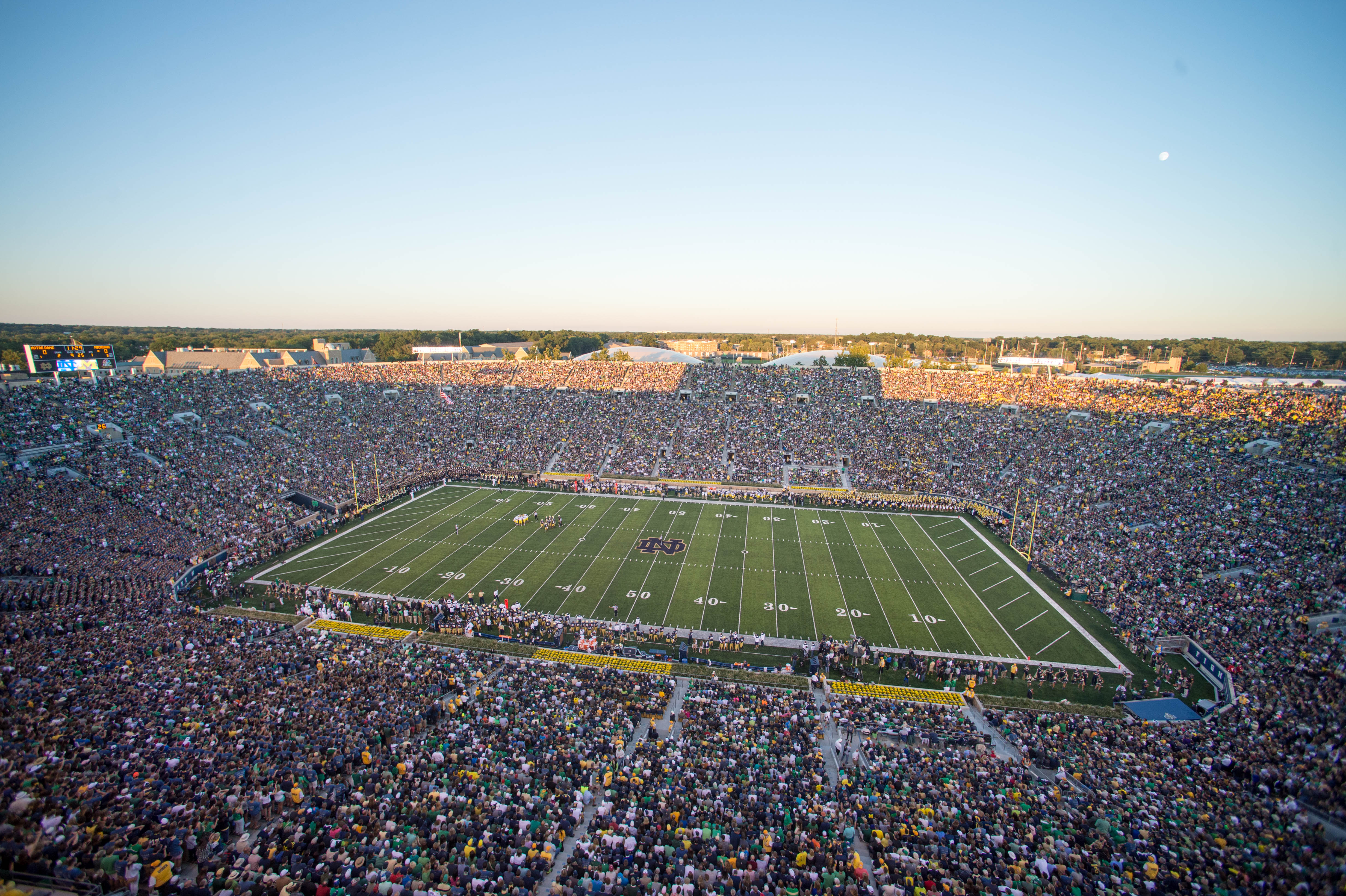
Because of its long athletic tradition, the university features many athletic buildings, which are concentrated in the southern and eastern sections of campus. The most prominent is Notre Dame Stadium, home of the Fighting Irish football team; it has been renovated several times and today can seat over 80,000 people. Prominent venues include the Edmund P. Joyce Center, with indoor basketball and volleyball courts, and the Compton Family Ice Arena, a two-rink facility dedicated to hockey. There are many outdoor fields, such as the Frank Eck Stadium for baseball.
Legends of Notre Dame (commonly called Legends) is a music venue, public house, and restaurant on campus, just 100 yd south of the stadium. The former Alumni Senior Club opened in September 2003 after a $3.5 million renovation and became an all-ages student hang-out. Legends is made up of two parts: The Restaurant and Alehouse and the nightclub.

Environmental sustainability
The Office of Sustainability was created in the fall of 2007 at the recommendation of a Sustainability Strategy Working Group and appointed the first director in April 2008. The pursuit of sustainability is related directly to the Catholic mission of the university. Other resources and centers on campus focusing on sustainability include the Environmental Change Initiative, Environmental Research Center, and the Center for Sustainable Energy at Notre Dame. The university also houses the Kellogg Institute for International Peace Studies.
Notre Dame received a gold rating from the Association for the Advancement of Sustainability in Higher Education (AASHE) in 2014, though in 2017 it was downgraded to silver. In 2016, the Office of Sustainability released its Comprehensive Sustainability Strategy to achieve its goals in a wide area of university operations. , 17 buildings have achieved LEED-Certified status, with 12 of them earning Gold certification. Notre Dame's dining service sources 40 percent of its food locally and offers sustainably caught seafood and many organic, fair-trade, and vegan options. In 2019, irrigation systems' improvements led to 244 million fewer gallons of water being used and a 50 percent reduction in water consumption over 10 years.
In 2015, Notre Dame announced major environmental sustainability goals, including eliminating using coal by 2020 and reducing its carbon footprint by half by 2030. Both these goals were reached in early 2019. This was achieved by implementing energy conservation, energy efficiency strategies, temperature setpoints, low-flow water devices, and diversifying its energy sources and infrastructures. New sources of renewable energy on campus include geothermal wells on East Quad and by the Notre Dame Stadium, substitution of boilers with gas turbines, solar panels on Fitzpatrick Hall and Stinson-Remick Hall and off-campus, a hydroelectric facility at Seitz Park in South Bend powered by the St. Joseph River, and heat recovery strategies. Future projects outlined by the university's utilities long-range plan include continual diversification of its energy portfolio, future geothermal wells in new buildings and some existing facilities, and a collaboration with the South Bend Solar Project. Current goals include cutting Notre Dame's carbon footprint by 83 percent by 2050 and eventually becoming carbon neutral, diverting 67 percent of all waste from landfills by 2030.
Global Gateways

The university owns several centers around the world used for international studies and research, conferences abroad, and alumni support.
- London. The university has had a presence in London since 1968. Since 1998, its London center has been based in Fischer Hall, the former United University Club in Trafalgar Square. The center hosts the university's programs in the city, and conferences and symposia. The university also owns a residence facility, Conway Hall, for students studying abroad.
- Beijing. The university owns space in the Liangmaqiao Station area. The center is the hub of Notre Dame Asia. It hosts a number of programs including study abroad.
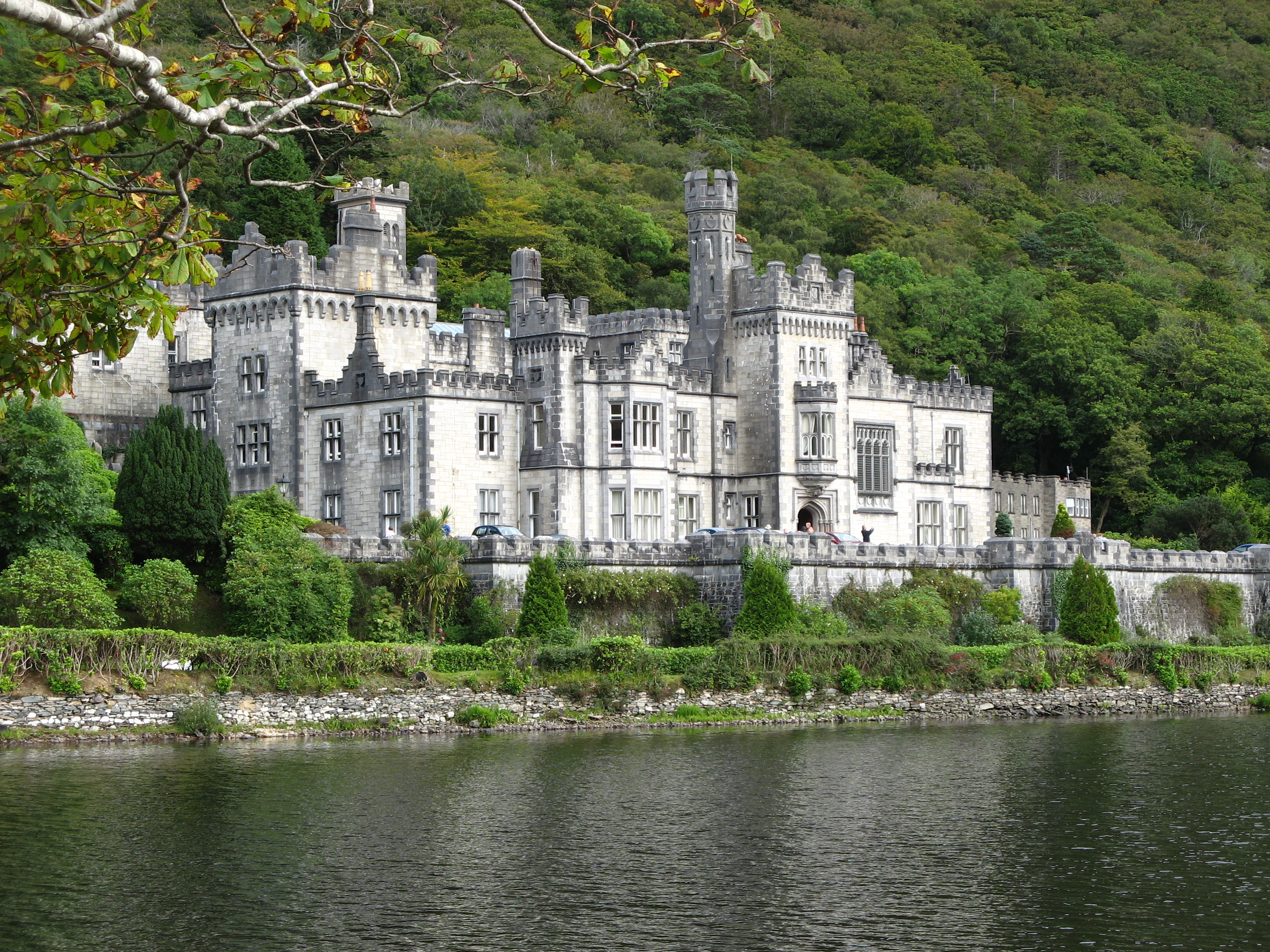
- Dublin. The university owns the O'Connell House, a building in Merrion Square in the heart of Georgian Dublin. It hosts academic programs and summer internships in Irish studies for both undergraduate and graduate students in addition to seminars, and is home to the Keough Naughton Centre. Since 2015, the university has partnered with Kylemore Abbey, renovating spaces in the abbey so it could host academic programs.
- Jerusalem. The Jerusalem Global Gateway shares space with the university's Tantur Ecumenical Institute, in a 100000 sqft facility on the seam between Jerusalem and Bethlehem. It hosts religious and ecumenical programs.
- Rome. The Rome Global Gateway is on Via Ostilia, very close to the Colosseum. It was recently acquired and renovated and now has 32000 sqft of space to host a variety of academic activities. The university purchased a second Roman villa on the Caelian hill.
In addition to the five Global Gateways, the university also owns the Santa Fe Building in Chicago, where it offers its executive Master of Business Administration program. The university also hosts Global Centers located in Santiago, São Paulo, Mexico City, Hong Kong, and Mumbai.
Community development
The first phase of Eddy Street Commons, a $215 million development adjacent to campus funded by the university, broke ground in June 2008. The project drew union protests when workers hired by the City of South Bend to construct the public parking garage picketed the private work site after a contractor hired non-union workers. The $90 million second phase broke ground in 2017.
|File:NDLS Kresge Law Library 2012.jpg |The central area of the Kresge Law Library |File:University of Notre Dame Grotto.JPG |University of Notre Dame's replica of the Grotto at Lourdes |File:Basilica and Dome, from God Quad.jpg |Basilica and Dome |File:North Quad from Fr. Hesburgh's Office in the Hesburgh Library.JPG |University of Notre Dame: Main and South Quadrangles |File:Winter Dome.jpg |The Golden Dome in the Winter |File:Dome though the trees.jpeg |Notre Dame Golden Dome from West Entrance of Cavanaugh Hall
Organization and administration
The university's president is always a priest of the Congregation of Holy Cross. The first president was Edward Sorin; and the current president is Robert A. Dowd. , John McGreevy is the provost overseeing academic functions. Until 1967, Notre Dame had been governed directly by the Congregation. Under the presidency of Theodore Hesburgh, two groups, the Board of Fellows, and the Board of Trustees, were established to govern the university. The 12 fellows are evenly divided between members of the Holy Cross order and the laity; they have final say over the operation of the university. They vote on potential trustees and sign off on all that board's major decisions. The trustees elect the president and provide general guidance and governance to the university.
Endowment
Notre Dame's endowment was started in the early 1920s by university president James Burns; it was $7 million by 1952 when Hesburgh became president. For fiscal year 2023, the university reported total endowment assets of $16.62 billion.
Academics
Colleges and schools
- The College of Arts and Letters was established as the university's first college in 1842. The first degrees were granted seven years later. The university's first academic curriculum was modeled after the Jesuit Ratio Studiorum from Saint Louis University. Today, the college, housed in O'Shaughnessy Hall, includes 20 departments in the areas of fine arts, humanities, and social sciences, and awards Bachelor of Arts (B.A.) degrees in nearly 70 majors and minors, making it the largest of the university's colleges. As of 2022, there were 2,000 undergraduates and graduates enrolled in the college, taught by 500 faculty members.

- The College of Science was established in 1865. The curriculum involved six years of coursework, including higher-level mathematics. Today, the college, housed in the Jordan Hall of Science, includes over 1,200 undergraduates in several departments, each awarding Bachelor of Science (B.S.) degrees. According to university statistics, its science pre-professional program has one of the highest acceptance rates to medical school of any university in the United States.
- The Notre Dame Law School was established in 1869 and is the oldest law program at a Catholic university in the United States. In 2024, the school ranked 20th among the top American law schools by U.S. News & World Report. The law school grants the professional Juris Doctor degree, as well as the graduate Master of Laws, and Doctor of Juridical Science degrees. It was ranked fourth in graduates attaining federal judicial clerkships in 2024, and seventh in graduates attaining Supreme Court clerkships in 2020.
- The School of Architecture was established in 1899, the year after Notre Dame first granted degrees in the field. Today, the school, housed in Walsh Family Hall of Architecture, offers a five-year undergraduate program leading to a bachelor's degree. All undergraduates spend their third year in Rome. The faculty teaches (pre-modernist) traditional and classical architecture and urban planning (e.g., following the principles of New Urbanism and New Classical Architecture). It also awards the annual Driehaus Architecture Prize.
- The College of Engineering was established in 1920; however, courses in civil and mechanical engineering had been taught in the College of Science, since the 1870s. Today, the college, housed in the Fitzpatrick, Cushing, and Stinson-Remick Halls of Engineering, includes five departments of study, with eight B.S. degrees offered. The college also offers five-year dual degree programs with the College of Arts and Letters and the College of Business awarding additional B.A. and Master of Business Administration (MBA) degrees, respectively.
- The Mendoza College of Business was established in 1921 by John Francis O'Hara, although a foreign commerce program had been launched in 1917. Today, the college offers degrees in accountancy, finance, management, and marketing and enrolls over 1,600 students. In 2016, Bloomberg Businessweek ranked Mendoza's undergraduate program as second in the country, after five consecutive years in the first position. For its 2023 ranking, U.S. News & World Report ranked the graduate school 25th, tied with Vanderbilt University.
- The Keough School of Global Affairs was established in 2014. The first new school in nearly a century, it builds on the presence of seven institutes founded for international research, scholarship, and education at Notre Dame. The school offers six doctoral programs related to international peace studies, a Masters in Global Affairs focused on either peace studies or sustainable development, and five undergraduate majors. It is focused on the study of global governance, human rights, and other areas of global social and political policy. A $50 million gift from Donald Keough, a former Coca-Cola executive, and his wife Marilyn funded the school's creation. The school opened officially in August 2017, in Jenkins Hall on Debartolo Quad.
Special programs
Every Notre Dame undergraduate is part of one of the school's five undergraduate colleges or is in the First Year of Studies program. The First Year of Studies program was established in 1962 to guide freshmen through their first year at the school before they have declared a major. Each student is assigned an academic advisor who helps them choose classes that give them exposure to any major in which they are interested. The program includes a Learning Resource Center, which provides time management, collaborative learning, and subject tutoring. First Year of Studies is designed to encourage intellectual and academic achievement and innovation among first-year students. It includes programs such as FY advising, the Dean's A-list, the Renaissance circle, NDignite, the First Year Urban challenge, and more. Every admissions cycle, the Office of Undergraduate Admissions selects a small number of students for the Glynn Family Honors Program, which grants top students within the College of Arts and Letters and the College of Science access to smaller class sizes taught by distinguished faculty, endowed funding for independent research, and dedicated advising faculty and staff.
Graduate education
Each college offers graduate education in the form of master's and doctoral programs. Most of the departments in the College of Arts and Letters offer PhDs, while a professional Master of Divinity (M.Div.) program also exists. All of the departments in the College of Science offer PhDs, except for the Department of Pre-Professional Studies. The School of Architecture offers a Master of Architecture, while each of the departments of the College of Engineering offer PhDs. The College of Business offers multiple professional programs, including MBA and Master of Science in Accountancy programs. It also operates facilities in Chicago and Cincinnati for its executive MBA program. The Alliance for Catholic Education program offers a Master of Education program, where students study at the university during the summer and teach in Catholic elementary schools, middle schools, and high schools across the South for two school years.
The university first offered graduate degrees, in the form of a Master of Arts (MA), in the 1854–1855 academic year. The program expanded to include Master of Laws (LLM) and Master of Civil Engineering in its early stages of growth, before a formal graduate school education was developed with a thesis not required to receive the degrees. This changed in 1924, with formal requirements developed for graduate degrees, including offering doctorates. Although Notre Dame does not have its own medical school, it offers a combined MD–PhD though the regional campus of the Indiana University School of Medicine, where Indiana medical students may spend the first two years of their medical education before transferring to the main medical campus at Indiana University–Purdue University Indianapolis.
Centers and institutes
In 2019, Notre Dame announced plans to rename the Center for Ethics and Culture, an organization focused on spreading Catholic moral and intellectual traditions. A $10 million gift from Anthony and Christie de Nicola funded the new de Nicola Center for Ethics and Culture.
The university is also home to the McGrath Institute for Church Life, which "partners with Catholic dioceses, parishes and schools to address pastoral challenges with theological depth and rigor".
The Joan B. Kroc Institute for International Peace Studies, founded in 1986 by donations from Joan B. Kroc, the surviving spouse of McDonald's owner Ray Kroc, and inspired by Father Hesburgh, is dedicated to research, education, and outreach on the causes of violent conflict and the conditions for sustainable peace. It offers Ph.D., master's, and undergraduate degrees in peace studies. It has contributed to international policy discussions about peace building practices.
Libraries

The university's library system is divided among the main 14-story Theodore M. Hesburgh Library, and each of the colleges and schools. The Hesburgh Library, completed in 1963, is the third building to house the main collection. The Word of Life mural by Millard Sheets, popularly known as "Touchdown Jesus" because of its proximity to Notre Dame Stadium and Jesus' arms appearing to make the signal for a touchdown, adorns the front of the library.
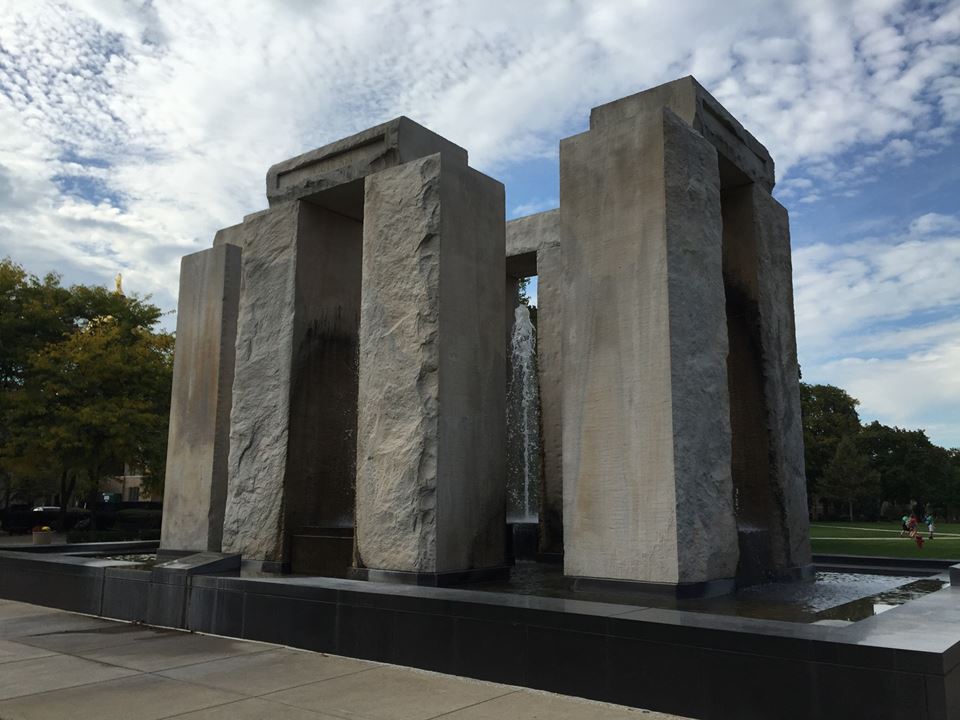
The library system also includes branch libraries for Architecture, Chemistry and Physics, Engineering, Law, Music, and Mathematics and information centers in the Mendoza College of Business, the Kellogg Institute for International Studies, the Joan B. Kroc Institute for International Peace Studies, and a slide library in O'Shaughnessy Hall. A theology library, opened in the fall of 2015 on the first floor of Stanford Hall, is the first branch of the library system to be housed in a dorm room. With over three million volumes, the library system was the single largest university library in the world at the time of completion. It remains one of the hundred largest libraries in the country.
Admissions
The fall 2024 incoming class admitted 3,324 from a pool of 29,943 applicants for 11.1 percent acceptance rate. The university practices a non-restrictive early action policy that allows admitted students to consider admission to Notre Dame and any other colleges that accepted them. This process admitted 1,675 of the 9,683 (17 percent) who requested it. Admission is need-blind for domestic applicants. Admitted students came from 1,311 high schools; the average student traveled over 750 mi to Notre Dame. While all entering students begin in the College of the First Year of Studies, 26 percent have indicated they plan to study in the liberal arts or social sciences, 21 percent in engineering, 26 percent in business, 24 percent in science, and 3 percent in architecture.
Tuition
Tuition for full-time students at the University of Notre Dame in 2023 is $62,693 a year. Room and board is estimated to be an additional $17,378 a year for students who live in campus housing. Notre Dame is a private university, so it offers the same tuition for in-state and out-of-state students.
Rankings
| Notre Dame Fighting Irish | color=white}}" | |
|---|---|---|
| Business | ||
| Engineering | ||
| Law |
| Notre Dame Fighting Irish | color=white}}" | |
|---|---|---|
| Biological Sciences | ||
| Chemistry | ||
| Clinical Psychology | ||
| Computer Science | ||
| Earth Sciences | ||
| Economics | ||
| English | ||
| Fine Arts | ||
| History | ||
| Mathematics | ||
| Physics | ||
| Political Science | ||
| Psychology | ||
| Sociology | ||
| Statistics |
In the 2026 of Best Colleges, Notre Dame ranked 10th for "best undergraduate teaching", 20th for "best value" school and tied for 20th overall among "national universities" in the United States in U.S. News & World Reports report. The university is a member of the Oak Ridge Associated Universities Consortium.
Research
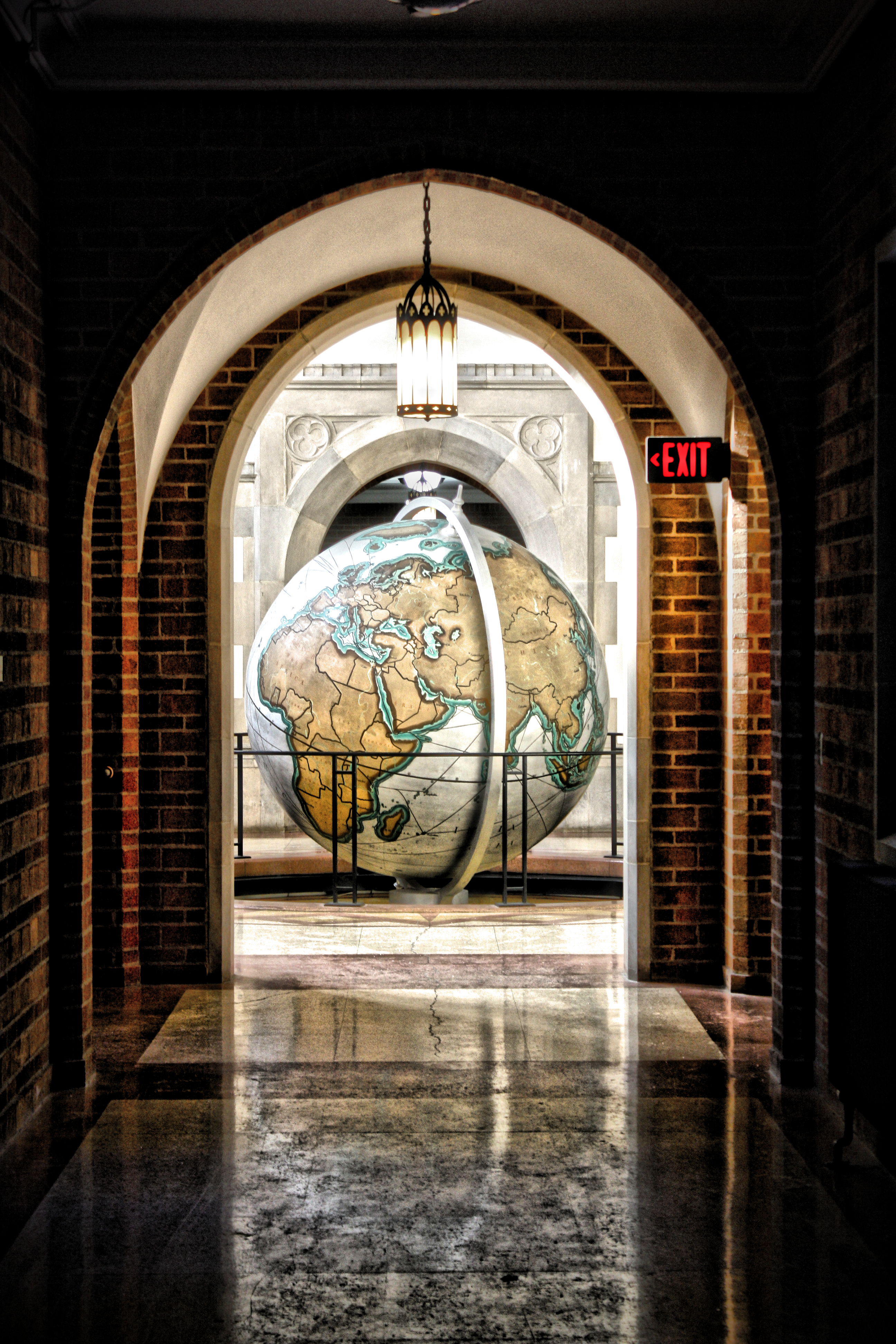
Joseph Carrier, director of the Science Museum and the library, was a professor of chemistry and physics until 1874. Carrier taught that scientific research and its promise for progress were not antagonistic to the ideals of intellectual and moral culture endorsed by the Catholic Church. Notable researchers in the early history of the university include John Augustine Zahm, whose book Evolution and Dogma (1896) defended certain aspects of evolutionary theory as true; Albert Zahm, John's brother, who built an early wind tunnel to compare lift to drag of aeronautical models; Jerome Green, who became the first American to send a wireless message; and Julius Nieuwland, who performed early work on basic reactions that were used to create neoprene. The study of nuclear physics at the university began with the building of a nuclear accelerator in 1936 and continues now partly through a partnership in the Joint Institute for Nuclear Astrophysics.
The rise of Hitler and other dictators in the 1930s forced many Catholic intellectuals to flee Europe; President John O'Hara brought many of them to Notre Dame. Anton-Hermann Chroust, in classics and law, and Waldemar Gurian, a German Catholic intellectual of Jewish descent, came from Germany. Ivan Meštrović, a renowned sculptor, brought Croat culture to campus. Yves Simon brought the insights of French studies in the Aristotelian-Thomistic tradition of philosophy to the university in the 1940s; his teacher, Jacques Maritain, was a frequent visitor to campus. The exiles developed a distinctive emphasis on the evils of totalitarianism. Richard T. Sullivan taught English from 1936 to 1974 and published six novels, dozens of short stories, and other works. Frank O'Malley was an English professor during the 1930s through the 1960s who developed a concept of Christian philosophy that was a fundamental element in his thought. In 1939, Waldemar Gurian founded The Review of Politics, which quickly emerged as part of an international Catholic intellectual revival, offering an alternative vision to positivist philosophy. The College of Arts and Letters is distinguished for its contributions in the field of theology and religious studies, while its affiliated Medieval Institute is the largest center for medieval studies in North America. The university has many multi-disciplinary research institutes, including the Medieval Institute, the Kellogg Institute for International Studies, the Kroc Institute for International Peace Studies, and the Center for Social Concerns. Recent research includes work on family conflict and child development, genome mapping, the increasing trade deficit of the United States with China, studies in fluid mechanics, computational science and engineering, supramolecular chemistry, and marketing trends on the Internet. , the university was home to the Notre Dame Global Adaptation Index, which ranks countries annually based on how vulnerable they are to climate change and how prepared they are to adapt.
In the fiscal 2019, the university received the all-time high research funding of $180.6 million, an increase of $100 million from 2009 and a 27 percent increase from the previous year, with funded projects including vector-borne diseases, urbanism, environmental design, cancer, psychology, economics, philosophy of religion, particle physics, nanotechnology, and hypersonics. Notre Dame has a strong background in the humanities, with 65 National Endowment for the Humanities fellowships, more than any other university. Focus areas include anti-poverty economic strategy, the premier Medieval Institute, Latino studies, sacred music, Italian studies, Catholic studies, psychology, aging and stress, social good, and theology. In the sciences, research focuses and specialized centers include the Harper Cancer Research Institute, the Boler-Parseghian Center for Rare and Neglected Diseases, the Center for Nano Science and Technology, the Center for Stem Cells and Regenerative Medicine, the Eck Institute for Global Health, the Joint Institute for Nuclear Astrophysics, the University of Notre Dame Environmental Research Center, Topology and Quantum Field Theory, the Nuclear Physics Research Group, and the Environmental Change Initiative.
Student life
| Race and ethnicity | Total | Economic diversity | |||
|---|---|---|---|---|---|
| White | {{bartable | 68 | % | 2 | background:gray}} |
| Hispanic | {{bartable | 12 | % | 2 | background:green}} |
| Other | {{bartable | 7 | % | 2 | background:brown}} |
| Asian | {{bartable | 5 | % | 2 | background:purple}} |
| Foreign national | {{bartable | 5 | % | 2 | background:orange}} |
| Black | {{bartable | 3 | % | 2 | background:mediumblue}} |
| Low-income | {{bartable | 11 | % | 2 | background:red}} |
| Affluent | {{bartable | 89 | % | 2 | background:black}} |
As of Fall 2024, the Notre Dame student body consisted of 8,880 undergraduates and 4,162 graduate and professional (Law, M.Div., Business, MEd) students. An estimated 21–24 percent of students are children of alumni, and the student body represents all 50 states and 88 countries. Thirty-seven percent of students come from the Midwestern United States, 40 percent of students are U.S. students of color, and eight percent are international citizens.
The strictly measured federal graduation rate for athletes was 98 percent for freshmen who entered between 2007 and 2010, the highest in the country. (All this is out-of-date)---
Residence halls
Main article: University of Notre Dame residence halls
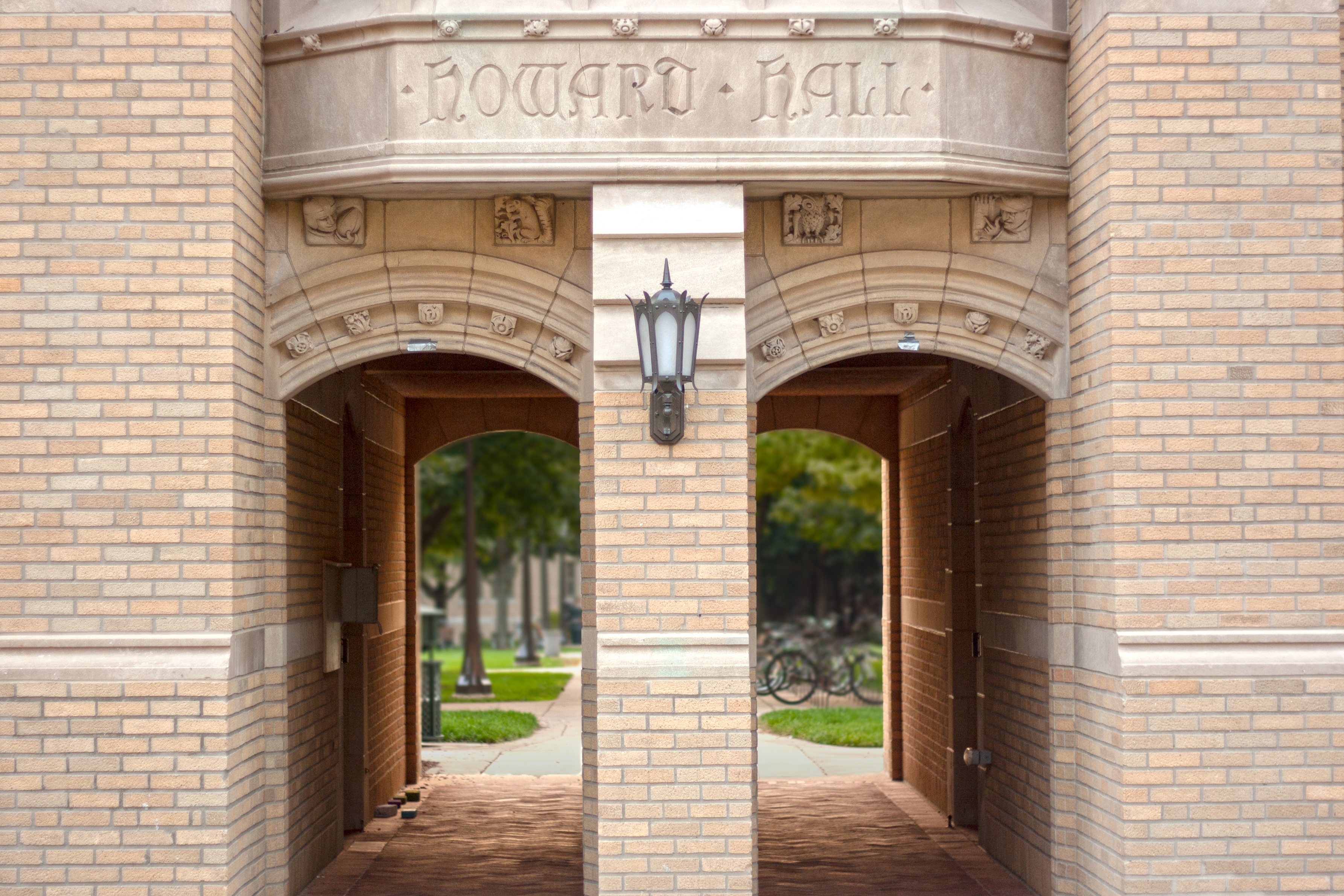
Fraternities and sororities are not allowed on campus, as they are described as in opposition to the university's educational and residential mission. The residential halls provide the social and communal aspect of fraternities, but in line with the university's policy of inclusion and zero tolerance of hazing.
Over four-fifths of students live in the same residence hall for three consecutive years and about one-third of students live in the same residence hall for all four years . A new policy was put into effect beginning in 2018, which required undergraduates to live on-campus for three years. In spring 2019, the university also announced a policy (that has since been reversed) that prohibited students living off campus from participating in dorm activities, such as intramural sports and dorm dances. Most intramural (interhall) sports are based on residence hall teams, where the university offers the only non-military academy program of full-contact intramural American football. At the end of the interhall football season, the championship game is played in Notre Dame Stadium.
Student clubs
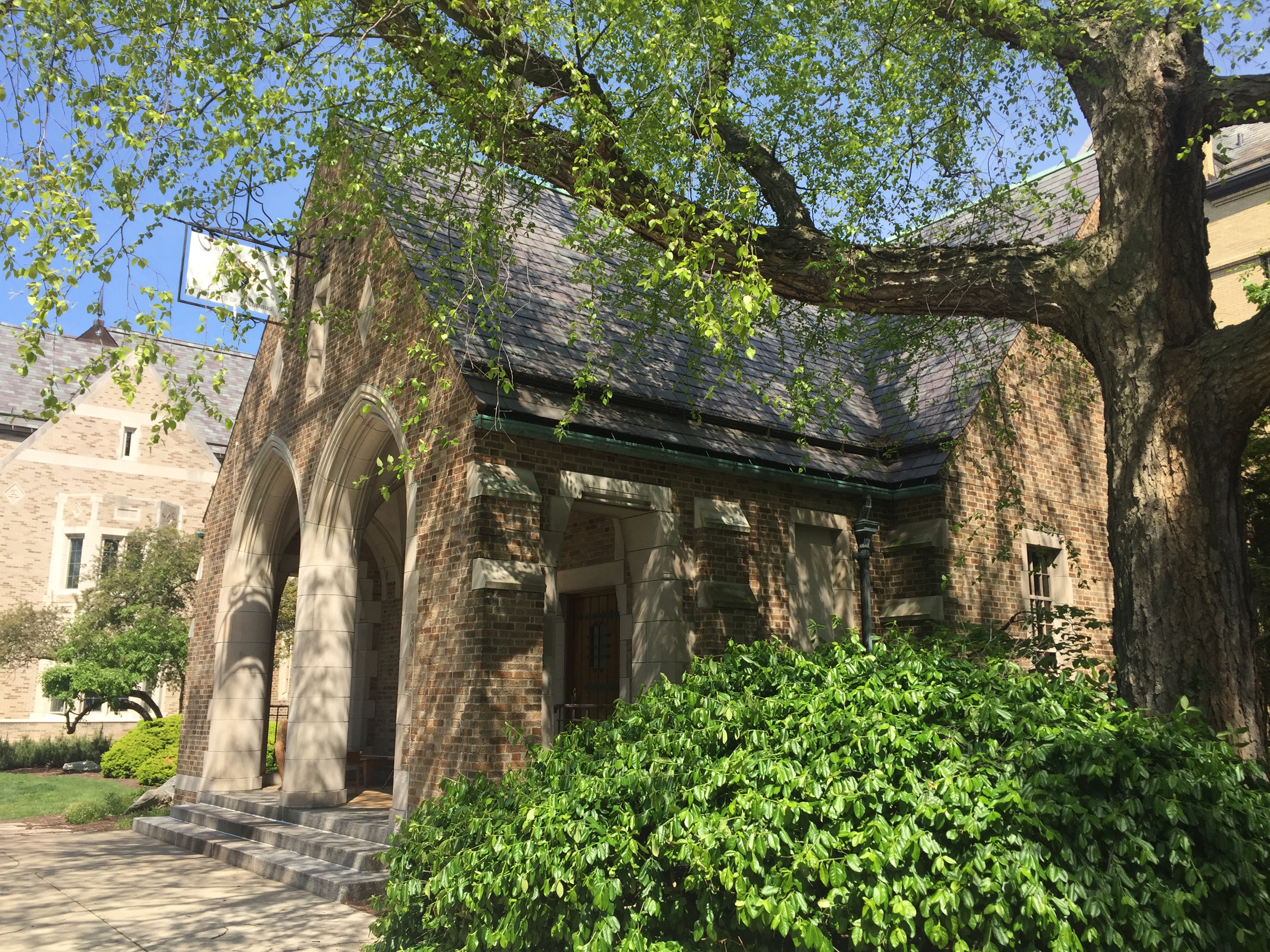
There are over 400 active student clubs at the University of Notre Dame, with the financial oversight of each club delegated by the student-run Club Coordination Council. The university subsidizes clubs, providing almost 15 percent of clubs' collective projected expenditures of $2.2 million during the 2018–2019 academic year. There are a variety of student clubs on campus, including nine for students from different states, about three dozen clubs that represent different nationalities and origins, and clubs dedicated to Catholic theology, diverse faith practices, social service, political advocacy and awareness, competitive athletics, professional development and networking, performing arts, academic debate, foreign affairs, fraternal brotherhood, women's empowerment, and many other interests. The university hosts their annual Student Activities Fair early in the fall semester for all students interested in joining clubs or other student organizations.
Student union
The Notre Dame Student Union is divided into nine branches, as articulated in Article I, Section 2 of the Constitution of the Undergraduate Student Body of the University of Notre Dame du Lac.
Senate
The Student Senate is the legislative body of the Student Union that shall formulate and advance the position of the undergraduate student body on all issues concerning campus life. The Senate is composed of representatives from each of the university's undergraduate residence halls, and other representatives from the Student Union.
Executive Cabinet
The Executive Cabinet is led by the Student Body President and Vice President. Membership is composed of Cabinet Directors who lead various departments. The Executive Cabinet is tasked with advancing the agenda of the President and Vice-President through working to protect the interests of students in all areas of university life, provide services to the undergraduate student body, and advance the policy priorities of the broader Student Union.
Student Union Board
According to the Student Union Board's (SUB) mission statement, "The SUB Programming Body shall enhance undergraduate student life by providing undergraduate student services and social, intellectual, and cultural opportunities that respond to the needs and wants of the undergraduate student body in the most efficient manner possible." SUB is divided into seven committees, which consist of Acousticafé, AnTostal, Community Engagement, Concerts, First Look Into Programming (FLIP), Live Entertainment, and Signature Events.
Hall Presidents Council
The Hall Presidents Council (HPC) is responsible for planning, funding, and executing residence hall events. The council is composed of leadership from all of Notre Dame's undergraduate residence halls, in addition to council leaders.
Club Coordination Council
The Club Coordination Council (CCC) is responsible for communicating issues facing undergraduate club issues, providing funding for undergraduate clubs, serving as the representative body of undergraduate student clubs, and working with student clubs to ensure that clubs can coordinate their programming of activities. The CCC oversees around 400 student clubs, each of which serves a unique purpose. The approval of the council, along with that of the Notre Dame Student Activities Office, is a requirement for official recognition of student clubs.
Class Councils
There are four Class Councils, one representing each undergraduate class level: First-Year, Sophomore, Junior, and Senior Class Councils. They each promote the wellbeing of their respective classes by sponsoring functions that promote unity among class members. Each class is represented by four elected class officers, including a President, Vice-President, Treasurer, and Secretary. In addition to the officers, the Class Councils are made up of members from all across campus that work together to plan events.
Off-Campus Council
The Off-Campus Council represents any undergraduate students not residing on the campus of the university. They provide to the needs of those students, given that the issues differ from those residing in the dorms.
Financial Management Board
The Financial Management Board (FMB) is responsible for the creation and maintenance of a budget for the Student Union. FMB conducts an annual hearing to ensure that undergraduate funds are allocated fairly, known as the Annual Allocation Hearing. The FMB representative from each organization prepares a budget and then meets with the Student Union Treasurer to discuss their organization's monetary needs, which are presented at the Annual Allocation Hearing. After the allocations are agreed upon by its members, the budget is proposed to the Senate Committee on the Budget, which either approves or rejects these allocations.
Judicial Council
The Judicial Council is tasked with overseeing the ethical behavior of Student Union leaders, maintaining the constitutional conduct of the Student Union, administering its elections, and providing support through Peer Advocates to students navigating the Office of Community Standards' hearings and conferences.
Student events
Website BestColleges.com ranks the university's intramural sports program as number one in the country in 2021. Over 700 teams participate each year in the annual Bookstore Basketball tournament; while the Notre Dame Men's Boxing Club hosts the annual Bengal Bouts tournament to raise money for the Holy Cross Missions in Bangladesh. In the fall, the Notre Dame Women's Boxing Club hosts an annual Baraka Bouts tournament that raises money for the Congregation of the Holy Cross Missions in Uganda.
Many of the most popular student events held on campus are organized by the 33 residential halls. Among these, the most notable are the Keenan Revue, the Fisher Hall Regatta, Howard Hall Totter for Water, Keenan Hall Muddy Sunday, the Morrissey Hall Medallion Hunt, the Dillon Hall Pep Rally, the Keough Hall Chariot Race and many others. Each dorm also hosts many formal and informal balls and dances each year.
Religious life

While having a religious affiliation is not a criterion for admission, over 93 percent of students identify as Christian, with over 80 percent of those being Catholic. There are 57 chapels on campus, including one in every residence hall. Collectively, Catholic Mass is celebrated over 100 times per week on campus, and a large campus ministry program provides for the faith needs of the community. There is also an active council of the Knights of Columbus on campus, which is the oldest and largest college council of the international Catholic men's organization. Non-Catholic religious organizations on campus include the Baptist Collegiate Ministry (BCM), Jewish Club of Notre Dame, the Muslim Student Association, the Orthodox Christian Fellowship, the Chi Alpha Christian Fellowship, and many more.
The university is the major seat of the Congregation of Holy Cross (albeit not its official headquarters, which are in Rome). Its main seminary, Moreau Seminary, is on the campus across St. Joseph Lake from the Main Building. Old College, the oldest building on campus near the shore of St. Mary's Lake, houses undergraduate seminarians. Retired priests and brothers reside in Fatima House (a former retreat center), Holy Cross House, and Columba Hall near the Grotto.
Student-run media
Notre Dame students run nine media outlets: three newspapers, a radio and television station, and several magazines and journals.
The Scholastic magazine, begun as a one-page journal in 1876, is issued twice monthly and claims to be the oldest continuous collegiate publication in the United States. The other magazine, The Juggler, is released twice a year and focuses on student literature and artwork. The Dome yearbook is published annually. The newspapers have varying publication interests, with The Observer published daily and mainly reporting university and other news, staffed by students from both Notre Dame and Saint Mary's College. Unlike Scholastic and The Dome, The Observer is an independent publication and does not have a faculty advisor or any editorial oversight from the university. In 2003, when other students believed that the paper had a liberal bias, they started The Irish Rover, a print and digital newspaper published twice per month that features regular columns from alumni and faculty and coverage of campus matters. As of 2005, The Observer and the Irish Rover were distributed to all students. In Spring 2008, Beyond Politics, an undergraduate journal for political science research, made its debut. In May 2023, a professor at the university, Tamara Kay, sued the Rover for defamation. The case was dismissed, and Kay filed an appeal in February 2024.
WSND-FM serves the student body and the larger South Bend community at 88.9 FM, offering students a chance to become involved in bringing classical music, fine arts and educational programming, and alternative rock to the airwaves. Another radio station, WVFI, began as a partner of WSND-FM; it now airs independently and is streamed on the Internet.
The television station (NDtv) grew from one show in 2002 to a full 24-hour channel with original programming by 2006.
Athletics
Main article: Notre Dame Fighting Irish

Notre Dame's sports teams are known as the Fighting Irish. They compete as a member of the National Collegiate Athletic Association (NCAA) Division I, primarily competing in the Atlantic Coast Conference (ACC) for all sports—except football and hockey —since the 2013–14 school year. Men's ice hockey is played in the Big Ten conference. Notre Dame men compete in baseball, basketball, cross country, fencing, football, golf, ice hockey, lacrosse, soccer, swimming and diving, tennis, track and field, and volleyball. Women's sports are basketball, cross country, fencing, golf, lacrosse, rowing, soccer, softball, swimming and diving, tennis, track and field, and volleyball. The football team competes as a Football Bowl Subdivision (FBS) Independent since its inception in 1887, except for 2020, when it competed as part of the Atlantic Coast Conference. Both fencing teams compete in the Midwest Fencing Conference.
Notre Dame's sports conference affiliations, except football and fencing, changed in July 2013 because of major conference realignment, and its fencing affiliation changed in July 2014. The Irish left the Big East for the ACC during a prolonged period of instability in the Big East; while they maintain their football independence, they have committed to playing five games per season against ACC opponents. After Notre Dame joined the ACC, the conference announced it would add fencing as a sponsored sport beginning in the 2014–15 school year.
There are many theories behind the adoption of the team name but the Fighting Irish name was used in the early 1920s with respect to the football team, and alumnus Francis Wallace popularized it in his New York Daily News columns. Notre Dame's official colors are gold and navy blue. Green is sometimes worn because of the Fighting Irish nickname.
The Notre Dame Leprechaun is the mascot of the athletic teams. Created by Theodore W. Drake in 1964, the leprechaun was first used on the football pocket schedule and later the football program covers. Time featured it on a November 1964 cover. Since its inception in 2011, Fighting Irish Media (FIM), made up of part-time student workers and full time producers, has filmed nearly all Fighting Irish sporting events for live digital and linear broadcasts. With the installation of a videoboard in Notre Dame Stadium in Fall 2017, FIM has taken over video board production for all Fighting Irish teams. In 2014, the University of Notre Dame and Under Armour reached an agreement whereby the company provides uniforms, apparel, equipment, and monetary compensation to Notre Dame for 10 years. This contract, worth almost $100 million, was the most lucrative in the history of the NCAA at that time. According to some analysts without direct connection to the university or its athletic department, Notre Dame promotes Muscular Christianity through its athletic programs.
Football
Main article: Notre Dame Fighting Irish football

The Notre Dame football team's history began when the Michigan team brought the game to Notre Dame in 1887 and played against a group of students. Since then, 13 Fighting Irish teams have won consensus national championships (although the university only claims 11), along with another nine teams being named national champions by at least one source. The program has the most members in the College Football Hall of Fame, is tied with Ohio State and Oklahoma for the most Heisman Trophies won by players, and has the 3rd highest winning percentage in NCAA history, behind Ohio State and Alabama. Notre Dame has accumulated many rivals; the annual game against USC for the Jeweled Shillelagh has been described as one of the greatest in college football.
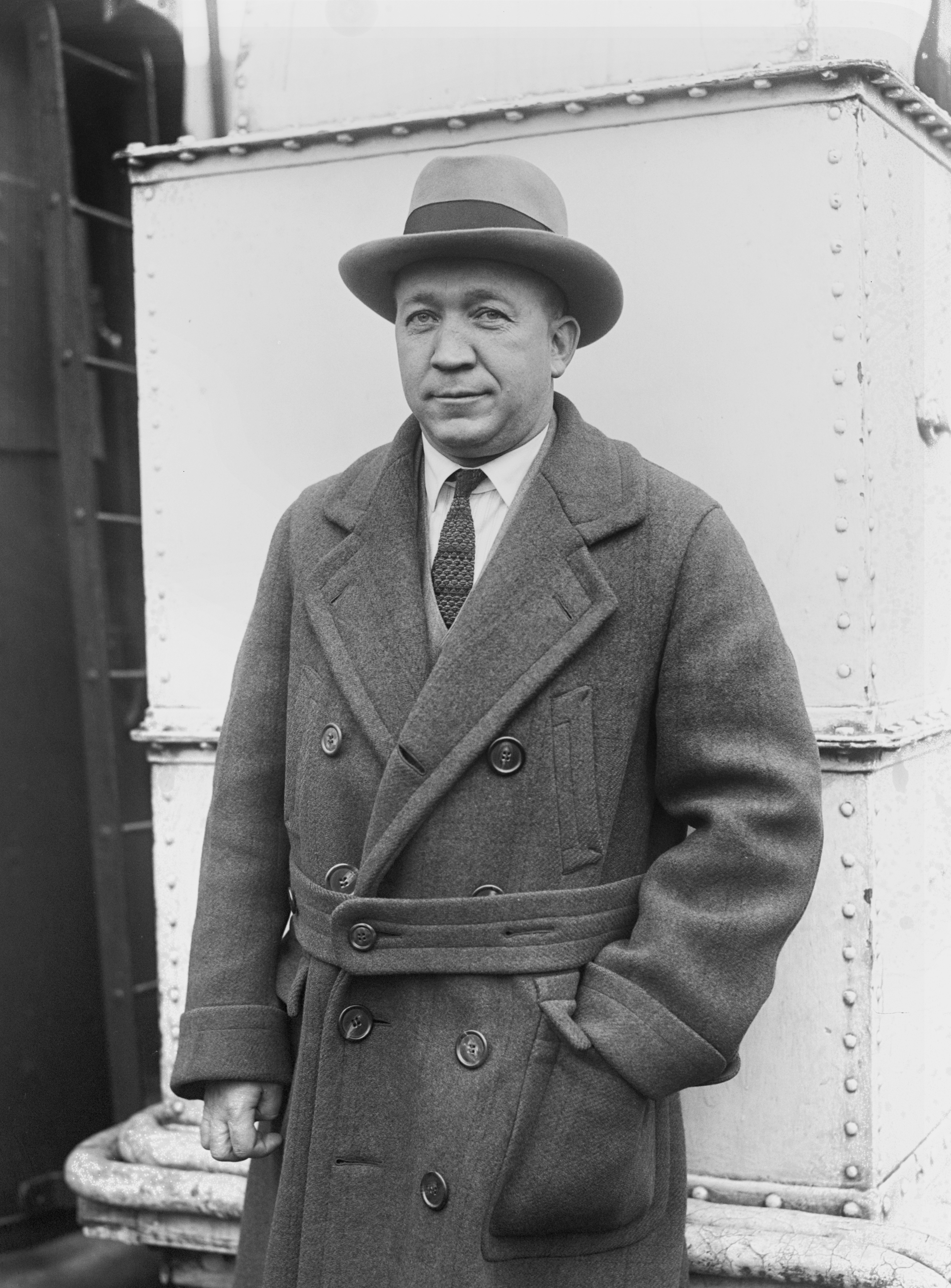
George Gipp was the school's legendary football player of the late 1910s. In 1928, coach Knute Rockne used his final conversation with the dying Gipp to inspire the Notre Dame team to beat Army and "win one for the Gipper"; that scene became the climax of the 1940 film Knute Rockne, All American, starring Pat O'Brien as Rockne and Ronald Reagan as Gipp.
The team competes in the 80,795-seat Notre Dame Stadium. The current head coach is Marcus Freeman, who was promoted to head coach after Brian Kelly departed Notre Dame to coach at LSU at the end of the 2021 regular season. Forbes ranked the program college football's eighth most valuable for its average annual revenue of $120 million. It has a TV contract with NBC worth an estimated $15 million per year and one of the country's largest fan bases.
Football game-day traditions
During home games, activities occur all over campus and dorms decorate their halls with a traditional item (e.g., Zahm Hall's two-story banner). Traditional activities begin at midnight with the Drummers' Circle, involving the Band of the Fighting Irish's drumline beginning the other festivities that will continue the rest of the game day. Later that day, the trumpet section will play the Notre Dame Victory March and the Notre Dame Alma Mater under the dome. The entire band will play a concert at the steps of Bond Hall, then march into the stadium, leading fans and students alike across campus to the game. At the end of each game, the Notre Dame Marching Band plays the alma mater.
|File:Zahm Hall Gameday Sign.JPG |The "Here Come the Irish" gameday sign on Zahm Hall is multiple stories tall|File:NDBandBondHall.png|The Band of the Fighting Irish plays on the steps of Bond Hall before every home game|alt2=The Band of the Fighting Irish plays on the steps of Bond Hall before every home game |File:Irish Guard with Band ND.jpg |The Irish Guard leading the Band of the Fighting Irish to the stadium |File:Notre Dame Game with Band.JPG |The Band of the Fighting Irish plays inside Notre Dame Stadium. |File:ND Stadium 2011.jpg |The Band of the Fighting Irish spells out ND through which the Notre Dame Fighting Irish Football Team runs onto the field. |File:Notre Dame Stadium 2011.JPG |Notre Dame Stadium student section wearing "The Shirt" for the 2011 football season}}
Men's basketball
Main article: Notre Dame Fighting Irish men's basketball

As of the 2020–2021 season, the men's basketball team has over 1,910 wins and appeared in 36 NCAA tournaments Former player Austin Carr holds the record for most points scored in a single game of the tournament with 61. Although the team has never won the NCAA Tournament, they were named by the Helms Athletic Foundation as national champions twice. The team has orchestrated a number of upsets of top-ranked teams, the most notable of which was ending UCLA's record 88-game winning streak in 1974. Notre Dame has beaten an additional eight number-one teams, and those nine wins rank second, to UCLA's 10, all-time in wins against the top team.
Other sports
Notre Dame has won an additional 15 national championships in sports other than football. Four teams have won multiple national championships; the fencing team leads with 10, followed by the men's lacrosse, men's tennis, and women's soccer teams with two each. The men's cross country and golf teams have won one and Notre Dame women's basketball has won two. In the first 10 years that Notre Dame competed in the Big East Conference its teams won a total of 64 championships. , the women's swimming and diving team holds the Big East record for consecutive conference championships in any sport with 14 straight conference titles (1997–2010).
Band and "Victory March"
The Band of the Fighting Irish was formed in 1846 and is the oldest university band in continuous existence. The marching band plays at home games for most sports. It regularly plays the school's fight song, the Notre Dame "Victory March", identified as the most played and most famous fight song by Northern Illinois professor William Studwell. According to College Fight Songs: An Annotated Anthology published in 1998, the "Victory March" is the greatest fight song. It was honored by the National Music Council as a "Landmark of American Music" during the United States Bicentennial. The song is featured in the films Knute Rockne, All American, Airplane! and Rudy.
Alumni
Main article: List of University of Notre Dame alumni, List of University of Notre Dame athletes
The school has over 130,000 alumni and 275 alumni clubs around the world. Notre Dame is ranked among the universities with strongest alumni networks. Many give the university yearly monetary support. Notre Dame is ranked among schools with the highest alumni donation rates. A school-record of 53.2 percent of alumni donating was set in 2006. Many buildings, including residence halls, on campus are named for major donors. Classroom buildings, and the performing arts center are also named for donors.
Alumni working in politics include state governors, members of the United States Congress, and former United States Secretary of State Condoleezza Rice. Notable alumni from the College of Science are Eric F. Wieschaus, winner of the 1995 Nobel Prize in medicine, and Philip Majerus, discoverer of the cardioprotective effects of aspirin. Many university officials are alumni, including the current president, John Jenkins and incoming President Robert Dowd, a professor of Political Science who specializes in African Studies. Alumni in media include talk show hosts Regis Philbin and Phil Donahue, and television and radio personalities such as Mike Golic and Hannah Storm. A number of sports alumni have continued their careers in professional sports, such as Joe Theismann, Joe Montana, Tim Brown, Ross Browner, Rocket Ismail, Ruth Riley, Jeff Samardzija, Jerome Bettis, Justin Tuck, Craig Counsell, Skylar Diggins-Smith, Brett Lebda, Olympic fencing gold medalist Mariel Zagunis and two-time bronze medalist Nick Itkin, professional boxer Mike Lee, former football coaches such as Charlie Weis, Frank Leahy and Knute Rockne, and Basketball Hall of Famers Austin Carr and Adrian Dantley. Other notable alumni include prominent businessman Edward J. DeBartolo Jr. and astronaut Jim Wetherbee. Two alumni have received the Presidential Medal of Freedom (Alan Page and Edward J. DeBartolo Jr.), and two the Congressional Gold Medal (Thomas Anthony Dooley III and Bill Hanzlik).
In popular culture
The University of Notre Dame is the setting of several works of fiction, as well as the alma mater of some fictional characters. In mid-20th century America, it became "perhaps the most popular symbol of Catholicism" as noted by The Routledge Companion to Religion and Popular Culture:
Film
- Knute Rockne, All American is a 1940 biographical film which tells the story of Knute Rockne, Notre Dame football coach.
- The "Win one for the Gipper" speech was parodied in the 1980 film Airplane! when, with the "Victory March" rising to a crescendo in the background, Dr. Rumak (played by Leslie Nielsen) urged reluctant pilot Ted Striker (played by Robert Hays) to "win just one for the Zipper", Striker's war buddy George Zipp. The "Victory March" also plays during the film's credits.
- Rudy is a 1993 account of the life of Daniel "Rudy" Ruettiger, who harbored dreams of playing football at Notre Dame despite significant obstacles.
Television
- President Josiah Bartlet from the show The West Wing is a Notre Dame graduate and First Lady Abigail Bartlet attended Saint Mary's College. Danny Concannon, a member of the White House press corps, is also a graduate of Notre Dame. Actor Martin Sheen specifically asked that his character be a Notre Dame alumnus due to the Catholicism shared by both the actor and the character.
Other media
- One of the music videos for the song "This Too Shall Pass" by OK Go was created in collaboration with the University of Notre Dame Marching Band and was shot on the university campus.
Notes
References
Bibliography
References
- "Search".
- "The Spirit of Notre Dame".
- (January 7, 2015). "Memories and lessons from Notre Dame".
- (November 14, 2025). "Consolidated Financial Statements for the years ended June 30, 2025 and 2024". University of Notre Dame.
- "About: Notre Dame at a Glance". University of Notre Dame.
- "This is Notre Dame at a Glance 2025-2026". University of Notre Dame.
- "Primary Colors". University of Notre Dame.
- {{cite gnis
- "University of Notre Dame".
- "University of Notre Dame Admissions". US News.
- (2024). "University of Notre Dame". [[American Council on Education]].
- "The Graduate School: Quick facts". University of Notre Dame.
- "Irish National Championships".
- (June 26, 2019). "Championships Summary". [[National Collegiate Athletic Association]].
- (4 January 2022). "Notre Dame Alumni By the Numbers". Notre Dame Alumni Association.
- "Founding Information". University of Notre Dame. Archived from the original on October 31, 2007. Retrieved December 31, 2007.
- "Foundations". Notre Dame University.
- Hope, Arthur J. (1979) [1948]. "IV". Notre Dame: One Hundred Years (2nd ed.). Notre Dame, IN: University Press. {{ISBN. 0-89651-501-X.
- Cohen, Ed (Autumn 2004). "One lake or two?". ''Notre Dame Magazine''. Archived from the original on July 1, 2007. Retrieved December 7, 2007.
- (December 10, 2019). "First women's college in region observes 175th anniversary".
- Hope, Arthur J. (1979) [1948]. "V". ''Notre Dame: One Hundred Years'' (2nd ed.). Notre Dame, IN: University Press. {{ISBN. 0-89651-501-X.
- "Notre Dame – Foundations: Conclusion". Archives.nd.edu.
- "VIII: University Library and Archives". University of Notre Dame.
- "The Story of Notre Dame: Main Building". University of Notre Dame Archives. Retrieved December 31, 2007.
- "The Story of Notre Dame: Lemmonier Library". University of Notre Dame Archives. Retrieved December 31, 2007.
- Miller, Greg. (November 14, 1986). "A Notre Dame Procession". Scholastic.
- (2009). "Catholic higher education in the 1960s: issues of identity, issues of governance". [[Information Age Publishing]].
- "The Story of Notre Dame: Washington Hall". University of Notre Dame Archives. Retrieved December 31, 2007.
- "The Story of Notre Dame: Science Hall". University of Notre Dame Archives. Retrieved December 31, 2007.
- "Notre Dame – 100 Years: Chapter XV".
- (2009). "Catholic higher education in the 1960s: issues of identity, issues of governance". Information Age Pub.
- (March 4, 2008). "The Laetare Medal {{!}} Commonweal Magazine".
- "A Notre Dame Procession". The Scholastic.
- "Notre Dame – 100 Years: Chapter XVIII".
- "Notre Dame – 100 Years: Chapter XX".
- "Father Hesburgh: Life & Legacy".
- (1963). "Notre Dame 1919–1922: The Burns Revolution". [[The Review of Politics]].
- Anne Hendershott. (2011). "Status Envy: The Politics of Catholic Higher Education". [[Transaction Publishers]].
- "The Story of Notre Dame: Academic Development of Notre Dame: Chapter IV – The College of Commerce". University of Notre Dame Archives.
- "Academic Development of Notre Dame". Archives.nd.edu.
- "History of Notre Dame Law School". University of Notre Dame.
- "A Notre Dame Procession". The Scholastic.
- Notre Dame Alumnus, IV, (1925–26), 106.
- Scholastic, LIX, (1925–26), 358.
- Notre Dame Alumnus, VI, (1927–28), 89.
- (January 7, 2013). "Notre Dame football's rise paralleled Irish-Americans' societal ascent".
- "Knute Rockne Coaching Record | College Football at". Sports-reference.com.
- "78 years ago: Notre Dame battles the KKK". [[Irish Echo]].
- "Notre Dame – 100 Years: Chapter XXVI". University of Notre Dame.
- "John Cardinal O'Hara // de Nicola Center for Ethics and Culture // University of Notre Dame".
- (November 17, 2017). "Notre Dame, Navy partnership serves as foundation of historic series // The Observer".
- "Notre Dame – 100 Years: Chapter XXXII".
- Wolfgang Saxon, Rev. John Cavanaugh, 80, Former President of Notre Dame (December 30, 1979).
- "Academic Development of Notre Dame: 2". University of Notre Dame.
- "Release: Monday, November 10 2 1947".
- "University of Notre Dame Advisory Council Community Pages". University of Notre Dame.
- (February 27, 2015). "Rev. Theodore Hesburgh, 97, Dies; Lifted Notre Dame and Advised Presidents".
- (February 27, 2015). "Theodore Hesburgh a visionary president who transformed Notre Dame".
- "Obituary: Theodore M. Hesburgh / Transformed Notre Dame into academic powerhouse".
- "Father Hesburgh, leader at Notre Dame and in American higher education, dies at 97".
- O'Brien, Michael. (1998). "Hesburgh: A Biography". Catholic University of America Press.
- (1999). "God, Country, Notre Dame". University of Notre Dame Press.
- "Archives of the University of Notre Dame :: Presidents of the University of Notre Dame". University of Notre Dame.
- Susan L. Poulson and Loretta P. Higgins, "Gender, Coeducation, and the Transformation of Catholic Identity in American Catholic Higher Education," ''[[Catholic Historical Review]]'' 2003 89(3): 489–510, for quotes.
- "Badin Hall". University of Notre Dame. Archived from the original on December 11, 2007. Retrieved January 1, 2008.
- "Walsh Hall". University of Notre Dame. Archived from the original on November 17, 2007. Retrieved January 1, 2008.
- "Breen-Phillips Hall". University of Notre Dame. Archived from the original on November 17, 2007. Retrieved January 1, 2008.
- "Farley Hall". University of Notre Dame. Archived from the original on December 11, 2007. Retrieved January 1, 2008.
- Sienko, Angela. (2007) "[https://magazine.nd.edu/stories/a-hardcover-thank-you-card/ A hardcover thank-you card]". ''Notre Dame Magazine''. Retrieved April 27, 2019.
- Therese, Ann (2007). ''Thanking Father Ted: Thirty-Five Years of Notre Dame Coeducation'', [[Andrews McMeel Publishing]], {{ISBN. 9780740770302. p. 78.
- James T. Burtchaell. (November 1976). "National Register of Historic Places Inventory/Nomination: University of Notre Dame Campus – Main and South Quadrangles". Indiana State Historic Architectural and Archaeological Research Database and [[National Park Service]]}} With {{NRHP url.
- (June 12, 1988). "Monk Molloy's Notre Dame".
- (July 20, 2016). "Father 'Monk' Malloy concludes his tale".
- Brown, Dennis. (July 12, 2011). "Notre Dame campaign raises $2.014 billion". University of Notre Dame.
- "About Notre Dame: Officer Group Bios: Rev. John I. Jenkins, C.S.C.". University of Notre Dame. Archived from the original on November 11, 2007. Retrieved January 1, 2008.
- Heninger, Claire (May 1, 2004). "Monk moves on: Jenkins will succeed Malloy after June 2005". ''The Observer''. Retrieved January 1, 2008.
- Campus Crossroads Project. http://crossroads.nd.edu/ {{Webarchive. link. (March 29, 2016 Retrieved March 23, 2016.)
- Brown, Dennis. (January 29, 2014). "Biggest Notre Dame project ever a 'crossroads' of academics, student life and athletics". University of Notre Dame.
- (December 4, 2023). "Rev. Robert A. Dowd, C.S.C., elected 18th president of the University of Notre Dame".
- Dame, Marketing Communications: Web {{!}} University of Notre. "About".
- "About Notre Dame". University of Notre Dame.
- "Resources:Campus and Physical Facilities". University of Notre Dame.
- {{NRISref
- (November 5, 2018). "The 50 Most Beautiful Colleges in America".
- (September 3, 2014). "The 100 Most Beautiful College Campuses In America – Best College Reviews".
- (January 29, 2016). "The 50 Most Beautiful College Campuses in America".
- (June 30, 2014). ""America's Most Beautiful College Campuses", ''Travel + Leisure'' (September, 2011)". Travelandleisure.com.
- (August 8, 2017). "The 10 most beautiful universities in the US".
- "The Economic Impact of the University of Notre Dame". University of Notre Dame.
- "Old College Program". University of Notre Dame.
- "Grotto of Our Lady of Lourdes // Campus Tour // University of Notre Dame". Tour.nd.edu.
- (November 8, 2018). "Walsh Family Hall of Archutecture".
- "DeBartolo Performing Arts Center History". University of Notre Dame.
- (October 14, 2005). "The Guglielmino Complex". University of Notre Dame.
- Newbart, Dave. (December 3, 2007). "'Huge leap forward' for Notre Dame". Chicago Sun-Times.
- Brown, Dennis. (February 6, 2007). "Construction on new engineering building to begin in November on Notre Dame Avenue". University of Notre Dame.
- Dame, Marketing Communications: Web // University of Notre. "Introducing - Undergraduate Community at Fischer // Residential Life // University of Notre Dame".
- "Lafortune Student Center". Student Activities Office.
- (September 2008). "Union Spotlight: LaFortune Student Center at the University of Notre Dame". Association of College Unions International.
- "Seen and heard on the Notre Dame campus". Notre Dame Magazine.
- Lynch, Lucy. (September 4, 2017). "Historic Notre Dame superstitions still honored today".
- "Notre Dame Stadium". CBS Interactive.
- "University of Notre Dame – Compton Family Ice Arena". CBS Interactive.
- "The Joyce Center". CBS Interactive.
- "Legends of Notre Dame". Student Activities Office, University of Notre Dame.
- Tardiff, Justin. (September 9, 2009). "Legends meets expectations". The Observer.
- Dame, Marketing Communications: Web – University of Notre. "Mission – Office of Sustainability – University of Notre Dame".
- Dame, Marketing Communications: Web // University of Notre. (September 21, 2015). "Notre Dame goal: No coal".
- (October 13, 2017). "University of Notre Dame".
- "About the Office". University of Notre Dame.
- "LEED Certified Buildings".
- "Design and Construction". University of Notre Dame, Office of Sustainability.
- "2018 Sustainability Report".
- McLaughlin, Merritt. "Notre Dame Reaches Sustainability Goals".
- (October 14, 2019). "Notre Dame ceases to burn coal, a year ahead of schedule".
- Torie, Caroline. (August 19, 2019). "Notre Dame and South Bend partner to build hydroelectric plant, improve Seitz Park".
- "Notre Dame Global Gateways". Notre Dome International.
- "University of Notre Dame London Centre". University of Notre Dame.
- (November 2019). "London // Notre Dame International // University of Notre Dame". International.nd.edu.
- "Homepage".
- "O'Connell House // University of Notre Dame". oconnellhouse.nd.edu.
- Ryan, Sue. (May 8, 2015). "Notre Dame announces new partnership at Kylemore Abbey in Ireland". University of Notre Dame.
- "Jerusalem". University of Notre Dame.
- "Rome". University of Notre Dame.
- Elliott, Carol. (August 13, 2008). "Notre Dame unveils Chicago executive classroom in historic Santa Fe Building". University of Notre Dame.
- Nagy, John. (November 3, 2008). "Eddy Street Commons".
- (Summer 2008). "Welcome to Eddy Street Commons".
- (October 23, 2008). "Police escort needed at Eddy Commons construction site". [[WNDU-TV]].
- (19 December 2017). "Eddy Street Commons Phase II breaks ground".
- "Charles and Jill Fischer Provost". University of Notre Dame.
- "Leadership". University of Notre Dame.
- "Fellows". University of Notre Dame.
- (February 15, 2024). "U.S. and Canadian 2023 NCSE Participating Institutions Listed by Fiscal Year 2023 Endowment Market Value, Change in Market Value from FY22 to FY23, and FY23 Endowment Market Values Per Full-time Equivalent Student". National Association of College and University Business Officers (NACUBO).
- (January 12, 2024). "2023 Annual Report". University of Notre Dame.
- Hope, Arthur J.. (1979). "Notre Dame: One Hundred Years". University Press.
- "About Notre Dame: The Early Days". University of Notre Dame.
- "Campus and Community: Virtual Tours". University of Notre Dame.
- (2019). "About". University of Notre Dame.
- Hope, Arthur J.. (1979). "Notre Dame: One Hundred Years". University Press.
- "Jordan Hall of Science". University of Notre Dame.
- "College of Science: About us". University of Notre Dame.
- "Profile". University of Notre Dame.
- "History of Notre Dame Law School". University of Notre Dame.
- "2024 Best Law Schools".
- (April 25, 2024). "These law schools dominated the federal clerk hiring market in 2023 (2024)".
- "Brian Leiter's Law School Reports".
- Hope, Arthur J.. (1979). "Notre Dame: One Hundred Years". University Press.
- "Inside the School". University of Notre Dame.
- "Campus and Community: Virtual Tours". University of Notre Dame.
- "Academic Programs". University of Notre Dame.
- (2019). "Academics and Programs". University of Notre Dame.
- "Driehaus Prize". University of Notre Dame.
- Moore, Philip S.. "The Story of Notre Dame: Academic Development of Notre Dame: Chapter 3: The College of Engineering". University of Notre Dame.
- Hope, Arthur J.. (1979). "Notre Dame: One Hundred Years". University Press.
- "Campus and Community: Virtual Tours". University of Notre Dame.
- "College of engineering degrees offered". University of Notre Dame.
- "History of the Mendoza College of Business". University of Notre Dame.
- "Mendoza College of Business: Programs". University of Notre Dame.
- "Best Undergraduate Business Schools". Bloomberg L.P..
- Rodkin, Jonathan. (October 20, 2015). "Best Business Schools 2015 – Bloomberg Businessweek". Bloomberg L.P..
- "Best Business Schools (MBA)".
- "Academics".
- (October 3, 2014). "Notre Dame to establish Keough School of Global Affairs; Scott Appleby appointed founding dean". University of Notre Dame.
- "Your First Year // First Year Advising // University of Notre Dame".
- "Message From the Dean". University of Notre Dame.
- "The Learning Resource Center". University of Notre Dame.
- "The Dean's A-List // First Year Advising // University of Notre Dame".
- "Glynn Family Honors Program".
- "Graduate and Professional Programs". University of Notre Dame.
- "Alliance for Catholic Education". University of Notre Dame.
- "Teacher Formation Program". University of Notre Dame.
- Moore, Philip S.. "The Story of Notre Dame: Academic Development of Notre Dame: Chapter 6: The Graduate School". University of Notre Dame.
- (May 24, 2012). "Home – IU School of Medicine – South Bend". Medicine.iu.edu.
- "Medicine and Doctor of Philosophy". University of Notre Dame.
- "Notre Dame receives $10 million gift for Center for Ethics and Culture".
- "About". University of Notre Dame.
- "History Kroc Institute".
- "Theodore M. Hesburgh Library". University of Notre Dame.
- "Word of Life Mural". University of Notre Dame.
- Brennan, Kevin. (September 27, 2006). "Road Trip – Notre Dame". Sports Illustrated on Campus.
- Quinlon, Ryne. (September 17, 2015). "On Stonehenge and student behavior". [[The Observer (Notre Dame)]].
- "Library Services". University of Notre Dame.
- "Hesburgh Library". University of Notre Dame.
- (May 2009). "The Nation's Largest Libraries". [[American Library Association]].
- (September 2025). "Common Data Set 2024–2025". University of Notre Dame.
- Dame, Marketing Communications: Web {{!}} University of Notre. "Admitted Students".
- (October 13, 2014). "Notre Dame Restrictive Early Action Program for First-Year Applicants".
- "University of Notre Dame Reviews a Record Number of 9,683 Restrictive Early Action Applications for the Class of 2026".
- "FAQ - Need-Blind Policy". University of Notre Dame.
- (July 6, 2015). "Meet the Notre Dame Class of 2019". University of Notre Dame.
- (November 26, 2020). "University of Notre Dame".
- "University of Notre Dame – U.S. News Best Grad School Rankings".
- (2020). "University of Notre Dame".
- "ORAU Consortium Members". ORAU.org.
- Ralph Edward Weber, ''Notre Dame's John Zahm: American Catholic Apologist and Educator'' (1961)
- Jerome J. Green. (July 1899). "The Apparatus for Wireless Telegraphy". American Electrician.
- "History of Research at Notre Dame". University of Notre Dame.
- "70 Years of Nuclear Physics at Notre Dame". University of Notre Dame.
- "JINACEE Institutions". Jinaweb.org.
- "Anton-Hermann Chroust".
- O'Malley, Frank. (January 1955). "Waldemar Gurian at Notre Dame". Review of Politics.
- (2004). "Ivan Meštrovic (1883–1962)". University of Notre Dame.
- (2004). "Yves R. Simon (1903–61)". University of Notre Dame.
- William S. Miller, "Gerhart Niemeyer: His Principles of Conservatism," ''[[Modern Age (periodical). Modern Age]]'' 2007 49(3): 273–284 online at [[EBSCO Information Services. EBSCO]]
- Una M. Cadegan, "How Realistic Can a Catholic Writer Be? Richard Sullivan and American Catholic Literature," ''[[Religion & American Culture]]'' 1996 6(1): 35–61
- Arnold Sparr, "The Catholic Laity, the Intellectual Apostolate and the Pre-Vatican II Church: Frank O'Malley of Notre Dame." ''U.S. Catholic Historian'' 1990 9(3): 305–320. 0735–8318
- (1978). "After Forty Years: Notre Dame and the Review of Politcis". [[The Review of Politics]].
- "QS World University Rankings by Subject 2021: Theology, Divinity & Religious Studies".
- "About // Medieval Institute // University of Notre Dame".
- "Research Institutes and Centers". University of Notre Dame.
- Gilroy, William G.. (February 2006). "New studies confirm impact of parental conflict on children's future development". University of Notre Dame.
- Deveau, Scott. (September 2006). "Marital conflict beats up kids". [[The Globe and Mail]].
- Gilroy, William G.. (June 2007). "Biologist David Severson helps map yellow fever/dengue mosquito genome". Lumen Magazine.
- Friess, Steve. (July 2006). "The Rising Trade Deficit With China – A Different Perspective". [[Lumpen (magazine).
- "Corke Honored for Research Achievements". University of Notre Dame.
- "NNSA Announces Selection of Centers of Excellence for Academic Computational Science Partnerships". The National Nuclear Security Administration.
- [http://www.mining.com/scientists-develop-technique-reduce-cost-environmental-impact-mining-precious-metal/ Leotaud, V. R.] "Scientists develop technique to reduce cost, environmental impact of mining precious metal", by Valentina Ruiz Leotaud, reporting on study published by the [[Journal of the American Chemical Society]], ''Mining.com'', June 10, 2018. Retrieved June 10, 2018.
- "Research: Study explores online marketing of food to children". University of Notre Dame.
- "Notre Dame to be new home of climate change index".
- (August 5, 2019). "Notre Dame announces significant growth in research funding".
- "A Research Focus // College of Arts and Letters // University of Notre Dame".
- "Centers and Institutes // College of Science // University of Notre Dame".
- "College Scorecard: University of Notre Dame". [[United States Department of Education]].
- Dame, University Communications {{!}} University of Notre. "About".
- Golden, Daniel. "What We're Reading: College Admissions Corrupted". Education Sector.
- (March 18, 2015). "2015 College Hopes & Worries Survey Report". The Princeton Review.
- Garcia, Kimberly. (March 2004). "The Top 25 Colleges for Latinos". Hispanic Magazine.
- Brown, Dennis. (November 8, 2006). "Increase in black freshmen at Notre Dame rated among best in nation". University of Notre Dame.
- (November 8, 2017). "Notre Dame Wins 11th Straight National Title in Graduation Based on 2017 NCAA Graduation Success Rate Numbers – UND Athletics". University of Notre Dame.
- Dame, Marketing Communications: Web – University of Notre. "Student Life".
- "Notre Dame Residential Life provides unique experience to students".
- "Office of Residence Life and Housing:Housing Information". University of Notre Dame.
- "Be a Rector at Notre Dame". University of Notre Dame.
- Dame, Marketing Communications: Web // University of Notre. "Rectors // Residential Life // University of Notre Dame".
- Dame, Marketing Communications: Web // University of Notre. "Hall Staff // Residential Life // University of Notre Dame".
- "Hall Staff, Residential Life". University of Notre Dame.
- (2012). "The chapels of Notre Dame". University of Notre Dame Press.
- "Student Activities Policies". University of Notre Dame.
- Ayala, Anikka M.. (2005). "University of Notre Dame: Notre Dame, Indiana". [[College Prowler]].
- Perry, Katie. (March 23, 2006). "ND policy upheld by hall tradition".
- "Kept on Campus". University of Notre Dame.
- "Residential Community Enhancements". University of Notre Dame.
- "Student Life FAQ". University of Notre Dame.
- (November 17, 2017). "Dillon hopes to maintain undefeated record". The Observer.
- (April 9, 2019). "Senate resolution aims to increase transparency with Club Coordination Council". The Observer.
- (February 5, 2019). "Senate rejects resolution to increase club funding". The Observer.
- (September 25, 2018). "State clubs help students feel at home at Notre Dame". The Observer.
- (December 8, 2015). "Diversity council in the wrong?". The Observer.
- (October 28, 2012). "New club on campus: Theology Club". [[The Irish Rover (newspaper).
- "Groups". University of Notre Dame Student Activities Office.
- "Activities Night 2019". University of Notre Dame Student Activities Office.
- The University of Notre Dame Student Union. [https://studentgovernment.nd.edu/assets/561180/3_6_2024_constitution.pdf "Constitution of the Undergraduate Student Body of the University of Notre Dame du Lac"] (PDF). ''University of Notre Dame Student Government.'' University of Notre Dame. Retrieved March 21, 2024.
- "Senate". University of Notre Dame.
- "Executive Leadership". University of Notre Dame.
- "Executive Cabinet". University of Notre Dame.
- "Mission Statement". University of Notre Dame.
- "Committee Chairs". University of Notre Dame.
- "Hall Presidents Council". University of Notre Dame.
- "Constitution of the Undergraduate Student Body of the University of Notre Dame du Lac". University of Notre Dame.
- "Student Groups". University of Notre Dame Division of Student Affairs.
- "Prospective Groups". University of Notre Dame Division of Student Affairs.
- (May 20, 2014). "Notre Dame won't recognize 'traditional marriage' student club". FOX News Network, LLC..
- (May 19, 2014). "Pro-Marriage Club Denied Official Status at Notre Dame". [[EWTN]] News, Inc..
- (September 14, 2014). "Questionable Decisions: A Catholic University?". The Irish Rover.
- (October 10, 2019). "Clubs Deserve Respect". The Irish Rover.
- "Class Councils". University of Notre Dame.
- "Off-Campus Council". University of Notre Dame.
- "Financial Management Board". University of Notre Dame.
- "Senate Committee on the Budget". University of Notre Dame.
- "Judicial Council". University of Notre Dame.
- (July 30, 2021). "The Best Colleges for Intramural Sports".
- (August 20, 2007). "Princeton review's annual College rankings based on 120,000 student surveys now out in "Best 366 colleges – 2008 Edition"". The Princeton Review.
- "General Information". University of Notre Dame.
- Retter, Eric. (March 18, 2005). "Bengal Bouts: From Nappy to Now". The Observer.
- (September 2025). "Baraka Bouts".
- (April 6, 2015). "Hall traditions great and small". University of Notre Dame.
- Peralta, Katie. (October 4, 2007). "ND welcomes non-Catholic faiths". The Observer.
- Cheffers, Elizabeth. (September 24, 2004). "Knights serve the community". The Observer.
- "The Chapels of Notre Dame // Books // University of Notre Dame Press". Undpress.nd.edu.
- (February 18, 2019). "The Tradition of the Knights of Columbus". The Observer.
- (December 15, 2015). "A Notre Dame Thanksgiving Tradition". Knights of Columbus Supreme Council.
- "Congregation of Holy Cross". University of Notre Dame.
- "Moreau Seminary". Congregation of Holy Cross.
- (September 2025). "Brothers of Holy Cross".
- Hope, Arthur J.. (1979). "Notre Dame: One Hundred Years". University Press.
- "Publications: Overview". University of Notre Dame.
- "About".
- Cohen, Ed. (2005). "The Student Media Frenzy". Notre Dame Magazine.
- "Beyond Politics: An Undergraduate Review of Politics". University of Notre Dame.
- "Notre Dame professor appeals dismissal of defamation suit against Irish Rover".
- "WVFI:About: History". University of Notre Dame.
- "About NDtv". University of Notre Dame.
- "Athletics". University of Notre Dame.
- Whiteside, Kelly. (July 2, 2003). "Notre Dame courted but relishes football independence". [[USA Today]].
- "Irish to host Midwest Fencing Conference Championship". CSTV.
- (September 12, 2012). "ACC Accepts Notre Dame as New Member". Atlantic Coast Conference.
- (March 12, 2013). "Big East, Notre Dame agree on exit". ESPN.
- (September 13, 2012). "Notre Dame joining ACC". [[ESPN]].
- (October 5, 2011). "Notre Dame to Join Hockey East in 2013–2014 Season". Hockey East.
- (September 27, 2013). "Fencing Back in ACC Mix". Atlantic Coast Conference.
- "What's in a Name? How Notre Dame became the Fighting Irish". University of Notre Dame.
- "Gold And Blue". und.com.
- "Ted Drake, Notre Dame and Sports Artist". Mail Management.
- Pierson, Renee. (November 22, 2019). "Fighting Irish Media student staffers promote Notre Dame athletics, build community".
- Arnold, Jess. (September 2, 2017). "Calling the shots: Meet the man behind Notre Dame's new video board".
- (January 21, 2014). "What richest apparel deal in NCAA history means for Notre Dame, Under Armour". [[Fox Sports]].
- Alister E. McGrath. (2008). "Christianity's Dangerous Idea". [[HarperOne]].
- (2004). "Men and Masculinities: a Social, Cultural, and Historical Encyclopædia, Volume 1". [[ABC-CLIO]].
- Meskill, Christopher. (February 2007). "History Repeated". Scholastic.
- "Notre Dame Football history databaseO". Nationalchamps.net.
- (May 9, 2007). "Chris Zorich Named To College Football Hall of Fame". und.com.
- "Heisman Winners". Heisman.com.
- "Winsipedia - Notre Dame Fighting Irish football all-time record, wins, and statistics - Independent Conference".
- "The Ten Greatest College Football Rivalries".
- John U. Bacon, "The Gipper," ''[[Michigan History (magazine). Michigan History]]'' 2001 85(6): 48–55,
- "Knute Rockne All American".
- "Notre Dame Stadium". University of Notre Dame.
- "College Football's Most Valuable Teams: Reigning Champion Clemson Tigers Claw Into Top 25".
- "Band of the Fighting Irish". University of Notre Dame.
- "Notre Dame Fighting Irish School History".
- "Notre Dame Men's Basketball Media Guide: Notre Dame Basketball A Storied Tradition". University of Notre Dame.
- "Tourney History: Single-Game Scoring Performances". CBS.
- Marquette, Ray. (February 2, 1974). "88 consecutive wins".
- "Notre Dame Fencing Media Guide:History". University of Notre Dame.
- (27 May 2024). "Notre Dame wins 2nd straight men's lacrosse title".
- "Men's Tennis: Quick Facts". University of Notre Dame.
- "History – Past Champions". NCAA.
- Coyle, Tom. (April 2, 2001). "Irish students overjoyed after national title win". USA Today.
- (February 7, 2005). "Notre Dame Will Officially Mark Its 10th Year in the Big East Conference Tuesday Night". University of Notre Dame.
- "Notre Dame Claims 14th Consecutive BIG EAST Title".
- "Notre Dame Marching Band". Ndband.com.
- Leroux, Charles. (October 21, 1998). "'Victory March' rated No. 1 college fight song". University of Notre Dame.
- "History". University of Notre Dame.
- "AFI{{!}}Catalog".
- "Alumni // ESTEEM // University of Notre Dame".
- "Notre Dame Clubs".
- "Top 20 Best Alumni Networks (Private Schools) {{!}} The Princeton Review".
- Hansen, Sarah. "Grateful Grads 2018 – 200 Colleges With The Happiest, Most Successful Alumni".
- Michaels, Amanda. (September 14, 2006). "Record number of ND alums donate money". The Observer.
- "McGlinn Hall: Hall History". University of Notre Dame.
- "Keough Hall: Hall History". University of Notre Dame.
- Downes, Meghanne. (October 28, 2003). "Board approves new construction". The Observer.
- (January 10, 2005). "Joe Kernan Former governor of Indiana". [[The Indianapolis Star]].
- "Congressman Peter King: Biography". United States House of Representatives.
- "Biography: Condoleezza Rice". U.S. Department of State.
- "Eric F. Wieschaus – Biographical". Nobel Web Media.
- (June 15, 2016). "Dr. Philip Majerus, Who Discerned Aspirin's Heart Benefits, Dies at 79". The New York Times.
- Nietzel, Michael T.. "University Of Notre Dame Selects Robert A. Dowd As Next President".
- Hanna, Maddie. (April 27, 2005). "Jenkins, family members reflect on rise to presidency". The Observer.
- "Regis Philbin Biography (1933–)". Biography.com.
- "Phil Donahue Biography (1935–)". Biography.com.
- "Mike Golic". ESPN.
- (October 14, 2002). "Hannah Storm". CBS News.
- Schwartz, Larry. "Montana was comeback king". ESPN.
- (January 21, 2007). "Cubs sign Samardzija to five-year, $10 million deal". ESPN.
- (December 13, 2004). "Weis to be introduced as Irish coach Monday". ESPN.
- "Biography". Knuterockne.com.
- "#562 Edward Debartolo Jr". Forbes.
- "Biographical Data: James D. Wetherbee, (Professor of Law at Marquette University) (Captain, USN Ret.) NASA Astronaut (former)". NASA.gov.
- (January 2, 2013). "Notre Dame=pop culture powerhouse".
- (2015). "The Routledge Companion to Religion and Popular Culture". Taylor & Francis.
- "AFI{{!}}Catalog".
- "Definition of win this one for the gipper {{!}} Dictionary.com".
- "WIN ONE FOR THE GIPPER".
- "Rudy Ruettiger on 'Rudy' at 25: Stop asking if that Notre Dame jersey scene really happened".
- (October 13, 2014). "15 years later: 'West Wing' cast members, producer reflect on political show". [[USA Today]].
- "The Definitive History Of The West Wing".
- "ShieldSquare Captcha".
- "OK Go offer an anthem for 2020, with marching band".
This article was imported from Wikipedia and is available under the Creative Commons Attribution-ShareAlike 4.0 License. Content has been adapted to SurfDoc format. Original contributors can be found on the article history page.
Ask Mako anything about University of Notre Dame — get instant answers, deeper analysis, and related topics.
Research with MakoFree with your Surf account
Create a free account to save articles, ask Mako questions, and organize your research.
Sign up freeThis content may have been generated or modified by AI. CloudSurf Software LLC is not responsible for the accuracy, completeness, or reliability of AI-generated content. Always verify important information from primary sources.
Report