From Surf Wiki (app.surf) — the open knowledge base
University of Bologna
Public university in Bologna, Italy
Public university in Bologna, Italy
| Field | Value | |
|---|---|---|
| name | University of Bologna | |
| native_name | Alma Mater Studiorum – Università di Bologna | |
| image | Seal of the University of Bologna.svg | |
| image_size | 175px | |
| caption | Seal of the university | |
| latin_name | Universitas Bononiensis | |
| motto | Petrus ubique pater legum Bononia mater (Latin) | |
| mottoeng | St. Peter is everywhere the father of the law, Bologna is its mother | |
| established | ||
| type | Public research university | |
| rector | Giovanni Molari | |
| students | 90,291 | |
| undergrad | 47,253 | |
| postgrad | 36,266 | |
| doctoral | 4,239 | |
| city | Bologna, plus Cesena, Forlì, Ravenna and Rimini | |
| country | Italy | |
| coordinates | ||
| campus | University town | |
| 103 hectares (256 acres) | ||
| free_label | Newspaper | |
| free | ||
| sports_free_label | Sports teams | |
| sports_free | ||
| colours | Red | |
| faculty | 2,917 | |
| administrative_staff | 2,965 | |
| academic_affiliations | {{Indented plainlist | |
| website | [www.unibo.it](https://www.unibo.it/en/) | |
| logo | University of bologna wordmark svg.svg |
103 hectares (256 acres)
- Coimbra Group
- European Universities Association
- Guild of European Research-Intensive Universities
- International Association of Universities
- Scholars at Risk
- Europaeum
- Una Europa
- Mediterranean Universities Union
- Utrecht Network
The University of Bologna (; abbreviated Unibo) is a public research university in Bologna, Italy. It is the oldest university in continuous operation in the world, and the first degree-awarding institution of higher learning. Teaching began around 1088, with the university becoming organised as universitas scholarium or guilds of students by the late 12th century.{{cite book|title=A History of the University in Europe|volume=1, Universities in the Middle Ages|page=48|chapter=Patterns|author=Jacques Verger|editor1=Hilde de Ridder-Symoens|editor2=Walter Rüegg|publisher=Cambridge University Press|date=16 October 2003|isbn=978-0-521-54113-8|quote=There is no indication, however, that up until around 1180, the Bolognese law schools were anything other than private schools opened and run by each master after his own fashion, gathering together the students that had entered into an agreement with him and paid him fees (collectae) in return for his teaching. The crucial change would seem to have taken place around the years 1180–90. ... The masters, who were themselves mainly Bolognese in origin, agreed from 1189 to swear an oath to the commune not to seek to transfer the studium elsewhere. The students, on the other hand, began to group themselves in nations, according to their places of origin (we hear of the Lombard nation as early as 1191), and these were soon federated into 'universities' with elected rectors at their head. |chapter-url=https://books.google.com/books?id=5Z1VBEbF0HAC&pg=PA48}} The university's emblem carries the motto Alma Mater Studiorum (Latin for 'Nourishing mother of studies') and the date A.D. 1088. With over 90,000 students, the University of Bologna is one of the largest universities in Europe.
The university saw the first woman to earn a university degree and teach at a university (Bettisia Gozzadini), and the first woman to earn both a doctorate in science and a salaried position as a university professor (Laura Bassi). The University of Bologna had a central role in the sciences during the medieval age and the Italian renaissance, when it housed and educated Nicholas Copernicus in addition to numerous other renaissance mathematicians. It has educated a wide range of notable alumni, amongst them a large number of Italian scientists, prime ministers, supreme court judges and priests.
Aside from its main campus in Bologna, the university has additional campuses in Cesena, Forlì, Ravenna and Rimini, as well as branches abroad in Buenos Aires, New York, Brussels and Shanghai. It houses the fully funded boarding college Collegio Superiore di Bologna, the Bologna School of Advanced Studies, the botanical gardens of Bologna, a large number of museums, libraries and archeological collections, as well as the Bologna University Press.
History
The date of the University of Bologna's founding is uncertain. The university was granted a charter (Authentica habita) by Holy Roman Emperor Frederick I Barbarossa in 1158, but in the 19th century, a committee of historians led by Giosuè Carducci traced the founding of the university back to 1088, which would make it the oldest continuously operating university in the world. However, the development of the institution at Bologna into a university was a gradual process. Paul Grendler writes that "it is not likely that enough instruction and organization existed to merit the term university before the 1150s, and it might not have happened before the 1180s."
The university arose around mutual aid societies (known as universitates scholarium) of foreign students called "nations" (as they were grouped by nationality) for protection against city laws which imposed collective punishment on foreigners for the crimes and debts of their countrymen. These students then hired scholars from the city's pre-existing lay and ecclesiastical schools to teach them subjects such as liberal arts, notarial law, theology, and ars dictaminis (scrivenery). The lectures were given in informal schools called scholae. In time the various universitates scholarium decided to form a larger association, or Studium—thus, the university. The Studium grew to have a strong position of collective bargaining with the city, since by then it derived significant revenue through visiting foreign students, who would depart if they were not well treated. The foreign students in Bologna received greater rights, and collective punishment was ended. There was also collective bargaining with the scholars who served as professors at the university. By the initiation or threat of a student strike, the students could enforce their demands as to the content of courses and the pay professors would receive. University professors were hired, fired, and had their pay determined by an elected council of two representatives from every student "nation" which governed the institution, with the most important decisions requiring a majority vote from all the students to ratify. The professors could also be fined if they failed to finish classes on time, or complete course material by the end of the semester. A student committee, the "Denouncers of Professors", kept tabs on them and reported any misbehavior. Professors themselves were not powerless, however, forming collegia doctorum (professors' committees) in each faculty, and securing the rights to set examination fees and degree requirements. Eventually, the city ended this arrangement, paying professors from tax revenues and making it a chartered public university.
The university is historically notable for its teaching of canon and civil law; indeed, it was set up in large part with the aim of studying the Digest, a central text in Roman law, which had been rediscovered in Italy in 1070, and the university was central in the development of medieval Roman law. Until modern times, the only degree granted at that university was the doctorate.
Bettisia Gozzadini earned a law degree in 1237, being one of the first women in history to obtain a university degree. She taught law from her own home for two years, and in 1239 she taught at the university, becoming the first woman in history to teach at a university.
In 1477, when Pope Sixtus IV issued a papal bull, authorizing the creation of Uppsala University in Sweden, the bull specified that the new university would have the same freedoms and privileges as the University of Bologna—a highly desirable situation for the Swedish scholars. This included the right of Uppsala to establish the four traditional faculties of theology, law (Canon Law and Roman law), medicine, and philosophy, and to award the bachelor's, master's, licentiate, and doctoral degrees.
In 1711, Luigi Ferdinando Marsili convinced Pope Clement XI to provide funds to establish the Observatory of Bologna, the first public astronomical observatory in Italy. It was a center for research by astronomers such as Eustachio Manfredi, Giovanni Battista Guglielmini, and Eustachio Zanotti in the 18th century, and physicists like Guido Horn d'Arturo and Luigi Giuseppe Jacchia in the 20th century.
Laura Bassi was born into a prosperous family of Bologna and was privately educated from the age of five. Bassi's education and intellect was noticed by Prospero Lorenzini Lambertini, who became the Archbishop of Bologna in 1731 (later Pope Benedict XIV). Lambertini became the official patron of Bassi. He arranged for a public debate between Bassi and four professors from the University of Bologna on 17 April 1732. In 1732, Bassi, aged twenty, publicly defended her forty-nine theses on Philosophica Studia at the Sala degli Anziani of the Palazzo Pubblico. The University of Bologna awarded her a doctorate degree on 12 May. She became the first woman to receive a doctorate in science, and the second woman in the world to earn a philosophy doctorate after Elena Cornaro Piscopia in 1678, fifty-four years prior. She was by then popularly known as Bolognese Minerva. On 29 October 1732, the Senate and the University of Bologna granted Bassi's candidature, and in December she was appointed professor of natural philosophy to teach physics. She became the first salaried woman lecturer in the world, thus beginning her academic career. She was also the first woman member of any scientific establishment, when she was elected to the Academy of Sciences of the Institute of Bologna in 1732. Bassi became the most important populariser of Newtonian mechanics in Italy.
In 1971, the Hellenist Benedetto Marzullo in company with Umberto Eco, Renato Barilli, Adelio Ferrero. instituted within the Faculty of Letters and Arts the DAMS (acronym of discipline delle arti, della musica e dello spettacolo, "Discipline of Arts, Musics and Performance"). It was the first degree course of this type to be opened in Italy. Between December 26, 1982, and November 29, 1983, there occurred the DAMS murders (in Italian: Delitti del DAMS), dealing with four victims who were students or professors of the DAMS: Angelo Fabbri (a brilliant student of Umberto Eco), Liviana Rossi, the dancer Francesca Alinovi (who was stabbed for 47 times), and Leonarda Polvani.
Organization
.jpg)

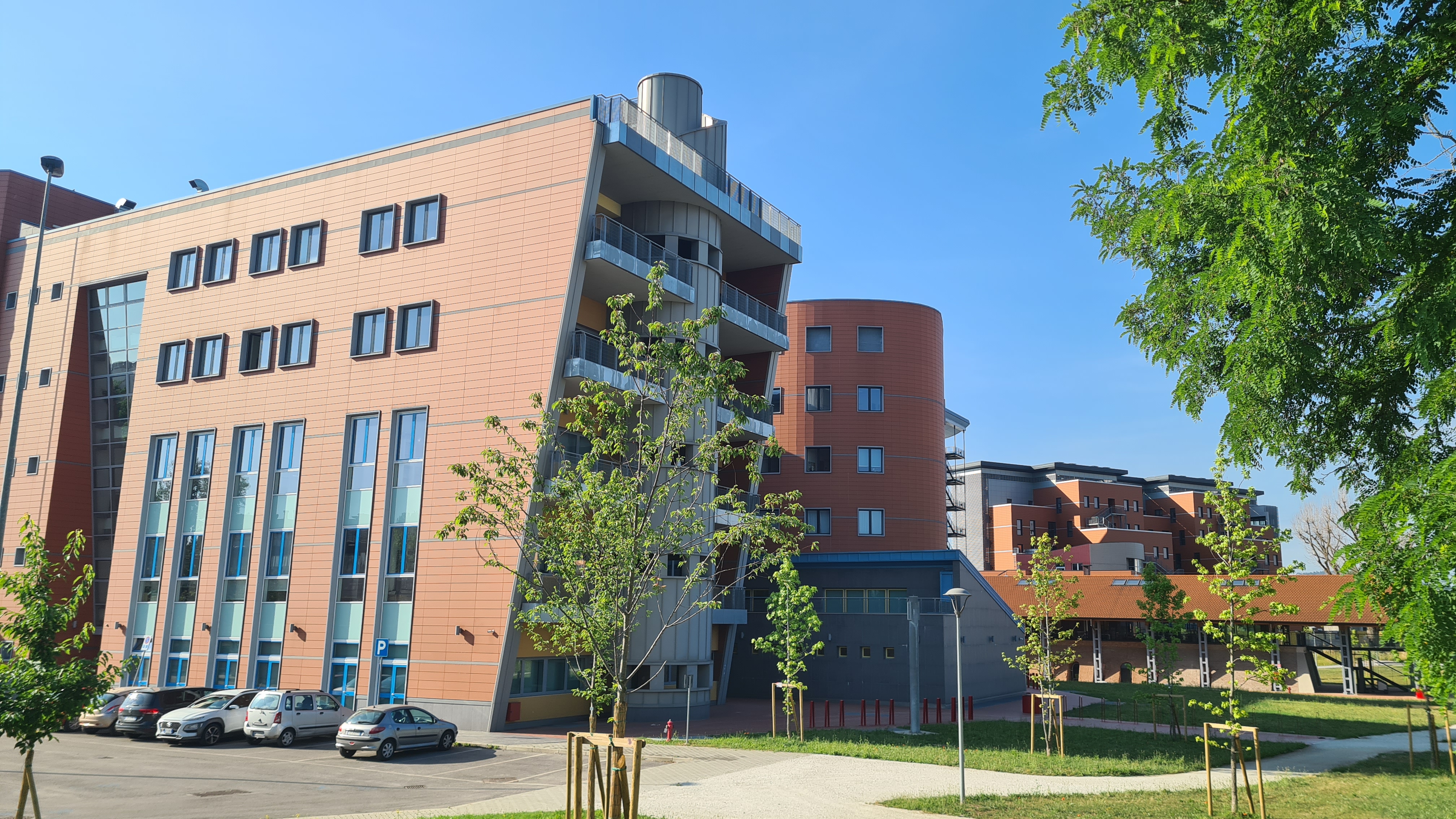
Higher education processes are being harmonised across the European Community. Nowadays the university offers 101 different "Laurea" or "Laurea breve" first-level degrees (three years of courses), followed by 108 "Laurea specialistica" or "Laurea magistrale" second-level degrees (two years). However 11 other courses have maintained the previous rules of "Laurea specialistica a ciclo unico" or "Laurea magistrale a ciclo unico", with only one cycle of study of five years, except for medicine and dentistry, which require six years of courses. After the "Laurea" one may attain first-level Master (one-year diploma, similar to a postgraduate diploma). After second-level degrees are attained, one may proceed to second-level Master, specialisation schools (residency) or research doctorates (PhD).
The 11 Schools (which replace the existing 23 faculties) are:
- School of Agriculture and Veterinary Medicine
- School of Economics, Management and Statistics
- School of Engineering and Architecture
- School of Foreign Languages and Literature, Interpreting and Translation
- School of Law
- School of Arts, Humanities, and Cultural Heritage
- School of Medicine and Surgery
- School of Pharmacy, Biotechnologies and Sport Sciences
- School of Political Sciences
- School of Psychology and Education Sciences
- School of Sciences
The university is structured in 33 departments (66 until 2012), organized by homogeneous research domains that integrate activities related to one or more faculty. A new department of Latin history was added in 2015.
The 33 departments are:
- Architecture – DA
- Cultural Heritage – DBC
- Chemistry "Giacomo Ciamician" – CHIM
- Industrial Chemistry "Toso Montanari" – CHIMIND
- Arts – DARvipem
- Pharmacy and Biotechnology – FaBiT
- Classical Philology and Italian Studies – FICLIT
- Philosophy and Communication Studies – FILCOM
- Physics and Astronomy – DIFA
- Computer Science and Engineering – DISI
- Civil, Chemical, Environmental, and Materials Engineering – DICAM
- Electrical, Electronic, and Information Engineering "Guglielmo Marconi" – DEI
- Industrial Engineering – DIN
- Interpreting and Translation – DIT
- Modern Languages, Literatures, and Cultures – LILEC
- Mathematics – MAT
- Experimental Medicine, Diagnostic Medicine and Specialty Medicine – DIMES
- Psychology – PSI
- Agricultural Sciences – DipSA
- Management – DiSA
- Biological, Geological, and Environmental Sciences – BiGeA
- Biomedical and Neuromotor Sciences – DIBINEM
- Education Studies "Giovanni Maria Bertin" – EDU
- Agricultural and Food Sciences – DISTAL
- Economics – DSE
- Legal Studies – DSG
- Medical and Surgical Sciences – DIMEC
- Veterinary Medical Sciences – DIMEVET
- Department for Life Quality Studies – QUVI
- Political and Social Sciences – SPS
- Statistical Sciences "Paolo Fortunati" – STAT
- Sociology and Business Law – SDE
- History and Cultures – DiSCi
Affiliates and other institutions
Il Mulino
In the early 1950s, some students of the University of Bologna were among the founders of the review "il Mulino". On 25 April 1951 the first issue of the review was published in Bologna. In a short time, "il Mulino" became one of the most interesting reference points in Italy for the political and cultural debate and established important editorial relationships in Italy and abroad. Editorial activities evolved along with the review. In 1954, the il Mulino publishing house (It. Società editrice il Mulino) was founded, which today represents one of the most relevant Italian publishers. In addition to this were initiated research projects (focusing mostly on the educational institutions and the political system in Italy), that eventually led, in 1964, to the establishment of the Istituto Carlo Cattaneo.
Collegio Superiore
The Collegio Superiore is an excellence institution inside the University of Bologna, aimed at promoting students' merit through dedicated learning programmes.
The institution was founded in 1998 as Collegio d'Eccellenza. Together with the Institute for Advanced Study it is part of the Institute for Higher Study.
The Collegio Superiore offers an additional educational path to students enrolled in a degree programme at the University of Bologna, providing specialized courses as part of an interdisciplinary framework.
All students of the Collegio Superiore are granted a full-ride scholarship and additional benefits such as the assistance of a personal tutor and free accommodation at the Residence for Higher Study. In order to remain members of the Collegio Superiore students are required to maintain high marks in both their degree programme and the additional courses.
Beatrice Fraboni, professor of Physics of Matter, has been head of Collegio Superiore since 2019.
Notable people
Main article: List of University of Bologna people
Alumni
- Adone Zoli, former Prime Minister of Italy.
- Cardinal Alberto Bolognetti
- Pope Alexander VI
- Álvaro de Figueroa, former Prime Minister of Spain.
- Anna M. Borghi, Italian cognitive psychologist
- Augusto Righi, pioneer in the study of electromagnetism
- Carlo Goldoni, Italian playwright
- Carlo Rovelli, Italian theoretical physicist
- Carlo Severini
- Saint Charles Borromeo, archbishop of Milan
- Corrado Gini, Italian statistician, demographer and sociologist who developed the Gini coefficient/ratio.
- Dante Alighieri,{{Cite web|url=https://www.unibo.it/it/ateneo/chi-siamo/la-nostra-storia/luniversita-dal-xii-al-xx-secolo|title= L'Università dal XII al XX secolo
- Daria de Pretis, Italian jurist, Constitutional Judge of the Constitutional Court of Italy.
- Diego Della Valle, chairman of the Italian leather goods company Tod's
- Enzo Ferrari, Italian racing driver, engineer and entrepreneur
- Erasmus of Rotterdam
- Fabrizio Zilibotti, Italian economist and Professor of International and Development Economics at Yale University.
- Fawziya Abikar Nur, Minister for Health and Social Care – Somalia.
- Filip Ivanović, Minister of Foreign Affairs of Montenegro.
- Gabriele Paleotti
- Gasparo Tagliacozzi, pioneer of plastic and reconstructive surgery
- Giacomo Matteotti
- Giovanni Pascoli
- Pope Gregory XIII (Ugo Boncompagni);
- Pope Gregory XV
- Gregorio Ricci-Curbastro, Italian mathematician and the inventor of tensor calculus.
- Guglielmo Marconi, Italian inventor and radio pioneer
- Henry of Susa (Hostiensis);
- Pope Innocent IX
- Irnerius, founder of the School of Glossators
- Joaquín Chapaprieta, former Prime Minister of Spain.
- Juan Fernando López Aguilar, former Minister of Justice – Spain.
- Julius Caesar Aranzi, the pioneer human anatomists and surgeons.
- Kristina Pardalos, Sammarinese jurist
- Laura Bassi, the world's first woman to earn a university chair in a scientific field of studies
- Lazzaro Spallanzani, Italian priest, biologist and physiologist
- Leon Battista Alberti;
- Luigi Galvani;
- Manuel Olivencia, lawyer and academic;
- Mauro Moretti, former CEO and general manager of Leonardo S.p.A.
- Marcello Malpighi;
- Michelangelo Antonioni;
- Nicolaus Copernicus, formulator of the heliocentric universal model;
- Cardinal Paolo Burali d'Arezzo;
- Paracelsus, founder of the discipline of toxicology;
- Patrizio Bianchi, Minister of Public Education in the Draghi Cabinet
- Petrarch;
- Pico della Mirandola;
- Pier Luigi Nervi, Italian Structural engineer and architect of UNESCO Headquarters Paris (1950).
- Pier Paolo Pasolini;
- Pierluigi Collina, Chairman of the FIFA referees committee
- Piero Gnudi, Minister of Tourism and Sports in the Monti cabinet.
- Pietro Mengoli;
- Remo Gaspari, Minister of Relationships with the Parliament and Minister of Public Function in the Bettino Craxi and Giulio Andreotti Cabinet.
- Stefano Domenicali, CEO of Formula One Group, former CEO of Italian sports car manufacturer Automobili Lamborghini S.p.A. and Team Principal of Formula One team Scuderia Ferrari.
- Archbishop Thomas Becket;
- Tommaso Perelli, Italian astronomer
- Torquato Tasso;
- Ulisse Aldrovandi;
- Umberto Eco, Italian semiotician, philosopher and writer
- Mihalj Šilobod Bolšić (1724–1787), Catholic priest, mathematician, writer, and musical theorist primarily known for writing the first Croatian arithmetic textbook Arithmatika Horvatzka (published in Zagreb, 1758)
- Bruno D'Amore, mathematician
Faculty and staff
Notable former faculty include:
- 11th century
- Irnerius
- 12th century
- Bulgarus
- Gratian
- Martinus Gosia
- Patriarch Heraclius of Jerusalem
- William of Tyre
- 13th century
- Benvenutus Scotivoli
- Bettisia Gozzadini
- Guido Guinizelli
- Henry of Susa (Hostiensis)
- Paul, Dominican martyr
- Sylvester Gozzolini
- William of Saliceto
- 14th century
- Manuel Chrysoloras
- Giovanni de' Marignolli
- Francesco Petrarca (also known as Petrarch)
- Coluccio Salutati
- 15th century
- Leon Battista Alberti
- Nicolaus Copernicus
- Lippo Bartolomeo Dardi
- Yuriy Drohobych (also known as Georgius de Drohobycz)
- Giovanni Pico della Mirandola
- 16th century
- Ulisse Aldrovandi
- Giovanni Antonio Magini
- Camillo Baldi
- Girolamo Cardano
- Ignazio Danti
- Giovanni Della Casa
- Girolamo Maggi
- Virgilio Malvezzi
- Paracelsus
- 17th century
- Giovanni Cassini
- Bonaventura Cavalieri
- Niall Ó Glacáin
- Marcello Malpighi
- Pietro Mengoli
- Lodovico Scapinelli
- 18th century
- Laura Bassi
- Luigi Galvani
- Maria Gaetana Agnesi
- Carlo Goldoni
- 19th century
- Augusto Righi
- Giacomo Ciamician
- Giosuè Carducci
- Giovanni Pascoli
- Pellegrino Rossi
- Francesco Selmi
- 20th century
- Umberto Eco
- Beppo Levi
- Guglielmo Marconi
- Pier Paolo Pasolini
- Maria Matilde Principi
- Romano Prodi
- 21st century
- Hamida Barmaki
- Özalp Babaoğlu
- Gabriella Campadelli-Fiume
- Pier Cesare Bori
- Augusto Barbera
- Gualtiero Calboli
- Ivano Dionigi
- Luciano Floridi
Rankings and reputation
| - |
|---|
| - |
| - |
| - |
The 2024 QS World University Rankings ranked the University of Bologna 154th in the world as well as 73rd (1st in Italy, 18th in Europe) with specific reference to academic reputation. In another measurement by the same organization, it was positioned among the world's top 100 universities for graduate employability.
In the 2024 Times Higher Education World University Rankings, it claimed the 155th place globally. In the 2023 THE Impact Rankings, which measure the universities' commitment to sustainable development in compliance with the UN 2030 Agenda, Bologna took 5th place in Europe and 23rd in the world.
Furthermore, Bologna topped Italy's 2023 list of large public universities ( 40,000 students), produced by the Italian Center for Social Investment Studies, for the 14th year in a row.
Points of interest
- Orto Botanico dell'Università di Bologna
References
References
- (1894). "Records of The Tercentenary Festival of Dublin University". [[Hodges Figgis.
- ''Charters of foundation and early documents of the universities of the Coimbra Group'', Hermans, Jos. M. M., {{ISBN. 90-5867-474-6.
- ""The University today: numbers and innovation"".
- Hunt Janin: "The university in medieval life, 1179–1499", McFarland, 2008, {{ISBN. 0-7864-3462-7, p. 55f.
- 0-521-36105-2, pp. 47–55
- "Schools". University of Bologna.
- "Nicolaus Copernicus {{!}} Biography, Facts, Nationality, Discoveries, Accomplishments, & Theory {{!}} Britannica".
- Luigi. (2012-06-27). "La storia dell'Università di Bologna {{!}} Universando.com".
- "Bruxelles, New York, Shanghai - Università di Bologna".
- "Campuses and Structures". University of Bologna.
- "Musei Universitari - Università di Bologna".
- [http://www.topuniversities.com/worlduniversityrankings/results/2007/overall_rankings/worlds_oldest_universities/ Top Universities] {{webarchive. link. (2008-01-15 ''World University Rankings'' Retrieved 2010-1-6)
- [http://www.eng.unibo.it/PortaleEn/University/Our+History/default.htm Our History] - Università di Bologna
- Paul L. Gaston. (2012). "The Challenge of Bologna: What United States Higher Education Has to Learn from Europe, and Why It Matters That We Learn It". Stylus Publishing, LLC..
- Paul F. Grendler, ''The Universities of the Italian Renaissance'' (JHU Press, 2002), 6.
- David A. Lines, "The University and the City: Cultural Interactions", in ''A Companion to Medieval and Renaissance Bologna'', ed. Sarah Rubin Blanshei (Leiden: Brill, 2017), 437–8.
- [http://www.freenation.org/a/f13l3.html A University Built by the Invisible Hand], by Roderick T. Long. This article was published in the Spring 1994 issue of ''Formulations'', by the Free Nation Foundation.
- "University of Bologna {{!}} History & Development".
- Berman, ''Law and Revolution'', ch. 3; Stein, ''Roman Law in European History'', part 3.
- See [[Corpus Juris Civilis#Recovery in the West. Corpus Juris Civilis: Recovery in the West]]
- Murphy, Caroline P.. (1999). "'In praise of the ladies of Bologna': the image and identity of the sixteenth-century Bolognese female patriciate". Renaissance Studies.
- Bonafede, Carolina. (1845). "Cenni biografici e ritratti d'insigni donne bolognesi: raccolti dagli storici più accreditati". Sassi.
- (July 10, 2018). "Luigi Ferdinando Marsili". Linda Hall Library.
- [http://www.encyclopedia.com/women/encyclopedias-almanacs-transcripts-and-maps/bassi-laura-1711-1778 Laura Bassi] at Encyclopedia.com
- "Laura Bassi (1711 - 1778)".
- (2020). "Women In The History Of Philosophy".
- Elena, Alberto. (1991). ""In lode della filosofessa di Bologna": An Introduction to Laura Bassi". Isis.
- Frize, Monique. (2013). "Famous Women in Science in Laura Bassi's Epoch". Springer Berlin Heidelberg.
- Monique Frize, ''Laura Bassi and Science in 18th Century Europe: The Extraordinary Life and Role of Italy's Pioneering Female Professor'', Springer, p. 174.
- Findlen, Paula. (2013-08-29). "Laura Bassi and the city of learning".
- Frize, Monique. (2013). "Laura Bassi and Science in 18th Century Europe". Springer Berlin Heidelberg.
- "Laura Bassi {{!}} Italian scientist".
- "Laura BASSI".
- Findlen, Paula. (1993). "Science as a career in Enlightenment Italy: The strategies of Laura Bassi". Isis.
- (July 3, 2021). "TG2 Dossier Storie".
- "Lea Polvani e i delitti del DAMS". Radio Caffè Criminale.
- [http://www.unibo.it/Portale/Ricerca/Dipartimenti/index.html List] of the Departments of the University of Bologna
- (5 April 2019). "La Società editrice".
- (2019-07-08). "Beatrice Fraboni è la nuova direttrice del Collegio Superiore".
- "Alexander VI {{!}} Biography, Legacy, & Facts".
- "Augusto Righi".
- "Righi, Augusto {{!}} Encyclopedia.com".
- "The University from the 12th to the 20th century – University of Bologna".
- (2007-12-05). "The Legacy of Mario Pieri in Geometry and Arithmetic". Springer Science & Business Media.
- "Biography of St. Charles Borromeo".
- "Erasmus {{!}} Biography & Facts".
- "PALEOTTI, Gabriele in "Dizionario Biografico"".
- "Gaspare Tagliacozzi (1545–99)".
- Zimbler, Marc S.. (2001-10-01). "Gaspare Tagliacozzi (1545–1599): Renaissance Surgeon". Archives of Facial Plastic Surgery.
- Ménard, Sophie. (January 2019). "An Unknown Renaissance Portrait of Tagliacozzi (1545–1599), the Founder of Plastic Surgery". Plastic and Reconstructive Surgery – Global Open.
- "Giacomo Matteotti {{!}} Italian social leader".
- "Biography".
- (16 March 2012). "Giovanni Pascoli, appointed professor at the University of Bologna,...".
- "Giovanni Pascoli {{!}} Italian poet".
- "Pope Gregory XIII: Accomplishments & Legacy".
- "Gregory Xiii {{!}} Encyclopedia.com".
- "Gregory XV {{!}} pope".
- "Marconi itinerary in Bologna and surroundings".
- "Guglielmo Marconi {{!}} Italian physicist".
- Brundage, James A.. (2014-06-11). "Medieval Canon Law". Routledge.
- "Innocent Iv {{!}} Encyclopedia.com".
- "Irnerius {{!}} Italian legal scholar".
- "Laura Bassi – University of Bologna".
- "Laura Bassi {{!}} Italian scientist".
- "Lazzaro Spallanzani (1729–1799) {{!}} The Embryo Project Encyclopedia".
- "Leon Battista Alberti {{!}} Italian architect and author".
- "Luigi Galvani – University of Bologna".
- "Luigi Galvani {{!}} Encyclopedia.com".
- "Luigi Galvani".
- "Manuel Olivencia receives Premio Pelayo para Juristas de Reconocido Prestigio award".
- "Marcello Malpighi – University of Bologna".
- "Marcello Malpighi {{!}} Italian scientist".
- "Michelangelo Antonioni {{!}} Italian director".
- (2018-03-30). "Spotlight: Michelangelo Antonioni {{!}}".
- "Michelangelo Antonioni {{!}} Encyclopedia.com".
- (May 2011). "Nicolaus Copernicus: not only a great astronomer but also a physician". Journal of Nephrology.
- "Studying at University of Bologna".
- "Comune di Itri – Sito comunale".
- "Famous people, guests and illustrious students – University of Bologna".
- (2019-04-25). "Petrarch".
- Copenhaver, Brian. (2016). "Giovanni Pico della Mirandola". Metaphysics Research Lab, Stanford University.
- "Giovanni Pico della Mirandola, count di Concordia {{!}} Italian scholar".
- "Pier Paolo Pasolini".
- "Pier Paolo Pasolini {{!}} Italian author and director".
- "Pietro Mengoli (1626–1686)".
- "Saint Thomas Becket {{!}} Biography, Death, & Significance".
- "Torquato Tasso {{!}} Encyclopedia.com".
- "Ulisse Aldrovandi – University of Bologna".
- "Ulisse Aldrovandi {{!}} Italian naturalist".
- Serafino Mazzetti, ''Repertorio di tutti I professori antichi e moderni della famosa Università...di Bologna'' (Bologna 1848).
- "Gualtiero Calboli — Università di Bologna — Home Page".
- "QS World University Rankings".
- (20 September 2023). "World University Rankings 2024". Times Higher Education.
- (January 2024). "2024 Academic Ranking of World Universities". Shanghai Ranking Consultancy.
- (24 June 2024). "2024-2025 Best Global Universities Rankings". U.S. News & World Report.
- (3 July 2024). "CWTS Leiden Ranking 2024". Leiden University.
- (13 May 2024). "Global 2000 List by the Center for World University Rankings - 2024 Edition". Center for World University Rankings (CWUR).
- "QS Graduate Employability Rankings 2020".
- (2020-09-03). "THE World University Rankings 2021".
- (2024-01-22). "Impact Rankings 2020".
- (2024-02-09). "La Classifica Censis delle Università italiane (edizione 2023/2024)".
This article was imported from Wikipedia and is available under the Creative Commons Attribution-ShareAlike 4.0 License. Content has been adapted to SurfDoc format. Original contributors can be found on the article history page.
Ask Mako anything about University of Bologna — get instant answers, deeper analysis, and related topics.
Research with MakoFree with your Surf account
Create a free account to save articles, ask Mako questions, and organize your research.
Sign up freeThis content may have been generated or modified by AI. CloudSurf Software LLC is not responsible for the accuracy, completeness, or reliability of AI-generated content. Always verify important information from primary sources.
Report