From Surf Wiki (app.surf) — the open knowledge base
United States Patent and Trademark Office
United States national patent bureau
United States national patent bureau
| Field | Value | |||
|---|---|---|---|---|
| image | Usptojamesmadisonbuildingsouthside.jpg | |||
| image_caption | The James Madison building on the campus of the United States Patent and Trademark Office headquarters in Alexandria. This is the largest building on the campus. | |||
| seal | Seal of the United States Patent and Trademark Office.svg | |||
| seal_width | 140 | |||
| seal_caption | Seal of the U.S. Patent and Trademark Office | |||
| formed | {{cite web | |||
| url | https://www.archives.gov/research/guide-fed-records/groups/241.html | title=Records of the Patent and Trademark office | work=National Archives and Records Administration | date=August 15, 2016 }} |
| Washington, D.C., U.S. | ||||
| headquarters | Alexandria, Virginia, U.S. | |||
| coordinates | ||||
| employees | 14,082 (2024) | |||
| chief1_name | Coke Morgan Stewart | |||
| chief1_position | Director (acting) | |||
| chief2_name | ||||
| chief2_position | ||||
| parent_agency | United States Department of Commerce | |||
| website | ||||
| chief3_name | Valencia Martin Wallace | |||
| chief3_position | Commissioner for Patents (Acting) | |||
| chief4_name | Dan Vavonese | |||
| chief4_position | Commissioner for Trademarks (Acting) |
Washington, D.C., U.S.
The United States Patent and Trademark Office (USPTO) is an agency in the U.S. Department of Commerce that serves as the national patent office and trademark registration authority for the United States. The USPTO's headquarters are in Alexandria, Virginia, after a 2005 move from the Crystal City area of neighboring Arlington, Virginia.
The USPTO is "unique among federal agencies because it operates solely on fees collected by its users, and not on taxpayer dollars". Its "operating structure is like a business in that it receives requests for services—applications for patents and trademark registrations—and charges fees projected to cover the cost of performing the services [it] provide[s]".
The office is headed by the under secretary of commerce for intellectual property and director of the United States Patent and Trademark Office. , John A. Squires is the undersecretary and director, having been confirmed by the U.S. Senate as part of an en bloc vote.
The USPTO cooperates with the European Patent Office (EPO) and the Japan Patent Office (JPO) as one of the Trilateral Patent Offices. The USPTO is also a Receiving Office, an International Searching Authority and an International Preliminary Examination Authority for international patent applications filed in accordance with the Patent Cooperation Treaty.
Mission
The legal basis for the United States patent system is the Copyright Clause in Section 8 of Article I of the U.S. Constitution, which gives Congress the power to grant patents and copyrights on a national basis. Trademark law, on the other hand, is considered to be authorized by the Commerce Clause.
The Congress shall have Power ... To promote the Progress of Science and useful Arts, by securing for limited Times to Authors and Inventors the exclusive Right to their respective Writings and Discoveries.
The USPTO maintains a permanent, interdisciplinary historical record of all U.S. patent applications in order to fulfill objectives outlined in the United States Constitution. The PTO's mission is to promote "industrial and technological progress in the United States and strengthen the national economy" by:
- Administering the laws relating to patents and trademarks;
- Advising the secretary of commerce, the president of the United States, and the administration on patent, trademark, and copyright protection; and
- Providing advice on the trade-related aspects of intellectual property.
Patent Office relief on the Herbert C. Hoover Building.JPG | Relief representing the Patent Office at the Herbert C. Hoover Building 14 12 31 US Patent Office Sign Alexandria VA 01.jpg | Signboard of U.S. Patent Office Alexandria
Structure
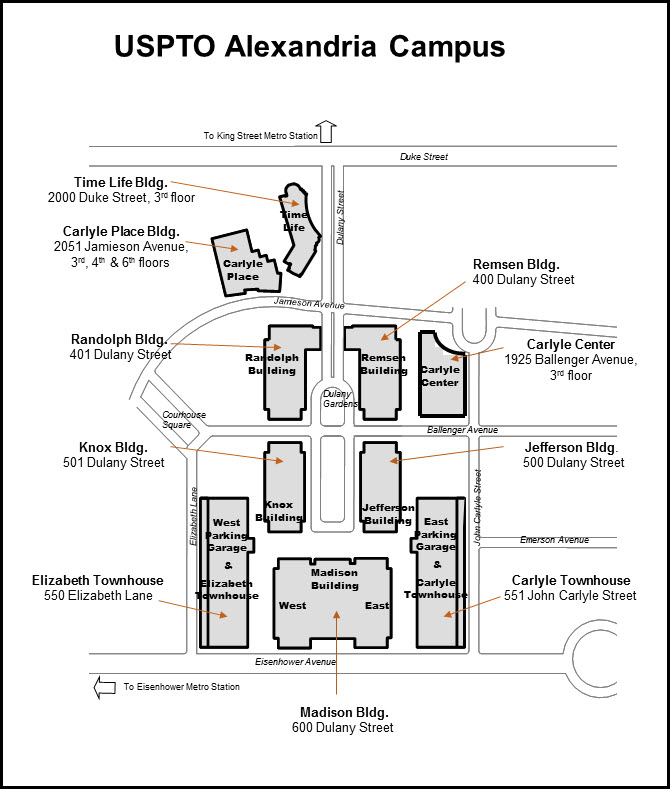
The USPTO is headquartered at the Alexandria Campus, consisting of 4 buildings in a city-like development surrounded by ground floor retail and high rise residential buildings between the Metro stations of King Street station (the main search building is two blocks due south of the King Street station) and Eisenhower Avenue station where the actual Alexandria Campus is located between Duke Street (on the North) to Eisenhower Avenue (on the South), and between John Carlyle Street (on the East) to Elizabeth Lane (on the West) in Alexandria, Virginia.
The USPTO was expected by 2014 to open its first ever satellite offices in Detroit, Dallas, Denver, and Silicon Valley to reduce backlog and reflect regional industrial strengths. The first satellite office opened in Detroit on July 13, 2012. In 2013, due to the budget sequestration, the satellite office for Silicon Valley, which is home to one of the nation's top patent-producing cities, was put on hold. However, renovation and infrastructure updates continued after the sequestration, and the Silicon Valley location opened in the San Jose City Hall in 2015.
In 2024, the USPTO reduced its leased space in Alexandria, pointing to its increasingly remote work force and cost savings initiatives. The Alexandria campus no longer includes the Remsen and Randolph buildings, nor the Elizabeth Townhouse and West Garage. In November 2025, the U.S. General Services Administration and U.S. National Science Foundation (NSF) announced the new NSF headquarters will be located at the Randolph building that the USPTO has vacated.
On October 1, 2025, the USPTO announced plans to close the Rocky Mountain Regional Outreach Office in Denver.
, the end of the U.S. government's fiscal year, the PTO had 9,716 employees, nearly all of whom are based at its five-building headquarters complex in Alexandria. Of those, 6,242 were patent examiners (almost all of whom were assigned to examine utility patents; only 99 were assigned to examine design patents) and 388 were trademark examining attorneys; the rest are support staff. While the agency has noticeably grown in recent years, the rate of growth was far slower in fiscal 2009 than in the recent past; this is borne out by data from fiscal 2005 to the present: As of the end of FY 2018, the USPTO was composed of 12,579 federal employees, including 8,185 patent examiners, 579 trademark examiners, and 3,815 other staff.
US Patent Office main building.jpg | USPTO Madison Building Exterior Interior of the US Patent and Trademark Madison Building.jpg | Interior atrium of the USPTO Madison Building United States Patent and Trademark Office, San Jose City Hall, San Jose, California.jpg | USPTO satellite office in San Jose, California
| At end of FY | Employees | Patent examiners | Trademark examining attorneys | Patent filings (utility) | Trademark filings | Patent application backlog | ||||||
|---|---|---|---|---|---|---|---|---|---|---|---|---|
| 2024 | 14,082 | 8,944 | 765 | 466,079 | 767,138 | |||||||
| url=https://www.uspto.gov/sites/default/files/documents/USPTOFY23AFR.pdf | title=Agency Financial Report | website=USPTO | access-date=September 26, 2024 | archive-date=August 28, 2024 | archive-url=https://web.archive.org/web/20240828131413/https://www.uspto.gov/sites/default/files/documents/USPTOFY23AFR.pdf | url-status=live}} | 13,452 | 8,568 | 756 | 594,143 | 737,018 | |
| 2022 | 13,103 | 8,509 | 718 | 457,510 | 787,798 | |||||||
| 2021 | 12,963 | 8,073 | 662 | 650,703 | 943,928 | |||||||
| 2020 | 12,928 | 8,434 | 622 | 653,311 | 738,112 | |||||||
| 2019 | 12,652 | 9,614 | 701 | 666,843 | 673,233 | |||||||
| 2018 | 12,579 | 8,185 | 579 | 647,572 | 594,107 | |||||||
| 2017 | 12,588 | 8,147 | 549 | 650,350 | 530,270 | 526,579 | ||||||
| url=https://www.uspto.gov/sites/default/files/documents/USPTOFY16PAR.pdf | title=Performance & Accountability Report FY 2016 | website=USPTO | access-date=June 22, 2023 | archive-date=May 16, 2023 | archive-url=https://web.archive.org/web/20230516131256/https://www.uspto.gov/sites/default/files/documents/USPTOFY16PAR.pdf | url-status=live}} | 12,725 | 8,351 | 570 | 650,411 | 530,270 | 537,655 |
| 2015 | 12,667 | 9,161 | 456 | 618,062 | 503,889 | 553,221 | ||||||
| 2014 | 12,450 | 9,302 | 429 | 618,457 | 455,017 | |||||||
| 2013 | 11,773 | 8,051 | 409 | 601,464 | 433,654 | |||||||
| 2012 | 11,531 | 7,935 | 386 | 565,406 | 415,026 | 608,283 | ||||||
| 2011 | 10,210 | 6,780 | 378 | 536,604 | 398,667 | |||||||
| 2010 | 9,507 | 6,225 | 378 | 509,367 | 368,939 | 726,331 | ||||||
| 2009 | 9,716 | 6,243 | 388 | 485,500 | 352,051 | 750,596 | ||||||
| 2008 | 9,518 | 6,055 | 398 | 495,095 | 401,392 | 750,596 | ||||||
| 2007 | 8,913 | 5,477 | 404 | 467,243 | 394,368 | |||||||
| url=https://www.uspto.gov/sites/default/files/about/stratplan/ar/USPTOFY2006PAR.pdf | title=Performance & Accountability Report FY 2006 | website=USPTO | access-date=June 22, 2023 | archive-date=May 16, 2023 | archive-url=https://web.archive.org/web/20230516131300/https://www.uspto.gov/sites/default/files/about/stratplan/ar/USPTOFY2006PAR.pdf | url-status=live}} | 4,779 | 413 | ||||
| 2005 | 4,177 | 357 | ||||||||||
| 2004 | 3,681 | 286 | ||||||||||
| 2003 | 3,579 | 256 | ||||||||||
| 1998 | 5,300 | |||||||||||
| url=https://www.uspto.gov/about-us/performance-and-planning/annual-reports/1996-annual-review-additional-information#tab | title=1996 Annual Review - Additional Information | website=USPTO | access-date=June 22, 2023 | archive-date=March 31, 2023 | archive-url=https://web.archive.org/web/20230331152819/https://www.uspto.gov/about-us/performance-and-planning/annual-reports/1996-annual-review-additional-information | url-status=live}} | 189,979 | 200,640 | ||||
| url=https://www.uspto.gov/sites/default/files/about/stratplan/ar/1995annualreport.pdf | title=Setting The Course For Our Future - A Patent and Trademark Office Review - Fiscal Year 1995 | website=USPTO | access-date=June 22, 2023 | archive-date=May 16, 2023 | archive-url=https://web.archive.org/web/20230516131252/https://www.uspto.gov/sites/default/files/about/stratplan/ar/1995annualreport.pdf | url-status=live}} | 221,304 | 175,307 | ||||
| url=https://www.uspto.gov/sites/default/files/about/stratplan/ar/1994annualreport.pdf | title=Working for Our Customers - A Patent and Trademark Office Review - Fiscal Year 1994 | website=USPTO | access-date=June 22, 2023 | archive-date=May 16, 2023 | archive-url=https://web.archive.org/web/20230516131249/https://www.uspto.gov/sites/default/files/about/stratplan/ar/1994annualreport.pdf | url-status=live}} | 186,126 | 155,376 | ||||
| 1993 | 174,553 | 139,735 | ||||||||||
| 1992 | 172,539 | 125,237 | ||||||||||
| 1986 | 120,988 | 69,253 | ||||||||||
| 1976 | 101,807 | 37,074 |
Patent examiners make up the bulk of the employees at USPTO. They hold degrees in various scientific disciplines, but do not necessarily hold law degrees. Unlike patent examiners, trademark examiners must be licensed attorneys.
All examiners work under a strict, "count"-based production system. For every application, "counts" are earned by composing, filing, and mailing a first office action on the merits, and upon disposal of an application.
Prior to 2012, decisions of patent examiners could be appealed to the Board of Patent Appeals and Interferences, an administrative law body of the USPTO. Decisions of the BPAI could further be appealed to the United States Court of Appeals for the Federal Circuit, or a civil suit could be brought against the Commissioner of Patents in the United States District Court for the Eastern District of Virginia. The United States Supreme Court may ultimately decide on a patent case. Under the America Invents Act, the BPAI was converted to the Patent Trial and Appeal Board or "PTAB". Similarly, decisions of trademark examiners could be appealed to the Trademark Trial and Appeal Board, with subsequent appeals directed to the Federal Circuit, or a civil action may also be brought.
Management
In March 2025, President Donald J. Trump nominated attorney John A. Squires, the former chief intellectual property attorney at Goldman Sachs, to serve as the USPTO director. He was sworn in on September 22, 2025. Coke Morgan Stewart, who served as Acting Director until Squires was sworn in, serves as the deputy director of the USPTO.
Fee diversion
For many years, Congress has "diverted" about 10% of the fees that the USPTO collected into the general treasury of the United States. In effect, this took money collected from the patent system to use for the general budget. This fee diversion has been generally opposed by patent practitioners (e.g., patent attorneys and patent agents), inventors, the USPTO, as well as former federal judge Paul R. Michel. These stakeholders would rather use the funds to improve the patent office and patent system, such as by implementing the USPTO's 21st Century Strategic Plan. The last six annual budgets of the George W. Bush administration did not propose to divert any USPTO fees, and the first budget of the Barack Obama administration continued this practice, as well as the second budget of the Trump administration; however, stakeholders continue to press for a permanent end to fee diversion.
The discussion of which party can appropriate the fees is more than a financial question. Patent fees represent a policy lever that influences both the number of applications submitted to the office as well as their quality.
Patents
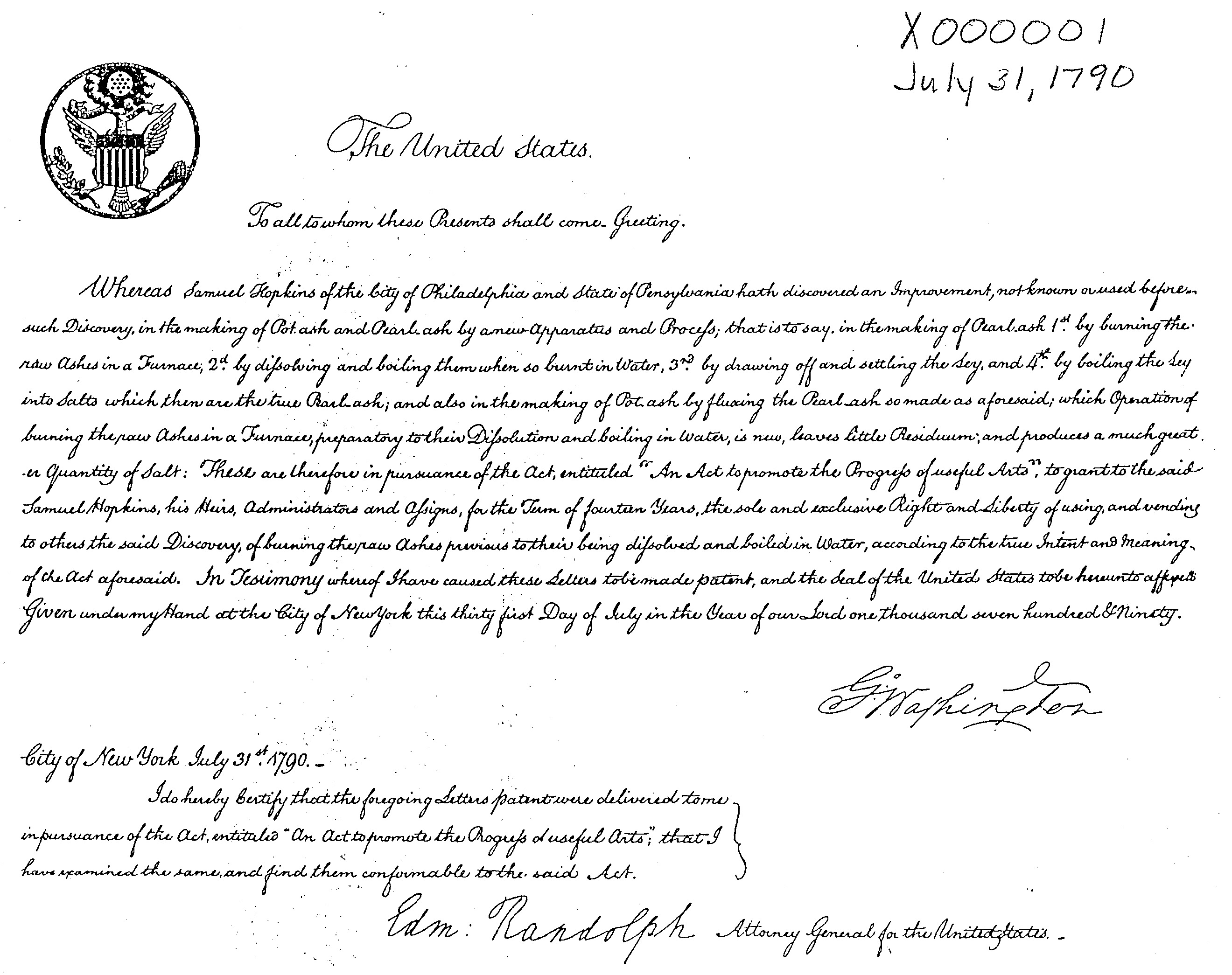
- On July 31, 1790, the first U.S. patent was issued to Samuel Hopkins for an improvement "in the making of Pot ash and Pearl ash by a new Apparatus and Process". This patent was signed by President George Washington.
- The X-Patents (the first 9,957 (approximately), issued between 1790 and 1836) were destroyed by a fire; fewer than 3,000 of those have been recovered and re-issued with numbers that include an "X". The X generally appears at the end of the numbers hand-written on full-page patent images; however, in patent collections and for search purposes, the X is considered to be the patent type – analogous to the "D" of design patents – and appears at the beginning of the number. The X distinguishes the patents from those issued after the fire, which began again with patent number 1.
- Each year, the PTO issues over 150,000 patents to companies and individuals worldwide. , the PTO had granted 8,743,423 patents and received 16,020,302 applications.
- On June 19, 2018, the 10 millionth U.S. patent was issued to Joseph Marron for invention of a "Coherent LADAR [System] Using Intra-Pixel Quadrature Detection" to improve laser detection and ranging (LADAR). The patent was the first to receive the newly redesigned patent cover. It was signed by President Donald Trump during a special ceremony at the Oval Office.
- In February 2024, the USPTO issued a new guideline relating to obtaining a patent as per earlier recommendation by Biden's administration. The guideline states that; to obtain a patent, a real person, not AI, must have made a "significant contribution" to the invention and that only a human being can be named as an inventor on a patent.
List of millionth U.S. patents
| Patent number | Patent title | Issue date | Days since preceding |
|---|---|---|---|
| millionth issue | |||
| 1 | Traction Wheels | July 13, 1836 | |
| 1,000,000 | Vehicle Tire | August 8, 1911 | |
| 2,000,000 | Vehicle Wheel Construction | May 12, 1932 | |
| 3,000,000 | Automatic Reading System | May 6, 1955 | |
| 4,000,000 | Process for Recycling Asphalt-Aggregate Compositions | December 28, 1976 | |
| 5,000,000 | Ethanol Production by Escherichia Coli Strains | March 19, 1991 | |
| 6,000,000 | Extendible Method and Apparatus for Synchronizing Multiple Files on Two Different Computer Systems | December 7, 1999 | |
| 7,000,000 | Polysaccharide Fibers | February 14, 2006 | |
| 8,000,000 | Visual Prosthesis | August 16, 2011 | |
| 9,000,000 | Windshield Washer Conditioner | April 7, 2015 | |
| 10,000,000 | Coherent Ladar Using Intra-Pixel Quadrature Detection | June 19, 2018 | |
| 11,000,000 | Repositioning Wires and Methods for Repositioning Prosthetic Heart Valve Devices within a Heart Chamber | May 11, 2021 | |
| 12,000,000 | Labeled Nucleotide Analogs, Reaction Mixtures, and Methods and System for Sequencing | June 4, 2024 |
Bar chart
|1911|27419|1932|7583|1955|8394|1976|7907|1991|5194|1999|3185|2006|2261|2011|2009|2015|1330|2018|1169|2021|1057|2024|1120}}
Trademarks
The USPTO examines applications for trademark registration, which can be filed under five different filing bases: use in commerce, intent to use, foreign application, foreign registration, or international registration. If approved, the trademarks are registered on either the Principal Register or the Supplemental Register, depending upon whether the mark meets the appropriate distinctiveness criteria. This federal system governs goods and services distributed via interstate commerce, and operates alongside state level trademark registration systems.{{cite web |access-date = February 11, 2008 |url-status = live |archive-url = https://web.archive.org/web/20080302103739/http://smallbusiness.findlaw.com/trademark/trademark-registration/state-trademark-info-links.html |archive-date = March 2, 2008 |access-date = February 11, 2008 |url-status = live |archive-url = https://web.archive.org/web/20100903003911/http://www.uspto.gov/ |archive-date = September 3, 2010 |access-date = September 14, 2015 |url-status = live |archive-url = https://web.archive.org/web/20150912050501/http://www.uspto.gov/learning-and-resources/trademark-faqs |archive-date = September 12, 2015
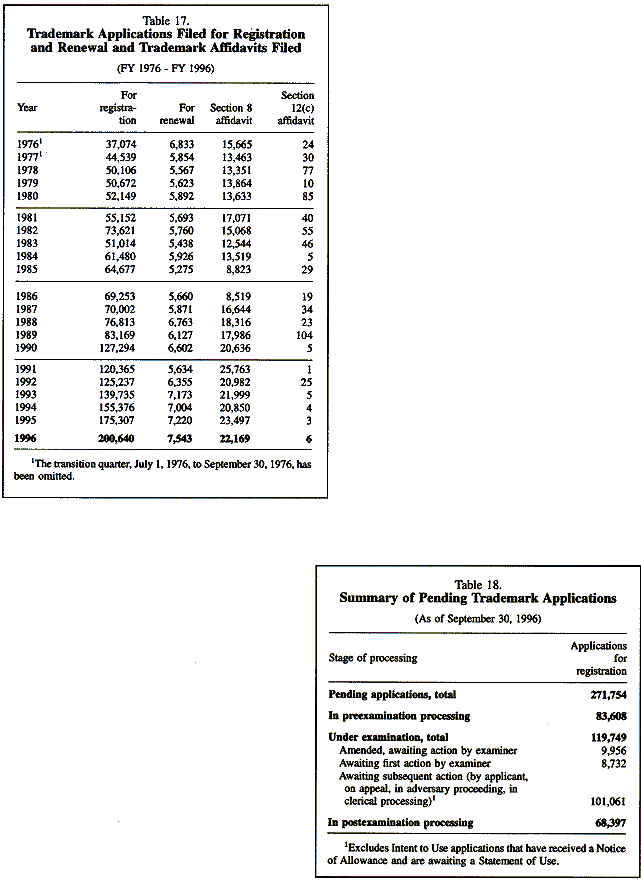
Trademark applications have grown substantially in recent years, jumping from 296,490 new applications in 2000, to 345,000 new applications in 2014, to 458,103 new applications in 2018. Recent growth has been driven partially by growing numbers of trademark applications originating in China; trademark applications from China have grown more than 12-fold since 2013, and in 2017, one in every nine trademark applications reviewed by the U.S. Trademark Office originated in China.
Since 2008, the Trademark Office has hosted a National Trademark Expo every two years, billing it as "a free, family-friendly event designed to educate the public about trademarks and their importance in the global marketplace." The Expo features celebrity speakers such as Anson Williams (of the television show Happy Days) and basketball player Kareem Abdul-Jabbar and has numerous trademark-holding companies as exhibitors. Before the 2009 National Trademark Expo, the Trademark Office designed and launched a kid-friendly trademark mascot known as T. Markey, who appears as an anthropomorphized registered trademark symbol. T. Markey is featured prominently on the Kids section of the USPTO website, alongside fellow IP mascots Ms. Pat Pending (with her robot cat GeaRS) and Mark Trademan.
In 2020, trademark applications marked the sharpest declines and inclines in American history. During the spring, COVID-19 lockdowns led to reduced filings, which then increased in July 2020 to exceed the previous year. August 2020 was subsequently the highest month of trademark filings in the history of the U.S. Patent and Trademark Office.
Representation
The USPTO only allows certain qualified persons to practice before the USPTO. Practice includes filing of patent and trademark applications on behalf of individuals and companies, prosecuting the patent and trademark applications, and participating in administrative appeals and other proceedings before the PTO examiners, examining attorneys and boards. The USPTO sets its own standards for who may practice. Any person who practices patent law before the USPTO must become a registered patent attorney or agent. A patent agent is a person who has passed the USPTO registration examination (the "patent bar") but has not passed any state bar exam to become a licensed attorney; a patent attorney is a person who has passed both a state bar and the patent bar and is in good standing as an attorney. A patent agent can only act in a representative capacity in patent matters presented to the USPTO, and may not represent a patent holder or applicant in a court of law. To be eligible for taking the patent bar exam, a candidate must possess a degree in "engineering or physical science or the equivalent of such a degree". Any person who practices trademark law before the USPTO must be an active member in good standing of the highest court of any state.
The United States allows any citizen from any country to sit for the patent bar (if he/she has the requisite technical background). Only Canada has a reciprocity agreement with the United States that confers upon a patent agent similar rights.
An unrepresented inventor may file a patent application and prosecute it on his or her own behalf (pro se). If it appears to a patent examiner that an inventor filing a pro se application is not familiar with the proper procedures of the Patent Office, the examiner may suggest that the filing party obtain representation by a registered patent attorney or patent agent. The patent examiner cannot recommend a specific attorney or agent, but the Patent Office does post a list of those who are registered.
While the inventor of a relatively simple-to-describe invention may well be able to produce an adequate specification and detailed drawings, there remains language complexity in what is claimed, either in the particular claim language of a utility application, or in the manner in which drawings are presented in a design application. There is also skill required when searching for prior art that is used to support the application and to prevent applying for a patent for something that may be unpatentable. A patent examiner will make special efforts to help pro se inventors understand the process but the failure to adequately understand or respond to an office action from the USPTO can endanger the inventor's rights, and may lead to abandonment of the application.
Electronic filing system
The USPTO accepts patent applications filed in electronic form. Inventors or their patent agents/attorneys can file applications as Adobe PDF documents. Filing fees can be paid by credit card or by a USPTO "deposit account".
Patent search tools

The USPTO web site provides free electronic copies of issued patents and patent applications as multiple-page TIFF (graphic) documents. The site also provides Boolean search and analysis tools.
The USPTO's free distribution service only distributes the patent documents as a set of TIFF files. Numerous free and commercial services provide patent documents in other formats, such as Adobe PDF and CPC.
Criticisms
The USPTO has been criticized for granting patents for impossible or absurd, already known, or arguably obvious inventions. Economists have documented that, although the USPTO makes mistakes when granting patents, these mistakes might be less prominent than some might believe.
Controversial patents
- , "Method of exercising a cat", covers having a cat chase the beam from a laser pointer. The patent has been criticized as being obvious.
- , "Sealed crustless sandwich", issued in 1999, covers the design of a sandwich with crimped edges. All claims of the patent were canceled by the PTO upon reexamination.
- , "Hyper-light-speed antenna", an antenna that sends signals faster than the speed of light. According to the description in the patent, "The present invention takes a transmission of energy, and instead of sending it through normal time and space, it pokes a small hole into another dimension, thus, sending the energy through a place which allows transmission of energy to exceed the speed of light."
- , "Method of swinging on a swing", issued April 9, 2002, was granted to a seven-year-old boy, whose father, a patent attorney, wanted to demonstrate how the patent system worked to his son who was five years old at the time of the application. The PTO initially rejected it due to prior art, but eventually issued the patent. Upon reexamination all claims of the patent were canceled by the PTO.
- , "Space vehicle propelled by the pressure of inflationary vacuum state", describes an anti-gravity device. In November 2005, the USPTO was criticized by physicists for granting it. The journal Nature first highlighted this patent issued for a device that presumably amounts to a perpetual motion machine, defying the laws of physics.{{cite journal |access-date = September 5, 2014 |url-status = live |archive-url = https://web.archive.org/web/20160201163821/http://sherinianlaw.net/wp-content/uploads/2014/09/11079670.pdf |archive-date = February 1, 2016
Controversial trademarks
- , "Cloud Computing" for Dell, covering "custom manufacture of computer hardware for use in data centers and mega-scale computing environments for others", was allowed by a trademark attorney on July 8, 2008. Cloud computing is a generic term that could define technology infrastructure for years to come, which had been in general use at the time of the application. The application was rejected on August 12, 2008, as descriptive and generic.
- , "Netbook" for Psion, covering "laptop computers" was registered on November 21, 2000. Although the company discontinued the netBook line in November 2003 and allowed the trademark to become genericized through use by journalists and vendors (products marketed as 'netbooks' include the Dell Inspiron Mini Series, Asus eeePC, HP Mini 1000, MSI Wind Netbook and others), USPTO subsequently rejected a number of trademarks citing a "likelihood of confusion" under section 2(d), including 'G NETBOOK' ( rejected October 31, 2008), MSI's 'WIND NETBOOK' () and Coby Electronics' 'COBY NETBOOK' () rejected January 13, 2009. Psion also delivered a batch of cease-and-desist letters on December 23, 2008, relating to the genericized trademark.
Slow patent examination and backlog
Main article: Backlog of unexamined patent applications
The USPTO has been criticized for taking an inordinate amount of time in examining patent applications. This is particularly true in the fast-growing area of business method patents. As of 2005, patent examiners in the business method area were still examining patent applications filed in 2001.
The delay was attributed by spokesmen for the Patent Office to a combination of a sudden increase in business method patent filings after the 1998 State Street Bank decision, the unfamiliarity of patent examiners with the business and financial arts (e.g., banking, insurance, stock trading etc.), and the issuance of a number of controversial patents (e.g., "Amazon one click patent") in the business method area.
Effective August 2006, the USPTO introduced an accelerated patent examination procedure in an effort to allow inventors a speedy evaluation of an application with a final disposition within twelve months. The procedure requires additional information to be submitted with the application and also includes an interview with the examiner. The first accelerated patent was granted on March 15, 2007, with a six-month issuance time.
As of the end of 2008, there were 1,208,076 patent applications pending at the Patent Office. At the end of 1997, the number of applications pending was 275,295. Therefore, over those eleven years there was a 439% increase in the number of pending applications.
December 2012 data showed that there was 597,579 unexamined patent applications in the backlog. During the four years since 2009, more than a 50% reduction was achieved. First action pendency was reported as 19.2 months.
Fraud by remote working employees
In 2012, the USPTO initiated an internal investigation into allegations of fraud by employees taking advantage of its remote work policies. Investigators discovered that some patent examiners had lied about the hours they had worked, but high level officials prevented access to computer records, thus limiting the number of employees who could be punished.
References
References
- An act to promote the progress of the useful arts, and to repeal all acts and parts of acts heretofore made for that purpose, ch. 356, {{USStat. 5. 117 (1836)
- "Coke Morgan Stewart: Acting Under Secretary of Commerce for Intellectual Property and Acting Director of the United States Patent and Trademark Office".
- "Valencia Martin Wallace". U.S. Patent & Trademark Office.
- "Dan Vavonese". U.S. Patent & Trademark Office.
- Smith, Nathan. (2020-07-13). "The Peripatetic U. S. Patent Office: Locations 1790 to Present {{!}} Inside Adams".
- Bohle, Shannon. (February 2014). "A Four Part Series on Open Notebook Science (Part 4)". Nature.com.
- (February 2014). "USPTO 2014–2018 Strategic Plan". United States Patent and Trademark Office.
- (2025-09-23). "Ceremonial Swearing-in Remarks of John A. Squires".
- (2025-09-18). "PN26-44 - Nomination of John Squires for Department of Commerce, 119th Congress (2025-2026)".
- (January 2014). "The United States Constitution". The U.S. National Archives.
- "USPTO headquarters".
- "USPTO Campus".
- Public Information Services Group. (September 27, 2009). "Visiting the USPTO – Map – Alexandria Headquarters".
- "USPTO Alexandria Campus".
- (July 4, 2012). "Silicon Valley wins in securing U.S. patent office".
- "Patent Reform Act of 2011 Amendment". Congressional Record 112th Congress (2011–2012).
- (December 16, 2010). "USPTO to Open First Ever Satellite Office in Detroit". U.S. Patent and Trademark Office.
- (July 13, 2012). "Detroit beats Silicon Valley in opening first-ever patent office outside Washington, D.C.". MLive.com.
- (March 1, 2012). "What Does a Patent Office Mean For Detroit?". Inc.com.
- (July 11, 2012). "Patent office prepares to open Detroit location". [[The Detroit News]].
- "Silicon Valley Patent Office Shelved".
- Office, Silicon Valley Regional. "Silicon Valley U.S. Patent and Trademark Office". United States Patent and Trademark Office.
- Kehoe, William. (2023-10-03). "Shifting in Footprint and Purpose: Upcoming Changes to USPTO Office Space".
- (2025-11-14). "GSA and NSF Announce NSF Headquarters Relocation to Modern, Right-Sized, and Mission-Ready Space".
- (2025-10-01). "USPTO announces closure of Rocky Mountain Regional Outreach Office".
- "USPTO Performance and Accountability Report Fiscal Year 2009". United States Patent and Trademark Office.
- "Performance & Accountability Report FY 17".
- "Agency Financial Report".
- "Performance & Accountability Report FY 2020".
- "Performance & Accountability Report FY 2019".
- "Performance & Accountability Report FY 2018".
- "Performance & Accountability Report FY 2017".
- "Performance & Accountability Report FY 2016".
- "Performance & Accountability Report FY 2015".
- "Performance & Accountability Report FY 2014".
- "Performance & Accountability Report FY 2013".
- "Performance & Accountability Report FY 2012".
- "Performance & Accountability Report FY 2011".
- "Performance & Accountability Report FY 2010".
- "Performance & Accountability Report FY 2009".
- "Performance & Accountability Report FY 2008".
- "Performance & Accountability Report FY 2007".
- "Performance & Accountability Report FY 2006".
- "PTO at a glance / Acknowledgements".
- "1996 Annual Review - Additional Information".
- "Table 2. Patent Applications Filed".
- "Table 17. Trademark Applications Filed".
- "Setting The Course For Our Future - A Patent and Trademark Office Review - Fiscal Year 1995".
- "Working for Our Customers - A Patent and Trademark Office Review - Fiscal Year 1994".
- "Become a trademark examining attorney".
- ["1705 Examiner Docket, Time, and Activity Recordation R-5] – 1700 Miscellaneous". United States Patent and Trademark Office.
- 35 U.S.C. § 145.
- (September 18, 2012). "PTAB Submissions Have Commenced".
- McDermott, Eileen. (2025-03-11). "John Squires Becomes Official Nominee to Head USPTO". IPWatchdog.com {{!}} Patents & Intellectual Property Law.
- (2025-01-21). "Ex-Deputy Director Coke Stewart to Lead Patent Office, for Now".
- {{cite press release. United States Patent and Trademark Office. (February 2, 2004). link. "President's proposed budget ends USPTO fee diversion in FY 2005"
- [http://www.ip-watch.org/weblog/2011/07/14/interview-with-chief-judge-paul-r-michel-on-us-patent-reform/ Interview With Chief Judge Paul R. Michel On U.S. Patent Reform] {{webarchive. link. (August 20, 2011 , Intellectual Property Watch, July 19, 2011. Consulted on August 8, 2011.)
- link. "Strategic Plan for the 21st Century". (February 24, 2006). United States Patent and Trademark Office
- Zuhn, Donald. (May 20, 2009). "Docs at BIO: Panel Offers Suggestions for Fixing the USPTO – Updated". PatentDocs.org.
- (May 23, 2017). "USPTO gets $3.6 billion in President's FY 2018 budget, avoids fee diversion".
- (May 17, 2016). "Diversion of USPTO user fees is a tax on innovation".
- (2012). "On the price elasticity of demand for patents". Oxford Bulletin of Economics and Statistics.
- (2018). "Are patent fees effective at weeding out low-quality patents?". Journal of Economics & Management Strategy.
- "Anniversary of the First Patent Issued in the United States".
- (December 12, 2012). "U.S. Patent Activity Calendar Years 1790 to the Present". United States Patent and Trademark Office.
- (June 19, 2018). "United States Issues Patent Number 10,000,000".
- (June 19, 2018). "Today, @POTUS signed patent ten...".
- Fung, Brian. (February 14, 2024). "Only real people, not AI, can patent inventions, US government says {{!}} CNN Business".
- "First U.S. Patent: Traction Wheels".
- "Millionth U.S. Patent: Vehicle Tire".
- "2 Millionths U.S. Patent: Vehicle Wheel Construction".
- "3 Millionth U.S. Patent: Automatic Reading System".
- "4 Millionth U.S. Patent: Process for Recycling Asphalt-Aggregate Compositions".
- "5 Millionth U.S. Patent: Ethanol Production by Escherichia Coli Strains".
- "6 Millionth U.S. Patent: Extendible Method and Apparatus for Synchronizing Multiple Files on Two Different Computer Systems".
- "7 Millionth U.S. Patent: Polysaccharide Fibers".
- "8 Millionth U.S. Patent: Visual Prosthesis".
- "9 Millionth U.S. Patent: Windshield Washer Conditioner".
- "10 Millionth U.S. Patent: Coherent Ladar Using Intra-Pixel Quadrature Detection".
- "11 Millionth U.S. Patent: Repositioning Wires and Methods for Repositioning Prosthetic Heart Valve Devices within a Heart Chamber".
- "12 Millionth U.S. Patent: Labeled Nucleotide Analogs, Reaction Mixtures, and Methods and System for Sequencing".
- Trademarks. "Basis for Filing".
- "USPTO Annual Report FY2000".
- Erik. (January 6, 2019). "USPTO received more than 458,000 trademark applications in 2018 – a new record, but slower growth".
- Gershman, Jacob. (May 5, 2018). "Flood of Trademark Applications From China Alarms U.S. Officials". Wall Street Journal.
- Trademarks. "About the USPTO's National Trademark Exposition".
- Trademarks. "2014 National Trademark Expo".
- "2018 National Trademark Exposition".
- Cushing, Tim. (December 4, 2014). "USPTO Acts Like A Three-Letter Agency, Redacts A Bunch Of Stuff About Its Kid-Friendly 'T. Markey' Character".
- "USPTO Kids".
- (October 30, 2020). "USPTO Director Andrei Iancu speaks on pandemic's effect on intellectual property". [[American Bar Association]].
- "General Information Concerning Patents: Attorneys and Agents". United States Patent and Trademark Office.
- "Becoming a trademark practitioner". USPTO.
- "37 CFR 11.7 – Requirements for registration.".
- (May 9, 2003). "Decision on Petition Under 37 C.F.R. § 10.2(c)".
- ''[[Manual of Patent Examining Procedure]]'', [http://www.uspto.gov/web/offices/pac/mpep/mpep_e8r3_0400.pdf Chapter 400] {{webarchive. link. (November 27, 2005)
- "Patent Attorney/Agent Search". Office of Enrollment and Discipline, United States Patent and Trademark Office.
- {{usurped
- "PatFT Full-Text Images".
- Philip E. Ross, [https://www.forbes.com/global/2000/0529/0311090a.html ''Patently Absurd''] {{webarchive. link. (July 29, 2017 , Forbes.com, May 29, 2000.)
- (2020). "Low-Quality Patents in the Eye of the Beholder: Evidence from Multiple Examiners". Journal of Law, Economics, & Organization.
- Hal H. Varian. (October 21, 2004). "Patent Protection Gone Awry". The New York Times.
- Lauren Weinstein. (October 21, 2002). "Stop the Patent Process Madness". [[Wired News]].
- Sara Schaefer Muñoz. (April 5, 2005). "Patent No. 6,004,596: Peanut Butter and Jelly Sandwich". [[The Wall Street Journal]].
- Reexamination certificate no. US 6,004,596 C1, September 25, 2007, retrieved from USPTO [http://portal.uspto.gov/external/portal/pair Public Patent Application Information Retrieval (PAIR)] {{webarchive. link. (January 14, 2009 , December 1, 2008 (request PAIR entry for Reexamination Control Number 90/005949 as "Application Number").)
- {{US patent. 6,025,810, col. 1, lines 30–34.
- Jeff Hecht. (April 17, 2002). "Boy takes swing at US patents". [[New Scientist]].
- Teresa Riordan. (May 13, 2002). "Patents; The Patent Office faces huge backlogs, extremely technical inventions, and absurd ones.". The New York Times.
- Reexamination certificate no. US 6,368,227 C1, July 1, 2003, retrieved from USPTO [http://portal.uspto.gov/external/portal/pair Public Patent Application Information Retrieval (PAIR)] {{webarchive. link. (January 14, 2009 , August 22, 2008)
- United Press International. (2005). "Patent issued for anti-gravity device". Phyorg.com.
- Brian Handwerk. (November 11, 2005). "Antigravity Machine Patent Draws Physicists' Ire". National Geographic News.
- (January 2010 {{webarchive). link. (December 4, 2005)
- Shah, Agam. "Dell Tries to Trademark 'cloud Computing'".
- (August 19, 2008). "Dell Cloud Computing Trademark Rejected".
- "A netbook by any other name, or how Psion is going discover you have to use it or lose it".
- "U.S. Patent Activity 1790 to the Present". USPTO.
- (2021). "U.S. Patent Activity / Calendar Years 1790 to the Present". U.S. Patent and Trademark Office (PTO).
- "Accelerated Examination".
- [http://www.uspto.gov/web/offices/com/speeches/07-13.htm USPTO grants first patent under accelerated review option] {{webarchive. link. (April 28, 2007 Press Release)
- Gene Quinn, [http://www.ipwatchdog.com/2008/11/21/how-to-fix-the-uspto/ ''How to Fix the USPTO''] {{Webarchive. link. (March 27, 2009 , IPWatchdog, November 21, 2008. Consulted on December 6, 2008.)
- "United States Patent and Trademark Office".
- (August 10, 2014). "Patent office filters out worst telework abuses in report to its watchdog". [[The Washington Post]].
- "Joseph Matal".
- (February 8, 2018). "Andrei Iancu Begins Role as New Director of United States Patent and Trademark Office". U.S. Patent and Trademark Office.
- "FY 2024 Agency Financial Report".
- "FY 2022 Agency Financial Report".
- "Performance & Accountability Report FY 2021".

This article was imported from Wikipedia and is available under the Creative Commons Attribution-ShareAlike 4.0 License. Content has been adapted to SurfDoc format. Original contributors can be found on the article history page.
Ask Mako anything about United States Patent and Trademark Office — get instant answers, deeper analysis, and related topics.
Research with MakoFree with your Surf account
Create a free account to save articles, ask Mako questions, and organize your research.
Sign up freeThis content may have been generated or modified by AI. CloudSurf Software LLC is not responsible for the accuracy, completeness, or reliability of AI-generated content. Always verify important information from primary sources.
Report