From Surf Wiki (app.surf) — the open knowledge base
United States Department of Energy National Laboratories
Laboratories owned by the United States Department of Energy

Laboratories owned by the United States Department of Energy
The United States Department of Energy National Laboratories and Technology Centers is a system of laboratories overseen by the United States Department of Energy (DOE) for scientific and technological research. The primary mission of the DOE national laboratories is to conduct research and development (R&D) addressing national priorities: energy and climate, the environment, national security, and health. Sixteen of the seventeen DOE national laboratories are federally funded research and development centers administered, managed, operated and staffed by private-sector organizations under management and operating (M&O) contracts with the DOE. The National Laboratory system was established in the wake of World War II, during which the United States had quickly set-up and pursued advanced scientific research in the sprawling Manhattan Project.
The laboratories and their research mission
The DOE is the nation's largest sponsor of research in the physical sciences and engineering, and is second to the Department of Defense in supporting computer sciences and mathematics. Most of that research is performed by the national laboratories.
Although the national laboratories form an integrated system, each of them has its individual mission, capabilities, and structure.
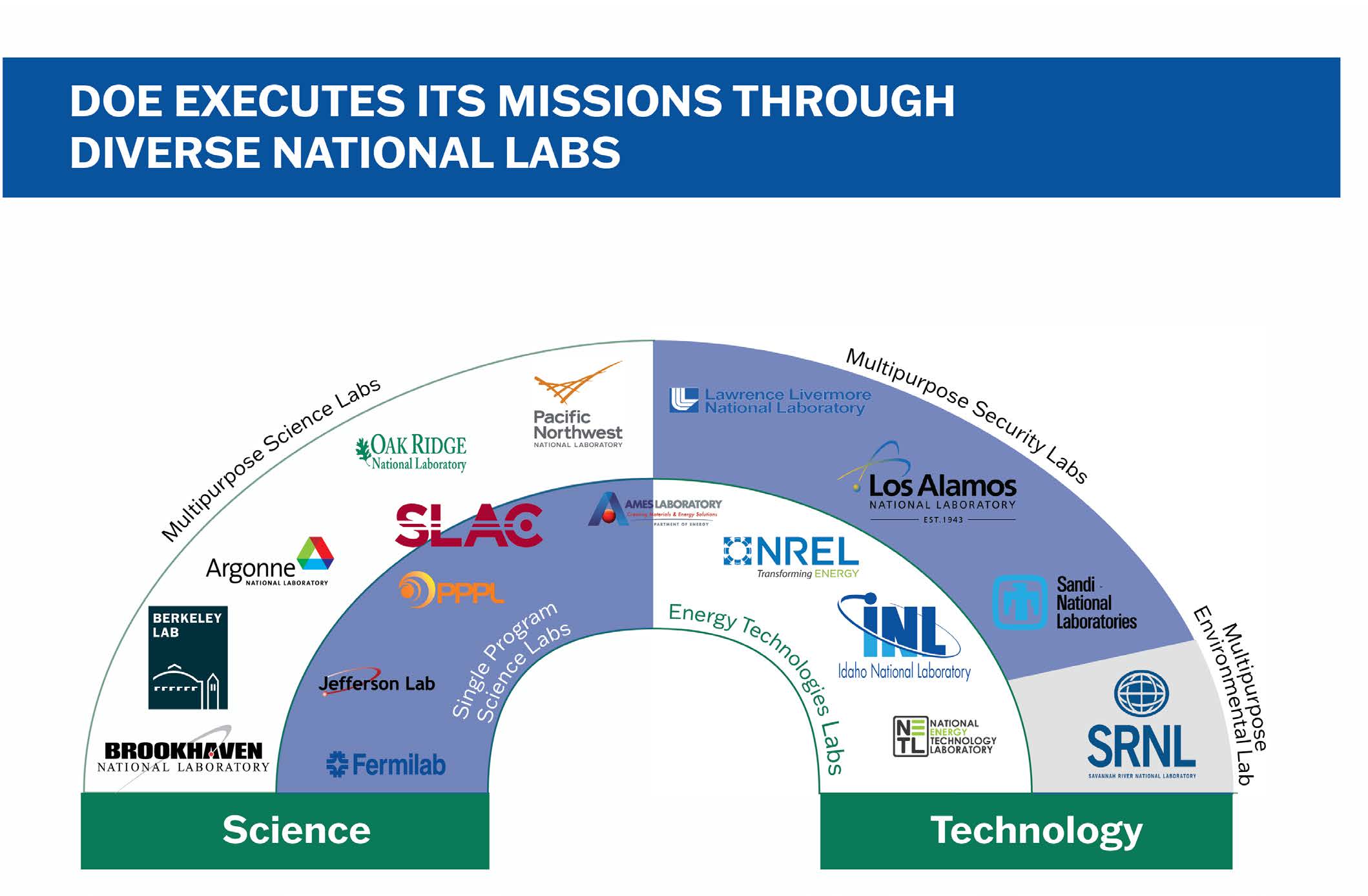
All 17 of the laboratories are listed below, along with the location, establishment date, and the organization that currently operates each.
| Name | Location & Establishment date | Operating organization | Number of employees(FTE)/ Annual budget (FY2023) | Office of Science | National Nuclear Security Administration | Office of Energy Efficiency and Renewable Energy | Office of Environmental Management | Office of Fossil Energy & Carbon Management | Office of Nuclear Energy |
|---|---|---|---|---|---|---|---|---|---|
| Lawrence Berkeley National Laboratory (LBNL) | author=Buck, Alice L. | url=http://energy.gov/sites/prod/files/AEC%20History.pdf | title= A History of the Atomic Energy Commission | location= Washington, D.C. | publisher= U.S. Department of Energy | date= July 1983}} | University of California (since 1931) | 3,804 | |
| $1,301 MM | |||||||||
| Argonne National Laboratory (ANL) | DuPage County, Illinois, 1941 (Argonne was named the first National Laboratory in 1946) | UChicago Argonne, LLC (UChicago since 1941) | 3,994 | ||||||
| $1,321 MM | |||||||||
| Oak Ridge National Laboratory (ORNL) | Oak Ridge, Tennessee, 1943 | 6,467 | |||||||
| $2,585 MM | |||||||||
| Ames National Laboratory | Ames, Iowa, 1947 | Iowa State University (since 1947) | 306 | ||||||
| $64 MM | |||||||||
| Brookhaven National Laboratory (BNL) | Upton, New York, 1947 | 2,754 | |||||||
| $710 MM | |||||||||
| Princeton Plasma Physics Laboratory (PPPL) | Princeton, New Jersey, 1951 | Princeton University (since 1951) | 752 | ||||||
| $140 MM | |||||||||
| SLAC National Accelerator Laboratory | Menlo Park, California, 1962 | Stanford University (since 1962) | 1,798 | ||||||
| $568 MM | |||||||||
| Pacific Northwest National Laboratory (PNNL) | Richland, Washington, 1965 | Battelle Memorial Institute (since 1965) | 4,815 | ||||||
| $1,467 MM | |||||||||
| Fermi National Accelerator Laboratory (FNAL) | Batavia, Illinois, 1967 | Fermi Forward Discovery Group (since 2025) | 2,137 | ||||||
| $655 MM | |||||||||
| Thomas Jefferson National Accelerator Facility (TJNAF) | Newport News, Virginia, 1984 | Jefferson Science Associates, LLC (since 2006) | 873 | ||||||
| $205 MM | |||||||||
| Los Alamos National Laboratory (LANL) | Los Alamos, New Mexico, 1943 | 11,591 | |||||||
| $3,999 MM | |||||||||
| Sandia National Laboratories (SNL) | Albuquerque, New Mexico, 1948 | 14,368 | |||||||
| $4,603 MM | |||||||||
| Livermore, California, 1956 | |||||||||
| Lawrence Livermore National Laboratory (LLNL) | Livermore, California, 1952 | 9,291 | |||||||
| $3,240 MM | |||||||||
| National Renewable Energy Laboratory (NREL) | Golden, Colorado, 1977 | Alliance for Sustainable Energy, LLC (since 2008) | 3,185 | ||||||
| $784 MM | |||||||||
| Savannah River National Laboratory (SRNL) | Aiken, South Carolina, 1952 | 1,400 | |||||||
| $436 MM | |||||||||
| National Energy Technology Laboratory (NETL) | Pittsburgh, Pennsylvania, 1910 | Department of Energy | 696 | ||||||
| $1,100 MM | |||||||||
| Morgantown, West Virginia, 1946 | |||||||||
| Albany, Oregon, 2005 | |||||||||
| Idaho National Laboratory (INL) | Idaho Falls, Idaho, 1949 | 6,475 | |||||||
| $1,823 MM |
National Scientific User Facilities
The DOE Office of Science operates an extensive network of 28 national scientific user facilities. A total of over 30,000 scientific users from universities, national laboratories, and technology companies use these facilities to advance their research and development. The staff of experts at each facility who build and operate the associated instruments and work with visiting scientists to mount experiments with them. This access and support is provided without charge to qualified scientific groups, with priority based on recommendations by expert review panels. All six research offices support scientific user facilities at national laboratories.
| Office of Science National Scientific User Facilities | Sponsoring program office | Type of facility | User facility name & laboratory | Number of staff (approx.)/ number of scientific users (2021) |
|---|---|---|---|---|
| Advanced Scientific Computing Research (ASCR) | High-performance computing (HPC) facilities | Argonne Leadership Computing Facility (ALCF) @ ANL | 170/1,168 | |
| National Energy Research Scientific Computing Center (NERSC) @ LBNL | 130/8,751 | |||
| Oak Ridge Leadership Computing Facility (OLCF) @ ORNL | 180/1,696 | |||
| High-performance research network | Energy Sciences Network (ESnet) @ LBNL | 135/ | ||
| Biological and Environmental Research(BER) | Atmospheric Radiation Measurement facility (ARM) @ PNNL (lead lab) | 100/960 | ||
| Environmental Molecular Sciences Laboratory (EMSL) @ PNNL | 180/801 | |||
| The Joint Genome Institute (JGI) @ LBNL | 250/2,180 | |||
| Basic Energy Sciences (BES) | X-ray light source facilities | The Advanced Light Source (ALS) @ LBNL | 200/1,159 | |
| The Advanced Photon Source (APS) @ ANL | 450/3,686 | |||
| National Synchrotron Light Source II (NSLS-II) @ BNL | 375/1,022 | |||
| The Linac Coherent Light Source (LCLS) @ SLAC | 326/720 | |||
| The Stanford Synchrotron Radiation Lightsource (SSRL) @ SLAC | 150/1030 | |||
| Nanoscale Science Research Centers (NSRCs) | The Center for Functional Nanomaterials (CFN) @ BNL | 65/571 | ||
| The *Center for Integrated Nanotechnologies* (CINT) @ LANL & SNL | 100/721 | |||
| The Center for Nanoscale Materials (CNM) @ ANL | 54/702 | |||
| The Center for Nanophase Materials Sciences (CNMS) @ ORNL | 108/656 | |||
| The Molecular Foundry (TMF) @ LBNL | 67/654 | |||
| Neutron Scattering Facilities | The High Flux Isotope Reactor (HFIR) @ ORNL | 100/202 | ||
| The Spallation Neutron Source (SNS) @ ORNL | 450/483 | |||
| Fusion Energy Sciences (FES) | Fusion Facilities | The DIII-D (tokamak) National Fusion Facility @ General Atomics | NA/429 | |
| National Spherical Torus Experiment (NSTX) @ PPPL | 300/358 | |||
| High Energy Physics (HEP) | Accelerator complex supporting physics experiments | The Fermilab Accelerator Complex @ FNAL | 500/1,725 | |
| Accelerator test facilities | The Accelerator Test Facility @ BNL | 16/80 | ||
| The Facility for Advanced Accelerator Experimental Tests (FACET) @ SLAC | 25/111 |
History
The system of national laboratories started with the massive scientific endeavors of World War II, in which several new technologies, especially the atomic bomb, proved decisive for the Allied victory. Though the United States government had begun seriously investing in scientific research for national security in World War I, it was only in this wartime period that significant resources were committed to scientific problems, under the auspices first of the National Defense Research Committee, and later the Office of Scientific Research and Development, organized and administered by Vannevar Bush.
During the Second World War, centralized sites such as the Radiation Laboratory at MIT and Ernest O. Lawrence's laboratory at Berkeley and the Metallurgical Laboratory at the University of Chicago allowed for a large number of expert scientists to collaborate towards defined goals as never before, and with government resources of unprecedented scale at their disposal.
In the course of the war, the Allied nuclear effort, the Manhattan Project, created several secret sites for the purpose of bomb research and material development, including a laboratory in the mountains of New Mexico directed by Robert Oppenheimer (Los Alamos), and sites at Hanford, Washington and Oak Ridge, Tennessee. Hanford and Oak Ridge were administered by private companies, and Los Alamos was administered by a public university (the University of California). Additional success was at the University of Chicago in reactor research, leading to the creation of Argonne National Laboratory outside Chicago, and at other academic institutions spread across the country.
After the war and its scientific successes, the newly created Atomic Energy Commission took over the future of the wartime laboratories, extending their lives indefinitely (they were originally thought of as temporary creations). Funding and infrastructure were secured to sponsor other "national laboratories" for both classified and basic research, especially in physics, with each national laboratory centered around one or many expensive machines (such as particle accelerators or nuclear reactors).
Most national laboratories maintained staffs of local researchers as well as allowing for visiting researchers to use their equipment, though priority to local or visiting researchers often varied from lab to lab. With their centralization of resources (both monetary and intellectual), the national labs serve as an exemplar for Big Science.
The national laboratory system, administered first by the Atomic Energy Commission, then the Energy Research and Development Administration, and currently the Department of Energy, is one of the largest (if not the largest) scientific research systems in the world. The DOE provides about a third of the total national funding for physics, chemistry, materials science, and other areas of the physical sciences.
In popular culture
- In the Netflix web series Stranger Things, a fictional laboratory called Hawkins National Laboratory run by the DOE is located in the fictional town of Hawkins, Indiana.
- In the AMC show Breaking Bad, Walter White works for Sandia National Laboratories prior to Season One.
- In the 2003 film The Hulk, a model of the Gamma Sphere, built at Lawrence Berkeley National Laboratory as a detector of gamma rays, is used as the powerful source of gamma rays. The Hulk ends up hurling it through the iconic dome of the Advanced Light Source, which was designed by Arthur Brown Jr. around 1940 for the 184-inch cyclotron.
References
References
- "National Laboratories".
- The [[National Energy Technology Laboratory]] is the only laboratory which is government owned – government operated (GOGO), or managed directly by the DOE. The others are government owned – contractor operated (GOCO).
- "Federal Funds for Research and Development: Fiscal Years 2020–21".
- "The State of the DOE National Laboratories (2020 edition)".
- "DOE National Laboratories at a glance, 2023".
- Buck, Alice L.. (July 1983). "A History of the Atomic Energy Commission". U.S. Department of Energy.
- (2012-10-17). "Swords to Plowshares: A Short History of Oak Ridge National Laboratory (1943-1993)".
- Associated Universities, Incorporated managed Brookhaven from 1947 to 1998
- Universities Research Association managed Fermilab from 1967 to 2007. Fermi Research Alliance managed Fermilab from 2007 to 2025.
- "Los Alamos National Laboratory".
- "Livermore National Laboratory".
- The Midwestern Research Institute and MRI Global managed NREL from 1977 to 2008.
- (May 7, 2004). "Energy Secretary Abraham Certifies Savannah River Technology Center As New Department of Energy National Laboratory".
- The Savannah River Nuclear Solutions, LLC managed SRNL from 2008 to 2021.
- [[Bechtel]] managed INL before 2005.
- (29 September 2020). "User Facilities".
- (9 December 2014). "ASCR User Facilities".
- "Top500 November 2022 list".
- "Argonne Leadership Computing Facility".
- "National Energy Research Scientific Computing Center".
- "Oak Ridge Leadership Computing Facility".
- "About ESnet".
- (9 December 2014). "BER User Facilities".
- (25 March 2015). "BES User Facilities".
- "Linear Coherent Light Source".
- (9 December 2014). "FES User Facilities".
- "HEP User Facilities".
- "Federal obligations for research in physical sciences, by agency and detailed field: FY 2019". National Science Foundation - National Center for Science and Engineering Statistics.
- "What ''Stranger Things'' didn't get quite so right about the Energy Department".
- Brumfiel, Geoff. (June 17, 2003). "Real Experiment Stars in Hulk Movie". Science Magazine.
- (11 October 2017). "The Advanced Light Source".
This article was imported from Wikipedia and is available under the Creative Commons Attribution-ShareAlike 4.0 License. Content has been adapted to SurfDoc format. Original contributors can be found on the article history page.
Ask Mako anything about United States Department of Energy National Laboratories — get instant answers, deeper analysis, and related topics.
Research with MakoFree with your Surf account
Create a free account to save articles, ask Mako questions, and organize your research.
Sign up freeThis content may have been generated or modified by AI. CloudSurf Software LLC is not responsible for the accuracy, completeness, or reliability of AI-generated content. Always verify important information from primary sources.
Report