From Surf Wiki (app.surf) — the open knowledge base
Unit of time
Measurement unit for time

Measurement unit for time
A unit of time is any particular time interval, used as a standard way of measuring or expressing duration. The base unit of time in the International System of Units (SI), and by extension most of the Western world, is the second, defined as about 9 billion oscillations of the caesium atom. The exact modern SI definition is "[The second] is defined by taking the fixed numerical value of the cesium frequency, ΔνCs, the unperturbed ground-state hyper-fine transition frequency of the cesium 133 atom, to be when expressed in the unit Hz, which is equal to s−1."
Historically, many units of time were defined by the movements of astronomical objects.
- Sun-based: the year is based on the Earth's orbital period around the sun. Historical year-based units include the Olympiad (four years), the lustrum (five years), the indiction (15 years), the decade, the century, and the millennium.
- Moon-based: the month is based on the Moon's orbital period around the Earth.
- Earth-based: the day is based on the time it takes for the Earth to rotate on its own axis, relative to the Sun. Units originally derived from this base include the week (seven days), and the fortnight (14 days). Subdivisions of the day include the hour (1/24 of a day), which is further subdivided into minutes and seconds. The second is the international standard unit (SI unit) for science.
- Celestial sphere-based: as in sidereal time, where the apparent movement of the stars and constellations across the sky is used to calculate the length of a year.
These units do not have a consistent relationship with each other and require intercalation. For example, the year cannot be divided into twelve 28-day months since 12 times 28 is 336, well short of 365. The lunar month (as defined by the moon's rotation) is not 28 days but 28.3 days. The year, defined in the Gregorian calendar as days has to be adjusted with leap days and leap seconds. Consequently, these units are now all defined for scientific purposes as multiples of seconds.
Historical
Main article: History of calendars
The natural units for timekeeping used by most historical societies are the day, the solar year and the lunation. Such calendars include the Sumerian, Egyptian, Chinese, Babylonian, ancient Athenian, Buddhist, Hindu, Islamic, Icelandic, Mayan, and French Republican calendars.
The modern calendar has its origins in the Roman calendar, which evolved into the Julian calendar, and then the Gregorian calendar.
Scientific
- The Planck time is the time that light takes to travel one Planck length.
- The Jiffy is the amount of time light takes to travel one femtometre (about the diameter of a nucleon).
- The atomic time relates to the orbital period of a ground state electron around a hydrogen atom and is about 24.2 attoseconds.
- The svedberg is a time unit used for sedimentation rates (usually of proteins). It is defined as 10−13 seconds (100 fs).
- The TU (for time unit) is a unit of time defined as 1024 μs for use in engineering.
- The galactic year, based on the rotation of the galaxy and usually measured in million years.
- The geological time scale relates stratigraphy to time. The deep time of Earth's past is divided into units according to events that took place in each period. For example, the boundary between the Cretaceous period and the Paleogene period is defined by the Cretaceous–Paleogene extinction event. The largest unit is the supereon, composed of eons. Eons are divided into eras, which are in turn divided into periods, epochs and ages. It is not a true mathematical unit, as all ages, epochs, periods, eras, or eons don't have the same length; instead, their length is determined by the geological and historical events that define them individually. Note: The light-year is not a unit of time, but a unit of length of about 9.5 petametres ().
Note: The parsec is not a unit of time, but a unit of length of about 30.9 trillion kilometres, despite movie references otherwise.
List
{| class="wikitable mw-collapsible" |+ Units of time !Name !Length !Notes |- | Planck time || ~ || The amount of time light takes to travel one Planck length. |- | quectosecond || || One nonillionth of a second. |- | rontosecond || || One octillionth of a second. |- | yoctosecond || || One septillionth of a second. |- | jiffy (physics) || || The amount of time light takes to travel one fermi (about the size of a nucleon) in a vacuum. |- | zeptosecond || || One sextillionth of a second. Time measurement scale of the NIST and JILA strontium atomic clock. Smallest fragment of time currently measurable is 247 zeptoseconds. |- | attosecond || || One quintillionth of a second. |- | atomic time || ~ || Derived from atomic theory of hydrogen. |- | femtosecond || || One quadrillionth of a second. |- | svedberg || || 100 femtoseconds, time unit used for sedimentation rates (usually of proteins). |- | picosecond || || One trillionth of a second. |- | nanosecond || || One billionth of a second. Time for molecules to fluoresce. |- | shake || || 10 nanoseconds, also a casual term for a short period of time. |- | microsecond || || One millionth of a second. Symbol is μs |- | millisecond || || One thousandth of a second. Shortest time unit used on stopwatches. |- | centisecond || || One hundredth of a second. |- | jiffy (electronics) ||~
| Used to measure the time between alternating power cycles. |
|---|
| decisecond |
| - style="background-color:rgba(255,255,0,0.25);" |
| second |
| - |
| decasecond |
| - |
| minute |
| - |
| hectosecond |
| - |
| milliday |
| 1.44 minutes, or 86.4 seconds. Also marketed as a ".beat" by the Swatch corporation. |
| - |
| moment |
| - |
| centiday |
| (1 % of a day) |
| 14.4 minutes, or 864 seconds. One-hundredth of a day is 1 cd (centiday), also called "kè" in traditional Chinese timekeeping. The unit was also proposed by Lagrange and endorsed by Rey-Pailhade in the 19th century, named "centijours" (from French centi- 'hundred' and jour 'day'). |
| - |
| kilosecond |
| - |
| hour |
| - |
| deciday |
| (10 % of a day) |
| 2.4 hours, or 144 minutes. One-tenth of a day is 1 dd (deciday), also called "gēng" in traditional Chinese timekeeping. |
| - |
| day |
| - |
| week |
| - |
| decaday |
| () |
| 10 days. A period of time analogous to the concept of "week", used by different societies around the world: the ancient Egyptian calendar, the ancient Chinese calendar, and also the French Republican calendar (in which it was called a décade). |
| - |
| megasecond |
| - |
| fortnight |
| - |
| lunar month |
| - |
| month |
| - |
| hectoday |
| () |
| 100 days, roughly equivalent to 1/4 of a year (91.25 days). In Chinese tradition "bǎi rì" (百日) is the hundredth day after one's birth, also called Baby's 100 Days Celebration. |
| - |
| semester |
| - |
| lunar year |
| - |
| common year |
| - |
| tropical year |
| - |
| Gregorian year |
| - |
| Julian year |
| - |
| sidereal year |
| The time it takes for the Earth to complete one full revolution around the Sun relative to the background stars |
| - |
| leap year |
| - |
| quadrennium olympiad |
| - |
| lustrum |
| - |
| decade |
| - |
| indiction |
| - |
| gigasecond |
| - |
| century |
| - |
| millennium |
| - |
| Age |
| - |
| Great Year |
| - |
| terasecond |
| - |
| megaannum |
| - |
| petasecond |
| - |
| Galactic year |
| - style="background-color:rgba(220,220,220,0.50);" |
| cosmological decade |
| - |
| eon |
| - |
| kalpa |
| - |
| exasecond |
| } |
Interrelation
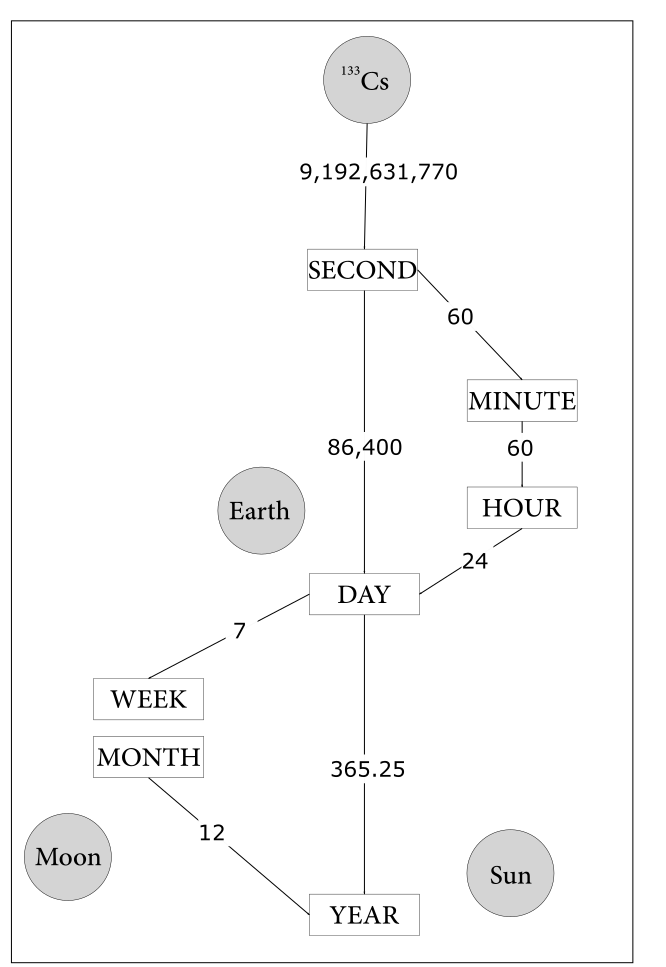
All of the formal units of time are scaled multiples of each other. The most common units are the second, defined in terms of an atomic process; the day, an integral multiple of seconds; and the year, usually 365 days. The other units used are multiples or divisions of these three.
References
References
- "Units of Time: Concepts, Conversion & Practice Questions".
- "- second".
- "SolarTime—Wolfram Documentation".
- "Solar Time vs. Sidereal Time".
- "Solar time {{!}} Equation of Time, Sundial & Clocks {{!}} Britannica".
- "Lunar calendar {{!}} Definition & Facts {{!}} Britannica".
- (2023-07-20). "Chapter 2: Reference Systems - NASA Science".
- "Sidereal time {{!}} Celestial Coordinates, Celestial Sphere & Equinoxes {{!}} Britannica".
- (2009-08-12). "A Walk Through Time - Ancient Calendars". NIST.
- (2025-10-02). "Gregorian calendar {{!}} Origins, Meaning, & Facts {{!}} Britannica".
- "Julian calendar {{!}} History & Difference from Gregorian Calendar {{!}} Britannica".
- "Planck Length {{!}} COSMOS".
- "Planck length {{!}} physics {{!}} Britannica".
- "CODATA Value: atomic unit of time".
- (2025-11-17). "SVEDBERG (UNIT) definition and meaning {{!}} Collins English Dictionary".
- (2025-11-17). "GALACTIC YEAR definition and meaning {{!}} Collins English Dictionary".
- "Geologic Time Scale - Geology (U.S. National Park Service)".
- (2020-03-04). "What is a light-year? - NASA Science".
- (2025-11-17). "PARSEC definition and meaning {{!}} Collins English Dictionary".
- Helmenstine, Todd. (2014-05-06). "What Is a Jiffy?".
- Staff, Smore Science. (2023-07-04). "How Long is a Jiffy? Jiffy in Seconds".
- (2020-10-16). "Zeptosecond birth time delay in molecular photoionization". Science.
- "Meet the zeptosecond, the shortest unit of time ever measured".
- "Atomic time {{!}} Atomic Time {{!}} Accuracy, Measurement, Clocks {{!}} Britannica".
- (2025-11-04). "Definition of SVEDBERG".
- (2010-04-12). "SI Units". NIST.
- "The International System of Units – 9th edition – Complete text in English and French (2019)".
- "The Swatch beat".
- "INTERNET TIME".
- Milham, Willis I.. (1945). "Time and Timekeepers". MacMillan.
- Gamez, Christophe. (2020-06-17). "La décimalisation du temps au prisme du Bureau des longitudes (1875-1901). Entre patriotisme, rationalité et politique". Université de Lorraine.
- "Semester". Webster's Dictionary.
- "Definition of TROPICAL YEAR".
- updated, Harry Baker last. (2024-01-05). "Why do we have leap years? And how did they come about?".
- (2020-02-27). "The Science of Leap Year".
- "Merriam-Webster Dictionary". Merriam-Webster Incorporated.
- "Definition of OLYMPIAD".
- "Definition of LUSTRUM".
- (2025-11-17). "LUSTRUM definition and meaning {{!}} Collins English Dictionary".
- (2025-11-17). "INDICTION definition and meaning {{!}} Collins English Dictionary".
- "Definition of INDICTION".
- "Astrological Ages as an Accurate and Effective Model of History".
- "Great Year Definition & Meaning {{!}} YourDictionary".
- "Definition of GREAT YEAR".
- "Mega-annum Definition & Meaning {{!}} YourDictionary".
- http://starchild.gsfc.nasa.gov/docs/StarChild/questions/question18.html NASA – StarChild Question of the Month for February 2000
- (2020-08-30). "How long is a galactic year?".
- "galactic adjective - Definition, pictures, pronunciation and usage notes {{!}} Oxford Advanced Learner's Dictionary at OxfordLearnersDictionaries.com".
- "Eon Definition & Meaning {{!}} Britannica Dictionary".
- "Dictionary.com {{!}} Meanings & Definitions of English Words".
- (2025-11-18). "eon".
- (2025-11-16). "Definition of EON".
- "Definition of KALPA".
This article was imported from Wikipedia and is available under the Creative Commons Attribution-ShareAlike 4.0 License. Content has been adapted to SurfDoc format. Original contributors can be found on the article history page.
Ask Mako anything about Unit of time — get instant answers, deeper analysis, and related topics.
Research with MakoFree with your Surf account
Create a free account to save articles, ask Mako questions, and organize your research.
Sign up freeThis content may have been generated or modified by AI. CloudSurf Software LLC is not responsible for the accuracy, completeness, or reliability of AI-generated content. Always verify important information from primary sources.
Report