From Surf Wiki (app.surf) — the open knowledge base
Ulysses (spacecraft)
NASA/ESA solar probe launched in 1990

NASA/ESA solar probe launched in 1990
| Field | Value |
|---|---|
| name | *Ulysses* |
| names_list | Odysseus |
| image | Ulysses spacecraft.jpg |
| image_caption | *Ulysses* spacecraft |
| image_size | 300px |
| mission_type | High-inclination solar orbiter |
| operator | NASA / ESA |
| COSPAR_ID | 1990-090B |
| SATCAT | 20842 |
| website | [NASA Page](https://web.archive.org/web/20031226150122/http://solarsystem.nasa.gov/missions/profile.cfm?MCode=Ulysses) |
| [ESA Page](https://www.esa.int/esaSC/120395_index_0_m.html) | |
| mission_duration | |
| manufacturer | Astrium GmbH, Friedrichshafen |
| (formerly Dornier Systems) | |
| launch_mass | 371 kg |
| payload_mass | 55 kg |
| dimensions | 3.2 × 3.3 × 2.1 m |
| power | 285 watts |
| launch_date | 6 October 1990, 11:47:16 UTC |
| launch_rocket | Space Shuttle *Discovery* (STS-41) with Inertial Upper Stage and PAM-S |
| launch_site | Kennedy Space Center, LC-39B |
| launch_contractor | NASA |
| disposal_type | Decommissioned |
| deactivated | 30 June 2009 |
| orbit_reference | Heliocentric orbit |
| orbit_periapsis | 1.35 AU |
| orbit_apoapsis | 5.40 AU |
| orbit_inclination | 79.11° |
| orbit_period | 2,264.26 days (6.2 years) |
| apsis | helion |
| interplanetary | {{Infobox spaceflight/IP |
| type | flyby |
| object | Jupiter (gravity assist) |
| arrival_date | 8 February 1992 |
| distance | 440,439 km (6.3 Jupiter radii) |
| insignia | Ulysses insignia.png |
| insignia_alt | *Ulysses* mission insignia |
| insignia_caption | *Ulysses* mission patch |
| insignia_size | 200px |
ESA Page (formerly Dornier Systems)
Ulysses ( , ) was a robotic space probe whose primary mission was to orbit the Sun and study it at all latitudes. It was launched in 1990 and made three "fast latitude scans" of the Sun in 1994/1995, 2000/2001, and 2007/2008. In addition, the probe studied several comets. Ulysses was a joint venture of the European Space Agency (ESA) and the United States' National Aeronautics and Space Administration (NASA), under leadership of ESA with participation from Canada's National Research Council. The last day for mission operations on Ulysses was 30 June 2009.
To study the Sun at all latitudes, the probe needed to change its orbital inclination and leave the plane of the Solar System. To change the orbital inclination of a spacecraft to about 80° requires a large change in heliocentric velocity, the energy to achieve which far exceeded the capabilities of any launch vehicle. To reach the desired orbit around the Sun, the mission's planners chose a gravity assist maneuver around Jupiter, but this Jupiter encounter meant that Ulysses could not be powered by solar cells. The probe was powered instead by a General-Purpose Heat Source Radioisotope Thermoelectric Generator (GPHS-RTG).
The spacecraft was originally named Odysseus, because of its lengthy and indirect trajectory to study the solar poles. It was renamed Ulysses, the Latin translation of "Odysseus", at ESA's request in honor not only of Homer's mythological hero but also of Dante's character in the Inferno. Ulysses was originally scheduled for launch in May 1986 aboard the Space Shuttle Challenger on STS-61-F. Due to the 28 January 1986 loss of Challenger, the launch of Ulysses was delayed until 6 October 1990 aboard Discovery (mission STS-41).
Spacecraft
The spacecraft was designed by ESA and built by Dornier Systems, a German aircraft manufacturer. The body was roughly a box, approximately 3.2 × 3.3 × 2.1 m in size. The box mounted the 1.65 m dish antenna and the GPHS-RTG radioisotope thermoelectric generator (RTG) power source. The box was divided into noisy and quiet sections. The noisy section abutted the RTG; the quiet section housed the instrument electronics. Particularly "loud" components, such as the preamps for the radio dipole, were mounted outside the structure entirely, and the box acted as a Faraday cage.
Ulysses was spin-stabilised about its z-axis which roughly coincides with the axis of the dish antenna. The RTG, whip antennas, and instrument boom were placed to stabilize this axis, with the spin rate nominally at 5 rpm. Inside the body was a hydrazine fuel tank. Hydrazine monopropellant was used for course corrections inbound to Jupiter, and later used exclusively to repoint the spin axis (and thus, the antenna) at Earth. The spacecraft was controlled by eight thrusters in two blocks. Thrusters were pulsed in the time domain to perform rotation or translation. Four Sun sensors detected orientation. For fine attitude control, the S-band antenna feed was mounted slightly off-axis. This offset feed combined with the spacecraft spin introduced an apparent oscillation to a radio signal transmitted from Earth when received on board the spacecraft. The amplitude and phase of this oscillation were proportional to the orientation of the spin axis relative to the Earth direction. This method of determining the relative orientation is called conical scanning and was used by early radars for automated tracking of targets and was also very common in early infrared guided missiles.
The spacecraft used S-band for uplinked commands and downlinked telemetry, through dual redundant 5-watt transceivers. The spacecraft used X-band for science return (downlink only), using dual 20 watts TWTAs until the failure of the last remaining TWTA in January 2008. Both bands used the dish antenna with prime-focus feeds, unlike the Cassegrain feeds of most other spacecraft dishes.
Dual tape recorders, each of approximately 45-megabit capacity, stored science data between the nominal eight-hour communications sessions during the prime and extended mission phases.
The spacecraft was designed to withstand both the heat of the inner Solar System and the cold at Jupiter's distance. Extensive blanketing and electric heaters protected the probe against the cold temperatures of the outer Solar System.
Multiple computer systems (CPUs/microprocessors/Data Processing Units) are used in several of the scientific instruments, including several radiation-hardened RCA CDP1802 microprocessors. Documented 1802 usage includes dual-redundant 1802s in the COSPIN, and at least one 1802 each in the GRB, HI-SCALE, SWICS, SWOOPS and URAP instruments, with other possible microprocessors incorporated elsewhere.
Total mass at launch was 371 kg, of which 33.5 kg was hydrazine propellant used for attitude control and orbit correction.
Instruments
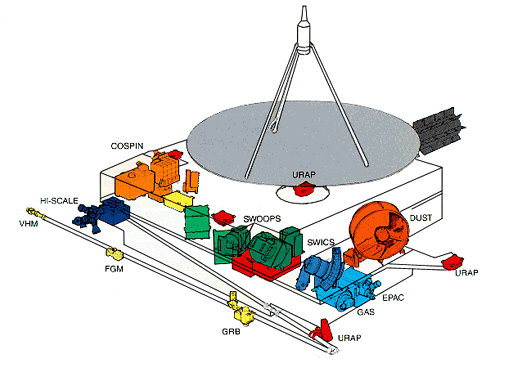

The twelve different Instruments came from ESA and NASA. The first design was based on two probes, one by NASA and one by ESA, but the probe of NASA was defunded and in the end the instruments of the cancelled probe were mounted on Ulysses.
- Radio/Plasma antennas: Two beryllium copper antennas were unreeled outwards from the body, perpendicular to the RTG and spin axis. Together this dipole spanned 72 meters (236.2 ft). A third antenna, of hollow beryllium copper, was deployed from the body, along the spin axis opposite the dish. It was a monopole antenna, 7.5 meters (24.6 ft) long. These measured radio waves generated by plasma releases, or the plasma itself as it passed over the spacecraft. This receiver ensemble was sensitive from DC to 1 MHz.
- Experiment Boom: A third type of boom, shorter and much more rigid, extended from the last side of the spacecraft, opposite the RTG. This was a hollow carbon-fiber tube, of 50 mm (2 in.) diameter. It can be seen in the photo as the silver rod stowed alongside the body. It carried four types of instruments: a solid-state X-ray instrument, composed of two silicon detectors, to study X-rays from solar flares and Jupiter's aurorae; the Gamma-Ray Burst experiment, consisting of two CsI scintillator crystals with photomultipliers; two different magnetometers, a helium vector magnetometer and a fluxgate magnetometer; and a two-axis magnetic search coil antenna measured AC magnetic fields.
- Body-Mounted Instruments: Detectors for electrons, ions, neutral gas, dust, and cosmic rays were mounted on the spacecraft body around the quiet section.
- Lastly, the radio communications link could be used to search for gravitational waves (through Doppler shifts) and to probe the Sun's atmosphere through radio occultation. No gravitational waves were detected.
- Total instrument mass was 55 kg.
- Magnetometer (MAG): MAG measured the magnetic field in the heliosphere. Measurements of Jupiter's magnetic field were also performed. Two magnetometers performed Ulysses magnetic field measurements, the Vector Helium Magnetometer and the Fluxgate Magnetometer.
- Solar Wind Plasma Experiment (SWOOPS): detected the solar wind at all solar distances and latitudes and in three dimensions. It measured positive ions and electrons.
- Solar Wind Ion Composition Instrument (SWICS): determined composition, temperature and speed of the atoms and ions that comprise the solar wind.
- Unified Radio and Plasma Wave Instrument (URAP): picked up radio waves from the Sun and electromagnetic waves generated in the solar wind close to the spacecraft.
- Energetic Particle Instrument (EPAC) and GAS: EPAC investigated the energy, fluxes and distribution of energetic particles in the heliosphere. GAS studied the uncharged gases (helium) of interstellar origin.
- Low-Energy Ion and Electron Experiment (HI-SCALE): investigated the energy, fluxes and distribution of energetic particles in the heliosphere.
- Cosmic Ray and Solar Particle Instrument (COSPIN): investigated the energy, fluxes and distribution of energetic particles and galactic cosmic rays in the heliosphere.
- Solar X-ray and Cosmic Gamma-Ray Burst Instrument (GRB): studied cosmic gamma ray bursts and X-rays from solar flares.
- Dust Experiment (DUST): Direct measurements of interplanetary and interstellar dust grains to investigate their properties as functions of the distance from the Sun and solar latitude.
Mission
Planning


Until Ulysses, the Sun had only been observed from low solar latitudes. The Earth's orbit defines the ecliptic plane, which differs from the Sun's equatorial plane by only 7.25°. Even spacecraft directly orbiting the Sun do so in planes close to the ecliptic because a direct launch into a high-inclination solar orbit would require a prohibitively large launch vehicle.
Several spacecraft (Mariner 10, Pioneer 11, and Voyagers 1 and 2) had performed gravity assist maneuvers in the 1970s. Those maneuvers were to reach other planets also orbiting close to the ecliptic, so they were mostly in-plane changes. However, gravity assists are not limited to in-plane maneuvers; a suitable flyby of Jupiter could produce a significant plane change. An Out-Of-The-Ecliptic mission (OOE) was thereby proposed.
Originally, two spacecraft were to be built by NASA and ESA, as the International Solar Polar Mission. One would be sent over Jupiter, then under the Sun. The other would fly under Jupiter, then over the Sun. This would provide simultaneous coverage. Due to cutbacks, the U.S. spacecraft was cancelled in 1981. One spacecraft was designed, and the project recast as Ulysses, due to the indirect and untried flight path. NASA would provide the Radioisotope Thermoelectric Generator (RTG) and launch services, ESA would build the spacecraft assigned to Astrium GmbH, Friedrichshafen, Germany (formerly Dornier Systems). The instruments would be split into teams from universities and research institutes in Europe and the United States. This process provided the 12 instruments on board.
The changes delayed launch from February 1983 to May 1986 when it was to be deployed by the Space Shuttle Challenger (boosted by the proposed Centaur G Prime upper stage). However, the Challenger disaster forced a two-and-a-half year stand down of the shuttle fleet, mandated the cancellation of the Centaur-G upper stage, and pushed the launch date to October 1990.
Launch
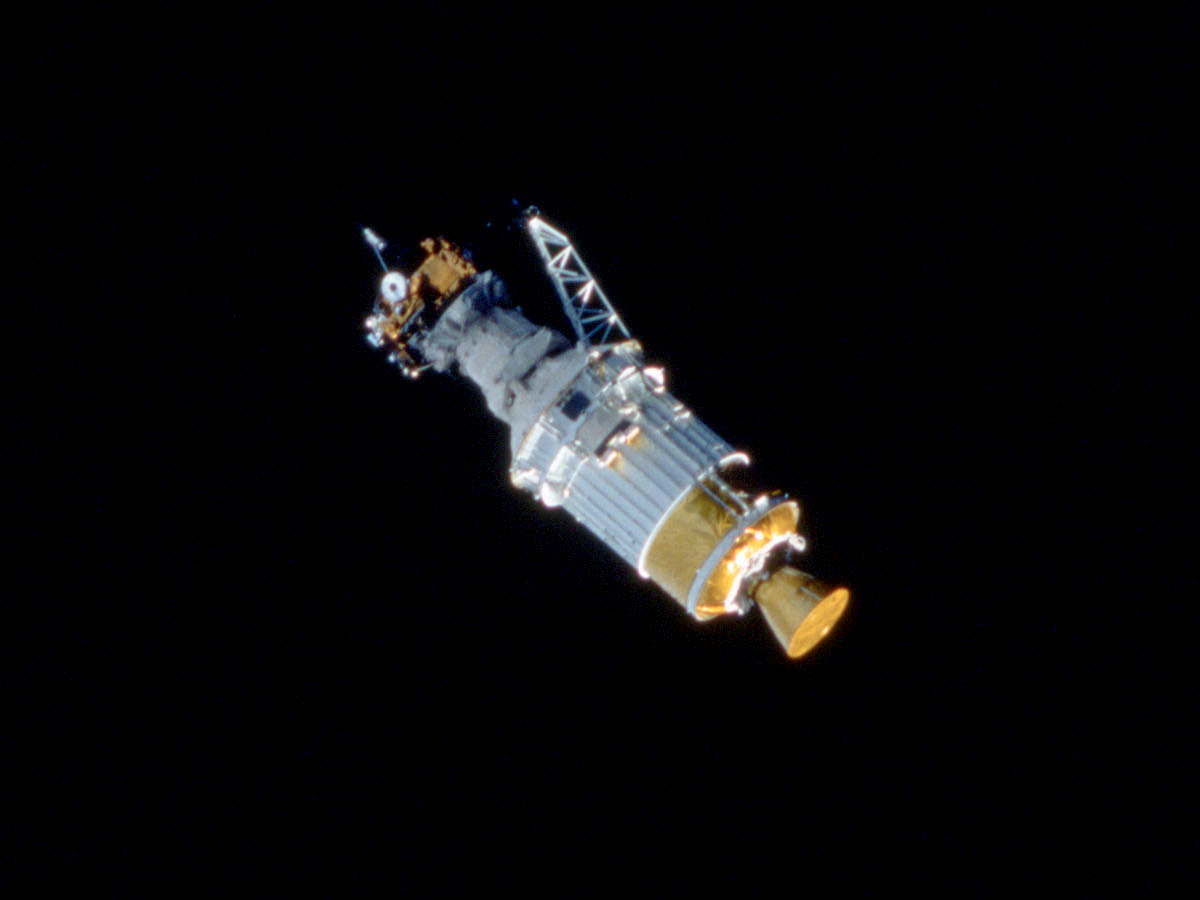
Ulysses was deployed into low Earth orbit from the Space Shuttle Discovery. From there, it was propelled on a trajectory to Jupiter by a combination of solid rocket motors. This upper stage consisted of a two-stage Boeing IUS (Inertial Upper Stage), plus a McDonnell Douglas PAM-S (Payload Assist Module-Special). The IUS was inertially stabilised and actively guided during its burn. The PAM-S was unguided and it and Ulysses were spun up to 80 rpm for stability at the start of its burn. On burnout of the PAM-S, the motor and spacecraft stack was yo-yo de-spun (weights deployed at the end of cables) to below 8 rpm prior to separation of the spacecraft. On leaving Earth, the spacecraft became the fastest ever artificially-accelerated spacecraft, and held that title until the New Horizons probe was launched.
On its way to Jupiter, the spacecraft was in an elliptical non-Hohmann transfer orbit. At this time, Ulysses had a low orbital inclination to the ecliptic.
Jupiter swing-by
- Pioneer H
References
References
- (27 December 2017). "Ulysses". [[NASA]].
- "Welcome to the HIA Ulysses Project". [[NRC Herzberg Astronomy and Astrophysics Research Centre.
- "The odyssey concludes...". [[NASA]] & [[JPL]].
- "Ulysses". [[NASA]].
- (1988). "Jane's Spaceflight Directory, 1988-89". Jane's Information Group.
- "Ulysses NASA Documentation Archive".
- "Ulysses factsheet". [[ESA]].
- "Unified Radio and Plasma Wave Investigation". [[NASA]] & [[JPL]].
- (January 1992). "The gravitational wave experiment". Astronomy & Astrophysics Supplement Series.
- (20 August 1991). "The magnetic field investigation on the ULYSSES mission - Instrumentation and preliminary scientific results". Astronomy & Astrophysics Supplement Series.
- Goldstein, Bruce. "SWOOPS/Electron - User Notes". [[NASA]] & [[JPL]].
- (19 May 1995). "The southern high-speed stream: results from the SWICS instrument on Ulysses". [[Science (journal).
- (1 April 1995). "Kinetic properties of heavy ions in the solar wind from SWICS/Ulysses". [[Space Science Reviews]].
- Carney, Emily. (9 October 2015). "A deathblow to the Death Star: The rise and fall of NASA's Shuttle-Centaur". [[Ars Technica]].
- (12 June 2008). "Sun to set on Ulysses solar mission on 1 July". [[ESA]].
- "Ulysses Jupiter Flyby - Scientific Results". ESA.
- (1 December 1993). "Introduction to the Ulysses Encounter With Jupiter". Journal of Geophysical Research: Space Physics.
- (2017-12-27). "Ulysses - NASA Science".
- (5 June 2013). "The Sun and the Heliosphere as an Integrated System". [[Springer Science+Business Media]].
- (9 February 2004). "Ulysses Catches Another Comet by the Tail". [[ESA]].
- (8 March 2004). "Cometary Ions Trapped in a Coronal Mass Ejection". [[The Astrophysical Journal]].
- "Ulysses Second Encounter with Jupiter". [[NASA]] & [[JPL]].
- (1 October 2007). "Encounter of the Ulysses Spacecraft with the Ion Tail of Comet McNaught". [[The Astrophysical Journal]].
- (12 February 2004). "Ulysses Mission Extended". [[ESA]].
- (7 February 2007). "Ulysses scores a hat-trick". [[ESA]].
- (22 February 2008). "Ulysses mission coming to a natural end". [[ESA]].
- (22 February 2008). "International Solar Mission to End Following Stellar Performance". [[NASA]] & [[JPL]].
- "RIP: Ulysses solar probe coming to end soon - Yahoo! News".
- "February 2003 Operations". European Space Agency.
- "Ulysses Mission Ops—No more data playback".
- (30 June 2009). "Ulysses: 12 extra months of valuable science". [[ESA]].
- (June 30, 2009). "Ulysses Spacecraft Ends Historic Mission of Discovery".
- (12 June 2008). "International Mission Studying Sun to Conclude". [[NASA]] & [[JPL]].
- Gorman, Steve. (1 July 2009). "Solar orbiter Ulysses ends mission after 18 years". [[Reuters]].
This article was imported from Wikipedia and is available under the Creative Commons Attribution-ShareAlike 4.0 License. Content has been adapted to SurfDoc format. Original contributors can be found on the article history page.
Ask Mako anything about Ulysses (spacecraft) — get instant answers, deeper analysis, and related topics.
Research with MakoFree with your Surf account
Create a free account to save articles, ask Mako questions, and organize your research.
Sign up freeThis content may have been generated or modified by AI. CloudSurf Software LLC is not responsible for the accuracy, completeness, or reliability of AI-generated content. Always verify important information from primary sources.
Report