From Surf Wiki (app.surf) — the open knowledge base
Turkmen language
Turkic language of the Oghuz sub-branch
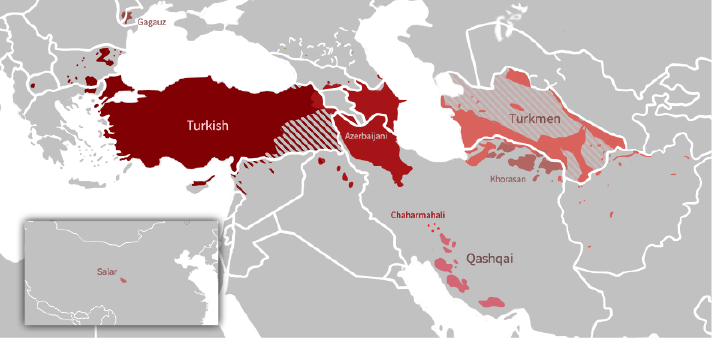
Turkic language of the Oghuz sub-branch
| Field | Value |
|---|---|
| name | Turkmen |
| nativename | türkmençe, türkmen dili, |
| түркменче, түркмен дили, | |
| image | Turkmen in Nastaliq, Latin, and Cyrillic.png |
| imagecaption | Türkmençe in the Perso-Arabic, Latin, and Cyrillic alphabets |
| states | Turkmenistan, Russia, Iran, Uzbekistan, Afghanistan, Tajikistan |
| speakers | L1: million |
| ethnicity | Turkmens |
| date | 2023 |
| ref | |
| speakers2 | L2: million (2021) |
| Total: million (2021–2023) | |
| speakers_label | Speakers |
| familycolor | Altaic |
| fam1 | Turkic |
| fam2 | Common Turkic |
| fam3 | Oghuz |
| fam4 | Eastern |
| dia1 | Türkpen |
| script | Latin (Turkmen alphabet, official in Turkmenistan), Perso-Arabic, Cyrillic |
| Turkmen Braille | |
| map | Turkmen language map.png |
| mapcaption | The distribution of the Turkmen language in Central Asia |
| nation | Turkmenistan |
| iso1 | tk |
| iso2 | tuk |
| iso3 | tuk |
| glotto | turk1304 |
| glottorefname | Turkmen |
| lingua | Part of 44-AAB-a |
| notice | IPA |
түркменче, түркмен дили,
Total: million (2021–2023) Turkmen Braille
Turkmen (türkmençe, түркменче, {{Script/Arabic|تۆرکمنچه}}, or türkmen dili, түркмен дили, {{Script/Arabic|تۆرکمن ديلی}}, ) is a Turkic language of the Oghuz branch spoken by the Turkmens of Central Asia. It has an estimated 4.7 million native speakers in Turkmenistan (where it is the official language), and a further 359,000 speakers in northeastern Iran and 1.2 million people in northwestern Afghanistan, where it has no official status. Turkmen is also spoken to lesser varying degrees in Turkmen communities of Uzbekistan and Tajikistan and by diaspora communities, primarily in Turkey and Russia.
Turkmen is a member of the Oghuz branch of the Turkic languages. It is closely related to Azerbaijani, Gagauz, Qashqai, and Turkish, sharing varying degrees of mutual intelligibility with each of those languages. However, the closest relative of Turkmen is considered Khorasani Turkic, spoken in northeastern regions of Iran and with which it shares the eastern subbranch of Oghuz languages, as well as Khorazm, the Oghuz dialect of Uzbek spoken mainly in Khorezm along the Turkmenistan border. Elsewhere in Iran, the Turkmen language comes second after the Azerbaijani language in terms of the number of speakers of Turkic languages of Iran.
The standardized form of Turkmen (spoken in Turkmenistan) is based on the Teke dialect, while Iranian Turkmen use mostly the Yomud dialect, and Afghan Turkmen use the Ersary variety. The Turkmen language, unlike other languages of the Oghuz branch, preserved most of the unique and archaic features of the language spoken by the early Oghuz Turks, including phonemic vowel length.
Iraqi and Syrian Turkmen speak dialects that form a continuum between Turkish and Azerbaijani, in both cases heavily influenced by Arabic and Persian. These varieties are not Turkmen in the sense of this article.
Classification
Turkmen is a member of the Oghuz branch of the Turkic family of languages, together with Turkish and Azerbaijani, with which it shares a relatively high degree of mutual intelligibility. However, an arguably closer language to Turkmen is Khorasani Turkic, with which it shares the eastern subbranch of the Oghuz languages, and also Khorazm, spoken mainly in northwestern Uzbekistan.
Turkmen has vowel harmony, is agglutinative and has no grammatical gender. Word order is subject–object–verb.
Written Turkmen today is based on the Teke (Tekke) dialect. The other dialects are Nohurly, Ýomud, Änewli, Hasarly, Nerezim, Gökleň, Salyr, Saryk, Ärsary and Çowdur. The Teke dialect is sometimes (especially in Afghanistan) referred to as "Chagatai", but like all Turkmen dialects it reflects only a limited influence from classical Chagatai.
Comparison with other Turkic languages
Turkmen has dental fricatives and unlike other Oghuz Turkic languages, where these sounds are pronounced as and . The only other Turkic language with a similar feature is Bashkir. However, in Bashkir and are two independent phonemes, distinct from and , whereas in Turkmen and are the two main realizations of the common Turkic and . In other words, there are no and phonemes in Turkmen, unlike Bashkir, which has , , and .
Turkmen vs. Azerbaijani
The 1st person personal pronoun is "men" in Turkmen, just as "mən" in Azerbaijani, whereas it is "ben" in Turkish. The same is true for demonstrative pronouns "bu", where sound "b" is replaced with sound "m". For example: tk. In Turkmen, "bu" undergoes some changes just as in: tk.
Here are some words with a different pronunciation in Turkmen and Azerbaijani that mean the same in both languages:
| Turkmen | Azeri | English |
|---|---|---|
| men | mən | I, me |
| sen | sən | you |
| haçan | haçan | when |
| başga | başqa | other |
| it, köpek | it, köpək | dog |
| deri | dəri | skin, leather |
| ýumurtga | yumurta | egg |
| ýürek | ürək | heart |
| eşitmek | eşitmək | to hear |
Turkmen vs. Turkish
Turkey was first to recognize Turkmenistan's independence on 27 October 1991, following the Dissolution of the Soviet Union and to open its embassy in Ashgabat on 29 February 1992. Sharing a common history, religion, language and culture, the two states have balanced special relations based on mutual respect and the principle of "One Nation, Two States".
Turkmen language is very close to Turkish with regard to linguistic properties. However, there are a couple of differences due to regional and historical reasons. Most morphophonetic rules are common in Turkmen and Turkish languages. For instance, both languages show vowel harmony and consonant mutation rules, and have similar suffixes with very close semantics.
Here are some words from the Swadesh list in Turkmen and Turkish that mean the same in both languages:
| Turkmen | Turkish | English |
|---|---|---|
| men | ben | I, me |
| uzyn | uzun | long |
| agaç | ağaç | tree |
| göz | göz | eye |
| ýürek | yürek | heart |
| ýaşamak | yaşamak | to live |
| suw | su | water |
| asman(loaned from Persian) | gök | sky |
| dogry | doğru | correct |
Phonology
Main article: Turkmen grammar#Phonology
| Front | Back | Unrounded | Rounded | Unrounded | Rounded | Close | Mid | Open |
|---|
| Labial | Dental | Alveolar | Palatal | Velar | Glottal | Nasal | Stop/ |
|---|---|---|---|---|---|---|---|
| Affricate | voiceless | voiced | Fricative | voiceless | voiced | Approximant | Tap |
Writing system
Main article: Turkmen alphabet
Turkmen written language was formed in the 13–14th centuries, with its literary tradition dating back to the 14th century. During this period, the Arabic alphabet was used extensively for writing. By in the 18th century, there had been a rich literary tradition in the Turkmen language. At the same time, the literacy of the population in their native language remained at low levels; book publishing was extremely limited, and the first primer in the Turkmen language appeared only in 1913, while the first newspaper ("Transcaspian native newspaper") was printed in 1914.
The Arabic script was not adapted to the phonetic features of the Turkic languages. Thus, it did not have necessary signs to designate specific sounds of the Turkmen language, and at the same time there were many letters to designate Arabic sounds that were not in the Turkmen language.
During the first years after the establishment of the Soviet power, the Arabic alphabet of Turkmen under the USSR was reformed twice, in 1922 and 1925. In the course of the reforms, letters with diacritics were introduced to denote Turkic phonemes; and letters were abolished for sounds that are absent in the Turkmen language.
The Turkmens of Afghanistan and Iran continue to use Arabic script.
In January 1925, on the pages of the republican newspaper Türkmenistan, the question of switching to a new, Latin alphabet was raised. After the first All-Union Turkological Congress in Baku (February–March 1926), the State Academic Council under the People's Commissariat of Education of the Turkmen SSR developed a draft of a new alphabet. On 3 January 1928, the revised new Latin alphabet was approved by the Central Executive Committee of the Turkmen SSR.
At the end of the 1930s, the process of the Cyrillization of writing began throughout the USSR. In January 1939, the newspaper Sowet Türkmenistany published a letter from teachers in Ashgabat and the Ashgabat region with an initiative to replace the Turkmen (Latin) script with Cyrillic. The Presidium of the Supreme Soviet of the Turkmen SSR instructed the Research Institute of Language and Literature to draw up a draft of a new alphabet. The teachers of the Ashgabat Pedagogical Institute and print workers also took part in the development of the new writing system. In April 1940, the draft alphabet was published.
In May 1940, the Council of People's Commissars of the Turkmen SSR adopted a resolution on the transition to a new alphabet of all state and public institutions from 1 July 1940, and on the beginning of teaching the new alphabet in schools from 1 September of the same year.
After the dissolution of the Soviet Union, in January 1993, a meeting was held at the Academy of Sciences of Turkmenistan on the issue of replacing the Cyrillic with the Latin alphabet, at which a commission was formed to develop the alphabet. In February, a new version of the alphabet was published in the press. On 12 April 1993, the Mejlis of Turkmenistan approved a presidential decree on the new alphabet.
Grammar
Main article: Turkmen grammar
Turkmen is a highly agglutinative language, in that much of the grammar is expressed by means of suffixes added to nouns and verbs. It is very regular compared with many other languages of non-Turkic group. For example, tk "from the villages" can be analysed as tk "village", -lar (plural suffix), -dan (ablative case, meaning "from"); alýaryn "I am taking" as al "take", -ýar (present continuous tense), -yn (1st person singular).
Another characteristic of Turkmen is vowel harmony. Most suffixes have two or four different forms, the choice between which depends on the vowel of the word's root or the preceding suffix: For example, the ablative case of tk is tk "from the villages" but, the ablative case of tk "dogs" is tk "from the dogs".
| Case | Example | Consonant-ending nouns | Vowel-ending nouns | With consonant voicing | With vowel deletion | Nominative | Accusative | Genitive | Dative | Locative | Ablative |
|---|---|---|---|---|---|---|---|---|---|---|---|
| ***Sygyr** yzyna geldi.* | *sygyr* | *ner* | *öý* | *ýara* | *gije* | *doly* | *köpek* | *ogul* | |||
| *Men **sygyry** sagdym.* | ''sygyr'''y''''' | ''ner'''i''''' | ''öý'''i''''' | ''ýarā'''ny''''' | ***gijǟni*** | ''dolȳ'''ny''''' | ***köpegi*** | ***ogly*** | |||
| *Men **sygyryň** guýrugyny çekdim.* | ''sygyr'''yň''''' | ''ner'''iň''''' | ''öý'''üň''''' | ''ýarā'''nyň''''' | ***gijǟniň*** | ''dolȳ'''nyň''''' | ***köpegiň*** | ***ogluň*** | |||
| *Men **sygyra** iým berdim.* | ''sygyr'''a''''' | ''ner'''e''''' | ''öý'''e''''' | ***ýarā*** | ***gijǟ*** | ***dola*** | ***köpege*** | ***ogla*** | |||
| ***Sygyrda** näme günä bar?* | ''sygyr'''da''''' | ''ner'''de''''' | ''öý'''de''''' | ''ýara'''da''''' | ''gije'''de''''' | ***doluda*** | ''köpek'''de''''' | ''ogul'''da''''' | |||
| *Bu kesel **sygyrdan** geçdi. Men sygyrdan ýadadym.* | ''sygyr'''dan''''' | ''ner'''den''''' | ''öý'''den''''' | ''ýara'''dan''''' | ''gije'''den''''' | ***doludan*** | ''köpek'''den''''' | ''ogul'''dan''''' |
Directives and speech levels
Levels of respect or formality are focused on the final suffix of commands, while in normal sentences adding -dyr can increase formality.
| Usage | Suffix | Example | Note | Positive | Negative | Positive | Negative |
|---|---|---|---|---|---|---|---|
| Neutral | -Ø[iň] | -ma[:ň] | bar[yň] | barma[:ň] | offensive if used with elders without -ň(plural marker). | ||
| Familiar | -sana | -masana | gelsene | gelmesene | common between friends. | ||
| Polite | -gyn | -magyn | goýgyn | goýmagyn | respectful but insistent on request. | ||
| Polite request(suggestive) | -a:ý[yň] | -ma:ý[yň] / -a:ýma[:ň] | gidäý | gitmäý[iň]/gidäýmäň | -ma:ý[yň] simply suggests not doing while -a:ýma[:ň] increases respect to the addressee . | ||
| Formal Polite | -saňyzla:[ň] | -masaňyzla:[ň] | gaýtsaňyzla:[ň] | gaýtmasaňyzla:[ň] | |||
| Respectful request | -i:ber[iň] | -i:bermä[:ň] | aýdyber | aýdybermä[:ň] | more common when the requested action is imminent. | ||
| Highly polite | -a:wer[i] | -ma:wer[i] / -a:werma[:ň] | edäweri | etmäweri / edäwermäň | used when talking to an elder or a ruler or when praying. | ||
| Polite command | -saňyz | -masaňyz | alsaňyz | almasaňyz | |||
| Highly polite suggestion | -a:ýsyňyz | -ma:ýsyňyz | ýaza:ýsyňyz | ýazma:ýsyňyz | |||
| Hortative | -a:ýyn | -ma:ýyn | gidäýin | gitmäýin | e.g. let me go/not go (as a question: shall I go? shall I not go?) | ||
| Cohortative | -a:ly[:ň] | -ma:ly[:ň] | başla:ly[:ň] | başlama:ly[:ň] | -:ň is used if and only if the addressee is more than two people. | ||
| 3rd p. directive | -syn[lar] | -masyn[lar] | bolsun[lar] | bolmasyn[lar] | used in wishes or indirect commands. |
Literature
Main article: Turkmen literature
Turkmen literature comprises oral compositions and written texts in Old Oghuz Turkic and Turkmen languages. Turkmens are direct descendants of the Oghuz Turks, who were a western Turkic people that spoke the Oghuz branch of the Turkic language family.
The earliest development of the Turkmen literature is closely associated with the literature of the Oghuz Turks. Turkmens have joint claims to a great number of literary works written in Old Oghuz and Persian (by Seljuks in 11–12th centuries) languages with other people of the Oghuz Turkic origin, mainly of Azerbaijan and Turkey. These works include, but are not limited to the Book of Dede Korkut, Zöhre Tahyr, Gorogly, Layla and Majnun, Yusuf Zulaikha and others.
There is general consensus, however, that distinctively modern Turkmen literature originated in the 18th century with the poetry of Magtymguly Pyragy, who is considered the father of the Turkmen literature. Other prominent Turkmen poets of that era are Döwletmämmet Azady (Magtymguly's father), Mollanepes, Nurmuhammet Andalyp, Mämmetweli Kemine, Abdylla Şabende, Şeýdaýy, Mahmyt Gaýyby and Gurbanally Magrupy.
Vocabulary
Numbers
| Number | Turkmen | Number | Turkmen |
|---|---|---|---|
| 0 | nol | 10 | on |
| 1 | bir | 20 | ýigrim |
| 2 | iki | 30 | otuz |
| 3 | üç | 40 | kyrk |
| 4 | dört | 50 | elli |
| 5 | bäş | 60 | altmyş |
| 6 | alty | 70 | ýetmiş |
| 7 | ýedi | 80 | segsen |
| 8 | sekiz | 90 | togsan |
| 9 | dokuz | 100 | ýüz |
| 1000 | müň |
Note: Numbers are formed identically to other Turkic languages, such as Turkish. So, eleven (11) is "on bir" (). Two thousand seventeen (2017) is iki müň on ýedi (two-thousand-ten-seven).
Colors
| English | Turkmen |
|---|---|
| black | gara |
| blue | gök |
| brown | goňur, mele |
| grey | çal |
| green | ýaşyl |
| orange | narynç, mämişi |
| pink | gülgün |
| purple | benewşe, melewşe |
| red | gyzyl |
| white | ak |
| yellow | sary |
Basic expressions
| **English** | **Turkmen** |
|---|---|
| yes | hawa |
| no | ýok |
| goodbye | sag boluň, hoş galyň |
| good morning | ertiriňiz haýyrly bolsun, ertiriňiz haýyr |
| good evening | agşamyňyz haýyrly bolsun, agşamyňyz haýyr |
| good night | gijäňiz rahat bolsun |
| please | haýyş, -aý/-äý |
| thank you | sag boluň, sagbol |
| Do you speak English? | Siz iňlisçe gürläp bilýärsiňizmi? |
| I don't speak Turkmen | Men türkmençe gürlemeýärin |
| What does it mean? | Bu nämäni aňladýar?, Ol näme diýmek? |
Example
The following is Magtymguly's Türkmeniň (of the Turkmen) poem with the text transliterated into Turkmen (Latin) letters, whereas the original language is preserved. Second column is the poem's Turkish translation, third one is the Azerbaijani translation, while the last one is the English translation.
| Turkmen | Turkish | Azerbaijani | English |
|---|---|---|---|
| ''Jeýhun bilen bahry-Hazar arasy, | ''Ceyhun ile Bahr-ı Hazar arası, | ''Ceyhun ilə Bəhri-Xəzər arası, | Between the Jeyhun and the Khazar sea, |
| ''Hak sylamyş bardyr onuň saýasy, | ''Hak sıylamış vardır onun sayesi, | ''Haqq saya salmış vardır onun sayəsi, | The Lord has exalted him and placed him under His protection. |
| ''Al-ýaşyl bürenip çykar perisi, | ''Al yeşil bürünüp çıkar perisi | ''Al-yaşıl bürünüb çıxar pərisi | His fairy-maids go forth clad in red and green, |
| ''Ol merdiň ogludyr, mertdir pederi, | ''O merdin oğludur, merttir pederi, | ''O mərdin oğludur, mərddir pedəri, | He is the son of a hero – a hero his father, |
| ''Köňüller, ýürekler bir bolup başlar, | ''Gönüller, yürekler bir olup başlar, | ''Könüllər, ürəklər bir olub başlar, | Hearts, breasts and heads are at one, |
| ''Köňül howalanar ata çykanda, | ''Gönül havalanır ata çıkanda, | ''Könül havalanar ata çıxanda, | His heart rejoices as he mounts his horse, |
| ''Gapyl galmaz, döwüş güni har olmaz, | ''Gafil kalmaz dövüş günü har olmaz, | ''Qafil qalmaz, döyüş günü xar olmaz, | On the day of battle he is not caught unaware, |
| ''Tireler gardaşdyr, urug ýarydyr, | ''Tireler kardeştir, uruk yaridir, | ''Tirələr qardaşdır, uruq yarıdır, | The tribes are brothers, clans are good friends, |
| ''Serhoş bolup çykar, jiger daglanmaz, | ''Sarhoş olup çıkar ciğer dağlanmaz, | ''Sərxoş olub çıxar, ciyər dağlanmaz, | He sets out in high spirits, sorrow feels not, |
Turkmen in Iran
Irani Turkmens speak a dialect of Turkmen in the province of Golestan. It is mutually intelligible with the Turkmen dialects in Afghanistan, and is written in the Nastaliq script.
Notes
References
Bibliography
- Garrett, Jon, Meena Pallipamu, and Greg Lastowka (1996). "Turkmen Grammar". www.chaihana.com.
References
- [https://web.archive.org/web/20130116004155/http://stat.tj/en/img/526b8592e834fcaaccec26a22965ea2b_1355502192.pdf Ethnic composition, language and citizenship of the population of the Republic of Tajikistan, Volume III (in Russian)]
- (2019-06-14). "Ethnic Turkmen of Tajikistan Preserve Traditions of Their Ancestors".
- {{e28. tuk
- {{e28. tuk
- {{e28. tuk
- Clark, Larry. (1998). "Turkmen Reference Grammar". Harrassowitz Verlag.
- Clark, Larry. (1998). "Turkmen Reference Grammar". Harrassowitz Verlag.
- "Turkmen". Ethnologue.
- "Iran".
- {{Ethnologue18. tuk
- "Where and how do the Turkmens abroad live? (in Russian)".
- "Turkmen".
- Sinor, Denis. (1969). "Inner Asia. History-Civilization-Languages. A syllabus". Bloomington.
- (2010). "Concise Encyclopedia of Languages of the World". Elsevier.
- "TURKMENS OF PERSIA ii. LANGUAGE".
- (2021). "Who are the Turkmen and where do they live?". [[Indiana University Bloomington]].
- "Turkmens of Persia. Language".
- Shiraliyev M. Fundamentals of Azerbaijan dialectology. Baku, 2008. p.76
- Kara M. Turkmen Grammar. Ankara, 2005. p.231
- "Swadesh list, compare the Azerbaijani language and the Turkmen language".
- "Relations between Turkey and Turkmenistan".
- Ahmet Cuneyd Tantug. ''A MT System from Turkmen to Turkish Employing Finite State and Statistical Methods''. Istanbul Technical University. 2008. p.2
- Hoey, Elliott Michael. (2013). "Grammatical Sketch of Turkmen". University of California.
- Languages of the peoples of the Russian Federation and neighboring states (in Russian), Vol.3; 2005. Nauka (Science). p. 138
- "Turkmen language | Britannica".
- Isaev M. M. ''Language construction in USSR''. 1979. Nauka (Science). p. 352
- Chariyarov B. ''Issues of improvement of the alphabets of Turkic languages of USSR''. 1972. Nauka (Science) pp. 149–156
- Soyegov, M. [http://www.akademikbakis.org/eskisite/35/22.pdf ''New Turkmen Alphabet: several questions on its development and adoption'']
- Johanson, L.. (6 April 2010). "Concise Encyclopedia of Languages of the World". [[Elsevier]].
- (2010). "Ancient Turkmen Literature, the Middle Ages (X-XVII centuries) (in Turkmen)". Turkmen State Pedagogical Institute, Ministry of Education of Turkmenistan.
- (9 August 2022). "Turkmenistan Culture".
- (2016). "Music of Central Asia". Indiana University press.
- "Nurmuhammet Andalyp".
- (1992). "Muslims in Central Asia: Expressions of Identity and Change". Duke University Press.
- (2016). "Mahtumkulu Guldeste". Salon Yayinlari.
- "Turkmen language | Britannica".
- (26 October 2015). "The Iranian Turkmen language from a contact linguistics perspective".
This article was imported from Wikipedia and is available under the Creative Commons Attribution-ShareAlike 4.0 License. Content has been adapted to SurfDoc format. Original contributors can be found on the article history page.
Ask Mako anything about Turkmen language — get instant answers, deeper analysis, and related topics.
Research with MakoFree with your Surf account
Create a free account to save articles, ask Mako questions, and organize your research.
Sign up freeThis content may have been generated or modified by AI. CloudSurf Software LLC is not responsible for the accuracy, completeness, or reliability of AI-generated content. Always verify important information from primary sources.
Report