From Surf Wiki (app.surf) — the open knowledge base
Tumblehome
Design element of ships and automobiles

Design element of ships and automobiles
Tumblehome or tumble home is the narrowing of a hull above the waterline, giving less beam at the level of the main deck. The opposite of tumblehome is flare.
A small amount of tumblehome is normal in many naval architecture designs in order to allow any small projections at deck level to clear wharves.
In automotive design, tumblehome sides taper inward as they go up. This includes a roof tapering in, and curved window glass.
Origins

Inward-sloping sides made it more difficult to board a vessel by force, as the ships would come to contact at their widest points, with the decks some distance apart. With the advent of gunpowder, extreme tumblehome also increased the effective thickness of the hull versus flat horizontal trajectory gunfire (as material grows effectively "thicker" as it is tilted towards the horizontal) and increased the likelihood of a shell striking the hull being deflected—much the same reasons that later tank armour became sloped.
Steel warships especially of the early 1880s frequently demonstrate tumblehome, though it has been an influential factor in their design ever since their beginnings. One of the first ironclad warships, the of 1862, could be considered an early example of this. The French Navy in particular promoted the design, advocating it to reduce the weight of the superstructure and increase seaworthiness by creating greater freeboard. A French yard was contracted to construct the pre-dreadnought battleship Tsesarevich along the lines of France's Jauréguiberry. Tsesarevich was delivered to the Russian Imperial Navy in time for it to fight as Admiral Wilgelm Vitgeft's flagship at the Battle of the Yellow Sea on 10 August 1904. The Russo-Japanese War proved that the tumblehome battleship design was excellent for long-distance navigation, but could be dangerously unstable when watertight integrity was breached. Four tumblehome s, which had been built in Russian yards to Tsesarevichs basic design, fought on 27 May 1905 at Tsushima. When three of the four were lost, the tumblehome design was largely abandoned for the remainder of the 20th century.
Another example of tumblehome hull design were the Dutch fluyt, 17th century cargo sailing vessels. Fluyt ships were designed to facilitate transoceanic delivery of cargo with maximum of cargospace and crew efficiency. Unlike rivals, they were not built for conversion in wartime to a warship, and so were cheaper to build and carried more than twice the cargo of a conventional vessel and could be handled by a much smaller crew. These factors resulted in a lower cost of transportation by Dutch merchants, giving them a major competitive advantage.
Modern warship design
_NOCO2014_01.JPG)
Tumblehome has been used in proposals for several modern ship projects. The hull form in combination with choice of materials results in decreased radar reflection, which together with other signature (sound, heat etc.) damping measures makes stealth ships. This faceted appearance is a common application of the principles of stealth aircraft. Most designs feature tumblehome only above deck level; the US Navy's Zumwalt-class destroyers demonstrate it above and below the waterline.
Due to stability concerns, most warships with narrow wave-piercing hulls combine tumblehome with multi-hull designs, such as the Type 022 missile boat.
In narrowboat design
Main article: Narrowboat

The inward slope of a narrowboat's superstructure (from gunwales to roof) is referred to as tumblehome. The amount of tumblehome is one of the key design choices when specifying a narrowboat, because the widest part of a narrowboat is rarely more than 7 feet across, so even a modest change to the slope of the cabin sides makes a significant difference to the "full-height" width of the cabin interior.
In automobile design
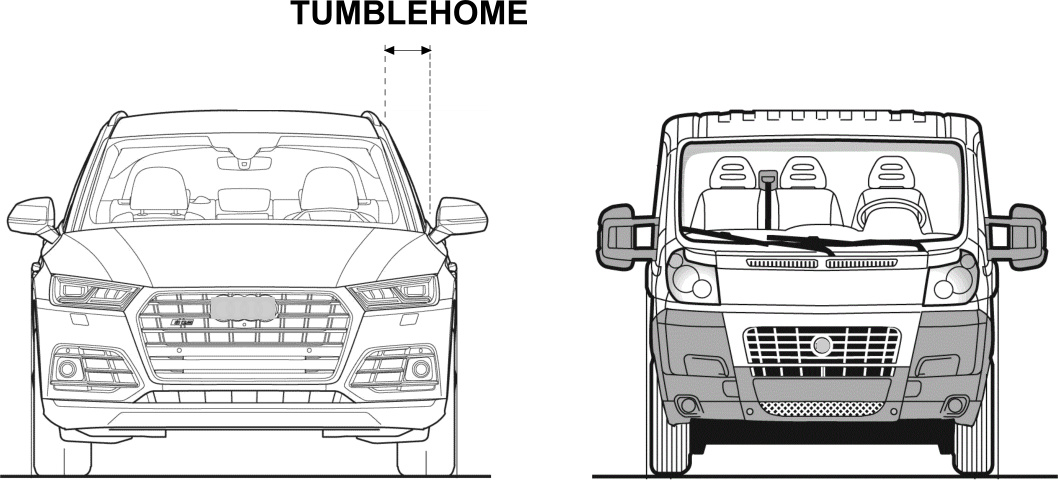
The inward slope of the "greenhouse" above the beltline of a motor vehicle is also called the tumblehome. An example of a car with a pronounced tumblehome is the Lamborghini Countach. Less commonly, the inward curve of the body near the bottom may also be called a tumblehome. In 21st century automobile designs this turnunder is less pronounced or eliminated to reduce aerodynamic drag and to help keep the lower portions of the vehicle cleaner under wet conditions.
It is known in bus body design as well.
In railway/bus design
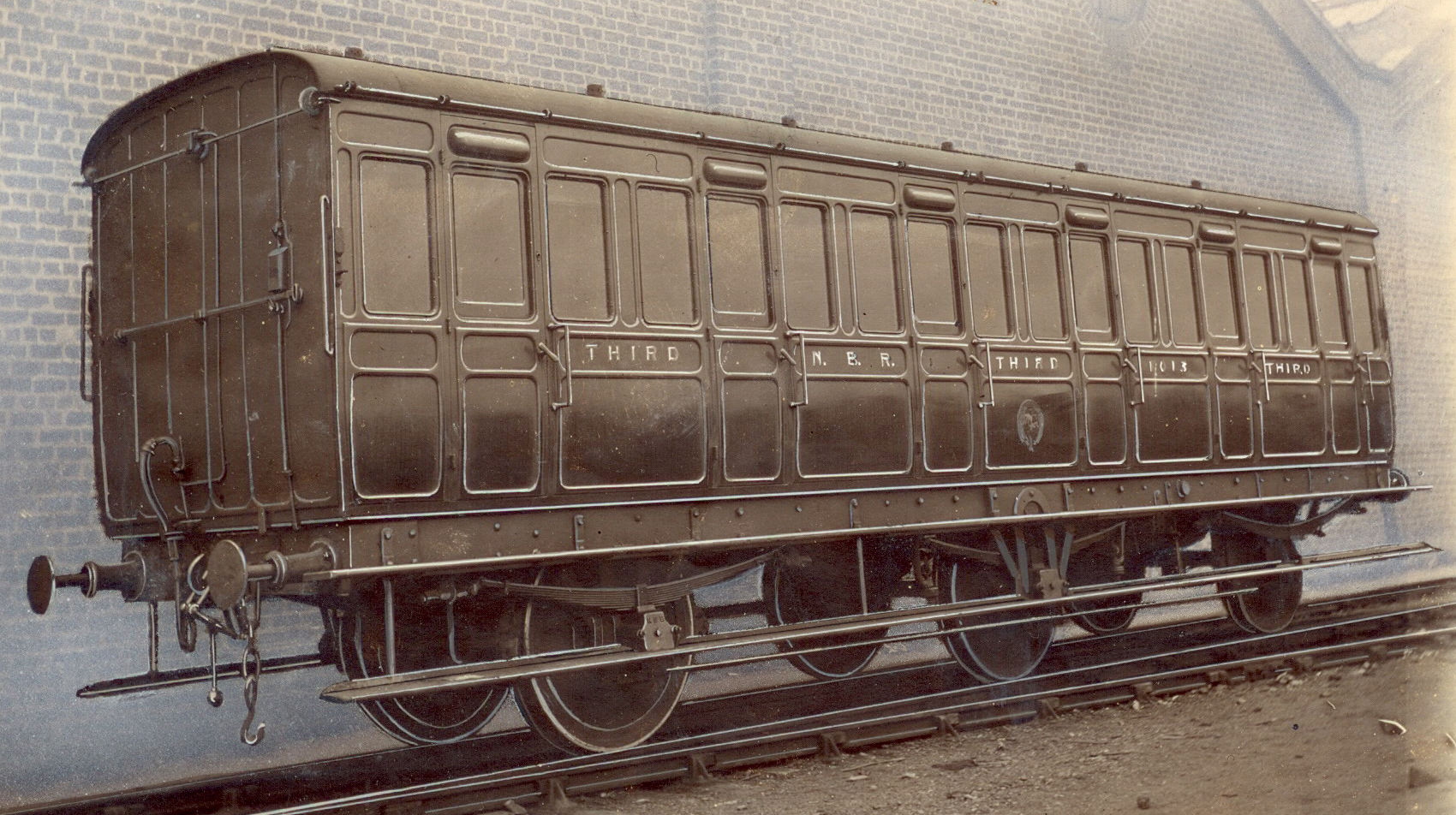
The inwardly curving portions of railway passenger carriages at the point where the carriage sides join the underframes is also called the tumblehome. Tumblehome styling of railway carriages was particularly prevalent in Britain and Ireland (or on railways influenced by British engineers or equipment builders) in the 19th century and "wood body" era of the early 20th century. This enabled a wooden step running the length of the carriage to remain within the dimensions of the loading gauge, while still allowing maximum width for the main body of the carriage. Thus there was space to place a foot when entering or leaving the carriage.
A tumblehome remains a feature of railway carriages in Great Britain and can be seen in most modern designs of passenger rolling stock.
Some recent vehicle designs for continental Europe, such as the "Lint" and "Talent" vehicles, also feature a tumblehome profile, which in some vehicles leads to the need for a retractable step to bridge the gap between vehicle floor and station platforms. The operation time of these steps, which must be fully extended before the sliding doors may be opened, can increase the train waiting time at stations, compared to vehicles without such steps.
It was also a feature of the profile of the rear of British and British-built double-decker buses in the late 1920/early 1930s, which had inside staircases for the first time. This feature was apparent, with the lower half of the buses' vertical rear having a bulge on the lower half, where the staircase curved round from side to rear to reach the rear platform.
In house design
The S. A. Foster House and Stable were designed during an experimental period by Frank Lloyd Wright in 1900 and have some rare design features including Japanese-influenced upward roof flares at all of the roof peaks and on each dormer. The house and stable also incorporate an extremely rare tumblehome design throughout. The exterior walls slant inward from the base to the top. Since the interior walls are straight, the transition takes place in the exterior windows and doors which are wider at the bottom than they are at the top. The house and stable are unique examples and similar to wooden water tower construction with flared supports for added strength.
References
Footnotes
Works cited
- Forczyk, Robert (2009). Russian Battleship vs Japanese Battleship, Yellow Sea 1904–05. Osprey. .
- Mather, Frederic G. (1885). The Evolution of Canoeing
- Pursey, H. J. (1959). Merchant Ship Construction Especially Written for the Merchant Navy
- Vaillancourt, Henri. Traditional Birchbark Canoes Built in the Malecite, Penobscot and Passamaquoddy style
- DDG-1000 Zumwalt / DD(X) Multi-Mission Surface Combatant Future Surface Combatant. GlobalSecurity.org. Modern use of tumblehome.
References
- Pursey p. 218.
- Forczyk, p. 18.
- Forczyk, p. 76.
- "Frank Lloyd Wright Building Conservancy".
This article was imported from Wikipedia and is available under the Creative Commons Attribution-ShareAlike 4.0 License. Content has been adapted to SurfDoc format. Original contributors can be found on the article history page.
Ask Mako anything about Tumblehome — get instant answers, deeper analysis, and related topics.
Research with MakoFree with your Surf account
Create a free account to save articles, ask Mako questions, and organize your research.
Sign up freeThis content may have been generated or modified by AI. CloudSurf Software LLC is not responsible for the accuracy, completeness, or reliability of AI-generated content. Always verify important information from primary sources.
Report