From Surf Wiki (app.surf) — the open knowledge base
Tropic of Cancer
Line of northernmost latitude at which the Sun can be directly overhead
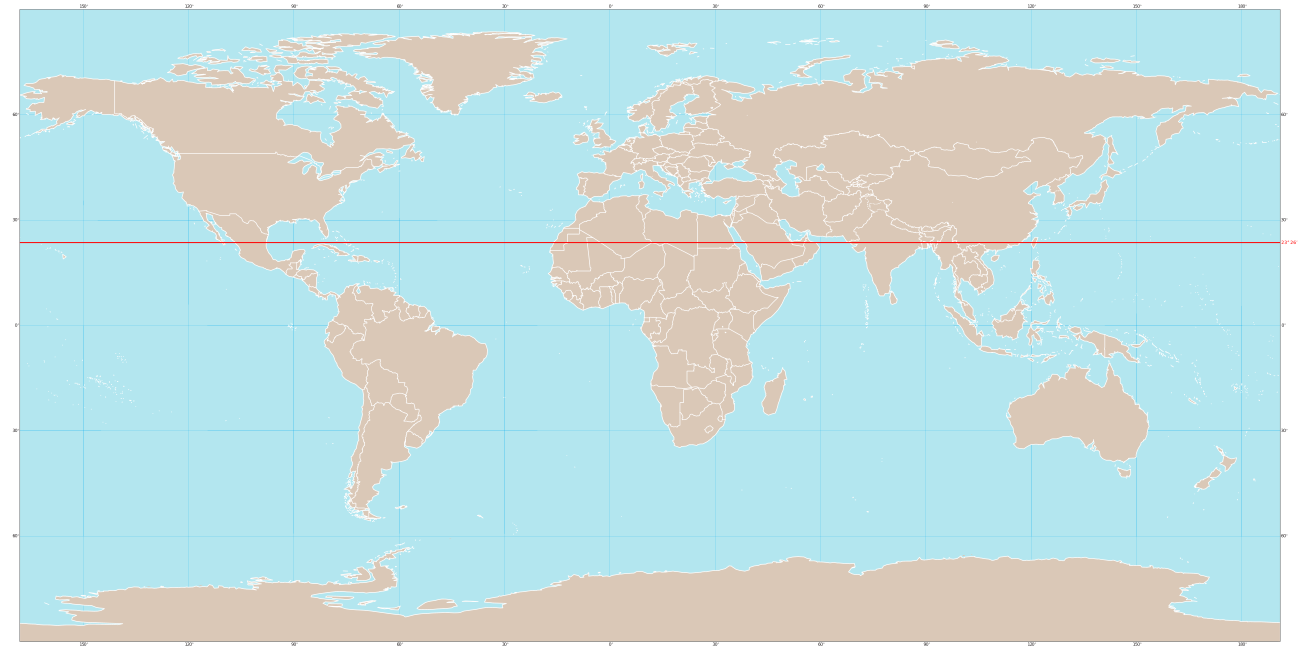
Line of northernmost latitude at which the Sun can be directly overhead
the circle of latitude

The Tropic of Cancer, also known as the Northern Tropic, is the Earth's northernmost circle of latitude where the Sun can be seen directly overhead. This occurs on the June solstice, when the Northern Hemisphere is tilted toward the Sun to its maximum extent. It also reaches 90 degrees below the horizon at solar midnight on the December solstice. Using a continuously updated formula, the circle is currently north of the Equator.
Its Southern Hemisphere counterpart, marking the most southerly position at which the Sun can be seen directly overhead, is the Tropic of Capricorn. These tropics are two of the seven major circles of latitude that mark maps of Earth, the others being the Arctic and Antarctic circles, the Equator, and the Poles (which are degenerate circles). The positions of these two circles of latitude (relative to the Equator) are dictated by the tilt of Earth's axis of rotation relative to the plane of its orbit, and since the tilt changes, the location of these two circles also changes.
In geopolitics, it is known for being the southern limitation on the mutual defence obligation of NATO, as member states of NATO are not obligated to come to the defence of territory south of the Tropic of Cancer.
Name
When this line of latitude was named in the last centuries BC, the Sun was in the constellation Cancer (Latin: Crab) at the June solstice (90° ecliptic longitude). Due to the precession of the equinoxes, this is no longer the case; today the Sun is in the constellation Taurus at the June solstice. The word "tropic" itself comes from the Greek "trope (τροπή)", meaning turn (change of direction or circumstance) or inclination, referring to the fact that the Sun appears to "turn back" at the solstices.
Drift
The Tropic of Cancer's position is not fixed, but constantly changes because of axial precession in the Earth's longitudinal alignment relative to the ecliptic, the plane in which the Earth orbits around the Sun. Earth's axial tilt varies over a 41,000-year period from about 22.1 to 24.5 degrees, and is about 23.4 degrees, which will continue to remain valid for about a millennium. This wobble means that the Tropic of Cancer is currently drifting southward at a rate of almost half an arcsecond (0.468″) of latitude, or 15 m, per year. The circle's position was at exactly 23°27′N in 1917 and will be at 23°26'N in 2045.
The distance between the Antarctic Circle and the Tropic of Cancer is essentially constant as they move in tandem. This is based on an assumption of a constant equator, but the precise location of the equator is not truly fixed. See: equator, axial tilt and circles of latitude for additional details.
Geography
North of the tropic are the subtropics and the North Temperate Zone. The equivalent line of latitude south of the Equator is called the Tropic of Capricorn, and the region between the two, centered on the Equator, is the tropics.
In the year 2000, more than half of the world's population lived north of the Tropic of Cancer.
On the Tropic of Cancer there are approximately 13 hours, 35 minutes of daylight during the summer solstice. During the winter solstice, there are 10 hours, 41 minutes of daylight.
Using 23°26'N for the Tropic of Cancer, the tropic passes through the following 17 countries (including two disputed territories) and 8 water bodies, starting at the prime meridian and heading eastward:
| Coordinates | ||||||||||||
|---|---|---|---|---|---|---|---|---|---|---|---|---|
| (1' accuracy ≈ 2 km ≈ 1 mi) | Country, territory or sea | Notes | Red Sea | Indian Ocean | Taiwan Strait | Philippine Sea | Pacific Ocean | Gulf of California | Gulf of Mexico | Atlantic Ocean | Atlantic Ocean | Western Sahara |
| The Tropic touches on the northernmost point of at | ||||||||||||
| The Tropic passes through Lake Nasser | ||||||||||||
| AlMedinah, Mecca, ArRiyadh, and The Eastern provinces. | ||||||||||||
| Abu Dhabi emirate only | ||||||||||||
| The tropic crosses Muscat, the country's capital. | ||||||||||||
| Arabian Sea | ||||||||||||
| States of Gujarat, Rajasthan, Madhya Pradesh, Chhattisgarh, Jharkhand and West Bengal | ||||||||||||
| Khulna, Dhaka, and Chittagong divisions | ||||||||||||
| State of Tripura | ||||||||||||
| Chittagong Division | ||||||||||||
| State of Mizoram | ||||||||||||
| Chin State, Sagaing Division, Mandalay Division, Shan State | ||||||||||||
| Provinces of Yunnan (passing about 7 km north of the border with ), Guangxi, and Guangdong | ||||||||||||
| Hujing Island (Huching Island), Chiayi County, Hualien County | ||||||||||||
| Passing just south of Necker Island, Hawaii, | ||||||||||||
| State of Baja California Sur | ||||||||||||
| States of Sinaloa, Durango, Zacatecas, San Luis Potosí, Nuevo León, and Tamaulipas | ||||||||||||
| Passing just north of Cuba | ||||||||||||
| Passing through the Straits of Florida and the Nicholas Channel | ||||||||||||
| Passing just south of the Anguilla Cays () | ||||||||||||
| Passing through the Santaren Channel and into the open ocean | ||||||||||||
| Exuma Islands and Long Island | ||||||||||||
| Claimed by and the |
Climate
The climate at the Tropic of Cancer is generally hot and dry, except for cooler highland regions in China, marine environments such as Hawaii, and easterly coastal areas, where orographic rainfall can be very heavy, in some places reaching 4 m annually. Most regions on the Tropic of Cancer experience two distinct seasons: an extremely hot summer with temperatures often reaching 45 C and a warm winter with maxima around 22 C. Much land on or near the Tropic of Cancer is part of the Sahara Desert, while to the east, the climate is torrid monsoonal with a short wet season from June to September, and very little rainfall for the rest of the year.
The highest mountain on or adjacent to the Tropic of Cancer is Yu Shan in Taiwan. It had glaciers descending as low as 2800 m during the Last Glacial Maximum. At present glaciers still exist around the Tropic. The nearest currently surviving are the Minyong and Baishui in the Himalayas to the north and on Pico de Orizaba in Mexico to the south.
Gallery
File:Tropicofcancer.jpg|Road sign south of Dakhla, marking the Tropic of Cancer. The sign was placed by Budapest-Bamako rally participants; thus, the inscription is in English and Hungarian. File:TropicofCancer JC IMG 5135.jpg|Road Sign near Mehsana City in Gujarat State, India Mehsana, Gujarat File:Tropic of Cancer - a few miles from Rann of Kutch.jpg|Sign marking the Tropic of Cancer a few kilometres from Rann of Kutch, Gujarat, India File:Tropic of cancer passes through Madhay Pradesh.jpg|Sign marking the Tropic of Cancer in Madhya Pradesh, India File:Tropic of cancer nadia wb india.jpg|Sign marking the Tropic of Cancer on National Highway 34 in Nadia District, West Bengal, India File:Ruisui Tropic of Cancer Marker 20100204.jpg|Ruisui Tropic of Cancer Marker in Ruisui Township, Hualien County, Taiwan File:Conghua toweroftropicofcancer.JPG|Tower of the Tropic of Cancer in Guangzhou, Guangdong Province, China
References
References
- "Obliquity of the Ecliptic and Arctic Circle Calculator".
- "NATO - Topic: Collective defence and Article 5". North Atlantic Treaty Organization.
- [http://www.homepage.montana.edu/~geol445/hyperglac/time1/milankov.htm Montana State University: Milankovitch Cycles & Glaciation] {{webarchive. link. (August 6, 2011)
- (12 August 2010). "The World's Population Mapped by Latitude and Longitude".
- within {{convert. 470. km. mi. -1
- Bakker et al., Radio Positioning at Sea: Geodetic Survey Computations Least Squares Adjustment, 1995 ({{ISBN. 90-6275-537-2)
This article was imported from Wikipedia and is available under the Creative Commons Attribution-ShareAlike 4.0 License. Content has been adapted to SurfDoc format. Original contributors can be found on the article history page.
Ask Mako anything about Tropic of Cancer — get instant answers, deeper analysis, and related topics.
Research with MakoFree with your Surf account
Create a free account to save articles, ask Mako questions, and organize your research.
Sign up freeThis content may have been generated or modified by AI. CloudSurf Software LLC is not responsible for the accuracy, completeness, or reliability of AI-generated content. Always verify important information from primary sources.
Report