From Surf Wiki (app.surf) — the open knowledge base
Trithuria
Genus of aquatic plants
Genus of aquatic plants
- Hydatella Diels
- Juncella F.Muell. ex Hieron.
Trithuria is a genus of small ephemeral aquatic herb that represent the only members of the family Hydatellaceae found in India, Australia, and New Zealand. Almost all described species of Trithuria are found in Australia, with the exception of T. inconspicua and T. konkanensis, from New Zealand and India respectively. Until DNA sequence data and a reinterpretation of morphology proved otherwise, these plants were believed to be monocots related to the grasses (Poaceae). They are unique in being the only plants besides two members of Triuridaceae (Lacandonia schizmatica and L. braziliana) in which the stamens are centred and surrounded by the pistils; in Hydatellaceae the resulting 'flowers' may instead represent condensed inflorescences or non-flowers.
These diminutive, superficially moss-like, aquatic plants are the closest living relatives of a clade comprising two closely related water-lily families Nymphaeaceae and Cabombaceae. Together, these three families compose the order Nymphaeales in the APG III system of flowering plant classification. Trithuria (Hydatellaceae) diverged from the rest of Nymphaeales soon after Nymphaeales diverged from its sister taxon, although the crown clade evolved relatively recently, in the early Miocene (~19 Ma;). The order as a whole is the sister group of all flowering plants except Amborellales.
Trithuria exhibits a remarkable similarity to Centrolepis and species of both genera were mistaken for members of the other genus.
The genus consists of tiny, relatively simple plants occurring in Australasia and India. It was formerly considered to be related to the grasses and sedges (order Poales), but has been reassigned to the order Nymphaeales as a result of DNA and morphological analyses showing that it represents one of the earliest groups to split off in flowering-plant phylogeny, rather than having a close relationship to monocots, which it bears a superficial resemblance to due to convergent evolution.
Description

_(20402793025).jpg)
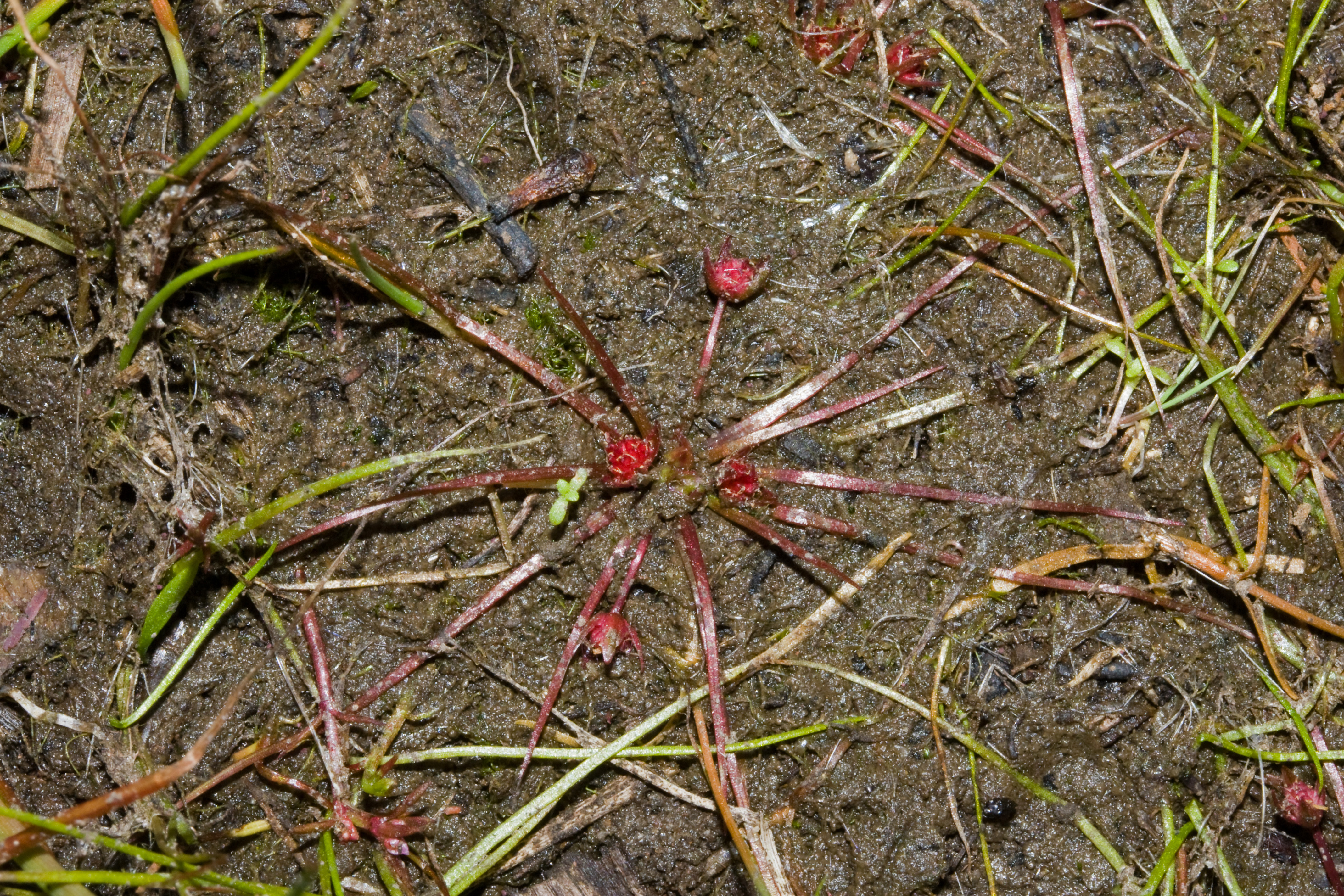
Plants are submerged and emergent aquatic plants, rooted in the substrate below the water. They are tiny plants, just a few cm tall. Most species are ephemeral aquatics that flower in vernal pools when the water draws down, but several species are submerged perennials found in shallow lakes. The simple leaves are concentrated basally around a short stem. Individual species are cosexual (with several types of hermaphroditic conditions) or dioecious, and are either wind-pollinated (anemophilous) or self-pollinating (autogamous). Two predominantly apomictic species are also known. Flower-like reproductive units are composed of small collections of minute stamen- and/or pistil-like structures that may each represent very reduced individual flower, so that the reproductive units may be pseudanthia. The non-fleshy fruits are follicles or achenes.
Cytology
The diploid chromosome count of Trithuria inconspicua subsp. inconspicua is 2n = c. 24. The diploid chromosome count of Trithuria submersa is 2n = 56. The diploid chromosome count of the tetraploid species Trithuria konkanensis 2n = 40. The diploid chromosome count of Trithuria australis is 2n = 14.
Etymology
The generic name Trithuria is derived from the Greek words τρεις treis meaning "three", and θυρις thyris meaning "window". It references the dehiscence of the capsule fruit.
Taxonomy
The genus Trithuria Hook.f. was described by Joseph Dalton Hooker in 1858 with the type species Trithuria submersa Hook.f. by Georg Hans Emmo Wolfgang Hieronymus based on previous work by Ferdinand von Mueller. Juncella is a nomen illegitimum. without a type designation, but the lectotype Hydatella australis Diels. has been designated in 2008. The genus Hydatella was synonymised with Trithuria in 2008.
Trithuria was initially placed in the family Centrolepidaceae Endl. (now synonymous with Restionaceae R.Br.), which is placed in the order Poales Small but it was separated as its own family Hydatellaceae U.Hamann by Ulrich Hamann in 1976 with Hydatella Diels as the type genus. Upon its separation, Hamann stated the new families affinity or placement were still obscure. The correct placement of the family became apparent in 2007, when it was identified as a basal angiosperm lineage. The family Hydatellaceae is now placed in the order Nymphaeales Salisb. ex Bercht. & J. Presl.. Alternatively, it is placed in a separate order Hydatellales Cronquist ex Reveal & Doweld validly published by James Lauritz Reveal and Alexander Borissowitsch Doweld in 1999 based on previous work by Arthur Cronquist (see the Cronquist system). This is however not widely accepted, as the order Hydatellales is mostly treated as a synonym of Nymphaeales.
Hydatellales
Hydatellales is a botanical name for an order of flowering plants. In the Cronquist system, 1981, the name was used for an order placed in the subclass Commelinidae in class Liliopsida [=monocotyledons]. The order consisted of one family only: Hydatellaceae
Similarly the Dahlgren system recognised this order (with the same circumscription and placed it in superorder Commelinanae in subclass Liliidae [=monocotyledons].
The APG II system assigned these plants to the order Poales, close to the grasses and sedges. Recent study by Saarela et al., however, suggests a position out of the Poales; here, the Hydatellaceae link with the waterlilies, the first time a plant has been ejected from the monocots. The Angiosperm Phylogeny Website had since updated the Nymphaeales page to include the family.
Hydatellaceae
Trithuria Hook.f. Hydatellaceae are a family of small, aquatic flowering plants that includes only the genus TrithuriaHook.f., which in 2008 was re-defined to include the genus Hydatella Diels. The type species is Trithuria submersa Hook.f.
The family was for many years assumed to be a close relative of the grasses and sedges and was even sometimes lumped under the poalean family Centrolepidaceae. Even as recently as 2003, the APG II system assigned Hydatellaceae to the grass order Poales in the commelinid monocots. However, research based on DNA sequences and morphology by Saarela et al. indicates that Hydatellaceae is the living sister group of the water lilies (Nymphaeaceae and Cabombaceae) and thus represents one of the most ancient lineages of flowering plants. Developers of earlier classifications were misled by the apparently reduced vegetative and reproductive morphology of these plants. As aquatic herbs, Hydatellaceae have environmental adaptations leading to derived characteristics that create a morphological similarity to the more distant taxon. Careful reanalysis of their morphological traits and comparisons with other so-called 'basal' angiosperms have supported this "dramatic taxonomic adjustment". This realignment is now recognized in the APG III and APG IV systems of classification.
Species and distribution
Trithuria has at least 13 species, although species diversity in the family has probably been substantially underestimated.
- Trithuria austinensis D.D.Sokoloff, Remizowa, T.D.Macfarl. & Rudall Western Australia
- Trithuria australis (Diels) D.D.Sokoloff, Remizowa, T.D.Macfarl. & Rudall - Western Australia
- Trithuria bibracteata Stapf ex D.A.Cooke - Western Australia
- Trithuria cookeana D.D.Sokoloff, Remizowa, T.D.Macfarl. & Rudall - Northern Territory of Australia
- Trithuria cowieana D.D.Sokoloff, Remizowa, T.D.Macfarl. & Rudall - Northern Territory
- Trithuria filamentosa Rodway - Tasmania
- Trithuria fitzgeraldii D.D.Sokoloff, I.Marques, T.D.Macfarl., Rudall & S.W.Graham - Western Australia
- Trithuria inconspicua Cheeseman - North Island of New Zealand Trithuria inconspicua subsp. brevistyla K.A.Ford - endemic to South Island, New Zealand
- Trithuria konkanensis S.R.Yadav & Janarth. - Maharashtra
- Trithuria lanterna D.A.Cooke - Northern Territory, Western Australia, Queensland
- Trithuria occidentalis Benth. - Western Australia
- Trithuria polybracteata D.A.Cooke ex D.D.Sokoloff, Remizowa, T.D.Macfarl. & Rudall - Western Australia
- Trithuria submersa Hook.f. - Western Australia, South Australia, Victoria, New South Wales, Tasmania
Conservation
The IUCN conservation status of Trithuria lanterna is Least Concern (LC). Trithuria inconspicua is critically endangered.
References
References
- [http://apps.kew.org/wcsp/namedetail.do?name_id=270876 Kew World Checklist of Selected Plant Families]
- (2016-04-01). "Transcriptome-derived evidence supports recent polyploidization and a major phylogeographic division in Trithuria submersa (Hydatellaceae, Nymphaeales)". New Phytologist.
- Dmitry D. Sokoloff, Margarita V. Remizowa, Terry D. Macfarlane, and Paula J. Rudall. 2008. [https://www.researchgate.net/profile/Paula-Rudall/publication/233621193_Classification_of_the_early-divergent_angiosperm_family_Hydatellaceae_One_genus_instead_of_two_four_new_species_and_sexual_dimorphism_in_dioecious_taxa/links/0a85e5329b5e2171eb000000/Classification-of-the-early-divergent-angiosperm-family-Hydatellaceae-One-genus-instead-of-two-four-new-species-and-sexual-dimorphism-in-dioecious-taxa.pdf?_sg%5B0%5D=started_experiment_milestone&origin=journalDetail&_rtd=e30%3D "Classification of the early-divergent angiosperm family Hydatellaceae: one genus instead of two, four new species and sexual dimorphism in dioecious taxa".] ''Taxon'' '''57'''(1):179-200.
- Yadav SR, Janarthanam MK. 1995 Trithuria konkanensis (Hydatellaceae), eine neue Art aus Indien. ''Aqua Planta'' '''20'''. (3): 91-97 (1995).
- (February 4, 2016). "Inside-out flowers of Lacandonia brasiliana (Triuridaceae) provide new insights into fundamental aspects of floral patterning". PeerJ.
- Else Marie Friis & Peter Crane. (15 March 2007). "Botany: New home for tiny aquatics". Nature.
- (2014). "Reconstructing the age and historical biogeography of the ancient flowering-plant family Hydatellaceae (Nymphaeales)". Springer Science and Business Media LLC.
- Sokoloff, D. D., Remizowa, M. V., Linder, H. P., & Rudall, P. J. (2009). [https://bsapubs.onlinelibrary.wiley.com/doi/pdf/10.3732/ajb.0900074 "Morphology and development of the gynoecium in Centrolepidaceae: the most remarkable range of variation in Poales."] American Journal of Botany, 96(11), 1925-1940.
- (2018-10-24). "Monocot plastid phylogenomics, timeline, net rates of species diversification, the power of multi-gene analyses, and a functional model for the origin of monocots". Wiley.
- (2019). "Genetic variation in Trithuria inconspicua and T. filamentosa (Hydatellaceae): a new subspecies and a hypothesis of apomixis arising within a predominantly selfing lineage". CSIRO Publishing.
- (2000). "Hydatellaceae U Hamann". FloraBase: Flora of Western Australian.
- Flora of New Zealand. Taxon Profile. ''Trithuria''. (n.d.). Retrieved July 26, 2023, from https://www.nzflora.info/factsheet/taxon/Trithuria.html
- Remizowa, M. V., Sokoloff, D. D., Macfarlane, T. D., Yadav, S. R., Prychid, C. J., & Rudall, P. J. (2008). [https://www.tandfonline.com/doi/full/10.1080/00173130802184214 "Comparative pollen morphology in the early‐divergent angiosperm family Hydatellaceae reveals variation at the infraspecific level."] Grana, 47(2), 81-100.
- Sokoloff, D. D., Marques, I., Macfarlane, T. D., Remizowa, M. V., Lam, V. K. Y., Pellicer, J., … Graham, S. W. (2019). Cryptic species in an ancient flowering-plant lineage (Hydatellaceae, Nymphaeales) revealed by molecular and micromorphological data. TAXON, 68(1), 1–19. doi:10.1002/tax.12026
- Hooker, Joseph Dalton, Fitch, W. H., & Reeve Brothers. (1844). The botany of the Antarctic voyage of H.M. discovery ships Erebus and Terror in the Years 1839-1843 :under the command of Captain Sir James Clark Ross (Vol. 3, Issue 2, pp. 78-79). Reeve Brothers. https://www.biodiversitylibrary.org/page/28467263
- Department for Environment and Water. (n.d.). ''Trithuria submersa'' (Hydatellaceae)
- "''Trithuria'' Hook.f.".
- ''Juncella tasmanica'' F.Muell. (n.d.). The Australian National Species List (auNSL). Retrieved November 18, 2024, from https://biodiversity.org.au/nsl/services/rest/name/apni/96340/api/apni-format
- ''Hydatella'' Diels. (n.d.). The Australian National Species List (auNSL). Retrieved November 17, 2024, from https://biodiversity.org.au/nsl/services/rest/name/apni/86441/api/apni-format
- Jeffery M. Saarela1. (15 March 2007). "Hydatellaceae identified as a new branch near the base of the angiosperm phylogenetic tree". Nature.
- "Restionaceae R.Br.".
- Linder, H. P., & Rudall, P. J. (2005). [https://www.researchgate.net/profile/Paula-Rudall/publication/201999057_Evolutionary_History_of_Poales/links/0c96052b3245664030000000/Evolutionary-History-of-Poales.pdf Evolutionary history of Poales.] Annu. Rev. Ecol. Evol. Syst., 36(1), 107-124.
- Hamann, Ulrich. International Plant Names Index. (n.d.). Retrieved November 17, 2024, from https://www.ipni.org/a/5-1
- "Hydatellaceae U.Hamann".
- WFO (2024): Nymphaeales Salisb. ex Bercht. & J. Presl. Published on the Internet;http://www.worldfloraonline.org/taxon/wfo-9000000354. Accessed on: 17 Nov 2024
- Doweld A.B. 2022. [https://www.palaeobotanicalsociety.org/geophytology/vol52_2022/1.%20Doweld%2030.pdf New names of fossil Nymphaeaceae and allied forms.] Geophytology 52(1&2): 1–28.
- Reveal, J. L., & Doweld, A. B. (1999). Validation of Some Suprageneric Names in Magnoliophyta. Novon, 9(4), 549–553. https://doi.org/10.2307/3392163
- Manaaki Whenua – Landcare Research. (n.d.-b). Nymphaeales Salisb. ex Bercht. & J.Presl. Flora of New Zealand Online. Retrieved November 17, 2024, from https://www.nzflora.info/factsheet/taxon/Nymphaeales.html
- Reveal, J. L. (2012). [https://www.phytoneuron.net/PhytoN-Magnoliidae.pdf An outline of a classification scheme for extant flowering plants.] Phytoneuron, 37(1), 1-221.
- Reveal, J. L., & Chase, M. W. (2011). [https://plantnetwork.org/wordpress/wp-content/uploads/2746/apg2fulltext.pdf APG III: Bibliographical information and synonymy of Magnoliidae.] {{Webarchive. link. (2021-12-27 Phytotaxa, 19, 71-134.)
- Saarela, Jeffery M., Hardeep S. Rai, James A. Doyle, Peter K. Endress, Sarah Mathews, Adam D. Marchant, Barbara G. Briggs & Sean W. Graham. 2007. Hydatellaceae identified as a new branch near the base of the angiosperm phylogenetic tree. Nature 446:312-315.
- Stevens, P. F. (2001 onwards). Nymphaeales. Angiosperm Phylogeny Website. Version 7, May 2006. Accessed 21 March 2007.
- "''Hydatellaceae'' U.Hamann".
- (2008). "Classification of the early-divergent angiosperm family Hydatellaceae: one genus instead of two, four new species and sexual dimorphism in dioecious taxa". Taxon.
- (2007). "Hydatellaceae identified as a new branch near the base of the angiosperm phylogenetic tree". Nature.
- (2007). "Morphology of Hydatellaceae, an anomalous aquatic family recently recognized as an early-divergent angiosperm lineage". American Journal of Botany.
- (2011). "Early Flowers and Angiosperm Evolution". Cambridge University Press.
- Angiosperm Phylogeny Group. (2009). "An update of the Angiosperm Phylogeny Group classification for the orders and families of flowering plants: APG III". Botanical Journal of the Linnean Society.
- Angiosperm Phylogeny Group. (2016). "An update of the Angiosperm Phylogeny Group classification for the orders and families of flowering plants: APG IV". [[Botanical Journal of the Linnean Society]].
- (2019-04-14). "Cryptic species in an ancient flowering-plant lineage (Hydatellaceae, Nymphaeales) revealed by molecular and micromorphological data". Wiley.
- (May 2013). "Impact of spatial constraints during seed germination on the evolution of angiosperm cotyledons: A case study from tropical Hydatellaceae (Nymphaeales)". American Journal of Botany.
- (March 2012). "Molecular phylogenetics of Hydatellaceae (Nymphaeales): Sexual-system homoplasy and a new sectional classification". American Journal of Botany.
- Brummitt, N. 2013. ''Trithuria lanterna''. The IUCN Red List of Threatened Species 2013: e.T44392948A44408157. https://dx.doi.org/10.2305/IUCN.UK.2013-1.RLTS.T44392948A44408157.en. Accessed on 13 December 2024.
- Critically endangered Northland lake plant voted NZ's favourite plant 2024. (2024, November 5). Northland Regional Council. Retrieved December 13, 2024, from https://www.nrc.govt.nz/news/2024/november/critically-endangered-northland-lake-plant-voted-nz-s-favourite-plant-2024/
This article was imported from Wikipedia and is available under the Creative Commons Attribution-ShareAlike 4.0 License. Content has been adapted to SurfDoc format. Original contributors can be found on the article history page.
Ask Mako anything about Trithuria — get instant answers, deeper analysis, and related topics.
Research with MakoFree with your Surf account
Create a free account to save articles, ask Mako questions, and organize your research.
Sign up freeThis content may have been generated or modified by AI. CloudSurf Software LLC is not responsible for the accuracy, completeness, or reliability of AI-generated content. Always verify important information from primary sources.
Report