From Surf Wiki (app.surf) — the open knowledge base
Tri-tet oscillator
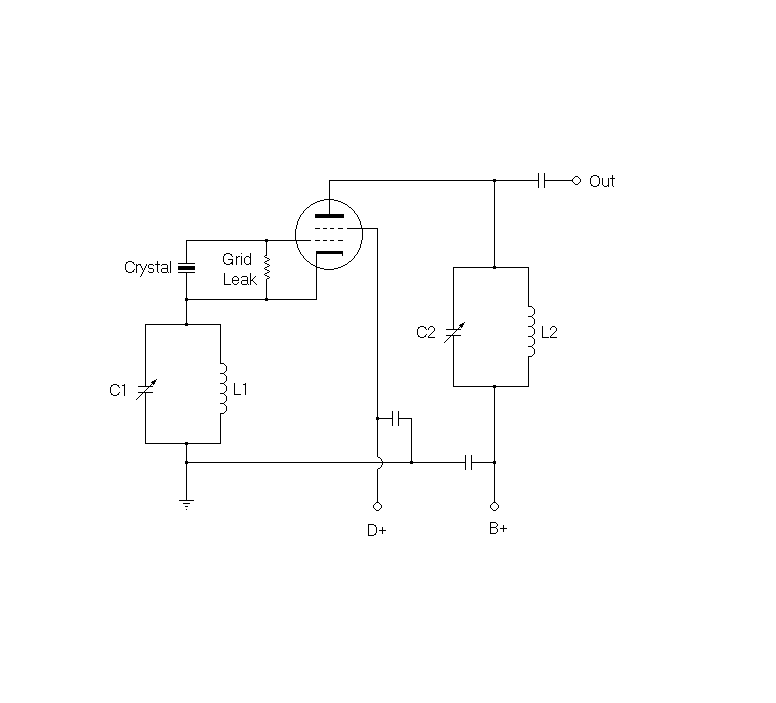
A tri-tet oscillator is a crystal-controlled vacuum tube electronic oscillator circuit. It is a type of electron-coupled oscillator (ECO), which uses a tetrode or pentode tube.
The tri-tet was introduced by James J. Lamb in the June 1933 issue of QST magazine.
In an ECO, the screen grid acts as a plate for the triode oscillator. Some of the electrons pass through the screen grid to the plate, causing a current to flow in the load. This effectively isolates the oscillator portion from the load, so that loading does not affect the operating frequency.
In the schematic shown, the C1/L1 tank circuit control the current through the crystal. It is normally tuned a point between the crystal's fundamental frequency and its first harmonic.
The C2/L2 tank circuit is tuned to the desired harmonic.
D+ acts as the "plate" voltage for the tetrode, and is slightly less than B+.
Tri-Tet in popular culture
Jean Shepherd occasionally mentioned the tri-tet oscillator in his writing and radio shows. It was used as the oscillator in one of the first amateur radio transmitters he used.{{Citation
References
References
- Lamb, James J. “A More Stable Crystal Oscillator of High Harmonic Output.” QST June 1933: 30-32.
- Sterling, George E. 1940. ''The Radio Manual for Engineers, Inspectors, Students, Operators and Radio Fans.'' 3rd ed. New York: D. Van Nostrand Company, Inc.
This article was imported from Wikipedia and is available under the Creative Commons Attribution-ShareAlike 4.0 License. Content has been adapted to SurfDoc format. Original contributors can be found on the article history page.
Ask Mako anything about Tri-tet oscillator — get instant answers, deeper analysis, and related topics.
Research with MakoFree with your Surf account
Create a free account to save articles, ask Mako questions, and organize your research.
Sign up freeThis content may have been generated or modified by AI. CloudSurf Software LLC is not responsible for the accuracy, completeness, or reliability of AI-generated content. Always verify important information from primary sources.
Report