From Surf Wiki (app.surf) — the open knowledge base
Tremissis
Small solid gold coin of Late Antiquity
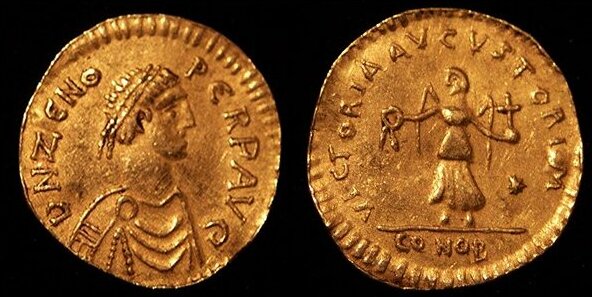
Small solid gold coin of Late Antiquity
the late antique coin valued at a third of a solidus
The tremissis or tremis (Greek: τριμίσιον, trimision) was a small pure gold coin of Late Antiquity. Its name, meaning "a third of a unit", formed by analogy with semissis (half of a unit), indicated its value relative to the solidus. It was introduced into Roman currency in the 380s by the Emperor Theodosius I and initially weighed 8 siliquae (equivalent to 1.52 grams).
Roman tremisses continued to be commonly minted into the reign of Leo III (717–741), but thereafter they were only rarely struck in the east of the empire, probably only for ceremonial uses, until the reign of Basil I (867–886), after which they disappeared. Nevertheless, the coin continued in common use in the Sicilian theme until the fall of Syracuse in 878. The trachy, introduced in the 11th century, was equivalent in value to the old tremissis. Although it was not made of gold, it was one third of the standard golden hyperpyron. It was not, however, called tremissis.
Outside of the Roman empire, tremisses were minted by the Anglo-Saxons, Burgundians, Franks, Frisians, Lombards, Ostrogoths, Suevi and Visigoths between the 5th and 8th centuries. The word tremissis was borrowed into Old English as thrymsa.
In Frankish sources, the tremissis is sometimes called a triens, a term likewise meaning "a third", which originally referred to a bronze coin worth a third of an as. The historian and bishop Gregory of Tours calls the Frankish tremissis a trians or treans. The German form dremise is also attested. In French historiography the term tiers (third) or tiers de sou (third of a solidus) is often used. The French, in general, prefer to call the coin of the Merovingian kings a triens (but avoiding the plural form trientes), while British scholarship prefers tremissis.
It was still used as an accounting currency until at least the 12th century in Sardinia. It appears as tremisse in the condaghe.
References
References
- [[Philip Grierson]], "Tremissis", in [[Alexander Kazhdan]], ed., ''The Oxford Dictionary of Byzantium'' (Oxford University Press, 1991 [online 2005]), vol. 3, p. 2113.
- "Tremissis", in Robert E. Bjork, ed., ''The Oxford Dictionary of the Middle Ages'' (Oxford University Press, 2010).
- "Thrymsas", in Robert E. Bjork, ed., ''The Oxford Dictionary of the Middle Ages'' (Oxford University Press, 2010).
- Philip Grierson and Mark Blackburn, ''Medieval European Coinage: Volume 1, The Early Middle Ages (5th–10th Centuries)'' (Cambridge University Press, 1986), p. 102.
- Il condaghe di Santa Maria di Bonarcado / a cura di Maurizio Virdis. - Nuoro : Ilisso, 2003
This article was imported from Wikipedia and is available under the Creative Commons Attribution-ShareAlike 4.0 License. Content has been adapted to SurfDoc format. Original contributors can be found on the article history page.
Ask Mako anything about Tremissis — get instant answers, deeper analysis, and related topics.
Research with MakoFree with your Surf account
Create a free account to save articles, ask Mako questions, and organize your research.
Sign up freeThis content may have been generated or modified by AI. CloudSurf Software LLC is not responsible for the accuracy, completeness, or reliability of AI-generated content. Always verify important information from primary sources.
Report