From Surf Wiki (app.surf) — the open knowledge base
Treaty of Melno
1422 treaty ending the Gollub War
1422 treaty ending the Gollub War
| Field | Value | ||
|---|---|---|---|
| }} | language | wikisource= |
| Teutonic Knights | Kingdom of Poland | Grand Duchy of Lithuania
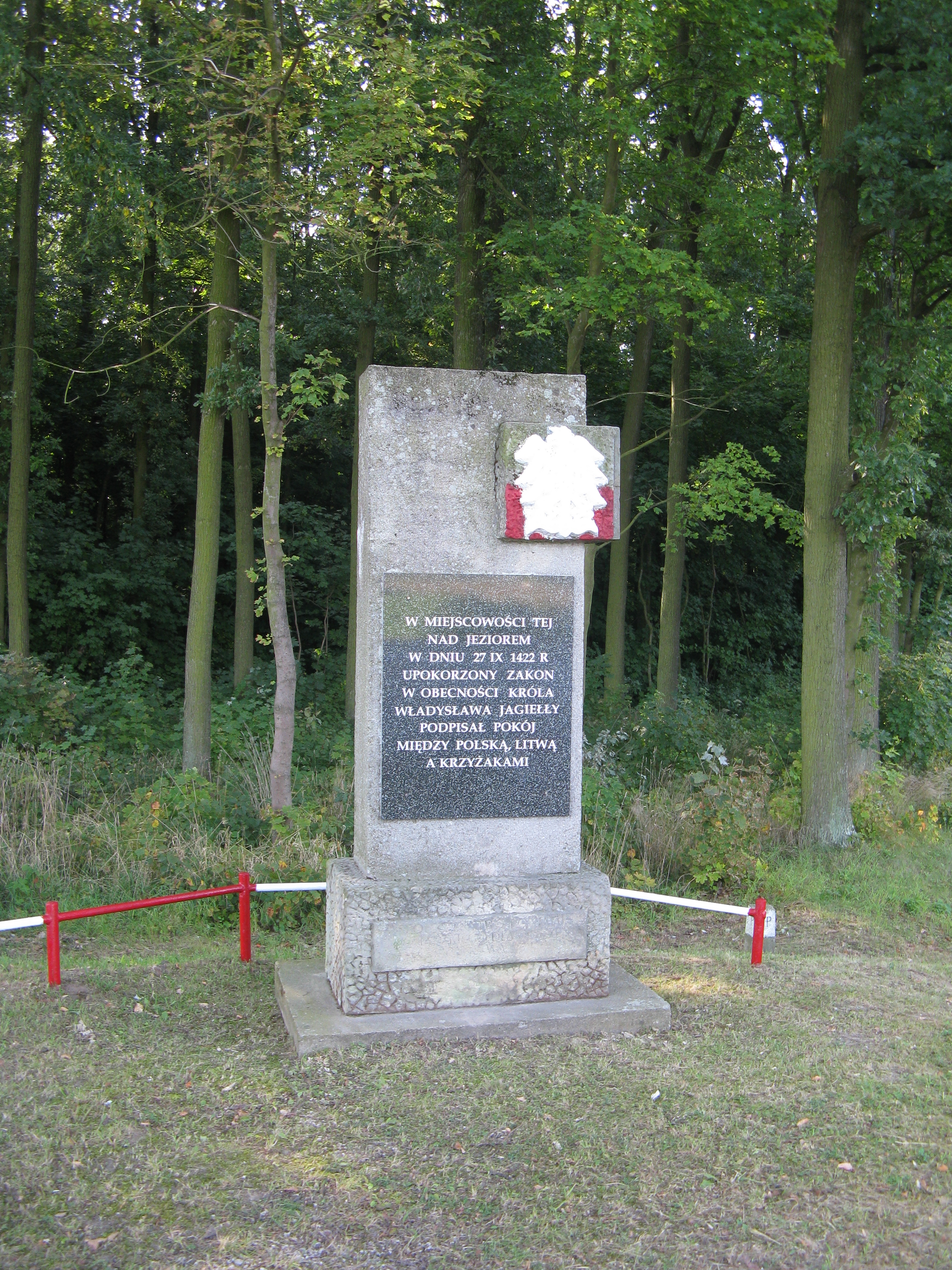
The Treaty of Melno (; ) or Treaty of Lake Melno () was a peace treaty ending the Gollub War. It was signed on 27 September 1422, between the Teutonic Knights and an alliance of the Kingdom of Poland and the Grand Duchy of Lithuania at Lake Melno (; ), east of Graudenz (Grudziądz). The treaty resolved territorial disputes between the Knights and Lithuania regarding Lithuania Minor and Samogitia, which had dragged on since 1382, and determined the Prussian–Lithuanian border, which afterwards remained unchanged for about 500 years. A portion of the original border survives as a portion of the modern border between the Republic of Lithuania and Kaliningrad Oblast, Russia, making it one of the oldest and most stable borders in Europe.
Background
Main article: Gollub War
The First Peace of Thorn of 1411 did not resolve long-standing territorial disputes between the Teutonic Knights and the Polish–Lithuanian union. The peace transferred Samogitia to the Grand Duchy of Lithuania, but only for the lifetimes of Polish King Jogaila (Władysław II Jagiełło) and Lithuanian Grand Duke Vytautas. At the time both rulers were aged men. Soon disagreements arose as to the Samogitian borders: Vytautas claimed that the entire northern bank of the Neman River, including the port of Memel (Klaipėda), was Samogitian territory.
Provisions
According to the terms of the treaty, the Teutonic Knights for the first time renounced all territorial, political, and missionary claims against the Grand Duchy of Lithuania. These results were described as a "disappointment" for Poland.
At the time of the treaty, the parties did not have their official seals and therefore it was not immediately ratified. Grand Master Rusdorf attempted to exploit the recess and renegotiate the treaty because his subjects were not satisfied with the terms. He hoped to wage a war with assistance from the Holy Roman Emperor. However, Sigismund and Jogaila met in Käsmark (Kežmarok) and agreed to an alliance: Sigismund would end his support to the Knights and Poland–Lithuania would stop their assistance to the Hussites in the Hussite Wars. This meant that Vytautas had to abandon his interventions in Bohemia. The agreement was signed on 30 March 1423. The Treaty of Melno was subsequently ratified on 9–18 May in Veliuona and approved by Pope Martin V on 10 July 1423. Poland–Lithuania affixed some 120 official seals to the treaty. The first Lithuanian signatories were voivode of Vilnius Albertas Manvydas, starosta of Vilnius Kristinas Astikas, voivode of Trakai Jonas Jaunius, elder of Samogitia Mykolas Skirgaila.
Aftermath
The treaty effectively ended warfare between the Teutonic Knights and the Grand Duchy of Lithuania, which had continued with brief interruptions since the 13th century. The last volunteer crusaders arrived in October 1422, after that the Knights had to rely on their own men or on mercenaries. It was a welcome development to Lithuania, as the treaty allowed it to direct its attention towards its Eastern territories and to internal reforms. War-devastated border regions in Samogitia and Suvalkija began to recover. However, the Polish–Teutonic disputes were not resolved. In a telling episode shortly after the treaty had been signed, the Knights and the Poles disputed a watermill in Lubicz, a strategic post which had been turned into a fortress. Vytautas was angered by the dispute and threatened to give up Palanga to the Knights if Poland did not surrender its claims to Lubicz. The Knights won this dispute.
The treaty put an effective end to the Polish–Lithuanian cooperation against the Knights. The Teutonic Knights attempted to befriend the Lithuanians, offering a royal crown to Vytautas in hopes of breaking up the Polish–Lithuanian union. During the Lithuanian Civil War (1431–1435), Lithuanian Duke Švitrigaila was able to employ the Polish–Teutonic animosity for his own advantages – the Knights invaded Poland, starting the Polish–Teutonic War. The two states battled again during the Thirteen Years' War (1454–66), a civil war that tore Prussia in half.
The agreement drew the Prussian–Lithuanian border roughly and imprecisely, resulting in local demarcation disputes. The border was redrawn with greater detail and precision in 1532 and 1545. The border survived without major changes until World War I. In 1919, the Treaty of Versailles detached the Klaipėda Region (Memel Territory) from Germany as a League of Nations mandate. Lithuania annexed the region in 1923. The southern portion of the border, with small modifications, still survives as the border between Lithuania and Kaliningrad Oblast, Russia.
Notes
References
References
- Stanislaus F. Belch. (2017). "Paulus Vladimiri and his doctrine concerning international law and politics". [[Walter de Gruyter]].
- Jóźwiak, Sławomir. (2003). "Zburzenie zamku komturskiego w Nieszawie w latach 1422–1423". Rocznik Toruński.
- Teutonic Knights sent two Teutonic officers, [[Bishop of Ermland]], [[Bishop of Pomesania]], Livonian marshal, and three secular knights.
- According to the [[Bychowiec Chronicle]], [[Birutė]], mother of Lithuanian Grand Duke Vytautas, hailed from Palanga.
- Čelkis, Tomas. (2008). "Nuo teritorinio ruožo prie linijos: sienų sampratos pokyčiai Lietuvos Didžiojoje Kunigaikštystėje XIV–XVI amžiuje". Lietuvos istorijos studijos.
- Christiansen, Eric. (1997). "The Northern Crusades". Penguin Books.
- "The Cambridge History of Poland to 1696". Cambridge University Press.
- Ivinskis, Zenonas. (1978). "Lietuvos istorija iki Vytauto Didžiojo mirties". Lietuvių katalikų mokslo akademija.
- Jučas, Mečislovas. (2009). "The Battle of Grünwald". National Museum Palace of the Grand Dukes of Lithuania.
- (2000). "The History of Lithuania Before 1795". Lithuanian Institute of History.
- Kirkienė, Genutė. (2008). "LDK politikos elito galingieji: Chodkevičiai XV–XVI amžiuje". Vilniaus universiteto leidykla.
- Lukowski, Jerzy. (2006). "A concise history of Poland". Cambridge University Press.
- McLachlan, Gordon. (2008). "Lithuania: the Bradt travel guide". Bradt Travel Guides.
- Mickūnaitė, Giedrė. (2006). "Making a great ruler: Grand Duke Vytautas of Lithuania". Central European University Press.
- Mickūnaitė, Giedrė. (2006). "Making a great ruler: Grand Duke Vytautas of Lithuania". Central European University Press.
- (2009). "[[History of Lithuania (book)". [[Baltos lankos]].
- Rašimaitė, Eglė. (24 March 2010). "Siena: šimtmečių vingiai". Kelias.
- Semaška, Algimantas. (2006). "Kelionių vadovas po Lietuvą: 1000 lankytinų vietovių norintiems geriau pažinti gimtąjį kraštą". Algimantas.
- Turnbull, Stephen. (2003). "Tannenberg 1410: Disaster for the Teutonic Knights". Osprey.
- Urban, William. (2003). "Tannenberg and After". Lithuanian Research and Studies Center.
- (1985–1988). "Melno taika". Vyriausioji enciklopedijų redakcija.
This article was imported from Wikipedia and is available under the Creative Commons Attribution-ShareAlike 4.0 License. Content has been adapted to SurfDoc format. Original contributors can be found on the article history page.
Ask Mako anything about Treaty of Melno — get instant answers, deeper analysis, and related topics.
Research with MakoFree with your Surf account
Create a free account to save articles, ask Mako questions, and organize your research.
Sign up freeThis content may have been generated or modified by AI. CloudSurf Software LLC is not responsible for the accuracy, completeness, or reliability of AI-generated content. Always verify important information from primary sources.
Report