From Surf Wiki (app.surf) — the open knowledge base
Transport in Singapore
none

none
Transport in Singapore is predominantly land-based, with a comprehensive network of roads making many parts of the city-state, including islands such as Sentosa and Jurong Island, accessible. The road network is complemented by a robust rail system consisting of the Mass Rapid Transit (MRT) and the Light Rail Transit (LRT), which cover the length and width of Singapore and serve a few neighbourhoods respectively. The main island of Singapore is also connected to other islands via ferryboat services. Furthermore, the city-state maintains strong international connections through two bridges linking it to Malaysia – the Causeway and the Second Link – and the Singapore Changi Airport, a major aviation hub in Asia.
Singapore's transport system is globally recognized for its reliability, efficiency and effectiveness. According to McKinsey's Urban Transportation report, it ranks as the world's best overall, excelling in five criteria: availability, affordability, efficiency, convenience, and sustainability. A study by London consulting firm Credo further highlights the cost-efficiency of Singapore's public transport networks, with integrated multi-modal (bus and train) single-journey regular trunk adult card-based fares ranging from S$0.99 to S$2.26. The Monthly Travel Pass, offering unlimited bus and train rides, is set at S$128 per month.
Public transport, encompassing public buses and the MRT and LRT rail networks, is the most common mode of transportation within the city-state and is far better developed than in the other ASEAN member states. The Land Transport Authority (LTA) fully integrates public transport, with state ownership and public financing of the public infrastructure and public capital assets of railways and buses. The operation and maintenance of these systems are tendered to bidding operator companies on contract.
Private transport, including cars, motorcycles, and commercial vehicles, is less commonly used due to the country's limited land space and dense population. The LTA has controlled and limited the private vehicle population through the Vehicle Quota System (VQS) ownership market-based license auctions since 1990. High taxes, such as the Certificate of Entitlement (COE) and Additional Registration Fee (ARF), make private vehicle ownership prohibitively expensive, leading to Singapore's reputation as the most expensive country in the world to own a car.
In recent years, Singapore has emerged as a preferred location for the testing and development of autonomous vehicles.
Road transport
Buses
Main article: Public buses of Singapore
.jpg)
Bus transport forms a significant part of public transport in Singapore, with over 4.0 million rides taken per day on average as of 2019. There are more than 365 scheduled bus services, operated by SBS Transit, SMRT Buses, Tower Transit Singapore and Go-Ahead Singapore. There are also around 5,800 buses, most of which are single-deck and double-deck, and a small minority of articulated buses and minibuses currently in active passenger service.
Since 2016, the Land Transport Authority regulates the public bus service standards and owns relevant assets whereas bus operators bid for operating bus services via competitive tendering, under its Bus Contracting Model.
Taxis and PHVs
Main article: Taxis of Singapore

Taxis and private hire vehicles (PHV) are a popular form of transport, with fares considered low compared to those in most cities in developed countries. Starting rates were $3.20 - $3.90. As of March 2019, the taxi and private hire car population has been increased to 83,037.
In Singapore, taxis can be flagged down at any time of the day along any public road outside of the Central Business District (CBD), while private hire cars can only be booked via ridesharing apps.
Private cars
As of 2018, there was a total of 957,006 motor vehicles in Singapore, with 509,302 of them being private cars.
Private transport (cars, motorcycles, commercial vehicles) is less commonly used as due to limited land space of the country. The Land Transport Authority (LTA) has limited and controlled the population of privately owned vehicles in the country through the Vehicle Quota System (VQS) ownership market-based license auctions since 1990. As a result, private vehicles are prohibitively expensive and Singapore is known to be most expensive country in the world to own a car. Prospective private vehicle owners are required to place a bid for a Certificate of Entitlement (COE) sold under auction (valid for ten years, as of May 2024; COEs are priced at more than S$92,700 for CAT A cars [below 97bhp], S$105,689 for bigger CAT B cars [above 97bhp], S$72,001 for prospective commercial vehicle owners and more than S$9,311 for prospective motorcycle owners) and pay the Additional Registration Fee (ARF) tax imposed at 100-320% of the open market value (OMV) of the vehicle, among other fees. As a result of the aforementioned taxes, on-the-road car prices in Singapore are approximately five times the on-the-road car prices in Western countries.
From 2025, new diesel cars were not allowed to be registered while new cars have to be of cleaner-energy models, including electric, hybrid or hydrogen fuel cell cars, from 2030.
Roads and expressways
Main article: Driving in Singapore, Expressways of Singapore

Singapore pioneered congestion pricing (the market-based usage management of public roads to reduce congestion at specific times within the city centre and certain expressways), with the Singapore Area Licensing Scheme, which has since been replaced with the Electronic Road Pricing, a form of electronic toll collection.
- Total length of expressways: 164 km
- Total length of major arterial roads: 576 km
- Total length of collector roads: 704 km
- Total length of local access roads: 2056 km (as of 2017)
Traffic drives on the left which is typical in Commonwealth countries.

The planning, construction and maintenance of the road network is fully conducted by the Land Transport Authority (LTA), and this extends to expressways in Singapore. These form key transport arteries between the distinct towns and regional centres as laid out in Singapore's urban planning, with the main purpose of allowing vehicles to travel from satellite towns to the city centre and vice versa in the shortest possible distance. These expressways include:
- Ayer Rajah Expressway (AYE)
- Bukit Timah Expressway (BKE)
- Central Expressway (CTE)
- East Coast Parkway (ECP)
- Marina Coastal Expressway (MCE)
- Kallang–Paya Lebar Expressway (KPE)
- Kranji Expressway (KJE)
- Pan Island Expressway (PIE)
- Seletar Expressway (SLE)
- Tampines Expressway (TPE)
- North–South Corridor (scheduled opening in 2027)
The influence of expressways on Singapore's transport policy developed shortly after independence during the history of Singapore because of frequent traffic congestion in the Central district. The aim was to encourage residential development in other parts of the island and give residents in these new "satellite towns" a convenient link between their homes and their workplaces (which were mostly situated around the city centre).
Causeway and link bridge
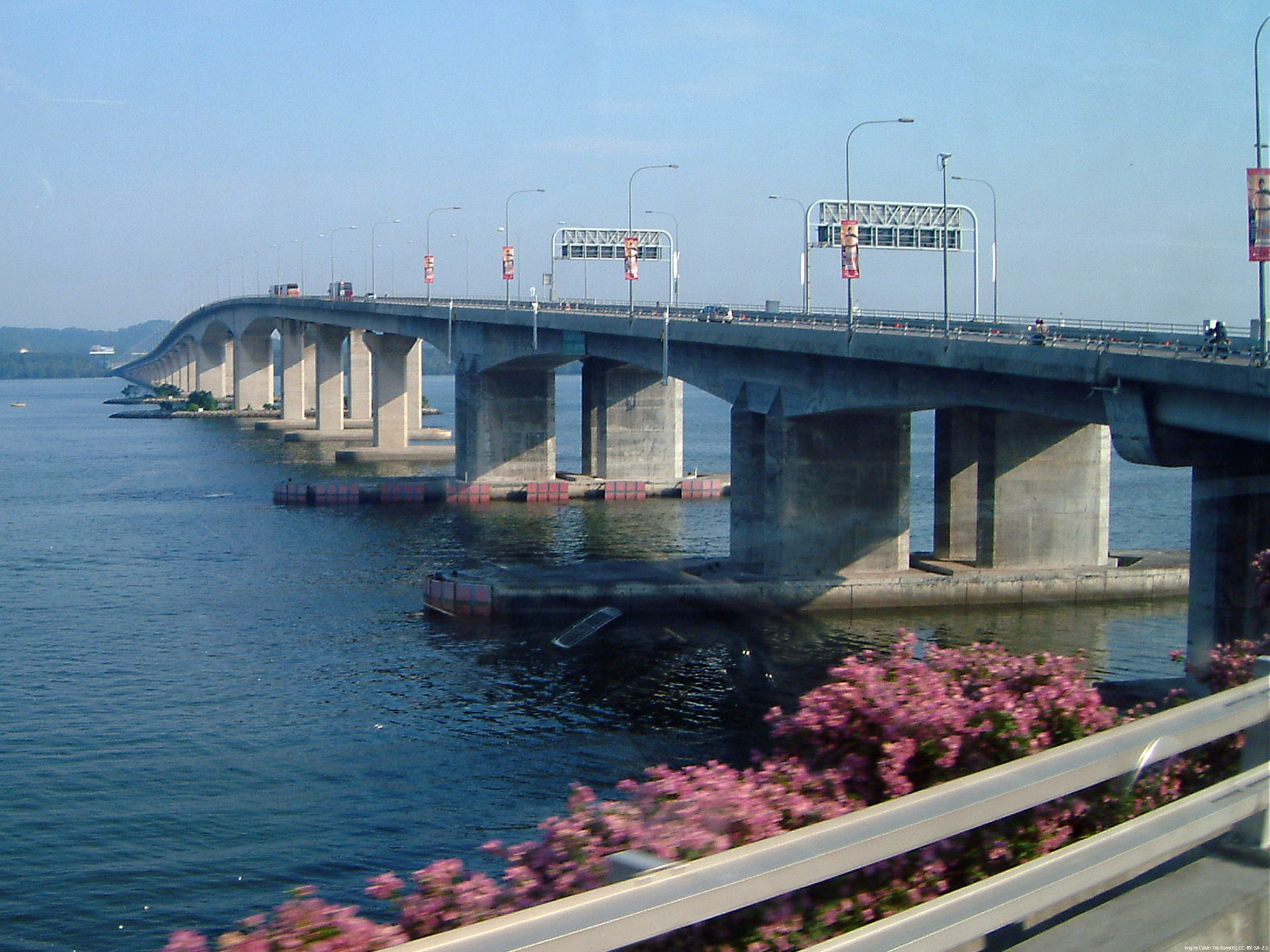
Singapore has two land links to Malaysia. The Johor-Singapore Causeway, built in the 1920s to connect Johor Bahru in Johor, Malaysia to Woodlands in Singapore, carries a road and a railway line. The Tuas Second Link, a bridge further west, was completed in 1996 and links Tuas in Singapore to Tanjung Kupang in Johor.
Trishaws
Before World War II, rickshaws were an important part of urban public transportation. In 1947 they were banned on humanitarian grounds, and replaced by trishaws (cycle rickshaws).
Usage of trishaws as a means of transportation had died out by 1983. Some trishaws then served as tourist attractions, taking tourists for a ride around the downtown district. Individual trishaw rider licenses were last issued in 2001, while the last licensed operator of trishaw tours, Trishaw Uncle, ended its contract with the Singapore Tourism Board at the end of May 2023. As of April 2024, there are no commercial trishaw services operating in Singapore.
Rail transport
Main article: Rail transport in Singapore
Mass Rapid Transit (MRT)
Main article: Mass Rapid Transit (Singapore)

The Mass Rapid Transit, which opened in 1987, is a heavy rail metro system that serves as the major backbone of Singapore's public transport system along with public buses; as of November 2022, the network has a length of 229.7 km and 166 stations. The Land Transport Authority, the main planning authority of the MRT, plans to provide a more comprehensive rail transport system by expanding the rail system to a total of 360 km by the year 2030, with eight in ten households living within a 10-minute walking distance of an MRT station.
The current MRT network consists of six main lines: the North–South Line, East–West Line, Circle Line and Thomson–East Coast Line operated by SMRT Trains (SMRT Corporation) and the North East Line and Downtown Line operated by SBS Transit. Two more lines, the Jurong Region Line and the Cross Island Line, will open in stages from 2027 and 2030 respectively.
Light Rail Transit (LRT)
Main article: Light Rail Transit (Singapore)
_-_cropped.jpg)
In several new towns, automated rubber-tyred light rail transit systems function as feeders to the main MRT network in lieu of feeder buses. The total length of Singapore's LRT systems is 28.8 km. The first LRT line, which is operated by SMRT Light Rail, opened in Bukit Panjang in 1999 to provide a connection to Choa Chu Kang in neighbouring Choa Chu Kang New Town. Although subsequently hit by over 50 incidents, some of which resulted in several days of system suspension, similar systems albeit from a different company were introduced in Sengkang and Punggol in 2003 and 2005 respectively, both operated by SBS Transit.
International rail links
The international railway line to Malaysia is an extension of the Malaysian rail network operated by Keretapi Tanah Melayu (Malayan Railways). Since 1 July 2011, Woodlands Train Checkpoint serves as the southern terminus of the KTM rail network. Previously, KTM trains terminated at Tanjong Pagar railway station in central Singapore. A new rail link is being built: the Johor Bahru-Singapore Rapid Transit System between Woodlands North and Bukit Chagar, Johor Bahru.
Air transport
Airlines
The national flag carrier is Singapore Airlines. The other Singaporean based airline is Scoot.
Malaysia's Firefly is the sole operator with scheduled services out of Seletar Airport.
Airports
Main article: List of airports in Singapore

The aviation industry is regulated by the Civil Aviation Authority of Singapore, a statutory board of the Singapore government under the Ministry of Transport.
An open skies agreement was concluded with the United Kingdom in October 2007 permitting unrestricted services from Singapore by UK carriers. Singapore carriers were allowed to operate domestic UK services as well as services beyond London Heathrow to a number of destinations, including the United States along with Canada.
Singapore Changi Airport, with its four terminals, is one of the most important air hubs in the region. The international airport is situated at the easternmost tip of the main island, and serves 185 cities in 58 countries. With the recent opening of the fourth terminal, Changi is now capable of handling more than 70 million passengers every year. Singapore Changi Airport is also named World's Best Airport in 2023 by Skytrax, its 12th selection in the past few decades.
Seletar Airport is Singapore's first civil aviation airport and is primarily used for private aviation. Smaller turbo props also serve Seletar Airport.
| Airport | ICAO | IATA | Usage | Runway | Length | ||
|---|---|---|---|---|---|---|---|
| (ft) | Length | ||||||
| (m) | Remarks | ||||||
| Paya Lebar Air Base | WSAP | QPG | Military | Paved | 12400 | 3800 | Former civilian |
| Seletar Airport | WSSL | XSP | Civilian/military | Paved | 6023 | 1836 | Mainly non-scheduled flights |
| Sembawang Air Base | WSAG | Military | Paved | 3000 | 914 | ||
| Singapore Changi Airport | WSSS | SIN | Civilian | Paved | 13200 | 4000 | |
| Tengah Air Base | WSAT | TGA | Military | Paved | 8900 | 2713 |
Heliports
Main article: List of heliports in Singapore
Aerial lift transport
Cable car
The Singapore Cable Car is a three-station gondola lift system that plies between Mount Faber on the main island of Singapore and the resort island of Sentosa via HarbourFront. Opened in 1974, it was the first aerial ropeway system in the world to span a harbour. The cable car system underwent a revamp that was completed in August 2010.
In addition, a similar gondola lift system also operates within Sentosa. Opening in 2015, this line provides a connection between Siloso Point and Imbiah.
Maritime transport
Ports and harbours

The Port of Singapore, run by the port operators PSA International (formerly the Port of Singapore Authority) and Jurong Port, is the world's busiest in terms of shipping tonnage handled. 1.04 billion gross tons were handled in 2004, crossing the one billion mark for the first time in Singapore's maritime history. Singapore also emerged as the top port in terms of cargo tonnage handled with 393 million tonnes of cargo in the same year, beating the Port of Rotterdam for the first time in the process. In 2019, it handled a total of 626 million tonnes of cargo.
In 2018, Singapore was ranked second globally in terms of containerised traffic, with 36.6 million Twenty-Foot Equivalent Units (TEUs) handled, and is also the world's busiest hub for transshipment traffic. Additionally, Singapore is the world's largest bunkering hub, with 49.8 million tonnes sold in 2018.
In 2007, the Port of Singapore was ranked the world's busiest port, surpassing Hong Kong and Shanghai. The Port of Singapore is also ranked the Best Seaport in Asia.
| Port | Operator | Type | Berths | Quay length | |||||||||
|---|---|---|---|---|---|---|---|---|---|---|---|---|---|
| (m) | Quay cranes | Area | |||||||||||
| (m2) | Capacity (kTEUs) | ||||||||||||
| url=https://www.singaporepsa.com/our-business/terminals/joint-venture-terminals | title=Our Business: Joint-Venture Terminals | website=www.singaporepsa.com | access-date=2020-03-07}} | K Line/Nippon Yusen/PSA International | Car | 2 | |||||||
| url=https://www.singaporepsa.com/our-business/terminals | title=Our Business: Terminals | website=www.singaporepsa.com | url-status=live | archive-url=https://web.archive.org/web/20200114010314/https://www.singaporepsa.com/our-business/terminals | archive-date=2020-01-14 | access-date=2020-03-07}} | PSA International | Container | 8 | 2,325 | 26 | 790,000 | |
| Cosco-PSA (CPT) | Cosco/PSA International | Container | 5 | 720 | 228,000 | 5,000 | |||||||
| Jurong | JTC | Multi-purpose | 23 | 4,486 | 1,200,028 | ||||||||
| Keppel (KT) | PSA International | Container | 14 | 3,164 | 27 | 1,025,000 | |||||||
| Magenta Singapore (MST) | ONE/PSA International | Container | 4 | 4,000 | |||||||||
| MSC-PSA Asia (MPAT) | MSC/PSA International | 7 | 14 | ||||||||||
| Pasir Panjang Automobile (PPT) | PSA International | Ro-ro | 3 | 1,010 | 250,000 | ||||||||
| Pasir Panjang (PPT 1) | PSA International | Container | 6 | 2,145 | 19 | 850,000 | |||||||
| Pasir Panjang (PPT 2) | PSA International | Container | 9 | 2,972 | 36 | 1,390,000 | |||||||
| Pasir Panjang (PPT 3) | PSA International | Container | 8 | 2,655 | 31 | 940,000 | |||||||
| Pasir Panjang (PPT 4) | PSA International | Container | 3 | 1,264 | 13 | 700,000 | |||||||
| Pasir Panjang (PPT 5) | PSA International | Container | 6 | 2,160 | 24 | 830,000 | |||||||
| Pasir Panjang (PPT 6) | PSA International | Container | 6 | 2,251 | 24 | 800,000 | |||||||
| PIL-PSA Singapore (PPST) | PIL/PSA International | Container | 3 | ||||||||||
| Sembawang Wharves | PSA International | General | 4 | 660 | 280,000 | ||||||||
| Tanjong Pagar (TPT) | PSA International | Container | 7 | 2,097 | 0 | 795,000 |
Passenger transport
Water transport within the main island is limited to the River Taxi along the Singapore River. The service was introduced in January 2013, with low ridership. There are also daily scheduled ferry services from the Marina South Pier to the Southern Islands such as Kusu Island, Lazarus Island & Saint John's Island and Sisters' Islands. Changi Point Ferry Terminal in the east offers daily ferry services to Pulau Ubin and some destinations in Johor, Malaysia.
Singapore Cruise Centre (SCC) runs Tanah Merah and HarbourFront Ferry Terminals which are connected by ferry services to Indonesian Riau Islands of Batam, Bintan and Karimun.
In addition to the ferry terminals, the Singapore Cruise Centre (SCC) also operates a cruise terminal which is handled by the International Passenger Terminal (IPT), and has two berths of 310 metres and 270 metres with a height limit of 52 metres. It has a draft of 12 metres. It underwent an upgrade in 2005 to improve its passenger handling facilities. An additional cruise terminal, the Marina Bay Cruise Centre Singapore, began construction in 2009 and was completed in 2012 in order to accommodate bigger cruise ships that are not able to dock at the Singapore Cruise Centre.
References
References
- Wong, Derek. (2018-08-23). "Singapore public transport system tops global list". [[The Straits Times]].
- Sim, Royston. (2014-06-02). "Study: Singapore's public transport system one of world's most efficient". The Straits Times.
- "Fare Structure". [[Public Transport Council]].
- Øren Aldal, Malin. (2025-08-07). "Does ASEAN climate policy pay sufficient attention to public transportation?". Discover Sustainability.
- "New Rail Financing Framework". [[Land Transport Authority]].
- "Bus Contracting Model". Land Transport Authority.
- Descalsota, Marielle. (2022-06-28). "Cars in Singapore cost on average 5 times more than they do in the US. Here's a breakdown of what 5 popular cars would set you back in each country.".
- Umar Zakir Abdul, Hamid. (2019). "Current Landscape of the Automotive Field in the ASEAN Region: Case Study of Singapore, Malaysia and Indonesia - A Brief Overview". ASEAN Journal of Automotive Technology.
- (13 February 2020). "Bus, train ridership rises to new high".
- "Annual Vehicle Statistics 2018: MOTOR VEHICLE POPULATION BY VEHICLE TYPE". Land Transport Authority.
- "How the COE system went from managing rapid vehicle growth to hitting record premiums".
- Ho, Timothy. (2022-04-11). "An Explanation On Why Cars In Singapore Are So Expensive".
- (January 2022). "Why are cars so expensive in Singapore?".
- (2023-10-05). "Cost of car ownership soars in Singapore". BBC News.
- (23 May 2024). "COE prices for smaller cars dip to $92,700, premiums for bigger cars inch up to $105,689".
- Yeoh, Grace. (2023-02-14). "Budget 2023: Higher additional registration fees, cap on rebates for luxury car owners".
- cue. (2023-02-14). "Budget 2023: Tax for higher-end cars to rise again; ARF to go up from 220% to 320% {{!}} The Straits Times".
- Hong, Lynda. (2024-01-29). "YTL PowerSeraya to build new 600MW hydrogen-ready turbine by 2027". [[The Straits Times]].
- (2018-04-06). "Length of Roads Maintained by LTA". Land Transport Authority.
- A redBus
'' [https://www.redbus.sg/travels/operators-directory Guide for navigating singapore'' ] ''Land Transport Authority, Singapore''. Retrieved 14 December 2024 - "Infopedia: Rickshaw".
- (2012). "A Slow Ride into the Past: The Chinese Trishaw Industry in Singapore, 1942-1983". Monash University Publishing.
- "From their heyday in the 1940s to their demise: The end of trishaws in Singapore". MediaCorp.
- "Loss of trishaw tours in Singapore linked to road development plans, waning demand".
- "Rail Length".
- "Land Transport Datamall, LTA".
- "Two New Rail Lines and Three New Extensions to Expand Rail Network by 2030".
- "Jurong Region Line to serve NTU, Tengah estate, Jurong Industrial Estate".
- (2019-01-25). "First phase of Cross Island MRT line finalised; will have 12 stations".
- (3 October 2007). "Singapore, UK conclude landmark Open Skies Agreement". Channelnewsasia.com.
- "Air Network". changiairport.com.
- "Skytrax names Singapore Changi as World's Best Airport". Skytrax.
- (2025-06-04). "Cable car rides shut down for upgrading works". The Straits Times.
- (2015-07-14). "New cable car service to help visitors get around Sentosa". The Straits Times.
- (2020-01-28). "Cargo Throughput, Monthly".
- "Top 50 World Container Ports".
- (2019-01-14). "Singapore's 2018 Maritime Performance".
- (12 January 2006). "Singapore remains world's busiest port". Xinhuanet.
- "Our Business: Joint-Venture Terminals".
- "Our Business: Terminals".
- (27 December 2011). "Water taxis to make a splash in Singapore". Telegraph.
- (2 August 2013). "Few using water taxis as regular mode of commute". TODAY.
- "Singapore Island Cruise". islandcruise.
- "wowgetaways.com". SCC.
This article was imported from Wikipedia and is available under the Creative Commons Attribution-ShareAlike 4.0 License. Content has been adapted to SurfDoc format. Original contributors can be found on the article history page.
Ask Mako anything about Transport in Singapore — get instant answers, deeper analysis, and related topics.
Research with MakoFree with your Surf account
Create a free account to save articles, ask Mako questions, and organize your research.
Sign up freeThis content may have been generated or modified by AI. CloudSurf Software LLC is not responsible for the accuracy, completeness, or reliability of AI-generated content. Always verify important information from primary sources.
Report