From Surf Wiki (app.surf) — the open knowledge base
Transition metal fullerene complex
Chemical compounds containing spheroidical carbon compounds
Chemical compounds containing spheroidical carbon compounds
One year after it was prepared in milligram quantities in 1990, C60 was shown to function as a ligand in the complex [Ph3P]2Pt(η2-C60).
Since this report, a variety of transition metals and binding modes were demonstrated. Most transition metal fullerene complex are derived from C60, although other fullerenes also coordinate to metals as seen with C70Rh(H)(CO)(PPh3)2.
Binding modes
As ligands, fullerenes behave similarly to electron-deficient alkenes such as tetracyanoethylene. Thus, their complexes are a subset of metal-alkene complexes. They almost always coordinate in a dihapto fashion and prefer electron-rich metal centers. This binding occurs on the junction of two 6-membered rings. Hexahapto and pentahapto bonding is rarely observed.
In Ru3(CO)9(C60), the fullerene binds to the triangular face of the cluster.
file:Fullerene 4.png|[[Ph3P]2Pt]6(η2-C60) file:Fullerene 2.png|Ru3(CO)9(C60) file:Fullerene 5.png|Platinum complex of isoxazoline-modified fullerene.
Examples
C60 forms stable complexes of the type M(C60)(diphosphine)(CO)3 for M = Mo, W. A dirhenium complexes is known with the formula Re2(PMe3)4H8(η2:η2C60) where two of the hydrogen act as bridging ligands.
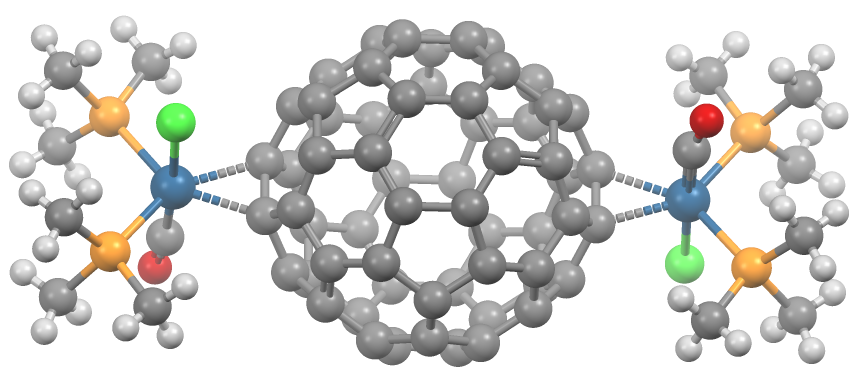
Many fullerene complexes are derived from platinum metals. An unusual cationic complex features three 16e Ru centers: :3 CpRu(MeCN)3+ + C60 → {[(CpRu(MeCN)2]3C60}3+ + 3 MeCN Vaska's complex forms a 1:1 adduct, and the analogous IrCl(CO)(PEt3)2 binds 200x more strongly. Complexes with more than one fullerene ligand are illustrated by Ir4(CO)3(μ4-CH)(PMe3)2(μ-PMe)2(CNCH2Ph)(μ-η2:η2C60)(μ4-η1:η1:η2:η2C60). In this Ir4 cluster two fullerene ligands with multiple types of mixed binding. Platinum, palladium, and nickel form complexes of the type C60ML2 where L is a monodentate or bidentate phosphorus ligand. They are prepared by displacement of weakly coordinating ligands such as ethylene: :[Ph3P]2Pt(C2H4) + C60 → [Ph3P]2Pt(η2-C60) + C2H4 In [(Et3P)2Pt]6(η2-C60), six Pt centers are bound to the fullerene.
Modified fullerenes as ligands
Osmium tetraoxide adds to C60 to give, in the presence of pyridine (py), the diolate C60O2OsO2(py)2.
The pentaphenyl anion C60Ph5− behaves as a cyclopentadienyl ligand. thumb|260 px|center|[[Ferrocene]]-like complex of C60Ph5−. In this example, the binding of the ligand is similar to ferrocene. The anion C60(PhCH2)2Ph functions as an indenyl-like ligand.
Fullerenes can also be substituents on otherwise conventional ligands as seen with an isoxazoline fullerene chelating to platinum, rhenium, and iridium compounds.
Ongoing research
Although no application has been commercialized. non-linear optical (NLO) materials, and as supramolecular building blocks.
References
Bibliography
- Spessard, Gary; Miessler, Gary (2010). Organometallic Chemistry
References
- Alan L. Balch. (1998). "Reactions of Transition Metal Complexes with Fullerenes (C60, C70, etc.) and Related Materials". Chem. Rev..
- (1990). "The infrared and ultraviolet absorption spectra of laboratory-produced carbon dust: evidence for the presence of the C60 molecule". Chemical Physics Letters.
- (1991). "The Chemical Nature of Buckminsterfullerene (C60) and the characterization of a platinum derivative". Science.
- (2010). "Electrochemical properties of transition metal complexes with C60 and C70 fullerene ligands (review)". Russian Journal of Electrochemistry.
- Spessard, p. 162
- Spessard, p. 165
- (1996). "Ru3(CO)9(μ3-η2,η2,η2-C60): A Cluster Face-Capping, Arene-Like Complex of C60". J. Am. Chem. Soc..
- (1991). "A multiply-substituted buckminsterfullerene (C60) with an octahedral array of platinum atoms". Journal of the American Chemical Society.
- (2003). "Synthesis and catalytic activity of rhodium diene complexes bearing indenyl-type fullerene η5-ligand". Journal of Organometallic Chemistry.
- (2011). "Metal Chelates Based on Isoxazoline[60]fullerenes". Organometallics.
- (2012). "An investigation on the second-order NLO properties of novel cationic cyclometallated Ir(III) complexes of the type [Ir(2-phenylpyridine)2(9-R-4,5-diazafluorene)]+ (R=H, fulleridene) and the related neutral complex with the new 9-fulleriden-4-monoazafluorene ligand". Inorganica Chimica Acta.
- (2011). "Synthesis of new porphyrin/fullerene supramolecular assemblies: A spectroscopic and electrochemical investigation of their coordination equilibrium in solution". Tetrahedron.
This article was imported from Wikipedia and is available under the Creative Commons Attribution-ShareAlike 4.0 License. Content has been adapted to SurfDoc format. Original contributors can be found on the article history page.
Ask Mako anything about Transition metal fullerene complex — get instant answers, deeper analysis, and related topics.
Research with MakoFree with your Surf account
Create a free account to save articles, ask Mako questions, and organize your research.
Sign up freeThis content may have been generated or modified by AI. CloudSurf Software LLC is not responsible for the accuracy, completeness, or reliability of AI-generated content. Always verify important information from primary sources.
Report