From Surf Wiki (app.surf) — the open knowledge base
Tourism in Belize
none

none

Tourism in Belize is a major industry in the country. The sector has grown in the 2020s, with international arrivals reportedly increasing 30% in 2024, the highest rate in the Caribbean. Former Prime Minister Dean Barrow stated his intention to use tourism to combat poverty throughout the country.
The growth in tourism has positively affected the agricultural, commercial, and finance industries, as well as the construction industry. The results for Belize's tourism-driven economy have been significant, with the nation welcoming almost one million tourists in a calendar year for the first time in its history in 2012.
History
Prior to its independence in 1981, Belize was not regarded as a tourist destination due to an inadequate infrastructure. However, rapid expansion of the tourist industry over the last decade has made it the nation's second largest industry.
Belize has large array of diverse tourist, adventure tourist, and eco-tourist attractions. The Belize Barrier Reef (second largest in the world), over 450 offshore Cayes (islands), excellent fishing, safe waters for windsurfing, swimming, cave rafting, boating, paddleboarding, scuba diving, and snorkelling, numerous rivers for rafting, and kayaking, various jungle and wildlife reserves of fauna and flora, for hiking, bird watching, and helicopter touring, as well as many Maya ruins, support the thriving tourism and ecotourism industry. Of the hundreds of cave systems, Belize also holds the largest cave system in Central America, 544 species of birds, and well-preserved natural beauty. Despite all this, it is still among the least visited countries in the region.
Statistics
In 2024 there were about 500,000 tourist arrivals.
Government promotion of tourism
Development costs are high, but the Government of Belize has designated tourism as its second development priority after agriculture. In 2012, tourist arrivals totalled 917,869 (with about 584,683 from the U.S.) and tourist receipts amounted to over $1.3 billion.
Tourism is the domain of the Ministry of Tourism, within which the Belize Tourism Board works as a link between the private and public sector.
Economic
The tourism industry is an important part of the economy of Belize, in 2007 contributing to over 25% of all jobs, and making up over 18% of the GDP. This constituted 590 million BZD (295 million USD), according to the Belize government, up 90 million BZD (45 million USD) from the year before. Important tourist attractions in Belize include the natural attractions of land and sea, making the areas important in Ecotourism, as well as the historic ruins of Belize's Pre-Columbian Maya civilization.
Tourist destinations
Popular tourist destinations include San Pedro Town and Caye Caulker, both located about 70 km and 40 km east off the coast of Belize, both situation only a few miles from the Barrier Reef at any point. They have been regarded as a "tropical paradises" by the Los Angeles Times. Cruise ships have been docking in Belize City, and average 850,000 tourists alone every year, some who partake in tours to nearby districts as well as the colonial city.


Mainland beaches
- Almond Beach, Hopkins
- Maya Beach, Placencia
- Sabal Beach, Punta Negra
- Sarteneja
- Orchid Bay, Corozal
- Monkey River Beach
- Cerros Beach (A mini Tulum)
- Cucumber Beach, Mile 4, Western Highway
- Gales Point Lagoon
- Honey Camp Lagoon
Popular cayes
Main article: Islands of Belize
- San Pedro Town, Ambergris Caye
- Caye Caulker
- Coco Plum Island
- Half Moon Caye
- Laughing Bird Caye
- Goff's Caye
- St. George's Caye
- Tobacco Caye
- Blackadore Caye
- Caye Chapel
- Sapodilla Cayes
Rural and community-based tourism
Many privately run companies have cooperatives in Southern Belize that manage a rural and community-based tourism project, which has been developed with support from the UNESCO. Tourism allows otherwise marginalized minorities such as the Maya and the Garifuna people to receive new opportunities in alternative markets, harvest crops, preserve and involve foreigners in their culture and diversify their income. Many companies offer visitors the opportunity to visit a cacao, cashew farm, learn about Maya, Kriol or Garifuna craftsmanship, and even to stay overnight on a Maya, Kriol or Garifuna village and explore with a community guide.
Ecological tourism
Eco-tourism aims to be ecologically and socially conscious, it focuses on local culture, wilderness, and adventure. Belize's eco-tourism is growing with every passing year, it boasts a number of eco-tourist tours and energy efficient hotels, with environmentally-conscious and renewable resources. Popular eco-tourism destinations in Belize include the Cockscomb Basin Wildlife Sanctuary, Mountain Pine Ridge Forest Reserve, Swallow Caye Wildlife Sanctuary, and the Community Baboon Sanctuary.
Waterfalls
- Antelope Falls in Mayflower Bocawina National Park
- Mayflower Bocawina Falls in Mayflower Bocawina National Park
- Big Rock Falls in the Mountain Pine Ridge Forest Reserve of the Cayo District
- Butterfly Falls in the Mountain Pine Ridge Forest Reserve of the Cayo District
- Five Sisters Falls in the Mountain Pine Ridge Forest Reserve of the Cayo District
- Rio Blanco Falls
- Rio On Pools
- San Antonio Falls
- Thousand Foot Falls 150 ft in the Mountain Pine Ridge Forest Reserve of the Cayo District
Archaeological reserves
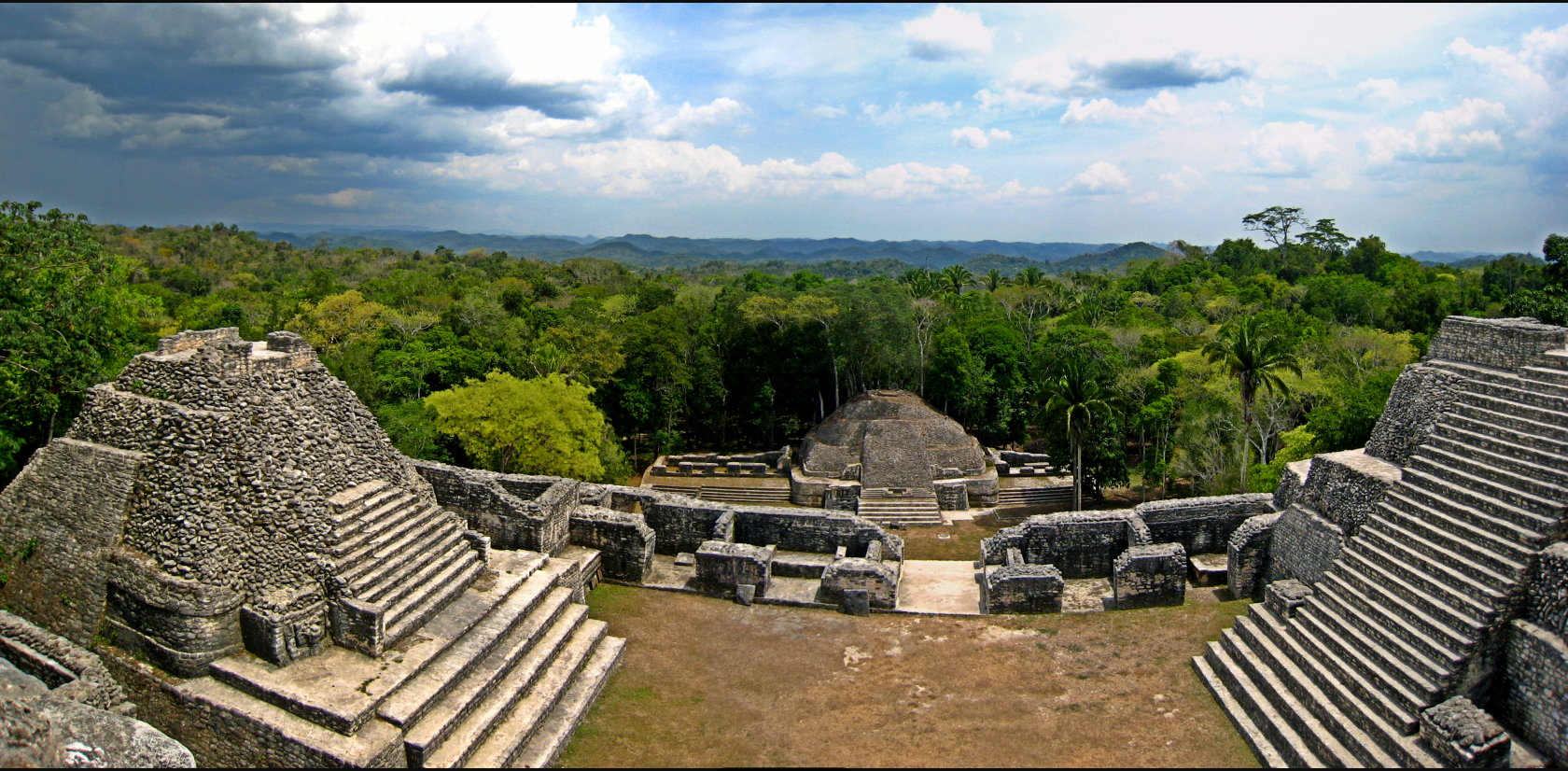
Before the arrival of Europeans in America, Belize lay in the heartland of the Maya civilisation, and consequently contains some of the earliest and most important Maya ruins. Archaeological findings at Caracol, in the southern end of the country, have suggested that it formed the centre of political struggles in the southern Maya lowlands. The complex covered an area much larger than present-day Belize City and supported more than twice the modern city's population. Meanwhile, Lamanai, in the north, is known for being the longest continually-occupied site in Mesoamerica, settled during the early Preclassic era and continuously occupied up to and during the area's colonisation.
While the majority of reserves under this category are related to the pre-colonial era, Serpon Sugar Mill and Yarborough Cemetery, both designated in 2009, only date from the 19th century and are alternatively described as historical reserves.
The country's 15 archaeological sites are managed by the Institute of Archaeology, a branch of the National Institute of Culture and History (NICH), which comes under the authority of the Ministry of Tourism, Civil Aviation and Culture. This type of protected area was gazetted under the Ancient Monuments and Antiquities Act, 1 May 1972. All of the following reserves are open to the public. Many other sites, such as Cuello and Uxbenka, are located on private land and can only be visited if prior permission is obtained from the landowner.
List of Maya ruins in Belize
The following is a list of other archaeological sites located within Belize:
-
Actun Tunichil Muknal
-
Altun Ha
-
Baking Pot
-
Barton Creek Cave
-
Cahal Pech
-
Caracol
-
Cerros
-
Chaa Creek
-
Colha
-
Cuello
-
El Pilar
-
Ka'Kabish
-
K'axob
-
La Milpa
-
Lamanai
-
Louisville
-
Lubaantun
-
Marco Gonzalez
-
Nim Li Punit
-
Nohmul
-
Nohoch Che'en
-
Pusilha
-
San Estevan
-
Santa Rita, Corozal
-
Serpon sugar mill
-
Tipu
-
Uxbenka
-
Xnaheb
-
Xunantunich
Main natural attractions
Roughly 26% (2.6 million acres, or 1.22 million hectares) of Belizean land and sea is preserved within a total of 95 reserves, which vary in their purpose and level of protection. This network of protected areas exists under a variety of management structures:
National parks
In Belize, national parks are areas designed for the protection and preservation of natural and aesthetic features of national significance for the benefit and enjoyment of the people. Therefore, they are areas of recreation and tourism, as well as environmental protection. National parks are gazetted under the National Parks System Act of 1981. They are administered by the Forest Department and managed through partnership agreements with community-based non-governmental organisations.
| Reserve | District | Size | |||||
|---|---|---|---|---|---|---|---|
| (ha) | Size | ||||||
| (acres) | IUCN | Co-management | Est. | Description | |||
| Aguas Turbias | Orange Walk | 3,541 ha | II | — | 1994 | ||
| Bacalar Chico | Belize | 4,510 ha | V | Green Reef Environmental Institute | 1996 | Excludes adjacent marine reserve. | |
| Billy Barquedier | Stann Creek | 663 ha | II | Steadfast Tourism and Conservation Association | 2001 | ||
| Chiquibul | Cayo | 106,839 ha | II | Friends for Conservation and Development | 1995 | Excludes adjacent forest reserve. | |
| Five Blues Lake | Cayo | 1,643 ha | II | Friends of Five Blues Lake National Park | 1994 | ||
| Gra Gra Lagoon | Stann Creek | 534 ha | II | Friends of Gra Gra Lagoon | 2002 | ||
| Guanacaste | Cayo | 23 ha | II | Belize Audubon Society | 1994 | ||
| Honey Camp | Corozal / Orange Walk | 3,145 ha | II | Association of Friends of Freshwater Creek | 2001 | ||
| Laughing Bird Caye | Stann Creek | 4,095 ha | II | Southern Environmental Association | 1996 | ||
| Mayflower Bocawina | Stann Creek | 2,868 ha | II | Friends of Mayflower Bocawina National Park | 2001 | ||
| Monkey Bay | Belize | 859 ha | II | Guardians of the Jewel {{#tag:ref | name="prosp"}} | 1994 | |
| Nojkaaxmeen Elijio Panti | Cayo | 5,130 ha | II | Belize Development Foundation | 2001 | ||
| Payne's Creek | Toledo | 14,739 ha | II | Toledo Institute for Development and Environment | 1994 | ||
| Peccary Hills | Belize | 4,260 ha | II | Gracie Rock Reserve for Adventure, Culture and Ecotourism | 2007 | ||
| Río Blanco | Toledo | 38 ha | II | Río Blanco Mayan Association | 1994 | ||
| Sarstoon-Temash | Toledo | 16,938 ha | II | Sarstoon Temash Institute for Indigenous Management | 1994 | Ramsar site. | |
| St. Herman's Blue Hole | Stann Creek | 269 ha | II | Belize Audubon Society | 1986 |
Natural monuments
A natural monument is designated for the preservation of unique geographic features of the landscape. The designation is primarily based on a feature's high scenic value, but may also be regarded as a cultural landmark that represents or contributes to a national identity.
Natural monuments are gazetted under the National Parks System Act of 1981; marine-based monuments additionally come under the Fisheries Act. Of the five natural monuments in the country, three are terrestrial, administered by the Forest Department, while the remaining two are marine-based and come under the authority of the Fisheries Department.
| Image | Reserve | District | Size | ||||||
|---|---|---|---|---|---|---|---|---|---|
| (ha) | Size | ||||||||
| (acres) | IUCN | Co-management | Est. | Description | |||||
| [[File:Actun tunichil muknal-pottery.jpg | 100x100px]] | Actun Tunichil Muknal | Cayo | 185 ha | Ia | Belize Audubon Society; Institute of Archaeology | 2004 | Terrestrial. | |
| [[File:Blue Hole coral.jpg | 100x100px]] | Blue Hole | Belize | 414 ha | III | Belize Audubon Society | 1996 | Marine. | |
| [[File:BZECAYE.jpg | 100x100px]] | Half Moon Caye | Belize | 3,954 ha | II | Belize Audubon Society | 1982 | Marine. | |
| [[File:1,000 foot water fall at Mountain Pine Ridge in Belize.jpg | 100x150px]] | Thousand Foot Falls | Cayo | 522 ha | III | — | 2004 | Terrestrial. | |
| [[File:Victoria-peak-2.jpg | 100x100px]] | Victoria Peak | Stann Creek | 1,959 ha | III | Belize Audubon Society | 1998 | Terrestrial. |
Nature reserves

The country's three nature reserves enjoy the highest level of protection within the national protected areas system. The designation was created for the strict protection of biological communities or ecosystems, and the maintenance of natural processes in an undisturbed state. They are typically pristine, wilderness ecosystems.
Nature reserves are legislated under the National Parks System Act of 1981. It is the strictest designation of all categories within the country's national protected areas system, with no extractive use or tourism access permitted. Permits are required to enter the area and are restricted to researchers only. The nature reserves are under the authority of the Forest Department.
The oldest of these, Bladen Nature Reserve, forms the centrepiece of the Maya Mountains biological corridor, and is considered one of the most biodiversity-rich, and topographically unique areas within the Mesoamerican biodiversity hotspot.
| Reserve | District | Size | |||||
|---|---|---|---|---|---|---|---|
| (ha) | Size | ||||||
| (acres) | IUCN | Co-management | Est. | Description | |||
| Bladen | Toledo | 40,411 ha | Ia | Ya’axché Conservation Trust; Bladen Management Consortium | 1990 | ||
| Burdon Canal | Belize | 2,126 ha | Ia | — | 1992 | ||
| Tapir Mountain | Cayo | 2,550 ha | Ia | Belize Audubon Society | 1994 | Formerly known as Society Hall Nature Reserve. |
Wildlife sanctuaries
Wildlife sanctuaries are created for the preservation of an important keystone species in the ecosystem. By preserving enough area for them to live in, many other species receive the protection they need as well.
Wildlife sanctuaries are gazetted under the National Parks System Act of 1981, and are the responsibility of the Forest Department. There are currently seven wildlife sanctuaries, three of which are being managed under co-management partnerships, whilst the other four are managed under informal arrangements. Two of the following wildlife sanctuaries are considered to be marine protected areas, and may also have collaborative agreements with the Fisheries Department in place.
| Reserve | District | Size | |||||
|---|---|---|---|---|---|---|---|
| (ha) | Size | ||||||
| (acres) | IUCN | Co-management | Est. | Description | |||
| Aguacaliente | Toledo | 2,213 ha | IV | Aguacaliente Management Team {{#tag:ref | name="prosp"}} | 1998 | Terrestrial. |
| Cockscomb Basin | Stann Creek / Toledo | 49,477 ha | IV | Belize Audubon Society | 1997 | Terrestrial. | |
| Corozal Bay | Belize / Corozal | 73,049 ha | IV | Sarteneja Alliance for Conservation and Development {{#tag:ref | name="prosp"}} | 1998 | Marine. |
| Crooked Tree | Belize / Orange Walk | 15,372 ha | IV | Belize Audubon Society | 1984 | Ramsar site. Boundaries ill defined. Terrestrial. | |
| Gales Point | Belize | 3,681 ha | IV | Gales Point Wildlife Sanctuary Community Management Committee {{#tag:ref | name="prosp"}} | 1998 | Terrestrial. |
| Spanish Creek | Belize / Orange Walk | 2,428 ha | IV | Rancho Dolores Development Group {{#tag:ref | name="prosp"}} | 2002 | Terrestrial. |
| Swallow Caye | Belize | 3,631 ha | IV | Friends of Swallow Caye | 2002 | Marine. |
Forest reserves
Forest reserves, overseen by the Forest Department, are designed for the sustainable extraction of timber without destroying the biodiversity of the location. These are gazetted under the Forests Act of 1927, which allows the department to grant permits to logging companies after extensive review. There are currently 16 forest reserves with a combined acreage of 380,328 ha, making up 9.3% of total national territory.
| Reserve | District | Size | ||||
|---|---|---|---|---|---|---|
| (ha) | Size | |||||
| (acres) | IUCN | Est. | Description | |||
| Caye Caulker | Belize | 38 ha | VI | 1998 | Excludes adjacent marine reserve. | |
| Chiquibul | Cayo | 59,822 ha | VI | 1995 | Excludes adjacent national park. | |
| Columbia River | Cayo / Toledo | 60,016 ha | VI | 1997 | ||
| Deep River | Toledo | 27,232 ha | VI | |||
| Fresh Water Creek | Corozal / Orange Walk | 13,513 ha | VI | 1926 | ||
| Grants Work | Stann Creek | 3,199 ha | VI | 1989 | ||
| Machaca | Toledo | 1,253 ha | VI | 1998 | ||
| Manatee | Belize / Stann Creek | 36,621 ha | VI | 1959 | ||
| Mango Creek | Stann Creek / Toledo | 12,090 ha | VI | 1989 | Comprises two separate segments. | |
| Monkey Caye | Toledo | 669 ha | VI | 1996 | ||
| Mountain Pine Ridge | Cayo | 43,372 ha | VI | 1944 | ||
| Maya Mountain | Stann Creek | 16,887 ha | VI | 1997 | ||
| Sibun | Cayo | 32,849 ha | VI | 1959 | ||
| Sittee River | Stann Creek | 37,360 ha | VI | |||
| Swasey Bladen | Toledo | 5,980 ha | VI | 1989 | ||
| Vaca | Cayo | 14,118 ha | VI | 1991 |
Marine reserves

Marine reserves are designed for the conservation of aquatic ecosystems, including marine wildlife and its environment. The majority of these reserves contribute to the conservation of Belize's Barrier Reef, which provides a protective shelter for pristine atolls, seagrass meadows and rich marine life. The preservation of the Barrier Reef system has been recognised as a global interest through the collective designation of seven protected areas, including four of the following marine reserves, as a World Heritage Site.
Marine reserves are legislated under the Fisheries Act, and are administered by the Fisheries Department. One of the department's key responsibilities is to ensure the sustainable extraction of marine resources. There are currently eight marine reserves, management of which is either direct, by the department, or in partnership with non-governmental agencies.
| Reserve | District | Size | |||||
|---|---|---|---|---|---|---|---|
| (ha) | Size | ||||||
| (acres) | IUCN | Co-management | Est. | Description | |||
| Bacalar Chico | Belize | 6,391 ha | IV | Green Reef Environmental Institute {{#tag:ref | name="prosp"}} | 1996 | Excludes adjacent national park. Divided into two zones: a conservation zone, and a general use zone. |
| Caye Caulker | Belize | 3,913 ha | VI | Forest & Marine Reserves Association of Caye Caulker | 1998 | Excludes adjacent forest reserve. | |
| Gladden Spit and Silk Cayes | Stann Creek | 10,514 ha | IV | Southern Environmental Association | 2000 | Divided into two zones: a general use zone, and a conservation zone. | |
| Glover's Reef | Belize | 86,653 ha | IV | — | 1993 | In 2001, the reserve was divided into four zones: a general use zone, a conservation zone, a seasonal closure zone, and a wilderness zone. A spawning aggregation zone was broken off in 2003 and comes under separate management (see below). | |
| Hol Chan | Belize | 1,444 ha | II | Hol Chan Trust Fund | 1987 | Divided into four zones: Mangrove, Seagrass, Shark Ray Alley, and Coral Reef. | |
| Port Honduras | Toledo | 40,470 ha | IV | Toledo Institute for Development and Environment | 2000 | Divided into two zones: a general use zone, and a conservation zone. | |
| Sapodilla Cayes | Toledo | 15,618 ha | IV | Southern Environmental Association | 1996 | ||
| South Water Caye | Stann Creek | 47,702 ha | IV | — | 1996 |
Gallery
File:Lamanai High Temple.jpg|High Temple at Lamanai File:San Pedro, Ambergris Caye, Belize - Beach.JPG|Beachront of Ramon's Village, San Pedro Town, Ambergris Caye File:USMC-110914-M-AF823-032.jpg|High Temple at Altun Ha File:The broken breakwall creates the perfect swimming hole at the Caulker Caye Split.jpg|The "Split" at Caye Caulker, Caused by Hurricane Hattie in 1961 File:Rio Frio Cave 2.jpg|Rio Frio Cave File:USMC-110914-M-AF823-091.jpg|Zip-lining in the jungles of Belize File:Barton Creek Cave, Belize.jpg|Barton Creek Cave File:Sarteneja, Belize, Central America.jpg|Sarteneja File:St. John's Anglican Church, Belize City 2.jpg|St. John's Cathedral File:Hunting Caye, Belize.jpg|Sapodilla Cayes File:San Antonio Falls, Toledo, Belize.jpg|San Antonio Falls File:Che Chem Ha Cave.jpg|Che Chem Ha Cave
Attractions by district
Belize District
- Altun Ha
- Great Blue Hole
- La Isla Bonita Ambergris Caye
- Belize Barrier Reef
- Hol Chan Marine Reserve
- Museum of Belize
- Fort Street Tourism Village
- The Bliss Institute for the Performing Arts
- Old Belize Museum and Cucumber Beach
- The Belize Zoo (Called, "The Best little zoo in the world")
- Caye Caulker
- Belikin beer brewery
- San Pedro Town
- Swing Bridge
- Bakabush Adventure Tours
- Crocland Eco-park
- Numerous Cayes (islands)
- Gales Point
- Bacab Eco Park
Stann Creek District
- Cockscomb Basin Wildlife Sanctuary and Jaguar Reserve
- Placencia
- Hopkins
- Victoria Peak
- Tobacco Caye
- Dangriga
- Numerous Cayes Orange Walk District
- Lamanai
- San Estevan (Maya site)
- Rio Bravo Conservation and Management Area
Cayo District
- Actun Tunichil Muknal
- Caracol
- Xunantunich
- Cahal Pech
- El Pilar
- Blue Hole (park)
- Guanacaste National Park
- Chiquibul National Park
- Mountain Pine Ridge Forest Reserve
- Barton Creek Cave and Actun Tunichil Muknal (cave)
- 1000 ft Falls
- Chaa Creek
- Big Rock Falls
- Belize Botanic Gardens
- Victoria Peak, Belize's 2nd highest point at 1,120 m (3,675 ft)
- Doyle's Delight, Belize's highest point at 1,124 m (3,688 ft)
- Maya Mountains
Toledo District
- Lubaantun
- Nim Li Punit
- Payne's Creek National Park
- Port Honduras Marine Reserve
- San Antonio, Santa Cruz and Rio Blanco Falls
- Maya Mountains
- Blue Creek
- Sapodilla Cayes
- Southwater Caye
Corozal District
- Bacalar Chico National Park
- Cerros
- The Corozal Free Zone
- Louisville, Belize
- Sarteneja
Notes
References
References
- "THE TOP 77". New7Wonders.
- "Thousand Foot Falls". GotoCayoBelize.com.
- Britell, Alexander. (2024-05-23). "Belize Is the Fastest-Growing Destination in the Caribbean Right Now".
- Cuellar, Marleni. (2013-03-01). "Foreign direct investments and tourism up". Channel 5 Belize.
- [http://www.sanpedrosun.com/travel-and-tourism/2013/02/08/2012-a-remarkable-year-for-belizes-tourism-industry/ 2012: A Remarkable Year for Belize’s Tourism Industry]. San Pedro Sun Newspaper. Retrieved on 6 March 2013.
- "Nicaragua Travel Guide". Travelotica.
- "UN Tourism Data Dashboard {{!}} Key Indicators".
- "UN Tourism Data Dashboard".
- "Mission Statement". Belize Tourism Board.
- Barrow, Dean. (2008-05-15). "Key Note Address by Prime Minister, Hon. Dean Barrow to the 10th Annual Industry Presentation". belizemediacenter.org.
- Wedner, Diane. (2007-04-06). "Nicaragua's Corn Islands, an unspoiled Paradise". Los Angeles Times.
- "Belize update: More tourists & greater". Escape Artist.
- Butler, Felicity. "Rural and community-based tourism harvests greater yields".
- Jennings, Trent. "Luxury Ecotourism in Belize". USA Today.
- "Ecotourism in Belize - Overview". Earth.com.
- "Cockscomb Basin Wildlife Sanctuary - Roam Belize - Project Expedition".
- "Mountain Pine Ridge - Hun Chi'ik Tours - Project Expedition".
- "Swallow Caye Wildlife Sanctuary Sights & Attractions - Project Expedition".
- "Community Baboon Sanctuary {{!}} Sights & Attractions - Project Expedition".
- Caracol Archaeological Project. (2011). "Site Overview". University of Central Florida, College of Sciences.
- Association for Belizean Archaeology. (2008). "Maya Archaeological Sites in Belize". Cubola Productions, Casado Internet Group.
- {{harvnb. Institute of Archaeology. 2011
- Meerman J.C.. (August 2005). "Protected Area Categories". National Protected Area System Analysis.
- National Institute of Culture and History. "About NICH". Government of Belize, Ministry of Tourism, Civil Aviation and Culture.
- {{harvnb. The Laws of Belize. 2000
- Ramos, Adele. (2 July 2010). "Belize protected areas 26% - not 40-odd percent". Amandala News Online.
- Meerman, Jan. (2005). "National Protected Areas Analysis". Government of Belize, Ministry of Natural Resources and the Environment.
- Biodiversity & Environmental Resource Data System. (11 November 2009). "Protected Areas". Belize Tropical Forest Studies.
- {{harvnb. The Laws of Belize. 2000
- Green Reef Environmental Institute. "The World Heritage Site". Greenreef Belize.
- Friends for Conservation and Development. (2011). "Index". FCD Belize.
- Naturalight Productions Ltd.. (2011). "Laughing Bird Caye National Park". Southern Environmental Association.
- Salam, T.. "Friends of Mayflower-Bocawina National Park". Association of Protected Areas Management Organisations.
- Guardians of the Jewel. (2011). "Projects".
- Garcia, M.. (2002). "Noj Kaax Meen Elijio Panti National Park". Itzamna Society.
- Belize Development Foundation. (2011). "Noj K'a'ax Meen Elijio Panti National Park". Elijio Panti National Park Official Website.
- Toledo Institute for Development and Environment. "Payne's Creek National Park".
- Gracie Rock Reserve for Adventure, Culture and Ecotourism. "GRACE Initiative". Rainforest Carbon Remove Society.
- Gomez, L.. "About SATIIM". Sarstoon Temash Institute for Indigenous Management.
- Ya’axché Conservation Trust. "Bladen Nature Reserve". Ya’axché Conservation Trust.
- Pop, F.. "Aguacaliente Management Team". Association of Protected Areas Management Organisations.
- Verde, J.. (2011). "Corozal Bay Wildlife Sanctuary". Sarteneja Alliance for Conservation and Development.
- Gales Point Wildlife Sanctuary Community Management Committee. (2009). "The Sanctuary". Gales Point.
- Friends of Swallow Caye. (2006). "Friends of Swallow Caye News". Belize Manatees.
- {{harvnb. The Laws of Belize. 2000
- "Mountain Pine Ridge Forest Reserve". Casado Internet Group.
- "Gladen Split/Silk Cayes". Southern Environmental Association.
- South Water Caye Marine Reserve. "Welcome". Government of Belize, Fisheries Department.
This article was imported from Wikipedia and is available under the Creative Commons Attribution-ShareAlike 4.0 License. Content has been adapted to SurfDoc format. Original contributors can be found on the article history page.
Ask Mako anything about Tourism in Belize — get instant answers, deeper analysis, and related topics.
Research with MakoFree with your Surf account
Create a free account to save articles, ask Mako questions, and organize your research.
Sign up freeThis content may have been generated or modified by AI. CloudSurf Software LLC is not responsible for the accuracy, completeness, or reliability of AI-generated content. Always verify important information from primary sources.
Report