From Surf Wiki (app.surf) — the open knowledge base
Total fertility rate
Average lifetime number of children per woman
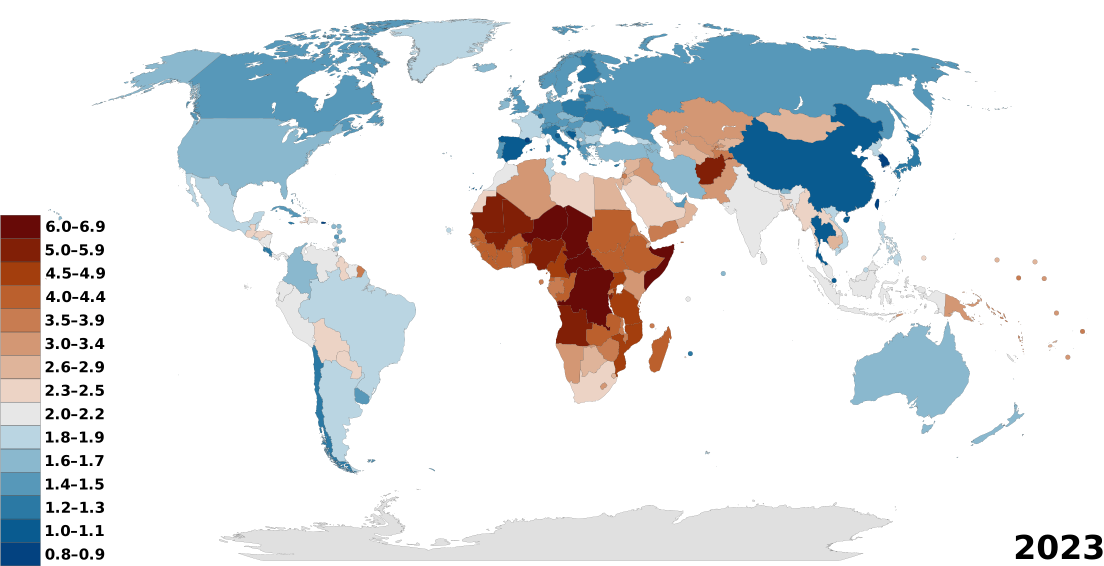
Average lifetime number of children per woman

The total fertility rate (TFR) of a population is the average number of children that are born to a woman over her lifetime, if they were to experience the exact current age-specific fertility rates (ASFRs) through their lifetime, and they were to live from birth until the end of their reproductive life.
As of 2023, the total fertility rate varied widely across the world, from 0.7 in South Korea, to 6.1 in Niger. Among sovereign countries that were not city states or microstates, in 2025 the following countries had a TFR of 1.0 or lower: China, South Korea, Taiwan, Thailand, and Ukraine; the following countries had a TFR of 1.2 or lower: Argentina, Belarus, Chile, Colombia, Costa Rica, Estonia, Italy, Japan, Lithuania, Poland, Spain, and Uruguay.
Fertility tends to be inversely correlated with levels of economic development. Historically, developed countries have significantly lower fertility rates, generally correlated with greater wealth, education, urbanization, and other factors. Conversely, in least developed countries, fertility rates tend to be higher. Families desire children for their labor and as caregivers for their parents in old age. Fertility rates are also higher due to the lack of access to contraceptives, generally lower levels of female education, and lower rates of female employment.
From antiquity to the beginning of the industrial revolution, around the year 1800, total fertility rates of 4.5 to 7.5 were common around the world. After this TFR declined only slightly and up until the 1960s the global average TFR was still 5. Since then, global average TFR has dropped steadily to less than half that number, 2.3 births per woman in 2023.
The United Nations predicts that global fertility will continue to decline for the remainder of this century and reach a below-replacement level of 1.8 by 2100, and that world population will peak in 2084.
How TFR is actually computed
The TFR for (say) year 2024 is usually computed by this formula:
TFR_{2024} = 5 \times \left( \frac{\text{Number of births in 2024 by women aged 15 to 19}}{\text{Number of women in 2024 aged 15 to 19}} + \dots + \frac{\text{Number of births by women in 2024 aged 45 to 49}}{\text{Number of women in 2024 aged 45 to 49}}\right) .
Ideally and more correctly, it should instead be computed by this formula:
TFR_{2024} = \frac{\text{Number of births in 2024 by women aged 15}}{\text{Number of women in 2024 aged 15}} + \dots + \frac{\text{Number of births by women in 2024 aged 49}}{\text{Number of women in 2024 aged 49}} .
But this second formula requires fertility rates for each single-year age group (which may not be available or may be poorly estimated). And so, government and international agencies usually prefer the first formula (which requires only fertility rates for each five-year age group).
Related metrics
Net reproduction rate

An alternative measure of fertility is the net reproduction rate (NRR), which calculates the number of daughters a female would have in her lifetime if she were subject to prevailing age-specific fertility and mortality rates in a given year. When the NRR is exactly 1, each generation of females is precisely replacing itself.
The NRR is not as commonly used as the TFR, but it is particularly relevant in cases where the number of male babies born is very high due to gender imbalance and sex selection. This is a significant consideration in world population dynamics, especially given the high level of gender imbalance in the heavily populated nations of China and India. The gross reproduction rate (GRR) is the same as the NRR, except that, like the TFR, it disregards life expectancy.
Total period fertility rate
The TFR, sometimes called TPFR—total period fertility rate, is a better index of fertility than the crude birth rate (annual number of births per thousand population) because it is independent of the age structure of the population, but it is a poorer estimate of actual completed family size than the total cohort fertility rate, which is obtained by summing the age-specific fertility rates that actually applied to each cohort as they aged through time.
In particular, the TFR does not necessarily predict how many children young women now will eventually have, as their fertility rates in years to come may change from those of older women now. However, the TFR is a reasonable summary of current fertility levels. TFR and long term population growth rate, g, are closely related. For a population structure in a steady state, growth rate equals \log(\mathrm{TFR}/2)/X_m, where X_m is the mean age for childbearing women.
Tempo effect
The TPFR (total period fertility rate) is affected by a tempo effect—if age of childbearing increases, and life cycle fertility is unchanged, then while the age of childbearing is increasing, TPFR will be lower, because the births are occurring later, and then the age of childbearing stops increasing, the TPFR will increase, due to the deferred births occurring in the later period, even though the life cycle fertility has been unchanged. In other words, the TPFR is a misleading measure of life cycle fertility when childbearing age is changing, due to this statistical artifact. This is a significant factor in some countries, such as the Czech Republic and Spain in the 1990s. Some measures seek to adjust for this timing effect to gain a better measure of life-cycle fertility.
Replacement rates {{anchor|Replacement rate}}
Replacement fertility is the total fertility rate at which women give birth to enough babies to sustain population levels, assuming that mortality rates remain constant and net migration is zero. If replacement level fertility is sustained over a sufficiently long period, each generation will exactly replace itself. In 2003, the replacement fertility rate was 2.1 births per female for most developed countries (2.1 in the UK, for example), but could be as high as 3.5 in undeveloped countries because of higher mortality rates, especially child mortality. The global average for the replacement total fertility rate, eventually leading to a stable global population, for 2010–2015, was 2.3 children per female.
Lowest-low fertility
| Country or region | TFR | Number of births |
|---|---|---|
| South Korea | 0.75 | 238,343 |
| Taiwan | 0.89 | 134,856 |
| Ukraine | 0.90 | 176,679 |
| Thailand | 0.98 | 462,240 |
| Chile | 1.03 | 154,441 |
| Colombia | 1.06 | 445,011 |
| Belarus | 1.08 | 59,938 |
| Poland | 1.10 | 251,782 |
| Lithuania | 1.11 | 19,086 |
| Costa Rica | 1.12 | 45,825 |
| Spain | 1.12 | 318,741 |
| China | 1.15 | 9,540,000 |
| Japan | 1.15 | 686,061 |
| Argentina | 1.16 | 420,000 |
| Estonia | 1.18 | 9,690 |
| Italy | 1.18 | 369,922 |
| Uruguay | 1.19 | 29,899 |
| Latvia | 1.24 | 12,571 |
| Greece | 1.24 | 69,675 |
| Luxembourg | 1.25 | 6,459 |
| Finland | 1.25 | 43,270 |
| Canada | 1.26 | 365,567 |
| Switzerland | 1.29 | 78,256 |
| Cuba | 1.30 | 71,374 |
The term lowest-low fertility is defined as a TFR at or below 1.3. Lowest-low fertility is found almost mostly within East Asian countries and European countries. The East Asian American community in the United States also exhibits lowest-low fertility. At one point in the late 20th century and early 21st century this was also observed in Eastern and Southern Europe. However, the fertility rate then began to rise in most countries of Europe. Since the 2020s, however, TFR are falling again: in 2023, Spain's TFR fell to 1.19, and Italy's TFR fell to 1.2 children per woman. In Canada, the TFR in 2023 fell to its lowest ever recorded level, at 1.26 children per woman, with Statistics Canada reporting that Canada "has now joined the group of 'lowest-low' fertility countries".
The lowest TFR recorded anywhere in the world in recorded history, is for the Xiangyang district of Jiamusi city (Heilongjiang, China) which had a TFR of 0.41 in 2000. In 2023, South Korea's TFR was 0.72 the world's lowest for that year.
Outside Asia, the lowest TFR ever recorded was 0.80 for Eastern Germany in 1994. The low Eastern German value was influenced by a change to higher maternal age at birth, with the consequence that neither older cohorts (e.g. women born until the late 1960s), who often already had children, nor younger cohorts, who were postponing childbirth, had many children during that time. The total cohort fertility rate of each age cohort of women in East Germany did not drop as significantly.
Population-lag effect

A population that maintained a TFR of 3.8 over an extended period, without a correspondingly high death or emigration rate, would increase rapidly, doubling period ≈32 years. A population that maintained a TFR of 2.0 over a long time would decrease, unless it had a large enough immigration.
It may take several generations for a change in the total fertility rate to be reflected in birth rate, because the age distribution must reach equilibrium. For example, a population that has recently dropped below replacement-level fertility will continue to grow, because the recent high fertility produced large numbers of young couples, who would now be in their childbearing years.
This phenomenon carries forward for several generations and is called population momentum, population inertia, or population-lag effect. This time-lag effect is of great importance to the growth rates of human populations.
TFR (net) and long-term population growth rate, g, are closely related. For a population structure in a steady state and with zero migration, g=\tfrac{\log(\text{TFR}/2)}{\text{X}_{m}}, where \text{X}_m is mean age for childbearing women and thus P(t) = P(0)^{(gt)}. At the left side is shown the empirical relation between the two variables in a cross-section of countries with the most recent y-y growth rate.
The parameter \tfrac{1}{b} should be an estimate of the \text{X}_m; here equal to \tfrac{1}{0.02}=50 years, way off the mark because of population momentum. E.g. for {\log}(\tfrac{\text{TFR}}{2}) = 0, g should be exactly zero, which is seen not to be the case.
Influencing factors
Main article: Fertility factor (demography)
Since the mid-20th-century baby boom that followed the end of World War II, declining fertility rates have been observed in many modern industrialized, affluent societies. Negative fertility factors (determinants of the number of children that an individual is likely to have) are often cited as a response to overpopulation. Countries and geographic regions that are currently experiencing the highest rates of declining populations include Western Europe, Japan, the Russian Federation, and South Korea. Populations in other industrialized countries, such as the United Kingdom and the United States, and developing, poorer regions of the world, including the Balkans, Central Asia, the Middle East, and Sub-Saharan Africa, are also being impacted.

]]
Many of these fertility factors may differ by levels of social and economic inequality, wealth disparities, religiosity, and social class in each country. For instance, Nordic countries and France are among the least religious in Europe but have the highest TFR, while the opposite is true about Cyprus, Greece, Poland, Portugal, and Spain. The impact of human development on TFR can best be summarized by a quote from Karan Singh at the 1974 United Nations world population conference in Bucharest, where he declared that "development is the best contraceptive."
National efforts to increase or decrease fertility
Governments have often set population targets, to either increase or decrease the total fertility rate, or to have certain ethnic or socioeconomic groups have a lower or higher fertility rate. Often such policies have been interventionist, and abusive. The most notorious natalist policies of the 20th century include those in communist Romania and communist Albania, under Nicolae Ceaușescu and Enver Hoxha respectively.
The natalist policy in Romania between 1967 and 1989 was very aggressive, including outlawing abortion and contraception, routine pregnancy tests for women, taxes on childlessness, and legal discrimination against childless people. It resulted in large numbers of children put into Romanian orphanages by parents who could not cope with raising them, street children in the 1990s, when many orphanages were closed and the children ended up on the streets, overcrowding in homes and schools, and over 9,000 women who died due to illegal abortions.
Conversely, in China the government sought to lower the fertility rate, and, as such, enacted the one-child policy (1978–2015), which included abuses such as forced abortions. In India, during the national emergency of 1975, a massive compulsory sterilization drive was carried out in India, but it is considered to be a failure and is criticized for being an abuse of power.
Some governments have sought to regulate which groups of society could reproduce through eugenic policies, including forced sterilizations of population groups they considered undesirable. Such policies were carried out against ethnic minorities in Europe and North America in the first half of the 20th century, and more recently in Latin America against the Indigenous population in the 1990s; in Peru, former President Alberto Fujimori has been accused of genocide and crimes against humanity as a result of a sterilization program put in place by his administration targeting indigenous people (mainly the Quechua and Aymara people).
Within these historical contexts, the notion of reproductive rights has developed. Such rights are based on the concept that each person freely decides if, when, and how many children to have - not the state or religion. According to the Office of the United Nations High Commissioner for Human Rights, reproductive rights "rest on the recognition of the basic rights of all couples and individuals to decide freely and responsibly the number, spacing and timing of their children and to have the information and means to do so, and the right to attain the highest standard of sexual and reproductive health. It also includes the right to make decisions concerning reproduction free of discrimination, coercion and violence, as expressed in human rights documents".
History and future projections
From around 10,000 BC to the beginning of the Industrial Revolution, fertility rates around the world were high by 21st-century standards, ranging from 4.5 to 7.5 children per woman.76-77,. The onset of the Industrial Revolution around the year 1800 brought about what has come to be called the demographic transition. This eventually led to a long-term decline in TFR in every region of the world that has continued in the 21st century.
Before 1800
During this period fertility rates of 4.5 to 7.5 were common around the world. 76-77 Child mortality could reach 50% and that plus the need to produce workers, male heirs, and old-age caregivers required a high fertility rate by 21st-century standards. To produce two adult children in this high mortality environment required at least four or more births. For example, fertility rates in Western Europe before 1800 ranged from 4.5 in Scandinavia to 6.2 in Belgium. In 1800, the TFR in the United States was 7.0. Fertility rates in East Asia during this period were similar to those in Europe. Fertility rates in Roman Egypt were 7.4., p77
Despite these high fertility rates, the number of surviving children per woman was always around two because of high mortality rates. As a result, global population growth was still very slow, about 0.04% per year.
1800 to 1950
After 1800, the Industrial Revolution began in some places, particularly Great Britain, continental Europe, and the United States, and they underwent the beginnings of what is now called the demographic transition. Stage two of this process fueled a steady reduction in mortality rates due to improvements in public sanitation, personal hygiene and the food supply, which reduced the number of famines.
These reductions in mortality rates, particularly reductions in child mortality, that increased the fraction of children surviving, plus other major societal changes such as urbanization, and the increased social status of women, led to stage three of the demographic transition. There was a reduction in fertility rates, because there was simply no longer a need to birth so many children.
The example from the US of the correlation between child mortality and the fertility rate is illustrative. In 1800, child mortality in the US was 33%, meaning that one third of all children born would die before their fifth birthday. The TFR in 1800 was 7.0, meaning that the average female would bear seven children during their lifetime. In 1900, child mortality in the US had declined to 23%, a reduction of almost one third, and the TFR had declined to 3.9, a reduction of 44%. By 1950, child mortality had declined dramatically to 4%, a reduction of 84%, and the TFR declined to 3.2. By 2018, child mortality had declined further to 0.6% and the TFR declined to 1.9, below replacement level.
| 2020–2025 | 2.35 | 1.51 | 2.47 |
|---|
The chart shows that the decline in the TFR since the 1960s has occurred in every region of the world. The global TFR is projected to continue declining for the remainder of the century, and reach a below-replacement level of 1.8 by 2100.
In 2022, the global TFR was 2.3. Because the global fertility replacement rate for 2010–2015 was estimated to be 2.3, humanity has achieved or is approaching a significant milestone where the global fertility rate is equal to the global replacement rate.
The global fertility rate may have fallen below the global replacement level of 2.2 children per woman as early as 2023. Numerous developing countries have experienced an accelerated fertility decline in the 2010s and early 2020s. The average fertility rate in countries such as Thailand or Chile approached the mark of one child per woman, which triggered concerns about the rapid aging of populations worldwide.
Total fertility rates in 2050 and 2100

The table shows that after 1965, the demographic transition spread around the world, and the global TFR began a long decline that continues in the 21st century.
By region
Main article: List of countries by total fertility rate
The United Nations Population Division divides the world into six geographical regions. The table below shows the estimated TFR for each region.
| Region | TFR |
|---|---|
| Africa | 4.4 |
| Asia | 2.2 |
| Europe | 1.6 |
| Latin America and the Caribbean | 2.0 |
| Northern America | 1.8 |
| Oceania | 2.4 |
In 2013, the TFR of Europe, Latin America and the Caribbean, and Northern America were below the global replacement-level fertility rate of 2.1 children per female.

Africa
Africa has a TFR of 4.1, the highest in the world. Angola, Benin, DR Congo, Mali, and the Niger have the highest TFR. In 2023, the most populous country in Africa, Nigeria, had an estimated TFR of 4.57. In 2023, the second most populous African country, Ethiopia, had an estimated TFR of 3.92.
The poverty of Africa, and the high maternal mortality and infant mortality had led to calls from WHO for family planning, and the encouragement of smaller families.
Within Africa, Sub-Saharan Africa has the highest fertility rate, with 27 out of the 30 countries with the highest fertility rates in the world being in Sub-Saharan Africa. As of 2021, 30% of all global births were in Sub-Saharan Africa. According to some estimates, by 2100 the share of the world's children born in sub-Saharan Africa will reach 55%, although other population projections suggest that fertility rates in Sub-Saharan Africa are declining faster than expected.
Asia
Eastern Asia

Hong Kong, Macau, Singapore, South Korea, and Taiwan have the lowest-low fertility, defined as TFR at or below 1.3, and are among the lowest in the world. In 2004, Macau had a TFR below 1.0. In 2018, North Korea had the highest TFR in East Asia, at 1.95.
China
In 2022, China's TFR was 1.09. China implemented the one-child policy in January 1979 as a drastic population planning measure to control the ever-growing population at the time. In January 2016, the policy was replaced with the two-child policy. In July 2021, a three-child policy was introduced, as China's population is aging faster than almost any other country in modern history.
Japan
In 2022, Japan had a TFR of 1.26. Japan's population is rapidly aging due to both a long life expectancy and a low birth rate. The total population is shrinking, losing 430,000 in 2018, to a total of 126.4 million. Hong Kong and Singapore mitigate this through immigrant workers. In Japan, a serious demographic imbalance has developed, partly due to limited immigration to Japan.
South Korea
In South Korea, a low birthrate is one of its most urgent socio-economic challenges. Rising housing expenses, shrinking job opportunities for younger generations, insufficient support to families with newborns either from the government or employers are among the major explanations for its crawling TFR, which fell to 0.92 in 2019. Koreans are yet to find viable solutions to make the birthrate rebound, even after trying out dozens of programs over a decade, including subsidizing rearing expenses, giving priorities for public rental housing to couples with multiple children, funding day care centers, reserving seats in public transportation for pregnant women, and so on.
In the past 20 years, South Korea has recorded some of the lowest fertility and marriage levels in the world. As of 2022, South Korea is the country with the world's lowest{{cite news |access-date=September 7, 2023 total fertility rate, at 0.78. In 2022, the TFR of the capital Seoul was 0.57.
Southern Asia
Bangladesh
The fertility rate fell from 6.8 in 1970–1975, to 2.0 in 2020, an interval of about 47 years, or a little less than two generations.
India
The Indian fertility rate has declined significantly over the early 21st century. The Indian TFR declined from 5.2 in 1971 to 2.2 in 2018. The TFR in India declined to 2.0 in 2019–2020, marking the first time it has gone below replacement level.In 2026 it is estimated to be around 1.9 a significant decline.
Iran
In the Iranian calendar year (March 2019 – March 2020), Iran's total fertility rate fell to 1.8.
Western Asia
In 2023, the TFR of Turkey reached 1.51.
Europe
Main article: Ageing of Europe

The average total fertility rate in the European Union (EU-27) was calculated at 1.53 children per female in 2021. In 2021, France had the highest TFR among EU countries at 1.84, followed by Czechia (1.83), Romania (1.81), Ireland (1.78) and Denmark (1.72). In 2021, Malta had the lowest TFR among the EU countries, at 1.13. Other southern European countries also had very low TFR (Portugal 1.35, Cyprus 1.39, Greece 1.43, Spain 1.19, and Italy 1.25).
In 2021, the United Kingdom had a TFR of 1.53. In 2021 estimates for the non-EU European post-Soviet states group, Russia had a TFR of 1.60, Moldova 1.59, Ukraine 1.57, and Belarus 1.52.
Emigration of young adults from Eastern Europe to the West aggravates the demographic problems of those countries. People from countries such as Bulgaria, Moldova, Romania, and Ukraine are particularly moving abroad.
Latin America and the Caribbean
In 2023, the TFR of Brazil, the most populous country in the region, was estimated at 1.75. In 2021, the second most populous country, Mexico, had an estimated TFR of 1.73. The next most populous four countries in the region had estimated TFRs of between 1.9 and 2.2 in 2023, including Colombia (1.94), Argentina (2.17), Peru (2.18), and Venezuela (2.20). Belize had the highest estimated TFR in the region at 2.59 in 2023. In 2021, Puerto Rico had the lowest, at 1.25.
Northern America
Canada
Main article: Aging of Canada
In 2023, the TFR of Canada was 1.26.
United States
The total fertility rate in the United States after World War II peaked at about 3.8 children per female in the late 1950s, dropped to below replacement in the early 1970s, and by 1999 was at 2 children. Currently, the fertility is below replacement among those native born, and above replacement among immigrant families, most of whom come to the US from countries with higher fertility. However, the fertility rate of immigrants to the US has been found to decrease sharply in the second generation, correlating with improved education and income. In 2021, the US TFR was 1.664, ranging between over 2 in some states and under 1.6 in others.
Oceania
Australia
After World War II, Australia's TFR was approximately 3.0. In 2017, Australia's TFR was 1.74, i.e. below replacement.
References
References
- (October 2022). "2022 World Population Data Sheet". [[Population Reference Bureau]].
- (2024). "World Population Prospects 2024, Standard Projections, Compact File, Estimates tab. United Nations Department of Economic and Social Affairs, Population Division".
- "How is the Total Fertility Rate calculated?".
- Craig, J. (1994). "Replacement level fertility and future population growth". Population Trends.
- (2003). "The surprising global variation in replacement fertility". Population Research and Policy Review.
- (December 2, 2019). "Is half the world's population really below 'replacement-rate'?". PLOS ONE.
- (February 15, 2006). "Low Fertility in Europe: Causes, Implications and Policy Options".
- (1 June 2019). "Persistent low fertility among the East Asia descendants in the United States: perspectives and implications". China Population and Development Studies.
- "Fertility statistics".
- (21 February 2024). "Spanish birth rate hits lowest level since records began in 1941". Reuters.
- (10 May 2024). "Italy's falling birth rate is a crisis that's only getting worse".
- "Canada's fertility rate now nearing Japan after remarkably sharp 10-year decline".
- Terrell, Heather Kathleen Mary. (May 2005). "Fertility In China In 2000: A County Level Analysis". Texas A&M University.
- (28 February 2024). "In South Korea, world's lowest fertility rate plunges again in 2023". Reuters.
- (July 2011). "East Germany Overtakes West Germany: Recent Trends in Order-Specific Fertility Dynamics".
- (3 March 2025). "The End of Children: Birth rates are crashing around the world. What does that mean for our future?". [[Condé Nast]].
- "China's Generation of Only Children Wants the Same for Their Kids".
- Weil, David N.. (2004). "Economic Growth". [[Addison-Wesley]].
- Kligman, Gail. "Political Demography: The Banning of Abortion in Ceausescu's Romania". In Ginsburg, Faye D.; Rapp, Rayna, eds. ''Conceiving the New World Order: The Global Politics of Reproduction.'' Berkeley, CA: University of California Press, 1995 :234–255. Unique Identifier : AIDSLINE KIE/49442.
- (14 June 2012). "Shock at Chinese abortion photo". BBC News.
- (24 July 2002). "Mass sterilisation scandal shocks Peru".
- "Handbook". www.ohchr.org.
- Roser, Max. (March 2024). "Fertility Rate". Our World in Data.
- Clark, Gregory. (2007). "A Farewell to Alms: A Brief Economic History of the World". Princeton University Press.
- Roser, Max. (2023). "Mortality in the past: every second child died". Our World in Data.
- Haines, Michael. "Fertility and Mortality in the United States".
- Roser, Max. (Nov 6, 2020). "Breaking out of the Malthusian trap: How pandemics allow us to understand why our ancestors were stuck in poverty". Our World in Data.
- Montgomery, Keith. "The Demographic Transition".
- "Bubble Chart of 'Babies per Woman' vs 'Child Mortality'". Gapminder.
- "Fertility rate, total (births per woman)". The World Bank.
- (13 May 2024). "Suddenly There Aren't Enough Babies. The Whole World Is Alarmed.".
- "Thailand is one of the world's fastest-ageing developing nations. This is how it happened".
- (2024-09-18). "Chile birth rate plummets as women say no to motherhood".
- (2019). "World Population Prospects 2019, Dept of Economic and Social Affairs, File: Total Fertility". United Nations Population Division.
- (8 July 2013). "Achieving Replacement Level Fertility".
- "Country Comparisons - Total Fertility Rate".
- "WHO - Family planning in sub-Saharan Africa: progress or stagnation?".
- "Total fertility rate Comparison - the World Factbook".
- "By 2100 half the world's children will be born in sub-Saharan Africa". The Economist.
- "By 2100 half the world's children will be born in sub-Saharan Africa". The Economist.
- "To the surprise of demographers, African fertility is falling".
- "Fertility rate, Macau SAR, China".
- (15 August 2023). "China's fertility rate drops to record low 1.09 in 2022- state media Reuters".
- Rapoza, Kenneth. (February 21, 2017). "China's Aging Population Becoming More Of A Problem".
- "Tokyo's fertility rate lowest in Japan as births fall for 7th year {{!}} The Asahi Shimbun: Breaking News, Japan News and Analysis".
- (12 April 2019). "Info". www.ft.com.
- Sang-Hun, Choe. (2016-12-30). "South Korea's Plan to Rank Towns by Fertility Rate Backfires". The New York Times.
- (2019-08-29). "South Korea's fertility rate falls to record low - CNN". CNN.
- . (August 30, 2023). ["2022년 출생 통계"](https://kostat.go.kr/board.es?mid=a10301010000&bid=204&tag=&act=view&list_no=426806&ref_bid=). *Korean Statistical Information Service*.
- "Fertility rate in Bangladesh 2.0, life expectancy 73yrs". New Age.
- (May 6, 2019). "How Long Is A Generation?".
- (July 2020). "Better education of women helped push total fertility rate down | India News - Times of India".
- (25 November 2021). "National Family and Health Survey: More women than men in India for the 1st time; Hindustan Times Nov 25, 2021".
- (11 November 2020). "Iran's demographic issue: fertility reaches lowest rate in 8 years". [[Tehran Times]].
- "TURKSTAT Corporate".
- (7 March 2025). "Record drop in children being born in the EU in 2023". Eurostat.
- Eurostat. (March 2023). "Fertility statistics".
- "Central and Eastern Europe Face Emigration Challenge".
- Aziz, Saba. (25 September 2022). "Canada's fertility rate has hit a record low. What's behind the drop?".
- (January 12, 2023). "The modern family size is changing. Four charts show how.". NBC News.
- (April 25, 2024). "Births dropped in 2023, ending pandemic baby boom". Axios.
- "Fertility rate, total (births per woman)".
- "How Fertility Changes Across Immigrant Generations." ''Research Brief #58'', Public Policy Institute of California, 2002.
- (24 May 2022). "Births: Provisional Data for 2021".
- (2012). "Ageing Baby Boomers in Australia".
- (11 December 2018). "Australian women are now having children older than ever".
This article was imported from Wikipedia and is available under the Creative Commons Attribution-ShareAlike 4.0 License. Content has been adapted to SurfDoc format. Original contributors can be found on the article history page.
Ask Mako anything about Total fertility rate — get instant answers, deeper analysis, and related topics.
Research with MakoFree with your Surf account
Create a free account to save articles, ask Mako questions, and organize your research.
Sign up freeThis content may have been generated or modified by AI. CloudSurf Software LLC is not responsible for the accuracy, completeness, or reliability of AI-generated content. Always verify important information from primary sources.
Report