From Surf Wiki (app.surf) — the open knowledge base
Torres Strait Islanders
One of the two categories of Indigenous Australians
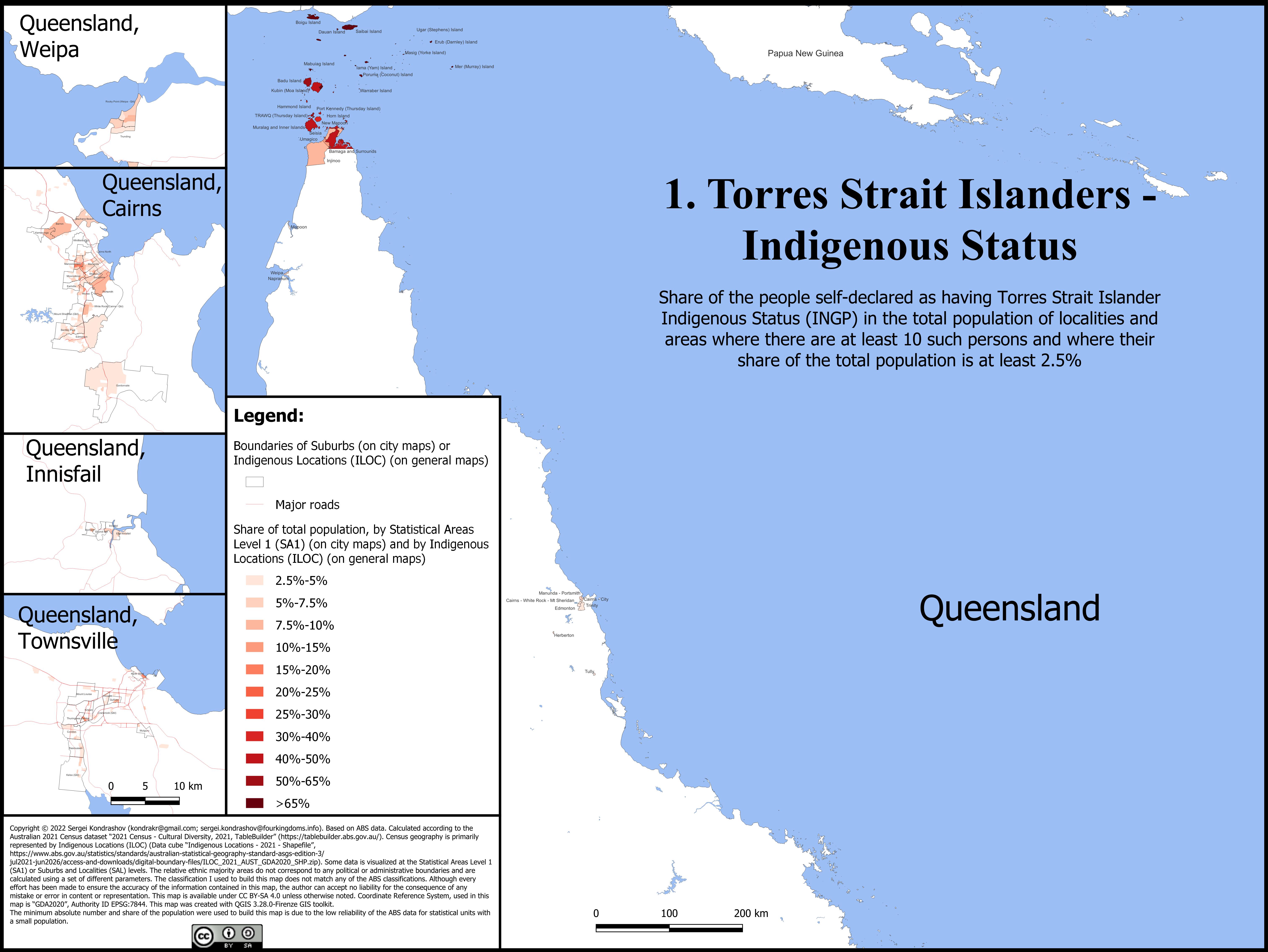
One of the two categories of Indigenous Australians
| Field | Value | ||
|---|---|---|---|
| group | Torres Strait Islanders | ||
| <!-- | flag | Link to file -- | image = TorresStraitIslandsMap.png |
| image_alt | A map of the Torres Strait Islands. | ||
| population | **82,054** (2021) | ||
| popplace | Torres Strait Islands 3,577 | ||
| languages | Torres Strait Island languages, Torres Strait Creole, Torres Strait English, Australian English | ||
| religions | Christianity, Islam | ||
| related | Melanesians |
one of the two ethnically distinct indigenous peoples of Australia, Torres Strait Islanders—the other being Aboriginal Australians
Torres Strait Islanders ( ) are the Indigenous Melanesian people of the Torres Strait Islands, which are part of the state of Queensland, Australia. Ethnically distinct from the Aboriginal peoples of the rest of Australia, they are often grouped with them as Indigenous Australians. Today, many more Torres Strait Islander people live in mainland Australia than on the islands.
Five distinct peoples exist within the broader designation of Torres Strait Islander people, based partly on geographical and cultural divisions. Kalaw Lagaw Ya and Meriam Mir comprise the two main Indigenous language groups; Yumplatok is also widely spoken as a language of trade and commerce. The core of Island culture is Papuan, and the people are traditionally a seafaring nation. Torres Strait Islanders exhibit a strong artistic culture, particularly in sculpture, printmaking, and mask-making.
Demographics


Of the 133 islands, only 38 are inhabited. The islands are culturally unique, with much to distinguish them from neighbouring Papua New Guinea, Indonesia and the Pacific Islands. Today the islands are multicultural, having attracted Asian and Pacific Island traders to the beche-de-mer, mother-of-pearl and trochus-shell industries over the years.
The 2021 Australian census counted 4,124 people living on the islands, of whom 86.7% were Torres Strait Islander or Aboriginal Australian people. (86.7% of the population identified as Torres Strait Islander; 16.9% as Aboriginal Australian; 2.3% as Australian; 1.8% as English, etc.).
People who identified themselves as being of Torres Strait Islander descent in Australia as a whole in the 2021 census accounted for 4.2% (39,538) of those who identified themselves as being of Indigenous origin, while those with both Torres Strait Islander and Aboriginal ancestry made up a further 4.4% (42,516).
Five communities of Torres Strait Islanders and Aboriginal Australians live on the coast of mainland Queensland, mainly at Bamaga, Seisia, Injinoo, Umagico and New Mapoon in the Northern Peninsula area of Cape York. |access-date= 21 October 2019
In June 1875, a measles epidemic killed about 25% of the population, with some islands suffering losses of up to 80% of their people, as the islanders had no natural immunity to European diseases.
Administration
Until the late 20th century, Torres Strait Islanders had been administered by a system of elected councils, a system based partly on traditional pre-Christian local government and partly on the introduced mission management system.
Today, the Torres Strait Regional Authority, an Australian government body established in 1994 and consisting of 20 elected representatives, oversees the islands, with its primary function being to strengthen the economic, social and cultural development of the peoples of the Torres Strait area.
Further to the TSRA, there are several Queensland LGAs which administer areas occupied by Torres Strait Islander communities:
- the Torres Strait Island Region, covering a large proportion of the Islands;
- the Northern Peninsula Area Region, administered from Bamaga, on the northern tip of Cape York; and
- the Shire of Torres, which governs several islands as well as portions of Cape York Peninsula, is effectively colocated with the Northern Peninsula Area Region, which covers a number of Deed of Grant in Trust areas on the peninsula, and the Torres Strait Island Region and administers those sections of its area which are not autonomous.
Ethnicity


Torres Strait Islander people are of predominantly Melanesian descent, distinct from Aboriginal Australians on the mainland and some other Australian islands, and share some genetic and cultural traits with the people of New Guinea.
The five-pointed star on the national flag represents the five cultural groups. Another source says that it originally represented the five groups of islands, but today (as of 2001) it represents the five major political divisions.
Pre-colonial Island people were not a homogeneous group and until then did not regard themselves as a single people. They have links with the people of Papua New Guinea, several islands being much closer to PNG than Australia, as well as the northern tip of Cape York on the Australian continent.
Sources are generally agreed that there are five distinct geographical and/or cultural divisions, but descriptions and naming of the groups differ widely.
- Encyclopaedia Britannica: the Eastern (Meriam, or Murray Island), Top Western (Guda Maluilgal), Near Western (Maluilgal), Central (Kulkalgal), and Inner Islands (Kaiwalagal).
- Multicultural Queensland 2001 (a Queensland Government publication): five groups may be distinguished, based on linguistic and cultural differences, and also related to their places of origin, type of area of settlement, and long-standing relationships with other peoples. these nations are: Saibailgal (Top Western Islanders), Maluilgal (Mid-Western Islanders), Kaurareg (Lower Western Islanders), Kulkalgal (Central Islanders) and Meriam Le (Eastern Islanders).
- Torres Shire Council official website (Queensland Government): Five major island clusters – the Top Western Group (Boigu, Dauan and Saibai), the Near Western Group (Badu, Mabuiag and Moa), the Central Group (Yam, Warraber, Coconut and Masig), the Eastern Group (Murray, Darnley and Stephen), and the TI Group (Thursday Island, Tabar Island, Horn, Hammond, Prince of Wales and Friday).
Ethno-linguistic groups include:
- Badu people, based on the central-west Badu island
- Kaurareg, lower Western Islanders, based on the Muralag (Prince of Wales Island) group.
- Mabuiag (or Mabuygiwgal) people, across a number of the islands.
- Meriam people, who living on a number of inner eastern islands, including Murray Island (also known as Mer Island) and Tabar Island.
Languages
Main article: Torres Strait Island languages

There are two distinct Indigenous languages spoken on the Islands, as well as a creole language.
The Western-central Torres Strait Language, or Kalaw Lagaw Ya, is spoken on the southwestern, western, northern and central islands; a further dialect, Kala Kawa Ya (Top Western and Western) may be distinguished. It is a member of the Pama-Nyungan family of languages of Australia.
Meriam Mir is spoken on the eastern islands. It is one of the four Eastern Trans-Fly languages, the other three being spoken in Papua New Guinea.
Torres Strait Creole, an English-based creole language, is also spoken.
Culture
Archaeological, linguistic and folk history evidence suggests that the core of Island culture is Papuo-Austronesian. The people have long been agriculturalists (evidenced, for example, by tobacco plantations on Aureed Island) as well as engaging in hunting and gathering. Dugong, turtles, crayfish, crabs, shellfish, reef fish and wild fruits and vegetables were traditionally hunted and collected and remain an important part of their subsistence lifestyle. Traditional foods play an important role in ceremonies and celebrations even when they do not live on the islands. Dugong and turtle hunting as well as fishing are seen as a way of continuing the Islander tradition of being closely associated with the sea. The islands have long history of trade and interactions with explorers from other parts of the globe, both east and west, which has influenced their lifestyle and culture.
The Indigenous people of the Torres Strait have a distinct culture which has slight variants on the different islands where they live. Cultural practices share similarities with Australian Aboriginal and Papuan culture. Historically, they have an oral tradition, with stories handed down and communicated through song, dance and ceremonial performance. As a seafaring people, sea, sky and land feature strongly in their stories and art.
Post-colonisation
Post-colonisation history has seen new cultural influences on the people, most notably the place of Christianity. After the "Coming of Light" (see below), artefacts previously important to their ceremonies lost their relevance, instead replaced by crucifixes and other symbols of Christianity. In some cases the missionaries prohibited the use of traditional sacred objects, and eventually production ceased. Missionaries, anthropologists and museums "collected" a huge amount of material: all of the pieces collected by missionary Samuel McFarlane, were in London and then split between three European museums and a number of mainland Australian museums.
In 1898–1899, British anthropologist Alfred Cort Haddon collected about 2,000 objects, convinced that hundreds of art objects collected had to be saved from destruction by the zealous Christian missionaries intent on obliterating the religious traditions and ceremonies of the native islanders. Film footage of ceremonial dances was also collected. The collection at Cambridge University is known as the Haddon Collection and is the most comprehensive collection of Torres Strait Islander artefacts in the world.
During the first half of the 20th century, Torres Strait Islander culture was largely restricted to dance and song, weaving and producing a few items for particular festive occasions.
Art
Torres Strait Islander people are the only culture in the world to make turtleshell masks, known as krar (turtleshell) in the Western Islands and le-op (human face) in the Eastern Islands.
Prominent among the artforms is wame (alt. wameya), many different string figures.
Elaborate headdresses or dhari (also spelt dari), as featured on the Torres Strait Islander flag, are created for the purposes of ceremonial dances.
The Islands have a long tradition of woodcarving, creating masks and drums, and carving decorative features on these and other items for ceremonial use. From the 1970s, young artists were beginning their studies at around the same time that a significant re-connection to traditional myths and legends was happening. Margaret Lawrie's publications, Myths and Legends of the Torres Strait (1970) and Tales from the Torres Strait (1972), reviving stories which had all but been forgotten, influenced the artists greatly. While some of these stories had been written down by Haddon after his 1898 expedition to the Torres Strait,{{cite book
An exhibition of Alick Tipoti's work, titled Zugubal, was mounted at the Cairns Regional Gallery in July 2015.
Music and dance
Main article: Indigenous music of Australia, Indigenous dance of Australia
For Torres Strait Islander people, singing and dancing is their "literature" – "the most important aspect of Torres Strait lifestyle. The Torres Strait Islanders preserve and present their oral history through songs and dances;...the dances act as illustrative material and, of course, the dancer himself is the storyteller" (Ephraim Bani, 1979). There are many songs about the weather; others about the myths and legends; life in the sea and totemic gods; and about important events. "The dancing and its movements express the songs and acts as the illustrative material".
Dance is also major form of creative and competitive expression. "Dance machines" (hand held mechanical moving objects), clappers and headdresses (dhari/dari) enhance the dance performances. Dance artefacts used in the ceremonial performances relate to Islander traditions and clan identity, and each island group has its own performances.
Artist Ken Thaiday Snr is renowned for his elaborately sculptured dari, often with moving parts and incorporating the hammerhead shark, a powerful totem.
Christine Anu is an ARIA Award-winning singer-songwriter of Torres Strait Islander heritage, who first became popular with her cover version of the song "My Island Home" (first performed by the Warumpi Band).
Sports
Sports are popular among Torres Strait Islanders and the community has many sporting stars in Australian and international sports. Sporting events bring together people from across the different islands and help to connect the Torres Strait with mainland Australia and Papua New Guinea. Rugby league is especially popular, including the annual 'Island of Origin' tournament between teams from different islands. Basketball is also extremely popular.
{{anchor|religion}}Religion and beliefs
The people still have their own traditional belief systems. Stories of the Tagai, their spiritual belief system, represent Torres Strait Islanders as sea people, with a connection to the stars, as well as a system of order in which everything has its place in the world. They follow the instructions of the Tagai.
Some Torres Strait Islander people share beliefs similar to the Aboriginal peoples' Dreaming and "Everywhen" concepts, passed down in oral history.
Oral history
One of the stories passed down in oral history tells of four brothers (bala) named Malo, Sagai, Kulka and Siu, who paddled their way up to the central and eastern islands from Cape York (Kay Daol Dai, meaning "big land"), and each established his own tribal following. Sagai landed at Iama Island (known as Yam), and after a time assumed a god-like status. The crocodile was his totem. Kulka settled on Aureed Island, and attained a similar status, as god of hunting. His totem was the fish known as gai gai (Trevally). Siu settled on Masig, becoming god of dancing, with the tiger shark (baidam) as his totem. The eldest brother, Malo, went on to Mer and became responsible for setting out a set of rules for living, a combination of religion and law, which were presented by Eddie Mabo in the famous Mabo native title case in 1992.
The cult of Kulka was in evidence on Aureed Island with the finding of a "skull house" by the rescuers of survivors two years after the wreck of Charles Eaton, in 1836.
Introduction of Christianity
From the 1870s, Christianity spread throughout the islands, and it remains strong today among Torres Strait Islander people everywhere. Christianity was first brought to the islands by the London Missionary Society (LMS) mission led by Rev. Samuel Macfarlane a schooner chartered by the LMS. They sailed to the Torres Strait after the French Government had demanded the removal of the missionaries from the Loyalty Islands and New Caledonia in 1869. Eight teachers and their wives from Loyalty Islands arrived with the missionaries on the boat from Lifu.
Clan elder and warrior Dabad greeted them on their arrival. Ready to defend his land and people, Dabad walked to the water's edge when McFarlane dropped to his knees and presented the Bible to Dabad. Dabad accepted the gift, interpreted as the "Light", introducing Christianity to the Torres Strait Islands. The people of the Torres Strait Islands adopted the Christian rituals and ceremonies and continued to uphold their connection to the land, sea and sky, practising their traditional customs, and cultural identity referred to as Ailan Kastom.[[File:Torres Strait Islander Religious affiliation.jpg|thumb|Religious affiliations of Torres Strait islanders in localities with significant share of Torres Strait islander population]]The Islanders refer to this event as "The Coming of the Light", also known as Zulai Wan, or Bi Akarida, and all Island communities celebrate the occasion annually on 1 July. Coming of the Light, an episode in the 2013 documentary television series Desperate Measures, features the annual event.
However the coming of Christianity did not spell the end of the people's traditional beliefs; their culture informed their understanding of the new religion, as the Christian God was welcomed and the new religion was integrated into every aspect of their everyday lives.
Religious affiliation, 2016 census
In the 2016 Census, a total of 20,658 Torres Strait Islander people (out of a total of 32,345) and 15,586 of both Torres Strait Islander and Aboriginal identity (out of 26,767) reported adherence to some form of Christianity. (Across the whole of Australia, the Indigenous and non-Indigenous population were broadly similar with 54% (vs 55%) reporting a Christian affiliation, while less than 2% reported traditional beliefs as their religion, and 36% reported no religion.)
{{anchor|adoption}}Traditional adoptions
A traditional cultural practice, known as kupai omasker, allows adoption of a child by a relative or community member for a range of reasons. The reasons differ depending on which of the many Torres Islander cultures the person belongs to, with one example being "where a family requires an heir to carry on the important role of looking after land or being the caretaker of land". Other reasons might relate to "the care and responsibility of relationships between generations".
There had been a problem in Queensland law, where such adoptions are not legally recognised by the state's Succession Act 1981, with one issue being that adopted children are not able to take on the surname of their adoptive parents. On 17 July 2020, the Queensland Government introduced a bill in parliament to legally recognise the practice. The bill was passed as the Meriba Omasker Kaziw Kazipa Act 2020 ("For Our Children's Children") on 8 September 2020.
Notable people

-
Activism
- Tanya Hosch, social activist based in Adelaide, South Australia
- Eddie Koiki Mabo, land rights campaigner who played a major role in a landmark decision which now characterises Australian law on land and title
- Sentah Sonny Leo Unmeopa, social activist and leader
- Muara (Lifu) Wacando, who was awarded a gold medal by the Royal Humane Society for her sea rescue during the 1899 Cyclone Mahina
- Elia Ware, soldier and activist
-
Arts
- Christine Anu, pop singer and actress, known for her song "My Island Home"
- Ken Thaiday Snr, artist based in Cairns
-
Education
- Martin Nakata, the first Torres Islander PhD degree graduate (1998), proponent of Indigenous Standpoint Theory
- Vanessa Lee-AhMat, the first female Torres Strait Islander PhD graduate (2016) from Griffith University School of Medicine
-
Sports
- Athletics
- Harry Mosby, 1976 Paralympian field athlete
- American football
- Jesse Williams, 2013 Super Bowl winner
- Athletics
-
Australian rules football
- Robert Ahmat, Australian Football League player with and
- Ben Davis, Australian Football League player with
- Fabian Francis, Australian Football League player with , ,
- Delma Gisu, AFLW player with
- Alicia Janz, AFLW player with
- Sam Powell-Pepper, Australian Football League player for
- Albert Proud, Australian Football League player for
- Heidi Talbot, AFLW player for
- Peter Ware, WAFL premiership winning footballer with Swan Districts and AFL Queensland Hall of Famer.
-
Rugby League
- Dane Gagai, Australian National Rugby League player for the Newcastle Knights
- Gehamat Shibasaki, Australian National Rugby League player for the Brisbane Broncos
- Jamal Shibasaki, Australian National Rugby League player for the North Queensland Cowboys
- Sam Thaiday, Australian National Rugby League player for the Brisbane Broncos
- Hamiso Tabuai-Fidow, Australian National Rugby League player for the Dolphins
-
Basketball
- Michael Ah Matt, 1964 Olympic basketballer
- Nathan Jawai, basketball player
- Patty Mills, NBA champion (2014, San Antonio Spurs) and captain for the Australian Boomers first Olympic medal win
- Danny Morseu, 1980 and 1984 Olympic basketballer
-
Soccer
- Allira Toby, soccer player in the W-League.
-
Politics
- Cynthia Lui, the first Torres Strait Islander elected to the Parliament of Queensland
-
Religion
- Kwami Dai, Assistant Bishop in the Anglican Diocese of Carpentaria
- Ted Mosby, Assistant Bishop in the Anglican Diocese of North Queensland
-
Other
- Kapiu Masi Gagai, pearler, boatman and mission worker who served in World War II
Footnotes
References
References
- (31 August 2023). "Estimates of Aboriginal and Torres Strait Islander Australians".
- "Torres Strait Islands".
- [https://www.slv.vic.gov.au/sites/default/files/La-Trobe-Journal-89-Regina-Ganter.pdf][https://www.tandfonline.com/doi/pdf/10.1080/07256868.2011.565737]
- ""2021 Census – Cultural Diversity, 2021, TableBuilder"". Australian Bureau of Statistics (ABS).
- "Australia's Aboriginal and Torres Strait Islander peoples". [[Government of Australia.
- Korff, Jens. (4 August 2021). "Aboriginal timeline: Health".
- Jeremy Beckett. (1990). "Torres Strait Islanders: Custom and Colonialism". Cambridge University Press.
- Kelly, John. (June 2001). "Evaluation of the Torres Strait Regional Authority".
- (July 2007). "Report of the Local Government Reform Commission". State of Queensland.
- (24 August 2015). "The people and history of the Torres Strait Islands". BBC News.
- "Australian Institute of Aboriginal and Torres Strait Islander Studies".
- Shnukal, Anna. "Torres Strait Islanders".
- "About the Torres Strait". Queensland Government.
- "Indigenous Fact Sheet: Torres Strait Islanders". [[Government of Australia.
- Peek, Veronica. (16 June 2012). "Part Four: a tale of two boys".
- Smyth, Dermot. (2002). "Valuing Fisheries". University of Queensland Press.
- "Art in the Torres Strait Islands".
- "Art Sets. Art of the Torres Strait Islands".
- "Torres Strait Islands".
- "BBC Two – Hidden Treasures of...". BBC.
- Robinson, Brian. (2001). "Torres Strait Islander printmaking".
- (2000). "The Pacific Islands: An Encyclopedia". University of Hawaii Press.
- [[Alfred Cort Haddon]], along with one of his daughters, the pioneers in the modern study of Torres Strait string figures
- [http://www.isfa.org/biblio.htm A string figure bibliography] including examples from Torres Strait.
- Whitford, Maddie. (13 April 2020). "Producers reflect on profound experience walking with Indigenous artists on country".
- "Dance machines & headdresses". Queensland Government.
- (1970). "Myths and Legends of the Torres Strait/collected and translated by Margaret Lawrie". University of Queensland Press.
- (1972). "Tales from Torres Strait". University of Queensland Press.
- "Alick Tipoti: Zugubal".
- Tipoti, Alick. (2015). "Alick Tipoti : Zugubal: ancestral spirits". Cairns Regional Gallery.
- Wiltshire, Kelly. (27 October 2017). "Audiovisual Heritage of Torres Strait Singing and Dancing".
- "Ken Thaiday".
- (15 May 2019). "Dr Ken Thaiday Senior".
- (18 January 2003). "Frog princess". [[The Sydney Morning Herald]].
- Osmond, Gary. (2020-05-23). "Sport and the Torres Strait: Thursday Island, Island Studies, the Archipelagic Turn, and Identity". The International Journal of the History of Sport.
- "8 interesting facts about Aboriginal and Torres Strait Islanders".
- (25 July 2018). "Spirituality and religion among Torres Strait Islanders".
- "The Dreaming".
- Mackie, Glen. "The Coming of Sagai".
- (2017). "Iesu ra mir giz (from the beginning) ge omaida (when the Gospel came), Mer ge baziarda (it took root in Erub) igiare Torres Strait (and branched out to the whole of the Torres Strait)". [[Logan Art Gallery]].
- {{cite encyclopedia. Gibbney. H. J.. (1974). National Centre of Biography, Australian National University
- Hammond, Philip. (30 June 2011). "Performers mark Coming of the Light".
- (15 September 1868). "Advertising". [[The Sydney Morning Herald]].
- (21 October 1871). "Cruise of the Jeannie Oswald.". [[The Argus (Melbourne)]].
- (13 January 1872). "The New Guinea Expedition.". [[The Herald (Melbourne)]].
- (3 February 1874). "Loss of the schooners Yarra and Surprise — both crews saved.". [[The Sydney Morning Herald]].
- (26 January 1937). "Missionary Ships". Shipping Wonders of the World.
- "The Coming of the Light".
- {{cite QHR. 15648. All Saints Anglican Church. 600873 Dated. 20 January 2016. Retrieved 31 July 2021. [[File:CC-BY icon.svg. 50px]] Text may have been copied from this source, which is available under a [https://creativecommons.org/licenses/by/4.0 Attribution 4.0 International (CC BY 4.0)] licence.
- Murray, Archibald Wright. (1888). "The Bible in the Pacific". James Nisbet and Company.
- (28 June 2021). "'The Coming of the Light' Celebrating 150 years of Christianity in the Torres Strait 1 July 2021".
- Willis, Carli. (26 July 2021). "Zulai Wan marks an encounter 150 years ago that changed Torres Strait Islanders' lives forever". [[Australian Broadcasting Corporation]].
- "Aboriginal Christians & Christianity".
- Burton, John. "History of Torres Strait to 1879 – a regional view". Torres Strait Regional Authority.
- (16 March 2018). "Coming of the Light (2013) – The Screen Guide".
- (28 June 2017). "2071.0 – Census of Population and Housing: Reflecting Australia – Stories from the Census, 2016: Religion in Australia, 2016".
- (25 May 2020). "Succession Act 1981".
- Rigby, Mark. (4 June 2020). "Torres Strait Islanders fear time running out for legal recognition of traditional adoptions". [[Australian Broadcasting Corporation]].
- Rigby, Mark. (16 July 2020). "Torres Strait Islander adoption practices bill introduced to Queensland Parliament". Australian Broadcasting Corporation.
- (9 September 2020). "'Historic moment': Queensland now recognises traditional Torres Strait Islander adoption practices".
- "History: Winners by Artist: Christine Anu". [[Australian Recording Industry Association]] (ARIA).
- (1999). "Plural Australia: Aboriginal and Asian labour in tropical white Australia, Darwin, 1911-1940".
- (27 May 2016). "Lifting the Lid: Abe Davis".
- [https://www.nmfc.com.au/news/1130512/what-sir-doug-nicholls-round-means-to-our-indigenous-players What Sir Doug Nicholls Round means to our Indigenous players] ''North Melbourne Football Club.'' Retrieved 16 January 2023.
- (11 May 2018). "Milestone occasion as Winter Series squad announced - goldcoastfc.com.au".
- (23 October 2018). "GIANTS Welcome Eight AFLW Draftees - GWSGIANTS.com.au".
- "ABC Indigenous on Twitter".
- (28 October 2018). "GWS AFLW Draftee Delma Gisu hopes to inspire more female Torres Strait Islanders to play footy".
- [https://www.mlc.wa.edu.au/assets/documents/2020-MLC-NAIDOC-Speech-Alicia-Janz.pdf MESSAGE FROM COLLEGIAN ALICIA JANZ (2007)]
- [http://www.perthnow.com.au/sport/resilience-the-driving-force-behind-sam-powellpeppers-draft-bid/news-story/d71dd6190727eb9efdff1290b9335fbe Resilience the driving force behind Sam Powell-Pepper's draft bid]
- AFL Record. Round 9,2009. Slattery Publishing. pg 75.
- (15 May 2025). "Ben Nabea Davis honours Torres Strait culture for Sir Doug Nicholls round".
- [https://www.aflq.com.au/2023-queensland-football-hall-of-fame-peter-ware/ 2023 Queensland Football Hall of Fame – Peter Ware] 18th September, 2023
- (2021-08-07). "After finishing fourth four times, the Boomers finally get on the Olympic podium". ABC News.
- (28 November 2017). "Labor one seat closer as first Torres Strait Islander woman elected to Parliament". Fairfax Media.
- [https://books.google.com/books?id=mcokBVUm62gC&pg=PA8 Loos, Noel. White Christ Black Cross: The Emergence of a Black Church] (Google Books) p. 8 (Accessed 25 September 2013)
- Rich, Jenny. "Kapiu Masi Gagai (1894–1946)". National Centre of Biography, Australian National University.
This article was imported from Wikipedia and is available under the Creative Commons Attribution-ShareAlike 4.0 License. Content has been adapted to SurfDoc format. Original contributors can be found on the article history page.
Ask Mako anything about Torres Strait Islanders — get instant answers, deeper analysis, and related topics.
Research with MakoFree with your Surf account
Create a free account to save articles, ask Mako questions, and organize your research.
Sign up freeThis content may have been generated or modified by AI. CloudSurf Software LLC is not responsible for the accuracy, completeness, or reliability of AI-generated content. Always verify important information from primary sources.
Report