From Surf Wiki (app.surf) — the open knowledge base
Timurid Empire
Persianate Turco-Mongol empire (1370–1507)

Persianate Turco-Mongol empire (1370–1507)
| Field | Value | |||||
|---|---|---|---|---|---|---|
| native_name | {{Nastaliq | ایران و توران}} | ||||
| Iran-o-Turan | ||||||
| national_motto | Persian:{{Nastaliq | راستى رستى}} | ||||
| *Rāstī rustī* | ||||||
| "In rectitude lies salvation" | ||||||
| conventional_long_name | Timurid Empire | |||||
| common_name | Timurid Empire | |||||
| era | Late Middle Ages | |||||
| status | Emirate | |||||
| government_type | Absolute monarchy | |||||
| year_start | 1370 | |||||
| year_end | 1507 | |||||
| event_pre | Timur begins conquests | |||||
| date_pre | 1363 | |||||
| event_start | Establishment of Timurid Empire | |||||
| event1 | Westward expansion begins | |||||
| date_event1 | 1380 | |||||
| event2 | Battle of Ankara | |||||
| date_event2 | 20 July 1402 | |||||
| event3 | Fall of Samarkand | |||||
| date_event3 | 1505 | |||||
| event_end | Fall of Herat | |||||
| event_post | Founding of the Mughal Empire | |||||
| date_post | 21 April 1526 | |||||
| image_coat | ||||||
| coa_size | 100 | |||||
| coat_alt | Three annulets symbol | |||||
| symbol_type | ||||||
| image_map | Timur Empire.jpg | |||||
| image_map_caption | Map of the Timurid Empire at its greatest extent under Timur, vassals are not shown | |||||
| p1 | Golden Horde | |||||
| p2 | Ottoman Empire | |||||
| p3 | Delhi Sultanate | |||||
| p4 | Mamluk Sultanate | |||||
| p5 | Chagatai Khanate | |||||
| p7 | Sufi dynasty | |||||
| p8 | Jalayirids | |||||
| p9 | Kurt dynasty | |||||
| p10 | Muzaffarids of IranMuzaffarid dynasty | |||||
| p11 | Sarbadars | |||||
| p12 | Marashis | |||||
| p13 | Afrasiyab dynasty | |||||
| p14 | Mihrabanids | |||||
| p6 | Kingdom of Georgia | |||||
| s1 | Khanate of Bukhara | |||||
| s2 | Safavid Iran | |||||
| s3 | Khanate of Khiva | |||||
| s4 | Qara Qoyunlu | |||||
| s5 | Aq Qoyunlu | |||||
| s6 | Mughal Empire | |||||
| s7 | Amb StateMulk-e-Tanol | |||||
| capital | {{plainlist | |||||
| common_languages | {{plainlist | |||||
| * Manz, Beatrice Forbes (1999). The Rise and Rule of Tamerlane. Cambridge University Press, p.109. . . [https://books.google.com/books?id | 2xDm2DCPRKMC&pg=PA109 p.109]. "In almost all the territories which Temür incorporated into his realm Persian was the primary language of administration and literary culture. Thus the language of the settled 'divan' was Persian." | |||||
| * {{cite web | url | http://www.iranicaonline.org/articles/central-asia-v | title=CENTRAL ASIA v. In the Mongol and Timurid Periodse | author=Bertold Spuler | publisher=Encyclopaedia Iranica | access-date=2017-09-14}} "Like his father, Olōğ Beg was entirely integrated into the Persian Islamic cultural circles, and during his reign Persian predominated as the language of high culture, a status that it retained in the region of Samarqand until the Russian revolution 1917 ... Ḥoseyn Bāyqarā encouraged the development of Persian literature and literary talent in every way possible ... |
| *Chagatai Turkic (dynastic, literature)<ref name | "homelanguage" / | |||||
| * Arabic (theology)<ref name | "EI - Manz2" /}} | |||||
| religion | ;State religion | |||||
| currency | Tanka | |||||
| title_leader | Emir | |||||
| leader1 | Timur (first) | |||||
| leader2 | Badi' al-Zaman (last) | |||||
| year_leader1 | 1370–1405 | |||||
| year_leader2 | 1506–1507 | |||||
| stat_year1 | 1405 est. | |||||
| stat_area1 | 4,400,000 |
Iran-o-Turan Rāstī rustī "In rectitude lies salvation"
- Samarkand (1370–1405)
- Herat (1405–1507)}}
- Persian (official, court language, high literature, lingua franca, administration)
- Manz, Beatrice Forbes (1999). The Rise and Rule of Tamerlane. Cambridge University Press, p.109. . . p.109. "In almost all the territories which Temür incorporated into his realm Persian was the primary language of administration and literary culture. Thus the language of the settled 'divan' was Persian."
- B.F. Manz, W.M. Thackston, D.J. Roxburgh, L. Golombek, L. Komaroff, R.E. Darley-Doran. "Timurids" Encyclopaedia of Islam Brill Publishers 2007; "During the Timurid period, three languages, Persian, Turkish, and Arabic were in use. The major language of the period was Persian, the native language of the Tajik (Persian) component of society and the language of learning acquired by all literate and/or urban Turks. Persian served as the language of administration, history, belles lettres, and poetry."
- "Like his father, Olōğ Beg was entirely integrated into the Persian Islamic cultural circles, and during his reign Persian predominated as the language of high culture, a status that it retained in the region of Samarqand until the Russian revolution 1917 ... Ḥoseyn Bāyqarā encouraged the development of Persian literature and literary talent in every way possible ...
- Robert Devereux (ed.) "Muhakamat Al-Lughatain (Judgment of Two Languages)" Mir 'Ali Shir Nawāi; Leiden, E.J. Brill 1966: "Nawa'i also employs the curious argument that most Turks also spoke Persian but only a few Persians ever achieved fluency in Turkic. It is difficult to understand why he was impressed by this phenomenon, since the most obvious explanation is that Turks found it necessary, or at least advisable, to learn Persian – it was, after all, the official state language – while Persians saw no reason to bother learning which was, in their eyes, merely the uncivilized tongue of uncivilized nomadic tribesmen.
- David J. Roxburgh. The Persian Album, 1400–1600: From Dispersal to Collection. Yale University Press, 2005. pg 130: "Persian literature, especially poetry, occupied a central in the process of assimilation of Timurid elite to the Perso-Islamicate courtly culture, and so it is not surprising to find Baysanghur commissioned a new edition of Firdawsi's Shanama."
- Chagatai Turkic (dynastic, literature)
- Arabic (theology)}} : ;Other religions :
The Timurid Empire was a late medieval, culturally Persianate, Turco-Mongol empire that dominated Greater Iran in the early 15th century, comprising modern-day Iran, Iraq, Afghanistan, much of Central Asia, the South Caucasus, and parts of contemporary Pakistan, North India, and Turkey. The empire had a syncretic culture and combined Turkic, Mongolic, and Persian influences, with the last members of the dynasty being regarded as "ideal Perso-Islamic rulers".
The empire was founded by Timur (Tamerlane), a warlord of Turco-Mongol lineage, who established the empire in 1370 and ruled it until his death in 1405. He saw himself as the great restorer of the Mongol Empire of Genghis Khan, regarding himself as Genghis's heir, and closely associated with the Borjigin. Timur continued to have strong trade relations with Ming China and the Golden Horde, with Chinese diplomats like Ma Huan and Chen Cheng regularly traveling west to Samarkand to conduct trade. The empire led to the Timurid Renaissance, particularly during the reign of astronomer and mathematician Ulugh Begh.
By 1467, the ruling Timurid dynasty, or Timurids, had lost most of Persia to the Aq Qoyunlu confederation. However, members of the Timurid dynasty continued to rule smaller states, sometimes known as Timurid emirates, in Central Asia and parts of India. In the 16th century, Babur, the Timurid prince of Ferghana (modern Uzbekistan), invaded Kabulistan (modern Afghanistan) and established a small kingdom there. Twenty years later, he used this kingdom as a staging ground to invade the Delhi Sultanate in India and established the Mughal Empire.
Names of the state
Timurid historian Sharaf al-Din Ali Yazdi states in his work Zafarnama (Book of victories) that the name of the Timur's state was Turan (). Timur personally ordered the name of his state as Turan be carved onto a rock fragment in Ulu Tagh mountainside (present-day Kazakhstan), known today as Karsakpay inscription. The original text, in particular, states:
... Sultan of Turan, Timur bey went up with three hundred thousand troops for Islam on the Bulgarian Khan, Tokhtamysh Khan...
In the literature of the Timurid era, the realm was formally referred to as Iran-o-Turan () in the same manner that the words 'Turk' and 'Tajik' were paired together. The border between the two areas was considered to be at the Oxus River. Both terms were concerned with imperial traditions, Iran being Persian and Perso-Islamic, and Turan with the steppe empires of the Turks and the Mongols. Mawarannahr () also appears as the name of the realm.
According to Shia authors, the ruling dynasty of the Timurids was called Gurkani (, Gurkāniyān). Gurkani means 'son-in-law', a title applied by Timur to help legitimise his rule as he could not claim Genghisid descent. To this end, he married a Genghisid princess, Saray Mulk Khanum.
Genealogy
The Timurid dynasty originated from the Barlas tribe. Timur's father told him the story of how his family was descended from Abu al-Atrāk ( 'Father of the Turks'), according to the statement of his father.
According to the Timurid ruler Ulugh Beg's Tārīkh-i arbaʿ ulūs ( 'History of Four Nations'), abridged as the Shajarat al-atrāk ( 'Genealogy of Turks'), Timurids were descendants of Turk, son of Yāfas (Japheth). Turk was commonly referred as "Father of the Turks". Mughul and Tatar were twin brothers and children of Aljeh Khan, and therefore fifth generation descendants of Turk.
Ulugh Beg's work on genealogy classified Mongols as Turks, while also praising their warrior spirit.** Ulugh Beg included Yāfas (Japheth), Turk, Mughūl, Tātār and Ughūz in the genealogical record of the Genghisids and Timurids.
History
Main article: Timur, History of Central Asia, History of Iran
Timur conquered large parts of the ancient greater Persian territories in Central Asia, primarily Transoxiana and Khorasan, from 1363 onwards with various alliances. He took Samarkand in 1366 and Balkh in 1369. He was recognized as ruler over them in 1370. Acting officially in the name of Suurgatmish, the Chagatai khan, he subjugated Transoxiana and Khwarazm in the years that followed. Already in the 1360s, he had gained control of the western Chagatai Khanate. While as emir he was nominally subordinate to the khan, in reality it was now Timur who picked the khans. These became mere puppet rulers. The western Chagatai khans were continually dominated by Timurid princes in the 15th and 16th centuries, and their figurehead importance was eventually reduced into total insignificance.
Rise
Timur began a campaign westwards in 1380, invading the various successor states of the Ilkhanate. By 1389, he had removed the Kartids from Herat and advanced into mainland Persia where he enjoyed many successes. This included the capture of Isfahan in 1387, the removal of the Muzaffarids from Shiraz in 1393, and the expulsion of the Jalayirids from Baghdad. Tokhtamysh, the khan of the Golden Horde, was a major rival to Timur in the region. In 1394–1395, he triumphed over the Golden Horde, following his successful campaign in Georgia, after which he enforced his sovereignty in the Caucasus.
In 1398, the anarchy prevailing in the Delhi Sultanate had drawn Timur's attention. At the beginning of 1398, Timur sent an army led by his grandson Pir Muhammad to cross the Indus and attack Multan; the successful siege lasted six months. Later in the same year, Timur himself marched the main army across the Indus, and after destroying Tulamba joined Pir Muhammad. At Sutlej, he defeated the Khokhar chief Jasrat and then took the Loni and Bhatnair forts, seven miles northeast of Delhi. In December 1398, Timur engaged with the armies of Sultan Mahmud Shah and won. This led to his triumphal entry into Delhi, where he conducted a massacre but spared the craftsmen to be sent to Samarkand. He left Delhi in January 1399. During Timur's entry into India, he was faced by a sultanate that was already in decline due to the secession of its richest provinces.
Later in 1400–1401 he conquered Aleppo, Damascus and eastern Anatolia. In 1401 he destroyed Baghdad, and in 1402 he defeated the Ottomans in the Battle of Ankara. This made Timur the most preeminent Muslim ruler of the time, as the Ottoman Empire plunged into civil war. Meanwhile, he transformed Samarkand into a major capital and seat of his realm.
Stagnation and decline
_in_battle_against_Timurid_forces_(right)._1430_Shahnama,_Bodleian_Library,_ms._Add_176,_folios_6r-7v.jpg)
Timur appointed his sons and grandsons to the main governorships of the different parts of his empire, and outsiders to some others. After his death in 1405, the family quickly fell into disputes and civil wars, effectively weakening themselves, and many of the governors became conclusively independent. Due to the fact that the Persian cities were desolated by wars, the seats of Persian culture were now in Samarkand and Herat, cities that became the centre of the Timurid renaissance. The costs of Timur's conquests included the deaths of possibly 17 million people.
Shahrukh Mirza, the fourth ruler of the Timurids, dealt with the Qara Qoyunlu, who aimed to expand into Iran. But in the wake of Shahrukh's death, the Qara Qoyunlu under Jahan Shah drove the Timurids out to eastern Iran after 1447 and also briefly occupied Herat in 1458. After the death of Jahan Shah, Uzun Hasan, bey of the Aq Qoyunlu, conquered the holdings of the Qara Qoyunlu in Iran between 1469 and 1471.
Fall
The power of Timurids declined rapidly during the second half of the 15th century, largely due to the Timurid/Mongol tradition of partitioning the empire as well as several civil wars. The Aq Qoyunlu conquered most of Iran from the Timurids, and by 1500, the divided and war-torn Timurid Empire had lost control of most of its territory, and in the following years it was effectively pushed back on all fronts. Persia, the Caucasus, Mesopotamia, and Eastern Anatolia fell quickly to the Shiite Safavid Empire, secured by Shah Ismail I in the following decade. Much of the Central Asian lands was overrun by the Uzbeks of Muhammad Shaybani who conquered the key cities of Samarkand and Herat in 1505 and 1507, and who founded the Khanate of Bukhara.
Mughal Empire
Main article: Mughal Empire
From Kabul, the Mughal Empire was established in 1526 by Babur, a Timurid prince, son of the Timurid governor of Fergana Umar Shaikh Mirza II, who was descendant of Timur through his father and possibly a descendant of Genghis Khan through his mother. The dynasty he established is commonly known as the Mughal dynasty though it was directly inherited from the Timurids. By the 17th century, the Mughal Empire ruled most of India but eventually declined during the following century. The Timurid dynasty finally came to an end when the remaining nominal rule of the Mughals was abolished by the British Empire following the 1857 rebellion.
Culture
,_Timurid_genealogy,_1405-1409,_Samarkand_(TSMK,_H2152).jpg)
Although the Timurids hailed from the Barlas tribe, which was of Turkicized Mongol origin, they converted to Islam, and resided in Turkestan and Khorasan. Thus, the Timurid era had a dual character, reflecting both its Turco-Mongol origins and the Persian literary, artistic, and courtly high culture of the dynasty.
Language
During the Timurid era, Central Asian society was bifurcated, with the responsibilities of government and rule divided into military and civilian spheres along ethnic lines. At least in the early stages, the military was almost exclusively Turco-Mongolian, while the civilian and administrative element was almost exclusively Persian. The spoken language shared by all the Turko-Mongolians throughout the area was Chaghatay. The political organization hearkened back to the steppe-nomadic system of patronage introduced by Genghis Khan. The major language of the period, however, was Persian, the native language of the Tājīk (Persian) component of society and the language of learning acquired by all literate or urban people. Timur was already steeped in Persian culture and in most of the territories he incorporated, Persian was the primary language of administration and literary culture. Thus the language of the settled "diwan" was Persian, and its scribes had to be thoroughly adept in Persian culture, whatever their ethnic origin. Persian became the official state language of the Timurid Empire and served as the language of administration, history, belles lettres, and poetry. The Chaghatay language was the native and "home language" of the Timurid family, while Arabic served as the language par excellence of science, philosophy, theology and the religious sciences.
Literature
Persian
Persian literature, especially Persian poetry, occupied a central place in the process of assimilation of the Timurid elite to the Perso-Islamic courtly culture. The Timurid sultans, especially Shāh Rukh Mīrzā and his son Mohammad Taragai Oloğ Beg, patronized Persian culture. Among the most important literary works of the Timurid era is the Persian biography of Timur, known as Zafarnāmeh (), written by Sharaf al-Din Ali Yazdi, which itself is based on an older Zafarnāmeh by Nizam al-Din Shami, the official biographer of Timur during his lifetime. The most famous poet of the Timurid era was Nūr ud-Dīn Jāmī, the last great medieval Sufi mystic of Persia and one of the greatest figures in Persian poetry. Hearing of the Persian culture of the Timurid empire, the Ottoman sultan Mehmed II encouraged those under his patronage to engage with the models provided by Persian cultural centers like Shiraz and Tabriz, and in particular by the Timurid court of Sultan Husayn Bayqara (r. 1469–1506) in Herat. Mehmed II was determined to foster the creation of a new language and literary-artistic culture for his burgeoning court in Istanbul.
In addition, some of the astronomical works of the Timurid sultan Ulugh Beg were written in Persian, although the bulk of it was published in Arabic. The Timurid prince Baysunghur also commissioned a new edition of the Persian national epic Shāhnāmeh, known as Shāhnāmeh of Baysunghur, and wrote an introduction to it. The Persian poet 'Ismat Allah Bukhari taught poetry to Khalil Sultan, grandson of Timur. According to T. Lenz:
Following the publication of Mukhtar al-Ikhtiyar, a legal manual that was used until the twentieth century, by the head magistrate of Bayqara in Herat, Persian was used as a language of jurisprudence (fiqh) under the late Timurids.
During the reign of sultan Husayn Bayqara, the Irshad al-zira'a, a Persian agricultural treatise, was written by Qasim b. Yusuf Abu Nasiri. Based on in-depth, first-hand conversations with farmers, the Irshad al-zira'a, covered the agricultural development of Herat and included minor architectural suggestions for gardens.
Chagatai

The Timurids also played a very important role in the history of Turkic literature. Based on the established Persian literary tradition, a national Turkic literature was developed in the Chagatai language. Chagatai poets such as Mīr Alī Sher Nawā'ī, Sultan Husayn Bāyqarā, and Zāhiruddīn Bābur encouraged other Turkic-speaking poets to write in their own vernacular in addition to Arabic and Persian. Nawa’i's work, predominantly based on Persian designs, was an attempt to create a culture that was specific to the Turkophone audience. The Bāburnāma, the autobiography of Bābur (although being highly Persianized in its sentence structure, morphology, and vocabulary), as well as Mīr Alī Sher Nawā'ī's Chagatai poetry are among the best-known Turkic literary works and have influenced many others.
Despite being spread throughout Central and South Asia, Chaghatai Turkic remained the junior partner to Persian, and was not promoted systemically in the Timurid Empire to replace Persian. Chaghatai texts were found at Sultan Husayn Bayqara's court, but the Timurid chancery and court continued to use Persian. Although the body of Turkic literature produced in Central Asia increased during the Timurid era of the fifteenth century—partially as a result of Mir 'Ali Shir Nawa'i's independent efforts toward the end of the Timurid century—it was still dwarfed by the Persian literary output that the Timurid elite supported. There are no surviving Turkic historical work from the Timurids, although two Turkic histories seem to have been written during the Timurid period before the flowering of the Timurid historiography in Persian.
Art
Main article: Timurid art, Central Asian art
The golden age of Persian painting began during the reign of the Timurids. During this period – and analogous to the developments in Safavid Iran – Chinese art and artists had a significant influence on Persian art. Timurid artists refined the Persian art of the book, which combines paper, calligraphy, illumination, illustration and binding in a brilliant and colourful whole. The Mongol ethnicity of the Chaghatayid and Timurid khans was the source of the stylistic depiction of Persian art during the Middle Ages. These same Mongols intermarried with the Persians and Turks of Central Asia, even adopting their religion and languages. Yet their simple control of the world at that time, particularly in the 13th–15th centuries, reflected itself in the idealised appearance of Persians as Mongols. Though the ethnic make-up gradually blended into the Iranian and Mesopotamian local populations, the Mongol stylism continued well after and crossed into Asia Minor and even North Africa.
File:Frise architecturale à inscription coranique - Arts de l'Islam Rennes 20220320.jpg|Timurid deocrative element, Central Asia or Iran, 1375-1400 File:Fragmentary tombstone in the shape of a mihrab - Uzbekistan, Samarkand - 14th century - Louvre - OA 4080.jpg|Fragmentary tombstone in the shape of a mihrab. Samarkand, 1385-1400. Louvre Museum OA 4080. File:Timurid Anthology Zhertva.jpg|The Angel Hinders the Offering of Isaac. Anthology of Sultan Iskandar, Shiraz 1410.
Architecture
Main article: Timurid architecture
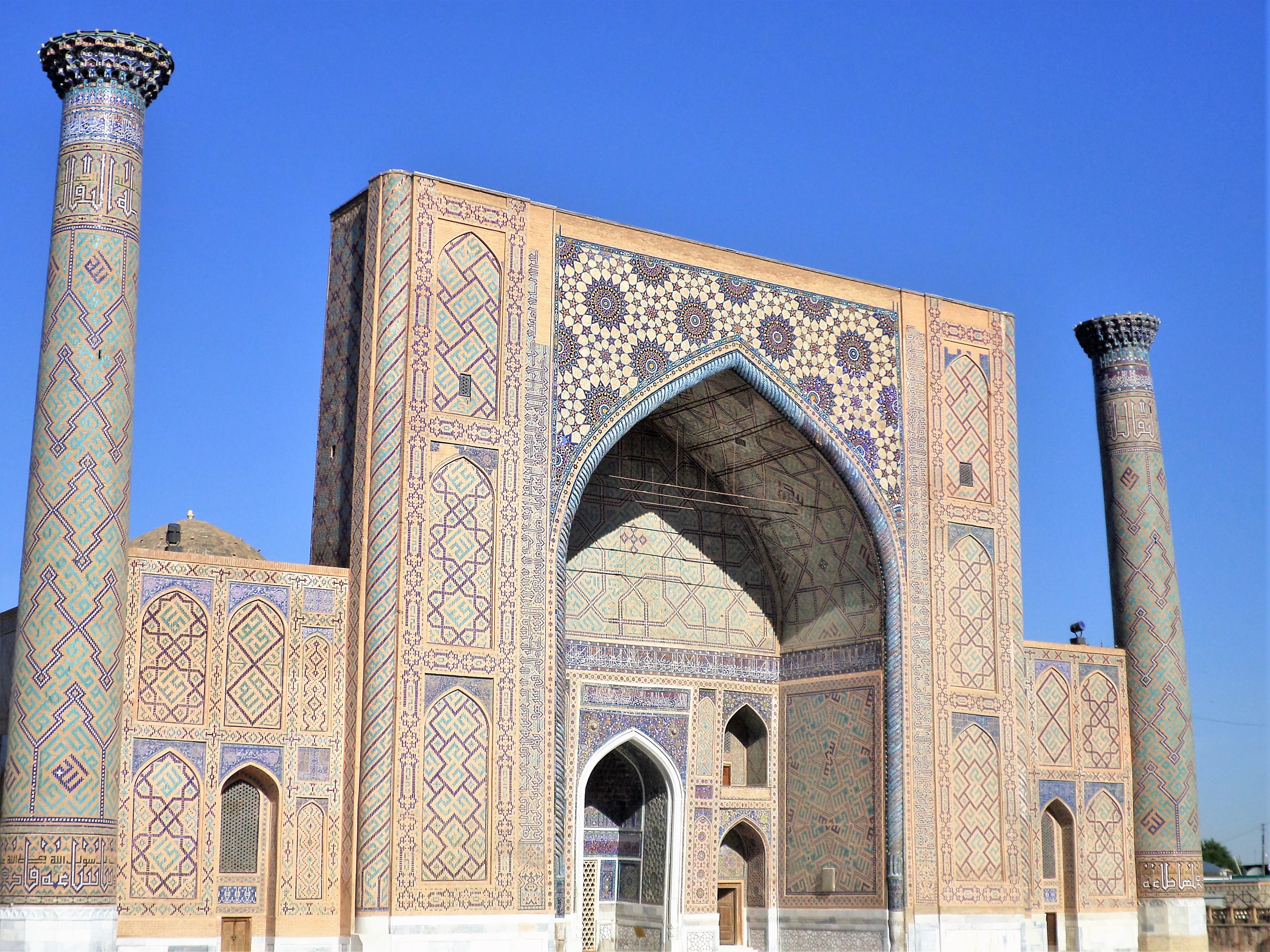
Timurid architecture elaborated on the existing tradition of Iranian and Central Asian architecture that had grown up to the preceding Ilkhanid period. The Timurid style is distinguished by large-scale buildings, layouts with strong axial symmetry, prominent double-shelled domes in bulbous form, rich exterior tile decoration (in both tile mosaic and banna'i techniques), and sophisticated interior vaulting. Timur used various tools for legitimisation, including urban planning in his capital, Samarkand. One of the earliest surviving Timurid monuments is the Mausoleum of Khoja Ahmed Yasawi in present-day Kazakhstan (1389–1399). Many of the major imperial monuments of the era are found in Samarkand, including the Gur-i Amir Mausoleum (completed ), the Bibi-Khanym Mosque (1399–1404), the Shah-i Zinda necropolis (late 14th to early 15th centuries), and the Ulugh Beg Madrasa (1417–1420). The most important patron of architecture in the 15th century was Gawhar Shad, whose constructions demonstrate a high quality of decoration and increasingly elaborate structural elements, with important examples being her religious and funerary complex in Herat and the mosque of Gawhar Shad in Mashhad. The power and prestige of the empire, along with the scale of its patronage, ensured that its architectural style was a major subsequent influence in many regions. In Iran, it was inherited by the Safavids, while in the east it was inherited by the Mughals (of Timurid origin) on the Indian subcontinent, where it was blended with Indo-Islamic influences to create the Mughal style. Further west, it also influenced early Ottoman architecture.
File:Gur-I Amir - Tomb of the King.jpg|Gur-e Amir, "Tomb of the King": Timur's tomb in Samarkand File:SamarkandBibiKhanym.jpg|Façade of the Bibi Khanum Mosque in Samarkand File:نمای کلی میل اخنگان (cropped).jpg|Akhangan Tower, the tomb of Gawhar Shad's sister Gowhartāj, in Akhangan (northeastern Iran)
Military
In the Chagatay translation of Ali Yazdi's Zafarnama, Timur's army is called a "Chagatay army" (Čaġatāy čerigi). Potentially a reference to the Chagatai Khanate.
The Timurids relied on the conscription of troops from settled populations. They were unable to fully subjugate many other nomadic tribes. This was not because of lack of military power as Timur succeeded in defeating them, but rather because he was unwilling to integrate autonomous tribes into his power structure due to his centralised governance. The tribes were too mobile to effectively suppress and the loss of their autonomy was unattractive to them. Hence, Timur was unable to win the loyalty of the tribes, and his hold over them did not survive his death.
The role of slave soldiers such as the ghilman and mamluks was considerably smaller in Mongol-based armies like the Timurids, as compared to other Islamic societies.
The Timurids had a contingent called the nambardar levy, which mostly consisted of native Iranians, and occasionally scholars and fiscal administrators. The nambardar were used to bolster the size of the army for large expeditions.
Symbols of the state
_mint._Undated,_circa_AH_795-807_AD_1393-1405.jpg)
The main symbol of the Timurids is thought to have been the so-called "sign of Timur", which is three equal circles (or rings) arranged in the form of an equilateral triangle ([[File:Three_annulets_symbol_of_the_Timurid_Empire.png|25px]]). Ruy de Clavijo (d. 1412), the ambassador of the king of Castile to the court of Timur in 1403, and the Arab historian, Ibn Arabshah described the sign, which was encountered on the seal of the Amir, as well as on Timurid coins. Timur himself issued several coins bearing the "three annulets" tamgha on the reverse.
It is not known for certain what meaning the triangular sign had, but according to Clavijo, each circle meant a part of the world (of which there were three before 1492), and the owner of the symbol was their ruler. The sign consisting of circles perhaps tried to illustrate Timur's nickname of "Sahib-Qiran" (the ruler of three benevolent planets). According to Ruy de Clavijo, the emblem adopted by Timur was composed of "three circlets" arranged into the shape of a triangle:
The special armorial bearing of Timur is the three circlets set thus to shape a triangle, which same it is said signifies that he Timur is lord of all three quarters of the world. This device Timur has ordered to be set on the coins that he has stuck, and on all buildings that he has erected (…) These three circlets which, as said, are like the letter O thrice repeated to form a triangle, further are the imprint of Timur's seal, and again by his special order are added so as to be seen patent on all the coins stuck by those princes who are become tributary to his government.
Often images of abstract symbols (tamga) on coins were accompanied by the Persian expression "Rāstī rustī" (), which can be translated as "In rectitude lies salvation". It is also known that the same expression was used in flags as well.
Flag

Standards with a golden crescent are mentioned in different historical sources. Some miniatures depict the red banners of Timur's army, and it is thought that Timur generally used red banners, probably for visibility, with variable cut-outs, to which may have been added the tail of a horse or yak (the Mongol tugh), topped with the crescent of Islam. During the Indian campaign, a black banner with a silver dragon was used. Before the campaign to China, however, Timur ordered the depiction of a golden dragon on the army's banners.
There is little certainty about the actual flag of the Timurid Empire. Yuka Kadoi studied the possibility that the "brown or originally silver flag with three circles or balls" in the Catalan Atlas could be associated with the "earlier dominions of the Timurid Empire", specifically referencing a flag raised over the city of Camull (the modern city of Khamil in Xinjiang).
Yuka Kadoi also noted the existence of Timur's umbrella detail with three-dots decorative motif, as well as some contemporary coins from Samarkand which also have the three circles as a motif. For other authors, the flag with the three red crescent moons ([[File:Catalan Atlas, Flag of Cathay.svg|20px]]), which is seen all over Mongol dominions in eastern Asia in the Catalan Atlas (dated to 1375), is simply intended as the flag of the Empire of the Great Khan (Yuan China).
File:Timur hunting, page from the Zafarnama of Sharaf al-Din ‘Ali, Yazdi. Shiraz, AH 839, 1436 CE (umbrella detail).jpg|Timur's umbrella, with three golden dots symbols. Zafarnama of Sharaf al-Din ‘Ali, Yazdi. Shiraz, AH 839, 1436 CE (detail) File:Timurid flag in the Campaign against China after Timur’s death in 1405. Zafarnama of Ibrahim Sultan of 1436.jpg|Timurid flags in the Campaign against China after Timur's death in 1405. Zafarnama of Ibrahim Sultan (1436) File:Banner of Timur Khan.svg|Banner type used by Timur during his campaigns, according to Pierre Lux-Wurm
List of rulers
Emperors
Main article: Timurid dynasty
- Timur
- Pir Muhammad (son of Jahangir) (ruled 1405–1407)
- Khalil Sultan
- Shah Rukh
- Ulugh Beg
- Abdal-Latif Mirza
- Abdullah Mirza
- Sultan Muhammad
- Abul-Qasim Babur Mirza
- Sultan Ahmed Mirza
- Sultan Mahmud Mirza
- Mirza Shah Mahmud
- Ibrahim Mirza
- Abu Sa'id Mirza
- Umar Shaikh Mirza II
- Babur
- Sultan Husayn Bayqara
- Yadgar Muhammad Mirza (ruled 1469–1470)
- Badi' al-Zaman Mirza
Governors
- Qaidu bin Pir Muhammad bin Jahāngīr 808–811 AH
- Abu Bakr bin Mīrān Shāh 1405–1407 (807–809 AH)
- Pir Muhammad (son of Umar Shaikh) 807–812 AH.
- Rustam 812–817 AH
- Sikandar 812–817 AH
- Ala al-Dawla Mirza 851 AH
- Abu Bakr bin Muhammad 851 AH
- Sultān Muhammad 850–855 AH
- Muhammad bin Hussayn 903–906 AH
- Abul A'la Fereydūn Hussayn 911–912 AH
- Muhammad Mohsin Khān 911–912 AH
- Muhammad Zamān Khān 920–923 AH
- Shāhrukh II bin Abu Sa'id 896–897 AH
- Ulugh Beg II, Governor of Kabul and Ghazni, 873–907 AH.
- Sultān Uways 1508–1522 (913–927 AH)
References
References
- (December 2006). "East-West Orientation of Historical Empires". Journal of World-Systems Research.
- Rein Taagepera. (September 1997). "Expansion and Contraction Patterns of Large Polities: Context for Russia". [[International Studies Quarterly]].
- (2020). "The Oxford World History of Empire: Volume One: The Imperial Experience". Oxford University Press.
- Green, Nile (2019-04-09). ''The Persianate World: The Frontiers of a Eurasian Lingua Franca''. Univ of California Press. {{ISBN. 978-0-520-97210-0.
- Spengler, Robert N. (2020-09-22). ''Fruit from the Sands: The Silk Road Origins of the Foods We Eat''. Univ of California Press. {{ISBN. 978-0-520-37926-8.
- "Timurids, The Columbia Encyclopedia, 6th ed.". Columbia University Press.
- (2008). "Zafarnama". San'at.
- "Timur's inscription, 1391".
- (2004). "Historiography and source study of the history of the countries of Asia and Africa". Saint-Petersburg State University.
- (2001). "Studies on Central Asian history in honor of Yuri Bregel". Bloomington, Ind..
- Ashraf, Ahmad. "IRANIAN IDENTITY iii. MEDIEVAL ISLAMIC PERIOD".
- (1960). "Defence of Samarqand in 1454". Social Sciences of Uzbekistan.
- (2011). "Concise History of Islam". Vij Books India Pvt Ltd.
- (2002). "Imam and the Indian". Orient Blackswan.
- Sonbol, Amira El-Azhary. (2005). "Beyond the Exotic : Women's Histories in Islamic Societies". Syracuse Univ. Press.
- Shterenshis, Michael. (2002). "Tamerlane and the Jews". RoutledgeCurzon.
- Grousset, René. (1988). "The Empire of the Steppes: A History of Central Asia". Rutgers University Press.
- (2020). "Persian Historiography across Empires: The Ottomans, Safavids, and Mughals". Cambridge University Press.
- (2013). "CHAPTER III". Cambridge University Press.
- Dodangeh, Abdollah. "Şeceretü'l-Etrak, Tarih-i Ekvâm-ı Erbe'a [Ulûs-u Erbe'a] Adlı Eser Üzerine Bir Değerlendirme".
- Lee, Joo-Yup. (2016). "The Historical Meaning of the Term Turk and the Nature of the Turkic Identity of the Chinggisid and Timurid Elites in Post-Mongol Central Asia". Central Asiatic Journal.
- Grousset, René. (1970). "The empire of the steppes; a history of central Asia". New Brunswick, N.J., Rutgers University Press.
- (2000). "The Theory and Practice of Portraiture in the Persian Tradition". Muqarnas.
- "Timurids". [[Columbia University]].
- "Selected Death Tolls: Timur Lenk (1369–1405)". Necrometrics.com.
- (4 December 2023). "Manuscript Albums and their Cultural Contexts: Collectors, Objects, and Practices". Walter de Gruyter GmbH & Co KG.
- M. S. Asimov and [[Clifford Edmund Bosworth. C. E. Bosworth]], ''History of Civilizations of Central Asia'', [[UNESCO]] Regional Office, 1998, {{ISBN. 92-3-103467-7, p. 320: "One of his followers was ... Timur of the Barlas tribe. This Mongol tribe had settled ... in the valley of Kashka Darya, intermingling with the Turkish population, adopting their religion (Islam) and gradually giving up its own nomadic ways, like a number of other Mongol tribes in Transoxania ..."
- ''The Baburnama: Memoirs of Babur, Prince and Emperor''. Translated, edited and annotated by W. M. Thackston (2002). Modern Library.
- Gérard Chaliand, ''Nomadic Empires: From Mongolia to the Danube'', translated by A. M. Berrett, Transaction Publishers, 2004. p. 75
- Beatrice Forbes Manz. The Rise and Rule of Tamerlane. Cambridge University Press, 1999. pg 109: "In Temür's government, as in those of most nomad dynasties, it is impossible to find a clear distinction between civil and military affairs, or to identify the Persian bureaucracy solely civil, and the Turko-Mongolian solely with military government. It is in fact difficult to define the sphere of either side of the administration and we find Persians and Chaghatays sharing many tasks. (In discussing the settled bureaucracy and the people who worked within it I use the word Persian in a cultural rather than ethnological sense. In almost all the territories which Temür incorporated into his realm Persian was the primary language of administration and literary culture. The language of the settled population and the chancery ("diwan") was Persian, and its scribes had to be thoroughly adept in Persian culture, whatever their ethnic origin.) Temür's Chaghatay emirs were often involved in civil and provincial administration and even in financial affairs, traditionally the province of Persian bureaucracy."
- Mir 'Ali Shir Nawāi. (1966). "Muhakamat Al-Lughatain (Judgment of Two Languages)". E.J. Brill.
- Spuler, Bertold. "Central Asia".
- (2007). "Timurids". [[Brill Publishers]].
- (2007). "Timurids". [[Brill Publishers]].
- (2007). "Timurids". [[Brill Publishers]].
- David J. Roxburgh. ''The Persian Album, 1400–1600: From Dispersal to Collection''. Yale University Press, 2005. p. 130: "Persian literature, especially poetry, occupied a central in the process of assimilation of Timurid elite to the Perso-Islamicate courtly culture, and so it is not surprising to find Baysanghur commissioned a new edition of Firdawsi's Shanameh ..."
- B. Spuler, "[http://www.iranicaonline.org/articles/central-asia-v Central Asia in the Mongol and Timurid periods]", in ''[[Encyclopædia Iranica]]''. "Like his father, Olōğ Beg was entirely integrated into the Persian Islamic cultural circles, and during his reign Persian predominated as the language of high culture, a status that it retained in the region of Samarqand until the Russian revolution 1917 ... Ḥoseyn Bāyqarā encouraged the development of Persian literature and literary talent in every way possible ..."
- B. F. Manz, W. M. Thackston, D. J. Roxburgh, L. Golombek, L. Komaroff, R. E. Darley-Doran. "Timurids". In ''[[Encyclopaedia of Islam]]'', Online Edition (2007), Brill. "As it had been prior to the Timurids and continued to be after them, Arabic was the language par excellence of science, philosophy, theology and the religious sciences. Much of the astronomical work of Ulugh Beg and his co-workers ... is in Arabic, although they also wrote in Persian. Theological works ... are generally in Arabic."
- "[http://www.iranicaonline.org/articles/baysongori-sah-nama BĀYSONḠORĪ ŠĀH-NĀMA]" in Encyclopædia Iranica by T. Lenz
- (2005). "Turks: a journey of a thousand years, 600-1600". Royal Academy of Arts ; Distributed in the U.S. and Canada by Harry N. Abrams.
- Stephen Frederic Dale (2004). ''The Garden of the Eight Paradises: Babur and the Culture of Empire''. Brill. p. 150
- Czechoslovak Society for Eastern Studies (1968). ''New Orient''. p. 139.
- John Onians, ''Atlas of World Art'', Laurence King Publishing, 2004. p. 132.
- (1385). "Pierre tombale fragmentaire en forme de mihrâb".
- (2009). "The Grove Encyclopedia of Islamic Art and Architecture". Oxford University Press.
- Tabbaa, Yasser. (2007). "Encyclopaedia of Islam, Three". Brill.
- (2009). "The Grove Encyclopedia of Islamic Art and Architecture". Oxford University Press.
- (2011). "Islam: Art and Architecture". h.f.ullmann.
- Malikov Azim, The cultural traditions of urban planning in Samarkand during the epoch of Timur. In: Baumer, C., Novák, M. and Rutishauser, S., Cultures in Contact. Central Asia as Focus of Trade, Cultural Exchange and Knowledge Transmission. Harrassowitz. 2022, p.343
- (1995). "The Art and Architecture of Islam 1250-1800". Yale University Press.
- {{cite encyclopedia. Indiana University Publications. János Eckmann. (1966)
- (1999). "The Rise and Rule of Tamerlane". Cambridge University Press.
- ((University of Michigan. Center for Chinese Studies, Freer Gallery of Art, University of Michigan. Department of Fine Arts, University of Michigan. Department of the History of Art)). (1993). "Ars Orientalis: The Arts of Islam and the East, Volume 23". Freer Gallery of Art.
- (2010). "On the Timurid flag". Beiträge zur islamischen Kunst und Archäologie.
- (2016). "Amir Timur's tamga". Young Scientist.
- (2009). "Grove Encyclopedia of Islamic Art & Architecture: Three-Volume Set". OUP USA.
- (2020). "Turkish History and Culture in India: Identity, Art and Transregional Connections (Chapter: Transregional Connections: The "Lion and Sun" Motif and Coinage between Anatolia and India)". Brill.
- (2020). "Turks. 12 Lectures on the History of the Turks of Central Asia". Yurayt Publishing house.
- (2019). "The making of the artist in late Timurid painting". Edinburgh University Press.
- (2001). "Les Drapeaux de l'Islam : De Mahomet à nos jours". Buchet Chastel.
- (2018). "Timur's shield".
- (2013). "Timur the Great. The Master of the Universe.".
- (2010). "On the Timurid flag". Beiträge zur islamischen Kunst und Archäologie.
- (2011). "Notice D'un Atlas En Langue Catalane, Manuscrit de L'An 1375 Conservé Parmi Les Manuscrits de La Bibliothèque Royale Sous Le Numéro 6816, Fonds Ancien".
- (2013). "The World Beyond Europe in the Romance Epics of Boiardo and Ariosto". University of Toronto Press.
- (2001). "Les Drapeaux de l'Islam : De Mahomet à nos jours". Buchet Chastel.
- Brend, Barbara. (2013). "Perspectives on Persian Painting: Illustrations to Amir Khusrau's Khamsah". Routledge.
- (1973). "The Encyclopaedia of Islam". Brill.
This article was imported from Wikipedia and is available under the Creative Commons Attribution-ShareAlike 4.0 License. Content has been adapted to SurfDoc format. Original contributors can be found on the article history page.
Ask Mako anything about Timurid Empire — get instant answers, deeper analysis, and related topics.
Research with MakoFree with your Surf account
Create a free account to save articles, ask Mako questions, and organize your research.
Sign up freeThis content may have been generated or modified by AI. CloudSurf Software LLC is not responsible for the accuracy, completeness, or reliability of AI-generated content. Always verify important information from primary sources.
Report