From Surf Wiki (app.surf) — the open knowledge base
Times Higher Education World University Rankings
Annual publication of university rankings
Annual publication of university rankings
| Field | Value |
|---|---|
| title | Times Higher Education World University Rankings |
| image_file | WUR logo large.jpg |
| image_size | 301px |
| editor | Phil Baty |
| frequency | Annual |
| category | Higher education |
| publisher | *Times Higher Education* |
| firstdate | (in partnership with *QS*) |
| (on its own) | |
| country | United Kingdom |
| language | English |
| website |
(on its own)
The Times Higher Education World University Rankings, often referred to as the THE Rankings, is the annual publication of university rankings by the Times Higher Education magazine. The publisher had collaborated with Quacquarelli Symonds (QS) to publish the joint THE-QS World University Rankings from 2004 to 2009 before it turned to Thomson Reuters for a new ranking system from 2010 to 2013. In 2014, the magazine signed an agreement with Elsevier to provide it with the data used in compiling its annual rankings.
The publication includes global rankings of universities, including by subject and reputation. It also has begun publishing three regional tables for universities in Asia, Latin America, and BRICS and emerging economies, which are ranked with separate criteria and weightings.
The THE Rankings is often considered one of the most widely observed university rankings together with the Academic Ranking of World Universities and the QS World University Rankings. It is praised for having a new, improved ranking methodology since 2010, but criticism and concerns have been voiced that this methodology underestimates non-science and non-English instructing institutions and relies on a subjective reputation survey.
History
The creation of the original Times Higher Education–QS World University Rankings has been attributed to John O'Leary, a former editor of Times Higher Education. Times Higher Education chose to partner with educational and careers advice company QS to supply the data.
After the 2009 rankings, Times Higher Education took the decision to break from QS and signed an agreement with Thomson Reuters to provide the data for its annual World University Rankings from 2010 onwards. The publication developed a new rankings methodology in consultation with its readers, its editorial board and Thomson Reuters. Thomson Reuters will collect and analyse the data used to produce the rankings on behalf of Times Higher Education. The first ranking was published in September 2010.
Commenting on Times Higher Educations decision to split from QS, former editor Ann Mroz said, "universities deserve a rigorous, robust and transparent set of rankings – a serious tool for the sector, not just an annual curiosity." She went on to explain the reason behind the decision to continue to produce rankings without QS' involvement, saying that: "The responsibility weighs heavy on our shoulders...we feel we have a duty to improve how we compile them."
Phil Baty, editor of the new Times Higher Education World University Rankings, admitted in Inside Higher Ed, "The rankings of the world's top universities that my magazine has been publishing for the past six years, and which have attracted enormous global attention, are not good enough. In fact, the surveys of reputation, which made up 40 percent of scores and which Times Higher Education until recently defended, had serious weaknesses. And it's clear that our research measures favored the sciences over the humanities."
He went on to describe previous attempts at peer review as "embarrassing" in The Australian: "The sample was simply too small, and the weighting too high, to be taken seriously." THE published its first rankings using its new methodology on 16 September 2010, a month earlier than previous years.
In 2010, Times Higher Education World University Rankings, along with the QS World University Rankings and the Academic Ranking of World Universities, were described to be the three most influential international university rankings. The Globe and Mail in that year also described the Times Higher Education World University Rankings to be "arguably the most influential."
In 2014 Times Higher Education announced a series of important changes to its flagship THE World University Rankings and its suite of global university performance analyses, following a strategic review by THE parent company TES Global.
Methodology
Criteria and weighting
The inaugural 2010–2011 methodology contained 13 separate indicators grouped under five categories: Teaching (30 per cent of final score), research (30 per cent), citations (research impact) (worth 32.5 per cent), international mix (5 per cent), industry income (2.5 per cent). The number of indicators is up from the Times-QS rankings published between 2004 and 2009, which used six indicators.
A draft of the inaugural methodology was released on 3 June 2010. The draft stated that 13 indicators would first be used and that this could rise to 16 in future rankings, and laid out the categories of indicators as "research indicators" (55 per cent), "institutional indicators" (25 per cent), "economic activity/innovation" (10 per cent), and "international diversity" (10 per cent). The names of the categories and the weighting of each was modified in the final methodology, released on 16 September 2010 The final methodology also included the weighting assigned to each of the 13 indicators, shown below (with some updates from 2022 to 2023 released methodology):
| Overall indicator | Individual indicator | Percentage weighting | |
|---|---|---|---|
| Industry Income – innovation | |||
| International diversity (currently: International outlook (staff, students, research)) | |||
| Teaching – the learning environment | |||
| Research – volume, income and reputation | |||
| Citations – research influence |
The Times Higher Education billed the methodology as "robust, transparent and sophisticated", stating that the final methodology was selected after considering 10 months of "detailed consultation with leading experts in global higher education", 250 pages of feedback from "50 senior figures across every continent" and 300 postings on its website. The overall ranking score was calculated by making Z-scores all datasets to standardize different data types on a common scale to better make comparisons among data.
The reputational component of the rankings (34.5 per cent of the overall score – 15 per cent for teaching and 19.5 per cent for research) came from an Academic Reputation Survey conducted by Thomson Reuters in spring 2010. The survey gathered 13,388 responses among scholars who, according to THE, were "statistically representative of global higher education's geographical and subject mix." However, the response rate of the survey in 2022-2024 was a mere 1.8%. The magazine's category for "industry income – innovation" came from a sole indicator, institution's research income from industry scaled against the number of academic staff." The magazine stated that it used this data as "proxy for high-quality knowledge transfer" and planned to add more indicators for the category in future years.
Data for citation impact (measured as a normalized average citation per paper), comprising 32.5 per cent of the overall score, came from 12,000 academic journals indexed by Thomson Reuters' Web of Science database over the five years from 2004 to 2008. The Times stated that articles published in 2009–2010 have not yet completely accumulated in the database. The normalization of the data differed from the previous rankings system and is intended to "reflect variations in citation volume between different subject areas," so that institutions with high levels of research activity in the life sciences and other areas with high citation counts will not have an unfair advantage over institutions with high levels of research activity in the social sciences, which tend to use fewer citations on average.
The magazine announced on 5 September 2011 that its 2011–2012 World University Rankings would be published on 6 October 2011. At the same time, the magazine revealed changes to the ranking formula that will be introduced with the new rankings. The methodology will continue to use 13 indicators across five broad categories and will keep its "fundamental foundations," but with some changes. Teaching and research will each remain 30 per cent of the overall score, and industry income will remain at 2.5 per cent. However, a new "international outlook – staff, students and research" will be introduced and will make up 7.5 per cent of the final score. This category will include the proportion of international staff and students at each institution (included in the 2011–2012 ranking under the category of "international diversity"), but will also add the proportion of research papers published by each institution that are co-authored with at least one international partner. One 2011–2012 indicator, the institution's public research income, will be dropped.
On 13 September 2011, the Times Higher Education announced that its 2011–2012 list will only rank the top 200 institutions. Phil Baty wrote that this was in the "interests of fairness," because "the lower down the tables you go, the more the data bunch up and the less meaningful the differentials between institutions become." However, Baty wrote that the rankings would include 200 institutions that fall immediately outside the official top 200 according to its data and methodology, but this "best of the rest" list from 201 to 400 would be unranked and listed alphabetically. Baty wrote that the magazine intentionally only ranks around 1 per cent of the world's universities in a recognition that "not every university should aspire to be one of the global research elite." However, the 2015/16 edition of the Times Higher Education World University Rankings ranks 800 universities, while Phil Baty announced that the 2016/17 edition, to be released on 21 September 2016, will rank "980 universities from 79 countries".
The methodology of the rankings was changed during the 2011–12 rankings process, with details of the changed methodology here. Phil Baty, the rankings editor, has said that the THE World University Rankings are the only global university rankings to examine a university's teaching environment, as others focus purely on research. Baty has also written that the THE World University Rankings are the only rankings to put arts and humanities and social sciences research on an equal footing to the sciences. However, this claim is no longer true. In 2015, QS introduced faculty area normalization to their QS World University Rankings, ensuring that citations data was weighted in a way that prevented universities specializing in the Life Sciences and Engineering from receiving undue advantage.
In November 2014, the magazine announced further reforms to the methodology after a review by parent company TES Global. The major change being all institutional data collection would be bought in house severing the connection with Thomson Reuters. In addition, research publication data would now be sourced from Elsevier's Scopus database.
Reception
The reception to the methodology was varied.
Ross Williams of the Melbourne Institute, commenting on the 2010–2011 draft, stated that the proposed methodology would favour more focused "science-based institutions with relatively few undergraduates" at the expense of institutions with more comprehensive programmes and undergraduates, but also stated that the indicators were "academically robust" overall and that the use of scaled measures would reward productivity rather than overall influence. Steve Smith, president of Universities UK, praised the new methodology as being "less heavily weighted towards subjective assessments of reputation and uses more robust citation measures," which "bolsters confidence in the evaluation method." David Willetts, British Minister of State for Universities and Science praised the rankings, noting that "reputation counts for less this time, and the weight accorded to quality in teaching and learning is greater." In 2014, David Willetts became chair of the TES Global Advisory Board, responsible for providing strategic advice to Times Higher Education.
Criticism
Times Higher Education places a high importance on citations to generate rankings. Citations as a metric for effective education is problematic in many ways, placing universities who do not use English as their primary language at a disadvantage. Because English has been adopted as the international language for most academic societies and journals, citations and publications in a language different from English are harder to come across. Thus, such a methodology is criticized for being inappropriate and not comprehensive enough. A second important disadvantage for universities of non-English tradition is that within the disciplines of social sciences and humanities the main tool for publications are books which are not or only rarely covered by digital citations records. In addition to these criticisms, the indicators used in the rankings have come under scrutiny. Several scholars, for example, have highlighted biases against universities in the Arab region within existing rankings. They have advocated for the development of new methodologies that account for institutional disparities and ensure fair representation.
Times Higher Education has also been criticized for its strong bias towards institutions that taught 'hard science' and had high quality output of research in these fields, often to the disadvantage of institutions focused on other subjects like the social sciences and humanities. For instance in the former THE-QS World University Rankings, the London School of Economics (LSE) was ranked 11th in the world in 2004 and 2005, but dropped to 66th and 67th in the 2008 and 2009 edition. In January 2010, THE concluded the method employed by Quacquarelli Symonds, who conducted the survey on their behalf, was flawed in such a way that bias was introduced against certain institutions, including LSE.
A representative of Thomson Reuters, THE's new partner, commented on the controversy: "LSE stood at only 67th in the last Times Higher Education-QS World University Rankings – some mistake surely? Yes, and quite a big one." Nonetheless, after the change of data provider to Thomson Reuters the following year, LSE fell to 86th place, with the ranking described by a representative of Thomson Reuters as 'a fair reflection of their status as a world class university'. LSE despite being ranked continuously near the top in its national rankings, has been placed below other British universities in the Times Higher Education World Rankings in recent years, other institutions such as Sciences Po have suffered due to the inherent methodology bias still used. Trinity College Dublin's ranking in 2015 and 2016 was lowered by a basic mistake in data it had submitted; education administrator Bahram Bekhradnia said the fact this went unnoticed evinced a "very limited checking of data" "on the part of those who carry out such rankings". Bekhradnia also opined "while Trinity College was a respected university which could be relied upon to provide honest data, unfortunately that was not the case with all universities worldwide."
In general it is not clear who the rankings are made for. Many students, especially the undergraduate students, are not interested in the scientific work of a facility of higher education. Also the price of the education has no effects on the ranking. That means that private universities on the North American continent are compared to the European universities. Many European countries like France, Sweden or Germany for example have a long tradition on offering free education within facilities of higher education.
In 2021, the University of Tsukuba in Ibaraki Prefecture, Japan, was alleged to have submitted falsified data on the number of international students enrolled at the university to the Times Higher Education World University Rankings. The discovery resulted in an investigation by THE and the provision of guidance to the university on the submission of data, however, it also led to the criticism amongst faculty members of the ease with which THE's ranking system could be abused. The matter was discussed in Japan's National Diet on April 21, 2021.
Seven Indian Institutes of Technology (Mumbai, Delhi, Kanpur, Guwahati, Madras, Roorkee and Kharagpur) have boycotted THE rankings from 2020. These IITs have not participated in the rankings citing concerns over transparency.
World Rankings
| Institution | 2024 | date=2021-08-25 | title=World University Rankings 2023 | url=https://www.timeshighereducation.com/world-university-rankings/2023/world-ranking | access-date=2022-10-18 | website=Times Higher Education (THE) | language=en | archive-date=2 September 2020 | archive-url=https://web.archive.org/web/20200902154147/https://www.timeshighereducation.com/world-university-rankings/2023/world-ranking | url-status=live}} | date=2021-08-25 | title=World University Rankings 2022 | url=https://www.timeshighereducation.com/world-university-rankings/2022/world-ranking | access-date=2021-09-04 | website=Times Higher Education (THE) | language=en | archive-date=1 September 2021 | archive-url=https://web.archive.org/web/20210901231822/https://www.timeshighereducation.com/world-university-rankings/2022/world-ranking | url-status=live}} | url=https://www.timeshighereducation.com/world-university-rankings/2021/world-ranking | title=World University Rankings 2021 | magazine=Times Higher Education | access-date=15 September 2020 | archive-date=31 October 2016 | archive-url=https://web.archive.org/web/20161031030023/https://www.timeshighereducation.com/world-university-rankings/2021/world-ranking | url-status=live}} | url=https://www.timeshighereducation.com/world-university-rankings/2020/world-ranking | title=World University Rankings 2020 | magazine=Times Higher Education | access-date=4 March 2020 | archive-date=18 September 2019 | archive-url=https://web.archive.org/web/20190918163456/https://www.timeshighereducation.com/world-university-rankings/2020/world-ranking | url-status=live}} | url=https://www.timeshighereducation.com/world-university-rankings/2019/world-rankin | title=World University Rankings 2019 | magazine=Times Higher Education | access-date=27 October 2019}} | url=https://www.timeshighereducation.com/world-university-rankings/2018/world-ranking | title=World University Rankings 2018 | magazine=Times Higher Education | access-date=11 September 2017 | archive-date=6 September 2017 | archive-url=https://web.archive.org/web/20170906013321/https://www.timeshighereducation.com/world-university-rankings/2018/world-ranking | url-status=live}} | url=https://www.timeshighereducation.com/world-university-rankings/2017/world-ranking | title=World University Rankings 2016–2017 | magazine=Times Higher Education | access-date=1 October 2016 | archive-date=22 September 2016 | archive-url=https://web.archive.org/web/20160922125852/https://www.timeshighereducation.com/world-university-rankings/2017/world-ranking | url-status=live}} | url=https://www.timeshighereducation.com/world-university-rankings/2016/world-ranking | title=World University Rankings 2015–2016 | magazine=Times Higher Education | access-date=1 October 2015 | archive-date=31 October 2016 | archive-url=https://web.archive.org/web/20161031030023/https://www.timeshighereducation.com/world-university-rankings/2016/world-ranking | url-status=live}} | url=https://www.timeshighereducation.com/world-university-rankings/2015/world-university-rankings | title=World University Rankings 2014–15 | magazine=Times Higher Education | access-date=14 March 2015 | archive-date=2 October 2015 | archive-url=https://web.archive.org/web/20151002094140/https://www.timeshighereducation.com/world-university-rankings/2015/world-university-rankings | url-status=live}} | url=https://www.timeshighereducation.com/world-university-rankings/2014/world-ranking/detailed | title=World University Rankings 2013–14 | magazine=Times Higher Education | access-date=14 March 2015 | archive-date=23 September 2021 | archive-url=https://web.archive.org/web/20210923124002/https://www.timeshighereducation.com/world-university-rankings/2014/world-ranking/detailed | url-status=live}} | url=https://www.timeshighereducation.com/world-university-rankings/2013/world-ranking/detailed | title=World University Rankings 2012–13 | magazine=Times Higher Education | access-date=14 March 2015 | archive-date=8 August 2021 | archive-url=https://web.archive.org/web/20210808084700/https://www.timeshighereducation.com/world-university-rankings/2013/world-ranking/detailed | url-status=live}} |
|---|---|---|---|---|---|---|---|---|---|---|---|---|---|---|---|---|---|---|---|---|---|---|---|---|---|---|---|---|---|---|---|---|---|---|---|---|---|---|---|---|---|---|---|---|---|---|---|---|---|---|---|---|---|---|---|---|---|---|---|---|---|---|---|---|---|---|---|---|---|---|---|---|---|---|---|---|---|---|---|
| UK University of Oxford | 1 | 1 | 1 | 1 | 1 | 1 | 1 | 1 | 2 | 3 | 2 | 2 | |||||||||||||||||||||||||||||||||||||||||||||||||||||||||||||||||||
| USA Stanford University | 2 | 4 | 4 | 2 | 4 | 3 | 3 | 3 | 3 | 4 | 4 | 3 | |||||||||||||||||||||||||||||||||||||||||||||||||||||||||||||||||||
| USA Massachusetts Institute of Technology | 3 | 5 | 5 | 5 | 5 | 4 | 5 | 5 | 5 | 6 | 5 | 5 | |||||||||||||||||||||||||||||||||||||||||||||||||||||||||||||||||||
| USA Harvard University | 4 | 2 | 2 | 3 | 7 | 6 | 6 | 6 | 6 | 2 | 2 | 4 | |||||||||||||||||||||||||||||||||||||||||||||||||||||||||||||||||||
| UK University of Cambridge | 5 | 3 | 5 | 6 | 3 | 2 | 2 | 4 | 4 | 5 | 7 | 7 | |||||||||||||||||||||||||||||||||||||||||||||||||||||||||||||||||||
| USA Princeton University | 6 | 7 | 7 | 9 | 6 | 7 | 7 | 7 | 7 | 7 | 6 | 6 | |||||||||||||||||||||||||||||||||||||||||||||||||||||||||||||||||||
| USA California Institute of Technology | 7 | 6 | 2 | 4 | 2 | 5 | 3 | 2 | 1 | 1 | 1 | 1 | |||||||||||||||||||||||||||||||||||||||||||||||||||||||||||||||||||
| UK Imperial College London | 8 | 10 | 12 | 11 | 10 | 9 | 8 | 8 | 8 | 9 | 10 | 8 | |||||||||||||||||||||||||||||||||||||||||||||||||||||||||||||||||||
| USA University of California, Berkeley | 9 | 8 | 8 | 7 | 13 | 15 | 18 | 10 | 13 | 8 | 8 | 9 | |||||||||||||||||||||||||||||||||||||||||||||||||||||||||||||||||||
| USA Yale University | 10 | 9 | 9 | 8 | 8 | 8 | 12 | 12 | 12 | 9 | 11 | 11 |
Young universities
Additionally, *Times Higher Education * provides a THE Universities Under 50 list (formerly only 150 Under 50 Universities) with different weightings of indicators to accredit the growth of higher education institutions that are under 50 years old. In particular, the ranking attaches less weight to reputation indicators: for instance, the University of Canberra, established in 1990, is placed at the 17th position, while the Paris Sciences et Lettres University (2010) is ranked 1st in 2023.
Subject
Various academic disciplines are sorted into six sub-categories in ''THE'''s subject rankings: "Arts &Humanities"; Business&Social Sciences; "Engineering & Technology"; Languages&Cultures; "Medicine&Health"; And "Science&Technology” plus many other subjects.::.
World Reputation Rankings
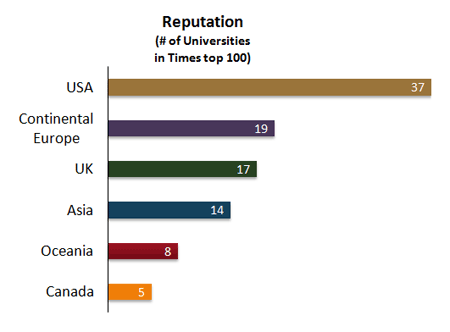
THE World Reputation Rankings serve as a subsidiary of the overall league tables and rank universities independently in accordance with their scores in prestige.
Scott Jaschik of Inside Higher Ed said of the new rankings: "...Most outfits that do rankings get criticised for the relative weight given to reputation as opposed to objective measures. While Times Higher Education does overall rankings that combine various factors, it is today releasing rankings that can't be criticised for being unclear about the impact of reputation – as they are strictly of reputation."
| Institution | 2025 | 2023 | 2022 | 2021 | 2020 | 2019 | 2018 | 2017 | url=https://www.timeshighereducation.com/world-university-rankings/2016/reputation-ranking#!/page/0/length/25/sort_by/rank_label/sort_order/asc/cols/rank_only | title=World Reputation Rankings 2016 | magazine=Times Higher Education | access-date=17 June 2016 | archive-date=5 March 2018 | archive-url=https://web.archive.org/web/20180305000224/https://www.timeshighereducation.com/world-university-rankings/2016/reputation-ranking#!/page/0/length/25/sort_by/rank_label/sort_order/asc/cols/rank_only | url-status=live}} | url=http://www.timeshighereducation.co.uk/world-university-rankings/2015/reputation-ranking | title=THE World Reputation Rankings (2015) | magazine=Times Higher Education | access-date=14 March 2015 | archive-date=15 March 2015 | archive-url=https://web.archive.org/web/20150315082437/http://www.timeshighereducation.co.uk/world-university-rankings/2015/reputation-ranking | url-status=live}} | url=http://www.timeshighereducation.co.uk/world-university-rankings/2014/reputation-ranking | title=THE World Reputation Rankings (2014) | magazine=Times Higher Education | access-date=14 March 2015 | archive-date=25 February 2016 | archive-url=https://web.archive.org/web/20160225193609/https://www.timeshighereducation.co.uk/world-university-rankings/2014/reputation-ranking | url-status=live}} | url=http://www.timeshighereducation.co.uk/world-university-rankings/2013/reputation-ranking | title=THE World Reputation Rankings (2013) | magazine=Times Higher Education | access-date=14 March 2015 | archive-date=3 July 2015 | archive-url=https://web.archive.org/web/20150703065611/https://www.timeshighereducation.co.uk/world-university-rankings/2013/reputation-ranking | url-status=live}} | url=http://www.timeshighereducation.co.uk/world-university-rankings/2012/reputation-ranking | title=THE World Reputation Rankings (2012) | magazine=Times Higher Education | access-date=14 March 2015 | archive-date=14 August 2015 | archive-url=https://web.archive.org/web/20150814051116/https://www.timeshighereducation.co.uk/world-university-rankings/2012/reputation-ranking | url-status=live}} | url=http://www.timeshighereducation.co.uk/world-university-rankings/2011/reputation-ranking | title=THE World Reputation Rankings (2011) | magazine=Times Higher Education | access-date=14 March 2015 | archive-date=1 September 2015 | archive-url=https://web.archive.org/web/20150901144932/https://www.timeshighereducation.co.uk/world-university-rankings/2011/reputation-ranking | url-status=live}} |
|---|---|---|---|---|---|---|---|---|---|---|---|---|---|---|---|---|---|---|---|---|---|---|---|---|---|---|---|---|---|---|---|---|---|---|---|---|---|---|---|---|---|---|---|---|---|---|---|---|---|---|
| United States Harvard University | 1 | 1 | 1 | 1 | 1 | 1 | 1 | 1 | 1 | 1 | 1 | 1 | 1 | 1 | ||||||||||||||||||||||||||||||||||||
| United States Massachusetts Institute of Technology | =2 | 2 | 2 | 2 | 2 | 2 | 2 | 2 | 2 | 4 | 2 | 2 | 2 | 2 | ||||||||||||||||||||||||||||||||||||
| United Kingdom University of Oxford | =2 | 4 | 4 | 3 | 5 | 5 | 5 | 4 | 5 | 3 | 5 | 4 | 6 | 6 | ||||||||||||||||||||||||||||||||||||
| United States Stanford University | =4 | 3 | 3 | 4 | 3 | 3 | 3 | 3 | 3 | 5 | 3 | 6 | 4 | 5 | ||||||||||||||||||||||||||||||||||||
| United Kingdom University of Cambridge | =4 | 5 | 5 | 5 | 4 | 4 | 4 | 4 | 4 | 2 | 4 | 3 | 3 | 3 | ||||||||||||||||||||||||||||||||||||
| United States University of California, Berkeley | 6 | 6 | 6 | 6 | 6 | 6 | 6 | 6 | 6 | 6 | 6 | 5 | 5 | 4 | ||||||||||||||||||||||||||||||||||||
| United States Princeton University | 7 | 7 | 7 | 7 | 7 | 7 | 7 | 7 | 7 | 7 | 7 | 7 | 7 | 7 | ||||||||||||||||||||||||||||||||||||
| China Tsinghua University | 8 | 8 | 9 | 10 | 13 | 14 | 14 | 14 | 18 | 26 | 36 | 35 | 30 | 35 | ||||||||||||||||||||||||||||||||||||
| United States Yale University | 9 | 9 | 8 | 8 | 8 | 8 | 8 | 8 | 8 | 8 | 8 | 10 | 10 | 9 | ||||||||||||||||||||||||||||||||||||
| Japan University of Tokyo | 10 | 10 | 10 | 13 | 10 | 11 | 13 | 11 | 12 | 12 | 11 | 9 | 8 | 8 |
Regional rankings
Asia
From 2013 to 2015, the outcomes of the Times Higher Education Asia University Rankings were the same as the Asian universities' position on its World University Rankings. In 2016, the Asia University Rankings was revamped and it "use the same 13 performance indicators as the THE World University Rankings, but have been recalibrated to reflect the attributes of Asia's institutions."
| Institution | 2025 | 2024 | 2023 | 2022 | 2021 | 2020 | url=https://www.timeshighereducation.com/world-university-rankings/2019/regional-ranking#!/page/0/length/25/sort_by/rank/sort_order/asc/cols/stats | title=Asia University Rankings 2019 | date=26 April 2019 | access-date=4 March 2020 | archive-date=4 May 2019 | archive-url=https://web.archive.org/web/20190504060851/https://www.timeshighereducation.com/world-university-rankings/2019/regional-ranking#!/page/0/length/25/sort_by/rank/sort_order/asc/cols/stats | url-status=live}} | url=https://www.timeshighereducation.com/world-university-rankings/2018/regional-ranking#!/page/0/length/25/sort_by/rank/sort_order/asc/cols/stats | title=Asia University Rankings 2018 | date=5 February 2018 | access-date=7 January 2019 | archive-date=6 February 2018 | archive-url=https://web.archive.org/web/20180206195302/https://www.timeshighereducation.com/world-university-rankings/2018/regional-ranking#!/page/0/length/25/sort_by/rank/sort_order/asc/cols/stats | url-status=live}} | url=https://www.timeshighereducation.com/world-university-rankings/2017/regional-ranking#!/page/0/length/25/sort_by/rank/sort_order/asc/cols/stats | title=Asia University Rankings 2017 | date=14 March 2017 | access-date=17 August 2017 | archive-date=21 November 2017 | archive-url=https://web.archive.org/web/20171121153125/https://www.timeshighereducation.com/world-university-rankings/2017/regional-ranking#!/page/0/length/25/sort_by/rank/sort_order/asc/cols/stats | url-status=live}} | url=https://www.timeshighereducation.com/world-university-rankings/2016/regional-ranking#!/page/0/length/25/sort_by/rank_label/sort_order/asc/cols/rank_only | title=Asia University Rankings 2016 | date=19 May 2016 | access-date=24 June 2016 | archive-date=16 September 2016 | archive-url=https://web.archive.org/web/20160916213554/https://www.timeshighereducation.com/world-university-rankings/2016/regional-ranking#!/page/0/length/25/sort_by/rank_label/sort_order/asc/cols/rank_only | url-status=live}} | url=https://www.timeshighereducation.co.uk/world-university-rankings/2014-15/regional-ranking/region/asia | title=Asia University Rankings 2015 Results | magazine=Times Higher Education | access-date=12 June 2015 | archive-date=12 June 2015 | archive-url=https://web.archive.org/web/20150612030406/https://www.timeshighereducation.co.uk/world-university-rankings/2014-15/regional-ranking/region/asia | url-status=live}} | url=http://www.timeshighereducation.co.uk/world-university-rankings/2013-14/regional-ranking/region/asia | title=THE Asia University Rankings (2014) | magazine=Times Higher Education | access-date=14 March 2015 | archive-date=12 August 2014 | archive-url=https://web.archive.org/web/20140812084308/http://www.timeshighereducation.co.uk/world-university-rankings/2013-14/regional-ranking/region/asia | url-status=live}} | url=http://www.timeshighereducation.co.uk/world-university-rankings/2012-13/regional-ranking/region/asia | title=THE Asia University Rankings (2013) | magazine=Times Higher Education | access-date=14 March 2015 | archive-date=12 August 2014 | archive-url=https://web.archive.org/web/20140812085851/http://www.timeshighereducation.co.uk/world-university-rankings/2012-13/regional-ranking/region/asia | url-status=live}} |
|---|---|---|---|---|---|---|---|---|---|---|---|---|---|---|---|---|---|---|---|---|---|---|---|---|---|---|---|---|---|---|---|---|---|---|---|---|---|---|---|---|---|---|---|---|---|---|---|---|---|---|---|---|---|---|---|
| CHN Tsinghua University | 1 | 1 | 1 | 1 | 1 | 1 | 1 | 2 | 3 | 5 | 5 | 6 | 6 | ||||||||||||||||||||||||||||||||||||||||||
| CHN Peking University | 2 | 2 | 2 | 2 | 2 | 2 | 5 | 3 | 2 | 2 | 4 | 5 | 4 | ||||||||||||||||||||||||||||||||||||||||||
| SIN National University of Singapore | 3 | 3 | 3 | 3 | 3 | 3 | 2 | 1 | 1 | 1 | 2 | 2 | 2 | ||||||||||||||||||||||||||||||||||||||||||
| SIN Nanyang Technological University | 4 | 4 | 5 | 5 | 5 | 6 | 6 | 5 | 4 | 2 | 10 | 11 | 11 | ||||||||||||||||||||||||||||||||||||||||||
| JPN University of Tokyo | 5 | 5 | 8 | 6 | 6 | 7 | 8 | 8 | 7 | 7 | 1 | 1 | 1 | ||||||||||||||||||||||||||||||||||||||||||
| HKG University of Hong Kong | 6 | 6 | 4 | 4 | 4 | 4 | 4 | 4 | 5 | 4 | 3 | 3 | 3 | ||||||||||||||||||||||||||||||||||||||||||
| CHN Fudan University | 7 | 8 | 9 | 10 | 11 | 17 | 17 | 16 | 16 | 19 | 24 | 25 | 24 | ||||||||||||||||||||||||||||||||||||||||||
| CHN Zhejiang University | 8 | 9 | 12 | 11 | 12 | =13 | 14 | 18 | 19 | 25 | 46 | 41 | 45 | ||||||||||||||||||||||||||||||||||||||||||
| HKG Chinese University of Hong Kong | 9 | 10 | 6 | 7 | 7 | 8 | 7 | 7 | 11 | 13 | 13 | 12 | 12 | ||||||||||||||||||||||||||||||||||||||||||
| CHN Shanghai Jiao Tong University | 10 | 7 | 9 | 13 | 16 | 19 | 24 | =20 | 18 | =32 | 39 | 47 | 40 |
Emerging economies
The Times Higher Education Emerging Economies Rankings (Formerly known as BRICS & Emerging Economies Rankings) only includes universities in countries classified as "emerging economies" by FTSE Group, including the "BRICS" nations of Brazil, Russia, India, China and South Africa. Hong Kong institutions are not included in this ranking.
| Institution | 2022 | 2021 | 2020 | 2019 | 2018 | 2017 | 2016 | url=http://www.timeshighereducation.co.uk/world-university-rankings/2015/brics-and-emerging-economies | title=THE BRICS & Emerging Economies Rankings 2015 | magazine=Times Higher Education | access-date=4 April 2015 | date=2015 | archive-date=6 September 2015 | archive-url=https://web.archive.org/web/20150906102849/https://www.timeshighereducation.co.uk/world-university-rankings/2015/brics-and-emerging-economies | url-status=live}} | url=http://www.timeshighereducation.co.uk/world-university-rankings/2014/brics-and-emerging-economies | title=THE BRICS & Emerging Economies Rankings 2014 | magazine=Times Higher Education | access-date=14 March 2015 | date=2014 | archive-date=18 March 2015 | archive-url=https://web.archive.org/web/20150318185625/http://www.timeshighereducation.co.uk/world-university-rankings/2014/brics-and-emerging-economies | url-status=live}} |
|---|---|---|---|---|---|---|---|---|---|---|---|---|---|---|---|---|---|---|---|---|---|---|---|
| PRC Peking University | 1 | 2 | 2 | 2 | 1 | 1 | 1 | 1 | 1 | ||||||||||||||
| PRC Tsinghua University | 2 | 1 | 1 | 1 | 2 | 2 | 2 | 2 | 2 | ||||||||||||||
| PRC Zhejiang University | 3 | 3 | 3 | 3 | 6 | 9 | 8 | 21 | 22 | ||||||||||||||
| PRC Fudan University | 4 | 4 | 7 | 6 | 4 | 6 | 17 | 9 | 8 | ||||||||||||||
| PRC Shanghai Jiao Tong University | 5 | 5 | 6 | 8 | 7 | 7 | 7 | 16 | 27 | ||||||||||||||
| RUS Lomonosov Moscow State University | 6 | 6 | 5 | 5 | 3 | 3 | 3 | 5 | 10 | ||||||||||||||
| PRC University of Science and Technology of China | 7 | 7 | 4 | 4 | 5 | 5 | 7 | 11 | 6 | ||||||||||||||
| PRC Nanjing University | 8 | 9 | 9 | 7 | 8 | 11 | 14 | 22 | 18 | ||||||||||||||
| ROC National Taiwan University | 9 | 8 | 8 | 10 | 10 | 10 | 5 | 6 | 4 | ||||||||||||||
| RUS Moscow Institute of Physics and Technology | 10 | 11 | 12 | 12 | 11 | 12 | 93 | 69 | – |
Notes
References
References
- Elsevier. "Discover the data behind the Times Higher Education World University Rankings".
- McKenna, Sioux. (2024). "Critical Look at the University Ranking Industry".
- (2018-03-02). "The history and development of higher education ranking systems". QS Asia News Network.
- (2016-09-14). "Strength and weakness of varsity rankings". NST Online.
- Bekhradnia, Bahram. "International university rankings: For good or ill?".
- Wildavsky, Ben. (2010). "The Great Brain Race: How Global Universities are Reshaping the World". [[Princeton University Press]].
- Baty, Phil. "New data partner for World University Rankings".
- Mroz, Ann. "Leader: Only the best for the best".
- Baty, Phil. (10 September 2010). "Views: Ranking Confession".
- (17 February 2010). "Back to square one on the rankings front". The Australian.
- Baty, Phil. "THE World Rankings set for release on 16 September".
- (2010-09-16). "New world university ranking puts Harvard back on top". Christian Science Monitor.
- Indira Samarasekera & Carl Amrhein. "Top schools don't always get top marks". The Edmonton Journal.
- Philip G. Altbach. (11 November 2010). "The State of the Rankings".
- Simon Beck and Adrian Morrow. (16 September 2010). "Canada's universities make the grade globally". [[The Globe and Mail]].
- (November 19, 2014). "Times Higher Education announces reforms to its World University Rankings".
- (16 September 2010). "Robust, transparent and sophisticated".
- Baty, Phil. "THE unveils broad, rigorous new rankings methodology".
- (5 October 2022). "World University Rankings 2023: Methodology".
- THE World University Rankings Masterclass 2024, January 20th, 2023.
- (11 December 2025). "THE 2025 World University Rankings Masterclass - APAC region".
- link. (25 September 2011 " (5 September 2011). ''Times Higher Education''.)
- link. (24 September 2011 " (13 September 2011), ''Times Higher Education''.)
- (30 September 2015). "World University Rankings 2015/16".
- (17 August 2016). "World University Rankings 2016–2017 launch date announced".
- [http://www.timeshighereducation.co.uk/world-university-rankings/2011-2012/analysis-rankings-methodology.html THE Global Rankings: Change for the better] {{Webarchive. link. (14 July 2012 . Times Higher Education (2011-10-06). Retrieved on 2013-07-17.)
- (2010-11-28). "GLOBAL: Crucial to measure teaching in rankings". Universityworldnews.com.
- Baty, Phil. (2011-08-16). "Arts on an equal footing". Timeshighereducation.co.uk.
- "Faculty Area Normalization – Technical Explanation". QS Quacquarelli Symonds.
- Andrew Trounson, "[http://www.theaustralian.com.au/higher-education/science-bias-will-affect-local-rankings/story-e6frgcjx-1225877209849 Science bias will affect local rankings] {{Webarchive. link. (20 August 2014 " (9 June 2010). ''[[The Australian]]''.)
- Steve Smith. (16 September 2010). "Pride before the fall?". Times Higher Education World University Rankings.
- "[http://www.timeshighereducation.co.uk/world-university-rankings/2010-2011/analysis-uk-education.html Global path for the best of British] {{Webarchive. link. (26 September 2012 ," (16 September 2010). ''Times Higher Education'' World University Rankings.)
- (27 November 2014). "New partner for THE rankings; David Willetts joins TES Global advisory board".
- "[http://www.eua.be/Libraries/Publications_homepage_list/Global_University_Rankings_and_Their_Impact.sflb.ashx Global university rankings and their impact] {{Webarchive. link. (26 August 2012 ," (2011). "European University Association")
- (2001). "Language biases in the coverage of the ''Science Citation Index'' and its consequences for international comparisons of national research performance".
- Holmes, Richard. (2006-09-05). "So That's how They Did It". Rankingwatch.blogspot.com.
- "Changingpublication patterns in the Social Sciences and Humanities 2000–2009".
- (2021-09-02). "A new perspective on university ranking methods worldwide and in the Arab region: facts and suggestions". Quality in Higher Education.
- "A World of Difference: A Global Survey of University League Tables".
- [http://www2.lse.ac.uk/.../LSEServices/.../LSEInvestigationsIntoTheTHEandQSleaguetables.aspx]{{dead link. (September 2010)
- "LSE in university league tables – External Relations Division – Administrative and academic support divisions – Services and divisions – Staff and students – Home". London School of Economics.
- "LSE in university league tables – About LSE – Home".
- (22 September 2016). "Trinity removed from rankings after data error". [[RTÉ.ie]].
- Guttenplan, D. d. (2010-11-14). "Questionable Science Behind Academic Rankings". The New York Times.
- Strasser, Franz. (2015-06-03). "How US students get a university degree for free in Germany". BBC News.
- "Rankings data row fuels push to oust university leader".
- "衆議院インターネット審議中継".
- (5 September 2021). "Seven IITs continue boycott, no Indian institute in top 300".
- (2023-09-25). "World University Rankings".
- (2021-08-25). "World University Rankings 2023".
- (2021-08-25). "World University Rankings 2022".
- "World University Rankings 2021".
- "World University Rankings 2020".
- "World University Rankings 2019".
- "World University Rankings 2018".
- "World University Rankings 2016–2017".
- "World University Rankings 2015–2016".
- "World University Rankings 2014–15".
- "World University Rankings 2013–14".
- "World University Rankings 2012–13".
- "Times Higher Education 150 Under 50 Rankings 2016".
- "Times Higher Education 150 Under 50 Rankings 2022".
- (13 April 2015). "TIMES Higher Education University Rankings by subjects (2013/14)".
- John Morgan. "Times Higher Education World Reputation Rankings".
- Scott Jaschik. "Global Comparisons".
- (2025-02-18). "World Reputation Rankings 2025: results announced".
- (2024-02-13). "The top 50 universities by reputation 2023".
- (2022-11-16). "World Reputation Rankings".
- (2021-10-25). "World Reputation Rankings".
- (2020-10-30). "World Reputation Rankings 2020".
- (July 2019). "World Reputation Rankings 2019".
- (2018-05-30). "World Reputation Rankings".
- (2017-06-05). "World Reputation Rankings".
- "World Reputation Rankings 2016".
- "THE World Reputation Rankings (2015)".
- "THE World Reputation Rankings (2014)".
- "THE World Reputation Rankings (2013)".
- "THE World Reputation Rankings (2012)".
- "THE World Reputation Rankings (2011)".
- (2025-04-16). "Asia University Rankings".
- (2024-04-23). "Asia University Rankings".
- (2023-06-13). "Asia University Rankings".
- (2022-06-01). "Asia University Rankings".
- (2021-05-18). "Asia University Rankings".
- (2020-05-28). "Asia University Rankings".
- (26 April 2019). "Asia University Rankings 2019".
- (5 February 2018). "Asia University Rankings 2018".
- (14 March 2017). "Asia University Rankings 2017".
- (19 May 2016). "Asia University Rankings 2016".
- "Asia University Rankings 2015 Results".
- "THE Asia University Rankings (2014)".
- "THE Asia University Rankings (2013)".
- (2021-10-15). "Emerging Economies".
- (2021-03-03). "Emerging Economies".
- (22 January 2020). "Emerging Economies University Rankings 2020".
- (15 January 2019). "Emerging Economies University Rankings 2019".
- (9 May 2018). "Emerging Economies University Rankings 2018".
- (24 November 2016). "Emerging Economies University Rankings 2017".
- (2 December 2015). "BRICS & Emerging Economies Rankings 2016".
- (2015). "THE BRICS & Emerging Economies Rankings 2015".
- (2014). "THE BRICS & Emerging Economies Rankings 2014".
This article was imported from Wikipedia and is available under the Creative Commons Attribution-ShareAlike 4.0 License. Content has been adapted to SurfDoc format. Original contributors can be found on the article history page.
Ask Mako anything about Times Higher Education World University Rankings — get instant answers, deeper analysis, and related topics.
Research with MakoFree with your Surf account
Create a free account to save articles, ask Mako questions, and organize your research.
Sign up freeThis content may have been generated or modified by AI. CloudSurf Software LLC is not responsible for the accuracy, completeness, or reliability of AI-generated content. Always verify important information from primary sources.
Report