From Surf Wiki (app.surf) — the open knowledge base
Tiki bar
Bar with a "Tiki" or Polynesian theme
.jpg)
Bar with a "Tiki" or Polynesian theme
Many early tiki bars were attached to hotels or were the bar sections for large Asian restaurants. While some are freestanding, cocktail-only affairs, many still serve food; and some hotel-related tiki establishments are still in existence. Large tiki bars may also incorporate a stage for live entertainment. Musicians such as Alfred Apaka and Don Ho played a historically important role in their popularity, and the bars also booked acts such as exotica-style bands and Polynesian dance floor shows.
History
Don the Beachcomber
One of the earliest and perhaps the first known tiki bar was named "Don the Beachcomber," established in the Hollywood area of Los Angeles, California in 1933 by Ernest Gantt (who later legally changed his name to "Donn Beach"). The bar served a wide variety of exotic rum drinks (including the Sumatra Kula and Zombie cocktail), and later Cantonese food. It displayed many artifacts that he had collected on earlier trips through the tropics. When Beach was sent to World War II, Don the Beachcomber flourished under his ex-wife's management (Sunny Sund), expanding into a chain of 16 restaurants. Ultimately there were at least 25 restaurants in the chain.
When Gantt returned from the War, he moved to Hawaii and opened Waikiki Beach, one of two archetypal tiki bars. The bar was designed to evoke the South Pacific, with palm trees, tiki masks on the walls, a garden hose that showered a gentle rain on the roof and a myna bird that was trained to shout "Give me a beer, stupid!" The bar was located on the beach, lit by tiki torches outside which enhanced its ambiance. A Don the Beachcomber was located at Waikiki's International Market Place.
Trader Vic's
The other archetypical bar is Trader Vic's, the first of which was created by Victor Bergeron in Oakland, California, in 1936. The quintessential tiki cocktail, the Mai Tai, was concocted at the original Trader Vic's in 1944. He began opening franchises outside of California, beginning with The Outrigger in Seattle, Washington in 1949.
In 1957, lacking the capital to expand, Bergeron partnered with Conrad Hilton and licensed the Trader Vic's brand to Hilton Hotels for $2,000,000, for use in Hiltons across the US and worldwide. Hilton retained Bergeron to oversee the decoration, staffing and operation of the restaurants for an annual salary of $65,000. Hilton soon estimated the popular Trader Vic's establishments were earning his hotel chain $5 million a year. As the chain expanded, Bergeron also marketed tiki mugs, cocktail mixes, and other products for mass retail sale.
Members of the Bergeron family still have a hand in the operations of at least one branch. The original restaurant in Oakland, California, no longer exists but there is still a Trader Vic's a few miles away in nearby Emeryville. Roughly 20 locations are operating throughout the world and bearing the iconic name.
Other historical establishments
.jpg)
Prior to Donn Beach opening his first tiki bar, during the 1930s South Pacific-influenced dreams of escapism had started to become more prevalent in American music and popular culture. The "kitschy" Clifton's Cafeteria opened in 1931 with some elements that today could be viewed as part of "tiki-like" thematics (indoor gardens with exotic travel themes), labeled by Tiki historian Sven Kirsten as pre-tiki and part of the "birth of Polynesian pop". In 1939 Clifton's Pacific Seas was remodeled to a full-blown exotic setting and decorated with 12 waterfalls, volcanic rock, and tropical foliage. The original restaurant was demolished, but a much smaller version in the form of a side-room bar named the Pacific Seas resides at another Clifton's location.
The Tonga Room of the Fairmont Hotel in San Francisco is an iconic tiki bar operating since 1945, still retaining its Polynesian flair after having undergone a number of facelifts over the years. At one time the Sheraton Hotel, Hilton Hotel, and Marriott Hotel chains all had several tiki bars incorporated into their establishments.
From California, tiki spread north, and The Alibi Tiki Lounge is a currently operating tiki bar established in Portland, Oregon from 1947. The Kalua Room opened as part of the Windsor Hotel in Seattle in 1953 and was one of the first to put a tiki-like image next to their restaurant's name. The oldest operating tiki bar in Hawaii is the La Mariana Sailing Club Tiki Bar and Restaurant, established in 1957. The Hawaiian Village Hotel was the home to legendary tiki bartender Harry Yee.
California's Tiki Ti is another historically important tiki establishment still in operation, as is Florida's Mai Kai, which is a focal spot for a large annual hukilau tiki gathering. Shelter Island, San Diego had at one time a heavily concentrated area of tiki bars, the best known being the still operating Bali Hai.
In 1962, the now famous Kon Tiki Bar opened in Tucson, Arizona. Also in 1962, the Sip 'n Dip Lounge opened in Great Falls, Montana, bringing a tiki theme to the cold northern state and featuring a swimming pool where swimmers could be observed underwater from a window in the bar, a concept inspired by a similar design at the Playboy Club in Chicago.
The Kahiki Supper Club was a very large tiki restaurant and bar in Columbus, Ohio (since demolished). The Pago Pago Lounge was in Tucson, and the Chin Tiki and Mauna Loa were in Detroit (both closed). The Zombie Hut closed in 1990. Stephen Crane's The Luau restaurant is also gone but was considered historically important in the tiki craze's early days, as were Trader Vic's and Don the Beachcomber.
Eli Hedley (1903–1981), a sculptor and beachcomber, had "Island Trade Store", a Polynesian-themed tiki bar, in Midway City, California, "Tiki's Tropical Traders", a retail venue in Disneyland, where Steve Martin worked, and also worked with Donn Beach.{{efn|Attributed to multiple sources: https://web.archive.org/web/*/http://www.tikiroom.com/tikicentral/bb/viewtopic.php?topic=22916&forum=1 --}}
Decline and revival
The original tiki bars flourished for about 30 years, and then fell out of vogue. In the 1990s, the tiki culture was revived by a new generation of fans and new tiki bars were founded worldwide that often looked to Trader Vic's and Don the Beachcomber for inspiration. In that decade, the Sip 'n Dip Lounge, which had survived with its tiki theme intact, added the feature of having women dressed as mermaids swimming in their pool within view of the bar's patrons. The live mermaid incorporation and the overall retro tiki ambience led GQ Magazine to rate the lounge as one of the top 10 bars in the world for 2003. By the mid-2010s, both traditional tiki cocktails and new cocktails with tiki characteristics were being served in bars associated with the craft cocktail movement.
Michael Warren of The Dispatch associates the tiki revival in the 2010s and 2020s with bars such as San Francisco's Smuggler's Cove and Brooklyn's Sunken Harbor Club.
Design and aesthetics
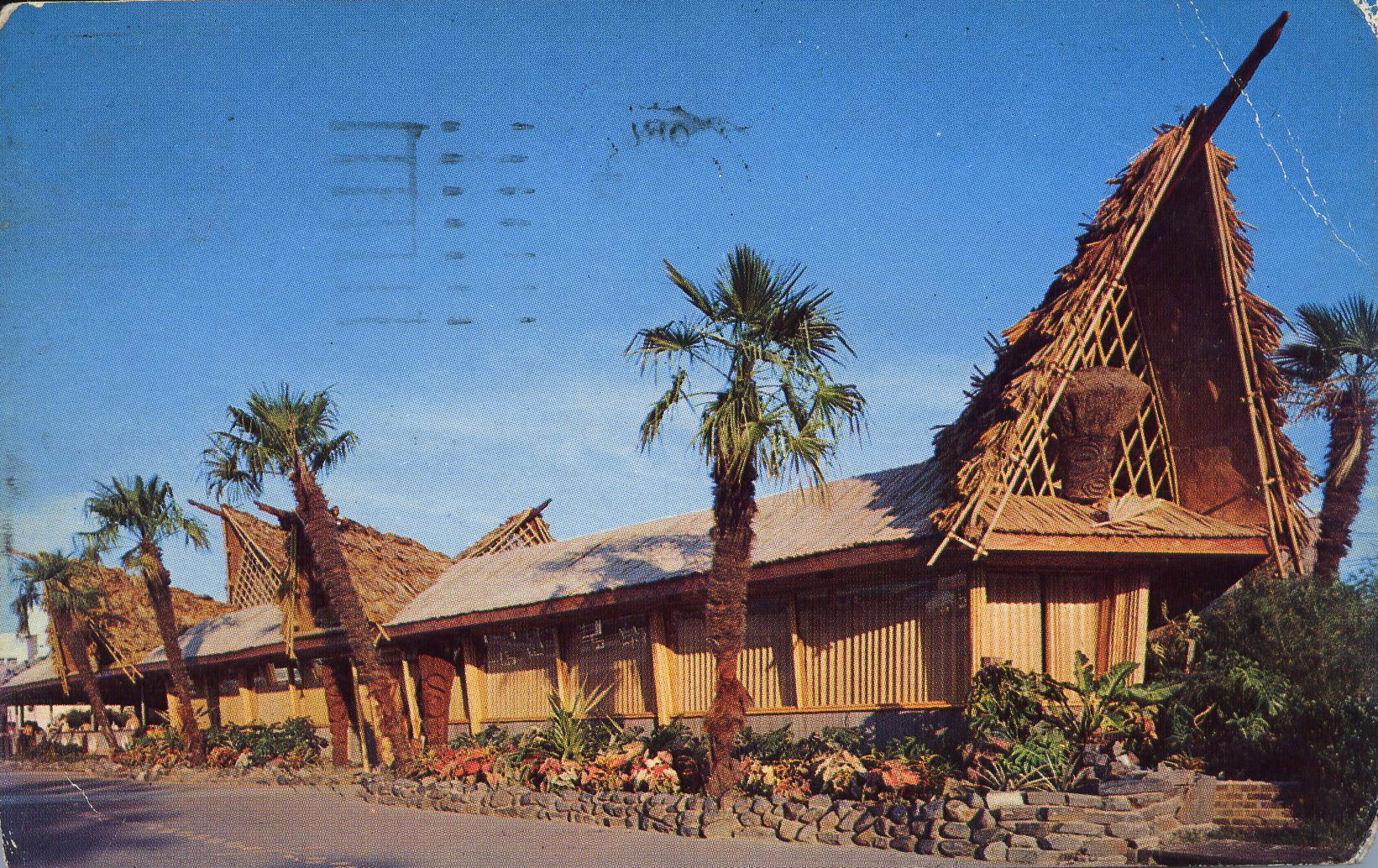
The interiors and exteriors of tiki bars often include tiki masks and carvings, hula girl motifs, black velvet paintings, large tropical murals, live plants or palm trees, bamboo, grasscloth, tapa cloth, and similar fabrics, torches, woven fish traps, pufferfish lamps, glass floats, and the use of rock and lava stone. Indoor fountains, waterfalls, or even lagoons are popular features.
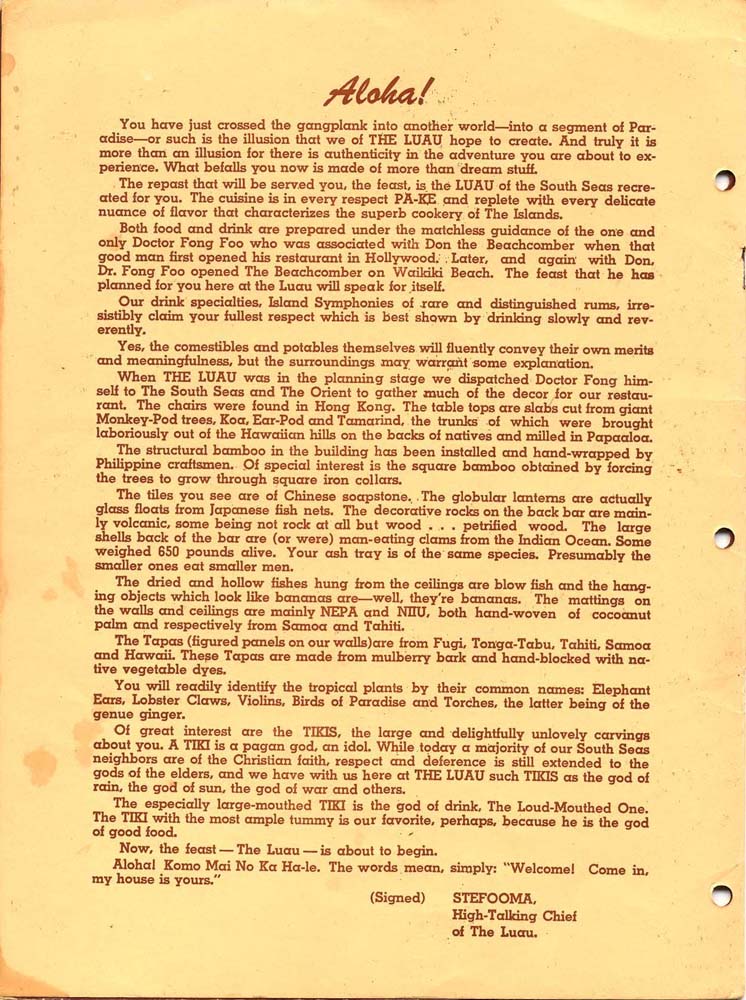
Beyond Donn Beach and Victor Bergeron, Stephen Crane was a well known promoter of the early tiki style, and was hired by Sheraton Hotels to design their Kon Tiki chain of establishments to compete with Hilton's Trader Vics. An early menu from his The Luau restaurant in Beverly Hills outlines where he got the materials for its decoration, including "chairs from Hong Kong", "Monkey pod furniture milled in Papaaloa", "structural bamboo hand-wrapped by Philippine craftsmen", "Chinese soapstone", the shells of "man-eating clams from the Indian ocean", and mentioning other materials from Nepa, Niiu, Samoa, Tahiti, Fuji, and of Tonga-Tabu origin.
"Mick" Brownlee was the main wood carver for Donn Beach in Hawaii. After 1956 many designs were also accomplished with original work from the company Oceanic Arts, co-owned by Bob Van Oosting and Leroy Schmaltz in California, which imported materials and did original wood carvings. The tiki aesthetic was also refined by restaurant designers Clif and Lou Sawyer, who took part in over 360 design projects including at The Luau, Don the Beachcomber (Palm Springs, AZ), The Reef (Casper, Wyoming), and the Pago Pago (Tucson, AZ).
Separate side rooms are employed, one of the earliest being "the black hole of Calcutta" as used by Donn Beach. Some of the biggest tiki restaurants are designed as large open air spaces with cavernous ceilings that allowed for the construction of separate areas with exotic names. The "cannibal room", "kon-tiki bar", "scorpion's den", and "trader's hut" could all be collected under one roof. Some like the Chin Tiki were multiple-level affairs, requiring patrons to climb stairs or cross bamboo bridges to get to other sections. The Kahiki Supper Club in Columbus, OH advertised as "The world's most elaborate Polynesian Supper Club" in Life Magazine and even provided its own interior map. This allowed keeping dinner show areas secluded away from more private drinking lounges, and lent to the "experience" by making patrons feel they had been transported away to an entire village. Limited windows or the use of fake windows with dioramas is done for similar reasons.
Live animals are sometimes present. The now closed Bahooka Tiki bar was famous for its over one-hundred fish tanks. The look of the establishment's menu, swizzle sticks, matchbook covers, and cocktail napkins can be extremely important design considerations for tiki bars. These add to the exotic destination immersion and feel for the bar and are taken home by customers where they then become a form of outside advertising.
Drinks

A hallmark of tiki bars are specialty drinks, some of which may be unique to a bar and the recipes for which were often carefully guarded in order to prevent imitation from competing bars or from customers trying to recreate a drink at home.
Multiple types of rums (light, dark, spiced, overproof and originating from various countries) are typically mixed together with orange liqueurs (Triple sec, Grand Marnier, Cointreau), tropical fruit juices, sweet syrups (falernum, fassionola, orgeat) and bitters. Many are bright in color, including more unusual cocktail colors such as blue (from Curaçao) and green hues (from Midori or Crème de menthe).
Some classic drink recipes from the early tiki era, many attributed to Don the Beachcomber or Trader Vic, include the:
Blue Hawaii, Cobra's Fang, Coffee Grog, Corpse Reviver, Doctor Funk, Diki-Diki, Fog Cutter, Fu Manchu, Gold Cup, Head Hunter, Mai Tai, Navy Grog, Lapu Lapu, Mr. Bali Hai, Outrigger, Pago Pago, Pearl Diver, Py Yi, Planter's Punch, QB Cooler, Rum Barrel, Scorpion, Shark's Tooth, Shrunken Head, Singapore Sling, Suffering Bastard, Sumatra Kula, Test Pilot, Three Dots & A Dash, and the Zombie
New tiki drinks continue to be created by a variety of bartenders and others. Jeff "Beachbum" Berry devised two cocktails in honor of new-wave tiki-pioneers Sven Kirsten and Otto Von Stroheim, with the Sven-Tiki and Otto's Grotto cocktails. He is also known from having created the Ancient Mariner and Von Tiki cocktails.
Beyond fruit, cocktails are often garnished for customers with paper cocktail umbrellas, fancy swizzle sticks, live flowers or plastic animals. Cocktails can be very complicated and dramatic, often served in decorated ceramic vessels, employing dry ice or ice shells, or may be set on fire. The ordering of some drinks also triggers a serving ritual, such as the Mystery Drink that could result in the ringing of a gong and a hula dressed "mystery girl" bringing the beverage to the table; the mystery drink was once popular enough that Johnny Carson "ordered" it twice during the filming of The Tonight Show. Some drinks ordered at Disney's Enchanted Tiki Bar also result in certain things happening, such as the ordering of a Krakatoa Punch causing the picture of a faux volcano to erupt.
Tiki mugs and drink vessels
Main article: Tiki mugs
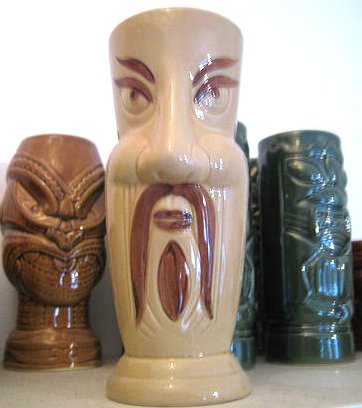
As the term is used generically, "tiki mugs" are ceramic drink vessels traditionally shaped as tikis, Easter Island statues (moai), shrunken heads, totems, coconuts, skulls, or in other Hawaiian, exotic, retro, or pirate-themed styles. The name of the bar is often listed on the back of the mug or its bottom. Wood may also be used, typically in the shapes of miniature barrels or boats. For some drinks actual fruit is used, such as hollowed-out pineapples or drilled coconuts with long straws that are used to serve customers.
Although many are much bigger than a typical coffee mug, for drinks that are meant to be shared, larger capacities are required. A Scorpion Bowl (or Kava Bowl) is an oversized cocktail that is served in a large bowl for communal drinking. A variation on the Scorpion Bowl is the Flaming Volcano. Also a communal drink, the Flaming Volcano is traditionally served in a ceramic volcano bowl that has a raised crater reservoir typically filled with a small amount of overproof rum (151 or 160) and carefully lit on fire. Large shells or their ceramic counterparts are also sometimes used for communal drinks, such as in the Chin Tiki Special.
Customers who want to keep a tiki mug can frequently do so for an additional fee. Mugs are often "taken" from the bar as a souvenir or collectible, and some mugs can be quite valuable.
Outside of the United States

Although a largely American creation, tiki bars are not limited to the United States, and many others exist in Canada, the Caribbean, Europe, Asia, and the Middle East, particularly in Germany and the United Kingdom. At least three tiki bars opened in Australia in 2017.
There are at least a dozen Trader Vic's locations in Europe and Asia, including in London, Tokyo, Munich, and Bangkok. The Trader Vic's franchise caters to its local clientele, and in London opened with a London Sour on its cocktail menu in 1965, and its Munich location with a Munich Sour in 1972.
In 2017 noted tiki historians Sven Kirsten, Jeff Berry, Martin Cate, Brian Miller, and Chris Osburn listed their top 15 operating tiki bars in the world and included four in London, one in Munich, one in Tokyo, and one in Barcelona. Other judges included top- rated tiki bars in Paris, Hong Kong, and Berlin.
Home tiki bars
In the wake of commercial tiki bars, during each wave of tiki popularity, home tiki bars were also built. Home bars often serve a dual purpose — to create a recreational space in which to imbibe home-crafted cocktails, and to show off tiki collections of mugs, art, and other artifacts. Home tiki bars are built both inside and outside, sometimes as man caves. Those built outdoors are typically placed in backyard patios but are also erected on the shorelines of boat docks for people living on the water.
Some of these home bars are simple but others are lavish enough to rival their commercial forebears. Not limited to America, many from around the world are uploaded onto internet sites and sometimes even toured.
Notes
References
References
- (2000). "The Book of Tiki". [[Taschen]].
- (1998). "Atomic Cocktails". Chronicle Books.
- (2010). "Beachbum Berry Remixed". Club Tiki Press.
- (5 January 2017). "A match made in paradise".
- (2000). "The Book of Tiki". Taschen.
- (September 16, 1986). "INTERVIEW WITH DONN BEACH". The Watumull Foundation, Oral History Project.
- "Don Ho polynesian palace".
- (2015). "Tiki Drinks: Tropical Cocktails for the Modern Bar". The Countryman Press.
- Wayne Curtis. (August 2006). "Tiki". American Heritage, Inc..
- (March 2009). "The History of the Tiki Bar". Tiki Bars.com.
- King. (25 November 2020). "Culinary Nationalism in Asia". Bloomsbury Academic.
- "Trader Vic's locations".
- "Cliftons Cafeteria".
- "Clifton's Pacific Seas".
- Laura Borman. (2015). "Discovering Vintage San Francisco: A Guide to the City's Timeless Eateries, Bars, Shops & More". Rowman & Littlefield.
- "Tiki History – The Kalua Room, Hotel Windsor, Seattle".
- "La Mariana Sailing Club".
- (7 October 2014). "14 Best Tiki Bars".
- "Oahu's private marina and original tiki bar".
- (9 September 2016). "The History of Tiki Cocktails and Where to Find the Best on Oʻahu and Maui".
- "Hukilau".
- "Bali Hai".
- "Kon Tiki Tucson".
- Tori Bender. (2014-02-15). "Tori Takes On Being a Mermaid At the Sip N Dip Lounge – KULR-8 Television, Billings, MT". Kulr8.com.
- "Tiki Bar Detroit".
- "Mauna Loa".
- (2000). "The Book of Tiki". Taschen.
- (31 May 1992). "Cool Jerk". [[New York Times]].
- (September 26, 2006). "Randottis' Visit WDW Construction Site and The Country Bears!".
- "Family Portraits, 1957".
- (1966). "Guide to Disneyland". Walt Disney Prod..
- (February 2015). "The Story of Disneyland". [[Issuu]].
- (December 16, 2017). "Remembering Disneyland".
- (2009-03-31). "Celebrating A Tribute To Royal Palms And Its History".
- (31 December 2018). "America Goes Hawaiian: The Influence of Pacific Island Culture on the Mainland". McFarland.
- (May 5, 2009). "Why Is There No Rum?".
- (3 May 2017). "Channeling the magic behind tiki bars with "Bamboo Ben"".
- (8 May 2017). "Eli Hedley's Island Trade Store Disneyland!".
- (8 October 2015). "Meet Bamboo Ben, Professional Tiki Bar Designer".
- (23 August 2017). "Tiki culture thrives in Las Vegas at Frankie's".
- "Nat Angelo Gozzano, Jr. Obituary".
- "Let's All Sing Like The Birdies Sing – Part I".
- "Remembering Tiki Boyd's".
- (14 November 2019). "Trader Mort's – San Diego CA".
- "And It All Started with a Thrift Store Find".
- (28 December 2010). "Bamboo Ben's Hut – Huntington Beach, CA".
- (22 January 1961). "Eli hedley". Independent.
- (28 March 1954). "Eli Hedley, tiki beachcomber, story". The Los Angeles Times.
- "Eli Hedley – Creator".
- "Ninety Years of Classic San Diego Tiki, 1928–2018 – The Book".
- (1979). "The Great Big Box Book". Crowell.
- (12 February 2015). "The Story of Disneyland".
- (26 September 2005). "Visit to the Hedley Homestead".
- (22 December 2005). "Storytime with Aunt Bungy".
- (11 July 2006). "Eli Hedley Beachcomber, 1943 Catalog (Reprint): Catalog of works of art made from driftwood and beachcombings". AuthorHouse.
- "Bibliographic Sources".
- (29 May 2013). "Frankie's talks true tiki". Las Vegas Review-Journal.
- "Frankie's Tiki Room". Atlas Obscura.
- (January 2017). "Happy 50th Birthday to Sunset Park!".
- "Disneyland > Adventureland > Photos".
- "Orange County's Tiki Bars of the Past and Present Help You to Forget About Your Boring Life". OC Weekly.
- (2009). "Rancho Palos Verdes". Arcadia Publishing.
- (November 2008). "View from the Top of the Mast". AuthorHouse.
- (1957). "How Daddy Became a Beachcomber". Bruce Humphries.
- "Space Age Tiki – Aku Aku at Stardust c. 1960".
- [http://www5.lasvegasnevada.gov/sirepub/view.aspx?cabinet=published_meetings&fileid=695352 Atomic Age Alliance] – LasVegasNevada.Gov
- "Aku Aku Statues".
- [https://www.clarkcountynv.gov/government/departments/parks___recreation/services/public_art/projects/aku_aku_tiki_head.php aku_aku_tiki_head] clarkcountynv.go
- (May 30, 2020). "Moai at the Stardust".
- (20 January 2016). "Why I love tiki bars and outrageous cocktails".
- (March 1, 2006). "Tiki comes home". The Star (Amman, Jordan).
- "Who Invented the Tiki Bar? A Brief (and Controversial) History". Men's Journal.
- (11 March 2006). "Tiki Style's Adoring Adherents Make Bygone Fad a Way of Life". Washington Post.
- (8 March 2006). "Tiki tacky? Paradise? Either way, it's coming back.".
- (May 15, 2017). "HopCat Founder Launches TikiCat, Kansas City's First Tiki Bar in Westport".
- "Bamboo Ben – Creator".
- "The Great Aku Aku!".
- (23 April 2014). "Aloha It's Me: Todd Rundgren On How To Open An Authentic Hawaiian Tiki Bar". Fast Company.
- (24 August 2006). "Family tribute to a tiki father". [[Los Angeles Times]].
- (26 September 2005). "Visit to the Hedley Homestead".
- (8 March 2008). "Eli Hedley, Midway City, and Beach Blvd.".
- (28 May 2007). "Tiki Road Trip: A Guide to Tiki Culture in North America". Santa Monica Press.
- "Island Trade Store - Tiki Bar".
- (5 June 2018). "A New Golden Age For The Tiki Bar".
- (3 September 2003). "Tik Bars Return to Detroit".
- (21 May 2014). "Philly's Tiki Heritage".
- Mark Ehrman. "Polynesian Review". Los Angeles Magazine.
- (19 February 2014). "Reports of Tiki's Death Have Been Greatly Exaggerated".
- (10 September 2012). "Mermaids: Entertainers with a tail". CNN.com.
- (2003-03-31). "MATR News: Quirky Sip-N-Dip (Great Falls) makes splash on GQ magazine's top 10 bars in the world". Matr.net.
- (4 August 2015). "How Tiki Cocktails Returned to Rock the Party, Again".
- (16 April 2025). "Tiki's Tide Crests Again".
- "The essential elements that comprise a Tiki bar".
- (24 October 2016). "Inside Don The Beachcomber: The Original Tiki Bar".
- (2000). "The Book of Tiki". Taschen.
- "LA public library data base".
- (2017). "Sippin' Safari". Cocktail Kingdom.
- "Mystery of the Hawaiian Fernwood Tiki".
- (2017). "Sippin' Safari". Cocktail Kingdom.
- "Project Gallery".
- (4 May 2018). "The Reef Lounge".
- (18 April 2013). "Don the Beachcomber's Tiki Haven".
- (11 September 2012). "History Lesson: The history of Columbus' most famed 'lost' restaurant – The Kahiki".
- "Tiki bar window illusion".
- (May 2011). "Don the Beachcomber helped launch wave of Polynesian restaurants".
- "The Myna Bird".
- (13 August 2016). "What's inside a tiki bird?".
- "tiki underground".
- "Fez Monkey".
- (2003). "Tiki Quest". Pegboard Press.
- (8 August 2012). "Tales of the Cocktail 2012: Stephen Crane".
- (6 June 2013). "5 Great Tiki Menus From The LA Library".
- (27 May 2016). "Swizzle sticks make a tiki comeback".
- "mermaid-cocktail".
- (September 2014). "Midori Colada".
- (2001). "Hawai'i Tropical Rum Drinks by Don the Beachcomber". Mutual Publishing.
- (1948). "Bartender's Guide". Garden City Books.
- (2010). "Beachbum Berry Remixed". Club Tiki Press.
- "Don The Beachcomber".
- (2010). "Beachbum Berry Remixed". Club Tiki Press.
- (29 August 2014). "The evolution of the garnish".
- "Most outrageous tiki drinks".
- (January 2012). "Mai Kai Mystery Girl".
- (6 June 2018). "A Brief History of Drinking Cocktails From Coconuts".
- Duggan McDonnell. (2015). "Drinking the Devil's Acre: A Love Letter from San Francisco and her Cocktails". Chronicle Books.
- "Hip bars say customers stealing".
- (8 September 2015). "Tiki bar mania heats up in Toronto".
- (23 October 2025). "Top Rated Tropical & Tiki Bar Experiences Across the Caribbean".
- "Tiki bars in Paris".
- "German Tiki Working Group".
- "Tiki Europe".
- "Best hidden bars in Berlin".
- "Tiki Bars in Munich".
- (23 March 2017). "Three new Tiki bars opening this year".
- (5 October 2017). "Tiki renaissance Australia podcast".
- "Trader Vic's locations".
- (2010). "Beachbum Berry Remixed". Club Tiki Press.
- (9 August 2017). "The World's 15 Most Important Tiki Bars".
- (13 April 2015). "World's 10 Best Tiki bars".
- (February 2019). "The Home Bar Guide to Tropical Cocktails: A Spirited Journey Through Suburbia's Hidden Tiki Temples". Korero Press.
- (22 February 2018). "How to outfit your home tiki bar".
- "Home Tiki Bars".
- (8 March 2017). "Tiki collectors escape winter in their basement paradise".
- "Home Tiki Bars".
- "LA Home Tiki Tour".
This article was imported from Wikipedia and is available under the Creative Commons Attribution-ShareAlike 4.0 License. Content has been adapted to SurfDoc format. Original contributors can be found on the article history page.
Ask Mako anything about Tiki bar — get instant answers, deeper analysis, and related topics.
Research with MakoFree with your Surf account
Create a free account to save articles, ask Mako questions, and organize your research.
Sign up freeThis content may have been generated or modified by AI. CloudSurf Software LLC is not responsible for the accuracy, completeness, or reliability of AI-generated content. Always verify important information from primary sources.
Report