From Surf Wiki (app.surf) — the open knowledge base
Thymol
Chemical compound found in plants including thyme

Chemical compound found in plants including thyme
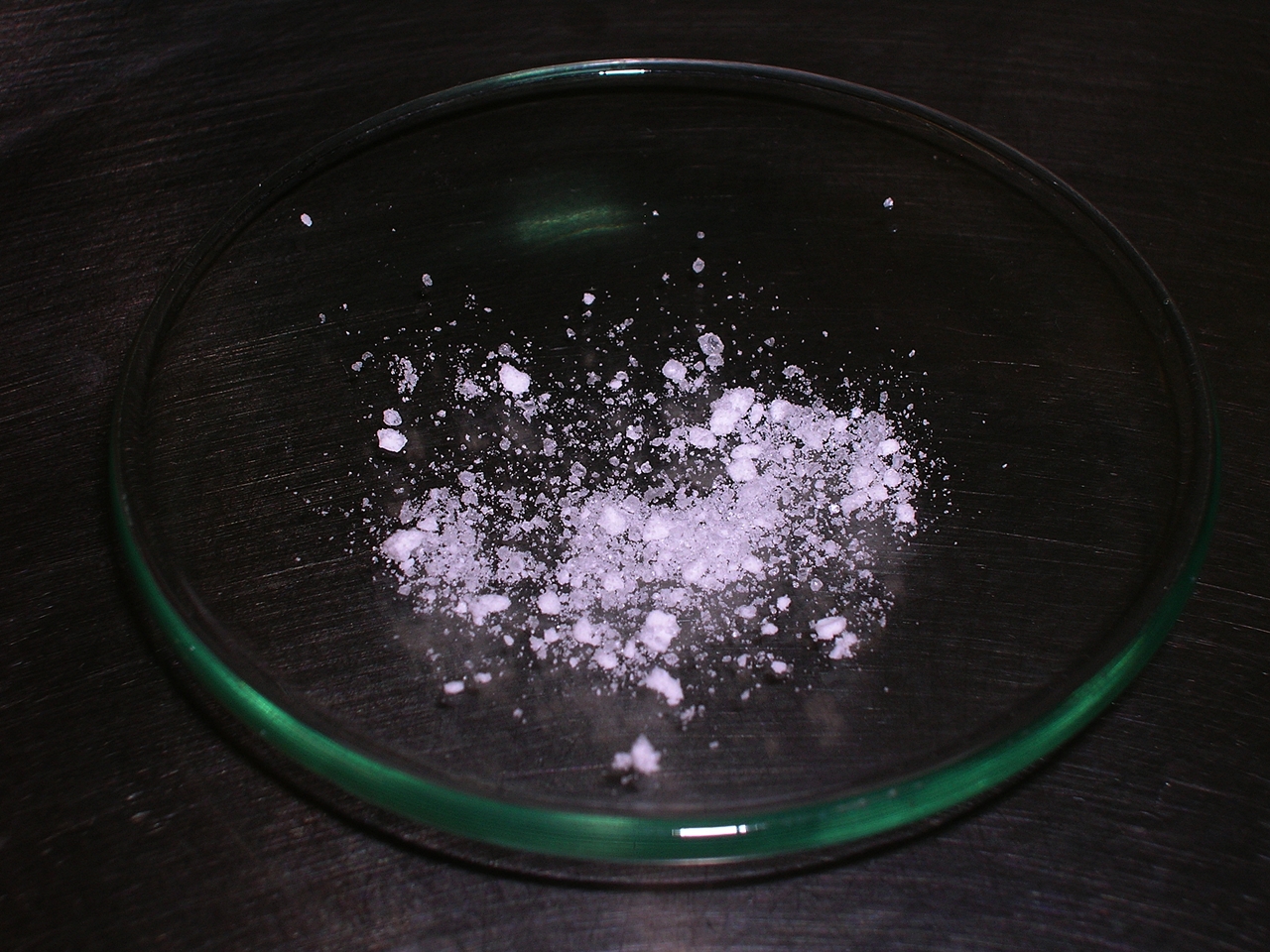
Thymol (also known as 2-isopropyl-5-methylphenol, IPMP), , is a monoterpenoid, phenol derivative of p-cymene, isomeric with carvacrol. It occurs naturally in oil of thyme and is extracted from Thymus vulgaris (common thyme), ajwain, and various other plants, as a white crystalline substance with a pleasant aromatic odor.
Thymol provides the distinctive flavor of the culinary herb thyme, also produced from T. vulgaris. Thymol is only slightly soluble in water at neutral pH, but due to deprotonation of the phenol, it is highly soluble in alcohols, other organic solvents, and strongly alkaline aqueous solutions.
Chemical synthesis
Thymol is produced by the alkylation of m-cresol and propene.
A predicted method of biosynthesis of thymol in thyme and oregano begins with the cyclization of geranyl diphosphate by TvTPS2 to γ-terpinene. Oxidation by a cytochrome P450 in the CYP71D subfamily creates a dienol intermediate, which is then converted into a ketone by short-chain dehydrogenase. Lastly, keto-enol tautomerization gives thymol. Its dissociation constant (pKa) is . Thymol absorbs maximum UV radiation at 274 nm.
History
The bee balms Monarda fistulosa and Monarda didyma, North American wildflowers, are natural sources of thymol. The Blackfoot Native Americans recognized these plants' strong antiseptic action and used poultices of the plants for skin infections and minor wounds. A tisane made from them was also used to treat mouth and throat infections caused by dental caries and gingivitis.
Thymol was first isolated by German chemist Caspar Neumann in 1719. In 1853, French chemist Alexandre Lallemand (1816-1886) named thymol and determined its empirical formula. Possible antiseptic properties of thymol were discovered in 1875, and it was first synthesized by Swedish chemist Oskar Widman (1852-1930) in 1882.
Extraction
The conventional method of extracting is hydro-distillation (HD), but can also be extracted with solvent-free microwave extraction (SFME). In 30 minutes, SFME yields similar amounts of thymol with more oxygenated compounds than 4.5 hours of hydro-distillation at atmospheric pressures without the need for solvent.
Uses
During the 1910s, thymol was used for hookworm infection in the United States. People of the Middle East continue to use za'atar, a delicacy made with large amounts of thyme, to reduce and eliminate internal parasites. It is also used as a preservative in halothane, an anaesthetic, and as an antiseptic in mouthwash. When used to reduce plaque and gingivitis, thymol has been found to be more effective when used in combination with chlorhexidine than when used purely by itself.
Thymol is a fragrance ingredient in some cosmetics. Thymol is also used as a rapidly degrading, non-persisting pesticide, Thymol is also used in the production of menthol through the hydrogenation of the aromatic ring.
List of plants that contain thymol
- Illicium verum
- Euphrasia rostkoviana
- Lagoecia cuminoides
- Monarda didyma
- Monarda fistulosa
- Mosla chinensis
- Ocimum gratissimum L.
- Origanum compactum
- Origanum dictamnus{{cite journal
- Origanum onites{{cite journal
- Origanum syriacum
- Origanum vulgare{{cite journal
- Satureja hortensis
- Satureja thymbra
- Thymus glandulosus{{cite journal
- Thymus hyemalis
- Thymus serpyllum
- Thymus praecox
- Thymus vulgaris{{cite journal
- Thymus zygis{{cite journal
- Trachyspermum ammi
Toxicology and environmental impacts
In 2009, the U.S. Environmental Protection Agency (EPA) reviewed the research literature on the toxicology and environmental impact of thymol and concluded that "thymol has minimal potential toxicity and poses minimal risk".
Environmental breakdown and use as a pesticide
Studies have shown that hydrocarbon monoterpenes and thymol in particular degrade rapidly (DT50 16 days in water, 5 days in soil) in the environment and are, thus, low risks because of rapid dissipation and low bound residues, supporting the use of thymol as a pesticide agent that offers a safe alternative to other more persistent chemical pesticides that can be dispersed in runoff and produce subsequent contamination. Though, there has been recent research into sustained released systems for botanically derived pesticides, such as using natural polysaccharides which would be biodegradable and biocompatible.
Compendial status
- British Pharmacopoeia{{cite web |access-date = 2009-07-05 |url-status = dead |archive-url = https://web.archive.org/web/20090411071437/http://www.pharmacopoeia.co.uk/pdf/2009_index.pdf |archive-date = 11 April 2009}}
- Japanese Pharmacopoeia
References
- (2014). "Nomenclature of Organic Chemistry : IUPAC Recommendations and Preferred Names 2013 (Blue Book)". The [[Royal Society of Chemistry]].
- "Thymol". PubChem.
- Mndzhoyan, A. L.. (1940). "Thymol from ''Thymus kotschyanus''.". Sbornik Trudov Armyanskogo Filial. Akad. Nauk..
- (21 June 2025). "Thymol". PubChem, US National Library of Medicine.
- O'Connell, John. (27 August 2019). "The book of spice: from anise to zedoary". Pegasus.
- (December 2012). "Newer Methods of Preparative Organic Chemistry, Volume 2". Academic Press.
- (2000). "Phenol Derivatives".
- CAS Registry: Data obtained from SciFinder{{full citation needed. (August 2017)
- (1986). "Study of the Steam Distillation of Phenolic Compounds Using Ultraviolent Spectrometry". Anal. Chem..
- Tilford, Gregory L.. (1997). "Edible and Medicinal Plants of the West". Mountain Press Publishing.
- Neuman, Carolo. (1724). "De Camphora". Philosophical Transactions of the Royal Society of London.
- Marie-Étienne-Alexandre Lallemand (25 December 1816 – 16 March 1886)
- Lallemand, A.. (1853). "Sur la composition de l'huile essentielle de thym". Comptes Rendus.
- Oettingen, Wolfgang Felix Von. (1949). "Phenol and Its Derivatives: The Relation Between Their Chemical Constitution and Their Effect on the Organism". U.S. Government Printing Office.
- Widmann, Oskar. (1882). "Ueber eine Synthese von Thymol aus Cuminol". Berichte der Deutschen Chemischen Gesellschaft zu Berlin.
- (2004-07-23). "Solvent-free microwave extraction of essential oil from aromatic herbs: comparison with conventional hydro-distillation". Journal of Chromatography A.
- (2021-12-28). "The biosynthesis of thymol, carvacrol, and thymohydroquinone in Lamiaceae proceeds via cytochrome P450s and a short-chain dehydrogenase". Proceedings of the National Academy of Sciences.
- Ferrell, John Atkinson. (1914). "The Rural School and Hookworm Disease". U.S. Government Printing Office.
- (1913). "Preventive Medicine and Hygiene". D. Appleton.
- (2013-06-11). "Za'atar: A Spice Mix With Biblical Roots And Brain Food Reputation". NPR.
- (2005). "Antimicrobial effects of essential oils in combination with chlorhexidine digluconate". Oral Microbiol. Immunol..
- Ward, Mark. (2006-03-08). "Almond farmers seek healthy bees". BBC.
- (2023-10-06). "Menthol {{!}} Definition, Structure, & Uses {{!}} Britannica".
- (2015). "Composition and Antimicrobial Activity of ''Euphrasia rostkoviana'' Hayne Essential Oil". Evid Based Complement Alternat Med.
- (1994). "Composition of the Essential Oil of ''Lagoecia cuminoides'' L. from Turkey". Journal of Essential Oil Research.
- (February 2017). "The Essential Oil of Monarda didyma L. (Lamiaceae) Exerts Phytotoxic Activity In Vitro against Various Weed Seeds". [[Molecules (journal).
- (1989). "An investigation of the component composition of the essential oil of ''Monarda fistulosa''". Chemistry of Natural Compounds.
- (2020-12-01). "Thymol bioactivity: A review focusing on practical applications". Arabian Journal of Chemistry.
- {{Federal Register. 74. 12613
- (2008). "Evaluation of the environmental fate of thymol and phenethyl propionate in the laboratory". Pest Manag. Sci..
- (2019-10-01). "Use of botanical insecticides for sustainable agriculture: Future perspectives". Ecological Indicators.
- "Japanese Pharmacopoeia".
This article was imported from Wikipedia and is available under the Creative Commons Attribution-ShareAlike 4.0 License. Content has been adapted to SurfDoc format. Original contributors can be found on the article history page.
Ask Mako anything about Thymol — get instant answers, deeper analysis, and related topics.
Research with MakoFree with your Surf account
Create a free account to save articles, ask Mako questions, and organize your research.
Sign up freeThis content may have been generated or modified by AI. CloudSurf Software LLC is not responsible for the accuracy, completeness, or reliability of AI-generated content. Always verify important information from primary sources.
Report