From Surf Wiki (app.surf) — the open knowledge base
Thyme
Herb
Herb
| Field | Value |
|---|---|
| name | Thyme |
| image | Thyme-Bundle.jpg |
| caption | A bundle of thyme |
| creator | |
| serving_size | 100 g |
| calories | 101 |
| protein | 6 |
| fat | 1.7 |
| carbohydrate | 24 |
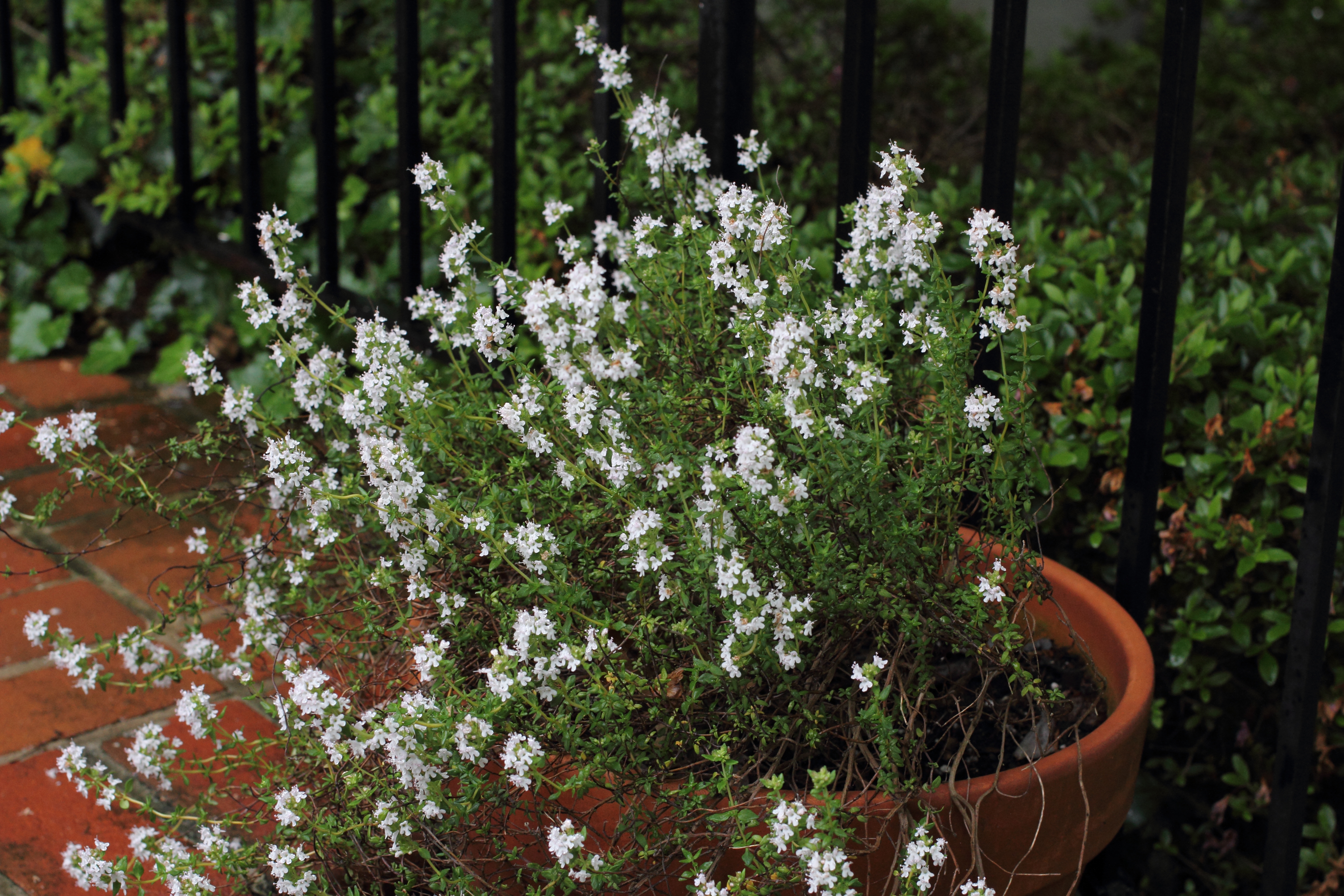
Thyme () is a culinary herb consisting of the dried aerial parts of some members of the genus Thymus of flowering plants in the mint family Lamiaceae. Thymes are native to Eurasia and north Africa. Thymes have culinary, medicinal, and ornamental uses. The species most commonly cultivated and used for culinary purposes is Thymus vulgaris, native to Southeast Europe.
History
Wild thyme grows in the Levant, where it might have been first cultivated. Ancient Egyptians used common thyme (Thymus vulgaris) for embalming. The ancient Greeks used it in their baths and burnt it as incense in their temples, believing it was a source of courage.
The spread of thyme throughout Europe was thought to be due to the Romans, as they used it to purify their rooms and to "give an aromatic flavour to cheese and liqueurs". In the European Middle Ages, the herb was placed beneath pillows to aid sleep and ward off nightmares. In this period, women also often gave knights and warriors gifts that included thyme leaves, as it was believed to bring courage to the bearer. Thyme was also used as incense and placed on coffins during funerals, as it was supposed to assure passage into the next life.
The name of the genus of fish Thymallus, first given to the grayling (T. thymallus, described in the 1758 edition of Systema Naturae by Swedish zoologist Carl Linnaeus), originates from the faint smell of thyme that emanates from the flesh.
Cultivation
Thyme is best cultivated in a hot, sunny location with well-drained soil. It is generally planted in the spring, and thereafter grows as a perennial. It can be propagated by seed, cuttings, or dividing rooted sections of the plant. It tolerates drought well. It can be pruned after flowering to keep from getting woody.
Culinary use
Thyme is a common component of the bouquet garni, and of herbes de Provence.
Thyme is sold both fresh and dried. While summer-seasonal, fresh greenhouse thyme is often available year-round. The fresh form is more flavourful but also less convenient; storage life is rarely more than a week. However, the fresh form can last many months if carefully frozen, and thyme retains its flavour on drying better than many other herbs.
Fresh thyme is commonly sold in bunches of sprigs. A sprig is a single stem snipped from the plant. It is composed of a woody stem with paired leaf or flower clusters ("leaves") spaced 1/2 to apart. A recipe may measure thyme by the bunch (or fraction thereof), or by the sprig, or by the tablespoon or teaspoon. Dried thyme is widely used in Armenia in tisanes.
Depending on how it is used in a dish, the whole sprig may be used, or the leaves removed and the stems discarded. Usually, when a recipe mentions a bunch or sprig, it means the whole form; when it mentions spoons, it means the leaves. It is perfectly acceptable to substitute dried for whole thyme. Leaves may be removed from stems either by scraping with the back of a knife, or by pulling through the fingers or tines of a fork.
Chemical and antimicrobial properties
The chemical composition of Thymus (thyme) includes a variety of essential oils, flavonoids, phenolic acids, triterpenes, and other compounds. The essential oils found in thyme include thymol, which is a major component responsible for the plant's antiseptic properties, and carvacrol, another primary component with similar functions. Other essential oils present are p-cymene, γ-terpinene, linalool, and 1,8-cineole. Gas chromatographic analysis reveals that the most abundant volatile component of thyme leaves is thymol, at 8.55mg/g. Other components are carvacrol, linalool, α-terpineol, and 1,8-cineole.
Some of these compounds have beneficial properties. In particular, thymol has been historically used as an antibiotic and antiseptic, especially in traditional medicine. Oil of thyme, the essential oil of common thyme, contains 20–54% thymol. Thymol is an active ingredient in various commercially produced mouthwashes, such as Listerine.
Flavonoids in thyme include luteolin-7-O-glucoside, a glycoside known for its antioxidant and anti-inflammatory properties, as well as apigenin, quercetin, and kaempferol. Phenolic acids such as rosmarinic acid, which is known for its antioxidant, anti-inflammatory, and antimicrobial activities, along with caffeic acid and chlorogenic acid, are also present in thyme.
Triterpenes, such as oleanolic acid and ursolic acid, are part of thyme's composition, contributing to its overall health benefits. Additionally, thyme contains tannins, which contribute to its astringent properties, as well as saponins and other minor compounds.
Important species and cultivars
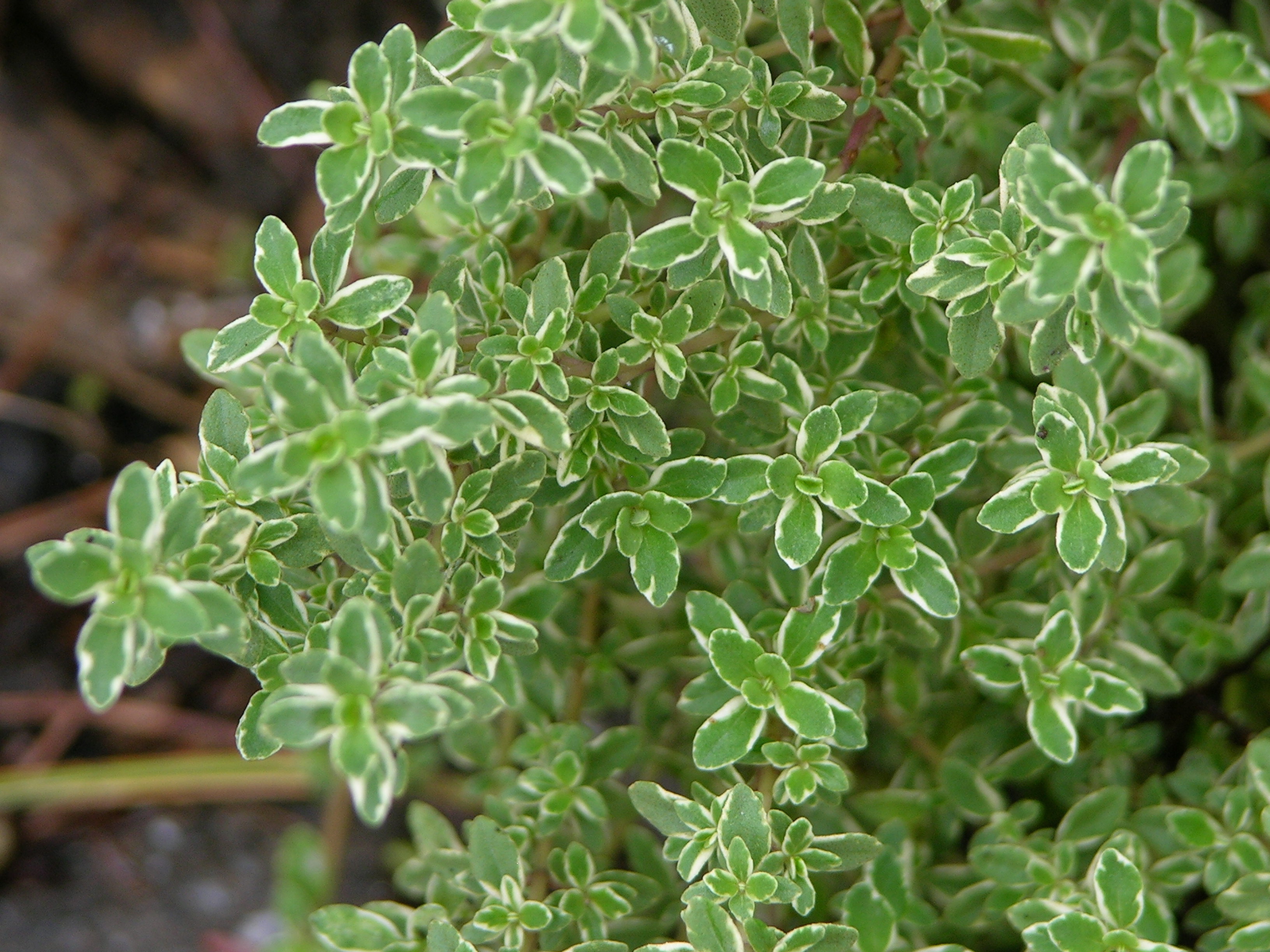
- Thymus citriodorus – various lemon thymes, orange thymes, lime thyme
- Thymus herba-barona (caraway thyme) is used both as a culinary herb and a ground cover, and has a very strong caraway scent due to the chemical carvone.
- Thymus praecox (mother of thyme, wild thyme), is cultivated as an ornamental, but is in Iceland also gathered as a wild herb for cooking, and drunk as a warm infusion.
- Thymus pseudolanuginosus (woolly thyme) is not a culinary herb, but is grown as a ground cover.
- Thymus serpyllum (wild thyme, creeping thyme) is an important nectar source plant for honeybees. All thyme species are nectar sources, but wild thyme covers large areas of droughty, rocky soils in southern Europe (both Greece and Malta are especially famous for wild thyme honey) and North Africa, as well as in similar landscapes in the Berkshire and Catskill Mountains of the northeastern US. The lowest growing of the widely used thyme is good for walkways. It is also an important caterpillar food plant for large and common blue butterflies.
- Thymus vulgaris (common thyme, English thyme, summer thyme, winter thyme, French thyme, or garden thyme) is a commonly used culinary herb. Common thyme is a Mediterranean perennial which is best suited to well-drained soils and full sun.
References
References
- Norman, Jill. (2015). "Herb and Spices The Cook's Reference: Over 200 Herbs and Spices, with Recipes for Marinades, Spice Rubs, Oils and more". Dorling Kindersley Limited.
- (23 August 2018). "Medical News Today - What are the benefits of thyme?".
- Grieve, Mrs. Maud. "Thyme. A Modern Herbal". botanical.com.
- Huxley, A., ed. (1992). ''New RHS Dictionary of Gardening''. Macmillan.
- "Thyme (thymus)". The English Cottage Garden Nursery.
- "The Ecology and Management of the European Grayling ''Thymallus thymallus'' (Linnaeus)". Institute of Freshwater Ecology.
- "Herb File. Global Garden". global-garden.com.au.
- Peter, K.V.. (2012). "Handbook of herbs and spices Volume 2".
- Walker, Paul. (2 September 2021). "What Is a Bouquet Garni? Easy Homemade Bouquet Garni Recipe, Plus Tips for Cooking With Bouquet Garni - 2022 - MasterClass".
- "Food Storage - How Long Can You Keep Thyme".
- "7 Herbs That Taste Good When Dried".
- "Thyme".
- "TeaWay Armenian Tea History".
- (2005). "Identification of Volatile Components in Basil (Ocimum basilicum L.) and Thyme Leaves (Thymus vulgaris L.) and Their Antioxidant Properties". Food Chemistry.
- (2023). "The potential benefits of polyphenols for corneal diseases". Biomedicine & Pharmacotherapy.
- ''Thymus Vulgaris. PDR for Herbal Medicine''. Montvale, NJ: Medical Economics Company. p. 1184.
- "LISTERINE® Ingredients: What's in Your Mouthwash?".
- (2021-08-31). "Application of approach for development of hptlc identification and quantification methods for determination of phenolic compounds and terpenoids of several Thymus L. species". ScienceRise: Pharmaceutical Science.
- (1998-12-01). "Composition and infraspecific variability of essential oil from Thymus herba barona Lois". Biochemical Systematics and Ecology.
- "Thymus herba-barona - Plant Finder".
- "Caterpillar food plants.pub".
- "French Thyme, Thymus vulgaris". Sand Mountain Herbs.
- "English thyme". Sara's Superb Herbs.
This article was imported from Wikipedia and is available under the Creative Commons Attribution-ShareAlike 4.0 License. Content has been adapted to SurfDoc format. Original contributors can be found on the article history page.
Ask Mako anything about Thyme — get instant answers, deeper analysis, and related topics.
Research with MakoFree with your Surf account
Create a free account to save articles, ask Mako questions, and organize your research.
Sign up freeThis content may have been generated or modified by AI. CloudSurf Software LLC is not responsible for the accuracy, completeness, or reliability of AI-generated content. Always verify important information from primary sources.
Report