From Surf Wiki (app.surf) — the open knowledge base
Thundersnow
Thunderstorm during which there is snowfall

Thunderstorm during which there is snowfall
Thundersnow, also known as a winter thunderstorm or a thundersnow storm, is a thunderstorm in which snow falls as the primary precipitation instead of rain. It is considered a rare phenomenon. It typically falls in regions of strong upward motion within the cold sector of an extratropical cyclone. Thermodynamically, it is not different from any other type of thunderstorm, but the top of the cumulonimbus cloud is usually quite low. In addition to snow, graupel or hail may fall as well. The heavy snowfall tends to muffle the sound of the thunder so that it sounds more like a low rumble than the loud, sharp bang that is heard during regular thunderstorms.
Thundersnow can occur during a normal snowstorm that sustains strong vertical mixing which allows for favorable conditions for lightning and thunder to occur. It can also occur from the lake effect or ocean effect thunderstorm which is produced by cold air passing over relatively warm water; this effect commonly produces snow squalls over the Great Lakes.
Occurrence
Americas
Within the United States, thundersnow is relatively rare but most common in "eastern Nevada and Utah, the central plains, and the Great Lakes states". Thundersnow also occurs in Nova Scotia and in the Northeastern United States, especially in New England and New York, sometimes several times per winter season. On December 30, 2019, a severe thunderstorm warning was issued for parts of Massachusetts for a thunderstorm cell that was producing "lightning, thundersnow, thundersleet, and thunderice". A "really rare" thundersnow storm occurred near Vancouver, British Columbia on December 17–18, 2022.
The South Region of Brazil registered episodes of thundersnow in 1984 and 2005, in the state of Santa Catarina, and in August 2011, in some municipalities of the highland region of Serra Gaúcha, in the southern state of Rio Grande do Sul.
Europe
The British Isles and other parts of northwestern Europe occasionally report thunder and lightning during sleet or (usually wet) snow showers during winter and spring. Scotland registered an episode of thundersnow in the early hours of 4 December 2020, the unusual noise causing alarm among local people. The Met Office warned of thundersnow in Scotland, Wales and northern England in early January 2022.
Western Europe has rare occurrences of thundersnow, as on 8 March 2010, when northeastern Catalonia, including Barcelona, experienced a heavy snowfall accompanied by lightning, with snow depths surpassing 30 cm in low altitude areas.
In Central Europe, a large-area (non-local) thundersnow occurred on 17 January 2022, when a strong synoptic-scale squall line passed north to south over whole central and eastern Poland, precipitating both granular snow and snowflakes, with discharge intensity exceeding 100 per minute. Other recent occurrences were in Poland and the Czech Republic in January 2023, Germany in January 2021, and Norway and Netherlands as well as Austria in April 2021, with previous occurrences in Norway in January 2019 and January 2020. Stockholm experienced thundersnow on 21 November 2022. It was detected once again in the Netherlands on 3 January 2026.
Asia
Low-pressure events in the eastern Mediterranean that originate from polar origin cause copious thundersnow occurrences during winter storms, especially over the elevated provinces of Israel, Jordan and Lebanon, including Amman and Jerusalem. When such storms happen at areas intended for skiing, the mountains are often evacuated for safety.
Thundersnow is also common around Kanazawa and the Sea of Japan, and even around Mount Everest.
Formation
Thundersnow is caused by the same mechanisms as regular thunderstorms, but it is much more rare because cold dense air is less likely to rise.
Lake effect precipitation
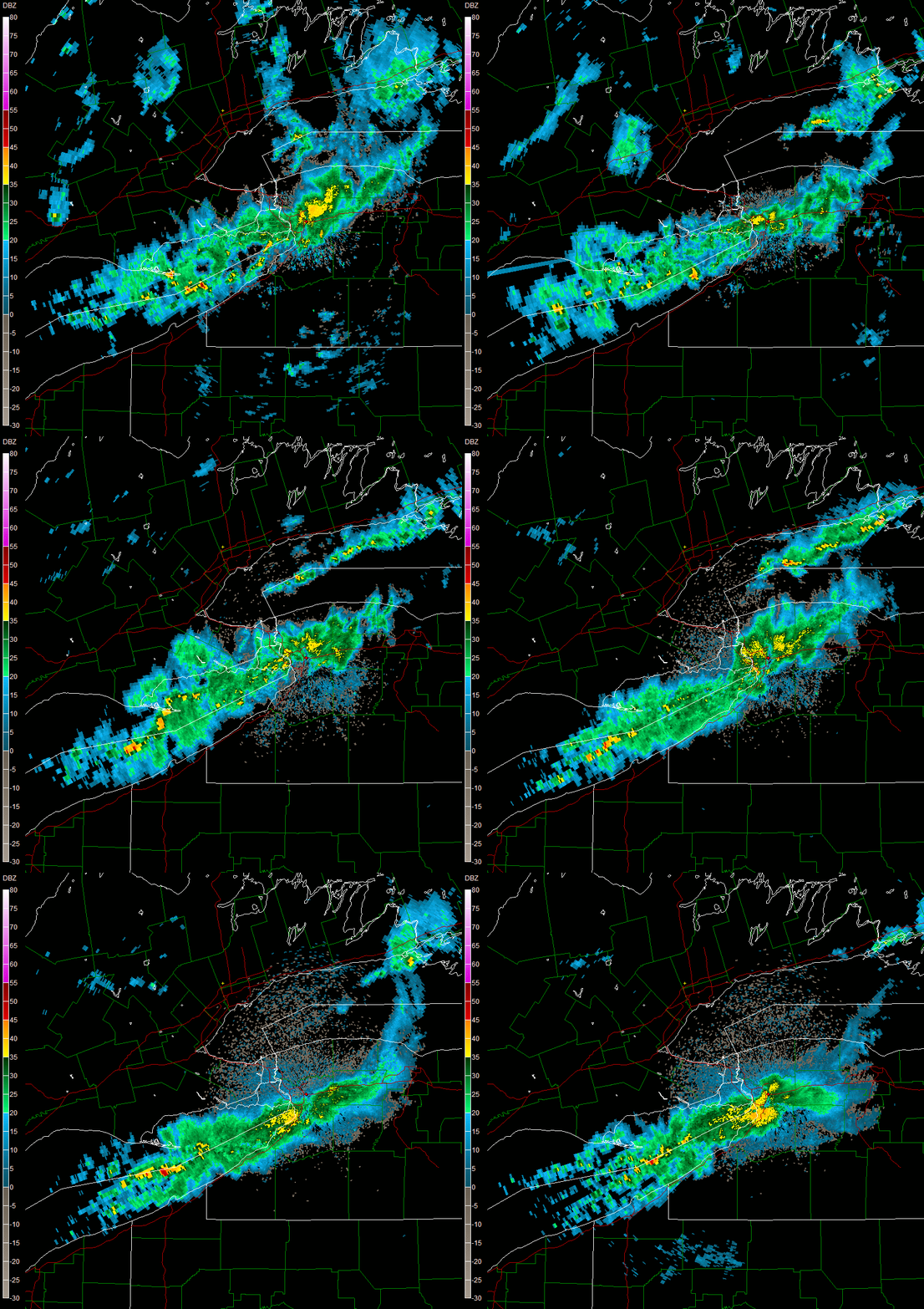
Lake effect thundersnow occurs after a cold front or shortwave aloft passes over a body of water. This steepens the thermal lapse rates between the lake temperature and the temperatures aloft. A difference in temperature of 25 C-change or more between the lake temperature and the temperature at about 1500 m (the 850 hPa level) usually marks the onset of thundersnow, if surface temperatures are expected to be below freezing. However several factors, including other geographical elements, affect the development of thundersnow.
The primary factor is convective depth. This is the vertical depth in the troposphere that a parcel of air will rise from the ground before it reaches the equilibrium (EQL) level and stops rising. A minimum depth of 1500 m is necessary, and an average depth of 3000 m or more is generally accepted as sufficient. Wind shear is also a significant factor. Linear snow squall bands produce more thundersnow than clustered bands; thus a directional wind shear with a change of less than 12° between the ground and 2000 m in height must be in place. However, any change in direction greater than 12° through that layer will tear the snow squall apart. A bare minimum fetch of 50 km/h is required so that the air passing over the lake or ocean water will become sufficiently saturated with moisture and will acquire thermal energy from the water.
The last component is the echo top or storm top temperature. This must be at least -30 C. It is generally accepted that at this temperature there is no longer any super cooled water vapour present in a cloud, but just ice crystals suspended in the air. This allows for the interaction of the ice cloud and graupel pellets within the storm to generate a charge, resulting in lightning and thunder.
Synoptic forcing
Synoptic snow storms tend to be large and complex, with many possible factors affecting the development of thundersnow. The best location in a storm to find thundersnow is typically in its Northwest quadrant (in the Northern Hemisphere, based on observations in the Midwestern United States), within what is known as the "comma head" of a mature extratropical cyclone. Thundersnow can also be located underneath the TROWAL, a trough of warm air aloft which shows up in a surface weather analysis as an inverted trough extending backward into the cold sector from the main cyclone. In extreme cases, thunderstorms along the cold front are transported towards the center of the low-pressure system and will have their precipitation change to snow or ice, once the cold front becomes a portion of the occluded front. The 1991 Halloween blizzard, Superstorm of 1993, and White Juan are examples of such blizzards featuring thundersnow.
Upslope flow
Similar to the lake effect regime, thundersnow is usually witnessed in terrain in the cold sector of an extratropical cyclone when a shortwave aloft moves into the region. The shortwave will steepen the local lapse rates, allowing for a greater possibility of both heavy snow at elevations where it is near or below freezing, and occasionally thundersnow.
Hazards
Thundersnow produces heavy snowfall rates in the range of 2 to 4 in per hour. Snowfall of this intensity may limit visibilities severely, even during light wind conditions. However, thundersnow is often a part of a severe winter storm or blizzard. Winds of above tropical storm force are frequent with thundersnow. As a result, visibilities in thundersnow are frequently under 2/5th of a mile. Additionally, such wind creates extreme wind chills and may result in frostbite. Finally, there is a greater likelihood that thundersnow lightning will have a positive polarity, which is associated with a greater destructive potential than the more common negatively-charged lightning. That said, lightning is far less frequent in a thundersnow storm than in a summertime storm, and is usually of the cloud-to-cloud variety, rather than a strike that travels to the ground.
References
References
- Coulter, Dauna. (24 February 2011). "The Mysterious Rumble of Thundersnow". [[NASA]].
- (18 November 2022). "Thundersnow is a rare weather phenomenon. Here's what you need to know".
- (1 December 2002). "A Climatology of Thundersnow Events over the Contiguous United States". [[American Meteorological Society]].
- (30 December 2019). "Thundersnow, hail and lightning reported during ice storm; thunderstorm warning issued for parts of Mass.".
- Silvestre, Irish Mae. "Vancouver sky lit up by really rare 'thunder snow'".
- (4 August 2011). "Estado registra episódio inédito de neve com trovoadas (Rio Grande do Sul registered an unprecedented episode of thundersnow)". [[Correio do Povo]].
- (4 December 2020). "Disruption after 'thundersnow' hits Scotland". BBC News.
- (5 January 2022). "UK weather: 'thundersnow' to fall from Thursday, warns Met Office".
- (1 April 2013). "Remote sensing analysis of a Mediterranean thundersnow and low-altitude heavy snowfall event".
- (17 January 2022). "Strong squall line across Poland, winds up to 120 km/h".
- (14 January 2019). "- Et lysshow uten side-stykke i snødrivet". [[Adressa]].
- (9 January 2020). "Over 1000 lynnedslag i Midt-Norge på ett døgn: - Sjelden det er så mye vintertorden som dette". [[Adressa]].
- "Kraftiga smällar över Stockholm – mitt i ovädret - Aftonbladet TV".
- (21 November 2022). "Snöblixtar över Stockholm – "Åsksnö"". SVT Nyheter.
- Gregoire, Jeroen. (3 January 2026). "Sneeuw en onweer tegelijk: zeldzame thundersnow in Nederland gezien".
- Strong, Hannah. (Feb 25, 2022). "What is Thundersnow". [[WDRB]].
- the USA Today. Jack Williams. [https://www.usatoday.com/weather/wlakeeff.htm Warm water helps create Great Lakes snowstorms.] {{Webarchive. link. (2012-03-15 Retrieved on 01-11-2006.)
- Patrick S. Market, Angela M. Oravetz, David Gaede, Evan Bookbinder, Rebecca Ebert, and Christopher Melick. [http://ams.confex.com/ams/pdfpapers/72662.pdf Upper Air Constant Pressure Composites of Midwestern Thundersnow Events.] {{Webarchive. link. (2011-06-09 Retrieved on 01-11-2006.)
- Rauber, R.M.. (2014). "Stability and Charging Characteristics of the Comma Head region of Continental Winter Cyclones". J. Atmos. Sci..
- National Weather Service Office, St. Louis, Missouri. [http://www.crh.noaa.gov/lsx/science/pdfppt/thun_prox_soundings.ppt Thundersnow Proximity Soundings.] Retrieved on 01-11-2006. {{webarchive. link. (2011-05-23)
- National Weather Service Office, Sacramento, California. Alexander Tardy. [http://www.wrh.noaa.gov/wrh/02TAs/0213/index.html Western Region Technical Attachment No. 02-13: Thundersnow in the Sierra Nevada.] Retrieved on 01-11-2006. {{webarchive. link. (2006-10-14)
- "A Lightning Primer – Characteristics of a Storm". NASA.
This article was imported from Wikipedia and is available under the Creative Commons Attribution-ShareAlike 4.0 License. Content has been adapted to SurfDoc format. Original contributors can be found on the article history page.
Ask Mako anything about Thundersnow — get instant answers, deeper analysis, and related topics.
Research with MakoFree with your Surf account
Create a free account to save articles, ask Mako questions, and organize your research.
Sign up freeThis content may have been generated or modified by AI. CloudSurf Software LLC is not responsible for the accuracy, completeness, or reliability of AI-generated content. Always verify important information from primary sources.
Report