From Surf Wiki (app.surf) — the open knowledge base
Three Gorges Dam
Dam in Yiling District, Hubei, China

Dam in Yiling District, Hubei, China
| Field | Value |
|---|---|
| name | Three Gorges Dam |
| 三峡大坝 | |
| image | ThreeGorgesDam-China2009.jpg |
| image_caption | The dam in September 2009 |
| image_size | 260px |
| location_map | Hubei#China (equirectangular) |
| location_map_caption | Location in Hubei Province |
| country | China |
| location | Sandouping, Yiling District, Hubei |
| purpose | Flood control, power, navigation |
| status | O |
| construction_began | December 14, 1994 |
| opening | 2003 |
| cost | ¥203 billion (US$31.765 billion) |
| owner | China Yangtze Power (subsidiary of China Three Gorges Corporation) |
| dam_type | G |
| dam_length | 2335 m |
| dam_height | 181 m |
| dam_width_crest | 40 m |
| dam_width_base | 115 m |
| dam_volume | 27.2 e6m3 |
| dam_crosses | Yangtze River |
| spillway_capacity | 116000 m3/s |
| res_name | Three Gorges Reservoir |
| res_elevation | 175 m |
| res_capacity_total | 39.3 km3 |
| res_catchment | 1000000 km2 |
| res_surface | 1084 km2 |
| res_max_length | 600 km |
| res_max_width | |
| plant_commission | 2003–2012 |
| plant_type | C |
| plant_turbines | 32 × 700 MW |
| 2 × 50 MW Francis-type | |
| plant_capacity | 22,500 MW |
| plant_capacity_factor | 45% |
| plant_annual_gen | 101.6 TWh (2018) |
| plant_hydraulic_head | Rated: 80.6 m |
| Maximum: 113 m | |
| mapframe | yes |
| mapframe-zoom | 13 |
三峡大坝 2 × 50 MW Francis-type Maximum: 113 m | mapframe-zoom = 13
The Three Gorges Dam, officially known as Yangtze River Three Gorges Water Conservancy Project is a hydroelectric gravity dam that spans the Yangtze River near Sandouping in Yiling District, Yichang, Hubei province, central China, downstream of the Three Gorges. The world's largest power station by installed capacity (22,500 MW), the Three Gorges Dam generates 95±20 TWh of electricity per year on average, depending on the amount of precipitation in the river basin. After the monsoons of 2020, the dam produced nearly 112 TWh in a year, breaking the record of 103 TWh set by the Itaipu Dam in 2016.
The dam's body, 185 meters high and 2,309 meters wide, was completed in 2006. The power plant became fully operational in 2012, when the last of the 32 main water turbines in the underground plant began production. The last major component of the project, the ship lift, was completed in 2015.
Each of the 32 turbines, considered state-of-the-art at the time of their installation, can generate 700 MW. Combined with two 50 MW generators that power the plant itself, the Three Gorges Dam can generate some 22,500 MW—far more than the next-biggest hydroelectric plant, Brazil’s 12,600-MW Itaipu facility.
The dam improves the Yangtze River's shipping capacity and provides flood control, helping to protect millions of people from severe flooding on the Yangtze Plain. Additionally, its hydroelectric power generation has helped fuel China's economic growth. As a result, the Chinese government considers the project a source of national pride and a major social and economic success. However, it is controversial domestically and abroad. Estimates of the number of people displaced by the dam's construction range from 1.13 million to around 1.4 million. Its construction has also inundated ancient and culturally significant sites. In operation, the dam has caused some ecological changes, including an increased risk of landslides.
History

Sun Yat-sen envisioned a large dam across the Yangtze River in The International Development of China (1919). He wrote that a dam capable of generating 30 million horsepower (22 GW) was possible downstream of the Three Gorges. In 1932, the Nationalist government, led by Chiang Kai-shek, began preliminary work on plans in the Three Gorges. In 1939, during the Second Sino-Japanese War, Japanese military forces occupied Yichang and surveyed the area.
In 1944, the United States Bureau of Reclamation's head design engineer, John L. Savage, surveyed the area and drew up a dam proposal for a "Yangtze River Project". Some 54 Chinese engineers went to the US for training. The original plans called for the dam to employ a unique method for moving ships: the ships would enter locks at the dam's lower and upper ends and then cranes would move them from each lock to the next. Groups of craft would be lifted together for efficiency. It is not known whether this solution was considered for its water-saving performance or because the engineers thought the difference in height between the river above and below the dam too great for alternative methods. No construction work was performed because of the Nationalists' worsening situation in the Chinese Civil War.
After the 1949 Communist Revolution, Mao Zedong supported the project, but began the Gezhouba Dam project nearby first, and economic problems including the Great Leap Forward and the Cultural Revolution slowed progress. After the 1954 Yangtze River Floods, in 1956, Mao wrote "Swimming", a poem about his fascination with a dam on the Yangtze River. In 1958, after the Hundred Flowers Campaign, some engineers who spoke out against the project were imprisoned.
During China's emphasis on the Four Modernizations during its early period of Reform and Opening Up, The Communist Party revived plans for the dam and proposed to start construction in 1986. It emphasized the need to develop hydroelectric power.
The Chinese People's Political Consultative Conference became a center of opposition to the proposed dam. It convened panels of experts who recommended delaying the project.
The National People's Congress approved the dam in 1992: of 2,633 delegates, 1,767 voted in favour, 177 voted against, 664 abstained, and 25 members did not vote, giving the legislation an unusually low 67.75% approval rate. Construction started on December 14, 1994. The dam was expected to be fully operational in 2009, but additional projects, such as the underground power plant with six additional generators, delayed full operation until 2012. The ship lift was completed in 2015. The dam raised the water level in the reservoir to 172.5 m above sea level by 2008 and to the designed maximum level of 175 m by 2010.
Composition and dimensions
Made of concrete and steel, the dam is 2335 m long and 185 m above sea level at its top. The project used 27.2 e6m3 of concrete (mainly for the dam wall), used 463,000 tonnes of steel (enough to build 63 Eiffel Towers), and moved about 102.6 e6m3 of earth. The concrete dam wall is 181 m high above the rock basis.
When the water level is at its maximum of 175 m above sea level, 110 m higher than the river level downstream, the dam reservoir is on average about 660 km in length and 1.12 km in width. It contains 39.3 km3 of water and has a total surface area of 1045 km2. On completion, the reservoir flooded a total area of 632 km2 of land, compared to the 1350 km2 of reservoir created by the Itaipu Dam.
Economics
The Chinese government estimated that the Three Gorges Dam project would cost 180 billion yuan (US$22.5 billion). It was estimated in 2009 that the cost of construction would be fully recouped when the dam had generated 1000 TWh of electricity, yielding 250 billion yuan; total cost recovery was thus expected to be completed ten years after the dam became fully operational. In fact, the entire cost of the Three Gorges Dam was recovered by December 20, 2013.
Funding sources include the Three Gorges Dam Construction Fund, profits from the Gezhouba Dam, loans from the China Development Bank, loans from domestic and foreign commercial banks, corporate bonds, and revenue from both before and after the dam had become fully operational. Additional charges were assessed as follows: every province receiving power from the Three Gorges Dam had to pay an extra ¥7.00 per MWh, and the other provinces had to pay an additional charge of ¥4.00 per MWh. No surcharge was imposed on the Tibet Autonomous Region.
Power generation and distribution
Generating capacity


Power generation is managed by China Yangtze Power, a listed subsidiary of China Three Gorges Corporation (CTGC), a Central Enterprise administered by SASAC. The Three Gorges Dam is the world's largest capacity hydroelectric power station, with 34 generators: 32 main generators, each with a capacity of 700 MW, and two plant power generators, each with capacity of 50 MW, for a total of 22,500 MW. Among the 32 main generators, 14 are installed on the dam's north side, 12 on the south side, and the remaining six in the underground power plant in the mountain south of the dam. Annual electricity generation in 2018 was 101.6 TWh, which is 20 times more than the Hoover Dam.
Generators
The main generators each weigh about 6,000 tonnes and are designed to produce more than 700 MW of power each. The designed hydraulic head of the generators is 80.6 m. The flow rate varies between 600 - depending on the head available; the greater the head, the less water needed to reach full power. Three Gorges uses Francis turbines with a diameter of 9.7/10.4 m (VGS design/Alstom's design) and a rotation speed of 75 revolutions per minute. This means that in order to generate power at 50 Hz, the generator rotors have 80 poles. Rated power is 778 MVA, with a maximum of 840 MVA and a power factor of 0.9. The generator produces electrical power at 20 kV. The electricity generated is then stepped up to 500 kV for transmission at 50 Hz. The generator's stator, the biggest of its kind, is 3.1/3 m in height; the outer diameter of the stator is 21.4/20.9 m, the inner diameter is 18.5/18.8 m, and the bearing load is 5,050/5,500 tonnes. Average efficiency is over 94%, with a maximum efficiency of 96.5% reached.
The generators were manufactured by two joint ventures: Alstom, ABB, Kvaerner, and the Chinese company Harbin Motor; and Voith, General Electric, Siemens (abbreviated as VGS), and the Chinese company Oriental Motor. The technology transfer agreement was signed together with the contract. Most of the generators are water-cooled. Some of the newer ones are air-cooled, making them simpler in design and easier to manufacture and maintain.
Generator installation progress
The first north-side main generator (No. 2) started up on July 10, 2003. The north side became completely operational on September 7, 2005, with the implementation of generator No. 9. Full power (9,800 MW) was eventually achieved on October 18, 2006, after the water level reached 156 meters.
On the south side, main generator No. 22 started up on June 11, 2007, and No. 15 became operational on October 30, 2008. The sixth (No. 17) began operation on December 18, 2007, raising capacity to 14.1 GW, exceeding that of Itaipu dam (14.0 GW) to become the world's largest hydro power plant by capacity.
When the last main generator (No. 27) finished its final test on May 23, 2012, the six underground main generators were all operational, raising the capacity to 22.5 GW. After nine years of construction, installation and testing, the power plant was fully operational by July 2012.
Output milestones
| Year | Number of | |||||||||||
|---|---|---|---|---|---|---|---|---|---|---|---|---|
| installed units | TWh | Reference | ||||||||||
| 2003 | 6 | 8.607 | ||||||||||
| 2004 | 11 | 39.155 | ||||||||||
| 2005 | 14 | 49.090 | ||||||||||
| 2006 | 14 | 49.250 | ||||||||||
| 2007 | 21 | 61.600 | ||||||||||
| 2008 | 26 | 80.812 | ||||||||||
| 2009 | 26 | 79.470 | ||||||||||
| 2010 | 26 | 84.370 | ||||||||||
| 2011 | 29 | 78.290 | ||||||||||
| 2012 | 32 | 98.100 | access-date=January 19, 2013 | archive-date=January 20, 2013 | archive-url=https://web.archive.org/web/20130120060226/http://www.gov.cn/gzdt/2013-01/14/content_2311905.htm | url=http://www.gov.cn/gzdt/2013-01/14/content_2311905.htm | language=zh | script-title=zh:2012年三峡工程建设与运行管理成效十分显著 | url-status=live}} | |||
| 2013 | 32 | 83.270 | ||||||||||
| 2014 | 32 | 98.800 | ||||||||||
| 2015 | 32 | 87.000 | ||||||||||
| 2016 | 32 | 93.500 | ||||||||||
| 2017 | 32 | 97.600 | ||||||||||
| 2018 | 32 | 101.600 | access-date=March 21, 2019 | archive-date=March 21, 2019 | archive-url=https://web.archive.org/web/20190321110824/http://www.chinadaily.com.cn/a/201812/21/WS5c1c5eeca3107d4c3a002168.html | url=http://www.chinadaily.com.cn/a/201812/21/WS5c1c5eeca3107d4c3a002168.html | title=Three Gorges Dam generates record amount of power | date=December 21, 2018 | last=Zhang | first=Jie | url-status=live | website=China Daily}} |
| 2019 | 32 | 96.880 | ||||||||||
| 2020 | 32 | 111.800 | ||||||||||
| 2021 | 32 | 103.649 | ||||||||||
| 2022 | 32 | 78.790 | ||||||||||
| 2023 | 32 | 80.271 | ||||||||||
| 2024 | 32 | 82.911 | ||||||||||
| 2025 | 32 | 95.715 |


By August 16, 2011, the plant had generated 500 TWh of electricity. In July 2008 it generated 10.3 TWh of electricity, its first month over 10 TWh. On June 30, 2009, after the river flow rate increased to over 24,000 m3/s, all 28 generators were switched on, producing only 16,100 MW because the head available during flood season is insufficient. During an August 2009 flood, the plant first reached its maximum output for a short period.
During the November to May dry season, power output is limited by the river's flow rate, as seen in the diagrams on the right. When there is enough flow, power output is limited by plant generating capacity. The maximum power-output curves were calculated based on the average flow rate at the dam site, assuming the water level is 175 m and the plant gross efficiency is 90.15%. The actual power output in 2008 was obtained based on the monthly electricity sent to the grid.
The Three Gorges Dam reached its design-maximum reservoir water level of 175 m for the first time on October 26, 2010, in which the intended annual power-generation capacity of 84.7 TWh was realized. It has a combined generating capacity of 22.5 gigawatts and a designed annual generation capacity of 88.2 TWh. In 2012, the dam's 32 generating units generated a record 98.1 TWh of electricity, which accounts for 14% of China's total hydro generation. Between 2012 (first year with all 32 generating units operating) and 2021, the dam generated an average of 97.22 TWh of electricity per year, higher than Itaipu dam's average of 89.22 TWh of electricity per year during the same period. Due to the extensive 2020 monsoon season rainfall, the annual production reached ~112 TWh that year, which broke the previous world record of annual production by Itaipu Dam equal to ~103 TWh.
Distribution
The State Grid Corporation and China Southern Power Grid paid a flat rate of ¥250 per MWh (US$35.7) until July 2, 2008. Since then, the price has varied by province, from ¥228.7 to ¥401.8 per MWh. Higher-paying customers, such as Shanghai, receive priority. Nine provinces and two cities consume power from the dam.
Power distribution and transmission infrastructure cost about 34.387 billion yuan. Construction was completed in December 2007, one year ahead of schedule.
Power is distributed over multiple 500 kV transmission lines. Three direct current (DC) lines to the East China Grid carry 7,200 MW: Three Gorges – Shanghai (3,000 MW), HVDC Three Gorges – Changzhou (3,000 MW), and HVDC Gezhouba – Shanghai (1,200 MW). The alternating current (AC) lines to the Central China Grid have a total capacity of 12,000 MW. The DC transmission line HVDC Three Gorges – Guangdong to the South China Grid has a capacity of 3,000 MW.
The dam was expected to provide 10% of China's power. However, electricity demand has increased more quickly than previously projected. Even fully operational and despite its size, on average, it supplies less than 1.0% of electricity demand in China in the year of 2024 when the Chinese electricity demand reached 9,852.1 TWh.
Environmental impact


Emissions
According to the National Development and Reform Commission, 366 grams of coal would produce 1 kWh of electricity during 2006. From 2003 to 2007, power production equaled that of 84 million tonnes of standard coal.
Erosion and sedimentation
Two hazards are uniquely identified with the dam: that sedimentation projections are not agreed upon, and that the dam sits on a seismic fault. At current levels, 80% of the land in the area is eroding, depositing about 40 million tons of sediment into the Yangtze annually. Because the flow is slower above the dam, much of this sediment settles there instead of flowing downstream, and there is less sediment downstream.
The absence of silt downstream has three effects:
- Some hydrologists expect downstream riverbanks to become more vulnerable to flooding.
- Shanghai, more than 1600 km away, rests on a massive sedimentary plain. The "arriving siltso long as it does arrivestrengthens the bed on which Shanghai is built ... the less the tonnage of arriving sediment the more vulnerable is this biggest of Chinese cities to inundation".
- Benthic sediment buildup causes biological damage and reduces aquatic biodiversity.
Landslides
Erosion in the reservoir, induced by rising water, causes frequent major landslides that have led to noticeable disturbance in the reservoir surface, including two incidents in May 2009 when somewhere between 20000 and of material plunged into the flooded Wuxia Gorge of the Wu River. In the first four months of 2010, there were 97 significant landslides.
Waste management

The dam catalyzed improved upstream wastewater treatment around Chongqing and its suburban areas. According to the Ministry of Environmental Protection, as of April 2007, more than 50 new plants could treat 1.84 million tonnes per day, 65% of the total need. About 32 landfills were added, which could handle 7,664.5 tonnes of solid waste every day. Over one billion tons of wastewater are released annually into the river, which was more likely to be swept away before the reservoir was created. This has left the water stagnant, polluted and murky.
Forest cover
In 1997, the Three Gorges area had 10% forestation, down from 20% in the 1950s.
Research by the United Nations Food and Agriculture Organization suggested that the Asia-Pacific region would gain about 6000 km2 of forest by 2008. That is a significant change from the 13000 km2 net loss of forest each year in the 1990s. This is largely due to China's large reforestation effort. This accelerated after the 1998 Yangtze River floods convinced the government that it should restore tree cover, especially in the Yangtze's basin upstream of the Three Gorges Dam.
Wildlife
Concerns about the dam's impact on wildlife predate the National People's Congress's approval in 1992. This region has long been known for its rich biodiversity. It is home to 6,388 plant species, which belong to 238 families and 1,508 genera. Of these species, 57 are endangered. These rare species are also used as ingredients in traditional Chinese medicines. The proportion of forested area in the region surrounding the Three Gorges Dam dropped from 20% in 1950 to less than 10% as of 2002, Other aquatic species have been endangered by the dam, particularly the baiji, or Chinese river dolphin, now extinct. In fact, Chinese Government scholars even claim that the Three Gorges Dam directly caused the extinction of the baiji.
Of the 3,000 to 4,000 remaining critically endangered Siberian crane, many spend the winter in wetlands that the Three Gorges Dam will destroy. Populations of the Yangtze sturgeon are guaranteed to be "negatively affected" by the dam. In 2022 the Chinese paddlefish was declared extinct, with the last confirmed sighting in 2003.
Terrestrial impact
In 2005, NASA scientists calculated that the shift of water mass stored by the dams would increase the total length of the Earth's day by 0.06 microseconds and make the Earth slightly more round in the middle and flat on the poles. A study published in 2022 in the journal Open Geosciences suggests that the change of reservoir water level affects the gravity field in western Sichuan, which in turn affects the seismicity in that area.
Floods, agriculture, industry
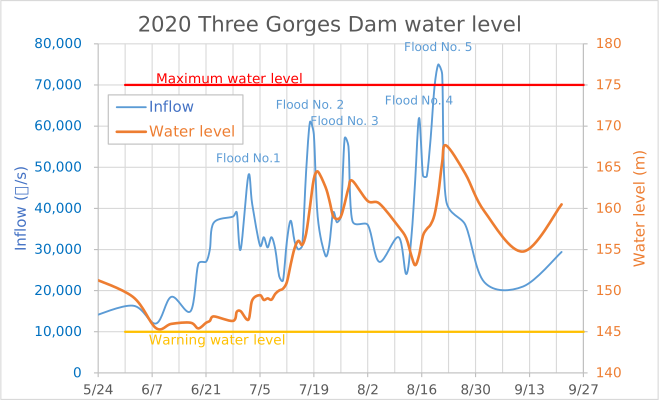
An important function of the dam is to control flooding, which is a major problem for the seasonal river of the Yangtze. Millions of people live downstream of the dam, with many large, important cities like Wuhan, Nanjing, and Shanghai located adjacent to the river. Large areas of farmland and China's most important industrial area are situated beside the river.
The reservoir's flood storage capacity is 22 km3. This capacity will reduce the frequency of major downstream flooding from once every 10 years to once every 100 years. The dam is expected to minimize the effect of even a "super" flood. The river flooded in 1954 over an area of 193000 km2, killing 33,167 people and forcing almost 18.9 million people to move. The flood waters covered Wuhan, a city of eight million people, for over three months, and the Jingguang Railway was out of service for more than 100 days. The 1954 flood carried 50 km3 of water. The dam could only divert the water above Chenglingji, leaving 30 to to be diverted. The dam cannot protect against some of the large tributaries downstream, including the Xiang, Zishui, Yuanshui, Lishui, Hanshui, and Gan.
In 1998, a flood in the same area caused billions of dollars' worth of damage, when 2039 km2 of farmland were flooded. The flood affected more than 2.3 million people, killing 1,526. In early August 2009, the largest flood in five years passed through the dam site. During this flood, the dam limited the water flow to less than 40000 m3/s per second, raising the upstream water level from 145.13 m on August 1, to 152.88 m on August 8. A full 4.27 km3 of flood water was captured and the river flow was cut by as much as 15000 m3 per second.
The dam discharges its reservoir during the dry season every year, between December and March. This increases the flow rate of the river downstream, providing fresh water for agricultural and industrial usage, and improving shipping conditions. The water level upstream drops from 175 to, in preparation for the rainy season. The water also powers the Gezhouba Dam downstream.
Since the filling of the reservoir in 2003, the Three Gorges Dam has supplied an extra 11 km3 of fresh water to downstream cities and farms over the course of the dry season. Navigation
During the South China floods in July 2010, inflows at the Three Gorges Dam reached a peak of 70000 m3/s, exceeding the peak inflow during the 1998 Yangtze River floods. The dam's reservoir rose nearly 3 m in 24 hours and reduced the outflow to 40000 m3/s in discharges downstream, preventing any significant impact on the middle and lower river.
Navigating the dam
Locks


The Three Gorges project includes locks to enable ships to pass the dam. Since the undammed gorges had been dangerous to navigate, officials said, the project would enable shipping on the Yangtze to rise from ten million to 100 million tonnes annually and would reduce shipping costs by roughly one-third.
There are two series of ship locks installed near the dam (). Each of them is made up of five stages, with transit time at around four hours. Maximum vessel size is 10,000 tons. The locks are 280 m long, 35 m wide, and 5 m deep (918 × 114 × 16.4 ft). That is 30 m longer than those on the St Lawrence Seaway, but half as deep.
Before the dam was constructed, the maximum freight capacity at the Three Gorges site was 18.0 million tonnes per year. From 2004 to 2007, a total of 198 million tonnes of freight passed through the locks. The freight capacity of the river increased six times and the cost of shipping was reduced by 25%. Originally, the total capacity of the ship locks was expected to reach 100 million tonnes per year. In 2022, their cargo turnover reached 159.65 million tons, with an annual increase of 6% over the previous few years.{{cite web |access-date = February 22, 2023
These locks are staircase locks, whereby inner lock gate pairs serve as both the upper gate of the chamber below and the lower gate of the chamber above. The gates are the vulnerable hinged type, which, if damaged, could temporarily render the entire flight unusable. As there are separate sets of locks for upstream and downstream traffic, this system is more water efficient than bi-directional staircase locks.
Ship lift
shiplift
.jpg)
Since 2016, a ship lift—a kind of elevator for vessels—has operated at the site. The ship lift can lift ships of up to 3,000 tons. The vertical distance traveled is 113 m, and the size of the ship lift's basin is 120 x. The ship lift takes 30 to 40 minutes to transit, as opposed to the three to four hours for stepping through the locks. One complicating factor is that the water level can vary dramatically. The ship lift must work even if water levels vary by 12 m on the lower side, and 30 m on the upper side.
The ship lift's design uses a helical gear system, to climb or descend a toothed rack.
The ship lift was not yet complete when the rest of the project was officially opened on May 20, 2006. In November 2007, it was reported in the local media that construction of the ship lift started in October 2007.
In February 2012, Xinhua reported that the four towers intended to support the ship lift were nearly complete. The report said that by that time, the towers had reached 189 m of the anticipated 195 m.
As of May 2014, the ship lift was expected to be completed by July 2015. It was tested in December 2015 and announced complete in January 2016. Lahmeyer, the German firm that designed the ship lift, said it will take a vessel less than an hour to transit the lift. An article in Steel Construction says the actual time of the lift will be 21 minutes. It says that the expected dimensions of the 3000 tonne passenger vessels the ship lift's basin was designed to carry will be 84.5 x. The moving mass (including counterweights) is 34,000 tonnes.
The trials of elevator finished in July 2016, the first cargo ship was lifted on July 15; the lift time comprised 8 minutes. Shanghai Daily reported that the first operational use of the lift was on September 18, 2016, when limited "operational testing" of the lift began.
Portage railways
Plans also exist for the construction of short portage railways bypassing the dam area altogether. Two short rail lines, one on each side of the river, are to be constructed. The 88 km northern portage railway (北岸翻坝铁路) will run from the Taipingxi port facility (太平溪港) on the northern side of the Yangtze, just upstream from the dam, via Yichang East Railway Station to the Baiyang Tianjiahe port facility in Baiyang Town (白洋镇), below Yichang. The 95 km southern portage railway (南岸翻坝铁路) will run from Maoping (upstream of the dam) via Yichang South Railway Station to Zhicheng (on the Jiaozuo–Liuzhou Railway).
In late 2012, preliminary work started along both future railway routes.
Displacement of residents
During planning, it was estimated that 13 cities, 140 towns and 1,350 villages would be partially or completely flooded by the reservoir, amounting to roughly 1.5% of Hubei's 60.3 million people and Chongqing Municipality's 31.44 million people. These people were moved to new homes by the Chinese government, which considered the displacement justified by the flood protection provided for the communities downstream of the dam.
Between 2002 and 2005, Canadian photographer Edward Burtynsky documented the impact of the project on the surrounding areas, including the town of Wanzhou. Other photographers who recorded the change include Chengdu-based Muge, Paris-based Zeng Nian (originally from Jiangsu), and Israeli Nadav Kander. Living conditions deteriorated for many, and hundreds of thousands of people could not find work. The older generation was particularly affected, but younger generations benefited from the educational and career opportunities afforded by moving to large cities with new, modern companies and schools.
Some 2007 reports claimed that Chongqing Municipality would encourage four million more people to move away from the dam to Chongqing's main urban area by 2020. The municipal government asserted that the relocation was driven by urbanization, rather than a direct result of the dam project, and that the people involved included other areas of the municipality.
By June 2008, China had moved 1.24 million residents as far as Gaoyang in Hebei Province, and the moves concluded the following month.
Other effects
Cultural and history
The area which would fill with water behind the dam included locations with significant cultural history. The State Council authorized a ¥505 million archaeology salvage effort. Over the course of several years, archaeologists excavated 723 sites and conducted surface archaeology recovery missions at an additional 346 sites. Archaeologists recovered 200,000 artifacts of which 13,000 were considered as particularly historically or culturally notable. As part of this effort, the old Chongqing City Museum was replaced by the Chongqing China Sanxia Museum to house many of the recovered artifacts.
Recovered structures that were too large for museums were moved upland to reconstruction districts (fu jian qu), which are outdoor museum parks. Recovered structures placed in such parks include temples, pavilions, houses, and bridges, among others.
Some sites could not be moved because of their location, size, or design, such as the hanging coffins site high in the Shen Nong Gorge, part of the cliffs.
National security
A 2004 United States Department of Defense report stated that "Since Taipei cannot match Beijing’s ability to field offensive systems, proponents of strikes against the mainland apparently hope that merely presenting credible threats to China's urban population or high-value targets, such as the Three Gorges Dam, will deter Chinese military coercion." In response, the Chinese Ministry of Foreign Affairs criticized the U.S. report as exhibiting a "Cold War mentality harbouring evil intentions." The People's Liberation Army Lieutenant General Liu Yuan cautioned that "[It] will not be able to stop war. It will have the exact opposite of the desired effect." He also remarked that China would be "seriously on guard against threats from Taiwan independence terrorists."
Sung Chao-wen, a senior advisory committee member of the Taiwanese Ministry of Defense, dismissed online comments about targeting the Three Gorges Dam with missiles as "ridiculous", saying that the dam's high-strength reinforced concrete could withstand a small nuclear weapon, any missile attack would have to penetrate multiple layers of ground and air defenses, and missiles would cause only minimal damage if they reached the dam at all. Zhang Boting, deputy secretary-general of the China Society for Hydropower Engineering, said that the Three Gorges Dam was designed as a concrete gravity dam and would therefore be resistant to nuclear attacks.
Debate among Chinese scholars and analysts about the basic principles of China's no first use (NFU) of nuclear weapons policy includes questions about whether to add narrow exceptions, such as acts that produce catastrophic consequences equivalent to that of a nuclear attack, including attacks intended to destroy the Three Gorges Dam. Nonetheless, supporters of the NFU policy maintain that foreign conventional attacks of such targets including the dam—with the intent to cause mass civilian casualties and economic losses—are highly improbable.
Structural integrity
Immediately after the reservoir was first filled, around 80 hairline cracks were observed in the dam's structure. Still, an experts group gave the project overall a good-quality rating. The 163,000 concrete units all passed quality testing, with normal deformation within design limits.
Upstream dams

In order to maximize the utility of the Three Gorges Dam and cut down on sedimentation from the Jinsha River, the upper course of the Yangtze River, authorities are building a series of dams on the Jinsha, including the now completed Wudongde, Baihetan, Xiluodu, and Xiangjiaba dams. The total capacity of those four dams is 38,500 MW, almost double the capacity of the Three Gorges.
Baihetan became fully operational in 2022. Wudongde was opened in June 2021. Another eight dams are in the midstream of the Jinsha and eight more upstream of it.
References
References
- Ma, Yue. (November 26, 2010). "Three Gorges Dam". Stanford University.
- (February 21, 2020). "Three Gorges Dam Hydro Electric Power Plant, China".
- "Three Gorges Project".
- (2014). "Engineering Geology for Society and Territory – Volume 2: Landslide Processes". Springer.
- (2013). "Handbook of Energy: Chronologies, Top Ten Lists, and Word Clouds". [[Elsevier Science]].
- Ehrlich, Robert. (2013). "Renewable Energy: A First Course". CRC Press.
- link. (January 10, 2019)
- Kirong, Nephele. (January 2, 2021). "China's Three Gorges Dam sets world hydropower production record – China Daily".
- (January 3, 2017). "Itaipu Ends 2016 with a Historic Production of 103.09 Million MWh".
- Singham, Ichchha. (2023-12-12). "Project in-depth: The Three Gorges Dam, China". RTF {{!}} Rethinking The Future.
- link. [[China Three Gorges Corporation]]. (May 24, 2012)
- (July 5, 2012). link. China Three Gorges Corporation
- (January 14, 2016). link. Chutian Jinbao]]
- (March 10, 2009). link. China Three Gorges Corporation
- Acker, Fabian. (March 2, 2009). "Taming the Yangtze". IET magazine.
- China Three Gorges Corporation. (October 30, 2008). link
- (October 7, 2008). "Three Gorges reservoir raises water to target level".
- (April 27, 2011). "Final Turbine at China's Three Gorges Dam Begins Testing".
- (February 3, 2009). link
- China Three Gorges Corporation. (April 8, 2009). link
- Yang, Lin. (October 12, 2007). "China's Three Gorges Dam Under Fire".
- Laris, Michael. (August 17, 1998). "Untamed Waterways Kill Thousands Yearly". The Washington Post.
- Grant, Stan. (June 18, 2005). "Global Challenges: Ecological and Technological Advances Around the World".
- Gerin, Roseanne. (December 11, 2008). "Rolling on A River". Beijing Review.
- Wilmsen, Brooke. (2016-08-01). "After the Deluge: A longitudinal study of resettlement at the Three Gorges Dam, China". World Development.
- Gan, Nectar. (2020-08-01). "China's Three Gorges Dam is one of the largest ever created. Was it worth it?"%20in%20economic%20losses.).
- (2000-06-01). "Resettlement for China's Three Gorges Dam: socio-economic impact and institutional tensions". Communist and Post-Communist Studies.
- link. People's Daily Online. (April 10, 2009)
- (April 9, 2009). link
- ""Swimming" by Mao Zedong". Marxists.org.
- Lin Yang. (October 12, 2007). "China's Three Gorges Dam Under Fire".
- Sina Corp. link
- (1978). "John Lucian Savage Biography". National Academy of Science.
- (June 1946). "China's Dream Dam". Bonnier Corporation.
- Harrell, Stevan. (2023). "An Ecological History of Modern China". [[University of Washington Press]].
- Steven Mufson. (November 9, 1997). "The Yangtze Dam: Feat or Folly?". The Washington Post.
- News.rednet.cn. link
- "人民网 – 404页面".
- Allin, Samuel Robert Fishleigh. (November 30, 2004). "An Examination of China's Three Gorges Dam Project Based on the Framework Presented in the Report of The World Commission on Dams". Virginia Polytechnic Institute and State University.
- (July 3, 2012). "Three Gorges Dam now at full capacity".
- News.sohu.com. link
- "Three Gorges Dam Project – Quick Facts". ibiblio.org.
- link. Xinhua Net. (November 21, 2003)
- By the end of 2008, spending had reached 148.365 billion yuan, of which 64.613 billion yuan was spent on construction, 68.557 billion yuan on relocating affected residents, and 15.195 billion yuan on financing.. link. (January 11, 2009)
- (January 10, 2007). "Beyond Three Gorges in China". International Water Power and Dam Construction.
- link. (December 20, 2013)
- link. China Three Gorges Project Corporation. (April 20, 2003)
- (June 9, 2006). "China's Three Gorges Dam, by the Numbers".
- (August 28, 2008). link
- "Three Gorges Dam".
- (July 26, 2002). "三峡工程及其水电机组概况". 中华商务网讯.
- (October 18, 2006). "Three Gorges Dam". Government of China.
- link. [[China Three Gorges Corporation]]. (May 5, 2008)
- China Three Gorges Corporation. (June 20, 2008). link
- link. China Three Gorges Corporation. (July 4, 2008)
- China Three Gorges Corporation. (August 22, 2008). link
- . link. Three Gorges Corporation. (July 4, 2011)
- "Three Gorges underground power station water-filled start the third unit successfully put into operation in July plans". Fenghuang Wang.
- link. Cepn.sp.com.cn. (March 2022)
- link. Chinaequip.gov.cn. (January 8, 2010)
- link
- "Three Gorges Project Generates 78.29 Bln Kwh of Electricity in 2011".
- link
- link
- "China's Three Gorges dam 'breaks world hydropower record'".
- (January 7, 2016). "Itaipu bate Três Gargantas e reassume liderança em produção". itaipu.gov.br.
- (March 1, 2017). "Three Gorges Project reaches 1 trillion kWh milestone". [[China Daily]].
- (January 4, 2017). "China's Three Gorges project increases power output in 2017". GBTimes.com.
- Zhang, Jie. (December 21, 2018). "Three Gorges Dam generates record amount of power".
- (January 7, 2020). "三峡工程2019年运行情况良好 综合效益显著发挥". Sina Corp.
- (March 14, 2022). "Three Gorges crosses 100b kWh power generation mark in 2021".
- (January 5, 2023). "长江电力:2022年总发电量1855.81亿千瓦时 同比减少10.92%".
- (January 11, 2024). "2023年三峡枢纽通过货运量再创新高".
- (January 7, 2025). "长江电力披露2024年发电量完成情况".
- (January 6, 2025). "长江电力:2025年境内所属六座梯级电站总发电量同比增长3.82%".
- link. ctgpc.com.cn
- (October 30, 2008). "The 26 units of the left and right shore power stations of the Three Gorges Project were all put into commercial operation.". CRI online.
- China Three Gorges Project Corporation. (August 15, 2008). link
- link. (June 30, 2009)
- link. Ctgpc.com.cn
- link. Sgcc.com.cn
- link. Sgcc.com.cn
- "Water level at Three Gorges Project raised to full capacity".
- (January 10, 2013). "China's Three Gorges sets new production record". Hydro World.
- link. Ctgpc.com.cn. (July 4, 2008)
- (November 27, 2007). "Construction of the Three Gorges Project and Ecological Protection". Chinagate.com.cn.
- (December 20, 2007). "Three Gorges Dam". National Development and Reform Commission.
- "Three Gorges, China". ABB Group.
- (May 25, 2006). "Three Gorges Dam". [[Chinese Society for Electrical Engineering]].
- http://www.xinhuanet.com/energy/20250121/a76978d06b5b47c498739c0a0ea79cde/c.html
- (March 7, 2007). "Three Gorges Dam". NDRC.
- link. (January 23, 2007)
- Topping, Audrey Ronning. (1996). "Environmental controversy over the Three Gorges Dam".
- link. The Wall Street Journal. (August 31, 2007)
- Winchester, Simon. (1998). "The River at the Center of the World". Henry Holt & Co.
- (2005). "The River at the Center of the World". Springer.
- Yang, Sung. "No Casualties in Three Gorges Dam Landslide". CRIEnglish.com.
- Richard Jones, Michael Sheridan. (May 30, 2010). "Chinese dam causes quakes and landslides". The Times.
- link. (April 19, 2007)
- (2016). "The River Dragon Has Come!: Three Gorges Dam and the Fate of China's Yangtze River and Its People". Routledge.
- Collins, Peter. (November 15, 2007). "Falling here, rising there". The Economist.
- Li, Long. (1989). "Environmental planning of large-scale water projects: The Three Gorges Dam case, China". Wilfrid Laurier University.
- (2003). "Three-Gorges Dam – Experiment in Habitat Fragmentation?". Science.
- Chetham, Deirdre. (2002). "Before the Deluge: The Vanishing World of the Yangtze's Three Gorges". Palgrave Macmillan.
- Xie, P.. (2003). "Three-Gorges Dam: Risk to Ancient Fish". Science.
- Toy, Mary-Anne. (September 27, 2007). "Three Gorges Dam 'could be huge disaster'".
- "Three Gorges Dam Case Study". American University, The School of International Service.
- Theuerkauf, Ethan. (October 2, 2007). "Three Gorges Dam: A Blessing or an Environmental Disaster?". [[The Flat Hat]].
- "Chinese Paddlefish". [[IUCN Red List]].
- "NASA Details Earthquake Effects on the Earth".
- (January 1, 2022). "Influence of Three Gorges Dam on earthquakes based on GRACE gravity field". Open Geosciences.
- link. People's Daily
- link. Chn-consulate-sapporo.or.jp. (May 16, 2006)
- "39.1931, 1935, 1954, 1998 年长江流域发生的4次大洪水造成了怎样的洪水灾害??". People's Daily.
- Dai, Qing. (1994). "Yangtze! Yangtze!". Earthscan.
- ([http://geb.uni-giessen.de/geb/volltexte/2004/1480/pdf/SdF-2002-1f1.pdf Consequences of the Three Gorges Project, in German]
- (April 20, 2002). "Three Gorges Dam". CTGPC.
- link. Gov.cn
- link. (February 19, 2009)
- link. Ctgpc.com.cn. (August 7, 2009)
- (July 10, 2010). "Three Gorges Dam will meet the first large-scale flood since being completed".
- link. SINA Corporation
- (May 30, 2007). "Yangtze as a vital logistics aid". China Economic Review.
- (April 20, 2002). "Three Gorges Dam". Missouri Chapter American Fisheries Society.
- (2002). "Its Buildings with Biggest Indices". China Three Gorges Project.
- MacKie, Nick. (May 4, 2005). "China's west seeks to impress investors". BBC.
- (2002). "Its Buildings with Biggest Indices". China Three Gorges Project.
- MacKie, Nick. (May 4, 2005). "China's west seeks to impress investors". BBC.
- (May 21, 2006). "Three Gorges Dam ready to go". The Taipei Times.
- (May 20, 2006). "China Completes Three Gorges Dam". [[CBS News]].
- link. CnHubei. (November 10, 2007)
- (February 27, 2012). "Tower columns for Three Gorges shiplift to be built".
- (May 23, 2014). "Three Gorges Dam exceeds cargo target set for 2030". South China Morning Post.
- (August 14, 2016). "Phase I Field Trial of Ship Lift at Three Gorges Dam Successfully Ends". China Three Gorges Project.
- (August 22, 2008). link. China Three Gorges Project Corporation
- (July 24, 2008). The Wall Street Journal. link
- "Three Gorges Dam". International Rivers.
- (October 13, 2007). "China dam to displace millions more". MWC News.
- "2012 Hydropower Roadmap".
- "Edward Burtynsky: Three Gorges Dam Project".
- "Photographs: China".
- Fletcher, Gem. "Muge travels the Yangtze River, tenderly photographing communities displaced by flooding - 1854 Photography".
- jess. (December 5, 2014). "Zeng Nian: Remembering the Three Gorges Dam".
- Dykstra, Jean. (December 27, 2012). "Nadav Kander: Yangtze: The Long River".
- Christoph Seeber, Lorenz King: ''Umsiedlungen am Yangtze – ein Erfolg? Ausmaß und Folgen des Landnutzungswandels in der Drei-Schluchten-Region.'' – Spiegel der Forschung 1/20: S. 50–63, 2010. [http://geb.uni-giessen.de/geb/volltexte/2010/7656/pdf/Sdf_2010_1_50_63.pdf ''Full text''] (PDF; 1,1 MB)
- (October 12, 2007). "Millions forced out by China dam". BBC News.
- Wang Hongjiang. (October 11, 2007). "Millions more face relocation from Three Gorges Reservoir Area".
- Jiang Yuxia. (September 26, 2007). "China warns of environmental "catastrophe" from Three Gorges Dam".
- link. People's Daily. (November 16, 2007)
- Liang Chao. (July 15, 2004). "More bid farewell to Three Gorges". China Daily.
- C.Michael Hogan. "Shen Nong Gorge Hanging Coffins". The Megalithic Portal.
- (2004). "Annual report on the military power of the People's Republic of China". [[US Department of Defense]].
- (15 March 2007). "Raising the risks of war: defence spending trends and competitive arms processes in East Asia". The Pacific Review.
- (16 June 2004). "China decries US advice for Taiwan".
- (17 June 2004). "China flexes its muscles over Taiwan".
- (November 6, 2017). "Can Taiwanese missiles destroy Three Gorges Dam? Only tiny dents: expert".
- (November 6, 2017). "台灣射彈攻擊三峽大壩?綠網民遭專家打臉直轟:軍事白癡!".
- (March 22, 2016). "China's Three Gorges Dam 'can survive nuclear attack' says nation's hydropower expert after academics raise safety concerns".
- Pan, Zhenqiang. (2016). "Understanding: Chinese Nuclear Thinking". Carnegie Endowment for International Peace.
- (October 2010). "China's Search for Assured Retaliation: The Evolution of Chinese Nuclear Strategy and Force Structure". International Security.
- (12 January 2018). "China's Evolving Nuclear Strategy: Will China Drop "No First Use?"".
- Adams, Jerry. "Three Gorges Dam". Awesome Library.
- "Three Gorges Dam". Living On Earth.
- link. Aqsiq.gov.cn
- link. chinapower.com.cn
- (March 7, 2003). "Beijing Environment, Science and Technology Update". U.S. Embassy in China.
- "New mega hydropower station to begin operations – China.org.cn".
- (January 10, 2007). "Beyond Three Gorges in China". Water Power Magazine.
- link. (October 12, 2012)
- link. (March 17, 2013)
- (2013). "Three Gorges Dam Ship Lift, People's Republic of China".
- (2009). "Ship lift at Three Gorges Dam, China − design of steel structures". Steel construction 2.
- Wang Yichen. (February 17, 2016). "China shifts from follower to leader in hydropower development". China Economic Net.
- (September 18, 2016). "World's largest shiplift starts operation at China's Three Gorges Dam". [[Shanghai Daily]].
This article was imported from Wikipedia and is available under the Creative Commons Attribution-ShareAlike 4.0 License. Content has been adapted to SurfDoc format. Original contributors can be found on the article history page.
Ask Mako anything about Three Gorges Dam — get instant answers, deeper analysis, and related topics.
Research with MakoFree with your Surf account
Create a free account to save articles, ask Mako questions, and organize your research.
Sign up freeThis content may have been generated or modified by AI. CloudSurf Software LLC is not responsible for the accuracy, completeness, or reliability of AI-generated content. Always verify important information from primary sources.
Report