From Surf Wiki (app.surf) — the open knowledge base
Thermohaline circulation
Part of large-scale ocean circulation
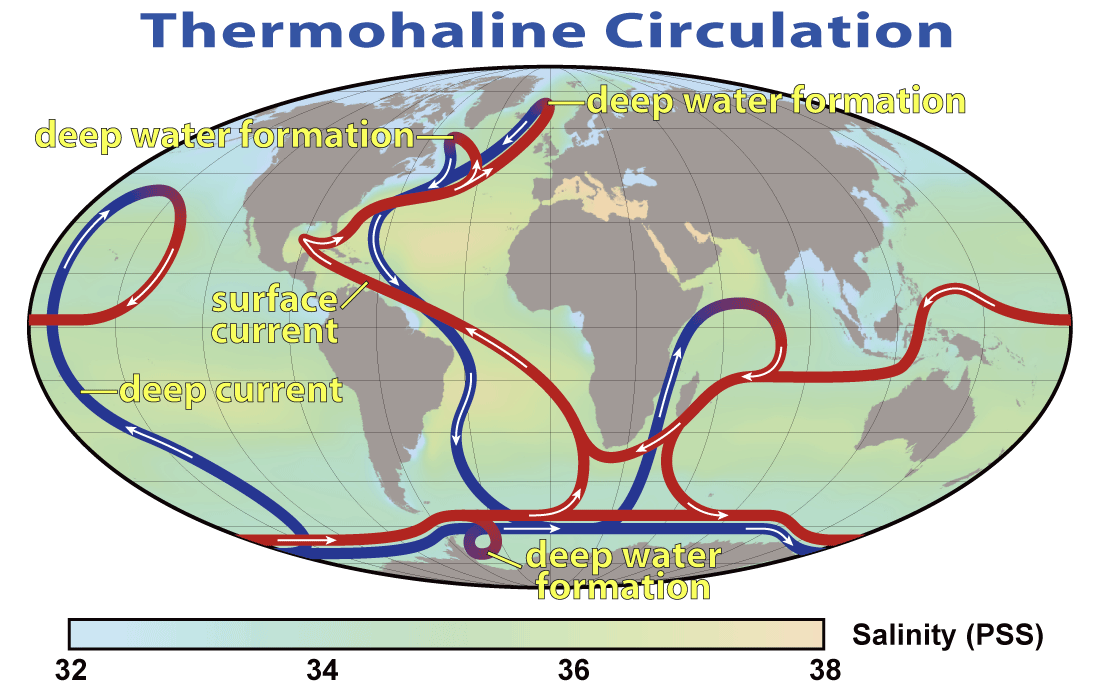
Part of large-scale ocean circulation
Thermohaline circulation (THC) is a part of the large-scale ocean circulation driven by global density gradients formed by surface heat and freshwater fluxes. The name thermohaline is derived from thermo-, referring to temperature, and haline, referring to salt content—factors which together determine the density of sea water.
Wind-driven surface currents (such as the Gulf Stream) travel polewards from the equatorial Atlantic Ocean, cooling and sinking en-route to higher latitudes - eventually becoming part of the North Atlantic Deep Water - before flowing into the ocean basins. While the bulk of thermohaline water upwells in the Southern Ocean, the oldest waters (with a transit time of approximately 1000 years) upwell in the North Pacific; extensive mixing takes place between the ocean basins, reducing the difference in their densities, forming the Earth's oceans a global system. The water in these circuits transport energy - as heat - and mass - as dissolved solids and gases - around the globe. Consequently, the state of the circulation greatly impacts the climate of Earth.
The thermohaline circulation is often referred to as the* ocean conveyor belt*, great ocean conveyor, or "global conveyor belt" - a term coined by climate scientist Wallace Smith Broecker. It is also known as the meridional overturning circulation, or MOC; a name used to signify that circulation patterns caused by temperature and salinity gradients are not necessarily part of a single global circulation. This is due, in part, to the difficulty in separating parts of the circulation driven by temperature and salinity from those affected by factors such as wind and tidal force.
This global circulation comprises two major "limbs;" the Atlantic meridional overturning circulation (AMOC) centered in the north Atlantic Ocean, and the Southern Ocean overturning circulation, or Southern Ocean meridional circulation (SMOC) located near Antarctica. Since 90% of the human population occupies the Northern Hemisphere, more extensive research has been undertaken on the AMOC, however the SMOC is of equal importance to the global climate. Evidence suggests both circulations are slowing due to climate change in line with increasing rates of dilution from melting ice sheets - critically affecting the salinity of Antarctic bottom water. In addition, the potential for outright collapse of either circulation to a much weaker state exemplifies tipping points in the climate system. If either hemisphere experiences collapse of its circulation, the likelihood of prolonged dry spells and droughts would increase as precipitation decreases, while the other hemisphere will become wetter. Marine ecosystems are then more likely to receive fewer nutrients and experience greater ocean deoxygenation. In the Northern Hemisphere, the collapse of AMOC would lead to substantially lower temperatures in many European countries, while the east coast of North America is predicted to see accelerated sea level rise. The collapse of these circulations is generally accepted to be more than a century away, and may only occur in the event of rapid and high sea-temperature increases. However, these projections are marked by significant uncertainty.
History of research
It has long been known that wind drives ocean currents, but only at the surface. In the 19th century, some oceanographers suggested that the convection of heat could drive deeper currents. In 1908, Johan Sandström performed a series of experiments at a Bornö Marine Research Station which proved that the currents driven by thermal energy transfer can exist, but require that "heating occurs at a greater depth than cooling". Normally, the opposite occurs, because ocean water is heated from above by the Sun and becomes less dense, so the surface layer floats on the surface above the cooler, denser layers, resulting in ocean stratification. However, wind and tides cause mixing between these water layers, with diapycnal mixing caused by tidal currents being one example. This mixing is what enables the convection between ocean layers, and thus, deep water currents.
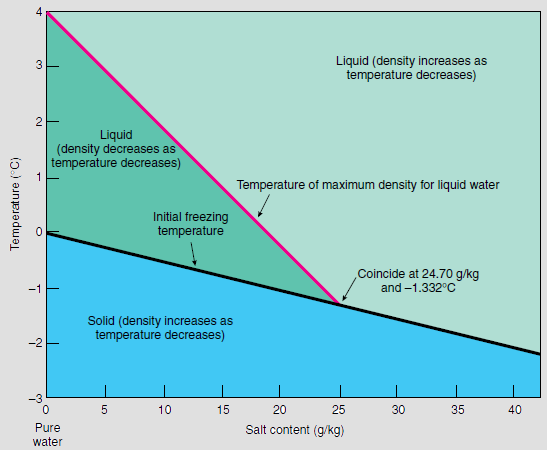
In the 1920s, Sandström's framework was expanded by accounting for the role of salinity in ocean layer formation. Salinity is important because like temperature, it affects water density. Water becomes less dense as its temperature increases and the distance between its molecules expands, but more dense as the salinity increases, since there is a larger mass of salts dissolved within that water. Further, while fresh water is at its most dense at 4 °C, seawater only gets denser as it cools, up until it reaches the freezing point. That freezing point is also lower than for fresh water due to salinity, and can be below −2 °C, depending on salinity and pressure.
Structure
These density differences caused by temperature and salinity ultimately separate ocean water into distinct water masses, such as the North Atlantic Deep Water (NADW) and Antarctic Bottom Water (AABW). These two waters are the main drivers of the circulation, which was established in 1960 by Henry Stommel and Arnold B. Arons. They have chemical, temperature and isotopic ratio signatures (such as 231Pa / 230Th ratios) which can be traced, their flow rate calculated, and their age determined. NADW is formed because North Atlantic is a rare place in the ocean where precipitation, which adds fresh water to the ocean and so reduces its salinity, is outweighed by evaporation, in part due to high windiness. When water evaporates, it leaves salt behind, and so the surface waters of the North Atlantic are particularly salty. North Atlantic is also an already cool region, and evaporative cooling reduces water temperature even further. Thus, this water sinks downward in the Norwegian Sea, fills the Arctic Ocean Basin and spills southwards through the Greenland-Scotland-Ridge – crevasses in the submarine sills that connect Greenland, Iceland and Great Britain. It cannot flow towards the Pacific Ocean due to the narrow shallows of the Bering Strait, but it does slowly flow into the deep abyssal plains of the south Atlantic.
In the Southern Ocean, strong katabatic winds blowing from the Antarctic continent onto the ice shelves will blow the newly formed sea ice away, opening polynyas in locations such as Weddell and Ross Seas, off the Adélie Coast and by Cape Darnley. The ocean, no longer protected by sea ice, suffers a brutal and strong cooling (see polynya). Meanwhile, sea ice starts reforming, so the surface waters also get saltier, hence very dense. In fact, the formation of sea ice contributes to an increase in surface seawater salinity; saltier brine is left behind as the sea ice forms around it (pure water preferentially being frozen). Increasing salinity lowers the freezing point of seawater, so cold liquid brine is formed in inclusions within a honeycomb of ice. The brine progressively melts the ice just beneath it, eventually dripping out of the ice matrix and sinking. This process is known as brine rejection. The resulting Antarctic bottom water sinks and flows north and east. It is denser than the NADW, and so flows beneath it. AABW formed in the Weddell Sea will mainly fill the Atlantic and Indian Basins, whereas the AABW formed in the Ross Sea will flow towards the Pacific Ocean. At the Indian Ocean, a vertical exchange of a lower layer of cold and salty water from the Atlantic and the warmer and fresher upper ocean water from the tropical Pacific occurs, in what is known as overturning. In the Pacific Ocean, the rest of the cold and salty water from the Atlantic undergoes haline forcing, and becomes warmer and fresher more quickly.
The out-flowing undersea of cold and salty water makes the sea level of the Atlantic slightly lower than the Pacific and salinity or halinity of water at the Atlantic higher than the Pacific. This generates a large but slow flow of warmer and fresher upper ocean water from the tropical Pacific to the Indian Ocean through the Indonesian Archipelago to replace the cold and salty Antarctic Bottom Water. This is also known as 'haline forcing' (net high latitude freshwater gain and low latitude evaporation). This warmer, fresher water from the Pacific flows up through the South Atlantic to Greenland, where it cools off and undergoes evaporative cooling and sinks to the ocean floor, providing a continuous thermohaline circulation.
Upwelling
As the deep waters sink into the ocean basins, they displace the older deep-water masses, which gradually become less dense due to continued ocean mixing. Thus, some water is rising, in what is known as upwelling. Its speeds are very slow even compared to the movement of the bottom water masses. It is therefore difficult to measure where upwelling occurs using current speeds, given all the other wind-driven processes going on in the surface ocean. Deep waters have their own chemical signature, formed from the breakdown of particulate matter falling into them over the course of their long journey at depth. A number of scientists have tried to use these tracers to infer where the upwelling occurs. Wallace Broecker, using box models, has asserted that the bulk of deep upwelling occurs in the North Pacific, using as evidence the high values of silicon found in these waters. Other investigators have not found such clear evidence.
Computer models of ocean circulation increasingly place most of the deep upwelling in the Southern Ocean, associated with the strong winds in the open latitudes between South America and Antarctica. Direct estimates of the strength of the thermohaline circulation have also been made at 26.5°N in the North Atlantic, by the UK-US RAPID programme. It combines direct estimates of ocean transport using current meters and subsea cable measurements with estimates of the geostrophic current from temperature and salinity measurements to provide continuous, full-depth, basin-wide estimates of the meridional overturning circulation. However, it has only been operating since 2004, which is too short when the timescale of the circulation is measured in centuries.
Effects on global climate
The thermohaline circulation plays an important role in supplying heat to the polar regions, and thus in regulating the amount of sea ice in these regions, although poleward heat transport outside the tropics is considerably larger in the atmosphere than in the ocean. Changes in the thermohaline circulation are thought to have significant impacts on the Earth's radiation budget.
Large influxes of low-density meltwater from Lake Agassiz and deglaciation in North America are thought to have led to a shifting of deep water formation and subsidence in the extreme North Atlantic and caused the climate period in Europe known as the Younger Dryas.
Slowdown or collapse of AMOC
Slowdown or collapse of SMOC
References
Other sources
References
- Lappo, SS. (1984). "On reason of the northward heat advection across the Equator in the South Pacific and Atlantic ocean". Moscow Department of Gidrometeoizdat (in Mandarin).
- Primeau, F. (2005). "Characterizing transport between the surface mixed layer and the ocean interior with a forward and adjoint global ocean transport model". Journal of Physical Oceanography.
- "What is the global ocean conveyor belt?". [[NOAA]].
- Schwartz, John. (20 February 2019). "Wallace Broecker, 87, Dies; Sounded Early Warning on Climate Change". The New York Times.
- de Menocal, Peter. (2019-03-26). "Wallace Smith Broecker (1931–2019)". Nature.
- Wunsch, C. (2002). "What is the thermohaline circulation?". Science.
- Collins, Kevin. (3 November 2023). "El Niño may be drying out the southern hemisphere – here's how that affects the whole planet". [[The Conversation (website).
- (29 March 2023). "NOAA Scientists Detect a Reshaping of the Meridional Overturning Circulation in the Southern Ocean". [[NOAA]].
- (2023). "The Global Tipping Points Report 2023". University of Exeter.
- (29 March 2023). "Landmark study projects 'dramatic' changes to Southern Ocean by 2050". [[ABC News (Australia).
- Schmidt, Gavin. (26 May 2005). "Gulf Stream slowdown?". [[RealClimate]].
- Rahmstorf, S. (2006). "Encyclopedia of Quaternary Sciences". Elsevier Science.
- Eden, Carsten. (2012). "Ocean Dynamics". Springer.
- Rahmstorf, S. (2003). "The concept of the thermohaline circulation". Nature.
- Wyrtki, K. (1961). "The thermohaline circulation in relation to the general circulation in the oceans". Deep-Sea Research.
- Pawlowicz, Rich. (2013). "Key Physical Variables in the Ocean: Temperature, Salinity, and Density". [[Nature Magazine]].
- Stommel, H., & Arons, A. B. (1960). On the abyssal circulation of the world ocean. – I. Stationary planetary flow patterns on a sphere. Deep Sea Research (1953), 6, 140–154.
- (11 June 2018). "Water Vapor Transfer and Near-Surface Salinity Contrasts in the North Atlantic Ocean". Scientific Reports.
- (1998). "The distribution and formative processes of latent heat polynyas in East Antarctica". Annals of Glaciology.
- (April 2008). "Mapping of sea ice production for Antarctic coastal polynyas". Geophysical Research Letters.
- (May 2020). "Warm Circumpolar Deep Water transport toward Antarctica driven by local dense water export in canyons". Science Advances.
- (2016-08-23). "The suppression of Antarctic bottom water formation by melting ice shelves in Prydz Bay". Nature Communications.
- (June 2023). "Zonal Distribution of Circumpolar Deep Water Transformation Rates and Its Relation to Heat Content on Antarctic Shelves". Journal of Geophysical Research: Oceans.
- [https://svs.gsfc.nasa.gov/vis/a000000/a003600/a003658/ The Thermohaline Circulation – The Great Ocean Conveyor Belt] {{Webarchive. link. (19 December 2022 ''NASA Scientific Visualization Studio'', visualizations by Greg Shirah, 8 October 2009. {{PD-notice)
- United Nations Environment Programme / GRID-Arendal, 2006, [http://www.grida.no/climate/vital/32.htm] {{Webarchive. link. (28 January 2017. ''Potential Impact of Climate Change'')
- Talley, Lynne. (1999). "Mechanisms of Global Climate Change at Millennial Time Scales".
- S., Broecker, Wallace. (2010). "The great ocean conveyor: discovering the trigger for abrupt climate change". Princeton University Press.
- Marshall, John. (26 February 2012). "Closure of the meridional overturning circulation through Southern Ocean upwelling". Nature Geoscience.
- "RAPID: monitoring the Atlantic Meridional Overturning Circulation at 26.5N since 2004".
- (2001). "Estimates of Meridional Atmosphere and Ocean Heat Transports". Journal of Climate.
- Broecker, WS. (2006). "Was the Younger Dryas Triggered by a Flood?". Science.
This article was imported from Wikipedia and is available under the Creative Commons Attribution-ShareAlike 4.0 License. Content has been adapted to SurfDoc format. Original contributors can be found on the article history page.
Ask Mako anything about Thermohaline circulation — get instant answers, deeper analysis, and related topics.
Research with MakoFree with your Surf account
Create a free account to save articles, ask Mako questions, and organize your research.
Sign up freeThis content may have been generated or modified by AI. CloudSurf Software LLC is not responsible for the accuracy, completeness, or reliability of AI-generated content. Always verify important information from primary sources.
Report