From Surf Wiki (app.surf) — the open knowledge base
Tengwar
Fictional script in Tolkien's writings
Fictional script in Tolkien's writings
| Field | Value |
|---|---|
| name | Tengwar |
| sample | Tengwar.svg |
| caption | The word "Tengwar" written using the Tengwar script in the Quenya mode |
| imagesize | 180px |
| type | Alternative |
| typedesc | abugida or alphabet according to the "mode" |
| time | 1930s–present |
| fam1 | Sarati |
| creator | J. R. R. Tolkien |
| languages | a number of Tolkien's constructed languages, Quenya and Sindarin, English |
| iso15924 | Teng |
The Tengwar () script is an artificial script, one of several scripts created by J. R. R. Tolkien, the author of The Lord of the Rings. Within the context of Tolkien's fictional world, the Tengwar were invented by the Elf Fëanor, and used first to write the Elvish languages Quenya and Telerin. Later a great number of Tolkien's constructed languages were written using the Tengwar, including Sindarin. Tolkien used Tengwar to write English: most of Tolkien's Tengwar samples are actually in English.
External history
Precursors
The sarati, a script developed by Tolkien in the late 1910s and described in Parma Eldalamberon 13, anticipates many features of the Tengwar: vowel representation by diacritics (which is found in many Tengwar varieties); different Tengwar shapes; and a few correspondences between sound features and letter shape features (though inconsistent).
Even closer to the Tengwar is the Valmaric script, described in Parma Eldalamberon 14, which Tolkien used from about 1922 to 1925. It features many Tengwar shapes, the inherent vowel found in some Tengwar varieties, and the tables in the samples V12 and V13 show an arrangement that is very similar to one of the primary Tengwar in the classical Quenya "mode".
In his An Introduction to Elvish, Jim Allan compared the Tengwar with the London merchant Francis Lodwick's 1686 Universal Alphabet, both on grounds of the correspondence between shape features and sound features, and of the actual letter shapes.
Tengwar

The Tengwar script was probably developed in the late 1920s or in the early 1930s. The Lonely Mountain Jar Inscription, the first published Tengwar sample, dates to 1937. The full explanation of the Tengwar was published in Appendix E of The Lord of the Rings in 1955.
The Mellonath Daeron Index of Tengwar Specimina (DTS) lists most of the known samples of Tengwar by Tolkien. There are only a few known samples predating publication of The Lord of the Rings (many of them published posthumously):
- The Lonely Mountain Jar Inscription, published 1937
- Middle Page from the Book of Mazarbul
- Last Page from the Book of Mazarbul, Last Line, this and the above one originally prepared for inclusion in The Lord of the Rings
- Steinborg Drawing Title
- Ilbereth's Greeting from The Father Christmas Letters, dating to 1937
- The Treebeard Page
- Edwin Lowdham's Manuscript from The Notion Club Papers has Old English language text written in Tengwar (with a few Adûnaic and Quenya words), dating to 1945/6.
- The Brogan Tengwa-greetings, appearing in The Letters of J. R. R. Tolkien, No. 118, tentatively dated to 1948
The following samples presumably predate The Lord of the Rings, but were not explicitly dated:
- Elvish Script Sample I, II, III, with parts of the English poems Errantry and Bombadil, first published in the Silmarillion Calendar 1978, later in Pictures by J. R. R. Tolkien,
- So Lúthien, a page of the English Lay of Leithian text
Internal history and terminology
Within the context of Tolkien's fictional world, the Tengwar were invented by the Elf Fëanor in Valinor, and used first to write the Elven tongues Quenya and Telerin. According to J. R. R. Tolkien's The War of the Jewels, at the time Fëanor created his script, he introduced a change in terminology. He called a letter, a written representation of a spoken phoneme (tengwë), a tengwa. Previously, any letter or symbol had been called a sarat (from *sar 'incise'). The alphabet of Rúmil of Tirion, on which Fëanor supposedly based his own work, was known as Sarati. It later became known as "Tengwar of Rúmil".
The plural of tengwa is tengwar, and this is the name by which Fëanor's writing system became known. Since, however, in commonly used modes, an individual tengwa was equivalent to a consonant, the term tengwa in the fiction became equivalent to "consonant sign", and the vowel signs were known as ómatehtar. By loan-translation, the Tengwar became known as tîw (singular têw) in Sindarin, when they were introduced to Beleriand. The letters of the earlier alphabet native to Sindarin were called cirth (singular certh, probably from *kirte 'cutting', and thus semantically analogous to Quenya sarat). This term was loaned into exilic Quenya as certa, plural certar.
Description

Letters
The most notable characteristic of the Tengwar script is that the shapes of the letters correspond to the distinctive features of the sounds they represent. The Quenya consonant system has five places of articulation: labial, dental, palatal, velar, and glottal. The velars distinguish between plain and labialized (that is, articulated with rounded lips, or followed by a sound). Each point of articulation, and the corresponding tengwa series, has a name in the classical Quenya mode. Dental sounds are called tincotéma and are represented with the Tengwar in column I. Labial sounds are called parmatéma, and represented by the column II Tengwar; velar sounds are called calmatéma, represented by column III; and labialized velar sounds are called quessetéma, represented by the Tengwar of column IV. Palatal sounds are called tyelpetéma and have no tengwa series of their own, but are represented by column III letters with an added diacritic for following .
Similarly shaped letters reflect not only similar places of articulation, but also similar manners of articulation. In the classical Quenya mode, row 1 represents voiceless stops, row 2 voiced prenasalized stops, row 3 voiceless fricatives, row 4 voiceless prenasalized stops, row 5 nasal stops, and row 6 approximants.
Regularly formed
Most letters are constructed by a combination of two basic shapes: a vertical stem (either long or short) and either one or two rounded bows (which may or may not be underscored, and may be on the left or right of the stem).
These principal letters are divided into four series (témar) that correspond to the main places of articulation and into six grades (tyeller) that correspond to the main manners of articulation. Both vary among modes.
Each series is headed by the basic signs composed of a vertical stem descending below the line, and a single bow. These basic signs represent the voiceless stop consonants for that series. For the classical Quenya mode, they are , , and , and the series are named tincotéma, parmatéma, calmatéma, and quessetéma, respectively; téma means "series" in Quenya.
In rows of the general use, there are the following correspondences between letter shapes and manners of articulation:
- Doubling the bow turns the voiceless consonant into a voiced one.
- Raising the stem above the line turns it into the corresponding fricative.
- Shortening it (so it is only the height of the bow) creates the corresponding nasal. In most modes, the signs with shortened stem and single bow do not correspond to the voiceless nasals, but to the approximants.
In addition to these variations of the Tengwar shapes, there is yet another variation, the use of stems that are extended both above and below the line. This shape may correspond to other consonant variations required. Except for some English abbreviations, it is not used in any of the better known Tengwar modes, but it occurs in a Quenya mode where the tengwa Parma with extended stem is used for and the tengwa Calma with extended stem is used for . The Tengwar with raised stems sometimes occur in glyph variants that look like extended stems, as seen in the inscription of the One Ring.
An example from the parmatéma (the signs with a closed bow on the right side) in the "general use" of the Tengwar is:
- The basic sign, named parma, (with descending stem) represents (it happens to look much like the Latin letter P).
- With the bow doubled, umbar, it represents .
- With a raised stem, formen, it represents .
- With a raised stem and a doubled bow, ampa, it represents generally but possibly (depending upon the language).
- With a short stem and double bow, malta, it represents .
- With short stem and single bow, vala, it represents , or if that has the phonological behaviour of a sonorant (e.g. in Quenya).
In languages such as Quenya, which do not contain any voiced fricatives other than "v", the raised stem + doubled bow row is used for the common nasal+stop sequences (nt, mp, nk, nqu). In such cases, the "w" sign in the previous paragraph is used for "v". In the mode of Beleriand, found on the door to Moria, the bottom tyellë is used for nasals (e.g., vala is used for ) and the fifth tyellë for doubled nasals (malta for ).
Irregularly formed
There are additional letters that do not have regular shapes. They may represent, e.g., , , and . Their use varies considerably from mode to mode. Some aficionados have added more letters not found in Tolkien's writings for use in their modes.
{{lang|qya|Tehtar}} diacritics
A tehta (Quenya 'marking') is a diacritic placed above or below the tengwa. They can represent vowels, consonant doubling, or nasal sound.
As Tolkien explained in Appendix E of The Lord of the Rings, the tehtar for vowels resemble Latin diacritics: circumflex (î) , acute (í) , dot (i) , left curl (ı̔) , and right curl (ı̓) . Long vowels, excepting , may be indicated by doubling the signs. Some languages from which is absent or in which compared to it appears sparsely, such as the Black Speech, use left curl for ; other languages swap the signs for and .
A vowel occurring alone is drawn on the vowel carrier, which resembles dotless i (ı) for a short vowel or dotless j (ȷ) for a long vowel.
Modes
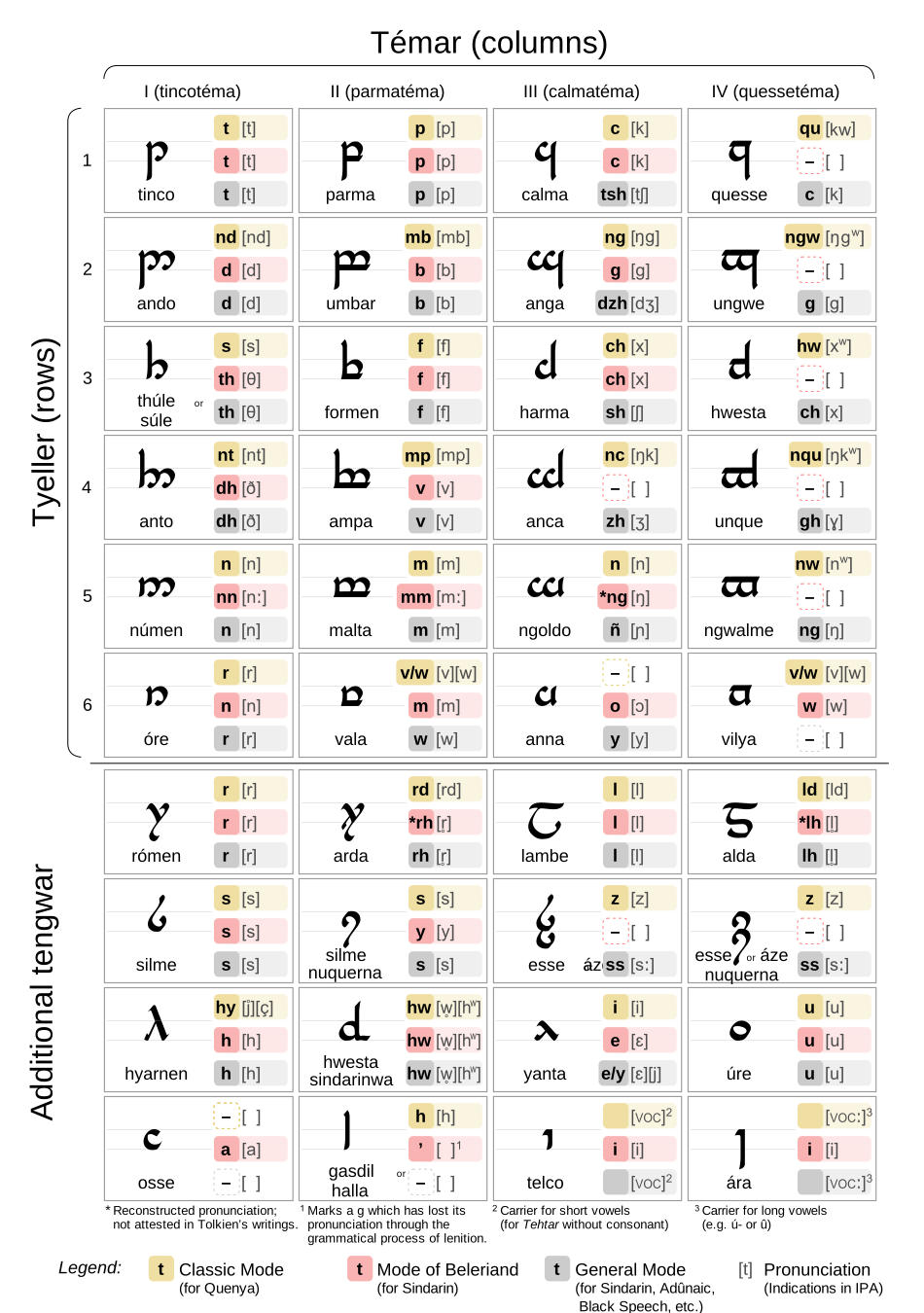
Just as with any alphabetic writing system, every specific language written in Tengwar requires a specific orthography, depending on the phonology of that language. These Tengwar orthographies are usually called modes. Some modes follow pronunciation, while others follow traditional orthography.
Some modes map the basic consonants to , , and (classical mode in chart at right), while others use them to represent , , and (general mode at right). The other main difference is in the fourth tyellë below, where those letters with raised stems and doubled bows can be either voiced fricatives, as in Sindarin (general mode at right), or nasalized stops, as in Quenya (classical mode).
Ómatehtar
In some modes, called ómatehtar (or vowel tehtar) modes, the vowels are represented with diacritics called tehtar (Quenya for 'signs'; corresponding singular: tehta, 'sign'). These ómatehtar modes can be considered abugidas rather than true alphabets. In some ómatehtar modes, the consonant signs feature an inherent vowel.
Ómatehtar modes can vary in that the vowel stroke can be placed either on top of the consonant preceding it, as in Quenya, or on the consonant following, as in Sindarin, English, and the notorious Black Speech inscription on the One Ring.
Full writing
In the full writing modes, the consonants and the vowels are represented by Tengwar. Only one such mode is well known. It is called the "mode of Beleriand" and one can read it on the Doors of Durin.
Modes for other languages
Since the publication of the first official description of the Tengwar at the end of The Lord of the Rings, others have created modes for other languages such as English, Spanish, German, Swedish, French, Finnish, Italian, Hungarian and Welsh. Modes have also been devised for the constructed languages Esperanto and Lojban.
Tolkien had used multiple modes for English, including full writing and ómatehtar alphabetic modes, phonetic full modes and phonetic ómatehtar modes known from documents published after his death.
Encoding schemes
Legacy encoding
The contemporary de facto standard in the Tengwar user community maps the Tengwar characters onto the ISO 8859-1 character encoding following the example of the Tengwar typefaces by Dan Smith. This implies a major flaw: If no corresponding Tengwar font is installed, a string of nonsense characters appears.
Since there are not enough places in ISO 8859-1's 191 codepoints for all the signs used in Tengwar orthography, certain signs are included in a "Tengwar A" font which also maps its characters on ISO 8859-1, overlapping with the first font.
For each Tengwar diacritic, there are four different codepoints that are used depending on the width of the character which bears it.
Other Tengwar typefaces with this encoding include Johan Winge's Tengwar Annatar, Måns Björkman's Tengwar Parmaitë, Enrique Mombello's Tengwar Élfica or Michal Nowakowski's Tengwar Formal (note that these differ in some details).
The following sample shows the first article of the Universal Declaration of Human Rights written in English, according to the traditional English orthography.
Unicode
Michael Everson made a proposal to include the Tengwar in the Unicode standard in 1997. The range to U+160FF in the SMP was tentatively allocated for Tengwar in the 2023 Unicode roadmap.
ConScript Unicode Registry
Tengwar are included in the unofficial ConScript Unicode Registry (CSUR), which assigns codepoints in the Private Use Area. Tengwar are mapped to the range U+E000–U+E07F.
Some typefaces that support this proposal are Everson Mono, Tengwar Telcontar, Constructium, Tengwar Formal Unicode, and FreeMonoTengwar (James Kass's Code2000 and Code2001 use an older, incompatible version of the proposal). The eight “Aux” variant fonts of Kurinto (such as Kurinto Text Aux, Book Aux, Sans Aux) also support Tengwar.
| Name | Image | CSUR | Designation annotation | |
|---|---|---|---|---|
| tinco | [[File:Tengwa tinco.svg | 24px | tinco]] | U+E000 |
| parma | [[File:Tengwa parma.svg | 24px | parma]] | U+E001 |
| calma | [[File:Tengwa calma.svg | 24px | calma]] | U+E002 |
| quessë | [[File:Tengwa quesse.svg | 24px | quessë]] | U+E003 |
| ando | [[File:Tengwa ando.svg | 24px | ando]] | U+E004 |
| umbar | [[File:Tengwa umbar.svg | 24px | umbar]] | U+E005 |
| anga | [[File:Tengwa anga.svg | 24px | anga]] | U+E006 |
| ungwë | [[File:Tengwa ungwe.svg | 24px | ungwë]] | U+E007 |
| súlë / thúlë | [[File:Tengwa súle.svg | 24px | súlë / thúlë]] | U+E008 |
| formen | [[File:Tengwa formen.svg | 24px | formen]] | U+E009 |
| harma / aha | [[File:Tengwa aha.svg | 24px | harma / aha]] | U+E00A |
| hwesta | [[File:Tengwa hwesta.svg | 24px | hwesta]] | U+E00B |
| anto | [[File:Tengwa anto.svg | 24px | anto]] | U+E00C |
| ampa | [[File:Tengwa ampa.svg | 24px | ampa]] | U+E00D |
| anca | [[File:Tengwa anca.svg | 24px | anca]] | U+E00E |
| unquë | [[File:Tengwa unque.svg | 24px | unquë]] | U+E00F |
| númen | [[File:Tengwa númen.svg | 24px | númen]] | U+E010 |
| malta | [[File:Tengwa malta.svg | 24px | malta]] | U+E011 |
| noldo / ñoldo | [[File:Tengwa noldo.svg | 24px | noldo / ñoldo]] | U+E012 |
| nwalmë / ñwalmë | [[File:Tengwa nwalme.svg | 24px | nwalmë / ñwalmë]] | U+E013 |
| órë | [[File:Tengwa óre.svg | 24px | órë]] | U+E014 |
| vala | [[File:Tengwa vala.svg | 24px | vala]] | U+E015 |
| anna | [[File:Tengwa anna.svg | 24px | anna]] | U+E016 |
| vilya / wilya | [[File:Tengwa wilya.svg | 24px | vilya / wilya]] | U+E017 |
| rómen | [[File:Tengwa rómen.svg | 24px | rómen]] | U+E018 |
| arda | [[File:Tengwa arda.svg | 24px | arda]] | U+E019 |
| lambë | [[File:Tengwa lambe.svg | 24px | lambë]] | U+E01A |
| alda | [[File:Tengwa alda.svg | 24px | alda]] | U+E01B |
| silmë | [[File:Tengwa silme.svg | 24px | silmë]] | U+E01C |
| silmë nuquerna | [[File:Tengwa silme nuquerna.svg | 24px | silmë nuquerna]] | U+E01D |
| essë / áre/áze | [[File:Tengwa esse.svg | 24px | essë / áre/áze]] | U+E01E |
| essë nuquerna / áre/áze nuquerna | [[File:Tengwa esse nuquerna.svg | 24px | essë nuquerna / áre/áze nuquerna]] | U+E01F |
| hyarmen | [[File:Tengwa hyarmen.svg | 24px | hyarmen]] | U+E020 |
| hwesta sindarinwa | [[File:Tengwa hwesta sindarinwa.svg | 24px | hwesta sindarinwa]] | U+E021 |
| yanta | [[File:Tengwa yanta.svg | 24px | yanta]] | U+E022 |
| úrë | [[File:Tengwa úre.svg | 24px | úrë]] | U+E023 |
| halla | [[File:Tengwa halla.svg | 24px | halla]] | U+E024 |
| telco | [[File:Tengwa telco.svg | 24px | telco]] | U+E025 |
| ára | [[File:Tengwa ára.svg | 24px | ára]] | U+E026 |
| Name | Image | CSUR | Designation annotation | |
|---|---|---|---|---|
| U+E027 | ||||
| U+E028 | ||||
| U+E029 | ||||
| U+E02A | ||||
| U+E02B | ||||
| U+E02C | ||||
| U+E02D | ||||
| U+E02E | ||||
| U+E02F | ||||
| U+E030 | ||||
| U+E031 | ||||
| U+E032 | ||||
| U+E033 |
| Name | Image | CSUR | Designation annotation | |
|---|---|---|---|---|
| amatixe 3 | [[File:Tehta amatixe3.GIF | 24px | amatixe 3]] | U+E040 |
| unutixe 3 | U+E041 | |||
| amatixe 2 | [[File:Tehta amatixe2.GIF | 24px | amatixe 2]] | U+E042 |
| unutixe 2 | [[File:Tehta unutixe2.GIF | 24px | unutixe 2]] | U+E043 |
| amatixe 1 | [[File:Tehta amatixe1.gif | 24px | amatixe 1]] | U+E044 |
| unutixe 1 | [[File:Tehta unutixe1.GIF | 24px | unutixe 1]] | U+E045 |
| tecco | [[File:Tehta tecco.gif | 24px | tecco]] | U+E046 |
| U+E047 | ||||
| rempe | [[File:Tehta rempe.GIF | 24px | rempe]] | U+E048 |
| U+E049 | ||||
| rempenuquerna | [[File:Tehta rempenuquerna.GIF | 24px | rempenuquerna]] | U+E04A |
| U+E04B | ||||
| amatwe | [[File:Tehta amatwe.GIF | 24px | amatwe]] | U+E04C |
| unuatwe | [[File:Tehta unuatwe.GIF | 24px | unuatwe]] | U+E04D |
| U+E04E | ||||
| U+E04F | ||||
| U+E050 | ||||
| U+E051 | ||||
| U+E052 | ||||
| U+E053 | ||||
| U+E054 | ||||
| U+E055 | ||||
| thinnas | [[File:Tehta thinnas.gif | 24px | thinnas]] | U+E056 |
| U+E057 | ||||
| U+E058 | ||||
| U+E05A | ||||
| sarince | [[File:Tehta sarince.gif | 24px | sarince]] | U+E05C |
| U+E05D |
| Name | Image | CSUR | Designation annotation | |
|---|---|---|---|---|
| 0 | U+E030 | |||
| 1 | U+E033 | |||
| 2 | U+E062 | |||
| 3 | U+E063 | |||
| 4 | U+E064 | |||
| 5 | U+E065 | |||
| 6 | U+E066 | |||
| 7 | U+E067 | |||
| 8 | U+E068 | |||
| 9 | U+E069 | |||
| 10 | U+E06A | |||
| 11 | U+E06B | |||
| U+E06C | ||||
| U+E06D | ||||
| U+E06E |
In popular culture
Tengwar has been used in Tolkien fandom since the publication of The Lord of the Rings in the 1950s.
With the exception of John Rhys-Davies, the actors playing the Fellowship of the Ring in The Lord of the Rings film trilogy have Tengwar tattoos of the English word nine.
Footballers such as Sergio Agüero and Fernando Torres have tattoos with their first name in Tengwar on their forearms.
References
Sources
For a list of linguistic material by Tolkien published in the journals Parma Eldalamberon and Vinyar Tengwar, see bibliography in Elvish languages (Middle-earth).
- Derzhanski, Ivan A. "The Fëanorian Tengwar and the Typology of Phonetic Writing Systems." Vinyar Tengwar 41 (2000): 20–23.
- Hostetter, Carl F. ""Si man i-yulmar n(g)win enquatuva": A Newly-Discovered Tengwar Inscription." Vinyar Tengwar 21 (1992): 6–10.
- Smith, Arden R., Irmengard Rauch and Gerald F. Carr. "The Semiotics of the Writing Systems of Tolkien's Middle-earth." In Semiotics around the World: Synthesis in Diversity, I-II, ed. Irmengard Rauch, 1239–42. Berlin, Germany: Mouton de Gruyter, 1997.
References
- (2025-11-02). "Tengwar".
- "The Alphabet of Rúmil". Parma Eldalamberon.
- "Early Qenya and the Valmaric Script". Parma Eldalamberon.
- "An Introduction to Elvish". Bran's Head Books.
- ''[[The Hobbit]]'', most editions with colour plates.
- ''[[The Lord of the Rings]]'', Appendix E, "Writing: The Fëanorian Letters "
- "The Mellonath Daeron Index of Tengwa Specimina".
- [http://www.forodrim.org/daeron/mdtci.html#DTS1 DTS 1]
- [http://www.forodrim.org/daeron/mdtci.html#DTS13 DTS 13]
- [http://www.forodrim.org/daeron/mdtci.html#DTS14 DTS 14]
- [http://www.forodrim.org/daeron/mdtci.html#DTS15 DTS 15]
- [http://www.forodrim.org/daeron/mdtci.html#DTS22 DTS 22]
- [http://www.forodrim.org/daeron/mdtci.html#DTS24 DTS 24]
- [http://www.forodrim.org/daeron/mdtci.html#DTS50 DTS 50]/[http://www.forodrim.org/daeron/mdtci.html#DTS51 51]
- [http://www.forodrim.org/daeron/mdtci.html#DTS10 DTS 10]
- [http://www.forodrim.org/daeron/mdtci.html#DTS16 DTS 16], [http://www.forodrim.org/daeron/mdtci.html#DTS17 DTS 17], [http://www.forodrim.org/daeron/mdtci.html#DTS18 DTS 18]
- [http://www.forodrim.org/daeron/mdtci.html#DTS23 DTS 23]
- Facsimiled in ''[[The Lays of Beleriand]]'':299.
- ''[[The War of the Jewels]]'', Appendix D to ''Quendi and Eldar''
- "Tengwar". Tolkien Gateway.
- Davy, Max. "Tengwar Feanor Elvish Transcriber".
- "Tengwar Handbook".
- Tyler, J. E. A.. (2022). "The Complete Tolkien Companion". Pan Books.
- See ''[[Parma Eldalamberon]]'' 19 (2010), pp. 41–43.
- (2025-11-02). "Tengwar".
- http://www.tolkien.ro/docs/Quenya-Elvish-Language-Course-Tolkien.pdf {{Bare URL PDF. (January 2026)
- (2011). "Proceedings of the Third International Conference on JRR Tolkien's Invented Languages, Omentielva Nelya, Whitehaven, 6-9 August 2009". The Arda Society.
- "Proposal to encode Tengwar in Plane 1 of ISO/IEC 10646-2".
- "Roadmap to the SMP".
- Everson, Michael. "Tengwar: U+E000 - U+E07F". ConScript Unicode Registry.
- "ConScript Unicode Registry". Evertype.com.
- (15 December 2009). "Free Tengwar Font Project: Tengwar Telcontar".
- (11 June 2010). "Free Tengwar Font Project: Tengwar Formal CSUR".
- (22 September 2009). "Free Tengwar Font Project: FreeMonoTengwar".
- [https://Kurinto.com/ Kurinto]
- Shelton , Luke. (25 October 2022). "Anna Voß's Experience — Tolkien Experience Project (212)". Luke Shelton.
- "The stars of The Lord of the Rings trilogy reach their journey's end". SciFi.com.
- Kaviraj, Tina. (22 February 2017). "10 things you need to know about Sergio Aguero".
- (2014-12-17). "Torres and Aguero's Elvish Obssession [sic]".
This article was imported from Wikipedia and is available under the Creative Commons Attribution-ShareAlike 4.0 License. Content has been adapted to SurfDoc format. Original contributors can be found on the article history page.
Ask Mako anything about Tengwar — get instant answers, deeper analysis, and related topics.
Research with MakoFree with your Surf account
Create a free account to save articles, ask Mako questions, and organize your research.
Sign up freeThis content may have been generated or modified by AI. CloudSurf Software LLC is not responsible for the accuracy, completeness, or reliability of AI-generated content. Always verify important information from primary sources.
Report