From Surf Wiki (app.surf) — the open knowledge base
Telstar 1
Defunct Communications Satellite
Defunct Communications Satellite
| Field | Value | ||||||||
|---|---|---|---|---|---|---|---|---|---|
| name | Telstar 1 | ||||||||
| names_list | |||||||||
| image | Telstar 1 replica.jpg | ||||||||
| image_caption | The original Telstar had a roughly spherical shape. | ||||||||
| image_alt | |||||||||
| mission_type | |||||||||
| operator | AT&TNASA | ||||||||
| Harvard_designation | |||||||||
| COSPAR_ID | 1962-029A | ||||||||
| SATCAT | 340 | ||||||||
| website | |||||||||
| mission_duration | (in orbit) | ||||||||
| distance_travelled | |||||||||
| orbits_completed | |||||||||
| suborbital_range | |||||||||
| suborbital_apogee | |||||||||
| spacecraft | |||||||||
| spacecraft_type | |||||||||
| spacecraft_bus | |||||||||
| manufacturer | Bell Labs | ||||||||
| launch_mass | 171 lbs | ||||||||
| BOL_mass | |||||||||
| landing_mass | |||||||||
| dry_mass | |||||||||
| payload_mass | |||||||||
| dimensions | |||||||||
| power | |||||||||
| launch_date | |||||||||
| launch_rocket | Thor-Delta | ||||||||
| launch_site | Cape Canaveral LC-17B | ||||||||
| launch_contractor | |||||||||
| deployment_from | |||||||||
| deployment_date | |||||||||
| entered_service | |||||||||
| disposal_type | |||||||||
| deactivated | 21 February 1963 | ||||||||
| destroyed | |||||||||
| last_contact | |||||||||
| recovery_by | |||||||||
| recovery_date | |||||||||
| decay_date | |||||||||
| landing_date | |||||||||
| landing_site | |||||||||
| {{end date | df | yes | YYYY | MM | DD | hh | mm | ss | TZ=Z}} (for Zulu/UTC) or (if time unknown) |
| orbit_reference | Geocentric | ||||||||
| orbit_regime | Medium Earth | ||||||||
| orbit_longitude | |||||||||
| orbit_slot | |||||||||
| orbit_semimajor | |||||||||
| orbit_eccentricity | |||||||||
| orbit_periapsis | 952 km | ||||||||
| orbit_apoapsis | 5933 km | ||||||||
| orbit_inclination | 44.8° | ||||||||
| orbit_period | 2 hours and 37 minutes | ||||||||
| orbit_RAAN | |||||||||
| orbit_arg_periapsis | |||||||||
| orbit_mean_anomaly | |||||||||
| orbit_mean_motion | |||||||||
| orbit_repeat | |||||||||
| orbit_velocity | |||||||||
| orbit_epoch | 1962-07-10 08:35:00 UTC | ||||||||
| orbit_rev_number | |||||||||
| apsis | gee | ||||||||
| trans_band | |||||||||
| trans_frequency | |||||||||
| trans_bandwidth | |||||||||
| trans_capacity | |||||||||
| trans_coverage | |||||||||
| trans_TWTA | |||||||||
| trans_EIRP | |||||||||
| trans_HPBW | |||||||||
| programme | *Telstar* | ||||||||
| previous_mission | *None* | ||||||||
| next_mission | Telstar 2 | ||||||||
| insignia | |||||||||
| insignia_caption | |||||||||
| insignia_alt | |||||||||
| insignia_size |
Include the dates applicable if possible, and separate each name with a linebreak. Omit if the spacecraft has only ever been known by one name. Do not include Harvard, COSPAR/NSSDC or SATCAT/NORAD/NASA designations as alternative names--
The following template should be used for ONE of the three above fields "end_of_mission", "decay" or "landing" if the spacecraft is no longer operational. If it landed intact, use it for the landing time, otherwise for the date it ceased operations, or the decay date if it was still operational when it re-entered. (for Zulu/UTC) or (if time unknown)
If in doubt, leave it out--
Telstar 1 is a defunct communications satellite launched by NASA on 10 July 1962. One of the earliest communications satellites, it was the first telecommunications satellite, achieving live transmission of broadcast television images between the United States and Europe. Telstar 1 remained active for only 7 months before it prematurely failed due to Starfish Prime, a high-altitude nuclear test conducted by the United States. Although the satellite is no longer operational, it remains in Earth orbit.
History

The idea of relaying information from one point on Earth to another by means of satellites was not new. As early as October 1945, the visionary Arthur C. Clarke published an article talking about it in the specialized magazine Wireless World. His idea was to enable communication between two points which were prevented from direct radio communication by the curve of the Earth, by relaying the information by radio through an orbiting satellite. During the Cold War, the shock caused by the successful launch of the first artificial satellite, Sputnik 1, by the Soviets increased the United States' interest in aerospace research. Soon thereafter, the Americans began their attempts to launch orbital communications satellites for transmitting telephone, radio, and television signals.
In December 1958, the United States successfully launched its first communications satellite, SCORE. Through it, then-President Dwight D. Eisenhower sent a Christmas message to the entire world. However, SCORE stayed in orbit for only a few months, its enormous surface area and very low Earth orbit forcing reentry after only 500 laps around the planet due to aerodynamic resistance. Also, SCORE relied on a passive reflector, which greatly reduced signal strength, since it did not amplify the signal before sending it back to earth.
The Telstar project represented a substantial financial investment to advance satellite communications technology. According to a memorandum dated 16 August 1962, the total expenditure for the Telstar experimental satellite project, as reported by AT&T to Senator Kerr, was approximately $50 million. This figure includes an initial estimate of $45 million as of 19 April 1962, covering the costs of orbiting the Telstar satellite and establishing a fully operational ground station in Andover, Maine. Additional expenses incurred after this date increased the total project costs by $5 million, with the Andover facility alone costing around $10 million and another $4 million for necessary tie-in lines.
AT&T also reported that it had invested $1.4 billion in research and development for the essential components of the communications system, of which over $1 billion was directed towards technology closely related to satellite communications.
Specific launch costs were also covered by AT&T. On 16 February 1962, approximately five months before the 10 July 1962, launch, AT&T made an advance payment to NASA totaling $2,680,982.
Launch
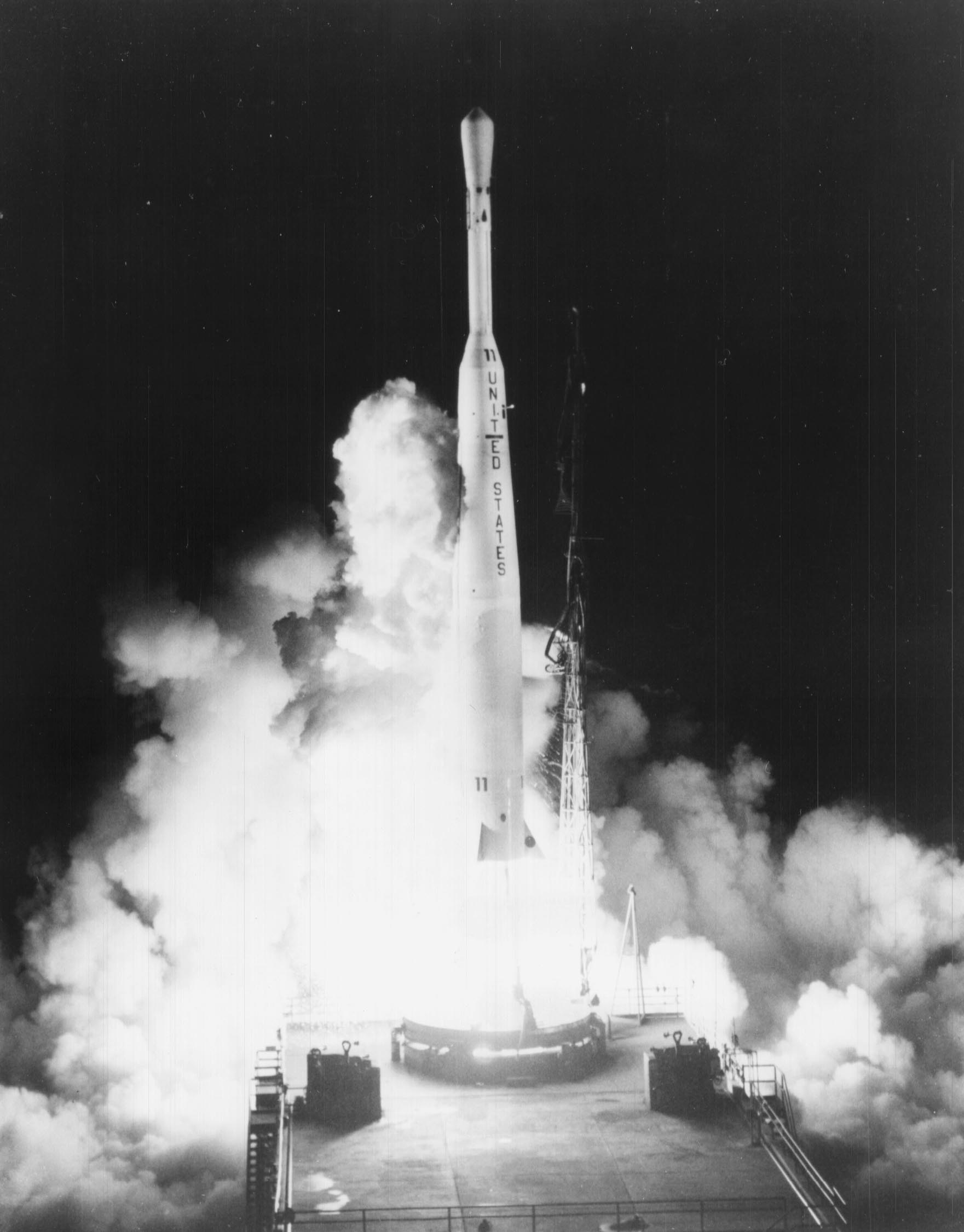
Telstar 1 was launched on 10 July 1962, from the Cape Canaveral Air Force Station, Florida, atop a Delta rocket. Spherical in shape, the satellite had a diameter of 88 cm and weighed 77 kg.
Operations
The satellite had a transponder (receiver and transmitter) with a 50 MHz bandwidth that could relay a single television channel or a FDM signal containing multiple telephone calls or datastreams. The two rings of microwave cavities visible around the satellite's middle were the uplink and downlink antennas for the data signal. The satellite received the 6.39 GHz microwave uplink signal from the transmitting ground station through the upper ring of smaller cavities, and transmitted the 4.17 GHz downlink signal back to the receiving ground station through the lower ring of larger cavities. Since the transmitter was very weak, with a radiated power of only 14 watts, and the antenna array was omnidirectional, very large aperture antennas were required at the ground stations to communicate with it. The satellite also had a helical antenna at one end to receive control commands.
A 53-meter terrestrial antenna manufactured by AT&T Corporation, located in Andover, Maine, was used for the transmissions between the United States and Europe. Built in 1961, and used by Telstar 1, it was later used by Relay 1. Telstar 1 operated normally from launch until November 1962 when the radiation from the Starfish Prime high altitude nuclear test detonation affected the command channel, which began to behave erratically. The satellite was continuously switched on to work around this problem. On 23 November 1962, the command channel stopped responding. On 20 December, the satellite was successfully reactivated, and intermittent data were obtained until 21 February 1963, when the transmitter failed. The energy used by it was produced by 3,600 solar cells. The satellite relied on an active repeater and magnified signal strength by a factor of a hundred using a travelling wave tube amplifier (TWTA). Thirteen days after the launch, the first live broadcast of a television show between the United States and Europe took place.
Broadcasting
References
References
- NASA, Goddard Space Flight Center. "Telstar 1". National Space Science Data Center Master Catalog.
- (2018-09-07). "Felker Talking Telstar". [[WNYC]].
- (17 August 1962). "(GPO-CRECB-1962) Congressional Record - Senate".
- (1989-06-30). "An Introduction to Satellite Communications". [[Institution of Electrical Engineers]].
- (n.d.). "1962: Nasa lança ao espaço o primeiro satélite de comunicações". [[Deutsche Welle]].
This article was imported from Wikipedia and is available under the Creative Commons Attribution-ShareAlike 4.0 License. Content has been adapted to SurfDoc format. Original contributors can be found on the article history page.
Ask Mako anything about Telstar 1 — get instant answers, deeper analysis, and related topics.
Research with MakoFree with your Surf account
Create a free account to save articles, ask Mako questions, and organize your research.
Sign up freeThis content may have been generated or modified by AI. CloudSurf Software LLC is not responsible for the accuracy, completeness, or reliability of AI-generated content. Always verify important information from primary sources.
Report