From Surf Wiki (app.surf) — the open knowledge base
TDRS-4
American communications satellite
American communications satellite
| Field | Value |
|---|---|
| name | TDRS-4 |
| image | Earth through the bay door2.jpg |
| image_caption | TDRS-D being deployed from *Discovery* |
| mission_type | Communication |
| operator | NASA |
| COSPAR_ID | 1989-021B |
| SATCAT | 19883 |
| mission_duration | Planned: 10 years |
| Final: | |
| spacecraft_bus | TDRS |
| manufacturer | TRW |
| launch_mass | 2108 kg |
| dimensions | 17.3 xx |
| power | 1700 watts |
| launch_date | UTC |
| launch_rocket | |
| STS-29R / IUS | |
| launch_site | Kennedy Space Center, LC-39B |
| launch_contractor | Rockwell International |
| disposal_type | Retired to graveyard |
| declared | December 2011 |
| deactivated | |
| orbit_epoch | 14 March 1989 |
| orbit_reference | Geocentric orbit |
| orbit_regime | Geostationary orbit |
| orbit_longitude | 41.0° West (1988–2005) |
| 46.0° West (2005–2011) | |
| apsis | gee |
| programme | **Tracking and Data Relay Satellite** |
| First-generation | |
| previous_mission | TDRS-3 |
| next_mission | TDRS-5 |
Final:
STS-29R / IUS
46.0° West (2005–2011)
First-generation TDRS-4, known before launch as TDRS-D, is an American communications satellite, of first generation, which was operated by NASA as part of the Tracking and Data Relay Satellite System from 1989 until 2011. It was constructed by TRW, based on a custom satellite bus which was used for all seven of the first generation TDRS satellites.
History
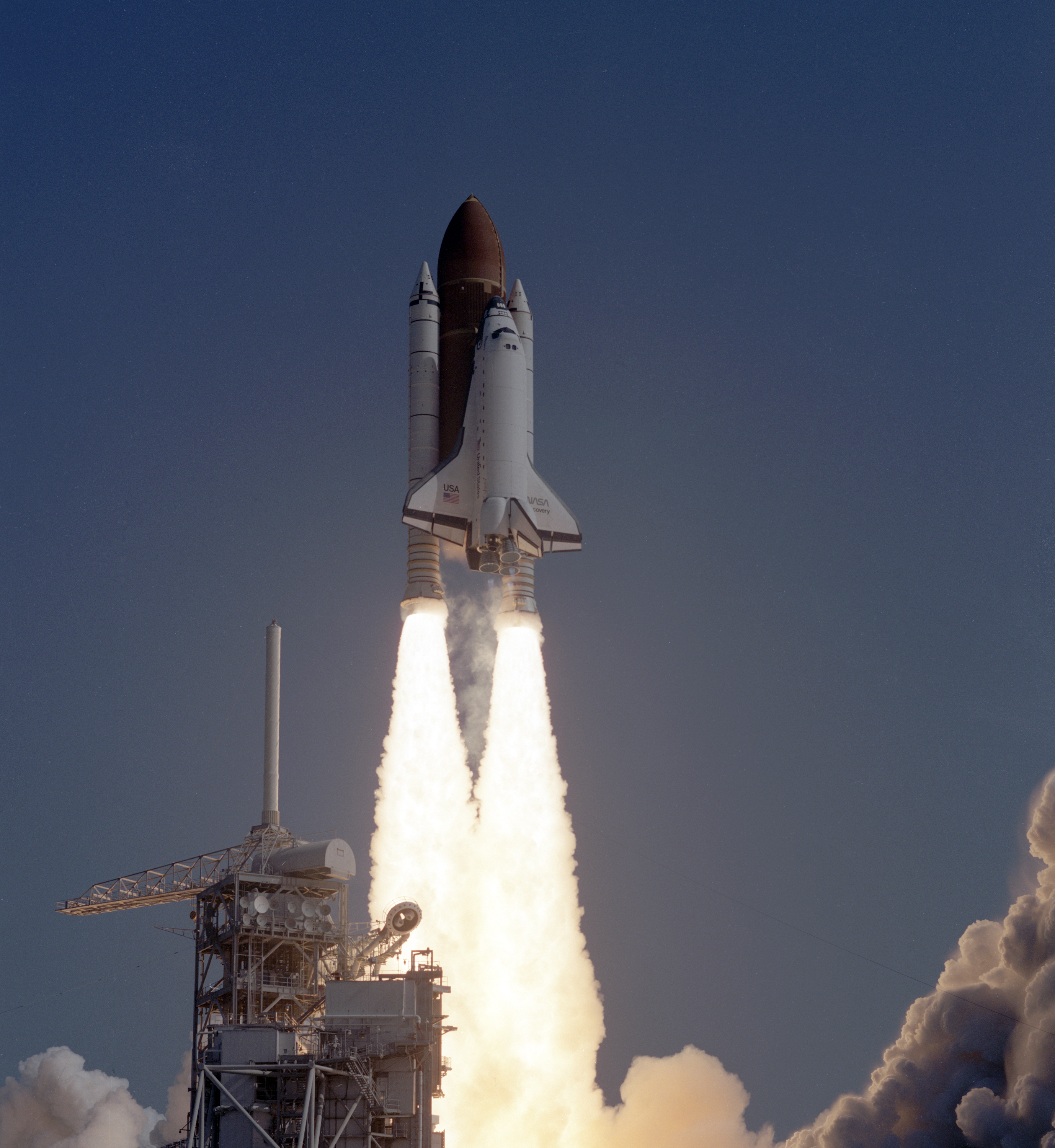
TDRS-D was launched aboard during the STS-29 mission in 1989. Discovery launched from Launch Complex 39B at the Kennedy Space Center at 14:57:00 UTC on 13 March 1989. TDRS-D was deployed from Discovery a few hours after launch, and was raised to geostationary orbit by means of an Inertial Upper Stage.
Deployment
The twin-stage solid-propellant Inertial Upper Stage made two burns. The first stage burn occurred shortly after deployment from Discovery, and placed the satellite into a geostationary transfer orbit (GTO). At 03:30 UTC on 14 March 1989, it reached apogee, and the second stage fired, placing TDRS-D into geostationary orbit. At this point, it received its operational designation, TDRS-4. It was placed at a longitude 41.0° West of the Greenwich Meridian, from where it provided communications services to spacecraft in Earth orbit, including the Space Shuttle and International Space Station. In 2005, it was relocated to 46.0° West.
Retirement
TDRS-4 completed its planned mission in December 2011, and was subsequently removed to a graveyard orbit 350 km above GEO orbit belt, per International Telecommunication Union (ITU) and United Nations (UN) recommendations. In May 2012, NASA reported that the orbit-raising manoeuvre had been completed successfully, and the spacecraft had been retired.


References
References
- (1 July 2009). "UCS Satellite Database". Union of Concerned Scientists.
- "NASA – NSSDCA – Spacecraft – Trajectory Details".
- Krebs, Gunter. "TDRS 1, 2, 3, 4, 5, 6". Gunter's Space Page.
- McDowell, Jonathan. "Launch Log". Jonathan's Space Page.
- McDowell, Jonathan. "Index". Jonathan's Space Page.
- "TDRS 4". TSE.
- (1 December 2002). "The TDRS-J satellite". Spaceflight Now.
- Johnson, Nicholas. (5 December 2011). "Space debris issues". The Space Show.
- (8 May 2012). "TDRS-4 Mission Complete; Spacecraft Retired From Active Service". NASA.
This article was imported from Wikipedia and is available under the Creative Commons Attribution-ShareAlike 4.0 License. Content has been adapted to SurfDoc format. Original contributors can be found on the article history page.
Ask Mako anything about TDRS-4 — get instant answers, deeper analysis, and related topics.
Research with MakoFree with your Surf account
Create a free account to save articles, ask Mako questions, and organize your research.
Sign up freeThis content may have been generated or modified by AI. CloudSurf Software LLC is not responsible for the accuracy, completeness, or reliability of AI-generated content. Always verify important information from primary sources.
Report