From Surf Wiki (app.surf) — the open knowledge base
Taranis
Celtic god of thunder
Celtic god of thunder
Taranis (sometimes Taranus or Tanarus) is a Celtic thunder god attested in literary and epigraphic sources.
The Roman poet Lucan's epic Pharsalia mentions Taranis, Esus, and Teutates as gods to whom the Gauls sacrificed humans. This rare mention of Celtic gods under their native names in a Latin text has been the subject of much comment. Almost as often commented on are the scholia to Lucan's poem (early medieval, but relying on earlier sources) which tell us the nature of these sacrifices: in particular, that the victims of Taranis were burned in a hollow wooden container. This sacrifice has been compared with the wicker man described by Caesar.
These scholia also tell us that Taranis was perhaps either equated by the Romans with Dis Pater, Roman god of the underworld, or Jupiter, Roman god of weather. Scholars have preferred the latter equation to the former, as Taranis is also equated with Jupiter in inscriptions. Both identifications have been studied against Caesar's lapidary remarks about the Gaulish Jupiter and Gaulish Dis Pater.
The equation of Taranis with Jupiter has been reason for some scholars to identify Taranis with the "wheel god" of the Celts. This god, known only from iconographic sources, is depicted with a spoked wheel and the attributes of Jupiter (including a thunderbolt). No direct evidence links Taranis with the wheel god, so other scholars have expressed reservations about this identification.
Various inscriptions attest to Taranis's worship, dating between the 4th century BCE and the 3rd century CE. Scholars have drawn contrary conclusions about the importance of Taranis from the distribution of these inscriptions.
Name
Etymology and development
The name Taranis derives from proto-Celtic torano- ("thunder"), which in turn derives from the proto-Indo-European root (s)tenh₂- ("to thunder"). Through this proto-Celtic etymon, the theonym is cognate with words for thunder in Old Irish (torann), Old Breton (taran), Middle Welsh (taran), and, as a loanword into a non-Celtic language, the Gascon dialect of French (taram). The Proto-Indo-European s-initial seems to have been retained in Celtiberian steniontes, stenion, and stena.
During the development of Celtic, the word for thunder appears to have undergone a metathesis (transposition of syllables), shifting from tonaro- to torano-. For some time, scholars debated whether the Chester altar (154 AD) attests to an unmetathesised form of the god's name, Tanaris. The issue was settled by the discovery of a dedication to Iovi Tanaro ('Jupiter Tanaris') in Dalmatia, which confirms that this form did exist. Ranko Matasović and John T. Koch have also suggested that the Gaulish name for the River Po, Tanarus, derives from the unmetathesised form of the god's name.
Thunder god
The association with thunder, suggested by the etymology of Taranis's name, is confirmed by his equation with Jupiter. Taranis's name corresponds etymologically to that of the Germanic god Donar (i.e., Thor). Calvert Watkins compared Taranis's name with the name of the Hittite weather god Tarḫunna. However, Koch pointed out that an etymology linking the two theonyms would reverse the order of the metathesis (so that Taranis precedes Tanaris) and therefore compromise the proto-Indo-European etymology.
Lucan and the scholia
Lucan
Lucan's Pharsalia or De Bello Civili (On the Civil War) is an epic poem, begun about 61 CE, on the events of Caesar's civil war (49–48 BCE). The passage relevant to Taranis occurs in "Gallic excursus", an epic catalogue detailing the rejoicing of the various Gaulish peoples after Caesar removed his legions from Gaul (where they were intended to control the natives) to Italy. The passage thus brings out two themes of Lucan's work, the barbarity of the Gauls and the unpatriotism of Caesar.
|Tu quoque laetatus converti proelia, Trevir, Et nunc tonse Ligur, quondam per colla decore Crinibus effusis toti praelate Comatae; Et quibus inmitis placatur sanguine diro Teutates horrensque feris altaribus Esus Et Taranis Scythicae non mitior ara Dianae. |Transferral of the warfare pleased you too, Treviri, and you, Ligures, now shorn of hair but once in all of Long-Haired Gaul unrivalled for your tresses flowing gracefully over your necks; and the people who with grim blood-offering placate Teutates the merciless and Esus dread with savage altars and the slab of Taranis, no kinder than Diana of the Scythians.}}
The substance of the last few lines is this: unspecified Gauls, who made human sacrifices to their gods Teutates, Esus, and Taranis, were overjoyed by the exit of Caesar's troops from their territory. That Lucan says little about these gods is not surprising. Lucan's aims were poetic, and not historical or ethnographic. The poet never travelled to Gaul and relied on secondary sources for his knowledge of Gaulish religion. When he neglects to add more, this may well reflect the limits of his knowledge.
We have no literary sources prior to Lucan which mention these deities, and the few which mention them after Lucan (in the case of Taranis, Papias alone) rely on this passage. Other Celtic gods mentioned under their own name in later literature include Belenus, Ogmios, Grannus, and Andraste.}} rather than identified with Greek or Roman gods. This departure from classical practice likely had poetic intent: emphasising the barbarity and exoticness the Gauls, whom Caesar had left to their own devices.
Some scholars, such as Jan de Vries, have argued that the three gods mentioned together here (Esus, Teutates, and Taranis) formed a divine triad in ancient Gaulish religion. However, there is little other evidence associating these gods with each other. Other scholars, such as Graham Webster, emphasise that Lucan may as well have chosen these deity-names for their scansion and harsh sound.
Scholia
Lucan's Pharsalia was a very popular school text in late antiquity and the medieval period. This created a demand for commentaries and scholia dealing with difficulties in the work, both in grammar and subject matter. In spite of their late date, the Commenta and Adnotationes are thought to incorporate very ancient material, some of it now lost; both are known to contain material at least as old as Servius the Grammarian (4th century CE). Also interesting, though less credible, are comments from a Cologne codex (the Glossen ad Lucan), dating to the 11th and 12th centuries. Below are excerpts from these scholia relevant to Taranis:
| Commentary | Latin | English | |||||||
|---|---|---|---|---|---|---|---|---|---|
| *Commenta Bernensia ad Lucan*, 1.445 | Taranis Ditis pater hoc modo aput eos placatur: in alveo ligneo aliquod homines cremantur. | Taranis Dispater is appeased in this way by them: several people are burned in a wooden tub. | |||||||
| *Commenta Bernensia ad Lucan*, 1.445 | item aliter exinde in aliis invenimus. [...] praesidem bellorum et caelestium deorum maximum Taranin Iovem adsuetum olim humanis placari capitibus, nunc vero gaudere pecorum. | title=Die Religion der Kelten in den antiken literarischen Zeugnissen | volume=2 | last=Hofeneder | first=Andreas | date=2008 | location=Wien | publisher=Österreichischen Akademie der Wissenschaften | page=317}} |
| *Adnotationes super Lucanum*, 1.445. | Taranis Iuppiter dictus a Gallis, qui sanguine litatur humano. | title=Die Religion der Kelten in den antiken literarischen Zeugnissen | volume=2 | last=Hofeneder | first=Andreas | date=2008 | location=Wien | publisher=Österreichischen Akademie der Wissenschaften | page=331 }} |
| *Glossen ad Lucan*, 1.445 | Tharanis Iuppiter. hi omnes in Teutonicis partibus colebantur a Taranu. ut feria teutonice dicitur. | Tharanis Jupiter. All of these were worshipped in the Teutonic regions at Taranus (?), as a day of the week is called in Teutonic. |
The first excerpt, about the sacrifice to Taranis, comes from a passage in the Commenta which details the human sacrifices offered each of to the three gods (persons were suspended from trees and dismembered for Esus, persons were drowned in a barrel for Teutates). This passage, which is not paralleled anywhere else in classical literature, has been much the subject of much commentary. It seems to have been preserved in the Commenta by virtue of its author's preference for factual (over grammatical) explanation. The Adnotationes, by comparison, tell us nothing about the sacrifices to Esus, Teutates, and Taranis beyond that they were each murderous.
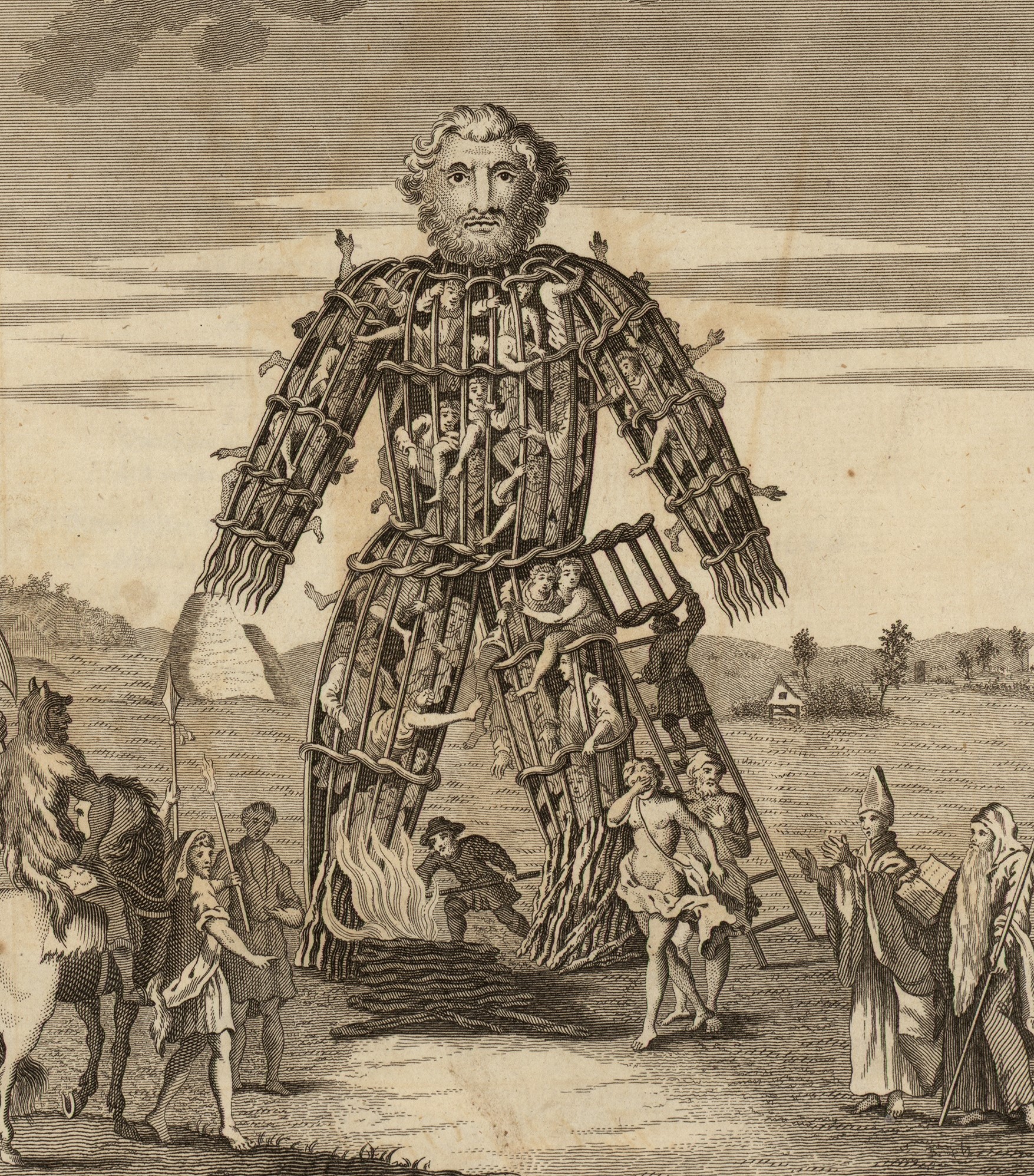
The Commenta tells us that as sacrifices to Taranis, several people were burned in a wooden alveus. The Latin word alveus is translated above as "tub", but it could applied to any hollow container. In various settings, the term could be used to mean a ship's hull, a bath tub, a drainage basin, a canoe, or a beehive.
The interpretatio romana of Taranis as Jupiter, given by all three commentaries, is otherwise attested in epigraphy, and agrees with our understanding of Taranis as a thunder god. By contrast, the interpretatio of Taranis as Dis Pater, which only the Commenta gives, Manfred Hainzmann points out that Dis was associated in Latin literature with the night sky and night thunderstorms. Statius, for example, refers to Dis Pater as the "thunderer of the underworld" (Thebaid, 11.209).
In the course of giving the interpretatio of Taranis as Jupiter, the scholiast of the Commenta mentions that Taranis was "leader of wars". This is an unusual trait to associate with Jupiter rather than Mars (Roman god of war), though the Romans occasionally gave Jupiter martial functions. Hofeneder has associated the comment that Taranis was "appeased with human heads" with this martial function, as the (pre-Roman) Celtic custom of carrying off their foes' heads in battle is well-attested.
Caesar states in his Commentaries on the Gallic War that the Gauls regarded a Gaulish god (whom Caesar equated with Dis Pater) as their ancestor. As Taranis is the only Celtic god equated with Dis Pater in ancient literary sources, Taranis has often been a cited as a candidate for Gaulish Dis Pater. The similarity between Caesar's description of Gaulish Jupiter, and the Commenta description of Taranis as "chief of the heavenly gods" (caelestium deorum maximum), has been noted, though this may reflect reliance on Caesar's text or a routine characterisation of the Roman god Jupiter.
Taranis and the wheel god{{anchor|Wheel god}}
The wheel god (Radgott) is a figure of Celtic religious iconography, a god wielding a spoked wheel. The wheel god is often depicted with the attributes of Jupiter: thunderbolt, sceptre, and eagle. The spoked wheel was an important religious motif for the Celts. Metal votive wheels (known as **) are known from Iron Age Europe. The Lexicon Iconographicum Mythologiae Classicae lists 15 depictions of the wheel god. Some are statuettes of the god dressed in Gaulish garb, with a wheel in one hand and a thunderbolt in the other. A mosaic from Saint-Romain-en-Gal shows a woman and a man leaving sacrifices to such a statuette. An obscure scene on the Gundestrup cauldron perhaps shows a leaping devotee offering a wheel to the wheel god. The so-called Jupiter columns, religious monuments widespread in Germania, are frequently crowned with an equestrian god, who sometimes wields a wheel.
Because both were identified with Jupiter, Taranis has been repeatedly equated with the wheel god (for example, by Pierre Lambrechts, , and Anne Ross). However, nothing connects the gods directly. No inscription links Taranis with wheel iconography. Some scholars have rejected this equation. Green rejects it, and argues that the wheel god was a solar deity, naturally identifiable with Jupiter, but distinct from the thunder god Taranis. and both express scepticism in their studies of Jupiter columns in Germany. Árpád M. Nagy described the equation as "probable, but not binding".
The combination of the thunderbolt and wheel as attributes is not unique to one deity: Hercules is occasionally depicted with these attributes in the Latin West, and a female deity with a thunderbolt and wheel is known from a statue in Autun.
|File:Iupiter Taranis Obernburg.jpg |Jupiter Column rider with a wheel from Obernburg. |File:Taranis Jupiter with wheel and thunderbolt Le Chatelet Gourzon Haute Marne.jpg |Jupiter with a thunderbolt and a wheel from . |File:ChaudronDeGundestrup3.jpg |A broken wheel held by a large bearded man and a leaping man on the Gundestrup cauldron (plate C). |File:Mosaic depicting a rustic calendar, panel showing a scene of sacrifice (Summer), from Saint-Romain-en-Gal, first quarter of 3rd century AD, Musée d'Archéologie Nationale, Saint-Germain-en-Laye (34574925420).jpg |Scene of two people offering sacrifices to the wheel god (wheel in one hand, thunderbolt in the other) on a mosaic from Saint-Romain-en-Gal. |File:Rouelle votive wheels.jpg |Votive wheels (rouelles) at the Musée d'Archéologie Nationale. |File:Altar dedicated to Jupiter, Nimes (CIL XII 2972).jpg |Altar to Jupiter with a relief of a wheel at the Musée de la Romanité.
Epigraphy
| Text | Context | Date | Language | Citation | Comments | |
|---|---|---|---|---|---|---|
| ṣ a[ / kakaka[(?) / θarani[? / saφ̣ạṇa / θ̣]arani?} | 325}} | [Raetic | *TIR* [FI-1](https://tir.univie.ac.at/wiki/FI-1) | The god Taranis (in the form Tarani) is invoked twice in this obscure (perhaps magico-religious) Raetic inscription. Simona Marchesini has argued that the absence of the Celtic final -s suggests "the god's name was well integrated in the Raetic world". | ||
| ΟΥΗΒΡΟΥΜΑΡΟΣ / ΔΕΔΕ ΤΑΡΑΝΟΟΥ / ΒΡΑΤΟΥΔΕΚΑΝΤΕΜ (translit. xtg) | Inscribed on a small cippus. Found in Orgon, Bouches-du-Rhône, France. | Gaulish | *RIG* I [G-27](https://riig.huma-num.fr/documents/BDR-09-01) | Lejeune offers the translation "Vebrumaros offered Taranus in gratitude (?) the tithe (?)". | ||
| IOVI TAN(ARO) / ]S APER | Inscribed on an altar. Found in [Bribir, Dalmatia, Croatia. | Latin | *AE* [2010, 1225](https://db.edcs.eu/epigr/epi_url.php?s_sprache=en&p_publication=AE+2010%2C+01227&r_sortierung=Belegstelle) | |||
| TARANUOS | Inscribed on a terracotta jug. Found near Amiens, Somme, France. | Latin | Another inscription found nearby () suggests the find-spot was originally a place of religious significance. | |||
| PATE]RNIANUS(?) / V(IVUS) / [ALUM]NO(?) SUO / [PI]O(?) POSUIT / [3]EMIO // ]O[3] / [3]M SA[3] / UXO[RI] / TARANU[TIUS(?)] / COMATULLUS(?) | Found in Caesarodunum (Roman [Tours), Indre-et-Loire, France | Latin | Taranu is a personal name. | |||
| IOVI TA/RANUCO / ARRIA SUC/CESSA V(OTUM) S(OLVIT) | Found in Scardona (Roman [Skradin), Dalmatia, Croatia | Latin | ||||
| E[ ]IMO / ESOET IVTRABAVTIO / RVTI DVO ESANA / TARAIN[I] PANOV / DIR FONT MEM / MIDR.MARMAR / EVI IABO . VIII . MV / MVLCOI CARBRVX | Inscribed on a gold lamella. Found in Baudecet, Gembloux, Belgium. | Latin (perhaps with Gaulish, Greek or Germanic elements) | *RIG* II.2 L-109 | This magico-religious inscription from Belgic Gaul is difficult to interpret. Several lines appear to be meaningless ephesia grammata. In arguing that the inscription has Gaulish elements, and Patrizia de Bernardo proposed that line 4 invokes the god Taranis. However, Pierre-Yves Lambert proposed the tablet is an Orphic gold tablet, and reads this line as an Orphic formula in Greek. | ||
| NUM(INI) AUG(USTI) / ET I(OVI) O(PTIMO) M(AXIMO) / TARANUEN / D(E) S(UO) P(RO) P(IETATE) P(OSUIT) | AE]]'' [1961, 159](https://www.jstor.org/stable/25606780) | Latin | It is uncertain whether Taranuen is a god name or a personal name. | |||
| I(OVI) O(PTIMO) M(AXIMO) TANARO / L(UCIUS) [ELUFRIUS(?)] GALER(IA) / PRAESENS [CL]UNIA / PRI(NCEPS) LEG(IONIS) XX V(ALERIAE) V(ICTRICIS) / COMMODO ET / LATERANO CO(N)S(ULIBUS) V(OTUM) S(OLVIT) L(IBENS) M(ERITO) | Inscribed on an altar. Found in Chester, England. | Latin | = | la | Iovi Tanaro}} in Dalmatia has somewhat obviated these concerns. | |
| IN H(ONOREM) D(OMUS) D(IVINAE) DEO / TARANUCNO // ET RAVINI / QUIBUS EX / COLLATA STIPEN[DIA] / IUL(IUS) IUL[3] / C(AIUS?) COPI[US(?)? EX] / IUSS[U POSU(ERUNT?)] | Inscribed on an altar. Found in Godramstein, Germany. | Latin | ||||
| DEO / TARANUCNO / VERATIUS / PRIMUS / EX IUSSU | Inscribed on an altar. Found in Böckingen, Germany. | Latin | ||||
| [...] VALE(N)S TARANIS [...] | Inscribed on a tablet. Found in Nicopolis ad Istrum, Bulgaria. | Latin | = = | Vale(n)s Taranis is a personal name. |
A few different forms of the god's name are known from epigraphy. The spelling "Taranus" (much more common than "Taranis" in epigraphy) is an older form than "Taranis". The un-metathesised form "Tanarus" is older still. There is also "Taranuc(n)us" ("son/descendant of Taranus"), known from two inscriptions of Germania Superior, which attaches a patronymic suffix to Taranis's name.
Scholars have drawn differing conclusions about Taranis's importance, and the geographical extent of his worship, from the epigraphic record. Marion Euskirchen calls the epigraphic evidence "scanty and altogether not unambiguous", which "suggests a rather limited significance of the god within a number of tribal federations". Hofeneder, on the other hand, states that Taranis is "attested surprisingly often" for a Celtic god, a fact which "clearly indicates that he must have been a deity worshipped in large parts of ** and over a long period of time".
Notes
References
References
- Matasović, Ranko. (2009). "Etymological Dictionary of Proto-Celtic". Brill.
- Meid, Wolfgang. (2003). "Keltische Religion im Zeugnis der Sprache". Zeitschrift für celtische Philologie.
- Jackson, Peter. (2002). "Light from Distant Asterisks. Towards a Description of the Indo-European Religious Heritage". Numen.
- Koch, John T.. (2020). "Celto-Germanic, Later Prehistory and Post-Proto-Indo-European vocabulary in the North and West". University of Wales Centre for Advanced Welsh and Celtic Studies.
- Hofeneder, Andreas. (2008). "Die Religion der Kelten in den antiken literarischen Zeugnissen". Österreichischen Akademie der Wissenschaften.
- Lucan, ''De Bello Civilo'', 1.441-446
- Braund, Susan H.. (1992). "Lucan: Civil War". Oxford University Press.
- Green, C. M. C.. (January 1994). "Lucan ''Bellum Civile'' 1.444-46: A Reconsideration". Classical Philology.
- Hofeneder, Andreas. (2011). "Die Religion der Kelten in den antiken literarischen Zeugnissen". Österreichischen Akademie der Wissenschaften.
- Hofeneder, Andreas. (2008). "Die Religion der Kelten in den antiken literarischen Zeugnissen". Österreichischen Akademie der Wissenschaften.
- Hofeneder, Andreas. (2008). "Die Religion der Kelten in den antiken literarischen Zeugnissen". Österreichischen Akademie der Wissenschaften.
- Hofeneder, Andreas. (2008). "Die Religion der Kelten in den antiken literarischen Zeugnissen". Österreichischen Akademie der Wissenschaften.
- Hainzmann, Manfred. (2002). "Dieux des Celtes – Götter der Kelten – Gods of the Celts".
- Green, Miranda J.. (1986). "Pagan Gods and Shrines of the Roman Empire". Oxford University School of Archaeology.
- Nagy, Árpád M. (1994). "Taranis".
- Espérandieu, Émile. (1908). "Recueil général des bas-reliefs, statues et bustes de la Gaule romaine". Imprimerie nationale.
- Marchesini, Simona. (2012). "Mode e modelli. Fortuna e insuccesso nella circolazione di cose e idee".
- RIG I [https://riig.huma-num.fr/documents/BDR-09-01 G-27] via ''Recueil informatisé des inscriptions gauloises''. Accessed on 16 January 2025.
- ''[[L'Année épigraphique. AE]]'' [https://www.jstor.org/stable/23513414 2010, 1225]
- ''[[L'Année épigraphique. AE]]'' [https://www.jstor.org/stable/25606822 1966, 269]
- {{CIL. 13. 3083
- {{CIL. 3. 2804
- Untermann, Jürgen. (1993). "Vorbemerkungen zur sprachlichen Deutung der Inscrift des Goldplättchen aus Baudecet". Latomus.
- ''[[Recueil des inscriptions gauloises. RIG]]'' II.2 L-109 in Lambert, Pierre-Yves (2002). ''Recueil des inscriptions gauloises. II, fasc. 2, Textes gallo-latins sur instrumentum''. Paris: Éd. du CNRS. pp. 310-312.
- Raepsaet-Charlier, Marie-Thérèse. (1993). "La plaquette en or inscrite de Baudecet: quelques considérations sur sa fonction et son interprétation". Latomus.
- ''[[L'Année épigraphique. AE]]'' [https://www.jstor.org/stable/25606780 1961, 159]
- {{RIB. 452
- (2018). "Altar to Jupiter Tanarus, Chester".
- {{CIL. 13. 6094
- {{CIL. 13. 6478
- {{CIL. 3. 6150
- Euskirchen, Marion. (2006). "Taranis". Brill..
This article was imported from Wikipedia and is available under the Creative Commons Attribution-ShareAlike 4.0 License. Content has been adapted to SurfDoc format. Original contributors can be found on the article history page.
Ask Mako anything about Taranis — get instant answers, deeper analysis, and related topics.
Research with MakoFree with your Surf account
Create a free account to save articles, ask Mako questions, and organize your research.
Sign up freeThis content may have been generated or modified by AI. CloudSurf Software LLC is not responsible for the accuracy, completeness, or reliability of AI-generated content. Always verify important information from primary sources.
Report