From Surf Wiki (app.surf) — the open knowledge base
Tamarind
Leguminous tree bearing edible fruit
Leguminous tree bearing edible fruit
the tropical plant
- Cavaraea Speg. 1916
- Cavaraea elegans Speg. 1916
- Tamarindus erythraeus Mattei 1908
- Tamarindus occidentalis Gaertn. 1791
- Tamarindus officinalis Hook. 1851
- Tamarindus somalensis Matteqi 1908
- Tamarindus umbrosa Salisb. 1796
Tamarind (Tamarindus indica) is a leguminous tree bearing edible fruit that is indigenous to tropical Africa and naturalized in Asia. The genus Tamarindus is monotypic, meaning that it contains only this species. It belongs to the family Fabaceae.
The tamarind tree produces brown, pod-like fruits that contain a sweet, tangy pulp, which is used in cuisines around the world. Because tamarind has multiple uses, it is cultivated worldwide in tropical and subtropical zones.
Description
The tamarind is a long-living, medium-growth tree, which attains a maximum crown height of 25-30 m. The crown has an irregular, vase-shaped outline of dense foliage up to 12 m wide. A tamarind trunk may grow to a circumference of 7.5 m. The tree grows well in full sun. It prefers clay, loam, sandy, and acidic soil types, with a high resistance to drought and wind-borne salt as found in coastal areas.
The evergreen leaves are alternately arranged and paripinnately compound. The leaflets are bright green, elliptic-ovular, pinnately veined, and less than 15 cm in length. The branches droop from a single, central trunk as the tree matures, and are often pruned in agriculture to optimize tree density and ease of fruit harvest.
As a tropical species, it is frost-sensitive. The pinnate leaves with opposite leaflets give a billowing effect in the wind. Tamarind timber consists of hard, dark red heartwood and softer, yellowish sapwood.
The tamarind flowers bloom (although inconspicuously), with red and yellow elongated flowers. Flowers are 2.5 cm (1 in) wide, five-petalled, borne in small racemes, and yellow with orange or red streaks.
File:TamarindSeedling.jpg|Seedling File:Tamarind flower vijayanrajapuram 02.jpg|Flower File:Tamarindus indica-flowers.jpg|Flowers File:Tamarindus indica, leaves, pod.jpg|Leaves and fruit pod File:Tamarind clara.jpg|Tamarind tree on the site of the founding of Santa Clara, Cuba
Fruit
_Tree_lower_trunk.jpg)
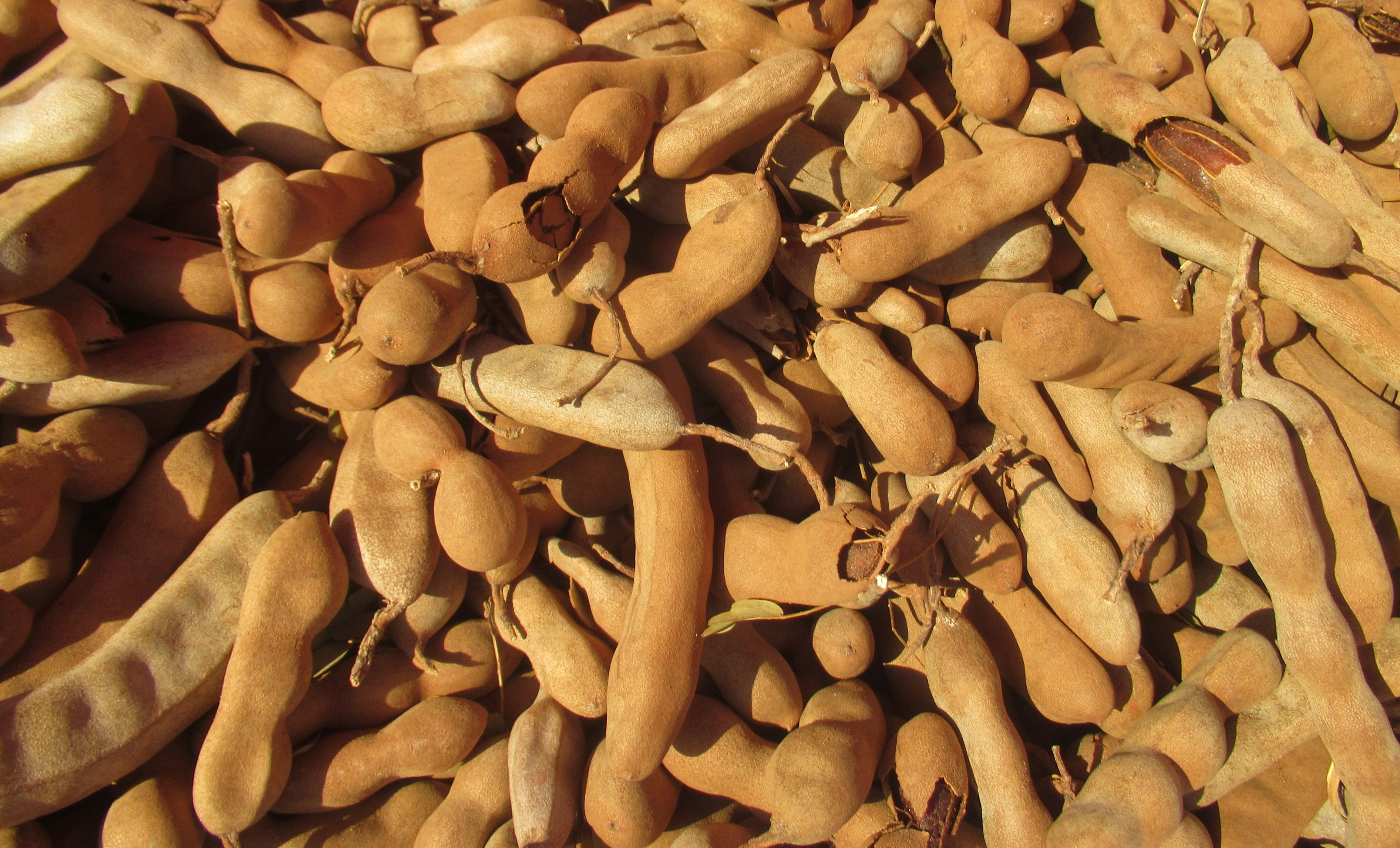
The fruit is an indehiscent pod, 12 to in length, with a hard, brown shell.
The fruit has a fleshy, acidic pulp, becoming mature when the flesh is colored brown or reddish brown. The tamarinds of Asia have longer pods (containing six to 12 seeds), whereas African and West Indian varieties have shorter pods (containing one to six seeds). The seeds are somewhat flattened, and a glossy brown. The fruit is sweet and sour in taste. A mature tree may produce up to 225 kg of fruit each year.
Etymology
The name derives from , romanized tamr hindi, "Indian date". Several early medieval herbalists and physicians wrote tamar indi, medieval Latin use was tamarindus, and Marco Polo wrote of tamarandi.
Common names
In countries of Southeast Asia, it is called asam jawa (Javanese sour fruit) or simply asam, and sukaer in Timor. In the Philippines, it is called sampalok or sampaloc in Filipino, and sambag in Cebuano.
Distribution
Tamarindus indica is indigenous to tropical Africa, but has been cultivated for so long on the Indian subcontinent that it is sometimes reported to be indigenous there. It grows wild in Africa. In Arabia, it is found growing wild in Oman, especially Dhofar, where it grows on the sea-facing slopes of mountains. It reached South Asia likely through human transportation and cultivation several thousand years ago. It is widely distributed throughout the tropics, from Africa to South Asia and Australia. In Madagascar, its fruit and leaves are a well-known favorite of the ring-tailed lemur, providing as much as 50 percent of their food resources during the year if available.
In the 16th century, it was introduced to Mexico and Central America, and to a lesser degree to South America, by Spanish and Portuguese colonists, to the degree that it became a staple ingredient in the region's cuisine.
Uses
Most parts of the tamarind tree (including the wood, bark, flowers, leaves, pulp and seeds) have various environmental, commercial, and culinary uses. Tamarind trees are used as shade trees and ornamental trees (common along highways and in parks).
Nutrition
Raw tamarind fruit is 63% carbohydrates, 31% water, 3% protein, and 1% fat (table). In a reference amount of 100 g, raw tamarind supplies 1000 kJ of food energy, and is a rich source (20% or more of the Daily Value, DV) of thiamine (36% DV) and dietary minerals, including magnesium and potassium at 22% and 21% DV, respectively (table).
Culinary


The fruit is harvested by pulling the pod from its stalk. The hard green pulp of a young fruit is used in savory dishes, as a pickling agent or as a means of making certain poisonous yams in Ghana safe for human consumption. As the fruit matures, it becomes sweeter and less sour (acidic). The sourness varies between cultivars and some sweet varieties have almost no acidity when ripe.
Tamarind pulp is the most common part of the tamarind plant used in chutneys, curries, and sauces, such as Worcestershire sauce, HP Sauce, some brands of barbecue sauce, and the traditional sharbat syrup drink. Tamarind sweet chutney is common in India and Pakistan as a dressing for many snacks and often served with samosa.
Across the Middle East, from the Levant to Iran, tamarind is used in savory dishes, notably meat-based stews, and often combined with dried fruits to achieve a sweet-sour tang.{{Cite web|title=Georgian Chicken in Pomegranate and Tamarind Sauce Recipe
Tamarind has been integrated into kosher and Jewish cuisine across several diasporas, beginning with its introduction to the Middle East via Jewish merchants on the Silk Road in the 7th century. Syrian Jews prepare tamarind syrup, known as ou or ouc, by soaking, straining, and boiling the fruit pulp with sugar and lemon, using it in dishes such as yebra (stuffed grape leaves), bazargan (bulgur salad), keftes (sweet-sour meatballs), and laham b'ajeen (meat flatbread). In India, Baghdadi, Cochin, and Bene Israel Jews use tamarind in regional recipes like bamia khutta, mahmoora, tamarind rice, and lamb with red chilies. Syrian Jewish communities in Mexico have adapted tamarind-based dishes with local ingredients, exemplified by chicken with tamarind, apricots, and chipotle. In contemporary Israel, tamarind juice has gained popularity beyond traditional communities, aided by commercial offerings like Prigat's seasonal releases during Ramadan.
In the Philippines, the whole fruit is used as one of the souring agents of the sour soup sinigang (which can also use other sour fruits), as well as another type of soup called sinampalukan (which uses tamarind leaves). The fruit pulp is cooked in sugar and salt to make champóy na sampalok (or simply "sampalok candy"), a traditional tamarind candy. Indonesia also has a similarly sour, tamarind-based soup dish called sayur asem.
In Sri Lanka, tamarind pulp has been used as a lime alternative, and in Senegal, the pulp is mixed with sugar to produce sweet meats known as 'bengal'. In India, tamarind pulp is made into a juice used in the preservation of fish, and in many countries of East Africa, the pulp is used in the making of a dish called ugali (a type of maize flour porridge).
Tamarind seeds need to be soaked and boiled in water before they are edible. The seeds are commonly used in jellies, marmalades and jams because they contain pectin which gives them jelly-forming properties, and have been used as a stabilizer to make cheese, ice cream and mayonnaise. In Indonesia, after the seeds have been roasted, they are consumed as a snack accompanied with salt and grated coconut and in Thailand tamarind seeds are used as a coffee alternative.
The leaves and bark are also edible, and the seeds can be cooked to make safe for consumption. Blanched, tender tamarind leaves are used in a Burmese salad called magyi ywet thoke (), a salad from Upper Myanmar that features tender blanched tamarind leaves, garlic, onions, roasted peanuts, and pounded dried shrimp. Tamarind seeds contain high levels of protein (26.9 grams per 100 grams) and oil (10.9 grams per 100 grams) and in some countries, tamarind seeds are used as an emergency food because of their high protein levels. The leaves of the tamarind plant are high in calcium and protein and have been consumed by domestic animals and wild animals, including elephants, as a fodder.
Seed oil and kernel powder
Tamarind seed oil is made from the kernel of tamarind seeds. The kernel is difficult to isolate from its thin but tough shell (or testa). It has a similar consistency to linseed oil, and can be used to make paint or varnish.
Tamarind kernel powder is used as sizing material for textile and jute processing, and in the manufacture of industrial gums and adhesives.
Tamarind seeds are used in the production of tamarind kernel powder which is used as a sizing agent in the textile industry because of its ability to absorb water and swell up, in India, tamarind kernel powder has also been used as a sizing agent in the production of cotton. In Bengal, tamarind seeds are used in the production of an oil used in varnishes. leaves and flowers are used as a setting agent for dyes.
| Composition | Original | De-oiled | ||
|---|---|---|---|---|
| Oil | ||||
| Protein | ||||
| Polysaccharide | ||||
| Crude fiber | ||||
| Total ash | ||||
| Acid insoluble ash | ||||
| Moisture | ||||
| The fatty acid composition of the oil is linoleic 46.5%, oleic 27.2%, | ||||
| and saturated fatty acids 26.4%. The oil is usually bleached after refining. |
| Fatty acid | (%) Range reported | |
|---|---|---|
| Lauric acid (C12:0) | ||
| Myristic acid (C14:0) | ||
| Palmitic acid (C16:0) | ||
| Stearic acid (C18:0) | ||
| Arachidic acid (C20:0) | ||
| Lignoceric acid (C24:0) | ||
| Oleic acid (C18:1) | ||
| Linoleic acid (18:2) | ||
| Linolenic acid (C18:3) |
Folk medicine
In Southeast Asia, tamarind fruit is used as a poultice applied to the foreheads of people with fevers. The fruit exhibits laxative effects for relief of constipation. Extracts of steamed and sun-dried old tamarind pulp (asem kawa) in Java are used to treat skin problems, like rashes and irritation; one traditional practice indicated tamarind could be ingested after dilution for use as an abortifacient.
Different parts of the tamarind plant have been used globally for other purposes in folk medicine. In the northern parts of Nigeria, the roots of the tamarind plant are thought to be useful for treating leprosy, and in America, tamarind pulp is considered in folk medicine to be a laxative and used for alleviating sunstroke and sore throats. In Thailand, the pulp has been transformed into a tablet in the belief it can reduce excess weight, and in Brazil, the pulp is used for its supposed hydrating effects. Tamarind seeds have been used in powdered form to possibly aid dysentery in India and Cambodia, and in Ethiopia, softened tamarind seeds are used as a possible treatment for parasitic worms.
Woodworking
Tamarind wood is used to make furniture, boats (as per Rumphius) carvings, turned objects such as mortars and pestles, chopping blocks, and other small specialty wood items like krises.
Metal polish
In homes and temples, especially in Buddhist Asian countries including Myanmar, the fruit pulp is used to polish brass shrine statues and lamps, and copper, brass, and bronze utensils.
Green Ways
Widely used for urban landscaping during the Dutch colonial period, tamarind trees are a common roadside feature in Indonesia today, serving as a living heritage of early 20th-century Dutch spatial planning.
Research
Lupeol, catechins, epicatechin, quercetin, and isorhamnetin are present in the leaf extract. Ultra-high-performance liquid chromatography analyses revealed that tamarind seeds contained catechins, procyanidin B2, caffeic acid, ferulic acid, chloramphenicol, myricetin, morin, quercetin, apigenin and kaempferol.
Cultivation
Seeds can be scarified or briefly boiled to enhance germination. They retain their germination capability for several months if kept dry.
Tamarind is a traditional food plant in Africa. Although not grown on a large-scale commercial basis, it has the potential to improve nutrition, boost food security, foster rural development, and support sustainable land care.
The tree is widely cultivated across India, especially in Maharashtra, Chhattisgarh, Karnataka, Telangana, Andhra Pradesh, and Tamil Nadu. Extensive tamarind orchards in India produced 250000 t annually in the late 20th century.
In the United States, it is a large-scale crop introduced for commercial use (second in net production quantity only to India), mainly in southern states, notably south Florida, and as a shade tree, along roadsides, in dooryards and in parks.
Horticulture
Throughout South Asia and the tropical world, tamarind trees are used as ornamental and garden plantings. Commonly used as a bonsai species in many Asian countries, it is also grown as an indoor bonsai in temperate parts of the world.
In dogs
Tamarind is toxic to dogs. The symptoms – which may include vomiting or diarrhea within 6–12 hours of ingestion, lethargy, dehydration or acute kidney injury – and proposed mechanism (via tartaric acid) are the same as in grape toxicity in dogs.
References
References
- Rivers, M.C.. (2017). "''Tamarindus indica''".
- Speg. ''Anales Soc. Ci. Argent''. 82: 223 1916
- (2013). "''Tamarindus indica'' L.". [[Royal Botanic Gardens, Kew]] and the [[Missouri Botanical Garden]].
- Quattrocchi U.. (2012). "CRC World Dictionary of Medicinal and Poisonous Plants: Common Names, Scientific Names, Eponyms, Synonyms, and Etymology". [[CRC Press]], [[Taylor & Francis Group]].
- USDA. (10 February 2005). "''Cavaraea'' Speg.". [[Henry A. Wallace Beltsville Agricultural Research Center.
- Morton, Julia F.. (1987). "Tamarind; In: Fruits of Warm Climates". New Crop Resource Online Program, Center for New Crops & Plant Products, [[Purdue University]].
- (2018-04-27). "Here's what you can cook with tender tamarind leaves". The Hindu.
- "Fact Sheet: ''Tamarindus indica''". University of Florida.
- Christman, S.. "''Tamarindus indica''". FloriData.
- (2003). "The Concise Oxford Dictionary of English Etymology". Oxford University Press.
- (1913). "[[The useful plants of the Dutch East Indies". Museum vor Economische Botanie & Ruygrok.
- . ["Asam Tree"](https://www.nparks.gov.sg/gardens-parks-and-nature/heritage-trees/ht-2001-28). *National Parks of Singapore*.
- (2017). "Philippine Food, Cooking, & Dining Dictionary". Anvil Publishing, Inc..
- "Ring-Tailed Lemur". Wisconsin Primate Research Center.
- (August 1995). "Technologies Related to Participatory Forestry in Tropical and Subtropical Countries". World Bank Publications.
- "BBC Food:Ingredients—Tamarind recipes". BBC.
- "Original Sweet & Thick BBQ Sauce - Products - Heinz".
- "MasterFoods Barbecue Sauce 500mL Ingredients".
- Azad, Salim. (2018). "Exotic Fruits". Academic Press.
- (2006). "The Complete Asian Cookbook". Tuttle Publishing.
- [http://www.pri.org/stories/2014-07-02/tamarind-sour-secret-syrian-cooking "Tamarind is the 'sour secret of Syrian cooking'"]. PRI. July 2014
- [https://www.middleeasteye.net/discover/ramadan-five-drinks-thirst-quenching-middle-east Ramadan: Five thirst-quenching drinks from across the Middle East], Nur Ayoubi, 4 April 2022, [[Middle East Eye]]
- Gavin, Paola. (December 1, 2021). "The Joys of Tamarind". Tablet Magazine.
- Myerson, Rachel. (February 2, 2023). "Tracing the Jewish History of Tamarind, From India to Syria and Beyond".
- (2019). "Tikim: Essays on Philippine Food and Culture". BRILL.
- "Tsampoy".
- (2010-02-08). "''Tamarindus indica'' L. – A review of traditional uses, phytochemistry and pharmacology". Afrika Focus.
- [[United States Department of the Army]]. (2009). "The Complete Guide to Edible Wild Plants". [[Skyhorse Publishing]].
- (2017). "Myanmar (Burma)". Lonely Planet.
- (2012). "Tropical fruits, Volume 2". CABI.
- [http://www.agriculturalproductsindia.com/seeds/seeds-tamarind-seeds.html Tamarind Seeds] {{Webarchive. link. (February 2, 2021 . agriculturalproductsindia.com)
- {{usurped
- (February 2010). "''Tamarindus indica'' L. (Fabaceae): Patterns of Use in Traditional African Medicine". Journal of Ethnopharmacology.
- (July 2008). "The laxative effect of fresh pulp aqueous extracts of Thai Tamarind cultivars". Planta Medica.
- Lim, T. K.. (2011-11-06). "Edible Medicinal and Non-Medicinal Plants". Springer Netherlands.
- (2015). "Life History of the Tamarind Weevil, Sitophilus linearis (Herbst) (Coleoptera: Curculionidae), on Tamarind Seed". Journal of Insects.
- (2010-02-17). "Tamarindus indica L. (Fabaceae): Patterns of use in traditional African medicine". Journal of Ethnopharmacology.
- "Tamarind".
- McGee, Joah. (2015). "The Golden Path". Pariyatti Publishing.
- (2007). "Two triterpenes lupanone and lupeol isolated and identified from Tamarindus indica linn.". [[Pakistan Journal of Pharmaceutical Sciences]].
- (2015). "Polyphenols from the extract and fraction of ''T. indica'' seeds protected HepG2 cells against oxidative stress". [[BMC Complementary and Alternative Medicine]].
- National Research Council. (January 25, 2008). "Lost Crops of Africa". [[National Academies Press]].
- "Food and Agriculture Organization of the United Nations".
- D'Cruz, Mark. "''Tamarindus indica'': Tamarind - Indian tamarind - kily tree - Imli". Mǎ-kè Bonsai.
- Hayes, Cristine. (September 2024). "Grape, Raisin, and Tamarind (''Vitis'' spp, ''Tamarindus'' spp) Toxicosis in Dogs". [[Merck & Co.]].
This article was imported from Wikipedia and is available under the Creative Commons Attribution-ShareAlike 4.0 License. Content has been adapted to SurfDoc format. Original contributors can be found on the article history page.
Ask Mako anything about Tamarind — get instant answers, deeper analysis, and related topics.
Research with MakoFree with your Surf account
Create a free account to save articles, ask Mako questions, and organize your research.
Sign up freeThis content may have been generated or modified by AI. CloudSurf Software LLC is not responsible for the accuracy, completeness, or reliability of AI-generated content. Always verify important information from primary sources.
Report