From Surf Wiki (app.surf) — the open knowledge base
Tajikistan
Landlocked country in Central Asia
Landlocked country in Central Asia
| Field | Value | |
|---|---|---|
| conventional_long_name | Republic of Tajikistan | |
| common_name | Tajikistan | |
| native_name | tg | |
| ru | ||
| image_flag | Flag of Tajikistan.svg | |
| image_coat | Emblem of Tajikistan.svg | |
| symbol_type | Emblem | |
| motto | ||
| tg | ||
| ru | ||
| "Independence, Freedom, Homeland" | ||
| national_anthem | ||
| tg | ||
| tg | ||
| "National Anthem" | ||
| image_map | ||
| capital | Dushanbe | |
| coordinates | ||
| largest_city | capital | |
| official_languages | ||
| ethnic_groups | {{unbulleted list | |
| ethnic_groups_ref | ||
| ethnic_groups_year | 2020 | |
| religion | 97.5% Islam | |
| 0.7% Christianity | ||
| 1.7% irreligion | ||
| 0.2% others | ||
| religion_year | 2020 | |
| religion_ref | ||
| demonym | ||
| government_type | Unitary presidential republic under an authoritarian dictatorship | |
| leader_title1 | President | |
| leader_name1 | Emomali Rahmon | |
| leader_title2 | Prime Minister | |
| leader_name2 | Kokhir Rasulzoda | |
| legislature | Supreme Assembly | |
| upper_house | National Assembly | |
| lower_house | Assembly of Representatives | |
| sovereignty_type | Independence | |
| sovereignty_note | from the Soviet Union | |
| established_event1 | Declared | |
| established_date1 | 9 September 1991 | |
| established_event2 | Recognised | |
| established_date2 | 26 December 1991 | |
| area_km2 | 143,100 | |
| area_rank | 94th | |
| area_sq_mi | 55,251 | |
| percent_water | 1.8 | |
| population_estimate | 10,786,734 | |
| population_estimate_year | 2025 | |
| population_density_km2 | 75.4 | |
| population_density_sq_mi | 195.2 | |
| GDP_PPP | $59.415 billion | |
| GDP_PPP_year | 2024 | |
| GDP_PPP_rank | 119th | |
| GDP_PPP_per_capita | $5,832 | |
| GDP_PPP_per_capita_rank | 145th | |
| GDP_nominal | $12.953 billion | |
| GDP_nominal_year | 2024 | |
| GDP_nominal_rank | 141st | |
| GDP_nominal_per_capita | $1,176 | |
| GDP_nominal_per_capita_rank | 163rd | |
| Gini | 34 | |
| Gini_year | 2015 | |
| Gini_change | ||
| Gini_ref | ||
| HDI | 0.691 | |
| HDI_year | 2023 | |
| HDI_change | increase | |
| HDI_ref | ||
| HDI_rank | 128th | |
| currency | Somoni | |
| currency_code | TJS | |
| time_zone | TJT | |
| utc_offset | +5 | |
| date_format | dd.mm.yyyy | |
| drives_on | Right | |
| calling_code | [+992](992) | |
| cctld | .tj | |
| footnote_a | Estimate from State Statistical Committee of Tajikistan, 2008; rank based on UN figures for 2005. -- | footnote_a = |
| area_water_km2 | 2575 |
ru
tg
ru "Independence, Freedom, Homeland" tg tg "National Anthem"
| 86.1% Tajiks | 11.3% Uzbeks | 0.4% Kyrgyz | 0.3% Russians | 1.9% other 0.7% Christianity 1.7% irreligion 0.2% others ORPHANED:
Tajikistan, officially the Republic of Tajikistan, is a landlocked country in Central Asia. Dushanbe is its capital and most populous city. Tajikistan borders Afghanistan to the south, Uzbekistan to the west, Kyrgyzstan to the north, and China to the east and is narrowly separated from Pakistan by Afghanistan's Wakhan Corridor. It has a population of more than 10.7million people.
The territory was previously home to cultures of the Neolithic and the Bronze Age, including the Oxus civilisation in west, with the Indo-Iranians arriving during the Andronovo culture. Parts of country were part of the Sogdian and Bactrian civilisations, and was ruled by those including the Achaemenids, Alexander the Great, the Greco-Bactrians, the Kushans, the Kidarites and Hephthalites, the First Turkic Khaganate, the Umayyad and Abbasid Caliphates, the Samanid Empire, the Kara-Khanids, Seljuks, Khwarazmians, the Mongols, Timurids and Khanate of Bukhara. The region was later conquered by the Russian Empire, before becoming part of the Soviet Union. Within the Soviet Union, the country's borders were drawn when it was part of Uzbekistan as an autonomous republic before becoming a constituent republic of the Soviet Union on 5 December 1929.
On 9 September 1991, Tajikistan declared itself an independent sovereign state as the Soviet Union was disintegrating. A civil war was fought after independence, lasting from May 1992 to June 1997. Since the end of the war, newly established political stability and foreign aid have allowed the country's economy to grow. The country has been led since 1994 by Emomali Rahmon, who heads an authoritarian regime and whose human rights record has been criticised.
Tajikistan is a presidential republic consisting of four provinces. Tajiks form the ethnic majority in the country, and their national language is Tajik. Russian is used as the official inter-ethnic language. While the state is constitutionally secular, Islam is nominally adhered to by 97.5% of the population. In the Gorno-Badakhshan oblast, there is a linguistic diversity where Rushani, Shughni, Ishkashimi, Wakhi, and Tajik are some of the languages spoken. Mountains cover more than 90% of the country. It is a developing country with a transitional economy that is dependent on remittances and on the production of aluminium and cotton. Tajikistan is a member of the United Nations, CIS, OSCE, OIC, ECO, SCO, CSTO, and a NATO PfP partner.
Etymology {{anchor|Etymology}}
Main article: Tajik people
The term "Tajik" itself ultimately derives from the Middle Persian Tāzīk, the Turkic rendition of the Arabic ethnonym Ṭayyi’, denoting a Qahtanite Arab tribe who emigrated to the Transoxiana region of Central Asia in the 7th century AD. Tajikistan appeared as Tadjikistan or Tadzhikistan in English prior to 1991. This is due to a transliteration from the . In Russian, there is no single letter "j" to represent the phoneme , and therefore , or dzh, is used. Tadzhikistan is the alternate spelling and is used in English literature derived from Russian sources.
History
Main article: History of Tajikistan
Cultures in the region have been dated back to at least the fourth millennium BC, including the Bronze Age Bactria–Margiana Archaeological Complex, the Andronovo cultures and the pro-urban site of Sarazm, a UNESCO World Heritage Site.
The earliest recorded history of the region dates back to about 500 BC when most, if not all, of Tajikistan was part of the Achaemenid Empire. Some authors have suggested that in the seventh and sixth centuries BC parts of Tajikistan, including territories in the Zeravshan valley, formed part of the Hindu Kambojas tribe before it became part of the Achaemenid Empire. After the region's conquest by Alexander the Great it became part of the Greco-Bactrian Kingdom, a successor state of Alexander's empire. Northern Tajikistan (the cities of Khujand and Panjakent) was part of Sogdia, a collection of city-states which was overrun by Scytho-Siberians and Yuezhi nomadic tribes around 150 BC. The Silk Road passed through the region and following the expedition of Chinese explorer Zhang Qian during the reign of Wudi (141 BC–87 BC) commercial relations between Han Empire and Sogdiana flourished. Sogdians played a role in facilitating trade and worked in other capacities, as farmers, carpetweavers, glassmakers, and woodcarvers.
The Kushan Empire, a collection of Yuezhi tribes, took control of the region in the first century AD and ruled until the fourth century AD during which time Buddhism, Nestorian Christianity, Zoroastrianism, and Manichaeism were practised in the region. Later the Hephthalite Empire, a collection of nomadic tribes, moved into the region, and the Arabs disseminated Islam in the eighth century.
Samanid Empire
Main article: Samanid Empire
The Samanid Empire, 819 to 999, restored Persian control of the region and enlarged the cities of Samarkand and Bukhara, which became the cultural centres of Iran; the region was known as Khorasan. The empire was centred in Khorasan and Transoxiana, at its greatest extent encompassing Afghanistan, parts of Iran, Tajikistan, Turkmenistan, Uzbekistan, Kyrgyzstan, parts of Kazakhstan, and Pakistan.
The Samanids revived Persian culture by patronizing Rudaki, Bal'ami and Daqiqi. The Samanids determinedly propagated Sunni Islam, and repressed Ismaili Shiism but were more tolerant of Twelver Shiism. Islamic architecture and Islamo-Persian culture was spread deep into the heartlands of Central Asia by the Samanids. Following the first complete translation of the Qur'an into Persian in the 9th century, populations under the Samanid empire began accepting Islam in significant numbers.
Four brothers Nuh, Ahmad, Yahya, and Ilyas founded the Samanid state. Each of them ruled territory under Abbasid suzerainty. In 892, Ismail Samani (892–907) united the Samanid state under one ruler, thus putting an end to the feudal system used by the Samanids. It was under him that the Samanids became independent of Abbasid authority.
The Kara-Khanid Khanate conquered Transoxania (which corresponded approximately with what later would be Uzbekistan, Tajikistan, southern Kyrgyzstan, and southwest Kazakhstan) and ruled between 999 and 1211. Their arrival in Transoxania signalled a definitive shift from Iranian to Turkic predominance in Central Asia, and gradually the Kara-khanids became assimilated into the Perso-Arab Muslim culture of the region.
The region was later ruled by the Ghurid and Kart dynasties, of Tajik origin. While the Qart dynasty ruled in present-day Afghanistan, Muhammad Gurid, the ruler of the Ghurid dynasty, conquered much of India.
In the 13th century, the Mongol Empire swept through Central Asia, invaded the Khwarezmian Empire and sacked its cities, looting and massacring people. Turco-Mongol conqueror Tamerlane founded the Timurid Empire, becoming the first ruler of the Timurid dynasty in and around what later became Tajikistan and Central Asia.
Bukharan rule
Main article: Khanate of Bukhara
What later became Tajikistan fell under the rule of the Khanate of Bukhara during the 16th century and, with the empire's collapse in the 18th century, it came under the rule of the Emirate of Bukhara and Khanate of Kokand. The Emirate of Bukhara remained intact until the 20th century.
Imperial Russia
Main article: Russian conquest of Turkestan
During the 19th century, the Russian Empire began to conquer parts of the region. Russian Imperialism led to the Russian Empire's conquest of Central Asia during the 19th century's Imperial Era. Between 1864 and 1885, Russia gradually took control of the entire territory of Russian Turkestan, the Tajikistan portion of which had been controlled by the Emirate of Bukhara and Khanate of Kokand. Russia was interested in gaining access to a supply of cotton and in the 1870s attempted to switch cultivation in the region from grain to cotton (a strategy later copied and expanded by the Soviets).
During the 19th century, the Jadidists established themselves as an Islamic social movement throughout the region. While the Jadidists were pro-modernisation and not necessarily anti-Russian, the Russians viewed the movement as a threat because the Russian Empire was predominantly Christian. Russian troops were required to restore order during uprisings against the Khanate of Kokand between 1910 and 1913. Further violence occurred in July 1916 when demonstrators attacked Russian soldiers in Khujand over the threat of forced conscription during World War I. While Russian troops brought Khujand back under control, clashes continued throughout the year in various locations in Tajikistan.
Soviet period
Main article: Basmachi movement, Tajik Soviet Socialist Republic
After the Russian Revolution of 1917 guerrillas throughout Central Asia, known as basmachi, waged a war against Bolshevik armies in an attempt to maintain independence. The Bolsheviks prevailed after a four-year war, in which mosques and villages were burned down and the population suppressed.
Between 1928 and 1941, Soviet authorities started an anti-religious campaign of secularisation. Practising Christianity, Islam, or Judaism was discouraged and repressed; due to the Soviet anti-religious legislation, several churches, mosques, and synagogues were closed. As a consequence of the conflict and Soviet agriculture policies, Central Asia, Tajikistan included, underwent a famine that claimed lives.
Tajikistan was first created in 1924 as the Tajik Autonomous Soviet Socialist Republic (abbrievated Tajik ASSR), an autonomous republic within the Uzbek Soviet Socialist Republic. Despite their historical status as Tajik cities and mostly being populated by Tajiks, none of the regional urban centres—such as Bukhara, Samarkand, Tirmiz, Qarshi, and Khojand—were included in Tajikistan. Instead, the Tajikistani capital was established in Dushanbe, a mountain town with approximately 1,000 residents.
A specific Persian dialect, with vocabulary and pronunciation different from formal written Persian, was deliberately made the national language of Tajikistan by the Soviets and renamed "Tajiki" to forcibly separate it from the common variant of Persian spoken from Istanbul to Calcutta. The Tajiks were also excluded from the enormous global world of Persian literature, both past and current, by the creation of a new phonetic alphabet, first Latin-based in 1928 and later Cyrillic in 1940. With Persian confined to Tajikistan and replaced by Russian as Central Asia's common language, the unity of the Persianate world was broken, steering Soviet and post-Soviet Central Asia onto a developmental path distinct from Iran and Afghanistan. In 1929, the Tajik ASSR was elevated to its own full union republic, the Tajik Soviet Socialist Republic. The Sughd Region was added to Tajikistan in the same year.
Between 1927 and 1934, collectivisation of agriculture and an expansion of cotton production took place, especially in the southern region. Soviet collectivization policy brought violence against farmers and peasants, classified as anti-Soviet categories of "enemies of the people", and forced resettlement occurred throughout Tajikistan. Consequently, some peasants fought collectivisation and revived the Basmachi movement. Some industrial development occurred during this time along with the expansion of irrigation infrastructure.
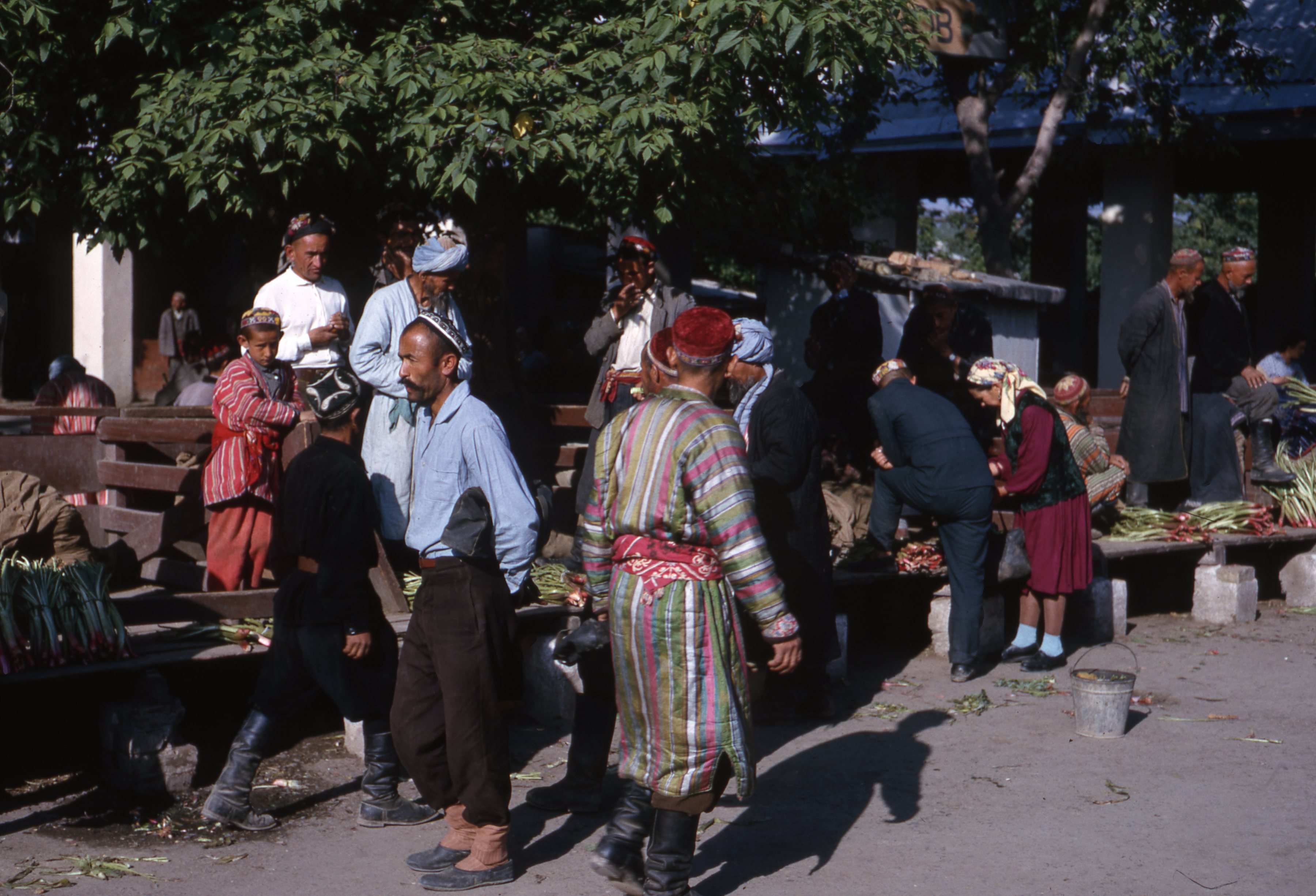
Two rounds of Stalin's purges (1927–1934 and 1937–1938) resulted in the expulsion of nearly 10,000 people from all levels of the Communist Party of Tajikistan. Ethnic Russians were sent in to replace those expelled and subsequently Russians dominated party positions at all levels, including the top position of first secretary. Between 1926 and 1959 the proportion of Russians among Tajikistan's population grew from less than 1% to 13%. Bobojon Ghafurov, First Secretary of the Communist Party of Tajikistan from 1946 to 1956, was the only Tajik politician of significance outside of the republic during the Soviet Era.
Tajiks began to be conscripted into the Red Army in 1939 and during World War II around 260,000 Tajik citizens fought against Nazi Germany, Finland, and the Empire of Japan. Between 60,000 (4%) and 120,000 (8%) of Tajikistan's 1,530,000 citizens were killed during World War II.
Following the war and the end of Stalin's reign, attempts were made to further expand the agriculture and industry of Tajikistan. During 1957–58 Nikita Khrushchev's Virgin Lands Campaign focused attention on Tajikistan, where living conditions, education and industry lagged behind the other Soviet Republics. In the 1980s, Tajikistan had the lowest household saving rate in the USSR, the lowest percentage of households in the two top per capita income groups, and the lowest rate of university graduates per 1000 people.
By the 1980s Tajik nationalists were calling for increased rights. Real disturbances did not occur within the republic until 1990. The following year, the Soviet Union collapsed, and Tajikistan declared its independence on 9 September 1991, a day which is celebrated as the country's Independence Day.
Independence
In February 1990, riots and strikes in Dushanbe and other cities began due to the difficult socio-economic situation, lack of housing, and youth unemployment. The nationalist and democratic opposition and supporters of independence joined the strikes and began to demand the independence of the republic and democratic reforms. Islamists began to hold strikes to demand respect for their rights and independence. The Soviet leadership introduced Internal Troops in Dushanbe to eliminate the unrest.
Following independence, the nation fell into civil war among factions distinguished by clan loyalties. Regional groups from the Gharm and Gorno-Badakhshan regions of Tajikistan, led by a combination of liberal democratic reformers and Islamists, who eventually became the United Tajik Opposition, rose up against the newly formed government of President Rahmon Nabiyev, which was dominated by people from the Khujand and Kulob regions.
The war lasted until 1997. More than 500,000 residents fled during this time because of persecution and increased poverty, seeking better economic opportunities in the West or in other former Soviet republics. The estimated dead numbered over 100,000. Around 1.2 million people were refugees inside and outside of the country.
Emomali Rahmon came to power in the early part of this conflict in 1992, after Nabiyev was forced at gunpoint on 7 September 1992 to resign from office. Rahmon defeated former prime minister Abdumalik Abdullajanov in a November presidential election with 58% of the vote.
In 1997, a ceasefire was reached between Rahmon and opposition parties under the guidance of Gerd D. Merrem, Special Representative to the Secretary General, a result praised as a successful United Nations peacekeeping initiative. The ceasefire guaranteed 30% of ministerial positions would go to the opposition. Elections were held in 1999 and were criticised by opposition parties and foreign observers as unfair; Rahmon was re-elected with 98% of the vote. Elections in 2006 were again won by Rahmon (with 79% of the vote) and he began his third term in office. Opposition parties boycotted the 2006 election and the Organization for Security and Cooperation in Europe (OSCE) criticised it, while observers from the Commonwealth of Independent States claimed the elections were legal and transparent.
Rahmon's administration came under further criticism from OSCE in October 2010 for its censorship and repression of the media. OSCE claimed that the Tajik Government censored Tajik and foreign websites and instituted tax inspections on independent printing houses that led to the cessation of printing activities for a number of independent newspapers.
Russian border troops were stationed along the Tajik–Afghan border until summer 2005. Since the September 11, 2001 attacks, French troops have been stationed at Dushanbe Airport in support of air operations of NATO's International Security Assistance Force in Afghanistan. United States Army and Marine Corps personnel periodically visit Tajikistan to conduct joint training missions of up to several weeks' duration. The Government of India rebuilt the Ayni Air Base, a military airport located 15 km southwest of Dushanbe, at a cost of $70 million, completing the repairs in September 2010. It is the main base of the Tajikistan air force. There have been talks with Russia concerning use of the Ayni facility, and Russia continues to maintain a base on the outskirts of Dushanbe.
In 2010, there were concerns among Tajik officials that Islamic militarism in the east of the country was on the rise following the escape of 25 militants from a Tajik prison in August, an ambush that killed 28 Tajik soldiers in the Rasht Valley in September, and another ambush in the valley in October that killed 30 soldiers, followed by fighting outside Gharm that left three militants dead. The country's Interior Ministry insisted that the central government maintained full control over the country's east, and the military operation in the Rasht Valley was concluded in November 2010.
Fighting erupted again, this time in and around Gorno-Badakhshan, in July 2012. In 2015, Russia sent more troops to Tajikistan.
In May 2015, Tajikistan's national security underwent a setback when Colonel Gulmurod Khalimov, commander of the special-purpose police unit (OMON) of the Interior Ministry, defected to the Islamic State. Khalimov was allegedly killed on 8 September 2017 during a Russian airstrike near Deir ez-Zor, Syria, although Tajikistan authorities express doubts whether he has died.
In 2021, following the Fall of Kabul, Tajikistan allegedly got involved in the Panjshir conflict against the Taliban on the side of the National Resistance Front of Afghanistan.
In September 2022 armed clashes, including the use of artillery, erupted along most of the border between Kyrgyzstan and Tajikistan.
Politics
Main article: Politics of Tajikistan

After independence, Tajikistan was plunged into a civil war. Factions were supported by foreign countries including Afghanistan, Iran, Pakistan, Uzbekistan and Russia. Russia and Iran focused on keeping peace in the warring nation to decrease the chances of U.S. or Turkish involvement. Russia backed the pro-government faction and deployed troops from the Commonwealth of Independent States to guard the Tajikistan-Afghan border. All but 25,000 of the more than 400,000 ethnic Russians, who were mostly employed in industry, fled to Russia. By 1997, the war had ended after a peace agreement between the government and the Islamist-led opposition, and a central government began to take form, with peaceful elections in 1999.
"Longtime observers of Tajikistan often characterize the country as profoundly averse to risk and skeptical of promises of reform, a political passivity they trace to the country's ruinous civil war," Ilan Greenberg wrote in a news article in The New York Times before the country's November 2006 presidential election.
The parliamentary elections of 2005 aroused accusations from opposition parties and international observers that President Emomali Rahmon corruptly manipulated the election process and unemployment. Elections in February 2010 saw the ruling PDPT lose four seats in Parliament, yet still maintain a majority. The Organization for Security and Co-operation in Europe election observers said the 2010 polling "failed to meet many key OSCE commitments" and that "these elections failed on many basic democratic standards." The government insisted that only minor violations had occurred, which would not affect the will of the Tajik people.
The Tajik government has reportedly clamped down on facial hair as part of a crackdown on Islamic influence and due to its perceived associations with Islamic extremism, which is evident in bordering Afghanistan.
The presidential election held on 6 November 2006 was boycotted by "mainline" opposition parties, including the 23,000-member Islamic Renaissance Party. Four remaining opponents "all but endorsed the incumbent", Rahmon.
Freedom of the press is officially guaranteed by the government, and independent press outlets remain restricted, as does an amount of web content. According to the Institute for War & Peace Reporting, access to local and foreign websites is blocked, and journalists are sometimes obstructed from reporting on some events. In practice, no public criticism of the regime is tolerated and all direct protest is suppressed and denied coverage in the local media.
In the 2020 Democracy Index by the Economist Intelligence Unit, Tajikistan was ranked 160th, after Saudi Arabia, while receiving the designation of "authoritarian regime".
In July 2019, UN ambassadors of 37 countries, including Tajikistan, signed a joint letter to UNHRC defending China's treatment of Uyghurs in the Xinjiang region.
In October 2020, President Emomali Rahmon was re-elected for another seven-year term with 90% of the vote, following a largely ceremonial election.
In April 2021, a conflict over water with Kyrgyzstan escalated into one of the border clashes between the two countries since independence.
In July 2021, Tajikistan appealed to members of a Russian-led Collective Security Treaty Organization (CSTO) of ex-Soviet states for help in dealing with security challenges emerging from neighbouring Afghanistan. The safety concerns emerged as foreign troops such as the US and British army exited the country, causing over 1,000 Afghan civilians and servicemen to flee to neighbouring Tajikistan after Taliban insurgents took control of parts of Afghanistan.
Geography
Main article: Geography of Tajikistan

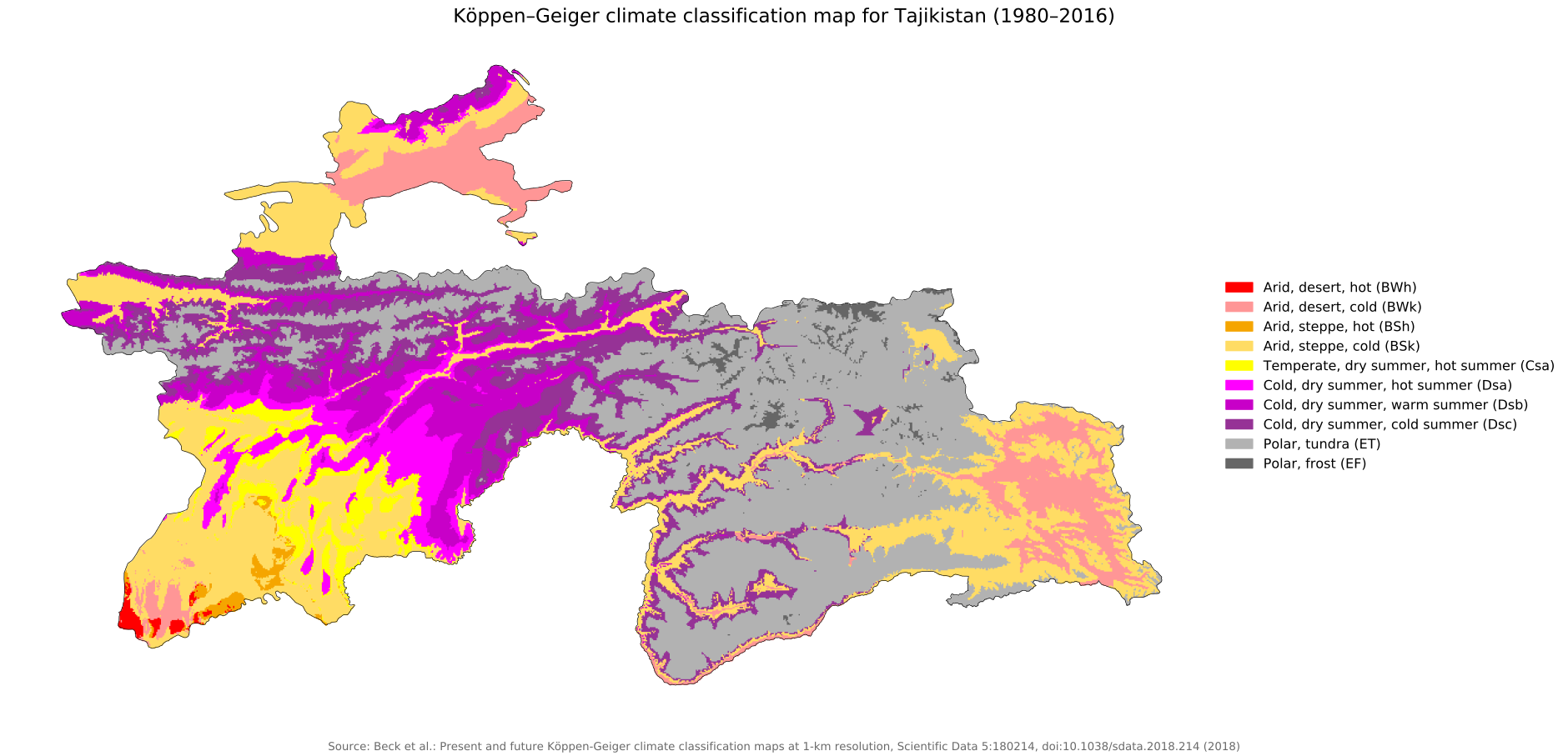
Tajikistan is landlocked, and is the smallest nation in Central Asia by area. It lies mostly between latitudes 36° and 41° N, and longitudes 67° and 75° E. It is covered by mountains of the Pamir range, and most of the country is over 3000 m above sea level. The areas of lower land are in the north (part of the Fergana Valley), and in the southern Kofarnihon and Vakhsh river valleys, which form the Amu Darya. Dushanbe is located on the southern slopes above the Kofarnihon valley.
| Kyzylart Pass | 4,280 m | 14,042 ft | Northern border in the Trans-Alay Range |
|---|
The Amu Darya and Panj rivers mark the border with Afghanistan, and the glaciers in Tajikistan's mountains are the source of runoff for the Aral Sea. There are over 900 rivers in Tajikistan longer than 10 kilometres.
Administrative divisions
Main article: Regions of Tajikistan, Districts of Tajikistan

Tajikistan consists of four administrative divisions. These are the provinces (viloyat) of Sughd and Khatlon, the autonomous province of Gorno-Badakhshan (abbreviated as GBAO), and the Regions of Republican Subordination (RRP – Raiony Respublikanskogo Podchineniya in transliteration from Russian or NTJ – Ноҳияҳои тобеи ҷумҳурӣ [Nohiyahoi tobei jumhurii] in Tajik). Each region is divided into districts (, nohiya or raion), which in turn are subdivided into jamoats (village-level self-governing units) and then villages (qyshloqs). , there were 58 districts and 367 jamoats in Tajikistan.
| Division | ISO 3166-2 | Map No | Capital | ru}} | Pop. (2019) | Sughd | Region of Republican Subordination | Khatlon | Gorno-Badakhshan | Dushanbe | |
|---|---|---|---|---|---|---|---|---|---|---|---|
| TJ-SU | 1 | Khujand | 25,400 | 2,658,400 | |||||||
| TJ-RR | 2 | Dushanbe | 28,600 | 2,122,000 | |||||||
| TJ-KT | 3 | Bokhtar | 24,800 | 3,274,900 | |||||||
| TJ-GB | 4 | Khorugh | 64,200 | 226,900 | |||||||
| Dushanbe | 124.6 | 846,400 |
Biodiversity
Tajikistan contains five terrestrial ecoregions: Alai-Western Tian Shan steppe, Gissaro-Alai open woodlands, Pamir alpine desert and tundra, Badghyz and Karabil semi-desert, and Paropamisus xeric woodlands.
Economy
Main article: Economy of Tajikistan

In 2019, nearly 29% of Tajikistan's GDP came from immigrant remittances (mostly from Tajiks working in Russia). With foreign revenue precariously dependent upon remittances from migrant workers overseas and exports of aluminium and cotton, the economy is vulnerable to external shocks. In fiscal year 2000, international assistance remained an essential source of support for rehabilitation programs that reintegrated former civil war combatants into the civilian economy, which helped keep the peace. International assistance was necessary to address the second year of drought that resulted in a continued shortfall of food production. On 21 August 2001, the Red Cross announced that a famine was striking Tajikistan, and called for international aid for the country. In January 2012, 680,152 of the people living in Tajikistan were living with food insecurity. Out of those, 676,852 were at risk of Phase 3 (Acute Food and Livelihoods Crisis) food insecurity, and 3,300 were at risk of Phase 4 (Humanitarian Emergency). Those with the highest risk of food insecurity were living in the Murghob District of GBAO.
The malnutrition rate in Tajikistan will reach 30% in 2023 according to the United Nations World Food Programme (WFP). As in the rest of Central Asia, soils are deteriorating and water resources are diminishing, particularly as a result of climate change.
Tajikistan's economy grew after the war. The GDP of Tajikistan expanded at an average rate of 9.6% over the period of 2000–2007 according to the World Bank data. This "improved" Tajikistan's position among other Central Asian countries (namely Turkmenistan and Uzbekistan), which seem to have degraded economically ever since. The primary sources of income in Tajikistan are aluminium production, cotton growing and remittances from migrant workers. Cotton accounts for 60% of agricultural output, supporting 75% of the rural population, and using 45% of irrigated arable land. The aluminium industry is represented by the state-owned Tajik Aluminum Company – the biggest aluminium plant in Central Asia and one of the biggest in the world.
Tajikistan's rivers, such as the Vakhsh and the Panj, have hydropower potential, and the government has focused on attracting investment for projects for internal use and electricity exports. Tajikistan is home to the Nurek Dam, the second highest dam in the world. Russia's RAO UES has been working on the Sangtuda-1 hydroelectric power station (670 MW capacity) which commenced operations on 18 January 2008. Other projects at the development stage include Sangtuda-2 by Iran, Zerafshan by the Chinese company SinoHydro, and the Rogun power plant that, at a projected height of 335 m, would supersede the Nurek Dam as highest in the world if it is brought to completion. A planned project, CASA-1000, will transmit 1000 MW of surplus electricity from Tajikistan to Pakistan with power transit through Afghanistan. The total length of transmission line is 750 km while the project is planned to be on Public-Private Partnership basis with the support of WB, IFC, ADB and IDB. The project cost is estimated to be around US$865 million. Other energy resources include coal deposits and smaller reserves of natural gas and petroleum.
In 2014 Tajikistan was the world's most remittance-dependent economy with remittances accounting for 49% of GDP and expected to fall by 40% in 2015 due to the economic crisis in the Russian Federation. Tajik migrant workers abroad, mainly in the Russian Federation, have become the main source of income for millions of Tajikistan's people and with the 2014–2015 downturn in the Russian economy the World Bank warned that numbers of Tajik men would return home and face "few" economic prospects.
According to some estimates about 47% of the population lives on less than US$1.25 per day. Migration from Tajikistan and the consequent remittances have been unprecedented in their magnitude and economic impact. In 2010, remittances from Tajik labour migrants totalled an estimated $2.1 billion US dollars, an increase from 2009. Tajikistan has achieved transition from a planned to a market economy without "substantial and protracted" recourse to aid, and by purely market-based means, simply by exporting its main commodity of comparative advantage — cheap labour. The World Bank Tajikistan Policy Note 2006 concludes that remittances have played a role as one of the drivers of Tajikistan's economic growth during the past years, have increased incomes, and as a result helped reduce poverty.
Drug trafficking is an illegal source of income in Tajikistan as it is a transit country for Afghan narcotics bound for Russian and, to a lesser extent, Western European markets; some opium poppy is raised locally for the domestic market. With the increasing assistance from international organisations, such as UNODC, and co-operation with the US, Russian, EU and Afghan authorities a level of progress on the fight against illegal drug-trafficking is being achieved.{{cite web
Besides Russia, China is one of the economic and trade partners of Dushanbe. Tajikistan belongs to the group of countries associated with Chinese investment within the Belt and Road Initiative.
Transportation
Main article: Transport in Tajikistan
As a landlocked country, Tajikistan has no ports and the majority of transportation is via roads, air, and rail. Over the years Tajikistan has pursued agreements with Iran and Pakistan to gain port access in those countries via Afghanistan. In 2009, an agreement was made between Tajikistan, Pakistan, and Afghanistan to improve and build a 1,300 km highway and rail system connecting the three countries to Pakistan's ports. The proposed route would go through the Gorno-Badakhshan Autonomous Province in the eastern part of the country. In 2012, the presidents of Tajikistan, Afghanistan, and Iran signed an agreement to construct roads and railways, and oil, gas, and water pipelines to connect the three countries.
Rail
Main article: Rail transport in Tajikistan
The railroad system totals only 680 km of track, Most international freight traffic is carried by train. The Bokhtar–Kulob railway connected the Kulob District with the central area of the country.
Air
In 2009 Tajikistan had 26 airports, 18 of which had paved runways, of which two had runways longer than 3,000 meters.
Roads
The total length of roads in the country is 27,800 kilometres. Automobiles account for more than 90% of the total volume of passenger transportation and more than 80% of domestic freight transportation.
In 2004 the Tajik–Afghan Friendship Bridge between Afghanistan and Tajikistan was built, improving the country's access to South Asia. The bridge was built by the United States.
highway and tunnel construction projects are underway or have been completed. Projects include rehabilitation of the Dushanbe – Chanak (Uzbek border), Dushanbe – Kulma (Chinese border), and Kurgan-Tube – Nizhny Pyanj (Afghan border) highways, and construction of tunnels under the mountain passes of Anzob, Shakhristan, Shar-Shar and Chormaghzak. These were supported by international donor countries.
Demographics
Main article: Demographics of Tajikistan

| Year | Million |
|---|---|
| 1926 | 0.83 |
| 1950 | 1.5 |
| 2000 | 6.2 |

In 2023, Tajikistan was estimated to have a population of 10,389,799 as per the World Bank data. The Tajiks who speak Tajik are the main ethnic group, while there are minorities of Uzbeks and Russians, whose numbers are declining due to emigration; this makes Tajikistan the only country in Central Asia to have a minority of Turkic people, and instead a majority of Iranic people. The Pamiris of Badakhshan, a population of Yaghnobi people, and a minority of Ismailis are considered to belong to the larger group of Tajiks. Citizens of Tajikistan are called Tajikistanis.
In 1989, ethnic Russians in Tajikistan made up 7.6% of the population; by 1998 the proportion had reduced to approximately 0.5% following the Tajikistani Civil War which had displaced the majority of ethnic Russians. Following the end of the war, Russian emigration continued. The ethnic German population of Tajikistan has declined due to emigration: having topped at 38,853 in 1979, it has "almost vanished" since the collapse of the Soviet Union.
The Tajiks are the principal ethnic group in most of Tajikistan, and in northern and western Afghanistan; there are more Tajiks in Afghanistan than in Tajikistan. Tajiks are a minority in Uzbekistan. About 2.4 million Tajik citizens were officially registered in Russia in 2021.
Languages
Main article: Languages of Tajikistan, Tajik language, Russian dialects#Tajikistani Russian
The official languages of Tajikistan are Tajik as the state language and Russian as the interethnic language, as understood in Article 2 of the Constitution: "The state language of Tajikistan shall be Tajik. Russian shall be the language of international communication."
The state (national) language (, ) of the Republic of Tajikistan is Tajik, which is written in the Tajik Cyrillic alphabet. Millions of native Tajik speakers live in neighbouring Uzbekistan and in Russia.
According to article 2 of the Constitution of the Republic of Tajikistan, Russian is recognised as the second official language of Tajikistan; the official language of inter-ethnic communication (; ) in the country.
Approximately 90% of the population of Tajikistan speaks Russian at varying levels. The varieties of Russian spoken in Tajikistan are referred to by scholars as Tajik(istani) Russian and it shares some similarities with Uzbek(istani) Russian, such as morphological differences and lexical differences such as the use of word урюк for a wild apricot or кислушка for rhubarb.
Both Russian and Tajik speakers in the country use the following words in common in addressing unfamiliar people and acquaintances.
| Tajikistani Russian | Standard Russian | English translation |
|---|---|---|
| апа | старшая сестра | older sister |
| ака | старший брат | older brother |
| хола | тетя | aunt |
| янга | жена брата, невестка | daughter-in-law; sister-in-law |
The "highly educated" part of the population of Tajikistan, and the intelligentsia, prefer to speak Russian and Persian, the pronunciation of which in Tajikistan is called the "Iranian style".
Native Uzbek speakers live in the north and west of Tajikistan. In fourth place (after Tajik, Russian and Uzbek) by number of native speakers are Pamir languages, whose native speakers live in Kuhistani Badakshshan Autonomous Region. The majority of Zoroastrians in Tajikistan speak one of the Pamir languages. Native speakers of the Kyrgyz language live in the north of Kuhistani Badakshshan Autonomous Region. Yagnobi language speakers live in the west of the country. The Parya language of local Romani people (Central Asian Gypsies) is spoken in Tajikistan. Tajikistan has communities of native speakers of Persian, Arabic, Pashto, Armenian, Azerbaijani, Tatar, Turkmen, Kazakh, Chinese, and Ukrainian.
Employment
In 2009 nearly 1 million Tajiks worked abroad (mainly in Russia). More than 70% of the female population lives in traditional villages.
Religion
Main article: Religion in Tajikistan
Tajikistan is a secular state with a constitution providing for freedom of religion, but nevertheless it heavily regulates the practices of its Muslim majority. Sunni Islam of the Hanafi school has been officially recognised by the government since 2009. The government has declared two Islamic holidays, Eid ul-Fitr and Eid al-Adha, as state holidays. According to a US State Department release and Pew research group, the population of Tajikistan is 98% Muslim. Approximately 87–95% of them are Sunni and roughly 3% are Shia and roughly 7% are non-denominational Muslims. The Shia part of the population predominantly live in the Gorno-Badakhshan Autonomous Region and are followers of the Ismailite branch of Shia Islam. The remaining 2% of the population are followers of Russian Orthodoxy, Protestantism, Zoroastrianism and Buddhism. Muslims fast during Ramadan, while about one third in the countryside and 10% in the cities observe daily prayer and dietary restrictions.
As of January 2016, as part of an "anti-radicalisation campaign", police in the Khatlon region reportedly shaved the beards of 13,000 men and shut down 160 shops selling the hijab. Shaving beards and discouraging women from wearing hijabs is part of a government campaign targeting trends that are deemed "alien and inconsistent with Tajik culture", and "to preserve secular traditions".
There is a concern for religious institutions becoming active in the political sphere. The Islamic Renaissance Party (IRP), a combatant in the 1992–1997 Civil War and then-proponent of the creation of an Islamic state in Tajikistan, constitutes no more than 30% of the government by statute. Membership in Hizb ut-Tahrir, a militant Islamic party which aims for an overthrow of secular governments and the unification of Tajiks under one Islamic state, is illegal and members are subject to arrest and imprisonment.
By law, religious communities must register by the State Committee on Religious Affairs (SCRA) and with local authorities. Registration with SCRA requires a charter, a list of 10 or more members, and evidence of local government approval prayer site location. Religious groups that do not have a physical structure are not allowed to gather publicly for prayer. Failure to register can result in fines and closure of a place of worship. There are reports that registration on the local level is sometimes difficult to obtain. People under the age of 18 are barred from public religious practice.
Approximately 1.6% of the population in Tajikistan is Christian, mostly Orthodox Christians. The territory of Tajikistan is part of the Dushanbe and Tajikistan Diocese of the Central Asian Metropolitan District of the Russian Orthodox Moscow Patriarchate. The country is home to communities of Catholics, Armenian Christians, Protestants, Lutherans, Jehovah's Witnesses, Baptists, Mormons, and Adventists.
Bukharan Jews had lived in Tajikistan since the second century BC. In the 1940s, the Jewish community of Tajikistan numbered nearly 30,000 people. Most were Persian-speaking Bukharan Jews who had lived in the region for millennia along with Ashkenazi Jews from Eastern Europe who resettled there in the Soviet era. As of 2011, the Jewish population was estimated at less than 500, with roughly half living in Dushanbe.
Health
Main article: Health in Tajikistan

The state's Ministry of Labor and Social Welfare reported that 104,272 disabled people are registered in Tajikistan (2000). The government of Tajikistan and the World Bank considered activities to support this part of the population described in the World Bank's Poverty Reduction Strategy Paper. Public expenditure on health was at 1% of the GDP in 2004.
Life expectancy at birth was estimated to be 69 years in 2020. The infant mortality rate was approximately 30.42 deaths per 1,000 children in 2018. In 2014, there were 2.1 physicians per 1,000 people, higher than any other low-income country after North Korea.
Tajikistan has experienced a decrease in per capita hospital beds since 1992 following the dissolution of the USSR, while the number remains at 4.8 beds per 1,000 people, above the world average of 2.7.
According to the World Bank, 96% of births are attended by skilled health staff, rising from 66.6% in 1999.
In 2010, the country experienced an outbreak of polio that caused more than 457 cases of polio in both children and adults and resulted in 29 deaths before being brought under control.
In the summer of 2021, coronavirus ravaged the country, and the Tajik president's sister reportedly died in a hospital of COVID-19. According to local media, the president's sister's sons physically assaulted the health minister and a senior doctor.
In 2023, according to the World Health Organization, Tajikistan received its certification, declaring its status as a malaria-free country.
Education
Main article: Education in Tajikistan
An estimated 99.8% of the population of Tajikistan have the ability to read and write.
Public education in Tajikistan consists of 11 years of primary and secondary education and the government planned to implement a 12-year system in 2016. There are a number of tertiary education institutions including Khujand State University, which has 76 departments in 15 faculties, Tajikistan State University of Law, Business, & Politics, Khorugh State University, Agricultural University of Tajikistan, Tajik National University, and other institutions. Universities were established during the Soviet Era. tertiary education enrollment was 17%, below the sub-regional average of 37%, while higher than any other low-income country after Syria. Tajiks left the education system due to "low" demand in the labour market for people with "extensive" educational training or professional skills.
Public spending on education was relatively constant between 2005–2012 and fluctuated from 3.5% to 4.1% of GDP below the OECD average of 6%. The United Nations reported that the level of spending was "severely inadequate to meet the requirements of the country's high-needs education system."
According to a UNICEF-supported survey, about 25% of girls in Tajikistan fail to complete compulsory primary education because of poverty and gender bias, while literacy is "generally high" in Tajikistan. Estimates of out of school children range from 4.6% to 19.4% with the majority being girls.
In September 2017, the University of Central Asia launched its second campus in Khorog, Tajikistan, offering majors in Earth & Environmental Sciences and Economics. Tajikistan was ranked 108th in the Global Innovation Index in 2025.
Science in the territory of Tajikistan achieved "success" in the Middle Ages, and scientific organisations were created in the Soviet period. During the period of independence, the scientific sphere has experienced a "crisis": the annual number of patent applications for inventions decreased in 1994–2011 from 193 to 5. A contribution to science is made by universities, where in 2011 6707 researchers worked, of which 2450 had academic degrees.
Culture
Main article: Culture of Tajikistan

The Tajik language is the mother tongue of around 80% of the citizens of Tajikistan. Urban centres in Tajikistan include Dushanbe (the capital), Khujand, Kulob, Panjakent, Bokhtar, Khorugh and Istaravshan. There are Uzbek, Kyrgyz and Russian minorities.
The Yaghnobi people live in areas of northern Tajikistan. The estimated number of Yaghnobis is about 25,000. Forced migrations in the 20th century decimated their numbers. They speak the Yaghnobi language, which is the only direct descendant of the Sogdian language.
Tajikistan artisans created the Dushanbe Tea House, which was presented in 1988 as a gift to the sister city of Boulder, Colorado.
In the country, especially among women from the indigenous population, the wearing of traditional national clothing is preserved. The seamstresses and embroiderers of regions of Tajikistan use factory fabrics and local needlework embroidery for home decoration and women's clothing. The practice of Chakan embroidery is preserved among women in certain areas, passing the knowledge down from one generation to the next.
Sport
The national sport of Tajikistan is gushtigiri, a form of wrestling.
Another sport is buzkashi, a game played on horseback, like polo. Buzkashi may be played as an individual sport and as a team sport. The aim of the game is to grab a 50 kg dead goat, ride clear of the other players, get back to the starting point and drop it in a designated circle. It is played at Nowruz celebrations.
Tajikistan has sent athletes to every Summer Olympic Games and four Winter Olympic Games since gaining independence and has enjoyed limited success. The country's best results have come in the hammer throw, with Andrey Abduvaliyev and Dilshod Nazarov each winning gold in the men's event in 1992 and 2016 respectively (albeit with Abduvaliyev participating as part of the Unified Team). Tajikistan's highest medal haul at an Olympic Games came in the 2024 Summer Olympics, where its athletes won three medals.
The Tajikistan Football Federation is the governing body of football in Tajikistan. While neither the men's nor the women's teams have qualified for a World Cup, the men's side qualified for the 2023 AFC Asian Cup, in which they unexpectedly reached the quarter finals. The men's team participated in the AFC Challenge Cup on four occasions, winning the inaugural edition in 2006. The women's side has twice participated in the CAFA Women's Championship, finishing third in the 2018 edition and hosting the tournament in 2022.
The Tajikistan Cricket Federation was formed in 2012 as the governing body for the sport of cricket in Tajikistan. It was granted affiliate membership of the Asian Cricket Council in the same year.
In 2008, rugby union was officially registered with the Ministry of Justice, and there are three men's clubs.
Khorugh, capital of Gorno-Badakhshan Autonomous Region, is the location of highest altitude where bandy has been played.
Tajikistan has one ski resort, called Safed Dara (formerly Takob), near the town of Varzob.
Notes
References
Sources
References
- "Dissemination of the Republic of Tajikistan Population and Housing Census Data 2020".
- "Association of Religion Data Archives". U.S. Department of State.
- "Tajikistan – World Factbook".
- [[Department of Foreign Affairs and Trade (Australia)]]. "Tajikistan country brief".
- globalEDGE. "Tajikistan: Government".
- [[Congressional Research Service]]. "Tajikistan".
- "Local government in Tajikistan".
- Equal Future. "Tajikistan".
- "Democracy Index 2020".
- "Tajikistan's eternal ruler Abass kunduzi– DW – 10/12/2020".
- (1 March 2013). "General information".
- (2012). "Demographic Yearbook – Table 3: Population by sex, rate of population increase, surface area and density". United Nations Statistics Division.
- Alex Sodiqov. (24 January 2011). "Tajikistan cedes disputed land to China". [[Jamestown Foundation]].
- (25 January 2025). "UN Population Prospects 2024".
- (10 October 2023). "World Economic Outlook Database, October 2023 Edition. (Tajikistan)". [[International Monetary Fund]].
- "GINI index (World Bank estimate)". [[World Bank]].
- (6 May 2025). "Human Development Report 2025 - A matter of choice: People and possibilities in the age of AI". United Nations Development Programme.
- "World Bank Open Data".
- "Tajikistan Population (2025)".
- Bergne, Paul (2007) ''The Birth of Tajikistan: National Identity and the Origins of the Republic'', IB Taurus & Co Ltd, pg. 39–40
- (15 January 2019). "World Report 2019: Rights Trends in Tajikistan". Human Rights Watch.
- Welle (www.dw.com), Deutsche. "Tajikistan's eternal ruler Emomali Rakhmon {{!}} DW {{!}} 12 October 2020".
- "Tajikistan Ethnic groups – Demographics".
- "People of Tajikistan".
- (18 September 2024). "Tajik | Central Asian, Persian, Pamiri, & Iranian Language | Britannica".
- Ali Shir Nava'i ''Muhakamat al-lughatain'' tr. & ed. Robert Devereaux (Leiden: Brill) 1966 p6
- (8 October 2018). "The Central Asian States: Discovering Independence". Routledge.
- (6 April 2017). "Historical Dictionary of Medieval China". Rowman & Littlefield.
- [[Xuanzang]] calls this region ''Kiumito'' which is thought to be ''Komdei'' of [[Ptolemy]] and ''Kumadh'' or ''Kumedh'' of [[Muslim]] writers (See: Studies in Indian History and Civilization, Agra, p 351; India and the World, 1964, p 71, Dr Buddha Prakash; India and Central Asia, 1955, p 35, P. C. Bagch).
- Centre, UNESCO World Heritage. "Proto-urban Site of Sarazm – UNESCO World Heritage Centre". unesco.org.
- [https://lccn.loc.gov/97005110 A Country Study: Tajikistan, Ethnic Background] {{Webarchive. link. (17 May 2020 . Library of Congress Call Number DK851. K34 (1997))
- Scholars have located the Kamboja realm on the southern side of the Hindu Kush ranges in the [[Kabul Valley. Kabul]], [[Swat Valley. Swat]], and [[Kunar Valley]]s, and the Parama-Kambojas in the territories on the north side of the Hindu Kush in [[Pamir Mountains. Pamir]] and [[Badakhshan]] region in Tajikistan. See: Geographical and Economic Studies in the Mahābhārata: Upāyana Parva, 1945, p 11–13, Moti Chandra – India; ''Geographical Data in the Early Purāṇas: A Critical Study'', 1972, p 165/66, M. R. Singh
- Dr Buddha Prakash maintains that, based on the evidence of [[Kalidasa]]'s [[Raghuvamsha]], Raghu defeated the [[Hunas]] on river Vamkshu (Raghu vamsha 4.68), and then he marched against the Kambojas (4.69–70). These Kambojas were of [[Iranian peoples. Iranian]] affinities who lived in [[Pamir Mountains. Pamir]]s and [[Badakshan]]. [[Xuanzang]] calls this region ''Kiumito'' which is thought to be ''Komdei'' of [[Ptolemy]] and ''Kumadh'' or ''Kumedh'' of [[Muslim]] writers (See: Studies in Indian History and Civilization, Agra, p 351; India and the World, 1964, p 71, Dr Buddha Prakash; India and Central Asia, 1955, p 35, P. C. Bagch).
- See: The Deeds of Harsha: Being a Cultural Study of Bāṇa's Harshacharita, 1969, p 199, Dr Vasudeva Sharana Agrawala; Proceedings and Transactions of the All-India Oriental Conference, 1930, p 118, Dr J. C. Vidyalankara; Prācīna Kamboja, jana aura janapada =: Ancient Kamboja, people and country, 1981, Dr Jiyālāla Kāmboja, Dr Satyavrat Śāstrī – Kamboja (Pakistan).
- link. (2 October 2013 . Megalithic.co.uk. Retrieved on 20 January 2017.)
- [[Records of the Grand Historian. Shiji]], trans. Burton Watson
- [[Frances Wood]] (2002) ''The Silk Road: Two Thousand Years in the Heart of Asia''. University of California Press. p. 66. {{ISBN. 978-0-520-23786-5.
- [https://www.loc.gov/rr/frd/cs/profiles/Tajikistan.pdf Tajikistan] {{webarchive. link. (21 December 2016 . loc.gov.)
- J. Calmard. (1993). "The Encyclopedia of Islam". Brill.
- Bosworth, C.E.. (1963). "The Ghaznavids: 994–1040". Edinburgh University Press.
- An Ismaili Heresiography: The "Bab Al-Shaytan" from Abu Tammam's Kitab Al ... By Wilferd Madelung, Paul Ernest Walker, p. 5.
- "Encyclopedia – Britannica Online Encyclopedia". eb.com.
- Grousset, Rene. (2004). "The Empire of the Steppes". Rutgers University Press.
- Svatopluk Soucek. (2000). "A history of Inner Asia". Cambridge University Press.
- [http://www.iranicaonline.org/articles/ilak-khanids ilak-khanids] {{webarchive. link. (9 September 2015 : Iranica. accessed May 2014.)
- Daʿadli, Tawfiq (9 April 2019). Esoteric Images: Decoding the Late Herat School of Painting. BRILL. p. 7. ISBN 978-90-04-39841-2.
- [[Richard M. Eaton. (2000). "Essays on Islam and Indian History". Oxford University Press.
- [[Encyclopaedia of Islam]], "Ghurids", C.E. Bosworth, Online Edition, 2006: ''"... The Shansabānīs were, like the rest of the Ghūrīs, of eastern Iranian Tājik stock ..."''
- Cynthia Talbot, ''The Last Hindu Emperor: Prithviraj Chauhan and the Indian Past, 1200–2000'', (Cambridge University Press, 2016), 36.
- "History of Central Asia – Under Russian rule".
- (1956). "Turkestan Cotton in Imperial Russia". Association for Slavic and Eurasian Studies.
- (10 April 2018). "Jadidism in Central Asia: Origins, Development, and Fate Under the Soviets".
- "Tajikistan – The Russian Conquest".
- (31 July 2018). "Tajikistan profile – Timeline". BBC.
- (1955). "Muslims of Soviet Central Asia: Trends and Prospects (Part I)". Middle East Journal.
- "A Country Study: Tajikistan, Impact of the Civil War". U.S. Library of Congress.
- "Tajikistan – Collectivization". Country Studies US.
- "Tajikistan – The Purges". Country Studies US.
- "Tajikistan – Ethnic Groups".
- Kamoludin Abdullaev and Shahram Akbarzaheh (2010) ''Historical Dictionary of Tajikistan'', 2nd ed. p. 383. {{ISBN. 0810860619.
- Vadim Erlikman (2004). ''Poteri narodonaseleniia v XX veke''. Moscow. pp. 23–35. {{ISBN. 5-93165-107-1
- C. Peter Chen. "Tajikistan in World War II". WW2DB.
- "Tajikistan – The Postwar Period". Country Studies US.
- Boris Rumer (1989) ''Soviet Central Asia: A Tragic Experiment'', Unwin Hyman, London. p. 126. {{ISBN. 0044451466.
- ''Statistical Yearbook of the USSR 1990'', Goskomstat, Moscow, 1991, p. 115 {{in lang. ru.
- ''Statistical Yearbook of the USSR 1990'', Goskomstat, Moscow, 1991, p. 210 {{in lang. ru.
- (9 September 2017). "Tajikistan celebrates Independence Day". Front News International.
- "Tajikistan: rising from the ashes of civil war". United Nations.
- Dubovitsky, Viktor. (February 2003). "Features of the ethnic and confessional situation in the Republic of Tajikistan".
- "Human Rights Watch World Report 1994: Tajikistan". Human Rights Watch.
- (17 November 1992). "Ситуация в Таджикистане".
- (June 1995). "Telling the truth for more than 30 years – Tajikistan After the Elections: Post-Soviet Dictatorship". Washington Report on Middle East Affairs.
- "Central Asia's Security: Issues and Implications for U.S. Interests". Federation of American Scientists.
- "REPUBLIC OF TAJIKISTAN PRESIDENTIAL ELECTION". Organization for Security and Cooperation in Europe.
- "OSCE and CIS Observers Disagree on Presidential Election in Tajikistan".
- (18 October 2010). "OSCE urges Tajikistan to stop attacks on free media". Reuters.
- Kucera, Joshua. (7 September 2010). "Tajikistan's Ayni airbase opens – but who is using it?". The Open Society Institute.
- (19 October 2010). "Tajikistan: Dushanbe Dangling Ayni Air Base Before Russia". EurasiaNet.org.
- "Ratification of Russian military base deal provides Tajikistan with important security guarantees".
- (18 October 2010). "Tajikistan says restive east is under control". BBC News.
- (18 October 2010). "Tajikistan Says Kills Three Suspected Islamist Militants". Radio Free Europe Radio Liberty.
- (3 November 2010). "Tajikistan: The government withdraws troops from the Rasht valley". Ferghana Information agency, Moscow.
- Khayrullo Fayz. (24 July 2012). "Tajikistan clashes: 'Many dead' in Gorno-Badakhshan". BBC Uzbek.
- "Why Russia Will Send More Troops to Central Asia". Stratfor.
- (28 May 2015). "Commander of elite Tajik police force defects to Islamic State". Reuters.
- (8 September 2017). "Russia says its air strike kills several top Islamic State commanders in Syria". Reuters.
- (4 October 2021). "Afghan resistance has sanctuary in Tajikistan, but fighting Taliban a 'non-viable prospect'".
- "Kyrgyzstan, Tajikistan diverge on approaches to Afghanistan {{!}} Eurasianet".
- "Armed clashes erupted all along the border of Kyrgyzstan and Tajikistan, Kyrgyz government sources reported on Sept. 16.".
- (30 December 2011). "The Tajik civil war: Causes and dynamics".
- "How The Tajik President Has Managed To Stay In Power For Nearly Three Decades".
- Greenberg, Ilan, "Media Muzzled and Opponents Jailed, Tajikistan Readies for Vote", ''[[The New York Times]]'', 4 November 2006 (article dateline 3 November 2006), page A7, New York edition
- (4 March 2010). "Change you can't believe in". [[The Economist]].
- (1 March 2010). "Tajikistan elections criticised by poll watchdog". [[BBC]].
- (20 April 2017). "Dictatorland: Tajikistan". BBC Three.
- (7 September 2015). "The men evading Tajikistan's de-facto beard ban".
- Welle (www.dw.com), Deutsche. (5 June 2020). "Press freedom in Tajikistan: Going from bad to worse {{!}} DW {{!}} 5 June 2020".
- (22 October 2010). "Tajik Government's Fury Over Conflict Reporting". Iwpr.net.
- "Global democracy has another bad year". The Economist.
- (15 July 2019). "Which Countries Are For or Against China's Xinjiang Policies?". [[The Diplomat (magazine).
- "Tajikistan re-elects leader Rahmon with overwhelming majority".
- (29 April 2021). "Kyrgyz, Tajik security forces clash at border in water dispute". [[Reuters]].
- (21 May 2021). "After Kyrgyzstan-Tajikistan Border Conflict, Time For a Human Rights Agenda". Human Rights Watch.
- (7 July 2021). "Tajikistan asks Russia-led bloc for help on Afghan border". Reuters.
- (7 July 2021). "Tajikistan Reportedly Calls On Allies For Help With Security Challenges From Afghanistan". Radio Free Europe/Radio Liberty.
- ''Population of the Republic of Tajikistan as of 1 January 2008'', State Statistical Committee, Dushanbe, 2008 {{in lang. ru
- (2019). "Population size, Republic of Tajikistan on January 1, 2019". Tajikistan Statistics Agency.
- (2017). "An Ecoregion-Based Approach to Protecting Half the Terrestrial Realm". BioScience.
- link. (7 June 2021 Accessed 6 June 2021. Link goes to current data.)
- "[https://www.economist.com/news/asia/21584999-russia-attempts-draw-tajikistan-and-kyrgyzstan-back-its-orbit-remittance-man Remittance man] {{webarchive. link. (18 November 2017 ". The Economist. 7 September 2013.)
- link. (11 April 2016 , United Nations, March 2014)
- "Spectre of famine over Tajikistan – IFRC".
- "Integrated Food Security Phase Classification". USAID.
- (31 March 2023). "Tajikistan {{!}} World Food Programme".
- (20 June 2005). "BBC's Guide to Central Asia". BBC News.
- (December 2007). "Background Note: Tajikistan". US Department of State, Bureau of South and Central Asian Affairs.
- (12 December 2013). "Tajikistan: Over 392.5 thousand tons of cotton picked in Tajikistan". BS-AGRO.
- link. Expert Kazakhstan. (6 December 2004)
- (1998). "Highest Dams (World and U.S.)". ICOLD World Register of Dams.
- link. Vesti. (25 December 2007)
- (5 January 2008). "Sangtuda-1 HPS launched on January 18, 2008". Today Energy.
- (24 April 2007). "Iran participates in power plant project in Tajikistan". IRNA.
- (18 January 2007). "Chinese To Build Tajik Hydroelectric Plant". Radio Free Europe / Radio Liberty.
- (13 August 2011). "Pakistan can end power crisis thru CASA-1000". Satrapia.
- "Tajikistan".
- "Tajikistan: Remittances to Plunge 40% – World Bank". EurasiaNet.org.
- (29 November 2007). "Remittance Trends 2007. Migration and Development Brief 3". [[World Bank]].
- (January 2008). "UNDP: Human development indices – Table 3: Human and income poverty (Population living below national poverty line (2000–2007))".
- Alexei Kireyev. (January 2006). "The Macroeconomics of Remittances: The Case of Tajikistan. IMF Working Paper WP/06/2". [[International Monetary Fund.
- (June 2006). "Tajikistan Policy Note. Poverty Reduction and Enhancing the Development Impact of Remittances. Report No. 35771-TJ". [[World Bank]].
- link. (3 April 2015 , BBC, 2011)
- "Country Factsheets, Eurasian Narcotics: Tajikistan 2004". Silk Road Studies.
- "Facts and Figures". Coordination and Analysis Unit of the [[UNODC]] Regional Office for Central Asia.
- (4 October 2007). "Fighting Drugs, Crime and Terrorism in the CIS". UNODC.
- Vakulchuk, Roman and Indra Overland (2019) "[https://www.researchgate.net/publication/329310641 China's Belt and Road Initiative through the Lens of Central Asia] {{Webarchive. link. (24 October 2021 ", in Fanny M. Cheung and Ying-yi Hong (eds) ''Regional Connection under the [[Belt and Road Initiative]]. The Prospects for Economic and Financial Cooperation''. London: Routledge, pp. 115–133.)
- (10 August 2009). "President Zardari chairs PPP consultative meeting". Associated Press of Pakistan.
- "Iran, Afghanistan, Tajikistan sign agreement on road, railway construction". Tehran Times.
- (1 September 2009). "Migrant Express Part 1: Good-bye Dushanbe". YouTube.
- Administrator. "Tajikistan Mission – Infrastructure". tajikistanmission.ch.
- "US Army Corps of Engineer, Afghanistan-Tajikistan Bridge". US Army Corps of Engineer.
- [http://centralasiaonline.com/en_GB/articles/caii/features/2009/09/03/feature-06 Shar-Shar auto tunnel links Tajikistan to China] {{webarchive. link. (31 May 2014 , The {{convert). 2.3. km. 0
- Payrav Chorshanbiyev (12 February 2014) [http://news.tj/en/news/chormaghzak-tunnel-renamed-khatlon-tunnel-and-shar-shar-tunnel-renamed-ozodi-tunnel Chormaghzak Tunnel renamed Khatlon Tunnel and Shar-Shar Tunnel renamed Ozodi Tunnel] {{webarchive. link. (31 May 2014 . news.tj)
- [http://blogs.fco.gov.uk/leighturner/2013/05/07/trade-tunnels-transit-and-training-in-mountainous-tajikistan/ Trade, tunnels, transit and training in mountainous Tajikistan] {{webarchive. link. (19 August 2013 . fco.gov.uk (7 May 2013))
- "96 ЛЕТ НАЗАД ТАДЖИКИСТАН ВПЕРВЫЕ ПОЯВИЛСЯ НА КАРТЕ МИРА".
- (8 February 2022). "Population, total - Tajikistan".
- [https://news.bbc.co.uk/2/hi/asia-pacific/4420922.stm Russians left behind in Central Asia] , Robert Greenall, BBC News, 23 November 2005.
- (October 2025). "Tajikistan".
- [http://countrystudies.us/tajikistan/23.htm Tajikistan – Ethnic Groups] {{webarchive. link. (7 December 2010 . Source: ''U.S. Library of Congress.'')
- [http://library.ndsu.edu/grhc/history_culture/history/tajikistan.html Russian-Germans in Tajikistan] {{webarchive. link. (20 August 2009 . Pohl, J. Otto. "Russian-Germans in Tajikistan", ''Neweurasia'', 29 March 2007.)
- (26 October 2021). "Why Tajikistan Is Taking a Stand Against the Taliban". The Moscow Times.
- (6 September 2016). "The Tajik Tragedy of Uzbekistan". The Diplomat.
- (12 February 2022). "Doctor Drain: 'Exodus' Of Tajiks To Russia Seen As Migration Laws Eased". Radio Free Europe/Radio Liberty.
- "Constitution of Tajikistan". UNESCO.
- "Tajik language".
- (22 October 2009). "The status of the Russian language in Tajikistan remains unchanged – Rahmon". RIA – RIA.ru.
- "В Таджикистане русскому языку вернули прежний статус". Lenta.ru.
- "Tajiki".
- "Russian: A Monocentric or Pluricentric Language". Colloquia Humanistica.
- (October 2022). "Урюк". ABBYY Lingvo.
- (March 2022). "Кислушка (ревень)". ABBYY Lingvo.
- "Взаимопроникновение русского и таджикского языков в разговорной речи населения Душанбе". ГОСУДАРСТВЕННЫЙ ИНСТИТУТ РУССКОГО ЯЗЫКА имени А.С.ПУШКИНА.
- (7 October 2009). "Tajikistan Drops Russian As Official Language". RFE/RL – Rferl.org.
- (August 2017). "What Languages Are Spoken In Tajikistan".
- link. (10 June 2009 . Arab News. 21 May 2007.)
- (27 July 2011). "Millennium Development Goals: Saving women's Lives". D+C.
- Putz, Catherine. "Tajikistan: No Hajj, No Hijab, and Shave Your Beard".
- Avaz Yuldashev. link. (5 March 2009)
- [http://www.pewforum.org/2012/08/09/the-worlds-muslims-unity-and-diversity-1-religious-affiliation/#identity Pew Forum on Religious & Public life, Chapter 1: Religious Affiliation] {{webarchive. link. (26 December 2016 retrieved 29 October 2013.)
- "Background Note: Tajikistan". State.gov.
- "Keeping religion alive: performing Pamiri identity in Central Asia {{!}} IIAS".
- "U.S. Department of State Annual Report on International Religious Freedom for 1999: Tajikistan". U.S. Department of State.
- (21 January 2016). "Tajikistan's battle against beards". BBC News.
- (27 August 2003). "Hizb ut Tahrir". BBC.
- link. (13 June 2010 -[[Forum 18]] News Service, 20 November 2003)
- "U. S. Department of State International Religious Freedom Report for 2013, Executive Summary.".
- [http://www.pewforum.org/2015/04/02/religious-projection-table/2010/percent/all/ Religious Composition by Country, 2010–2050. Pew Research Center] {{webarchive. link. (2 August 2017 . Pewforum.org (2 April 2015). Retrieved on 20 January 2017.)
- link. (9 February 2017 . Globalreligiousfutures.org. Retrieved on 20 January 2017.)
- "Tajikistan – Religion".
- (4 January 2011). "Home Stand". Tablet Magazine.
- (31 October 2002). "Tajikistan – Poverty Reduction Strategy Paper (PRSP) and joint assessment". World Bank.
- "Human Development Report 2009 – Tajikistan". Hdrstats.undp.org.
- "Field Listing :: Life expectancy at birth — The World Factbook – Central Intelligence Agency".
- (March 2022). "Child Mortality – Tajikistan}}{{Dead link".
- "Physicians (per 1,000 people) – Tajikistan, Low income {{!}} Data".
- "Hospital beds (per 1,000 people) – World, Tajikistan, Low income {{!}} Data".
- "Births attended by skilled health staff (% of total) – Tajikistan, Low income {{!}} Data".
- (10 July 2012). "2010 polio outbreak in Tajikistan: A reminder of the continued need for vigilance as the Region marks 10 years of polio-free status". World Health Organization.
- Dixon, Robyn. [https://www.washingtonpost.com/world/europe/tajik-covid-president-nephews-assault-doctors/2021/07/27/660efdaa-eebb-11eb-ab6f-b41a066381df_story.html After the Tajik president's sister died of covid, her sons beat up the country's top health officials.] {{Webarchive. link. (28 July 2021 Washington Post 27 August 2021.)
- "WHO certifies Azerbaijan and Tajikistan as malaria-free".
- "Tajikistan Education System".
- [http://www.unicef.org/ceecis/Tajikistan.pdf Education in Tajikistan] {{webarchive. link. (6 November 2013 . unicef.org)
- "School enrollment, tertiary (% gross) – Low income {{!}} Data".
- link. (14 July 2014 World Bank)
- (9 June 2005). "Tajikistan hosts education forum". UNICEF.
- "University of Central Asia – University of Central Asia".
- "GII Innovation Ecosystems & Data Explorer 2025".
- (2025). "Global Innovation Index 2025: Innovation at a Crossroads". [[World Intellectual Property Organization]].
- ''Султанова Л. Ш., Айдинова М. А.'' Значение канала трансфера новых технологий для Узбекистана // Актуальные вопросы современной науки. — 2014. — № 1 (2,3). — С. 87.
- ''Шарипов М. М.'' Роль вузов в формировании и развитии инновационной экономики в Республике Таджикистан // Современные проблемы науки и образования. — 2014. — № 6. — С. 627.
- "Tajikistan – People".
- "Award-winning Yaghnobi-Czech dictionary captures dying language".
- [https://web.archive.org/web/20120527123614/http://www.boulder-dushanbe.org/teahouse.html The Dushanbe-Boulder tea house]. boulder-dushanbe.org
- "UNESCO - Chakan, embroidery art in the Republic of Tajikistan".
- (2013). "Tajikistan". Bradt Travel Guides.
- (30 June 2016). "Tajikistan National Sport - Gushtigiri, Then And Now".
- (27 April 2010). "Historical Dictionary of Tajikistan". Scarecrow Press.
- (13 February 2024). "Segrt: Asian Cup euphoria can spark bright Tajikistan future".
- (19 April 2006). "Tajikistan lift inaugural AFC Challenge Cup".
- (2 December 2018). "Uzbekistan inaugural CAFA Women's Championship winners".
- (10 July 2022). "Turkmen football players tied with the team of Tajikistan at the CAFA-2022 championship in Dushanbe".
- "Cricket in Tajikisyan".
- (March 2022). "Таъсиси нахустин тими духтаронаи рогбӣ дар Тоҷикистон".
- "Google Translate". google.co.uk.
- "Safed Dara". Trip Advisor.
This article was imported from Wikipedia and is available under the Creative Commons Attribution-ShareAlike 4.0 License. Content has been adapted to SurfDoc format. Original contributors can be found on the article history page.
Ask Mako anything about Tajikistan — get instant answers, deeper analysis, and related topics.
Research with MakoFree with your Surf account
Create a free account to save articles, ask Mako questions, and organize your research.
Sign up freeThis content may have been generated or modified by AI. CloudSurf Software LLC is not responsible for the accuracy, completeness, or reliability of AI-generated content. Always verify important information from primary sources.
Report