From Surf Wiki (app.surf) — the open knowledge base
Tagbilaran
Capital of Bohol, Philippines

Capital of Bohol, Philippines
| Field | Value | |
|---|---|---|
| name | ||
| image_skyline | Tagbilaran skyline.JPG | |
| image_caption | Aerial View | |
| image_flag | Flag_of_Tagbilaran,_Bohol_(New).png | |
| flag_size | 120x80px | |
| image_seal | Tagbilaran Bohol.png | |
| seal_size | 100x80px | |
| image_map | ||
| map_caption | ||
| mapframe | yes | |
| pushpin_map | Philippines | |
| pushpin_label_position | left | |
| pushpin_map_caption | Location within the | |
| coordinates | ||
| settlement_type | ||
| subdivision_type | Country | |
| subdivision_name | Philippines | |
| subdivision_type1 | Region | |
| subdivision_name1 | ||
| subdivision_type2 | Province | |
| subdivision_name2 | ||
| official_name | ||
| etymology | ||
| named_for | ||
| other_name | San José de Tagbilarán | |
| nickname | City of Friendship | |
| subdivision_type3 | District | |
| subdivision_name3 | ||
| established_title | Incorporated | |
| established_date | ||
| parts_type | Barangays | |
| parts_style | para | |
| p1 | (see Barangays) | |
| leader_title | Mayor | |
| leader_name | Jane Cajes Yap | |
| leader_title1 | Vice Mayor | |
| leader_name1 | Adam Jala | |
| leader_title2 | Representative | |
| leader_name2 | John Geesnell Yap | |
| leader_title3 | City Council | |
| leader_name3 | {{PH Town Council | |
| 1 | Jose Floro Balangkig Ringca | |
| 2 | Gian Carlo Tocmo Besas | |
| 3 | Jose Esteban Timoteo Borja Butalid | |
| 4 | Nerio Dote Zamora II | |
| 5 | Leonides Lagura Borja | |
| 6 | Fausto Sebandal Budlong | |
| 7 | Agustinus Varquez Gonzaga | |
| 8 | Christian Merick Monton Blanco | |
| 9 | Charles Tinonga Cabalit | |
| 10 | Gemma Manding Inting | |
| leader_title4 | Electorate | |
| leader_name4 | voters (electorate_point_in_time}} | ) |
| government_type | ||
| government_footnotes | ||
| elevation_m | ||
| elevation_max_m | 449 | |
| elevation_min_m | 0 | |
| elevation_footnotes | ||
| area_footnotes | ||
| area_total_km2 | ||
| population_footnotes | ||
| population_total | ||
| population_as_of | ||
| population_density_km2 | auto | |
| population_blank1_title | Households | |
| population_blank1 | ||
| timezone | PST | |
| utc_offset | +8 | |
| postal_code_type | ZIP code | |
| postal_code | ||
| postal2_code_type | ||
| postal2_code | ||
| area_code_type | ||
| area_code | ||
| website | ||
| demographics_type1 | Economy | |
| demographics1_title1 | ||
| demographics1_info1 | ||
| demographics1_title2 | Poverty incidence | |
| demographics1_info2 | % () | |
| demographics1_title3 | Revenue | |
| demographics1_info3 | ||
| demographics1_title4 | Revenue rank | |
| demographics1_title5 | Assets | |
| demographics1_info5 | ||
| demographics1_title6 | Assets rank | |
| demographics1_title7 | IRA | |
| demographics1_title8 | IRA rank | |
| demographics1_title9 | Expenditure | |
| demographics1_info9 | ||
| demographics1_title10 | Liabilities | |
| demographics1_info10 | ||
| demographics_type2 | Service provider | |
| demographics2_title1 | Electricity | |
| demographics2_info1 | ||
| demographics2_title2 | Water | |
| demographics2_title3 | Telecommunications | |
| demographics2_title4 | Cable TV | |
| blank_name_sec1 | ||
| blank_info_sec1 | ||
| blank1_name_sec1 | Native languages | |
| blank1_info_sec1 | ||
| blank2_name_sec1 | Crime index | |
| blank1_name_sec2 | Major religions | |
| blank2_name_sec2 | Feast date | |
| blank3_name_sec2 | Catholic diocese | |
| blank4_name_sec2 | Patron saint | |
| blank4_info_sec2 |
- Municipality
- City
Tagbilaran, officially the City of Tagbilaran (; ), is a component city and capital of the province of Bohol, Philippines. According to the 2024 census, it has a population of 106,120 people making it the most populous in the province.
Tagbilaran is the principal gateway to Bohol, 630 km southeast of the national capital of Manila and 72 km south of the regional capital, Cebu City.
Etymology
According to oral tradition, the name is a Hispanicized form of "Tagubilaan", a compound of tagu, meaning "to hide" and "Bilaan", referring to the Blaan people, who were said to have raided the Visayan Islands. This explanation seems to correlate with the government's explanation. According to the official government website of Tagbilaran, it is said to have been derived from tinabilan meaning shielded, as the town was protected by Panglao from potential invaders.
History

A hundred years before Spaniards arrived in the Philippines, the settlement which eventually became Tagbilaran was already involved in trading with China and Malays. Tagbilaran Strait was the location of the precolonial polity of Bo-ol. This early settlement had contact with the Spaniards in 1565, when the Spanish conquistador Miguel López de Legazpi and the native chieftain Datu Sikatuna pledged peace and cooperation through the famous blood compact. San José de Tagbilaran was established as a town on 9 February 1742, by General Francisco Antonio Calderón de la Barca, Military Governor of the Visayas Islands, who separated it from the town of Baclayon. The town was dedicated to St. Joseph the Worker. Since then it was part of the province of Bohol until it became a chartered city on 18 July 1966, by virtue of Republic Act No. 4660.
The city was occupied by the United States during the Philippine–American War and by Imperial Japan during World War II.
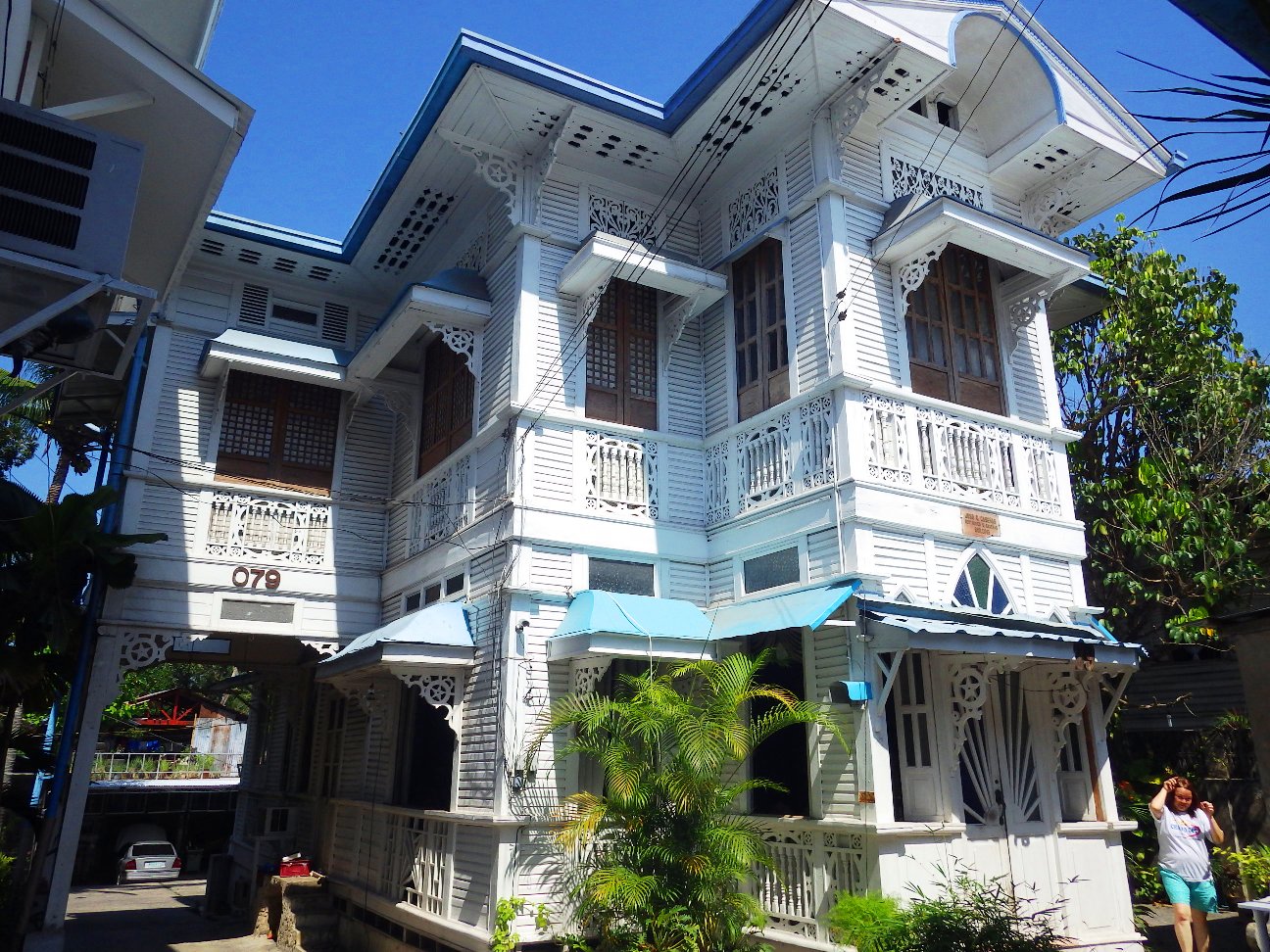
Sitio Ubos (Lower Town) is Tagbilaran's former harbor site and is considered to be the city's oldest portion, having been a busy trading center since the seventeenth century until the early twentieth century. As such, the place houses the oldest and largest number of heritage houses in Bohol. Sitio Ubos declined as a major port towards the end of the Spanish era when the causeway to Panglao Island was constructed. Since then, the area lost its former glory and its old houses were either demolished or neglected.
In 2002, in recognition of its cultural and historic significance, Sitio Ubos was declared a "Cultural Heritage Area". Some of the surviving heritage houses to this day include the Rocha–Suarez House, Rocha House, Hontanosas House, Beldia House, and Yap House.
Historic events
One of the most important events in Philippine history (immortalized on canvas by the famous Filipino painter Juan Luna) was the blood compact between Datu Sikatuna, a local native chieftain, and Captain Miguel López de Legazpi, the Spanish explorer and colonizer. It was believed that it took place in the coast of Bool, now a district of Tagbilaran, on 16 March 1565, a day after Legazpi and his crew of conquistadores on four ships chanced upon the shores of Bool during their trip to the province of Butuan from Camiguin Island because of strong southwest monsoon winds and low tide.
But in March 2006, the National Historical Institute (now National Historical Commission of the Philippines) installed a stone marker with an iron plaque at Villalimpia, Hinawanan Bay, Loay, to rectify the error once and for all. The historical marker states that:
Ang Sandugo
Sa look ng Hinawanan, Loay naganap ang sandugo sa pagitan nina Miguel Lopez de Legazpi at Datu Sikatuna ng Bohol sa loob ng barkong San Pedro ng Espanya, 25 Marso 1565. Isinagawa sa pamamagitan ng pag-inom ng alak na inihalo sa dugo mula sa hiwa sa dibdib ng dalawang pinuno. Naging simula ng pagkakaibigan ng mga Espanyol at mga Boholano at Kristiyanisasyon ng Pulo.
Tagbilaran was occupied by Imperial Japanese forces on 17 May 1942, after the fall of the Philippines during World War II.
During the Japanese occupation, the municipal government of Tagbilaran, whose mayor at the time was Manuel Espuelas, moved from the Poblacion to Tiptip. Another significant event was the Battle of Ubujan wherein a guerrilla unit under the command of Captain Francisco Salazar (aka Vicente Cubello) engaged Japanese troops against overwhelming odds.
2013 earthquake
An earthquake with magnitude 7.2, with an epicenter near Sagbayan, Bohol, struck Bohol on October 15, 2013. Tagbilaran received four fatalities and 21 injuries, and damage to buildings, including the seaport, airport, and city hall.
Geography

Tagbiliran is shaped a strip with two hills, Elley Hull (100 meters) and Banat-i (145 meters), located on its southern and northern borders respectively.
With a coastline of 13 km on the southwestern part of the island, the city shares its boundaries with the towns of Cortes, Corella, and Baclayon.
Climate
| archive-url = https://web.archive.org/web/20181018214345/https://data.gov.ph/sites/default/files/pagasanormvaltagbibohol1981-2010.csv | archive-date = October 18, 2018 | access-date = October 18, 2018}}
Barangays
Tagbilaran is politically subdivided into 15 barangays. Each barangay consists of puroks and some have sitios.
With a population of 104,976 for the year 2020 census, and an annual growth rate of . However, 44% of the city's population reside in the four urban districts where trade and commerce are also concentrated.
| {{#invoke:Chart | pie chart | radius = 110 | slices = | percent = true | hide group legends = yes |
|---|
|}
Demographics
Economy

The city has the advantage of being the province's main business capital and center of governance, education and transportation. Local and international visitors to Bohol pass through the city via the Port of Tagbilaran.
Alturas Group (operator of Alturas Mall, Island City Mall and Plaza Marcela), Bohol Quality Corporation and Alvarez Group are some of the notable locally owned companies based in the city.
Government
.png)
Chief Executives since 1742
Main article: Mayor of Tagbilaran

The city is governed locally by a mayor, although historically by a gobernadorcillo and presidente municipal afterwards.
Tourism

Main article: List of Cultural Properties in Tagbilaran
The city is a start-off point to Bohol province's attractions: the Chocolate Hills, tarsiers, white sandy beaches, dive spots, heritage sites and old stone churches. Home to several hotels, resorts, and restaurants, the city has recently become a venue for national conventions and gatherings.
Festivals
Saulog-Tagbilaran Festival is a celebration every April 20 to May 2. This includes street-dancing, fluvial procession, nightly activities, novena masses and beauty pageant. Tagbilaranon families invite relatives and friends for a lunch or dinner during desperas (visper) and katumanan (grand feast day May 1).
The Sandugo Festival is an annual celebration in Tagbilaran in commemoration of the blood compact between Miguel López de Legazpi and Datu Sikatuna in March 1565. The festival is celebrated every July to coincide with the month-long activities celebrating the city's Charter Day on July 1 and the Province's (Bohol) Day on July 22.
Transportation


Tagbilaran's land network consists of sealed and unsealed roads. Local transport plying the routes within the city are tricycles, multicabs, taxis, and jeepneys. Buses, taxis and vans are usually hired for out-of-town travel. The Integrated Bus Terminal (IBT) located in the city district of Dao serves as the terminal point for public transport vehicles serving the inter-city routes within the province and also serves as the embarkation point for passengers taking the Pan-Philippine Highway (AH26) bus route from Tagbilaran to Metro Manila. There is also a long-distance bus station within Cogon market.
The city is linked by sea to the major port cities in the Visayas Islands and Mindanao, which of major commercial importance is its link to the regional capital of Cebu City. A fastcraft ferry ride to Cebu City's Pier 1 takes approximately 2 hours depending on weather and sea conditions. The route is served by Ocean Jet exclusively as of June 2024 several times daily, with Weesam Express and SuperCat having suspended operations.
Bohol–Panglao International Airport is situated at the Panglao Island southwest of the city. It replaced Tagbilaran Airport on November 27, 2018. It serves as the principal gateway airport to the rest of the province. Airlines using the airport serve primarily the Tagbilaran-Manila route, Tagbilaran-Clark route, and also Mindanao. The route is served by Cebu Pacific, PAL Express, and AirAsia Philippines using Airbus A319, Airbus A320 and ATR 72 planes. Flight time to Manila is approximately 1h:15.
Healthcare
The city is served with a mix of public and private health care institutions that also cater to the health needs of the rest of the province. Complex major cases and services are sent to nearby Cebu City due to limited facilities.
Health facilities:
- Holy Name University Medical Center Foundation, Inc.
- Borja Family Hospital Corporation - Closed
- Bohol Doctors Hospital
- Governor Celestino Gallares Memorial Regional Hospital (tertiary public)
- MMG Bohol Cooperative Hospital
- Ramiro Community Hospital (tertiary private)
- Bohol St. Jude General Hospital - Closed
- Tagbilaran Community Hospital
- Tagbilaran Maternity and Children's Hospital - Closed
Education
As the capital of Bohol, Tagbilaran is the main center for education in the province. All of the province's universities are located in the city as well as other well-known institutions of learning.
Colleges and universities:
- Tagbilaran City College
- Bohol Island State University (BISU)
- BIT International College (BIT-IC, formerly Bohol Institute of Technology (BIT))
- Bohol Technical Institute (BTI)
- Bohol Wisdom School
- Holy Name University
- Holy Spirit School of Tagbilaran, Inc.
- Immaculate Heart of Mary Seminary (IHMS)
- PMI Colleges Bohol
- University of Bohol
Notable personalities
Sports
- Mark Magsayo – Boxer
- Czar Amonsot – Boxer
- Vanessa Sarno – Medalist, Weightlifting
Academe
- José Abueva – Academician
Culture and Arts
- Napoleon Abueva – Artist
Entertainment and Media
- Colet Vergara - Member of Pinoy pop group Bini
- Rich Asuncion – Starstruck Finalist/TV Actress
- Maxelende Ganade – Singer-songwriter
- Luke Mejares – TV Personality/Singer
- Hazel Mae - sportscaster
- Marco Sison – Singer
- Isagani Yambot – Journalist
Politics
- Jose Clarin – Third President pro tempore of the Senate of the Philippines (1934–1935) and former acting Senate President of the Philippines (1932)
- Cecilio Putong – Secretary of Education (1952)
- Fermin Torralba – Secretary of the Philippine Senate (1931–1935)
- Nestor Principe - Martial arts instructor and activist martyred during the Marcos dictatorship and honored at the Bantayog ng mga Bayani
References
Sources
- {{cite book
References
- {{DILG detail
- "''Tagbiliran''". Value Alliance.
- "History".
- "Historical and Cultural Life of the Barrio of Tiptip".
- [https://www.tagbilaran.gov.ph/?page_id=9 History of Tagbilaran] Retrieved December 6, 2009.
- (1 July 2005). "The City of Tagbilaran Fast Facts". Philippine Daily Inquirer.
- (September 19, 2019). "Cebu to Bohol". GeckoRoutes.
- Rey, Aika. (November 27, 2018). "Duterte inaugurates Bohol-Panglao International Airport". Rappler.
- (23 January 2022). "Mark Magsayo wins WBC featherweight title". Philippine News Agency.
- (25 September 2015). "Aussie trainer helps revive Filipino boxer's title dream". SBS News.
- "Meet the BINI Bisdak beauties". Cebu Daily News.
- (1935). "Our Delegates to the Constitutional Assembly: English-Spanish". Benipayo Press.
This article was imported from Wikipedia and is available under the Creative Commons Attribution-ShareAlike 4.0 License. Content has been adapted to SurfDoc format. Original contributors can be found on the article history page.
Ask Mako anything about Tagbilaran — get instant answers, deeper analysis, and related topics.
Research with MakoFree with your Surf account
Create a free account to save articles, ask Mako questions, and organize your research.
Sign up freeThis content may have been generated or modified by AI. CloudSurf Software LLC is not responsible for the accuracy, completeness, or reliability of AI-generated content. Always verify important information from primary sources.
Report