From Surf Wiki (app.surf) — the open knowledge base
Tagalog language
Austronesian language spoken in the Philippines
Austronesian language spoken in the Philippines
| Field | Value |
|---|---|
| name | Tagalog |
| nativename | Wikang Tagalog |
| pronunciation | |
| states | Philippines |
| region | Katagalugan; Metro Manila (as Filipino), parts of Central Luzon, most of Calabarzon, parts of Mimaropa, northwestern Bicol Region, and Ilocos Region (southeast Pangasinan) |
| ethnicity | Tagalog |
| speakers | L1: million |
| date | 2023 |
| ref | |
| speakers2 | L2: million (2020) |
| Total: million (2020–2023) | |
| speakers_label | Speakers |
| familycolor | Austronesian |
| fam2 | Malayo-Polynesian |
| fam3 | Philippine |
| fam4 | Greater Central Philippine |
| fam5 | Central Philippine |
| fam6 | Kasiguranin–Tagalog |
| ancestor | Proto-Austronesian |
| ancestor2 | Proto-Malayo-Polynesian |
| ancestor3 | Proto-Philippine |
| ancestor4 | Old Tagalog |
| dia1 | Bataan |
| dia2 | Batangas |
| dia3 | Bulacan |
| dia4 | Lubang |
| dia5 | Manila |
| dia6 | Marinduque |
| dia7 | Puray |
| dia8 | Tanay–Paete (Eastern Rizal-Northern Laguna) |
| dia9 | Tayabas |
| dia10 | Soccsksargen (Mindanao) |
| stand1 | Filipino |
| script | |
| nation | Philippines (as Filipino) |
| minority | Philippines (as a regional language and an auxiliary official language in the predominantly Tagalog-speaking areas of the Philippines) |
| agency | Komisyon sa Wikang Filipino |
| iso1 | tl |
| iso2 | tgl |
| iso3 | tgl |
| lingua | 31-CKA |
| map | Idioma tagalo.png |
| mapcaption | Predominantly Tagalog-speaking regions in the Philippines |
| glotto | taga1280 |
| glottoname | Tagalogic |
| glotto2 | taga1269 |
| glottoname2 | Tagalog-Filipino |
| glotto3 | taga1270 |
| glottoname3 | Tagalog |
Total: million (2020–2023)
ASEAN (as Filipino)
Tagalog ( , ; Baybayin: ) is an Austronesian language spoken as a first language by the ethnic Tagalog people, who make up a quarter of the population of the Philippines, and as a second language by the majority. Its de facto standardized and codified form, Filipino, is the national language of the Philippines, and is one of the nation's two official languages, alongside English.
Tagalog is closely related to other Philippine languages, such as the Bikol languages, the Bisaya languages, Ilocano, Kapampangan, and Pangasinan, and more distantly to other Austronesian languages, such as the Formosan languages of Taiwan, Indonesian, Malay, Hawaiian, Māori, Malagasy, and many more.
Classification
Tagalog is a Central Philippine language within the Austronesian language family. Being Malayo-Polynesian, it is related to other Austronesian languages, such as Malagasy, Javanese, Indonesian, Malay, Tetum (of Timor), and Yami (of Taiwan). It is closely related to the languages spoken in the Bicol Region and the Visayas islands, such as the Bikol group and the Visayan group, including Waray-Waray, Hiligaynon and Cebuano.
Tagalog differs from its Central Philippine counterparts with its treatment of the Proto-Philippine schwa vowel . In most Bikol and Visayan languages, this sound merged with and . In Tagalog, it has merged with . For example, Proto-Philippine (adhere, stick) is Tagalog dikít and Visayan and Bikol dukót.
Proto-Philippine , , and merged with but is between vowels. Proto-Philippine (name) and (kiss) became Tagalog ngalan and halík. Adjacent to an affix, however, it becomes instead: bayád (paid) → bayaran (to pay).
Proto-Philippine merged with . (water) and (blood) became Tagalog tubig and dugô.
History
Main article: Old Tagalog
The word Tagalog is possibly derived from the endonym taga-ilog ("river dweller"), composed of tagá- ("native of" or "from") and ilog ("river"), or alternatively, taga-alog deriving from alog ("pool of water in the lowlands"; "rice or vegetable plantation"). Linguists such as David Zorc and Robert Blust speculate that the Tagalogs and other Central Philippine ethno-linguistic groups originated in Northeastern Mindanao or the Eastern Visayas.
Possible words of Old Tagalog origin are attested in the Laguna Copperplate Inscription from the tenth century, which is largely written in Old Malay. The first known complete book to be written in Tagalog is the Doctrina Christiana (Christian Doctrine), printed in 1593. The Doctrina was written in Spanish and two transcriptions of Tagalog; one in the ancient, then-current Baybayin script and the other in an early Spanish attempt at a Latin orthography for the language.

Throughout the 333 years of Spanish rule, various grammars and dictionaries were written by Spanish clergymen. In 1610, the Dominican priest Francisco Blancas de San José published the Arte y reglas de la lengua tagala (which was subsequently revised with two editions in 1752 and 1832) in Bataan. In 1613, the Franciscan priest Pedro de San Buenaventura published the first Tagalog dictionary, his Vocabulario de la lengua tagala in Pila, Laguna.
The first substantial dictionary of the Tagalog language was written by the Czech Jesuit missionary Pablo Clain in the beginning of the 18th century. Clain spoke Tagalog and used it actively in several of his books. He prepared the dictionary, which he later passed over to Francisco Jansens and José Hernandez. Further compilation of his substantial work was prepared by P. Juan de Noceda and P. Pedro de Sanlucar and published as Vocabulario de la lengua tagala in Manila in 1754 and then repeatedly reedited, with the last edition being in 2013 in Manila.
Among others, Arte de la lengua tagala y manual tagalog para la administración de los Santos Sacramentos (1850) in addition to early studies of the language.
The indigenous poet Francisco Balagtas (1788–1862) is known as the foremost Tagalog writer, his most notable work being the 19th-century epic Florante at Laura.
Official status
Main article: Filipino language
Tagalog was declared the official language by the first revolutionary constitution in the Philippines, the Constitution of Biak-na-Bato in 1897.
In 1935, the Philippine constitution designated English and Spanish as official languages, but mandated the development and adoption of a common national language based on one of the existing native languages. After study and deliberation, the National Language Institute, a committee composed of seven members who represented various regions in the Philippines, chose Tagalog as the basis for the evolution and adoption of the national language of the Philippines. President Manuel L. Quezon then, on December 30, 1937, proclaimed the selection of the Tagalog language to be used as the basis for the evolution and adoption of the national language of the Philippines. In 1939, President Quezon renamed the proposed Tagalog-based national language as Wikang Pambansâ (national language). Quezon himself was born and raised in Baler, Aurora, which is a native Tagalog-speaking area. Under the Japanese puppet government during World War II, Tagalog as a national language was strongly promoted; the 1943 Constitution specifying: "The government shall take steps toward the development and propagation of Tagalog as the national language."
In 1959, the language was further renamed as "Pilipino". and the present 1987 constitution (as Filipino).
Controversy
The adoption of Tagalog in 1937 as basis for a national language is not without its own controversies. Instead of specifying Tagalog, the national language was designated as Wikang Pambansâ ("National Language") in 1939. Twenty years later, in 1959, it was renamed by then Secretary of Education, José E. Romero, as Pilipino to give it a national rather than ethnic label and connotation. The changing of the name did not, however, result in acceptance among non-Tagalogs, especially Cebuanos who had not accepted the selection.
The national language issue was revived once more during the 1971 Constitutional Convention. The majority of the delegates were in favor of scrapping the idea of a "national language" altogether. A compromise solution was worked out—a "universalist" approach to the national language, to be called Filipino rather than Pilipino. The 1973 constitution makes no mention of Tagalog. When a new constitution was drawn up in 1987, it named Filipino as the national language. The constitution specified that as the Filipino language evolves, it shall be further developed and enriched on the basis of existing Philippine and other languages. Filipino and Tagalog are varieties of the same language, sharing a big bulk of common lexical items, and having very similar grammatical structures.
Use in education
Upon the issuance of Executive Order No. 134, Tagalog was declared as basis of the National Language. On April 12, 1940, Executive No. 263 was issued ordering the teaching of the national language in all public and private schools in the country.
Article XIV, Section 6 of the 1987 Constitution of the Philippines specifies, in part:
Under Section 7, however:
In 2009, the Department of Education promulgated an order institutionalizing a system of mother-tongue based multilingual education ("MLE"), wherein instruction is conducted primarily in a student's mother tongue (one of the various regional Philippine languages) until at least grade three, with additional languages such as Filipino and English being introduced as separate subjects no earlier than grade two. In secondary school, Filipino and English become the primary languages of instruction, with the learner's first language taking on an auxiliary role. After pilot tests in selected schools, the MLE program was implemented nationwide from School Year (SY) 2012–2013.
Tagalog is the first language of a quarter of the population of the Philippines (particularly in Central and Southern Luzon) and the second language for the majority.
Geographic distribution
In the Philippines


According to the 2000 Philippine Census, approximately 96% of the household population who were able to attend school could speak Filipino; and about 28% of the total population spoke it natively.
The following regions and provinces of the Philippines are majority Tagalog-speaking, overlapping with Filipino-speaking (from north to south):
- Cordillera Administrative Region
- Baguio (While the regional language Ilocano and indigenous languages Ibaloi and Kankanaey are the native languages of Baguio, a provincial dialect of Filipino, is the majority language.)
- Central Luzon Region
- Aurora
- Bataan
- Bulacan
- Nueva Ecija
- Zambales
- Metro Manila (National Capital Region)
- Southern Luzon
- Southern Tagalog (Calabarzon and Mimaropa)
- Batangas
- Cavite
- Laguna
- Rizal
- Quezon
- Marinduque
- Occidental Mindoro
- Oriental Mindoro
- Romblon (While Romblomanon, Onhan, and Asi are the native languages of the province, a provincial dialect of Filipino, is the lingua franca between the various language groups.)
- Palawan (Historically a non-Tagalog-speaking province, waves of cross-migration from various other regions, especially Calabarzon, has resulted in a dialect of Filipino, becoming the main spoken language.)
- Bicol Region (While the Bikol languages have traditionally been the majority languages in the following provinces, heavy Tagalog influence and migration has resulted in its significant presence in these provinces and in many communities, Tagalog is now the majority language.)
- Camarines Norte
- Camarines Sur
- Southern Tagalog (Calabarzon and Mimaropa)
- Bangsamoro
- Maguindanao del Norte and Maguindanao del Sur (While Maguindanao has traditionally been the majority language of these provinces, Tagalog, or especially or more accurately and specifically as, through or in the form of a dialect of Filipino, is now the main language of "mother tongue" primary education (but here as the local and regional auxiliary official Tagalog language, rather than or instead of the national and official Filipino language) in the province, the majority language in the regional center of Cotabato City (either or both Tagalog or Filipino), and the lingua franca of the Bangsamoro Autonomous Region in Muslim Mindanao or BARMM (predominantly Filipino).)
- Davao Region
- Metro Davao (While Cebuano is the majority language of the region, a linguistic phenomenon has developed whereby local residents have either shifted to Tagalog or Filipino, or significantly mix Tagalog terms and grammar into their Cebuano speech, or a regional metropolitan variety of Filipino, because older generations speak Tagalog/Filipino in home settings, and Cebuano is spoken in everyday settings, making Tagalog/Filipino the secondary lingua franca. Additionally, migrations from Tagalog-speaking provinces to the area are a contributing factor.)
- Soccsksargen
- Cotabato, South Cotabato and Sultan Kudarat (Despite Hiligaynon being the regional main lingua franca, migrations from Luzon and Visayas (including influx of migrants from Tagalog-speaking regions) to Cotabato, South Cotabato and Sultan Kudarat has made a dialect of Filipino the secondary lingua franca between various ethnolinguistic groups on everyday basis, especially those not fluent in Hiligaynon. Signages in the region are typically written in Filipino or Tagalog. Filipino is also used in administrative functions by local government, in education and in local media.)
Outside the Philippines
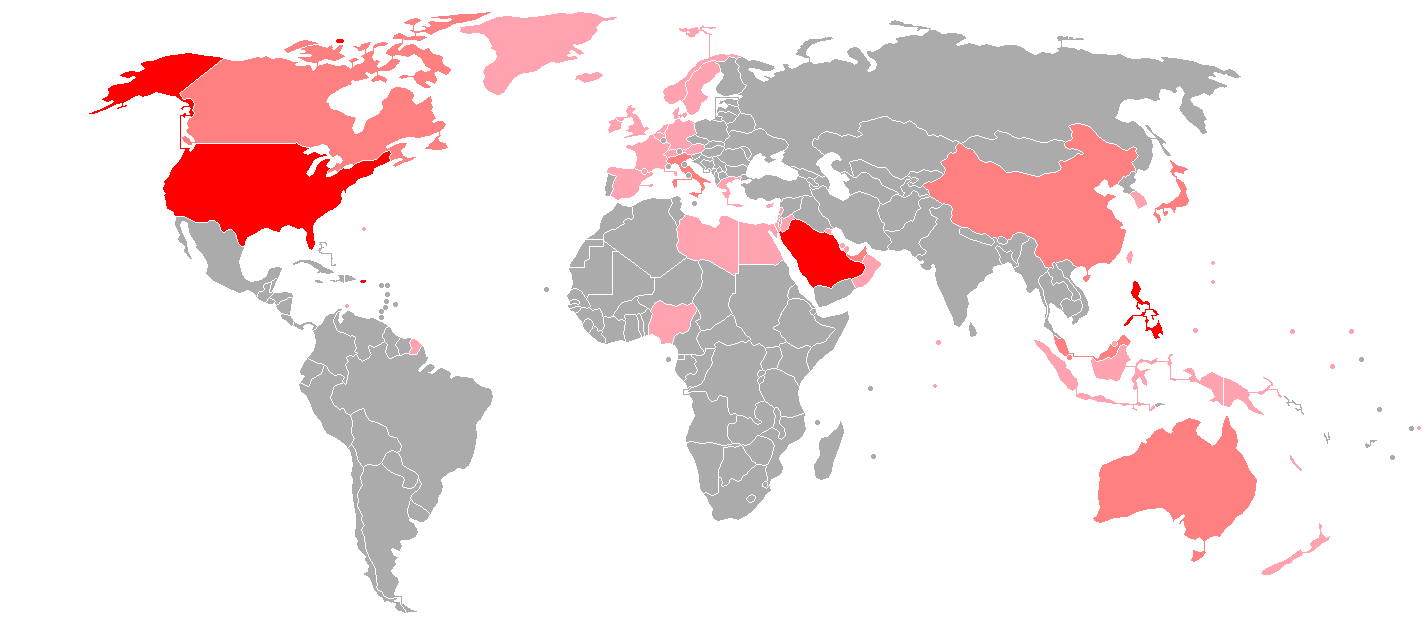
]]
Tagalog serves as the common language among Overseas Filipinos, though its use overseas is usually limited to communication among Filipino ethnic groups. The largest concentration of Tagalog speakers outside the Philippines is found in the United States, where the 2020 census reported (based on data collected in 2018) that it was the fourth most-spoken non-English language at home with over 1.7 million speakers, behind Spanish, French, and Chinese (with figures for Cantonese and Mandarin combined).
A study based on data from the United States Census Bureau's 2015 American Consumer Survey shows that Tagalog is the most commonly spoken non-English language after Spanish in California, Nevada, and Washington states.
Tagalog is one of three recognized languages in San Francisco, California, along with Spanish and Chinese, making all essential city services be communicated using these languages along with English. In Hawaii, state-funded entities are required to provide oral and written translations for everything in Tagalog and Ilocano. Nevada provides Tagalog Election ballots.
Other countries with significant concentrations of overseas Filipinos and Tagalog speakers include Saudi Arabia with 938,490, Canada with 676,775, Japan with 313,588, United Arab Emirates with 541,593, Kuwait with 187,067, and Malaysia with 620,043.
Dialects
]]
At present, no comprehensive dialectology has been done in the Tagalog-speaking regions, though there have been descriptions in the form of dictionaries and grammars of various Tagalog dialects. Ethnologue lists Manila, Lubang, Marinduque, Bataan (Western Central Luzon), Batangas, Bulacan (Eastern Central Luzon), Tanay-Paete (Rizal-Laguna), and Tayabas (Quezon) as dialects of Tagalog; however, there appear to be four main dialects, of which the aforementioned are a part: Northern (exemplified by the Bulacan dialect), Central (including Manila), Southern (exemplified by Batangas), and Marinduque.
Some example of dialectal differences are:
- Many Tagalog dialects, particularly those in the south, preserve the glottal stop found after consonants and before vowels. This has been lost in Standard Tagalog, probably influenced by Spanish, where the glottal stop doesn't exist. For example, standard Tagalog ngayón (now, today), sinigáng (broth stew), gabí (night), matamís (sweet), are pronounced and written ngay-on, sinig-ang, gab-i, and matam-is in other dialects.
- In Teresian-Morong Tagalog, alternates with . For example, bundók (mountain), dagat (sea), dingdíng (wall), isdâ (fish), and litid (joints) become bunrók, ragat, ringríng, isrâ, and litir, e.g. "sandók sa dingdíng" ("ladle on a wall" or "ladle on the wall", depending on the sentence) becoming "sanrók sa ringríng". However, exceptions are recent loanwords, and if the next consonant after a is an (durog) or an (dilà).
- In many southern dialects, the progressive aspect infix of -um- verbs is na-. For example, standard Tagalog kumakain (eating) is nákáin in Aurora, Quezon, and Batangas Tagalog. This is the butt of some jokes by other Tagalog speakers, for should a Southern Tagalog ask nákáin ka ba ng patíng? ("Do you eat shark?"), he would be understood as saying "Has a shark eaten you?" by speakers of the Manila Dialect.
- Some dialects have interjections which are considered a regional trademark. For example, the interjection ala e! usually identifies someone from Batangas as does hane?! in Rizal and Quezon provinces and akkaw in Aurora.
Perhaps the most divergent Tagalog dialects are those spoken in Marinduque. Linguist Rosa Soberano identifies two dialects, western and eastern, with the former being closer to the Tagalog dialects spoken in the provinces of Batangas and Quezon.
One example is the verb conjugation paradigms. While some of the affixes are different, Marinduque also preserves the imperative affixes, also found in Visayan and Bikol languages, that have mostly disappeared from most Tagalog early 20th century; they have since merged with the infinitive.
| Manileño Tagalog | Marinduqueño Tagalog | English | Susulat siná María at Esperanza kay Juan. | Mag-aaral siya sa Maynilà. | Maglutò ka na. | Kainin mo iyán. | Tinatawag tayo ni Tatay. | Tútulungan ba kayó ni Hilario? |
|---|---|---|---|---|---|---|---|---|
| Másúlat da María at Esperanza kay Juan. | "María and Esperanza will write to Juan." | |||||||
| Gaaral siya sa Maynilà. | "[He/She] will study in Manila." | |||||||
| Paglutò. | "Cook now." | |||||||
| Kaina yaan. | "Eat it." | |||||||
| Inatawag nganì kitá ni Tatay. | "Father is calling us." | |||||||
| Atulungan ga kamo ni Hilario? | "Is Hilario going to help you?" |
The Manila Dialect is the basis for the national language.
Outside of Luzon, a variety of Tagalog called Soccsksargen Tagalog (Sox-Tagalog, also called Kabacan Tagalog) is spoken in Soccsksargen, a southwestern region in Mindanao, as well as Cotabato City. This "hybrid" Tagalog dialect is a blend of Tagalog (including its dialects) with other languages where they are widely spoken and varyingly heard such as Hiligaynon (a regional lingua franca), Ilocano, Cebuano as well as Maguindanaon and other indigenous languages native to region, as a result of migration from Panay, Negros, Cebu, Bohol, Siquijor, Ilocandia, Cagayan Valley, Cordillera Administrative Region, Central Luzon, Calabarzon, Mindoro and Marinduque since the turn of 20th century, therefore making the region a melting pot of cultures and languages.
Phonology
Main article: Tagalog phonology
Tagalog has 21 phonemes: 16 are consonants and 5 are vowels. Native Tagalog words follow CV(C) syllable structure, though more complex consonant clusters are permitted in loanwords.
Vowels
Tagalog has five vowels and four diphthongs. Tagalog originally had three vowel phonemes, , , and . Tagalog is now considered to have five vowel phonemes following the introduction of two marginal phonemes from Spanish, /o/ and /e/.
| Front | Central | Back | Close | Mid | Open |
|---|
- an open central unrounded vowel roughly similar to English "father"; in the middle of a word, a near-open central vowel similar to Received Pronunciation "cup"; or an open front unrounded vowel similar to Received Pronunciation or California English "hat"
- an open-mid front unrounded vowel similar to General American English "bed"
- a close front unrounded vowel similar to English "machine"
- a mid back rounded vowel similar to General American English "soul" or Philippine English "forty"
- a close back rounded vowel similar to English "flute"
Nevertheless, simplification of pairs and is likely to take place, especially in some Tagalog as second language, remote location and working class registers.
The four diphthongs are , , , and . Long vowels are not written apart from pedagogical texts, where an acute accent is used: á é í ó ú.
| Front | Central | Back | Close | Near-close | Close-mid | Mid | Open-mid | Near-open | Open |
|---|---|---|---|---|---|---|---|---|---|
| **** | **** | ||||||||
| **** | |||||||||
| **** | |||||||||
| **** |
The table above shows all the possible realizations for each of the five vowel sounds depending on the speaker's origin or proficiency. The five general vowels are in bold.
Consonants
Below is a chart of Tagalog consonants. All the stops are unaspirated. The velar nasal occurs in all positions including at the beginning of a word. Loanword variants using these phonemes are italicized inside the angle brackets.
| Bilabial | Alv./Dental | Post-alv./ | ||||||||||||
|---|---|---|---|---|---|---|---|---|---|---|---|---|---|---|
| Palatal | Velar | Glottal | Nasal | Stop | voiceless | voiced | Affricate | voiceless | voiced | Fricative | Approximant | Rhotic | ||
| () | () | |||||||||||||
| () | () | |||||||||||||
| () |
- between vowels has a tendency to become as in loch, German Bach, whereas in the initial position it has a tendency to become , especially in the Manila dialect.
- Intervocalic and tend to become , as in Spanish agua, especially in the Manila dialect.
- and were once allophones, and they still vary grammatically, with initial becoming intervocalic in many words.
- A glottal stop that occurs in pausa (before a pause) is omitted when it is in the middle of a phrase, especially in the Metro Manila area. The vowel it follows is then lengthened. However, it is preserved in many other dialects.
- The phoneme is an alveolar rhotic that has a free variation between a trill, a flap and an approximant ().
- The phoneme may become a consonant cluster in between vowels such as sadyâ .
Glottal stop is not indicated. Glottal stops are most likely to occur when:
- the word starts with a vowel, like aso (dog)
- the word includes a dash followed by a vowel, like mag-aral (study)
- the word has two vowels next to each other, like paano (how)
- the word starts with a prefix followed by a verb that starts with a vowel, like mag-aayos ([will] fix)
Stress and final glottal stop
Stress is a distinctive feature in Tagalog. Primary stress occurs on either the final or the penultimate syllable of a word. Vowel lengthening accompanies primary or secondary stress except when stress occurs at the end of a word.
Tagalog words are often distinguished from one another by the position of the stress or the presence of a final glottal stop. In formal or academic settings, stress placement and the glottal stop are indicated by a diacritic (tuldík) above the final vowel. The penultimate primary stress position (malumay) is the default stress type and so is left unwritten except in dictionaries.
| Common spelling | Stressed non-ultimate syllable | ||||||||||
|---|---|---|---|---|---|---|---|---|---|---|---|
| no diacritic | Stressed ultimate syllable | ||||||||||
| acute accent (´) | Unstressed ultimate syllable with glottal stop | ||||||||||
| grave accent (`) | Stressed ultimate syllable with glottal stop | ||||||||||
| circumflex accent (^) | baba | baka | bata | bayaran | labi | pito | sala | ||||
| baba ('father') | babá ('piggy back') | babà ('chin') | babâ ('descend [imperative]') | ||||||||
| baka ('cow') | baká ('possible') | ||||||||||
| bata ('bath robe') | batá ('persevere') | batà ('child') | |||||||||
| bayaran ('pay [imperative]') | bayarán ('for hire') | ||||||||||
| / labì ('lips') | / labî ('remains') | ||||||||||
| pito ('whistle') | pitó ('seven') | ||||||||||
| sala ('living room') | salá ('interweaving [of bamboo slats]') | salà ('sin') | salâ ('filtered') |
Grammar
Main article: Tagalog grammar, Austronesian alignment
The grammar of Tagalog is agglutinative, predicate-initial, and organized around the Austronesian alignment system, in which intricate verbal morphology indicates which semantic role is associated with the topic ("ang"-marked) argument.
Tagalog verbs combine a wide array of prefixes, infixes, suffixes, circumfixes, and clitic particles to express voice/"trigger", aspect, mood, and valency changes, resulting in morphologically complex predicate structures.
Tagalog noun morphology is relatively simple compared to its verbal system, though nouns are also productively derived from a range of affixes. Grammatical roles are expressed not by case endings but by a three-way article system (ang, ng, sa) placed directly before the noun clause, distinguishing topic, non-topic, and oblique arguments. Pronouns reflect distinctions in person, number, clusivity, and case.
Word order is typically verb-initial, though SVO may be used in formal contexts. Because the voice/trigger system and article markers indicate grammatical roles, arguments can be freely rearranged to shift focus or emphasize different participants without changing the core meaning.
A defining feature of the language is its productive reduplication system, which includes partial and full reduplication. These patterns perform both grammatical and derivational functions, marking imperfective aspect, intensity, plurality, distributive or repeated action, among other functions.
Another important feature is phonemic stress, wherein the placement of stress is lexically contrastive: identical sequence of sounds can represent distinct words depending on stress (e.g., arálin “to study” vs. aralín “lesson”), and the presence or absence of a glottal stop. Stress interacts with affixation and reduplication in systematic but sometimes nontransparent ways.
Writing system
Tagalog, like other Philippines languages today, is written using the Latin alphabet. Prior to the arrival of the Spanish in 1521 and the beginning of their colonization in 1565, Tagalog was written in an abugida—or alphasyllabary—called Baybayin. This system of writing gradually gave way to the use and propagation of the Latin alphabet as introduced by the Spanish. As the Spanish began to record and create grammars and dictionaries for the various languages of the Philippine archipelago, they adopted systems of writing closely following the orthographic customs of the Spanish language and were refined over the years. Until the first half of the 20th century, most Philippine languages were widely written in a variety of ways based on Spanish orthography.
In the late 19th century, a number of educated Filipinos began proposing for revising the spelling system used for Tagalog at the time. In 1884, Filipino doctor and student of languages Trinidad Pardo de Tavera published his study on the ancient Tagalog script Contribucion para el Estudio de los Antiguos Alfabetos Filipinos and in 1887, published his essay El Sanscrito en la lengua Tagalog which made use of a new writing system developed by him. Meanwhile, Jose Rizal, inspired by Pardo de Tavera's 1884 work, also began developing a new system of orthography (unaware at first of Pardo de Tavera's own orthography). A major noticeable change in these proposed orthographies was the use of the letter ⟨k⟩ rather than ⟨c⟩ and ⟨q⟩ to represent the phoneme .
In 1889, the new bilingual Spanish-Tagalog La España Oriental newspaper, of which Isabelo de los Reyes was an editor, began publishing using the new orthography stating in a footnote that it would "use the orthography recently introduced by ... learned Orientalis". This new orthography, while having its supporters, was also not initially accepted by several writers. Soon after the first issue of La España, Pascual H. Poblete's Revista Católica de Filipina began a series of articles attacking the new orthography and its proponents. A fellow writer, Pablo Tecson was also critical. Among the attacks was the use of the letters "k" and "w" as they were deemed to be of German origin and thus its proponents were deemed as "unpatriotic". The publishers of these two papers would eventually merge as La Lectura Popular in January 1890 and would eventually make use of both spelling systems in its articles. Pedro Laktaw, a schoolteacher, published the first Spanish-Tagalog dictionary using the new orthography in 1890.
In April 1890, Jose Rizal authored an article Sobre la Nueva Ortografia de la Lengua Tagalog in the Madrid-based periodical La Solidaridad. In it, he addressed the criticisms of the new writing system by writers like Pobrete and Tecson and the simplicity, in his opinion, of the new orthography. Rizal described the orthography promoted by Pardo de Tavera as "more perfect" than what he himself had developed. The new orthography was, however, not broadly adopted initially and was used inconsistently in the bilingual periodicals of Manila until the early 20th century. The revolutionary society Kataás-taasan, Kagalang-galang Katipunan ng̃ mg̃á Anak ng̃ Bayan or Katipunan made use of the k-orthography and the letter k featured prominently on many of its flags and insignias.
In 1937, Tagalog was selected to serve as basis for the country's national language. In 1940, the Balarilâ ng Wikang Pambansâ () of grammarian Lope K. Santos introduced the Abakada alphabet. This alphabet consists of 20 letters and became the standard alphabet of the national language. The orthography as used by Tagalog would eventually influence and spread to the systems of writing used by other Philippine languages (which had been using variants of the Spanish-based system of writing). In 1987, the Abakada was dropped and replaced by the expanded Filipino alphabet.
Baybayin
Main article: Baybayin
Tagalog was written in an abugida (alphasyllabary) called Baybayin prior to the Spanish colonial period in the Philippines, in the 16th century. This particular writing system was composed of symbols representing three vowels and 14 consonants. Belonging to the Brahmic family of scripts, it shares similarities with the Old Kawi script of Java and is believed to be descended from the script used by the Bugis in Sulawesi.
Although it enjoyed a relatively high level of literacy, Baybayin gradually fell into disuse in favor of the Latin alphabet taught by the Spaniards during their rule.
There has been confusion of how to use Baybayin, which is actually an abugida, or an alphasyllabary, rather than an alphabet. Not every letter in the Latin alphabet is represented with one of those in the Baybayin alphasyllabary. Rather than letters being put together to make sounds as in Western languages, Baybayin uses symbols to represent syllables.
A "kudlít" resembling an apostrophe is used above or below a symbol to change the vowel sound after its consonant. If the kudlit is used above, the vowel is an "E" or "I" sound. If the kudlit is used below, the vowel is an "O" or "U" sound. A special kudlit was later added by Spanish missionaries in which a cross placed below the symbol to get rid of the vowel sound all together, leaving a consonant. Previously, the consonant without a following vowel was simply left out (for example, bundók being rendered as budo), forcing the reader to use context when reading such words.
Example:
| a | i |
|---|---|
| *e* | u |
| *o* |
|
| b | ba | bi |
|---|---|---|
| *be* | bu | |
| *bo* |
|
| k | ka | ki |
|---|---|---|
| *ke* | ku | |
| *ko* |
|
| d/r | da/ra | di/ri |
|---|---|---|
| *de/re* | du/ru | |
| *do/ro* |
|
| g | ga | gi |
|---|---|---|
| *ge* | gu | |
| *go* |
|
| h | ha | hi |
|---|---|---|
| *he* | hu | |
| *ho* |
|
| l | la | li |
|---|---|---|
| *le* | lu | |
| *lo* |
|
| m | ma | mi |
|---|---|---|
| *me* | mu | |
| *mo* |
|
| n | na | ni |
|---|---|---|
| *ne* | nu | |
| *no* |
|
| ng | nga | ngi |
|---|---|---|
| *nge* | ngu | |
| *ngo* |
|
| p | pa | pi |
|---|---|---|
| *pe* | pu | |
| *po* |
|
| s | sa | si |
|---|---|---|
| *se* | su | |
| *so* |
|
| t | ta | ti |
|---|---|---|
| *te* | tu | |
| *to* |
|
| w | wa | wi |
|---|---|---|
| *we* | wu | |
| *wo* |
|
| y | ya | yi |
|---|---|---|
| *ye* | yu | |
| *yo* |
|}
Latin alphabet
Abecedario
Until the first half of the 20th century, Tagalog was widely written in a variety of ways based on Spanish orthography consisting of 32 letters called ''''ABECEDARIO'''' (Spanish for "alphabet"). The additional letters beyond the 26-letter English alphabet are: ch, ll, ng, ñ, n͠g / ñg, and rr.
| Majuscule | Minuscule | Majuscule | Minuscule |
|---|---|---|---|
| A | a | Ng | ng |
| B | b | Ñ | ñ |
| C | c | N͠g / Ñg | n͠g / ñg |
| Ch | ch | O | o |
| D | d | P | p |
| E | e | Q | q |
| F | f | R | r |
| G | g | Rr | rr |
| H | h | S | s |
| I | i | T | t |
| J | j | U | u |
| K | k | V | v |
| L | l | W | w |
| Ll | ll | X | x |
| M | m | Y | y |
| N | n | Z | z |
Abakada
Main article: Abakada alphabet
When the national language was based on Tagalog, grammarian Lope K. Santos introduced a new alphabet consisting of 20 letters called Abakada in school grammar books called balarilâ. The only letter not in the English alphabet is ng.
| Majuscule | Minuscule | Majuscule | Minuscule |
|---|---|---|---|
| A | a | N | n |
| B | b | Ng | ng |
| K | k | O | o |
| D | d | P | p |
| E | e | R | r |
| G | g | S | s |
| H | h | T | t |
| I | i | U | u |
| L | l | W | w |
| M | m | Y | y |
Revised alphabet
Main article: Filipino alphabet
In 1987, the Department of Education, Culture and Sports issued a memo stating that the Philippine alphabet had changed from the Pilipino-Tagalog Abakada version to a new 28-letter alphabet to make room for loans, especially family names from Spanish and English. The additional letters beyond the 26-letter English alphabet are: ñ, ng.
| Majuscule | Minuscule | Majuscule | Minuscule |
|---|---|---|---|
| A | a | Ñ | ñ |
| B | b | Ng | ng |
| C | c | O | o |
| D | d | P | p |
| E | e | Q | q |
| F | f | R | r |
| G | g | S | s |
| H | h | T | t |
| I | i | U | u |
| J | j | V | v |
| K | k | W | w |
| L | l | X | x |
| M | m | Y | y |
| N | n | Z | z |
''ng'' and ''mga''
The genitive marker ng and the plural marker mga (e.g. Iyan ang mga damít ko. (Those are my clothes)) are abbreviations that are pronounced nang and mangá . Ng, in most cases, roughly translates to "of" (ex. Siyá ay kapatíd ng nanay ko. She is the sibling of my mother) while nang usually means "when" or can describe how something is done or to what extent (equivalent to the suffix -ly in English adverbs), among other uses.
- Nang si Hudas ay nadulás.—When Judas slipped.
- Gumising siya nang maaga.—He woke up early.
- Gumalíng nang si Juan dahil nag-ensayo siyá.—Juan greatly improved because he practiced.
In the first example, nang is used in lieu of the word noong (when; Noong si Hudas ay madulás). In the second, nang describes that the person woke up (gumising) early (maaga); gumising nang maaga. In the third, nang described up to what extent that Juan improved (gumalíng), which is "greatly" (*nang *). In the latter two examples, the ligature na and its variants -ng and -g may also be used (Gumising na maaga/Maagang gumising; Gumalíng na /Todong gumalíng).
The longer nang may also have other uses, such as a ligature that joins a repeated word:
- Naghintáy sila nang naghintáy.—They kept on waiting" (a closer calque: "They were waiting and waiting.")
''pô/hô'' and ''opò/ohò''
The words pô/hô originated from the word "Panginoon." and "Poon." ("Lord."). When combined with the basic affirmative Oo "yes" (from Proto-Malayo-Polynesian *heqe), the resulting forms are opò and ohò.
"Pô" and "opò" are specifically used to denote a high level of respect when addressing older persons of close affinity like parents, relatives, teachers and family friends. "Hô" and "ohò" are generally used to politely address older neighbours, strangers, public officials, bosses and nannies, and may suggest a distance in societal relationship and respect determined by the addressee's social rank and not their age. However, "pô" and "opò" can be used in any case in order to express an elevation of respect.
- Example: "Pakitapon namán pô/hô yung basura." ("Please throw away the trash.")
Used in the affirmative:
- Ex: "Gutóm ka na ba?" "Opò/Ohò". ("Are you hungry yet?" "Yes.")
Pô/Hô may also be used in negation.
- Ex: "Hindi ko pô/hô alám 'yan." ("I don't know that.")
Vocabulary and borrowed words
Tagalog vocabulary is mostly of native Austronesian or Tagalog origin, such as most of the words that end with the diphthong -iw, (e.g. giliw) and words that exhibit reduplication (e.g. halo-halo, patpat, etc.). Besides inherited cognates, this also accounts for innovations in Tagalog vocabulary, especially traditional ones within its dialects. Tagalog has also incorporated many Spanish and English loanwords; the necessity of which increases in more technical parlance.
In precolonial times, Trade Malay was widely known and spoken throughout Maritime Southeast Asia, contributing a significant number of Malay vocabulary into the Tagalog language. Malay loanwords, identifiable or not, may often already be considered native as these have existed in the language before colonisation.
Tagalog also includes loanwords from Indian languages (Sanskrit and Tamil, mostly through Malay), Chinese languages (mostly Hokkien, followed by Cantonese, Mandarin, etc.), Japanese, Arabic and Persian.
English has borrowed some words from Tagalog, such as abaca, barong, balisong, boondocks, jeepney, Manila hemp, pancit, ylang-ylang, and yaya. Some of these loanwords are more often used in Philippine English.
| Example | Definition | boondocks | cogon | ylang-ylang | abacá | Manila hemp | capiz |
|---|---|---|---|---|---|---|---|
| meaning "rural" or "back country", borrowed through American soldiers stationed in the Philippines in the Philippine–American War as a corruption of the Tagalog word *bundok*, which means "mountain" | |||||||
| a type of grass, used for thatching, came from the Tagalog word *kugon* (a species of tall grass) | |||||||
| a tree whose fragrant flowers are used in perfumes | |||||||
| a type of hemp fiber made from a plant in the banana family, came from the Tagalog word *abaká* | |||||||
| a light brown cardboard material used for folders and paper, usually made from abaca hemp, from Manila, the capital of the Philippines | |||||||
| a type of marine mollusc also known as a "windowpane oyster" used to make windows |
Tagalog has contributed several words to Philippine Spanish, like barangay (from balan͠gay, meaning barrio), the abacá, cogon, palay, dalaga etc. abaca — Via Spanish. http://en.wiktionary.org/wiki/abaca#Etymology "Tagalog name for the plant, via Spanish abacá" adobo — May be heard from communities with interest in Filipino cuisine. Reminiscent of the Hispanic concept. (Dec 2021, Myrnamyers) aggrupation — Rarely heard outside of FilAm communities. barong — Rarely heard outside of FilAm communities. balisong — A popular term among international enthusiasts of this type of knife; interchangeable with the term "butterfly knife". (Dec 2021, Myrnamyers) boondocks — Yes. jeepney — Rarely heard outside of FilAm communities. Manila hemp — Someone must be kidding here. For "Hemp" see Cannabis (etymology). ... in response to this, the word being referred to is the adjective "manila". (Dec 2021, Myrnamyers) pancit — Rarely heard outside of FilAm communities. ylang ylang — Rarely heard outside of FilAm communities. yaya — Rarely heard outside of FilAm communities.
Tagalog words of foreign origin
Main article: List of loanwords in Tagalog
Taglish (Englog)
Main article: Taglish
Taglish and Englog are names given to a mix of English and Tagalog. The amount of English vs. Tagalog varies from the occasional use of English loan words to changing language in mid-sentence. Such code-switching is prevalent throughout the Philippines and in various languages of the Philippines other than Tagalog.
Code-mixing also entails the use of foreign words that are "Filipinized" by reforming them using Filipino rules, such as verb conjugations. Users typically use Filipino or English words, whichever comes to mind first or whichever is easier to use.
|Magshoshopping kamí sa mall. Sino ba ang magdadrive sa shopping center? |We will go shopping at the mall. Who will drive to the shopping center?
Urbanites are the most likely to speak like this.
The practice is common in television, radio, and print media as well. Advertisements from companies like Wells Fargo, Wal-Mart, Albertsons, McDonald's and Western Union have contained Taglish.
Cognates with other Philippine languages
| Tagalog word | Meaning | Language of cognate | Spelling | bakit | akyát | bundók | at | aso | huwág | tayo | itó, nitó | ng | araw | ang |
|---|---|---|---|---|---|---|---|---|---|---|---|---|---|---|
| why (from *bakin* + *at*) | Kapampangan | obakit | ||||||||||||
| climb/step up | Kapampangan | ukyát/mukyát | ||||||||||||
| mountain | Kapampangan | bunduk | ||||||||||||
| and | Kapampangan | |||||||||||||
| Pangasinan | at | |||||||||||||
| tan | ||||||||||||||
| dog | Kapampangan and Maguindanaon | |||||||||||||
| Pangasinan, Ilocano, and Maranao | asu | |||||||||||||
| aso | ||||||||||||||
| don't | Pangasinan | ag | ||||||||||||
| we (inc.) | Pangasinan | |||||||||||||
| Ilocano | ||||||||||||||
| Kapampangan | ||||||||||||||
| Tausug | ||||||||||||||
| Maguindanao | ||||||||||||||
| Maranao | ||||||||||||||
| Ivatan | ||||||||||||||
| Ibanag | ||||||||||||||
| Yogad | ||||||||||||||
| Gaddang | ||||||||||||||
| Tboli | sikatayo | |||||||||||||
| datayo | ||||||||||||||
| ikatamu | ||||||||||||||
| kitaniyu | ||||||||||||||
| tanu | ||||||||||||||
| tano | ||||||||||||||
| yaten | ||||||||||||||
| sittam | ||||||||||||||
| sikitam | ||||||||||||||
| ikkanetam | ||||||||||||||
| tekuy | ||||||||||||||
| this, its | Ilocano | |||||||||||||
| Bicolano | to | |||||||||||||
| iyó/ini | ||||||||||||||
| of | Cebuano | |||||||||||||
| Hiligaynon | ||||||||||||||
| Waray | ||||||||||||||
| Kapampangan | ||||||||||||||
| Pangasinan | ||||||||||||||
| Bicolano | ||||||||||||||
| Ilocano | sa/og | |||||||||||||
| sang/sing | ||||||||||||||
| han/hin/san/sin | ||||||||||||||
| ning | ||||||||||||||
| na | ||||||||||||||
| kan/nin | ||||||||||||||
| a | ||||||||||||||
| sun; day | Visayan languages | |||||||||||||
| Kapampangan | ||||||||||||||
| Pangasinan | ||||||||||||||
| Bicolano (Central/East Miraya) and Ilocano | ||||||||||||||
| Rinconada Bikol | ||||||||||||||
| Ivatan | ||||||||||||||
| Ibanag | ||||||||||||||
| Yogad | ||||||||||||||
| Gaddang | ||||||||||||||
| Tboli | adlaw | |||||||||||||
| aldo | ||||||||||||||
| agew | ||||||||||||||
| aldaw | ||||||||||||||
| aldəw | ||||||||||||||
| araw | ||||||||||||||
| aggaw | ||||||||||||||
| agaw | ||||||||||||||
| aw | ||||||||||||||
| kdaw | ||||||||||||||
| definite article | Visayan languages (except Waray) | |||||||||||||
| Bicolano and Waray | ang | |||||||||||||
| an |
Comparisons with Austronesian languages
Below is a chart of Tagalog and a number of other Austronesian languages comparing thirteen words.
| Tagalog | Tombulu (Minahasa) | Central Bikol | East Miraya Bikol | Rinconada Bikol | Waray | Kinaray-a | Akeanon | Tausug | Maguindanao | Maranao | Kapampangan | Pangasinan | Ilocano | Ivatan | Ibanag | Yogad | Gaddang | Tboli | Kadazan | Indonesian/**Malay** | Javanese | Acehnese | Lampung | Buginese | Batak | Minangkabau | Tetum | Māori | Tuvaluan | Hawaiian | Banjarese | Malagasy | Dusun | Iban | Melanau |
|---|---|---|---|---|---|---|---|---|---|---|---|---|---|---|---|---|---|---|---|---|---|---|---|---|---|---|---|---|---|---|---|---|---|---|---|
| isá | dalawá | tatló | apat | tao | bahay | aso | niyóg | araw | bago | táyo | anó | apóy | |||||||||||||||||||||||
| esa | zua/rua | telu | epat | tou | walé | asu | po'po' | endo | weru | kai/kita | apa | api | |||||||||||||||||||||||
| sarô | duwa | tulo | apat | tawo | harong | ayam | niyog | aldaw | bâgo | kita | ano | kalayo | |||||||||||||||||||||||
| əsad | əpat | taw | balay | ayam/ido | nuyog | unu/uno | kalayō | ||||||||||||||||||||||||||||
| darwā | tolō | tawō | baləy | ayam | noyog | aldəw | bāgo | kitā | onō | ||||||||||||||||||||||||||
| usá | duhá | tuló | upát | tawo | baláy | ayám/idô | lubí | adlaw | bag-o | kitá | anú/nano | kalayo | |||||||||||||||||||||||
| sara | darwa | ayam | niyog | ||||||||||||||||||||||||||||||||
| isaea/sambilog | daywa | ap-at | baeay | kaeayo | |||||||||||||||||||||||||||||||
| isa/hambuuk | duwa | tu | upat | tau | bay | iru' | niyug | ba-gu | kitaniyu | unu | kayu | ||||||||||||||||||||||||
| isa | dua | telu | pat | walay | asu | gay | bagu | tanu | ngin | apuy | |||||||||||||||||||||||||
| dowa | t'lo | phat | taw | aso | neyog | gawi'e | bago | tano | tonaa | apoy | |||||||||||||||||||||||||
| isa/metung | adwa | atlu | apat | tau | bale | asu | ngungut | aldo | bayu | ikatamu | nanu | api | |||||||||||||||||||||||
| sakey | dua/duara | talo/talora | apat/apatira | too | abong | aso | niyog | ageo/agew | balo | sikatayo | anto | pool | |||||||||||||||||||||||
| maysa | dua | tallo | uppat | tao | balay | niog | aldaw | baro | datayo | ania | apoy | ||||||||||||||||||||||||
| asa | dadowa | tatdo | apat | vahay | chito | niyoy | araw | va-yo | yaten | ango | |||||||||||||||||||||||||
| tadday | dua | tallu | appa' | tolay | balay | kitu | niuk | aggaw | bagu | sittam | anni | afi | |||||||||||||||||||||||
| tata | addu | appat | binalay | atu | iyyog | agaw | sikitam | gani | afuy | ||||||||||||||||||||||||||
| antet | addwa | tallo | balay | ayog | aw | bawu | ikkanetam | sanenay | |||||||||||||||||||||||||||
| sotu | lewu | tlu | fat | tau | gunu | ohu | lefo | kdaw | lomi | tekuy | tedu | ofih | |||||||||||||||||||||||
| iso | duvo | tohu | apat | tuhun | hamin | tasu | piasau | tadau | vagu | tokou | onu | tapui | |||||||||||||||||||||||
| satu | dua | tiga | empat | orang | rumah/balai | anjing | kelapa/nyiur | hari | baru/baharu | kita | apa | api | |||||||||||||||||||||||
| siji | loro | telu | papat | uwong | omah/bale | asu | klapa/kambil | hari/dina/dinten | anyar/enggal | apa/anu | geni | ||||||||||||||||||||||||
| sa | duwa | lhèë | peuët | ureuëng | rumoh/balèë | asèë | u | uroë | barô | (geu)tanyoë | peuë | apuy | |||||||||||||||||||||||
| sai | khua | telu | pak | jelema | lamban | asu | nyiwi | khani | baru | kham | api | apui | |||||||||||||||||||||||
| se'di | dua | tellu | eppa' | tau | bola | kaluku | esso | idi' | aga | api | |||||||||||||||||||||||||
| sada | tolu | opat | halak | jabu | biang | harambiri | ari | hita | aha | ||||||||||||||||||||||||||
| ciek | duo | tigo | ampek | urang | rumah | anjiang | karambia | kito | apo | ||||||||||||||||||||||||||
| ida | rua | tolu | haat | ema | uma | asu | nuu | loron | foun | ita | saida | ahi | |||||||||||||||||||||||
| tahi | toru | wha | tangata | whare | kuri | kokonati | ra | hou | taua | aha | |||||||||||||||||||||||||
| tasi | lua | tolu | fá | toko | fale | moku | aso | fou | tāua | ā | afi | ||||||||||||||||||||||||
| kahi | kolu | hā | kanaka | hale | 'īlio | niu | ao | hou | kākou | aha | ahi | ||||||||||||||||||||||||
| asa | dua | talu | ampat | urang | rumah | hadupan | kalapa | hari | hanyar | kita | apa | api | |||||||||||||||||||||||
| isa | roa | telo | efatra | olona | trano | alika | voanio | andro | vaovao | isika | inona | afo | |||||||||||||||||||||||
| iso | duo | tolu | apat | tulun | walai | tasu | piasau | tadau | wagu | tokou | onu/nu | tapui | |||||||||||||||||||||||
| sa/san | duan | dangku | dangkan | orang | rumah | ukui/uduk | nyiur | hari | baru | kitai | nama | api | |||||||||||||||||||||||
| satu | dua | telou | empat | apah | lebok | asou | nyior | lau | baew | teleu | apui |
Religious literature
Religious literature remains one of the most dynamic components to Tagalog literature. The first Bible in Tagalog, then called Ang Biblia ("the Bible") and now called Ang Dating Biblia ("the Old Bible"), was published in 1905. In 1970, the Philippine Bible Society translated the Bible into modern Tagalog. Even before the Second Vatican Council, devotional materials in Tagalog had been in circulation. There are at least four circulating Tagalog translations of the Bible
- the Magandang Balita Biblia (a parallel translation of the Good News Bible), which is the ecumenical version
- the Bibliya ng Sambayanang Pilipino
- the 1905 Ang Biblia, used more by Protestants
- the Bagong Sanlibutang Salin ng Banal na Kasulatan (New World Translation of the Holy Scriptures), exclusive to the Jehovah's Witnesses
When the Second Vatican Council, (specifically the Sacrosanctum Concilium) permitted the universal prayers to be translated into vernacular languages, the Catholic Bishops' Conference of the Philippines was one of the first to translate the Roman Missal into Tagalog. The Roman Missal in Tagalog was published as early as 1982. In 2012, the Catholic Bishops' Conference of the Philippines revised the 41-year-old liturgy with an English version of the Roman Missal, and later translated it in the vernacular to several native languages in the Philippines. For instance, in 2024, the Roman Catholic Diocese of Malolos uses the Tagalog translation of the Roman Missal entitled "Ang Aklat ng Mabuting Balita."
Jehovah's Witnesses were printing Tagalog literature at least as early as 1941 and The Watchtower (the primary magazine of Jehovah's Witnesses) has been published in Tagalog since at least the 1950s. New releases are now regularly released simultaneously in a number of languages, including Tagalog. The official website of Jehovah's Witnesses also has some publications available online in Tagalog. The revised bible edition, the New World Translation of the Holy Scriptures, was released in Tagalog on 2019 and it is distributed without charge both printed and online versions.
Tagalog is quite a stable language, and very few revisions have been made to Catholic Bible translations. Also, as Protestantism in the Philippines is relatively young, liturgical prayers tend to be more ecumenical.
Example texts
Lord's Prayer
In Tagalog, the Lord's Prayer is known by its incipit, Amá Namin (literally, "Our Father").
Amá namin, sumasalangit Ka, Sambahín ang ngalan Mo. Mapasaamin ang kaharián Mo. Sundín ang loób Mo, Dito sa lupà, gaya nang sa langit. Bigyán Mo kamí ngayón ng aming kakanin sa araw-araw, At patawarin Mo kamí sa aming mga salà, Para nang pagpápatawad namin, Sa nagkakasalà sa amin; At huwág Mo kamíng ipahintulot sa tuksô, At iadyâ Mo kamí sa lahát ng masamâ. [Sapagkát sa Inyó ang kaharián, at ang kapangyarihan, At ang kaluwálhatian, ngayón, at magpakailanman.] Amen.}} ᜀᜋ ᜈᜋᜒᜈ᜔᜵ ᜐᜓᜋᜐᜎᜅᜒᜆ᜔ ᜃ᜵ ᜐᜋ᜔ᜊᜑᜒᜈ᜔ ᜀᜅ᜔ ᜅᜎᜈ᜔ ᜋᜓ᜶ ᜋᜉᜐᜀᜋᜒᜈ᜔ ᜀᜅ᜔ ᜃᜑᜇᜒᜀᜈ᜔ ᜋᜓ᜶ ᜐᜓᜈ᜔ᜇᜒᜈ᜔ ᜀᜅ᜔ ᜎᜓᜂᜊ᜔ ᜋᜓ᜶ ᜇᜒᜆᜓ ᜐ ᜎᜓᜉ᜵ ᜄᜌ ᜈᜅ᜔ ᜐ ᜎᜅᜒᜆ᜔᜶ ᜊᜒᜄ᜔ᜌᜈ᜔ ᜋᜓ ᜃᜋᜒ ᜈᜅ᜔ ᜀᜋᜒᜅ᜔ ᜃᜃᜈᜒᜈ᜔ ᜐ ᜀᜇᜏ᜔ᜀᜇᜏ᜔᜵ ᜀᜆ᜔ ᜉᜆᜏᜇᜒᜈ᜔ ᜋᜓ ᜃᜋᜒ ᜐ ᜀᜋᜒᜅ᜔ ᜋᜅ ᜐᜎ᜵ ᜉᜇ ᜈᜅ᜔ ᜉᜄ᜔ᜉᜉᜆᜏᜇ᜔ ᜈᜋᜒᜈ᜔᜵ ᜐ ᜈᜄ᜔ᜃᜃᜐᜎ ᜐ ᜀᜋᜒᜈ᜔; ᜀᜆ᜔ ᜑᜓᜏᜄ᜔ ᜋᜓ ᜃᜋᜒᜅ᜔ ᜁᜉᜑᜒᜈ᜔ᜆᜓᜎᜓᜆ᜔ ᜐ ᜆᜓᜃ᜔ᜐᜓ᜵ ᜀᜆ᜔ ᜁᜀᜇ᜔ᜌ ᜋᜓ ᜃᜋᜒ ᜐ ᜎᜑᜆ᜔ ᜈᜅ᜔ ᜋᜐᜋ᜶ [ᜐᜉᜄ᜔ᜃᜆ᜔ ᜐ ᜁᜈ᜔ᜌᜓ ᜀᜅ᜔ ᜃᜑᜇᜒᜀᜈ᜔᜵ ᜀᜆ᜔ ᜀᜅ᜔ ᜃᜉᜅ᜔ᜌᜇᜒᜑᜈ᜔᜵ ᜀᜆ᜔ ᜀᜅ᜔ ᜃᜎᜓᜏᜎ᜔ᜑᜆᜒᜀᜈ᜔᜵ ᜅᜌᜓᜈ᜔᜵ ᜀᜆ᜔ ᜋᜄ᜔ᜉᜃᜁᜎᜈ᜔ᜋᜈ᜔᜶] ᜀᜋᜒᜈ᜔᜶}}}}
Universal Declaration of Human Rights
This is Article 1 of the Universal Declaration of Human Rights (Pangkalahatáng Pagpapahayág ng Karapatáng Pantao)
;Tagalog (Latin) Bawat tao'y isinilang na may layà at magkakapantáy ang tagláy na dangál at karapatán. Silá'y pinagkalooban ng pangangatwiran at budhî, at dapat magpálagayan ang isá't-isá sa diwà ng pagkákapatiran. ;Tagalog (Baybayin) ;English All human beings are born free and equal in dignity and rights. They are endowed with reason and conscience and should act towards one another in a spirit of brotherhood.
Numbers
Numbers (mga bilang/mga numero) in Tagalog follow two systems. The first consists of native Tagalog words and the other are Spanish-derived. (This may be compared to other East Asian languages, except with the second set of numbers borrowed from Spanish instead of Chinese.) For example, when a person refers to the number "seven", it can be translated into Tagalog as "pitó" or "siyete" (Spanish: siete).
| Number | Cardinal | Spanish-derived | |||||||||||||||||||||||||||||||||||||||||||||||||||
|---|---|---|---|---|---|---|---|---|---|---|---|---|---|---|---|---|---|---|---|---|---|---|---|---|---|---|---|---|---|---|---|---|---|---|---|---|---|---|---|---|---|---|---|---|---|---|---|---|---|---|---|---|---|
| (Original Spanish) | Ordinal | 0 | 1 | 2 | 3 | 4 | 5 | 6 | 7 | 8 | 9 | 10 | 11 | 12 | 13 | 14 | 15 | 16 | 17 | 18 | 19 | 20 | 21 | 30 | 40 | 50 | 60 | 70 | 80 | 90 | 100 | 200 | 300 | 400 | 500 | 600 | 700 | 800 | 900 | 1,000 | 2,000 | 10,000 | 20,000 | 100,000 | 200,000 | 1,000,000 | 2,000,000 | 10,000,000 | 100,000,000 | 1,000,000,000 | 1,000,000,000,000 | ||
| sero / walâ () | sero (cero) | – | |||||||||||||||||||||||||||||||||||||||||||||||||||
| isá | uno (uno) | una | |||||||||||||||||||||||||||||||||||||||||||||||||||
| dalawá [dalaua] | dos (dos) | pangalawá / ikalawá | |||||||||||||||||||||||||||||||||||||||||||||||||||
| tatló | tres (tres) | pangatló / ikatló | |||||||||||||||||||||||||||||||||||||||||||||||||||
| apat | kuwatro (cuatro) | pang-apat / ikaapat (In standard Filipino orthography, "ika" and the number-word are never hyphenated.) | |||||||||||||||||||||||||||||||||||||||||||||||||||
| limá | singko (cinco) | panlimá / ikalimá | |||||||||||||||||||||||||||||||||||||||||||||||||||
| anim | seis (seis) | pang-anim / ikaanim | |||||||||||||||||||||||||||||||||||||||||||||||||||
| pitó | siyete (siete) | pampitó / ikapitó | |||||||||||||||||||||||||||||||||||||||||||||||||||
| waló | otso (ocho) | pangwaló / ikawaló | |||||||||||||||||||||||||||||||||||||||||||||||||||
| siyám | nuwebe (nueve) | pansiyám / ikasiyám | |||||||||||||||||||||||||||||||||||||||||||||||||||
| sampû / pû (archaic) [sang puwo] | diyés (diez) | pansampû / ikasampû (or ikapû in some literary compositions) | |||||||||||||||||||||||||||||||||||||||||||||||||||
| labíng-isá | onse (once) | panlabíng-isá / pang-onse / ikalabíng-isá | |||||||||||||||||||||||||||||||||||||||||||||||||||
| labíndalawá | dose (doce) | panlabíndalawá / pandose / ikalabíndalawá | |||||||||||||||||||||||||||||||||||||||||||||||||||
| labíntatló | trese (trece) | panlabíntatló / pantrese / ikalabíntatló | |||||||||||||||||||||||||||||||||||||||||||||||||||
| labíng-apat | katorse (catorce) | panlabíng-apat / pangkatorse / ikalabíng-apat | |||||||||||||||||||||||||||||||||||||||||||||||||||
| labínlimá | kinse (quince) | panlabínlimá / pangkinse / ikalabínlimá | |||||||||||||||||||||||||||||||||||||||||||||||||||
| labíng-anim | disisais (dieciséis) | panlabíng-anim / pandyes-sais / ikalabíng-anim | |||||||||||||||||||||||||||||||||||||||||||||||||||
| labímpitó | disisiyete (diecisiete) | panlabímpitó / pandyes-syete / ikalabímpitó | |||||||||||||||||||||||||||||||||||||||||||||||||||
| labíngwaló | disiotso (dieciocho) | panlabíngwaló / pandyes-otso / ikalabíngwaló | |||||||||||||||||||||||||||||||||||||||||||||||||||
| labinsiyám / labins'yam / labingsiyam | disinuwebe (diecinueve) | panlabinsiyám / pandyes-nwebe / ikalabinsiyám | |||||||||||||||||||||||||||||||||||||||||||||||||||
| dalawampû | beynte (veinte) | pandalawampû / ikadalawampû (rare literary variant: ikalawampû) | |||||||||||||||||||||||||||||||||||||||||||||||||||
| dalawampú't isá | beynte y uno / beynte'y uno (veintiuno) | pang-dalawampú't isá / ikalawamapú't isá | |||||||||||||||||||||||||||||||||||||||||||||||||||
| tatlumpû | treynta (treinta) | pantatlumpû / ikatatlumpû (rare literary variant: ikatlumpû) | |||||||||||||||||||||||||||||||||||||||||||||||||||
| apatnapû | kuwarenta (cuarenta) | pang-apatnapû / ikaapatnapû | |||||||||||||||||||||||||||||||||||||||||||||||||||
| limampû | singkuwenta (cincuenta) | panlimampû / ikalimampû | |||||||||||||||||||||||||||||||||||||||||||||||||||
| animnapû | sesenta (sesenta) | pang-animnapû / ikaanimnapû | |||||||||||||||||||||||||||||||||||||||||||||||||||
| pitumpû | setenta (setenta) | pampitumpû / ikapitumpû | |||||||||||||||||||||||||||||||||||||||||||||||||||
| walumpû | otsenta (ochenta) | pangwalumpû / ikawalumpû | |||||||||||||||||||||||||||||||||||||||||||||||||||
| siyamnapû | nobenta (noventa) | pansiyamnapû / ikasiyamnapû | |||||||||||||||||||||||||||||||||||||||||||||||||||
| sándaán / daán | siyen (cien) | pan(g)-(i)sándaán / ikasándaán (rare literary variant: ikaisándaán) | |||||||||||||||||||||||||||||||||||||||||||||||||||
| dalawandaán | dosyentos (doscientos) | pandalawándaán / ikadalawandaan (rare literary variant: ikalawándaán) | |||||||||||||||||||||||||||||||||||||||||||||||||||
| tatlóndaán | tresyentos (trescientos) | pantatlóndaán / ikatatlondaan (rare literary variant: ikatlóndaán) | |||||||||||||||||||||||||||||||||||||||||||||||||||
| apat na raán | kuwatrosyentos (cuatrocientos) | pang-apat na raán / ikaapat na raán | |||||||||||||||||||||||||||||||||||||||||||||||||||
| limándaán | kinyentos (quinientos) | panlimándaán / ikalimándaán | |||||||||||||||||||||||||||||||||||||||||||||||||||
| anim na raán | seissiyentos (seiscientos) | pang-anim na raán / ikaanim na raán | |||||||||||||||||||||||||||||||||||||||||||||||||||
| pitondaán | setesyentos (setecientos) | pampitóndaán / ikapitóndaán (or ikapitóng raán) | |||||||||||||||||||||||||||||||||||||||||||||||||||
| walóndaán | otsosyentos (ochocientos) | pangwalóndaán / ikawalóndaán (or ikawalóng raán) | |||||||||||||||||||||||||||||||||||||||||||||||||||
| siyám na raán | nobesyentos (novecientos) | pansiyám na raán / ikasiyám na raán | |||||||||||||||||||||||||||||||||||||||||||||||||||
| sánlibo / libo | mil / uno mil (mil) | pan(g)-(i)sánlibo / ikasánlibo | |||||||||||||||||||||||||||||||||||||||||||||||||||
| dalawánlibo | dos mil (dos mil) | pangalawáng libo / ikalawánlibo | |||||||||||||||||||||||||||||||||||||||||||||||||||
| sánlaksâ / sampúng libo | diyes mil (diez mil) | pansampúng libo / ikasampúng libo | |||||||||||||||||||||||||||||||||||||||||||||||||||
| dalawanlaksâ / dalawampúng libo | beynte mil (veinte mil) | pangalawampúng libo / ikalawampúng libo | |||||||||||||||||||||||||||||||||||||||||||||||||||
| sangyutá / sandaáng libo | siyento mil (cien mil) | ||||||||||||||||||||||||||||||||||||||||||||||||||||
| dalawangyutá / dalawandaáng libo | dosyentos mil (doscientos mil) | ||||||||||||||||||||||||||||||||||||||||||||||||||||
| sang-angaw / sangmilyón | milyón (un millón) | ||||||||||||||||||||||||||||||||||||||||||||||||||||
| dalawang-angaw / dalawang milyón | dos milyónes (dos millones) | ||||||||||||||||||||||||||||||||||||||||||||||||||||
| sangkatì / sampung milyón | diyes milyónes (diez millones) | ||||||||||||||||||||||||||||||||||||||||||||||||||||
| sambahalà / sampúngkatì / sandaáng milyón | siyen milyónes (cien millones) | ||||||||||||||||||||||||||||||||||||||||||||||||||||
| sanggatós / sang-atós / sambilyón | bilyón / mil milyón (un billón (US), mil millones, millardo) | ||||||||||||||||||||||||||||||||||||||||||||||||||||
| sang-ipaw / santrilyón | trilyón / bilyón (un trillón (US), un billón) |
| Number | English | Spanish | Ordinal / Fraction / Cardinal | 1st | 2nd | 3rd | 4th | 5th | 6th | 7th | 8th | 9th | 10th | 0.5 | 0.05 | 0.005 | 1.25 | 2.025 | 25% | 50% | 75% | |||||||||
|---|---|---|---|---|---|---|---|---|---|---|---|---|---|---|---|---|---|---|---|---|---|---|---|---|---|---|---|---|---|---|
| first | primer, primero, primera | una / ikaisá | ||||||||||||||||||||||||||||
| second | segundo/a | ikalawá | ||||||||||||||||||||||||||||
| third | tercero/a | ikatló | ||||||||||||||||||||||||||||
| fourth | cuarto/a | ikaapat | ||||||||||||||||||||||||||||
| fifth | quinto/a | ikalimá | ||||||||||||||||||||||||||||
| sixth | sexto/a | ikaanim | ||||||||||||||||||||||||||||
| seventh | séptimo/a | ikapitó | ||||||||||||||||||||||||||||
| eighth | octavo/a | ikawaló | ||||||||||||||||||||||||||||
| ninth | noveno/a | ikasiyám | ||||||||||||||||||||||||||||
| tenth | décimo/a | ikasampû | ||||||||||||||||||||||||||||
| half | medio/a, mitad | kalahatì | ||||||||||||||||||||||||||||
| one quarter | cuarto | kapat | ||||||||||||||||||||||||||||
| three fifths | tres quintas partes | tatlóng-kalimá | ||||||||||||||||||||||||||||
| two thirds | dos tercios | dalawáng-katló | ||||||||||||||||||||||||||||
| one and a half | uno y medio | isá't kalahatì | ||||||||||||||||||||||||||||
| two and two thirds | dos y dos tercios | dalawá't dalawáng-katló | ||||||||||||||||||||||||||||
| zero point five | title=coma | encyclopedia=Diccionario panhispánico de dudas | publisher=Real Academia Española | url=https://www.rae.es/dpd/coma#4 | access-date=April 6, 2020 | date=2005 | language=es | archive-date=April 6, 2020 | archive-url=https://web.archive.org/web/20200406171758/https://www.rae.es/dpd/coma#4 | url-status=live }} cero con cinco | salapî / limá hinatì sa sampû | |||||||||||||||||||
| zero point zero five | cero punto cero cinco, cero coma cero cinco, cero con cero cinco | bagól / limá hinatì sa sandaán | ||||||||||||||||||||||||||||
| zero point zero zero five | cero punto cero cero cinco, cero coma cero cero cinco, cero con cero cero cinco | limá hinatì sa sanlibo | ||||||||||||||||||||||||||||
| one point two five | uno punto veinticinco, uno coma veinticinco, uno con veinticinco | isá't dalawampú't limá hinatì sa sampû | ||||||||||||||||||||||||||||
| two point zero two five | dos punto cero veinticinco, dos coma cero veinticinco, dos con cero veinticinco | dalawá't dalawampú't limá hinatì sa sanlibo | ||||||||||||||||||||||||||||
| twenty-five percent | veinticinco por ciento | dalawampú't-limáng bahagdán | ||||||||||||||||||||||||||||
| fifty percent | cincuenta por ciento | limampúng bahagdán | ||||||||||||||||||||||||||||
| seventy-five percent | setenta y cinco por ciento | pitumpú't-limáng bahagdán |
Months and days
Months and days in Tagalog are also localised forms of Spanish months and days. "Month" in Tagalog is buwán (also the word for moon) and "day" is araw (the word also means sun). Unlike Spanish, however, months and days in Tagalog are always capitalised.
| Month | Original Spanish | Tagalog (abbreviation) | January | February | March | April | May | June | July | August | September | October | November | December |
|---|---|---|---|---|---|---|---|---|---|---|---|---|---|---|
| enero | Enero (Ene.) | |||||||||||||
| febrero | Pebrero (Peb.) | |||||||||||||
| marzo | Marso (Mar.) | |||||||||||||
| abril | Abríl (Abr.) | |||||||||||||
| mayo | Mayo (Mayo) | |||||||||||||
| junio | Hunyo (Hun.) | |||||||||||||
| julio | Hulyo (Hul.) | |||||||||||||
| agosto | Agosto (Ago.) | |||||||||||||
| septiembre | Setyembre (Set.) | |||||||||||||
| octubre | Oktubre (Okt.) | |||||||||||||
| noviembre | Nobyembre (Nob.) | |||||||||||||
| diciembre | Disyembre (Dis.) |
| Day | Original Spanish | Tagalog | Sunday | Monday | Tuesday | Wednesday | Thursday | Friday | Saturday |
|---|---|---|---|---|---|---|---|---|---|
| domingo | Linggó | ||||||||
| lunes | Lunes | ||||||||
| martes | Martes | ||||||||
| miércoles | Miyérkules / Myérkules | ||||||||
| jueves | Huwebes / Hwebes | ||||||||
| viernes | Biyernes / Byernes | ||||||||
| sábado | Sábado |
Time
Time expressions in Tagalog are also Tagalized forms of the corresponding Spanish. "Time" in Tagalog is panahón or oras.
| Time | English | Original Spanish | Tagalog | 1 hour | 2 min | 3 sec | 1:00 am | 7:00 pm | 1:15 | 2:30 | 3:45 | 4:25 | 5:35 |
|---|---|---|---|---|---|---|---|---|---|---|---|---|---|
| one hour | una hora | Isáng oras | |||||||||||
| two minutes | dos minutos | Dalawáng sandalî/minuto | |||||||||||
| three seconds | tres segundos | Tatlóng saglít/segundo | |||||||||||
| morning | mañana | Umaga | |||||||||||
| afternoon | tarde | Hápon | |||||||||||
| evening/night | noche | Gabí | |||||||||||
| noon | mediodía | Tanghalì | |||||||||||
| midnight | medianoche | Hatinggabí | |||||||||||
| one in the morning | una de la mañana | Ika-isá ng umaga | |||||||||||
| seven at night | siete de la noche | Ikapitó ng gabí | |||||||||||
| quarter past one | |||||||||||||
| one-fifteen | una y cuarto | Kapat makalipas ika-isá | |||||||||||
| Labínlimá makalipas ika-isá | |||||||||||||
| Apatnapú't-limá bago mag-ikalawá | |||||||||||||
| Tatlong-kapat bago mag-ikalawá | |||||||||||||
| half past two | |||||||||||||
| two-thirtyhalf-way to/of three | dos y media | Kalahatì makalipas ikalawá | |||||||||||
| Tatlumpû makalipas ikalawá | |||||||||||||
| Tatlumpû bago mag-ikatló | |||||||||||||
| Kalahatì bago mag-ikatló | |||||||||||||
| three-forty-five | |||||||||||||
| quarter to/of four | tres y cuarenta y cinco | ||||||||||||
| cuatro menos cuarto | Tatlóng-kapat makalipas ikatló | ||||||||||||
| Apatnapú't-limá makalipas ikatló | |||||||||||||
| Labínlimá bago mag-ikaapat | |||||||||||||
| Kapat bago mag-ikaapat | |||||||||||||
| four-twenty-five | |||||||||||||
| twenty-five past four | cuatro y veinticinco | Dalawampú't-limá makalipas ikaapat | |||||||||||
| Tatlumpú't-limá bago mag-ikaapat | |||||||||||||
| five-thirty-five | |||||||||||||
| twenty-five to/of six | cinco y treinta y cinco | ||||||||||||
| seis menos veinticinco | Tatlumpú't-limá makalipas ikalimá | ||||||||||||
| Dalawampú't-limá bago mag-ikaanim |
Common phrases
| English | Tagalog (with Pronunciation) |
|---|---|
| Filipino | Pilipino |
| English | Inglés |
| Tagalog | Tagálog |
| Spanish | Espanyol/Español/Kastila |
| What is your name? | Anó ang pangálan ninyó/nilá*? (plural or polite) , Anó ang pangálan mo? (singular) |
| How are you? | Kumustá (modern), Anó pô ang lagáy ninyó/nilá? (old use) |
| Knock knock | Tao pô |
| Good day! | Magandáng araw! |
| Good morning! | Magandáng umaga! |
| Good noontime! (from 11 a.m. to 1 p.m.) | Magandáng tanghalì! |
| Good afternoon! (from 1 p.m. to 6:00 p.m.) | Magandáng hapon! |
| Good evening! | Magandáng gabí! |
| Good-bye | Paálam |
| Please | Depending on the nature of the verb, either pakí- or makí- is attached as a prefix to a verb. Ngâ is optionally added after the verb to increase politeness. (e.g. Pakipasa ngâ ang tinapay. ("Can you pass the bread, please?")) |
| Thank you | Salamat |
| This one | Itó , sometimes pronounced (literally—"it", "this") |
| That one (close to addressee) | Iyán |
| That one (far from speaker and addressee) | Iyón |
| Here | Dito , heto , simplified to eto ("Here it is") |
| Right there | Diyán , (h)ayán , diyaán ("There it is") |
| Over there | Doón , ayón ("There it is") |
| How much? | Magkano? |
| How many? | Ilán? |
| Yes | Oo |
| No | Hindî (at the end of a pause or sentence), often shortened to dî |
| I don't know | Hindî ko alám |
| Sorry | Pasénsiya pô (literally from the word "patience") or paumanhín pô , patawad pô (literally—"asking your forgiveness") |
| Because | Kasí or dahil |
| Hurry! | Dalî! , Bilís! |
| Again | Mulî , ulít |
| I don't understand | Hindî ko naíintindihán or |
| What? | Anó? |
| Where? | Saán? , Nasaán? (literally – "Where at?") |
| Why? | Bakit? |
| When? | Kailán? , , or (literally—"In what order?/"At what count?") |
| How? | Paánó? (literally—"By what?") |
| Where's the bathroom? | Nasaán ang banyo? |
| *Generic toast* | Mabuhay! (literally—"long live") |
| Do you speak English? | Marunong ka bang magsalitâ ng Inglés? |
| It is fun to live. | Masayá ang mabuhay! or Masaya'ng mabuhay (contracted version) |
*Pronouns such as niyó (2nd person plural) and nilá (3rd person plural) are used on a single 2nd person in polite or formal language. See Tagalog grammar.
Proverbs
Ang hindî marunong lumingón sa pinánggalingan ay hindî makaráratíng sa paroroonan. :(— José Rizal) One who knows not how to look back to whence he came will never get to where he is going.
Unang kagát, tinapay pa rin. First bite, still bread. All fluff, no substance.
Tao ka nang humaráp, bilang tao kitáng haharapin. You reach me as a human, I will treat you as a human and never act as a traitor. (A proverb in Southern Tagalog that has made people aware of the significance of sincerity in Tagalog communities.)
Hulí man daw (raw) at magalíng, nakáhahábol pa rin. If one is behind but capable, one will still be able to catch up.
Magbirô ka na sa lasíng, huwág lang sa bagong gising. Make fun of someone drunk, if you must, but never one who has just awakened.
Aanhín pa ang damó kung patáy na ang kabayò? What use is the grass if the horse is already dead?
Ang sakít ng kalingkingan, damdám ng buóng katawán. The pain in the pinkie is felt by the whole body.
In a group, if one goes down, the rest follow.
Nasa hulí ang pagsisisi. Regret is always in the end.
Pagkáhabà-habà man ng prusisyón, sa simbahan pa rin ang tulóy. The procession may stretch on and on, but it still ends up at the church.
(In romance: refers to how certain people are destined to be married. In general: refers to how some things are inevitable, no matter how long you try to postpone it.)
Kung 'dî mádaán sa santóng dasalan, daanin sa santóng paspasan. If it cannot be got through holy prayer, get it through blessed force.
(In romance and courting: santóng paspasan literally means 'holy speeding' and is a euphemism for sexual intercourse. It refers to the two styles of courting by Filipino boys: one is the traditional, protracted, restrained manner favored by older generations, which often featured serenades and manual labor for the girl's family; the other is upfront seduction, which may lead to a slap on the face or a pregnancy out of wedlock. The second conclusion is known as pikot or what Western cultures would call a 'shotgun marriage'. This proverb is also applied in terms of diplomacy and negotiation.)
References
References
- {{Ethnologue28. tgl
- Manuel, E. Arsenio. (1971). "A Lexicographic Study of Tayabas Tagalog of Quezon Province". Diliman Review.
- (July 9, 2024). "The Morphology of Sox-Tagalog".
- Donoso, Isaac. (2019). "Letra de Meca: Jawi Script in the Tagalog Region During the 16th Century". [[Universidad de Alicante]].
- According to the ''[[OED]]'' and [http://www.merriam-webster.com/dictionary/TAGALOG Merriam-Webster Online Dictionary] {{Webarchive. link. (January 21, 2018)
- (2014). "Tagalog".
- Zorc, R. David Paul. (1977). "The Bisayan Dialects of the Philippines: Subgrouping and Reconstruction". The Australian National University.
- Blust, Robert. (1991). "The Greater Central Philippines Hypothesis". Oceanic Linguistics.
- Postma, Anton. (1992). "The Laguna Copper-Plate Inscription: Text and Commentary". Philippine Studies.
- (2013). "Vocabulario de la lengua tagala". Komisyon sa Wikang Filipino.
- (1860). "Vocabulario de la lengua tagala: compuesto por varios religiosos doctos y graves, y coordinado". Ramirez y Giraudier.
- (2013). "Vocabulario de la lengua tagala". Komisyon sa Wikang Filipino.
- Spieker-Salazar, Marlies. (1992). "A Contribution to Asian Historiography: European Studies of Philippines Languages from the 17th to the 20th Century". Archipel.
- Cruz, Hermenegildo. (1906). "Kun Sino ang Kumathâ ng̃ "Florante": Kasaysayan ng̃ Búhay ni Francisco Baltazar at Pag-uulat nang Kanyang Karunung̃a't Kadakilaan". Librería "Manila Filatélico".
- (November 1897). "1897 Constitution of Biak-na-Bato, Article VIII".
- "1935 Philippine Constitution (amended), Article XIV, Section 3". Official Gazette of the Republic of the Philippines.
- Quezon, Manuel L.. (December 30, 1937). "Speech of His Excellency Manuel L. Quezon President of the Philippines on Filipino National Language".
- Gonzalez, Andrew. (1998). "The Language Planning Situation in the Philippines". Journal of Multilingual and Multicultural Development.
- "1973 Philippine Constitution, Article XV, Sections 2–3". Official Gazette of the Republic of the Philippines.
- "Mga Probisyong Pangwika sa Saligang-Batas".
- Tan, Nigel. (August 7, 2014). "What the PH Constitutions Say About the National Language".
- "Tagalog (Filipino) {{!}} Department of Asian Studies".
- Espiritu, Clemencia. (April 29, 2015). "Filipino Language in the Curriculum".
- "1987 Philippine Constitution, Article XIV, Sections 6–9". Official Gazette of the Republic of the Philippines.
- Department of Education. (2009). "Order No. 74".
- (February 17, 2012). "DO 16, s. 2012".
- Dumlao, Artemio. (May 21, 2012). "K+12 to Use 12 Mother Tongues". Philstar Global.
- Philippine Census, 2000. Table 11. Household Population by Ethnicity, Sex and Region: 2000
- McKenna, Thomas M.. (1998). "Muslim Rulers and Rebels: Everyday Politics and Armed Separatism in the Southern Philippines". University of California Press.
- (March 18, 2005). "Educational Characteristics of the Filipinos (Results from the 2000 Census of Population and Housing, NSO)".
- (October 16, 2002). "Philippines: Population Expected to Reach 100 Million Filipinos in 14 Years (Results from the 2000 Census of Population and Housing, NSO)". National Statistics Office.
- Maulana, Nash. (August 3, 2014). "Filipino or Tagalog Now Dominant Language of Teaching for Maguindanaons". Inquirer.net.
- "Detailed Languages Spoken at Home and Ability to Speak English for the Population 5 Years and Over for United States: 2014-2018".
- (July 7, 2017). "Study: Tagalog California's Most Commonly Spoken Foreign Language After Spanish". CBS Los Angeles.
- (April 2, 2014). "Tagalog Certified As Third Language To Be Used In SF City Services Communications". CBS San Francisco.
- "Office of Language Access: Find a Law". State of Hawaii.
- "Office of Language Access: "Free Interpreter Help" in Multi-Languages". State of Hawaii.
- (February 12, 2020). "Tagalog Was on the Ballot for the First Time in Nevada". CNN.
- "Distribution on Filipinos Overseas".
- Soberano, Ros. (1980). "The Dialects of Marinduque Tagalog". The Australian National University.
- "My Marinduque | Travel Blog".
- (March 30, 2007). "Salita Blog: Tagalog verbs".
- (2020-08-03). "On Writing in Hybrid Language: An Interview with Gerald Galindez".
- Pagsusuri sa Varayti at Varyasyon ng Sox-Tagalog: Isang Komparatibong Pag-aaral.
- Leceña, Hanna A.. (2023). "Mga Tula sa Filipino-SOX na Zines: Túngo sa Pagpapakilala ng Multilingguwal at Multikultural na Komunidad sa Timog Mindanao". Philippine High School for the Arts, Makiling los Baños.
- Cordial, J.. (2024-07-09). "The Morphology of Sox-Tagalog".
- Himmelmann. Nikolaus P.. "The Austronesian Languages of Asia and Madagascar". (2011). Routledge
- Rubino. Carl R. Galvez. "Tagalog-English, English-Tagalog Dictionary". (2002). Hippocrene Books, Inc.
- Guzman. Videa. "Facts about the world's languages : an encyclopedia of the world's major languages, past and present". (2001). New England Publishing Associates
- Quilis. Antonio. "Scientific and Humanistic Dimensions of Language: Festschrift for Robert Lado". (1985). Benjamins
- "Tagalog Reference Grammar". (1972). University of California Press
- Zamar. Sheila. "Filipino: An Essential Grammar". (October 31, 2022). Routledge
- {{ELL2. Tagalog
- (2012). "Revisiting population size vs. phoneme inventory size". Language.
- Himmelmann, Nikolaus. (2005). "The Austronesian Languages of Asia and Madagascar". Routledge.
- Thomas, Megan C.. (2007). "K is for De-Kolonization: Anti-Colonial Nationalism and Orthographic Reform". Comparative Studies in Society and History.
- "Is 'K' a Foreign Agent? Orthography and Patriotism: Accusations of Foreign-ness of the ''Revista Católica de Filipina''".
- "Ebolusyon ng Alpabetong Filipino".
- Gómez Rivera, Guillermo. (April 10, 2001). "The Evolution of the Native Tagalog Alphabet".
- Signey, Richard C.. (2005). "The Evolution and Disappearance of the "Ğ" in Tagalog Orthography since the 1593 Doctrina Christiana". Philippine Journal of Linguistics.
- (2002). "Contemporary Asian American Communities: Intersections and Divergences". Temple University Press.
- (1971). ["Philippine Journal of Education"]({{Google books). Philippine Journal of Education.
- Martin, Perfecto T.. (1986). ["Diksiyunaryong Adarna: Mga Salita at Larawan para sa Bata"]({{Google books). Children's Communication Center.
- {{Harvnb. Trinh. Bonus. 2002
- Perdon, Renato. (2005). ["Pocket Tagalog Dictionary: Tagalog-English/English-Tagalog"]({{Google books). Periplus Editions.
- (1997). ["Undoing and Redoing Corpus Planning"]({{Google books). Mouton de Gruyter.
- (May 13, 2021). "English Words Used in Filipino".
- (June 2004). "Tagalog-English Code Switching as a Mode of Discourse". Education Research Institute, [[Seoul National University]].
- Worth, Roland H.. (2008). "Biblical Studies on the Internet: A Resource Guide". McFarland.
- "Genesis 1". Bible Hub.
- (January 16, 2012). "Manila Archdiocese starts seminars for new translation of Roman Missal". [[GMA Integrated News]].
- (November 25, 2011). "Church revises Roman Missal". [[Philippine Daily Inquirer]].
- (January 1, 2024). "Sandigan". [[Roman Catholic Diocese of Malolos]].
- "2003 Yearbook of Jehovah's Witnesses". Watch Tower Society.
- "Watchtower Online Library". Watch Tower Society.
- (January 21, 2019). "''New World Translation'' Released in Tagalog".
- "The Universal Declaration of Human Rights".
- (2019). "billón". Real Academia Española and ASALE.
- (2005). "billón". Real Academia Española.
- (2019). "trillón". Real Academia Española and ASALE.
- (2005). "coma". Real Academia Española.
This article was imported from Wikipedia and is available under the Creative Commons Attribution-ShareAlike 4.0 License. Content has been adapted to SurfDoc format. Original contributors can be found on the article history page.
Ask Mako anything about Tagalog language — get instant answers, deeper analysis, and related topics.
Research with MakoFree with your Surf account
Create a free account to save articles, ask Mako questions, and organize your research.
Sign up freeThis content may have been generated or modified by AI. CloudSurf Software LLC is not responsible for the accuracy, completeness, or reliability of AI-generated content. Always verify important information from primary sources.
Report